Paul Maharg
http://paulmaharg.com/slides
http://zeugma.typepad.com/sci
The simulated client initiative
preview
1.What is a simulated client (SC)? How did the
simulated client initiative (SCI) begin?
2.Current uses & SC training
3.Implications for legal education
Slides available at: http://paulmaharg.com/slides
http://zeugma.typepad.com/sci
1
1. What is a simulated client?
1. How did the SCI begin?
Simulated Client Initiative (SCI):
our hypotheses back in 2005 in Glasgow…
1. The idea of a simulated patient can be transferred
from medical education to become a simulated
client in legal education.
2. With proper training and carefully designed
assessment procedures, Standardised or Simulated
Clients (SCs) can assess important aspects of client
interviewing with validity and reliability comparable
to assessment by law teachers.
aims
• develop a practical and cost-effective method to
assess the effectiveness of lawyer-client
communication which correlates assessment with
the degree of client satisfaction & confidence.
• ie answer the following questions…
1.Is our current system of teaching and assessing
interviewing skills sufficiently reliable and valid?
2.Can the Simulated Patient method be translated
successfully to the legal domain?
3.Is the method of Simulated Client training and
assessment more reliable, valid and cost-effective
than the current system at the Glasgow Graduate
School of Law (GGSL)?
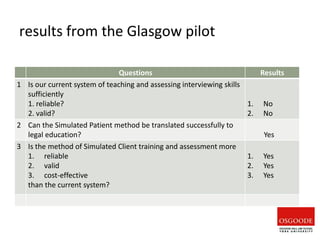
results from the Glasgow pilot
Questions Results
1 Is our current system of teaching and assessing interviewing skills
sufficiently
1. reliable?
2. valid?
1. No
2. No
2 Can the Simulated Patient method be translated successfully to
legal education? Yes
3 Is the method of Simulated Client training and assessment more
1. reliable
2. valid
3. cost-effective
than the current system?
1. Yes
2. Yes
3. Yes
what changed for us…?
• We made what the client thinks important in the most
salient way for the student: an assessment where most of
the grade is given by the client
• We did not conclude that all aspects of client interviewing
can be assessed by SCs
– We focus the assessment on aspects we believe can be
accurately evaluated by non-lawyers
– We focus the assessment on initial interview (which has
been extended at one centre to an advice-giving second
interview)
• This has changed the way we enable students, trainees and
lawyers to learn interviewing & client-facing ethical
behaviour
independent studies…
eg University of New Hampshire
Daniel Webster Honors Scholar
Program
• ‘In focus groups, members of the profession
and alumni said they believe that students
who graduate from the program [at UNH]
are a step ahead of new law school graduates;
• When evaluated based on simulated client interviews,
students in the program outperformed lawyers who had been
admitted to practice within the last two years; and
• The only significant predictor of simulated client interview
performance was whether or not the interviewer participated
in the Daniel Webster Scholar Honors Program. Neither LSAT
scores nor class rank was significantly predictive of
interview performance’ (my emphasis) 8
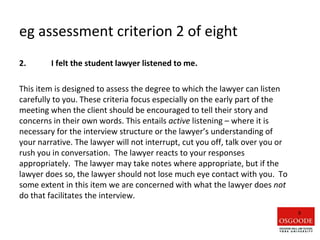
eg assessment criterion 2 of eight
2. I felt the student lawyer listened to me.
This item is designed to assess the degree to which the lawyer can listen
carefully to you. These criteria focus especially on the early part of the
meeting when the client should be encouraged to tell their story and
concerns in their own words. This entails active listening – where it is
necessary for the interview structure or the lawyer’s understanding of
your narrative. The lawyer will not interrupt, cut you off, talk over you or
rush you in conversation. The lawyer reacts to your responses
appropriately. The lawyer may take notes where appropriate, but if the
lawyer does so, the lawyer should not lose much eye contact with you. To
some extent in this item we are concerned with what the lawyer does not
do that facilitates the interview.
9
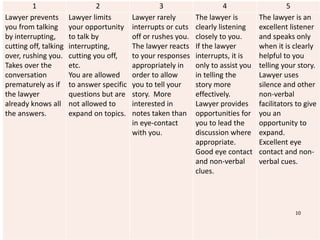
1 2 3 4 5
Lawyer prevents
you from talking
by interrupting,
cutting off, talking
over, rushing you.
Takes over the
conversation
prematurely as if
the lawyer
already knows all
the answers.
Lawyer limits
your opportunity
to talk by
interrupting,
cutting you off,
etc.
You are allowed
to answer specific
questions but are
not allowed to
expand on topics.
Lawyer rarely
interrupts or cuts
off or rushes you.
The lawyer reacts
to your responses
appropriately in
order to allow
you to tell your
story. More
interested in
notes taken than
in eye-contact
with you.
The lawyer is
clearly listening
closely to you.
If the lawyer
interrupts, it is
only to assist you
in telling the
story more
effectively.
Lawyer provides
opportunities for
you to lead the
discussion where
appropriate.
Good eye contact
and non-verbal
clues.
The lawyer is an
excellent listener
and speaks only
when it is clearly
helpful to you
telling your story.
Lawyer uses
silence and other
non-verbal
facilitators to give
you an
opportunity to
expand.
Excellent eye
contact and non-
verbal cues.
10
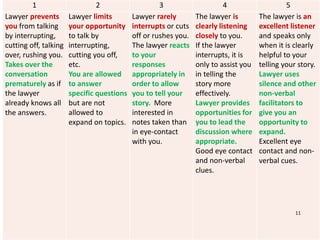
1 2 3 4 5
Lawyer prevents
you from talking
by interrupting,
cutting off, talking
over, rushing you.
Takes over the
conversation
prematurely as if
the lawyer
already knows all
the answers.
Lawyer limits
your opportunity
to talk by
interrupting,
cutting you off,
etc.
You are allowed
to answer
specific questions
but are not
allowed to
expand on topics.
Lawyer rarely
interrupts or cuts
off or rushes you.
The lawyer reacts
to your
responses
appropriately in
order to allow
you to tell your
story. More
interested in
notes taken than
in eye-contact
with you.
The lawyer is
clearly listening
closely to you.
If the lawyer
interrupts, it is
only to assist you
in telling the
story more
effectively.
Lawyer provides
opportunities for
you to lead the
discussion where
appropriate.
Good eye contact
and non-verbal
clues.
The lawyer is an
excellent listener
and speaks only
when it is clearly
helpful to your
telling your story.
Lawyer uses
silence and other
non-verbal
facilitators to
give you an
opportunity to
expand.
Excellent eye
contact and non-
verbal cues.
11
2. Where is the SCI, and how are SCs trained?
Professor Paul Maharg | CC BY-NC-ND 2.5 CANADA
13
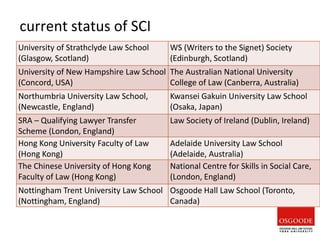
current status of SCI
University of Strathclyde Law School
(Glasgow, Scotland)
WS (Writers to the Signet) Society
(Edinburgh, Scotland)
University of New Hampshire Law School
(Concord, USA)
The Australian National University
College of Law (Canberra, Australia)
Northumbria University Law School,
(Newcastle, England)
Kwansei Gakuin University Law School
(Osaka, Japan)
SRA – Qualifying Lawyer Transfer
Scheme (London, England)
Law Society of Ireland (Dublin, Ireland)
Hong Kong University Faculty of Law
(Hong Kong)
Adelaide University Law School
(Adelaide, Australia)
The Chinese University of Hong Kong
Faculty of Law (Hong Kong)
National Centre for Skills in Social Care,
(London, England)
Nottingham Trent University Law School
(Nottingham, England)
Osgoode Hall Law School (Toronto,
Canada)
training of SCs
‘The best way to learn how to do standardized
patients is to do it along side of someone who has
already done it before. It’s [the] apprenticeship
system.’
Wallace, P. (1997) Following the threads of an innovation: the
history of standardized patients in medical education, Caduceus, A
Humanities Journal for Medicine and the Health Sciences,
Department of Medical Humanities, Southern Illinois University
School of Medicine, 13, 2, 5-28.
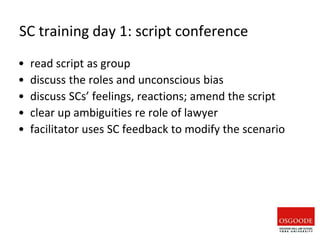
SC training day 1: script conference
• read script as group
• discuss the roles and unconscious bias
• discuss SCs’ feelings, reactions; amend the script
• clear up ambiguities re role of lawyer
• facilitator uses SC feedback to modify the scenario
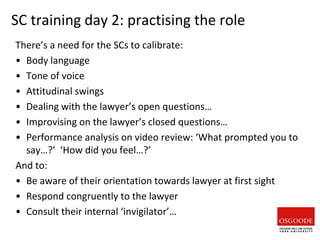
SC training day 2: practising the role
There’s a need for the SCs to calibrate:
• Body language
• Tone of voice
• Attitudinal swings
• Dealing with the lawyer’s open questions…
• Improvising on the lawyer’s closed questions…
• Performance analysis on video review: ‘What prompted you to
say…?’ ‘How did you feel…?’
And to:
• Be aware of their orientation towards lawyer at first sight
• Respond congruently to the lawyer
• Consult their internal ‘invigilator’…
SC training days 3 & 4: assessing
lawyers/law students
• We discuss the marking system, and form a
common understanding of it
• SCs view and mark videos, comparing to ‘standard’
• SCs view each other’s ‘live’ performances with
lawyers & actors and assess lawyers & actors
• Process repeated until everyone has role-played at
least once, ideally three times
• Rich comment on performance
• Marks are collated in the room (suspense factor…)
• SCs are also trained to give formative feedback
after initial training?
• SCs role-play clients with students, real lawyers
and other professionals
• SCs are given refresher training on the scenario
• If they are trained on a new scenario they will
have the same pattern of training
• They should form a community of practice with
two core members of staff – ideally, admin +
academic to:
– improve practice
– suggest ways they may be used inside or
outside the law school
4. Implications for legal education?
SCs: people as co-producers, co-designers
The SC approach challenges:
1. Curriculum methods
2. Ethics of the client encounter
3. The cognitive poverty of conventional law school assessment
4. Law school as a self-regarding, monolithic construct
5. Law school categories of employment
6. The curricular isolation of clinic within some law schools
7. Hollowed-out skills rhetoric
8. Conventional forms of regulation by regulatory bodies
9. The role of regulator, as encourager of innovation & radical reform…?
10.Disciplinary boundaries – what about a SC Unit that’s interdisciplinary?
11.Local jurisdictional practices: how might such a project work globally?
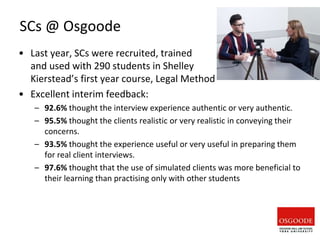
SCs @ Osgoode
• Last year, SCs were recruited, trained
and used with 290 students in Shelley
Kierstead’s first year course, Legal Method
• Excellent interim feedback:
– 92.6% thought the interview experience authentic or very authentic.
– 95.5% thought the clients realistic or very realistic in conveying their
concerns.
– 93.5% thought the experience useful or very useful in preparing them
for real client interviews.
– 97.6% thought that the use of simulated clients was more beneficial to
their learning than practising only with other students
some comments…
• One of my favourite and most worthwhile opportunities all year
• Great opportunity! No prep required-good low stress experience
• Yes! I loved the feedback that the simulated client gave me. She was
honest (but also very kind). I haven’t viewed my video yet , but I’m sure
it will be extremely useful to go back and review my
questions/demeanour/etc.
• Helpful feedback
• I would love to get more opportunities to do this
• Yes, I feel better prepared and the feedback I got was very reassuring
• I really enjoyed this experience and would recommend that it be
implemented into the legal process course curriculum
• The feedback was splendid I see where I need to improve and at the
same time I was made aware of my strengths that I need to hone
• I feel like it was a worthwhile and that that we should have more
opportunities to participate in similar activities
Professor Paul Maharg | CC BY-NC-ND 2.5 CANADA
23
more information…
1. Websites:
1. See Simulated Client Initiative, http://zeugma.typepad.com/sci
2. these slides @ http://paulmaharg.com.
2. Barton, K., Cunningham, C.D., Jones, G.T., Maharg, P. (2006). Valuing what
clients think: standardized clients and the assessment of communicative
competence. Clinical Law Review, 13, 1, 1-65.
3. Maharg, P. (2007). Transforming Legal Education: Learning and Teaching
the Law in the Early Twenty-first Century. Aldershot, Ashgate Publishing,
chapter 2, 64-67.
4. Daniel Webster Scholar Honors Program:
https://law.unh.edu/sites/default/files/media/dwsonepager2016update.p
df
5. Barton, K., Garvey, J.B., Maharg (2013). ‘You are here’: learning law,
practice and professionalism in the academy. In Bankowski, Z., Maharg, P.
del Mar, M., editors, The Arts and the Legal Academy. Beyond Text in
Legal Education, vol 1. Routledge.
25
Email:pmaharg@osgoode.yorku.ca
Web: paulmaharg.com
Slides: paulmaharg.com/slides

Maharg opd slides for video

  • 1.
  • 2.
    preview 1.What is asimulated client (SC)? How did the simulated client initiative (SCI) begin? 2.Current uses & SC training 3.Implications for legal education Slides available at: http://paulmaharg.com/slides http://zeugma.typepad.com/sci 1
  • 3.
    1. What isa simulated client?
  • 4.
    1. How didthe SCI begin?
  • 5.
    Simulated Client Initiative(SCI): our hypotheses back in 2005 in Glasgow… 1. The idea of a simulated patient can be transferred from medical education to become a simulated client in legal education. 2. With proper training and carefully designed assessment procedures, Standardised or Simulated Clients (SCs) can assess important aspects of client interviewing with validity and reliability comparable to assessment by law teachers.
  • 6.
    aims • develop apractical and cost-effective method to assess the effectiveness of lawyer-client communication which correlates assessment with the degree of client satisfaction & confidence. • ie answer the following questions… 1.Is our current system of teaching and assessing interviewing skills sufficiently reliable and valid? 2.Can the Simulated Patient method be translated successfully to the legal domain? 3.Is the method of Simulated Client training and assessment more reliable, valid and cost-effective than the current system at the Glasgow Graduate School of Law (GGSL)?
  • 7.
    results from theGlasgow pilot Questions Results 1 Is our current system of teaching and assessing interviewing skills sufficiently 1. reliable? 2. valid? 1. No 2. No 2 Can the Simulated Patient method be translated successfully to legal education? Yes 3 Is the method of Simulated Client training and assessment more 1. reliable 2. valid 3. cost-effective than the current system? 1. Yes 2. Yes 3. Yes
  • 8.
    what changed forus…? • We made what the client thinks important in the most salient way for the student: an assessment where most of the grade is given by the client • We did not conclude that all aspects of client interviewing can be assessed by SCs – We focus the assessment on aspects we believe can be accurately evaluated by non-lawyers – We focus the assessment on initial interview (which has been extended at one centre to an advice-giving second interview) • This has changed the way we enable students, trainees and lawyers to learn interviewing & client-facing ethical behaviour
  • 9.
    independent studies… eg Universityof New Hampshire Daniel Webster Honors Scholar Program • ‘In focus groups, members of the profession and alumni said they believe that students who graduate from the program [at UNH] are a step ahead of new law school graduates; • When evaluated based on simulated client interviews, students in the program outperformed lawyers who had been admitted to practice within the last two years; and • The only significant predictor of simulated client interview performance was whether or not the interviewer participated in the Daniel Webster Scholar Honors Program. Neither LSAT scores nor class rank was significantly predictive of interview performance’ (my emphasis) 8
  • 10.
    eg assessment criterion2 of eight 2. I felt the student lawyer listened to me. This item is designed to assess the degree to which the lawyer can listen carefully to you. These criteria focus especially on the early part of the meeting when the client should be encouraged to tell their story and concerns in their own words. This entails active listening – where it is necessary for the interview structure or the lawyer’s understanding of your narrative. The lawyer will not interrupt, cut you off, talk over you or rush you in conversation. The lawyer reacts to your responses appropriately. The lawyer may take notes where appropriate, but if the lawyer does so, the lawyer should not lose much eye contact with you. To some extent in this item we are concerned with what the lawyer does not do that facilitates the interview. 9
  • 11.
    1 2 34 5 Lawyer prevents you from talking by interrupting, cutting off, talking over, rushing you. Takes over the conversation prematurely as if the lawyer already knows all the answers. Lawyer limits your opportunity to talk by interrupting, cutting you off, etc. You are allowed to answer specific questions but are not allowed to expand on topics. Lawyer rarely interrupts or cuts off or rushes you. The lawyer reacts to your responses appropriately in order to allow you to tell your story. More interested in notes taken than in eye-contact with you. The lawyer is clearly listening closely to you. If the lawyer interrupts, it is only to assist you in telling the story more effectively. Lawyer provides opportunities for you to lead the discussion where appropriate. Good eye contact and non-verbal clues. The lawyer is an excellent listener and speaks only when it is clearly helpful to you telling your story. Lawyer uses silence and other non-verbal facilitators to give you an opportunity to expand. Excellent eye contact and non- verbal cues. 10
  • 12.
    1 2 34 5 Lawyer prevents you from talking by interrupting, cutting off, talking over, rushing you. Takes over the conversation prematurely as if the lawyer already knows all the answers. Lawyer limits your opportunity to talk by interrupting, cutting you off, etc. You are allowed to answer specific questions but are not allowed to expand on topics. Lawyer rarely interrupts or cuts off or rushes you. The lawyer reacts to your responses appropriately in order to allow you to tell your story. More interested in notes taken than in eye-contact with you. The lawyer is clearly listening closely to you. If the lawyer interrupts, it is only to assist you in telling the story more effectively. Lawyer provides opportunities for you to lead the discussion where appropriate. Good eye contact and non-verbal clues. The lawyer is an excellent listener and speaks only when it is clearly helpful to your telling your story. Lawyer uses silence and other non-verbal facilitators to give you an opportunity to expand. Excellent eye contact and non- verbal cues. 11
  • 13.
    2. Where isthe SCI, and how are SCs trained?
  • 14.
    Professor Paul Maharg| CC BY-NC-ND 2.5 CANADA 13
  • 15.
    current status ofSCI University of Strathclyde Law School (Glasgow, Scotland) WS (Writers to the Signet) Society (Edinburgh, Scotland) University of New Hampshire Law School (Concord, USA) The Australian National University College of Law (Canberra, Australia) Northumbria University Law School, (Newcastle, England) Kwansei Gakuin University Law School (Osaka, Japan) SRA – Qualifying Lawyer Transfer Scheme (London, England) Law Society of Ireland (Dublin, Ireland) Hong Kong University Faculty of Law (Hong Kong) Adelaide University Law School (Adelaide, Australia) The Chinese University of Hong Kong Faculty of Law (Hong Kong) National Centre for Skills in Social Care, (London, England) Nottingham Trent University Law School (Nottingham, England) Osgoode Hall Law School (Toronto, Canada)
  • 16.
    training of SCs ‘Thebest way to learn how to do standardized patients is to do it along side of someone who has already done it before. It’s [the] apprenticeship system.’ Wallace, P. (1997) Following the threads of an innovation: the history of standardized patients in medical education, Caduceus, A Humanities Journal for Medicine and the Health Sciences, Department of Medical Humanities, Southern Illinois University School of Medicine, 13, 2, 5-28.
  • 17.
    SC training day1: script conference • read script as group • discuss the roles and unconscious bias • discuss SCs’ feelings, reactions; amend the script • clear up ambiguities re role of lawyer • facilitator uses SC feedback to modify the scenario
  • 18.
    SC training day2: practising the role There’s a need for the SCs to calibrate: • Body language • Tone of voice • Attitudinal swings • Dealing with the lawyer’s open questions… • Improvising on the lawyer’s closed questions… • Performance analysis on video review: ‘What prompted you to say…?’ ‘How did you feel…?’ And to: • Be aware of their orientation towards lawyer at first sight • Respond congruently to the lawyer • Consult their internal ‘invigilator’…
  • 19.
    SC training days3 & 4: assessing lawyers/law students • We discuss the marking system, and form a common understanding of it • SCs view and mark videos, comparing to ‘standard’ • SCs view each other’s ‘live’ performances with lawyers & actors and assess lawyers & actors • Process repeated until everyone has role-played at least once, ideally three times • Rich comment on performance • Marks are collated in the room (suspense factor…) • SCs are also trained to give formative feedback
  • 20.
    after initial training? •SCs role-play clients with students, real lawyers and other professionals • SCs are given refresher training on the scenario • If they are trained on a new scenario they will have the same pattern of training • They should form a community of practice with two core members of staff – ideally, admin + academic to: – improve practice – suggest ways they may be used inside or outside the law school
  • 21.
    4. Implications forlegal education?
  • 22.
    SCs: people asco-producers, co-designers The SC approach challenges: 1. Curriculum methods 2. Ethics of the client encounter 3. The cognitive poverty of conventional law school assessment 4. Law school as a self-regarding, monolithic construct 5. Law school categories of employment 6. The curricular isolation of clinic within some law schools 7. Hollowed-out skills rhetoric 8. Conventional forms of regulation by regulatory bodies 9. The role of regulator, as encourager of innovation & radical reform…? 10.Disciplinary boundaries – what about a SC Unit that’s interdisciplinary? 11.Local jurisdictional practices: how might such a project work globally?
  • 23.
    SCs @ Osgoode •Last year, SCs were recruited, trained and used with 290 students in Shelley Kierstead’s first year course, Legal Method • Excellent interim feedback: – 92.6% thought the interview experience authentic or very authentic. – 95.5% thought the clients realistic or very realistic in conveying their concerns. – 93.5% thought the experience useful or very useful in preparing them for real client interviews. – 97.6% thought that the use of simulated clients was more beneficial to their learning than practising only with other students
  • 24.
    some comments… • Oneof my favourite and most worthwhile opportunities all year • Great opportunity! No prep required-good low stress experience • Yes! I loved the feedback that the simulated client gave me. She was honest (but also very kind). I haven’t viewed my video yet , but I’m sure it will be extremely useful to go back and review my questions/demeanour/etc. • Helpful feedback • I would love to get more opportunities to do this • Yes, I feel better prepared and the feedback I got was very reassuring • I really enjoyed this experience and would recommend that it be implemented into the legal process course curriculum • The feedback was splendid I see where I need to improve and at the same time I was made aware of my strengths that I need to hone • I feel like it was a worthwhile and that that we should have more opportunities to participate in similar activities Professor Paul Maharg | CC BY-NC-ND 2.5 CANADA 23
  • 25.
    more information… 1. Websites: 1.See Simulated Client Initiative, http://zeugma.typepad.com/sci 2. these slides @ http://paulmaharg.com. 2. Barton, K., Cunningham, C.D., Jones, G.T., Maharg, P. (2006). Valuing what clients think: standardized clients and the assessment of communicative competence. Clinical Law Review, 13, 1, 1-65. 3. Maharg, P. (2007). Transforming Legal Education: Learning and Teaching the Law in the Early Twenty-first Century. Aldershot, Ashgate Publishing, chapter 2, 64-67. 4. Daniel Webster Scholar Honors Program: https://law.unh.edu/sites/default/files/media/dwsonepager2016update.p df 5. Barton, K., Garvey, J.B., Maharg (2013). ‘You are here’: learning law, practice and professionalism in the academy. In Bankowski, Z., Maharg, P. del Mar, M., editors, The Arts and the Legal Academy. Beyond Text in Legal Education, vol 1. Routledge.
  • 26.