Legal Education and
Training Review
Regulating legal education and training
in a liberalised legal services market
Research phase 2011-2013
Overview
The aims of the project
Recommendations and domestic impact
Impact outside England and Wales
Continuing issues:
Equality and diversity
Professionalism and competence
Regulation: shared space and beyond standard-setting
Research and policy
The next five years?
Questions
The aims of the project
To assist the regulators in England and Wales in developing legal
services education and training policy and practice by:
a) assessing the perceived strengths and weaknesses of the
existing systems of legal education and training across the
regulated and unregulated sectors in England and Wales;
b) identifying the skills, knowledge and attributes required by a
range of legal service providers currently and in the future;
c) assessing the potential to move to sector-wide outcomes for
legal services education and training;
d) assessing the potential extension of regulation of legal
services education and training for the currently unregulated
sector;
The aims of the project
e) making recommendations as to whether and, if so, how, the
system of legal services education and training in England
and Wales may be made more responsive to emerging
needs;
f) including suggestions and alternative models to assure that
the system will support the delivery of:
i. high quality, competitive and ethical legal services;
ii. flexible education and training options, responsive to the
need for different career pathways, and capable of
promoting diversity.
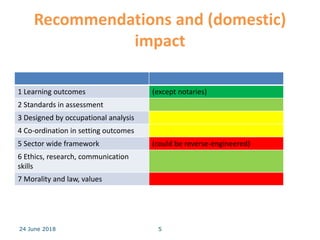
Recommendations and (domestic)
impact
1 Learning outcomes (except notaries)
2 Standards in assessment
3 Designed by occupational analysis
4 Co-ordination in setting outcomes
5 Sector wide framework (could be reverse-engineered)
6 Ethics, research, communication
skills
7 Morality and law, values
24 June 2018 5
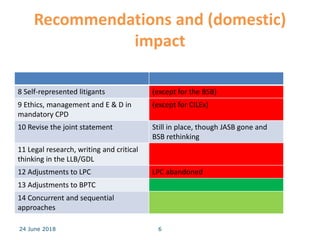
Recommendations and (domestic)
impact
8 Self-represented litigants (except for the BSB)
9 Ethics, management and E & D in
mandatory CPD
(except for CILEx)
10 Revise the joint statement Still in place, though JASB gone and
BSB rethinking
11 Legal research, writing and critical
thinking in the LLB/GDL
12 Adjustments to LPC LPC abandoned
13 Adjustments to BPTC
14 Concurrent and sequential
approaches
24 June 2018 6
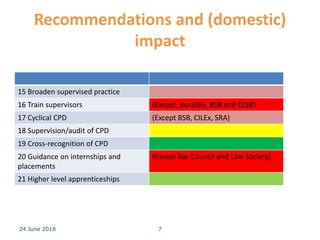
Recommendations and (domestic)
impact
15 Broaden supervised practice
16 Train supervisors (Except, possibly, BSB and CLSB)
17 Cyclical CPD (Except BSB, CILEx, SRA)
18 Supervision/audit of CPD
19 Cross-recognition of CPD
20 Guidance on internships and
placements
(Except Bar Council and Law Society)
21 Higher level apprenticeships
24 June 2018 7
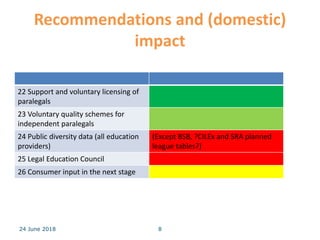
Recommendations and (domestic)
impact
22 Support and voluntary licensing of
paralegals
23 Voluntary quality schemes for
independent paralegals
24 Public diversity data (all education
providers)
(Except BSB, ?CILEx and SRA planned
league tables?)
25 Legal Education Council
26 Consumer input in the next stage
24 June 2018 8
Impact outside England and Wales
24 June 2018 9
Continuing issues
24 June 2018 10
Equality, diversity and social mobility
• “Your CV looks good, but you don’t speak enough languages. You
haven’t travelled”.
• “.. I can’t afford to travel places, I’m trying to pay debts? … I’m sorry I
couldn’t go to Cambodia.” LETR data (2013)
• “…[E]mployers too often expect persons to have certain character
traits or to have certain experiences that are linked to their
background. She said in an interview she was asked ‘why she hadn’t
been travelling', when this was not something she could afford”. All
Party Parliamentary Committee (2017)
24 June 2018 11
Professionalism and competence
 What core competences are required in the
C21st?
 General lack of imagination in the responses to
LETR!
 Underestimated the pace of technological change
since 2012
 SRA competences – massively over- and yet
under-inclusive
 Compare other models
24 June 2018 12
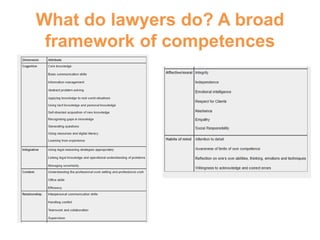
SCLET Final Report (2018)
• To demonstrate competence in a relevant area or areas of practice
(technical knowledge)
• To perform a range of legal tasks (task skills – client
interviewing/conferencing, legal research, drafting and advocacy)
• To manage a range of tasks within a job (task and project management
skills – including time management)
• To respond to uncertainties and breakdowns in routine/normal activities
(task/project contingency management)
• To work effectively for and with others (team and professional relationship
skills)
• To identify and deal with embedded issues of ethics, professionalism and
professional regulation ‘in context’ (ethical and regulatory risk management)
• To reflect on and understand the limits of one’s own competence and to
address one’s own personal and professional development needs (self-
management)
What do lawyers do? A broad
framework of competences
Shared space
Shared spaces concept in traffic zones:
• Redistributes risk among road users
• Treats road users as responsible, imaginative, human
• Holds that environment is a stronger influence on behaviour
than formal rules & legislation.
‘All those [road]signs are saying to cars, “this is your space, and we have
organized your behaviour so that as long as you behave this way, nothing
can happen to you”. That is the wrong story’.
Hans Monderman, http://www.pps.org/reference/hans-monderman/
De Brinke, Oosterwalde, The Netherlands. In Hamilton-Baillie, B. (2008).
Shared space: reconciling people, places and traffic. Built Environment,
34, 2, 161-81, 168, fig.7.
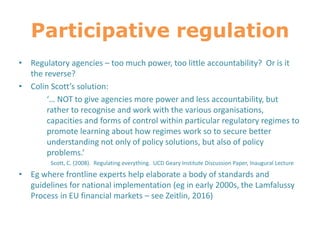
Participative regulation
• Regulatory agencies – too much power, too little accountability? Or is it
the reverse?
• Colin Scott’s solution:
‘… NOT to give agencies more power and less accountability, but
rather to recognise and work with the various organisations,
capacities and forms of control within particular regulatory regimes to
promote learning about how regimes work so to secure better
understanding not only of policy solutions, but also of policy
problems.’
Scott, C. (2008). Regulating everything. UCD Geary Institute Discussion Paper, Inaugural Lecture
• Eg where frontline experts help elaborate a body of standards and
guidelines for national implementation (eg in early 2000s, the Lamfalussy
Process in EU financial markets – see Zeitlin, 2016)
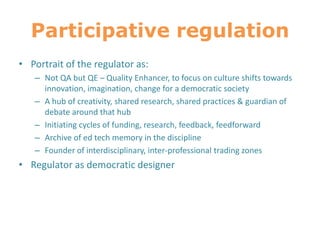
Participative regulation
• Portrait of the regulator as:
– Not QA but QE – Quality Enhancer, to focus on culture shifts towards
innovation, imagination, change for a democratic society
– A hub of creativity, shared research, shared practices & guardian of
debate around that hub
– Initiating cycles of funding, research, feedback, feedforward
– Archive of ed tech memory in the discipline
– Founder of interdisciplinary, inter-professional trading zones
• Regulator as democratic designer
LETR Recommendation 25
Recommendation 25 A body, the ‘Legal Education Council’, should be
established to provide a forum for the coordination of the continuing review of
LSET and to advise the approved regulators on LSET regulation and effective
practice. The Council should also oversee a collaborative hub of legal
information resources and activities able to perform the following functions:
– Data archive (including diversity monitoring and evaluation of diversity
initiatives);
– Advice shop (careers information);
– Legal Education Laboratory (supporting collaborative research and
development);
– Clearing house (advertising work experience; advising on transfer
regulations and reviewing disputed transfer decisions).
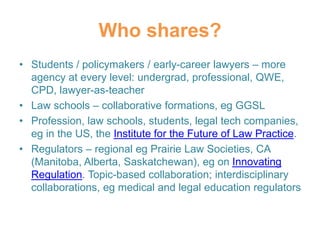
Who shares?
• Students / policymakers / early-career lawyers – more
agency at every level: undergrad, professional, QWE,
CPD, lawyer-as-teacher
• Law schools – collaborative formations, eg GGSL
• Profession, law schools, students, legal tech companies,
eg in the US, the Institute for the Future of Law Practice.
• Regulators – regional eg Prairie Law Societies, CA
(Manitoba, Alberta, Saskatchewan), eg on Innovating
Regulation. Topic-based collaboration; interdisciplinary
collaborations, eg medical and legal education regulators
International sharing among
regulators
• In 2012 Laurel Terry identified four possible goals for the
then new international conference of legal regulators:
– Co-operation and information sharing on specific cases
– Clearinghouse for information about regulators’ practices & tools
– Exchange of information on policy issues & projects
– Development of common policies or practices
• First three accepted, last proved divisive & rejected. But
perhaps we should go in a different direction: peer-
review of legal educational regulation, based on the work
of peer review of agency decision-making.
Terry, L.S. (2012). Creating an international network of lawyer regulators: The 2012 International
Conference of Legal Regulators. The Bar Examiner, 82, 2, 18-27. https://bit.ly/2txmlK7
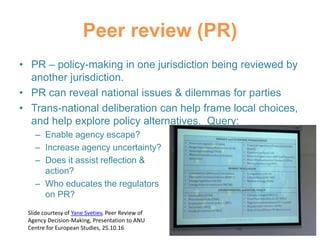
Peer review (PR)
• PR – policy-making in one jurisdiction being reviewed by
another jurisdiction.
• PR can reveal national issues & dilemmas for parties
• Trans-national deliberation can help frame local choices,
and help explore policy alternatives. Query:
– Enable agency escape?
– Increase agency uncertainty?
– Does it assist reflection &
action?
– Who educates the regulators
on PR?
Slide courtesy of Yane Svetiev, Peer Review of
Agency Decision-Making, Presentation to ANU
Centre for European Studies, 25.10.16
Experimentalist governance
• OFR is necessary but insufficient
• ‘Standards’ underpin the quality of outcomes
• But process regulation of standards inhibits the flexibility and scope for
innovation of OFR.
• Hence the usefulness to legal education of experimentalist alternatives to
top-down hierarchical governance:
‘The crucial point that distinguishes such experimentalist
architectures from conventional hierarchical governance is their
contestability, whereby local actors have the autonomy to report
problems with existing rules and explore alternatives, while the
organizational centre is obliged to take account of such local
experience in reconsidering and revising the rules.’
Zeitlin, J. (2016). EU experimentalist governance in times of crisis. West European Politics, 39, 5,
1073-94, 1073.
International interest, liaison and
impact
• See the following blog posts for a summary of LETR activities
across the UK, Caribbean jurisdictions, Australia, Hong Kong,
Singapore, India, Ireland, Scotland, Canada:
– paulmaharg.com
– HeadSpace
– Centre for Legal Education, Nottingham Law School
Research and Policy-uneasy bed-fellows.
Can
research
manage
without
funders?
Can policy
manage
without
research?
 What do policy makers want?
 What do researchers want?
 Conflicts of interest, power, funds,
reputation.
 The possibility of bullying, about
finishing times etc. if not about
content.
So why does policy want research?
 A basis from an apparently independent body
 Help in understanding complex situations and
issues
 The possibility of blame
 The possibility of ignoring but having fulfilled the
responsibility to consult
 “Real facts”- see for example current MoJ output
relating to Legal Aid Review (next slide)
Give us your hard figures, LASPO
review team urges
By Monidipa Fouzder18 June 2018, Law Society Gazette
 The Ministry of Justice has asked practitioners to 'be a bit more
open' with hard data to inform an ongoing review of the
government's controversial legal aid reforms.
The ministry has discussed the impact of the Legal Aid, Sentencing
and Punishment of Offenders Act (LASPO) with more than 50
organisations so far as part of its post-implementation review, due to
be completed this year.
Asked at a LASPO review conference last week about the scale of the
data the MoJ review team wants to incorporate into the review,
Matthew Shelley, the ministry's deputy director for legal support and
court fees, said 'a lot of data' is collected by the ministry and HM
Courts & Tribunals Service. However, when evidence is requested
from the sector, the information is 'largely anecdotal'.
'Yet you must collect your own data and it's hard to get access to that
data, to release the data [you] hold. My plea is to be a bit more open
about that information to inform our review,' Shelley said.
There are many
This is just one…
Ignored Messages
Overall Percentages Observed Solicitor time
0
5
10
15
20
25
A
dm
instration
and
m
anagem
ent
D
ead
tim
e
Interview
ing
clients
D
rafting
R
eading
and
assessing
papers
D
iscussions
w
ith
otherlaw
yers
T
ravelling
N
egotiation
A
dvocacyLegalresearch
Interview
ing
w
itnesses
T
im
e
w
ith
counsel
Task
Time
Series1
Series2
Series3
Series4
Series5
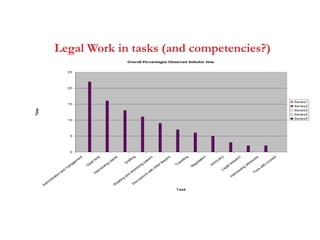
Legal Work in tasks (and competencies?)
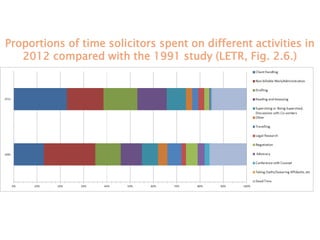
Proportions of time solicitors spent on different activities in
2012 compared with the 1991 study (LETR, Fig. 2.6.)
Ignored messages
 Relative ineffability of “legal work”?
 Unchangeability of lawyers or lawyering?
 Difficulties of organising, planning, engendering
CHANGE?
 Cannot simply rely on the market even if it actually
worked!
LETR may be a butterfly
 not yet out of its
chrysalis
The next five years? Questions?
24 June 2018 32

Letr 5 years later final 2406 2018

  • 1.
    Legal Education and TrainingReview Regulating legal education and training in a liberalised legal services market Research phase 2011-2013
  • 2.
    Overview The aims ofthe project Recommendations and domestic impact Impact outside England and Wales Continuing issues: Equality and diversity Professionalism and competence Regulation: shared space and beyond standard-setting Research and policy The next five years? Questions
  • 3.
    The aims ofthe project To assist the regulators in England and Wales in developing legal services education and training policy and practice by: a) assessing the perceived strengths and weaknesses of the existing systems of legal education and training across the regulated and unregulated sectors in England and Wales; b) identifying the skills, knowledge and attributes required by a range of legal service providers currently and in the future; c) assessing the potential to move to sector-wide outcomes for legal services education and training; d) assessing the potential extension of regulation of legal services education and training for the currently unregulated sector;
  • 4.
    The aims ofthe project e) making recommendations as to whether and, if so, how, the system of legal services education and training in England and Wales may be made more responsive to emerging needs; f) including suggestions and alternative models to assure that the system will support the delivery of: i. high quality, competitive and ethical legal services; ii. flexible education and training options, responsive to the need for different career pathways, and capable of promoting diversity.
  • 5.
    Recommendations and (domestic) impact 1Learning outcomes (except notaries) 2 Standards in assessment 3 Designed by occupational analysis 4 Co-ordination in setting outcomes 5 Sector wide framework (could be reverse-engineered) 6 Ethics, research, communication skills 7 Morality and law, values 24 June 2018 5
  • 6.
    Recommendations and (domestic) impact 8Self-represented litigants (except for the BSB) 9 Ethics, management and E & D in mandatory CPD (except for CILEx) 10 Revise the joint statement Still in place, though JASB gone and BSB rethinking 11 Legal research, writing and critical thinking in the LLB/GDL 12 Adjustments to LPC LPC abandoned 13 Adjustments to BPTC 14 Concurrent and sequential approaches 24 June 2018 6
  • 7.
    Recommendations and (domestic) impact 15Broaden supervised practice 16 Train supervisors (Except, possibly, BSB and CLSB) 17 Cyclical CPD (Except BSB, CILEx, SRA) 18 Supervision/audit of CPD 19 Cross-recognition of CPD 20 Guidance on internships and placements (Except Bar Council and Law Society) 21 Higher level apprenticeships 24 June 2018 7
  • 8.
    Recommendations and (domestic) impact 22Support and voluntary licensing of paralegals 23 Voluntary quality schemes for independent paralegals 24 Public diversity data (all education providers) (Except BSB, ?CILEx and SRA planned league tables?) 25 Legal Education Council 26 Consumer input in the next stage 24 June 2018 8
  • 9.
    Impact outside Englandand Wales 24 June 2018 9
  • 10.
  • 11.
    Equality, diversity andsocial mobility • “Your CV looks good, but you don’t speak enough languages. You haven’t travelled”. • “.. I can’t afford to travel places, I’m trying to pay debts? … I’m sorry I couldn’t go to Cambodia.” LETR data (2013) • “…[E]mployers too often expect persons to have certain character traits or to have certain experiences that are linked to their background. She said in an interview she was asked ‘why she hadn’t been travelling', when this was not something she could afford”. All Party Parliamentary Committee (2017) 24 June 2018 11
  • 12.
    Professionalism and competence What core competences are required in the C21st?  General lack of imagination in the responses to LETR!  Underestimated the pace of technological change since 2012  SRA competences – massively over- and yet under-inclusive  Compare other models 24 June 2018 12
  • 13.
    SCLET Final Report(2018) • To demonstrate competence in a relevant area or areas of practice (technical knowledge) • To perform a range of legal tasks (task skills – client interviewing/conferencing, legal research, drafting and advocacy) • To manage a range of tasks within a job (task and project management skills – including time management) • To respond to uncertainties and breakdowns in routine/normal activities (task/project contingency management) • To work effectively for and with others (team and professional relationship skills) • To identify and deal with embedded issues of ethics, professionalism and professional regulation ‘in context’ (ethical and regulatory risk management) • To reflect on and understand the limits of one’s own competence and to address one’s own personal and professional development needs (self- management)
  • 14.
    What do lawyersdo? A broad framework of competences
  • 15.
    Shared space Shared spacesconcept in traffic zones: • Redistributes risk among road users • Treats road users as responsible, imaginative, human • Holds that environment is a stronger influence on behaviour than formal rules & legislation. ‘All those [road]signs are saying to cars, “this is your space, and we have organized your behaviour so that as long as you behave this way, nothing can happen to you”. That is the wrong story’. Hans Monderman, http://www.pps.org/reference/hans-monderman/ De Brinke, Oosterwalde, The Netherlands. In Hamilton-Baillie, B. (2008). Shared space: reconciling people, places and traffic. Built Environment, 34, 2, 161-81, 168, fig.7.
  • 16.
    Participative regulation • Regulatoryagencies – too much power, too little accountability? Or is it the reverse? • Colin Scott’s solution: ‘… NOT to give agencies more power and less accountability, but rather to recognise and work with the various organisations, capacities and forms of control within particular regulatory regimes to promote learning about how regimes work so to secure better understanding not only of policy solutions, but also of policy problems.’ Scott, C. (2008). Regulating everything. UCD Geary Institute Discussion Paper, Inaugural Lecture • Eg where frontline experts help elaborate a body of standards and guidelines for national implementation (eg in early 2000s, the Lamfalussy Process in EU financial markets – see Zeitlin, 2016)
  • 17.
    Participative regulation • Portraitof the regulator as: – Not QA but QE – Quality Enhancer, to focus on culture shifts towards innovation, imagination, change for a democratic society – A hub of creativity, shared research, shared practices & guardian of debate around that hub – Initiating cycles of funding, research, feedback, feedforward – Archive of ed tech memory in the discipline – Founder of interdisciplinary, inter-professional trading zones • Regulator as democratic designer
  • 18.
    LETR Recommendation 25 Recommendation25 A body, the ‘Legal Education Council’, should be established to provide a forum for the coordination of the continuing review of LSET and to advise the approved regulators on LSET regulation and effective practice. The Council should also oversee a collaborative hub of legal information resources and activities able to perform the following functions: – Data archive (including diversity monitoring and evaluation of diversity initiatives); – Advice shop (careers information); – Legal Education Laboratory (supporting collaborative research and development); – Clearing house (advertising work experience; advising on transfer regulations and reviewing disputed transfer decisions).
  • 19.
    Who shares? • Students/ policymakers / early-career lawyers – more agency at every level: undergrad, professional, QWE, CPD, lawyer-as-teacher • Law schools – collaborative formations, eg GGSL • Profession, law schools, students, legal tech companies, eg in the US, the Institute for the Future of Law Practice. • Regulators – regional eg Prairie Law Societies, CA (Manitoba, Alberta, Saskatchewan), eg on Innovating Regulation. Topic-based collaboration; interdisciplinary collaborations, eg medical and legal education regulators
  • 20.
    International sharing among regulators •In 2012 Laurel Terry identified four possible goals for the then new international conference of legal regulators: – Co-operation and information sharing on specific cases – Clearinghouse for information about regulators’ practices & tools – Exchange of information on policy issues & projects – Development of common policies or practices • First three accepted, last proved divisive & rejected. But perhaps we should go in a different direction: peer- review of legal educational regulation, based on the work of peer review of agency decision-making. Terry, L.S. (2012). Creating an international network of lawyer regulators: The 2012 International Conference of Legal Regulators. The Bar Examiner, 82, 2, 18-27. https://bit.ly/2txmlK7
  • 21.
    Peer review (PR) •PR – policy-making in one jurisdiction being reviewed by another jurisdiction. • PR can reveal national issues & dilemmas for parties • Trans-national deliberation can help frame local choices, and help explore policy alternatives. Query: – Enable agency escape? – Increase agency uncertainty? – Does it assist reflection & action? – Who educates the regulators on PR? Slide courtesy of Yane Svetiev, Peer Review of Agency Decision-Making, Presentation to ANU Centre for European Studies, 25.10.16
  • 22.
    Experimentalist governance • OFRis necessary but insufficient • ‘Standards’ underpin the quality of outcomes • But process regulation of standards inhibits the flexibility and scope for innovation of OFR. • Hence the usefulness to legal education of experimentalist alternatives to top-down hierarchical governance: ‘The crucial point that distinguishes such experimentalist architectures from conventional hierarchical governance is their contestability, whereby local actors have the autonomy to report problems with existing rules and explore alternatives, while the organizational centre is obliged to take account of such local experience in reconsidering and revising the rules.’ Zeitlin, J. (2016). EU experimentalist governance in times of crisis. West European Politics, 39, 5, 1073-94, 1073.
  • 23.
    International interest, liaisonand impact • See the following blog posts for a summary of LETR activities across the UK, Caribbean jurisdictions, Australia, Hong Kong, Singapore, India, Ireland, Scotland, Canada: – paulmaharg.com – HeadSpace – Centre for Legal Education, Nottingham Law School
  • 24.
    Research and Policy-uneasybed-fellows. Can research manage without funders? Can policy manage without research?  What do policy makers want?  What do researchers want?  Conflicts of interest, power, funds, reputation.  The possibility of bullying, about finishing times etc. if not about content.
  • 25.
    So why doespolicy want research?  A basis from an apparently independent body  Help in understanding complex situations and issues  The possibility of blame  The possibility of ignoring but having fulfilled the responsibility to consult  “Real facts”- see for example current MoJ output relating to Legal Aid Review (next slide)
  • 26.
    Give us yourhard figures, LASPO review team urges By Monidipa Fouzder18 June 2018, Law Society Gazette  The Ministry of Justice has asked practitioners to 'be a bit more open' with hard data to inform an ongoing review of the government's controversial legal aid reforms. The ministry has discussed the impact of the Legal Aid, Sentencing and Punishment of Offenders Act (LASPO) with more than 50 organisations so far as part of its post-implementation review, due to be completed this year. Asked at a LASPO review conference last week about the scale of the data the MoJ review team wants to incorporate into the review, Matthew Shelley, the ministry's deputy director for legal support and court fees, said 'a lot of data' is collected by the ministry and HM Courts & Tribunals Service. However, when evidence is requested from the sector, the information is 'largely anecdotal'. 'Yet you must collect your own data and it's hard to get access to that data, to release the data [you] hold. My plea is to be a bit more open about that information to inform our review,' Shelley said.
  • 27.
    There are many Thisis just one… Ignored Messages
  • 28.
    Overall Percentages ObservedSolicitor time 0 5 10 15 20 25 A dm instration and m anagem ent D ead tim e Interview ing clients D rafting R eading and assessing papers D iscussions w ith otherlaw yers T ravelling N egotiation A dvocacyLegalresearch Interview ing w itnesses T im e w ith counsel Task Time Series1 Series2 Series3 Series4 Series5 Legal Work in tasks (and competencies?)
  • 29.
    Proportions of timesolicitors spent on different activities in 2012 compared with the 1991 study (LETR, Fig. 2.6.)
  • 30.
    Ignored messages  Relativeineffability of “legal work”?  Unchangeability of lawyers or lawyering?  Difficulties of organising, planning, engendering CHANGE?  Cannot simply rely on the market even if it actually worked!
  • 31.
    LETR may bea butterfly  not yet out of its chrysalis
  • 32.
    The next fiveyears? Questions? 24 June 2018 32