10/9/2016 1Nithin Lalachan BSc. Psychology
Table of Contents
Table of Contents
Table of Contents
Do the varied experiences of people
from different cultures lead to cross-
cultural variations in problem solving ?
Table of Contents
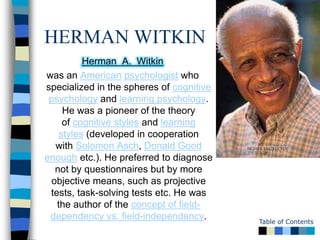
HERMAN WITKIN
Herman A. Witkin
was an American psychologist who
specialized in the spheres of cognitive
psychology and learning psychology.
He was a pioneer of the theory
of cognitive styles and learning
styles (developed in cooperation
with Solomon Asch, Donald Good
enough etc.). He preferred to diagnose
not by questionnaires but by more
objective means, such as projective
tests, task-solving tests etc. He was
the author of the concept of field-
dependency vs. field-independency.
10/9/2016 6Nithin Lalachan BSc. Psychology
Culture, Cognitive Style,
and Problem Solving
• Field dependence – relying on
external frames of reference
• Field independence – relying on
internal frames of reference
10/9/2016 7Nithin Lalachan BSc. Psychology
Table of Contents
1. Rely on external frames of reference
2. Tend to accept the physical
environment as it is given
3. Focus on total context of a problem
4. Found more in sedentary agricultural
societies and in societies that stress
conformity
Table of Contents
1. Rely on internal frames of reference
2. Tend to analyze and restructure the
physical environment
3. Focus on specific features of a
problem
4. Reorganize the component part
5. Predominant in nomadic societies
Table of Contents
Create your own story...
Sun
KCMT
BMW
Dulquer
SalmanKurisummoodu
Award
India
Table of Contents
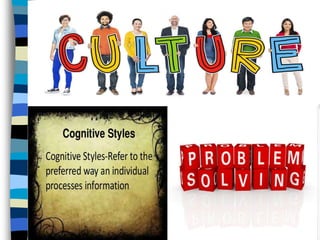
Cognitive Styles
Cognitive styles – Refer to the preferred way an individual
process of information
Table of Contents
Richard E. Nisbett is Theodore M.
Newcomb Distinguished Professor
of social psychology and co-director of
the Culture and Cognition program at
the University of Michigan at Ann Arbor.
Nisbett's research interests are in social
cognition, culture, social class, and aging.
He received his Ph.D. From Columbia
University, where his advisor was Stanley
Schachter, whose other students at that
time included Lee Ross and Judith Rodin
10/9/2016 13Nithin Lalachan BSc. Psychology
10/9/2016 14Nithin Lalachan BSc. Psychology
Table of Contents
 East-Asian culture
 Focuses on context and
relationships among the elements.
 Looking at the ‘BIG PICTURE’ the
‘OVERALL IDEA’ and less
attentive to the details; more
INTUIATIVE
Table of Contents
 Western Culture
 Focuses on object and their
properties.
 Paying more attention to ‘THE
INNER DETAILS OF A SITUATION’
Table of Contents
Quick review :
• Definitions of :
– Culture
– Cognitive Style
– Problem Solving
• Herman Witkin
– Field Dependence
– Field Independence
• Richard Nisbett
– Holistic cognitive style
– Analytic cognitive style
Table of Contents
References
 Witkin,1950;Witkin et al.,1962
 Witkin & Goodenough, 1981
 Berry,1990;Mishra,2001
 Suny Cortland:Cognitive Learning Styles
 Themes And Variations
 www.apa.com
Table of Contents
10/9/2016
Nithin Lalachan
BSc. Psychology
2
Thank You

Culture,Cognitive Styles and Problem Solving

  • 1.
  • 2.
  • 3.
  • 4.
    Table of Contents Dothe varied experiences of people from different cultures lead to cross- cultural variations in problem solving ?
  • 5.
    Table of Contents HERMANWITKIN Herman A. Witkin was an American psychologist who specialized in the spheres of cognitive psychology and learning psychology. He was a pioneer of the theory of cognitive styles and learning styles (developed in cooperation with Solomon Asch, Donald Good enough etc.). He preferred to diagnose not by questionnaires but by more objective means, such as projective tests, task-solving tests etc. He was the author of the concept of field- dependency vs. field-independency.
  • 6.
  • 7.
    Culture, Cognitive Style, andProblem Solving • Field dependence – relying on external frames of reference • Field independence – relying on internal frames of reference 10/9/2016 7Nithin Lalachan BSc. Psychology
  • 8.
    Table of Contents 1.Rely on external frames of reference 2. Tend to accept the physical environment as it is given 3. Focus on total context of a problem 4. Found more in sedentary agricultural societies and in societies that stress conformity
  • 9.
    Table of Contents 1.Rely on internal frames of reference 2. Tend to analyze and restructure the physical environment 3. Focus on specific features of a problem 4. Reorganize the component part 5. Predominant in nomadic societies
  • 10.
    Table of Contents Createyour own story... Sun KCMT BMW Dulquer SalmanKurisummoodu Award India
  • 11.
    Table of Contents CognitiveStyles Cognitive styles – Refer to the preferred way an individual process of information
  • 12.
  • 13.
    Richard E. Nisbettis Theodore M. Newcomb Distinguished Professor of social psychology and co-director of the Culture and Cognition program at the University of Michigan at Ann Arbor. Nisbett's research interests are in social cognition, culture, social class, and aging. He received his Ph.D. From Columbia University, where his advisor was Stanley Schachter, whose other students at that time included Lee Ross and Judith Rodin 10/9/2016 13Nithin Lalachan BSc. Psychology
  • 14.
  • 15.
    Table of Contents East-Asian culture  Focuses on context and relationships among the elements.  Looking at the ‘BIG PICTURE’ the ‘OVERALL IDEA’ and less attentive to the details; more INTUIATIVE
  • 16.
    Table of Contents Western Culture  Focuses on object and their properties.  Paying more attention to ‘THE INNER DETAILS OF A SITUATION’
  • 17.
  • 18.
    Quick review : •Definitions of : – Culture – Cognitive Style – Problem Solving • Herman Witkin – Field Dependence – Field Independence • Richard Nisbett – Holistic cognitive style – Analytic cognitive style
  • 19.
    Table of Contents References Witkin,1950;Witkin et al.,1962  Witkin & Goodenough, 1981  Berry,1990;Mishra,2001  Suny Cortland:Cognitive Learning Styles  Themes And Variations  www.apa.com
  • 20.
    Table of Contents 10/9/2016 NithinLalachan BSc. Psychology 2 Thank You

Editor's Notes

  • #9 The whole part is concerned ......l and
  • #12 11 Cognitive styles refer to the preferred way an individual processes information. Unlike individual differences in abilities (e.g., Gardner, Guilford, Sternberg) which describe peak performance, styles describe a person's typical mode of thinking, remembering or problem solving. Furthermore, styles are usually considered to be bipolar dimensions whereas abilities are unipolar (ranging from zero to a maximum value). Having more of an ability is usually considered beneficial while having a particular cognitive style simply denotes a tendency to behave in a certain manner. Cognitive style is a usually described as a personality dimension which influences attitudes, values, and social interaction.
  • #13 Proposed by Richard Nisbett orange – Holistic thinking Pieces – Analytical thinking
  • #16  The holistic person does not tear things apart mentally to understand them. The holistic person tends to approach a subject by trying to understand its gist or general meaning.
  • #17 Eg :a motor mechanic needs to know how the components of a car function in order to ‘analyse’ the difficulties of a car brought in for repair