KNOWING A PERSON'S LEARNING STYLE ENABLES
LEARNING TO BE ORIENTATED ACCORDING TO THE
PREFERRED METHOD. THAT SAID, EVERYONE
RESPONDS TO AND NEEDS THE STIMULUS OF ALL
TYPES OF LEARNING STYLES TO ONE EXTENT OR
ANOTHER - IT'S A MATTER OF USING EMPHASIS
THAT FITS BEST WITH THE GIVEN SITUATION AND
A PERSON'S LEARNING STYLE PREFERENCES.
Learning Styles
David Kolb’s
Learning Styles
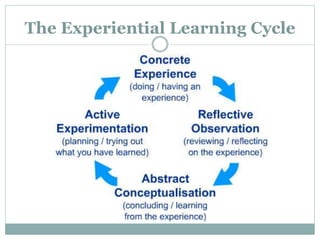
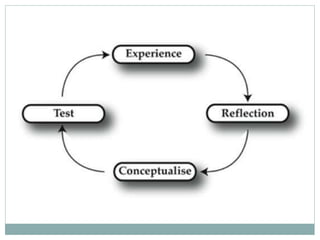
The Experiential Learning Cycle
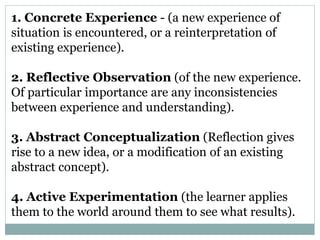
1. Concrete Experience - (a new experience of
situation is encountered, or a reinterpretation of
existing experience).
2. Reflective Observation (of the new experience.
Of particular importance are any inconsistencies
between experience and understanding).
3. Abstract Conceptualization (Reflection gives
rise to a new idea, or a modification of an existing
abstract concept).
4. Active Experimentation (the learner applies
them to the world around them to see what results).
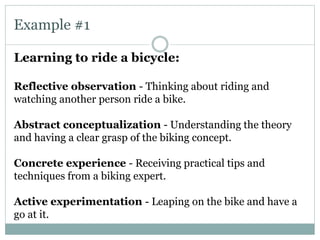
Learning to ride a bicycle:
Reflective observation - Thinking about riding and
watching another person ride a bike.
Abstract conceptualization - Understanding the theory
and having a clear grasp of the biking concept.
Concrete experience - Receiving practical tips and
techniques from a biking expert.
Active experimentation - Leaping on the bike and have a
go at it.
Example #1
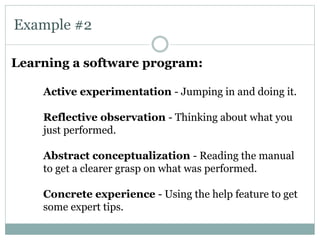
Learning a software program:
Active experimentation - Jumping in and doing it.
Reflective observation - Thinking about what you
just performed.
Abstract conceptualization - Reading the manual
to get a clearer grasp on what was performed.
Concrete experience - Using the help feature to get
some expert tips.
Example #2
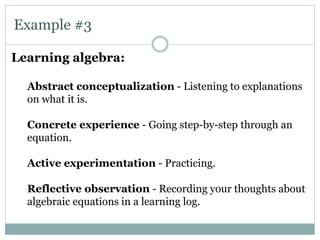
Example #3
Learning algebra:
Abstract conceptualization - Listening to explanations
on what it is.
Concrete experience - Going step-by-step through an
equation.
Active experimentation - Practicing.
Reflective observation - Recording your thoughts about
algebraic equations in a learning log.
Four learning styles
The experimenter, like the concrete experiencer,
takes a hands-on route to see if their ideas will
work, whilst the reflective observers prefer to
watch and think to work things out.
1. Divergers (Concrete experiencer/Reflective
observer)
Divergers take experiences and think deeply about
them, thus diverging from a single experience to
multiple possibilities in terms of what this might
mean. They like to ask 'why', and will start from
detail to constructively work up to the big picture.
Converges think about things and then try out their
ideas to see if they work in practice. They like to
ask 'how' about a situation, understanding how
things work in practice. They like facts and will
seek to make things efficient by making small and
careful changes.
2. Convergers (Abstract
conceptualization/Active experimenter)
Accommodators have the most hands-on approach,
with a strong preference for doing rather than
thinking. They like to ask 'what if?' and 'why not?' to
support their action-first approach. They do not like
routine and will take creative risks to see what
happens.
3. Accomodators (Concrete experiencer/Active
experimenter)
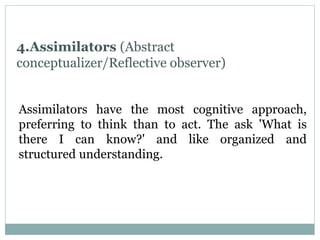
4.Assimilators (Abstract
conceptualizer/Reflective observer)
Assimilators have the most cognitive approach,
preferring to think than to act. The ask 'What is
there I can know?' and like organized and
structured understanding.
 describes four cognitive styles for
perceiving, processing, and ordering
information. The model describes these
styles according to four variables:
concrete, abstract, random and sequential,
creating four styles:
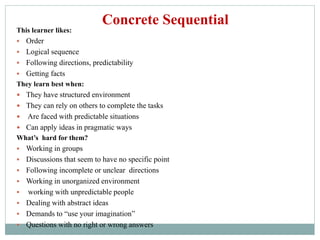
 Concrete Sequential (CS)
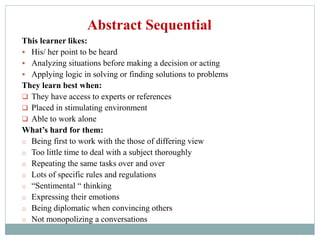
 Abstract Sequential (AS)
 Abstract Random (AR)
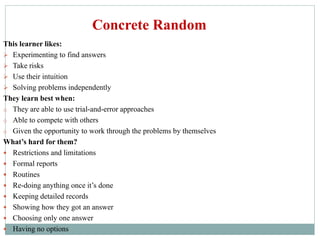
 Concrete Random (CR)
GREGORE COGNITIVE STYLES METHODS
This learner likes:
 Order
 Logical sequence
 Following directions, predictability
 Getting facts
They learn best when:
 They have structured environment
 They can rely on others to complete the tasks
 Are faced with predictable situations
 Can apply ideas in pragmatic ways
What’s hard for them?
 Working in groups
 Discussions that seem to have no specific point
 Following incomplete or unclear directions
 Working in unorganized environment
 working with unpredictable people
 Dealing with abstract ideas
 Demands to “use your imagination”
 Questions with no right or wrong answers
Concrete Sequential
This learner likes:
 His/ her point to be heard
 Analyzing situations before making a decision or acting
 Applying logic in solving or finding solutions to problems
They learn best when:
 They have access to experts or references
 Placed in stimulating environment
 Able to work alone
What’s hard for them:
o Being first to work with the those of differing view
o Too little time to deal with a subject thoroughly
o Repeating the same tasks over and over
o Lots of specific rules and regulations
o “Sentimental “ thinking
o Expressing their emotions
o Being diplomatic when convincing others
o Not monopolizing a conversations
Abstract Sequential
This learner likes:
 Experimenting to find answers
 Take risks
 Use their intuition
 Solving problems independently
They learn best when:
o They are able to use trial-and-error approaches
o Able to compete with others
o Given the opportunity to work through the problems by themselves
What’s hard for them?
 Restrictions and limitations
 Formal reports
 Routines
 Re-doing anything once it’s done
 Keeping detailed records
 Showing how they got an answer
 Choosing only one answer
 Having no options
Concrete Random
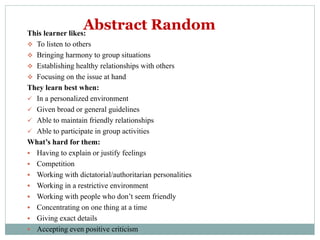
This learner likes:
 To listen to others
 Bringing harmony to group situations
 Establishing healthy relationships with others
 Focusing on the issue at hand
They learn best when:
 In a personalized environment
 Given broad or general guidelines
 Able to maintain friendly relationships
 Able to participate in group activities
What’s hard for them:
 Having to explain or justify feelings
 Competition
 Working with dictatorial/authoritarian personalities
 Working in a restrictive environment
 Working with people who don’t seem friendly
 Concentrating on one thing at a time
 Giving exact details
 Accepting even positive criticism
Abstract Random
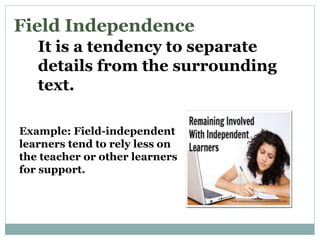
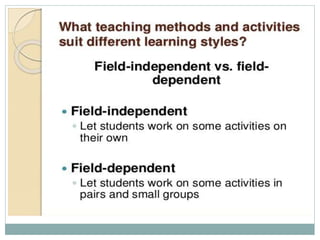
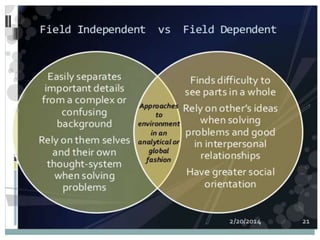
Field Independence
It is a tendency to separate
details from the surrounding
text.
Example: Field-independent
learners tend to rely less on
the teacher or other learners
for support.
Field Dependence
-is defined by a relative inability to
distinguish detail from other information
around it.
-people who exhibit field dependence tend
to rely on information provided by the outer
world, the field or frame of a situation and
their cognition (toward other things) is
based on this overall field.
learning styles by alvin bugaoisan BMLS

learning styles by alvin bugaoisan BMLS

  • 1.
    KNOWING A PERSON'SLEARNING STYLE ENABLES LEARNING TO BE ORIENTATED ACCORDING TO THE PREFERRED METHOD. THAT SAID, EVERYONE RESPONDS TO AND NEEDS THE STIMULUS OF ALL TYPES OF LEARNING STYLES TO ONE EXTENT OR ANOTHER - IT'S A MATTER OF USING EMPHASIS THAT FITS BEST WITH THE GIVEN SITUATION AND A PERSON'S LEARNING STYLE PREFERENCES. Learning Styles
  • 2.
  • 3.
  • 5.
    1. Concrete Experience- (a new experience of situation is encountered, or a reinterpretation of existing experience). 2. Reflective Observation (of the new experience. Of particular importance are any inconsistencies between experience and understanding). 3. Abstract Conceptualization (Reflection gives rise to a new idea, or a modification of an existing abstract concept). 4. Active Experimentation (the learner applies them to the world around them to see what results).
  • 6.
    Learning to ridea bicycle: Reflective observation - Thinking about riding and watching another person ride a bike. Abstract conceptualization - Understanding the theory and having a clear grasp of the biking concept. Concrete experience - Receiving practical tips and techniques from a biking expert. Active experimentation - Leaping on the bike and have a go at it. Example #1
  • 7.
    Learning a softwareprogram: Active experimentation - Jumping in and doing it. Reflective observation - Thinking about what you just performed. Abstract conceptualization - Reading the manual to get a clearer grasp on what was performed. Concrete experience - Using the help feature to get some expert tips. Example #2
  • 8.
    Example #3 Learning algebra: Abstractconceptualization - Listening to explanations on what it is. Concrete experience - Going step-by-step through an equation. Active experimentation - Practicing. Reflective observation - Recording your thoughts about algebraic equations in a learning log.
  • 9.
    Four learning styles Theexperimenter, like the concrete experiencer, takes a hands-on route to see if their ideas will work, whilst the reflective observers prefer to watch and think to work things out.
  • 10.
    1. Divergers (Concreteexperiencer/Reflective observer) Divergers take experiences and think deeply about them, thus diverging from a single experience to multiple possibilities in terms of what this might mean. They like to ask 'why', and will start from detail to constructively work up to the big picture.
  • 11.
    Converges think aboutthings and then try out their ideas to see if they work in practice. They like to ask 'how' about a situation, understanding how things work in practice. They like facts and will seek to make things efficient by making small and careful changes. 2. Convergers (Abstract conceptualization/Active experimenter)
  • 12.
    Accommodators have themost hands-on approach, with a strong preference for doing rather than thinking. They like to ask 'what if?' and 'why not?' to support their action-first approach. They do not like routine and will take creative risks to see what happens. 3. Accomodators (Concrete experiencer/Active experimenter)
  • 13.
    4.Assimilators (Abstract conceptualizer/Reflective observer) Assimilatorshave the most cognitive approach, preferring to think than to act. The ask 'What is there I can know?' and like organized and structured understanding.
  • 14.
     describes fourcognitive styles for perceiving, processing, and ordering information. The model describes these styles according to four variables: concrete, abstract, random and sequential, creating four styles:  Concrete Sequential (CS)  Abstract Sequential (AS)  Abstract Random (AR)  Concrete Random (CR) GREGORE COGNITIVE STYLES METHODS
  • 15.
    This learner likes: Order  Logical sequence  Following directions, predictability  Getting facts They learn best when:  They have structured environment  They can rely on others to complete the tasks  Are faced with predictable situations  Can apply ideas in pragmatic ways What’s hard for them?  Working in groups  Discussions that seem to have no specific point  Following incomplete or unclear directions  Working in unorganized environment  working with unpredictable people  Dealing with abstract ideas  Demands to “use your imagination”  Questions with no right or wrong answers Concrete Sequential
  • 16.
    This learner likes: His/ her point to be heard  Analyzing situations before making a decision or acting  Applying logic in solving or finding solutions to problems They learn best when:  They have access to experts or references  Placed in stimulating environment  Able to work alone What’s hard for them: o Being first to work with the those of differing view o Too little time to deal with a subject thoroughly o Repeating the same tasks over and over o Lots of specific rules and regulations o “Sentimental “ thinking o Expressing their emotions o Being diplomatic when convincing others o Not monopolizing a conversations Abstract Sequential
  • 17.
    This learner likes: Experimenting to find answers  Take risks  Use their intuition  Solving problems independently They learn best when: o They are able to use trial-and-error approaches o Able to compete with others o Given the opportunity to work through the problems by themselves What’s hard for them?  Restrictions and limitations  Formal reports  Routines  Re-doing anything once it’s done  Keeping detailed records  Showing how they got an answer  Choosing only one answer  Having no options Concrete Random
  • 18.
    This learner likes: To listen to others  Bringing harmony to group situations  Establishing healthy relationships with others  Focusing on the issue at hand They learn best when:  In a personalized environment  Given broad or general guidelines  Able to maintain friendly relationships  Able to participate in group activities What’s hard for them:  Having to explain or justify feelings  Competition  Working with dictatorial/authoritarian personalities  Working in a restrictive environment  Working with people who don’t seem friendly  Concentrating on one thing at a time  Giving exact details  Accepting even positive criticism Abstract Random
  • 19.
    Field Independence It isa tendency to separate details from the surrounding text. Example: Field-independent learners tend to rely less on the teacher or other learners for support.
  • 20.
    Field Dependence -is definedby a relative inability to distinguish detail from other information around it. -people who exhibit field dependence tend to rely on information provided by the outer world, the field or frame of a situation and their cognition (toward other things) is based on this overall field.