



LEARNING OUT LOUD
Michelle Pacansky-Brock brocansky.com
How does it impact the online st:dent lear;ing ex>erience?
@brocansky
CC-BY Gustavo Devito
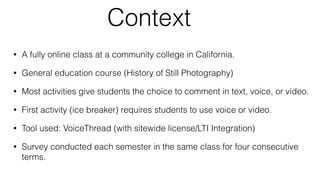
Context
• A fully online class at a community college in California.
• General education course (History of Still Photography)
• Most activities give students the choice to comment in text, voice, or video.
• First activity (ice breaker) requires students to use voice or video.
• Tool used: VoiceThread (with sitewide license/LTI Integration)
• Survey conducted each semester in the same class for four consecutive
terms.
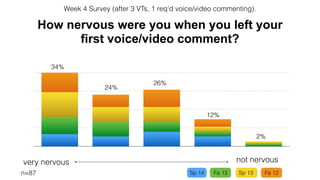
Week 4 Survey (after 3 VTs, 1 req’d voice/video commenting).
very nervous not nervous
n=109
How nervous were you when you left your
first voice/video comment?
0
10
20
30
40
1 2 3 4 5
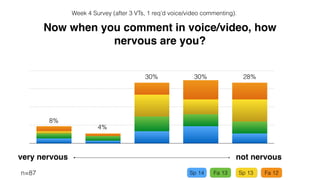
Now when you comment in voice/video, how
nervous are you?
Week 4 Survey (after 3 VTs, 1 req’d voice/video commenting).
very nervous not nervous
n=109
0
10
20
30
40
1 2 3 4 5
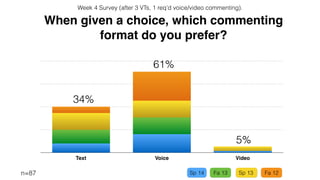
When given a choice, which commenting
format do you prefer?
Week 4 Survey (after 3 VTs, 1 req’d voice/video commenting).
n=109
0
17.5
35
52.5
70
Text Voice Video
CC-BY-NC-SA By Coofdy
a social-emotional speed bump?
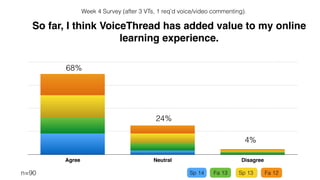
So far, I think VoiceThread has added value to my online
learning experience.
Week 4 Survey (after 3 VTs, 1 req’d voice/video commenting).
n=109
0
20
40
60
80
Agree Neutral Disagree
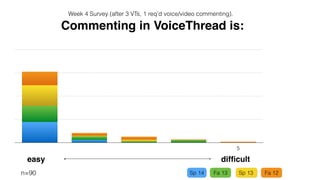
Commenting in VoiceThread is:
1 5
Week 4 Survey (after 3 VTs, 1 req’d voice/video commenting).
easy difficult
n=109
71%
17%
6% 3% 1%
End of Semester Survey
•work in progress
•1 class surveyed each term for 4 consecutive terms
•anonymous
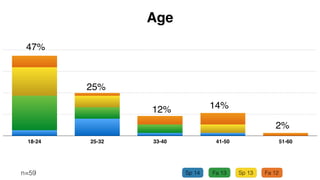
0
10
20
30
40
Age
n=78
49%
19%
12%14%
2% 1%1%
under 18 18-24 25-32 33-40 41-50 51-60 decline to state
Race/Ethnicity
13
25
38
50
W
hite/C
aucasian
H
Ispanic/Latino
A
sian/Pacific
IslandN
ative
A
m
erican
IndianA
frican
A
m
erican/B
lack
M
ixed
O
ther
D
ecline
to
State
n=59
57%
20%
7%
3% 3%
6%
4%
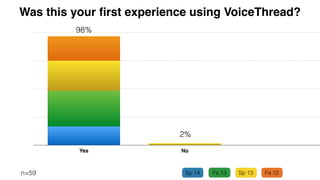
n=92
Was this your first experience using VoiceThread?
0
22.5
45
67.5
90
Yes No
n=82
99%
1%
0
12.5
25
37.5
50
Strongly Agree Agree Neutral Disagree Strongly Disagree
86%
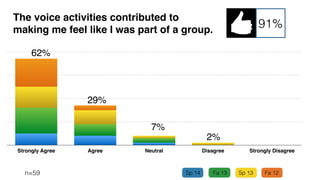
The voice activities contributed to
making me feel like I was part of a group.
n=82
56%
30%
13%
1%
0
10
20
30
40
Strongly Agree Agree Neutral Disagree Strongly Disagree
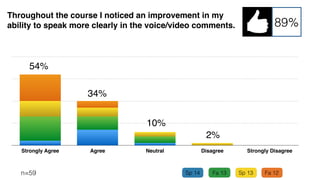
Throughout the course I noticed an improvement in my
ability to speak more clearly in the voice/video comments.
n=82
47%
34%
17%
1%
81%
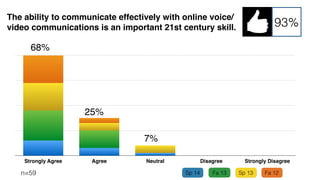
The ability to communicate effectively with online voice/
video communications is an important 21st century skill.
Strongly Agree Agree Neutral Disagree Strongly Disagree
n=59
60%
30%
5%
90%
Strongly Agree Agree Neutral Disagree Strongly Disagree
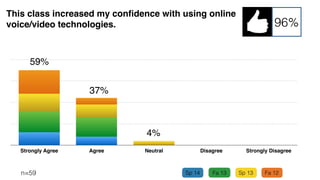
This class increased my confidence with using online
voice/video technologies.
n=82
51%
42%
7%
93%
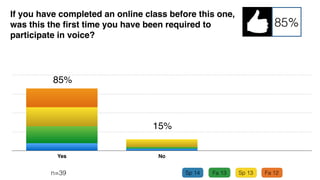
If you have completed an online class before this one, was this the
first time you have been required to participate in voice?
Yes No
n=55
83%
13%
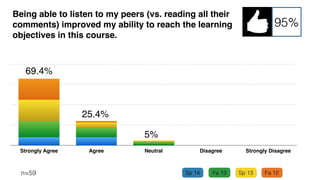
Being able to listen to my peers (vs. reading all their
comments) improved my ability to reach the learning
objectives in this course.
0
12.5
25
37.5
50
Strongly Agree Agree Neutral Disagree Strongly Disagree
n=82
60%
28%
12%
95%
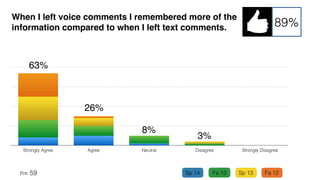
When I left voice comments I remembered more of the
information compared to when I left text comments.
Strongly Agree Agree Neutral Disagree Strongly Disagree
n= 82
57%
25%
15%
3%
82%
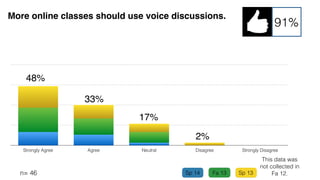
More online classes should use voice discussions.
Strongly Agree Agree Neutral Disagree Strongly Disagree
n= 69
36% 36%
25%
6%
72%
CC-BY-NC-SA Zanthia
“I can say that all of my other online
classes, I remember maybe one name from
the class and that is because I knew them in
real life. I feel like I ‘know’ most of my
classmates because of the activities
assigned.”
CC-BY-NC-SA Zanthia
“I feel like we got to know each other better. I
actually recognized a classmate at my
children's Taekwondo class because of the
sound of her voice!”
CC-BY-NC-SA Zanthia
“Listening gave me a better understanding of
the material. In the showcase assignments, you
could actually hear the passion in the speakers’
voices for their photographer.”
CC-BY-NC-SA Zanthia
“Yes, it feels more personal and
intimate which I think helps you retain
what you are learning.”
CC-BY-NC-SA Zanthia
“I enjoyed it more.”
CC-BY-NC-SA Zanthia
“I think speaking…engaged me more…It is
easy for online students to feel a disconnect…
Having to … speak and …directly engage a
fellow student through voice makes you feel a
part of an actual class.”
CC-BY JD Hancock
“…having to say the words helped me
understand what I was talking about better
than if I had just been writing it down.”
How did speaking (vs. writing all your
assignments) affect your learning?
CC-BY JD Hancock
CC-BY JD Hancock
“I found ... that I would ... unearth more thoughts
and opinions as I spoke them out loud while
looking at the content, as opposed to looking at
the content, forming an opinion, then looking at
my text as I wrote it.”
CC-BY JD Hancock
“…it made me re-evaluate my answers. Mostly
because I didn't want to sound like I had no idea
what I was talking about. Plus when you write
something down there is not much emotion to it
and being able to speak out loud my ideas made
me feel like I could connect and explain the
material better.”
Were there any benefits to being
able to hear your peers’ comments?
CC-BY JD Hancock
How did speaking (vs. writing all your
assignments) affect your learning?
“I felt the need to more fully research the
material before leaving comments. I wanted
to sound proficient when discussing
questions in voice comments.”
CC-BY JD Hancock
“I felt more motivated to produce a better
quality assignment.”
How did speaking (vs. writing all your
assignments) affect your learning?
CC-BY JD Hancock
“I was able to remember more information
because when I read something I often get
distracted and it’s harder for me to retain
information.”
How did speaking (vs. writing all your
assignments) affect your learning?
CC-BY JD Hancock
“It made me more conscious of what I was
saying, which helped me understand it more.”
How did speaking (vs. writing all your
assignments) affect your learning?
CC-BY JD Hancock
“It made me feel knowledgeable…”
How did speaking (vs. writing all your
assignments) affect your learning?
CC-BY JD Hancock
“I felt very responsible to know the
subject matter.”
How did speaking (vs. writing all your
assignments) affect your learning?
I think it's a great tool to help people
who may have trouble with social
situations, hence their reason for
taking online classes, break out of
their shell a bit more.
CC-BY kodomut.com
“I feel that taking this class and
having been required to push myself
to leave voice comments has helped
me learn that I am capable of
overcoming my fears of
embarrassment.”
CC-BY kodomut.com
CC-BY kodomut.com
Having a teacher that is involved and is
talking to you constantly, keeps the lines of
communication open. Learning is easier
because the teacher is approachable. You
can actually see the passion for the subject
in the teacher voice messages.
“I did not like the voicethread
activities. I don't feel that it added to
my learning experience since it is not
a speech or public speaking class.”
CC-BY kodomut.com
What drawbacks were there to
being required to speak?
“None really, other than me tripping
over my tongue and having to re-
record a lot. But that gets better as
you get more comfortable with it.”
CC-BY kodomut.com
Were there any drawbacks to
being required to speak?
“For me, working them around my noisy
(and consistently busy) family and house. I
also had to buy a microphone for my
comments, but acquiring materials is just a
part of school.”
CC-BY kodomut.com
Were there any drawbacks to
being required to speak?
“I don't think it affected my learning in any way. But,
it did make things more interesting.”
CC-BY kodomut.com
Were there any drawbacks to
being required to speak?
“My biggest challenge was to try and sound
like I wasnt reading from what I had typed. I
felt too nervous most of the time to just
"wing it". I tried to make myself sound more
natural. “
CC-BY kodomut.com
Were there any drawbacks to
being required to speak?
CC-BY Gustavo Devito
Were there any drawbacks to
being required to speak?
“At first, I was nervous ...but ... I found [VoiceThread
to] be most useful. It was fun and made the class
more interactive. In my opinion, the online class
would be a bit boring without VoiceThread.”
Photo by JasonSamfield CC-BY-NC-SA
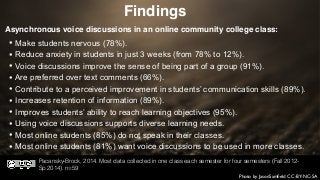
• Make students nervous (78%).
• Reduce anxiety in students in just 3 weeks (from 78% to 12%).
• Voice discussions improve the sense of being part of a group (91%).
• Are preferred over text comments (66%).
• Contribute to a perceived improvement in students’ communication skills (89%).
• Increases retention of information (89%).
• Improves students’ ability to reach learning objectives (95%).
• Using voice discussions supports diverse learning needs.
• Most online students (85%) do not speak in their classes.
• Most online students (81%) want voice discussions to be used in more classes.
Findings
Asynchronous voice discussions in an online community college class:
Pacansky-Brock, 2014. Most data collected in one class each semester for four semesters (Fall 2012-
Sp 2014). n=59
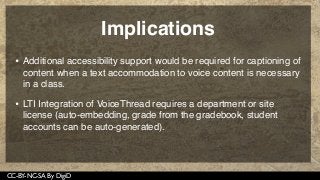
Implications
• Additional accessibility support would be required for captioning of
content when a text accommodation to voice content is necessary
in a class.
• LTI Integration of VoiceThread requires a department or site
license (auto-embedding, grade from the gradebook, student
accounts can be auto-generated).
CC-BY-NC-SA By DigiD

Learning Out Loud: How Does It Impact the Online Student Learning Experience?

  • 1.
    LEARNING OUT LOUD MichellePacansky-Brock brocansky.com How does it impact the online st:dent lear;ing ex>erience? @brocansky CC-BY Gustavo Devito
  • 2.
    Context • A fullyonline class at a community college in California. • General education course (History of Still Photography) • Most activities give students the choice to comment in text, voice, or video. • First activity (ice breaker) requires students to use voice or video. • Tool used: VoiceThread (with sitewide license/LTI Integration) • Survey conducted each semester in the same class for four consecutive terms.
  • 3.
    Week 4 Survey(after 3 VTs, 1 req’d voice/video commenting). very nervous not nervous n=109 How nervous were you when you left your first voice/video comment? 0 10 20 30 40 1 2 3 4 5
  • 4.
    Now when youcomment in voice/video, how nervous are you? Week 4 Survey (after 3 VTs, 1 req’d voice/video commenting). very nervous not nervous n=109 0 10 20 30 40 1 2 3 4 5
  • 5.
    When given achoice, which commenting format do you prefer? Week 4 Survey (after 3 VTs, 1 req’d voice/video commenting). n=109 0 17.5 35 52.5 70 Text Voice Video
  • 6.
    CC-BY-NC-SA By Coofdy asocial-emotional speed bump?
  • 7.
    So far, Ithink VoiceThread has added value to my online learning experience. Week 4 Survey (after 3 VTs, 1 req’d voice/video commenting). n=109 0 20 40 60 80 Agree Neutral Disagree
  • 8.
    Commenting in VoiceThreadis: 1 5 Week 4 Survey (after 3 VTs, 1 req’d voice/video commenting). easy difficult n=109 71% 17% 6% 3% 1%
  • 9.
    End of SemesterSurvey •work in progress •1 class surveyed each term for 4 consecutive terms •anonymous
  • 10.
    0 10 20 30 40 Age n=78 49% 19% 12%14% 2% 1%1% under 1818-24 25-32 33-40 41-50 51-60 decline to state
  • 11.
  • 12.
    Was this yourfirst experience using VoiceThread? 0 22.5 45 67.5 90 Yes No n=82 99% 1%
  • 13.
    0 12.5 25 37.5 50 Strongly Agree AgreeNeutral Disagree Strongly Disagree 86% The voice activities contributed to making me feel like I was part of a group. n=82 56% 30% 13% 1%
  • 14.
    0 10 20 30 40 Strongly Agree AgreeNeutral Disagree Strongly Disagree Throughout the course I noticed an improvement in my ability to speak more clearly in the voice/video comments. n=82 47% 34% 17% 1% 81%
  • 15.
    The ability tocommunicate effectively with online voice/ video communications is an important 21st century skill. Strongly Agree Agree Neutral Disagree Strongly Disagree n=59 60% 30% 5% 90%
  • 16.
    Strongly Agree AgreeNeutral Disagree Strongly Disagree This class increased my confidence with using online voice/video technologies. n=82 51% 42% 7% 93%
  • 17.
    If you havecompleted an online class before this one, was this the first time you have been required to participate in voice? Yes No n=55 83% 13%
  • 18.
    Being able tolisten to my peers (vs. reading all their comments) improved my ability to reach the learning objectives in this course. 0 12.5 25 37.5 50 Strongly Agree Agree Neutral Disagree Strongly Disagree n=82 60% 28% 12% 95%
  • 19.
    When I leftvoice comments I remembered more of the information compared to when I left text comments. Strongly Agree Agree Neutral Disagree Strongly Disagree n= 82 57% 25% 15% 3% 82%
  • 20.
    More online classesshould use voice discussions. Strongly Agree Agree Neutral Disagree Strongly Disagree n= 69 36% 36% 25% 6% 72%
  • 21.
    CC-BY-NC-SA Zanthia “I cansay that all of my other online classes, I remember maybe one name from the class and that is because I knew them in real life. I feel like I ‘know’ most of my classmates because of the activities assigned.”
  • 22.
    CC-BY-NC-SA Zanthia “I feellike we got to know each other better. I actually recognized a classmate at my children's Taekwondo class because of the sound of her voice!”
  • 23.
    CC-BY-NC-SA Zanthia “Listening gaveme a better understanding of the material. In the showcase assignments, you could actually hear the passion in the speakers’ voices for their photographer.”
  • 24.
    CC-BY-NC-SA Zanthia “Yes, itfeels more personal and intimate which I think helps you retain what you are learning.”
  • 25.
  • 26.
    CC-BY-NC-SA Zanthia “I thinkspeaking…engaged me more…It is easy for online students to feel a disconnect… Having to … speak and …directly engage a fellow student through voice makes you feel a part of an actual class.”
  • 27.
    CC-BY JD Hancock “…havingto say the words helped me understand what I was talking about better than if I had just been writing it down.” How did speaking (vs. writing all your assignments) affect your learning?
  • 28.
  • 29.
    CC-BY JD Hancock “Ifound ... that I would ... unearth more thoughts and opinions as I spoke them out loud while looking at the content, as opposed to looking at the content, forming an opinion, then looking at my text as I wrote it.”
  • 30.
    CC-BY JD Hancock “…itmade me re-evaluate my answers. Mostly because I didn't want to sound like I had no idea what I was talking about. Plus when you write something down there is not much emotion to it and being able to speak out loud my ideas made me feel like I could connect and explain the material better.” Were there any benefits to being able to hear your peers’ comments?
  • 31.
    CC-BY JD Hancock Howdid speaking (vs. writing all your assignments) affect your learning? “I felt the need to more fully research the material before leaving comments. I wanted to sound proficient when discussing questions in voice comments.”
  • 32.
    CC-BY JD Hancock “Ifelt more motivated to produce a better quality assignment.” How did speaking (vs. writing all your assignments) affect your learning?
  • 33.
    CC-BY JD Hancock “Iwas able to remember more information because when I read something I often get distracted and it’s harder for me to retain information.” How did speaking (vs. writing all your assignments) affect your learning?
  • 34.
    CC-BY JD Hancock “Itmade me more conscious of what I was saying, which helped me understand it more.” How did speaking (vs. writing all your assignments) affect your learning?
  • 35.
    CC-BY JD Hancock “Itmade me feel knowledgeable…” How did speaking (vs. writing all your assignments) affect your learning?
  • 36.
    CC-BY JD Hancock “Ifelt very responsible to know the subject matter.” How did speaking (vs. writing all your assignments) affect your learning?
  • 37.
    I think it'sa great tool to help people who may have trouble with social situations, hence their reason for taking online classes, break out of their shell a bit more. CC-BY kodomut.com
  • 38.
    “I feel thattaking this class and having been required to push myself to leave voice comments has helped me learn that I am capable of overcoming my fears of embarrassment.” CC-BY kodomut.com
  • 39.
    CC-BY kodomut.com Having ateacher that is involved and is talking to you constantly, keeps the lines of communication open. Learning is easier because the teacher is approachable. You can actually see the passion for the subject in the teacher voice messages.
  • 40.
    “I did notlike the voicethread activities. I don't feel that it added to my learning experience since it is not a speech or public speaking class.” CC-BY kodomut.com What drawbacks were there to being required to speak?
  • 41.
    “None really, otherthan me tripping over my tongue and having to re- record a lot. But that gets better as you get more comfortable with it.” CC-BY kodomut.com Were there any drawbacks to being required to speak?
  • 42.
    “For me, workingthem around my noisy (and consistently busy) family and house. I also had to buy a microphone for my comments, but acquiring materials is just a part of school.” CC-BY kodomut.com Were there any drawbacks to being required to speak?
  • 43.
    “I don't thinkit affected my learning in any way. But, it did make things more interesting.” CC-BY kodomut.com Were there any drawbacks to being required to speak?
  • 44.
    “My biggest challengewas to try and sound like I wasnt reading from what I had typed. I felt too nervous most of the time to just "wing it". I tried to make myself sound more natural. “ CC-BY kodomut.com Were there any drawbacks to being required to speak?
  • 45.
    CC-BY Gustavo Devito Werethere any drawbacks to being required to speak? “At first, I was nervous ...but ... I found [VoiceThread to] be most useful. It was fun and made the class more interactive. In my opinion, the online class would be a bit boring without VoiceThread.”
  • 46.
    Photo by JasonSamfieldCC-BY-NC-SA • Make students nervous (78%). • Reduce anxiety in students in just 3 weeks (from 78% to 12%). • Voice discussions improve the sense of being part of a group (91%). • Are preferred over text comments (66%). • Contribute to a perceived improvement in students’ communication skills (89%). • Increases retention of information (89%). • Improves students’ ability to reach learning objectives (95%). • Using voice discussions supports diverse learning needs. • Most online students (85%) do not speak in their classes. • Most online students (81%) want voice discussions to be used in more classes. Findings Asynchronous voice discussions in an online community college class: Pacansky-Brock, 2014. Most data collected in one class each semester for four semesters (Fall 2012- Sp 2014). n=59
  • 47.
    Implications • Additional accessibilitysupport would be required for captioning of content when a text accommodation to voice content is necessary in a class. • LTI Integration of VoiceThread requires a department or site license (auto-embedding, grade from the gradebook, student accounts can be auto-generated). CC-BY-NC-SA By DigiD