..Rethinking Faculty Support
THE
CHASM
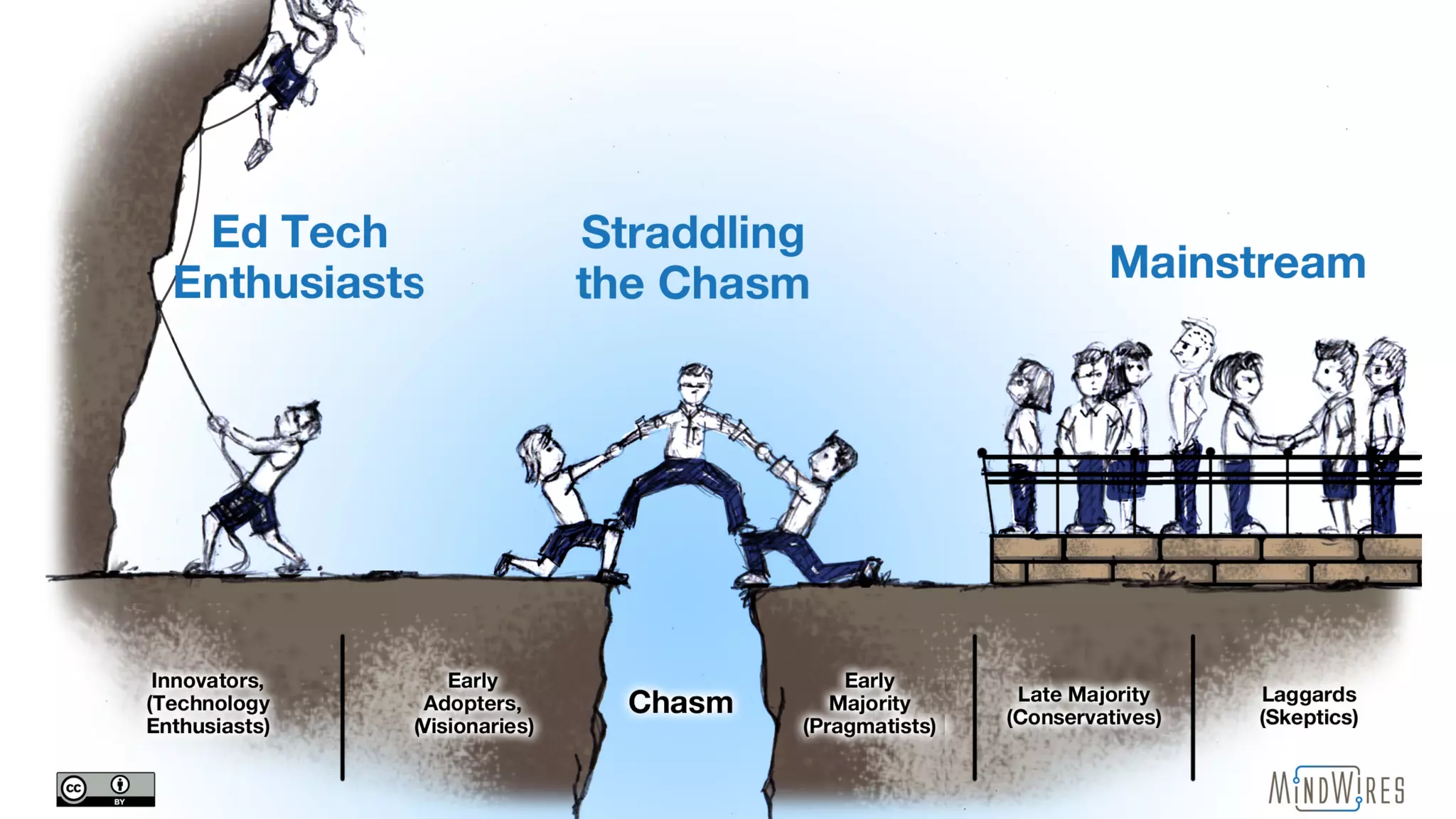
STRADDLINGSTRADDLING
THE
CHASM
Rethinking Faculty Support
photo by Hugo Stephen CC-BY
Michelle Pacansky-Brock
@brocansky
CSU Channel Islands
#NUTN15
Savannah, GA
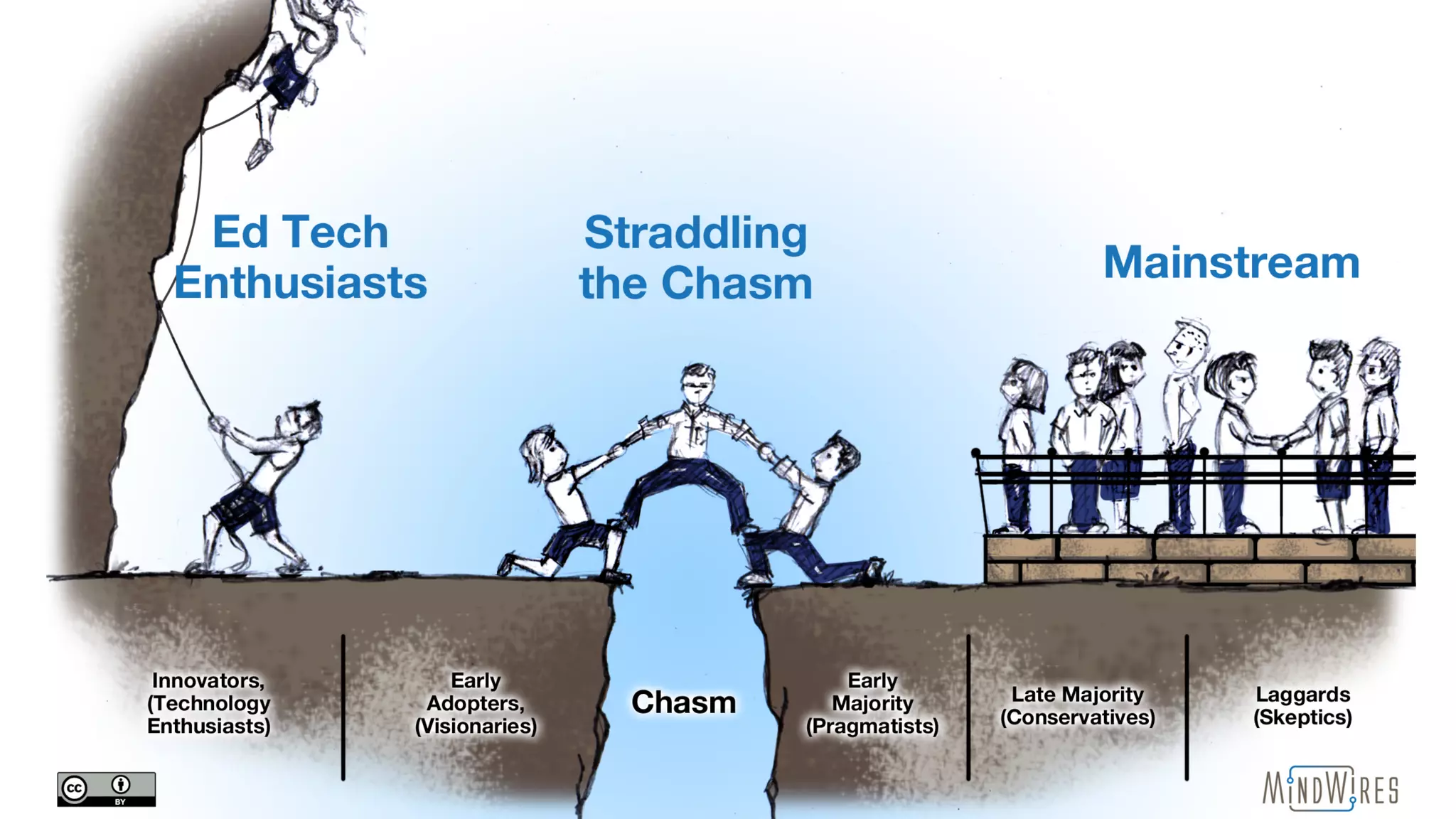
Slide by Michelle Pacansky-Brock
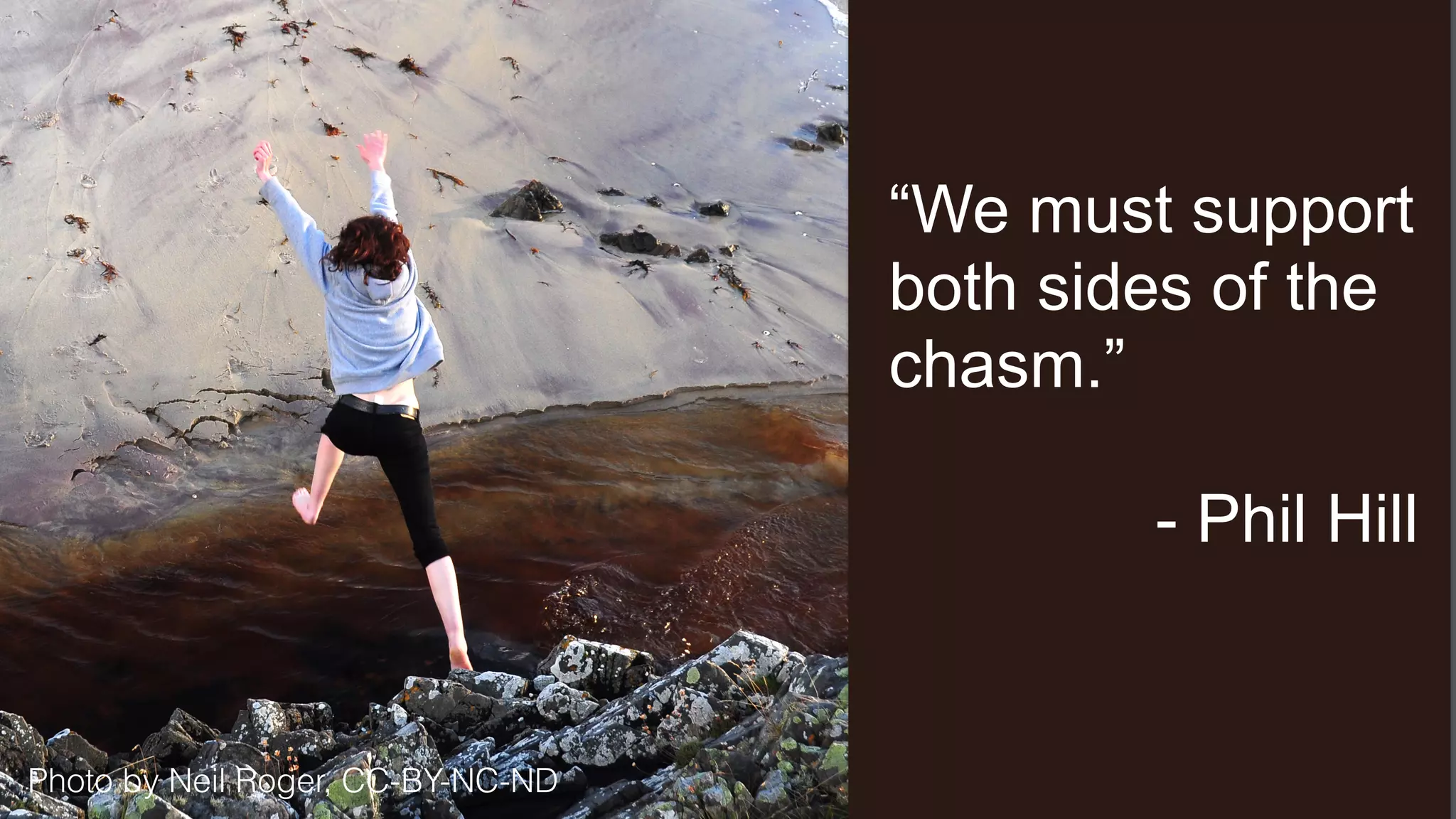
“We must support
both sides of the
chasm.”
- Phil Hill
Slide by Michelle Pacansky-BrockPhoto by Neil Roger, CC-BY-NC-ND
Professional development
and training are major
factors affecting
technological innovation
within higher education
organizations.
Austin, A. E., & Sorcinelli, M. D. (2013). The future of faculty
development: Where are we going?. New Directions for Teaching
and Learning, 2013(133), 85-97.
Slide by Michelle Pacansky-Brockphoto by Sharon Mollerus CC-BY
HOW?
Slide by Michelle Pacansky-Brock
WHAT
DO WE
KNOW?
Slide by Michelle Pacansky-Brock
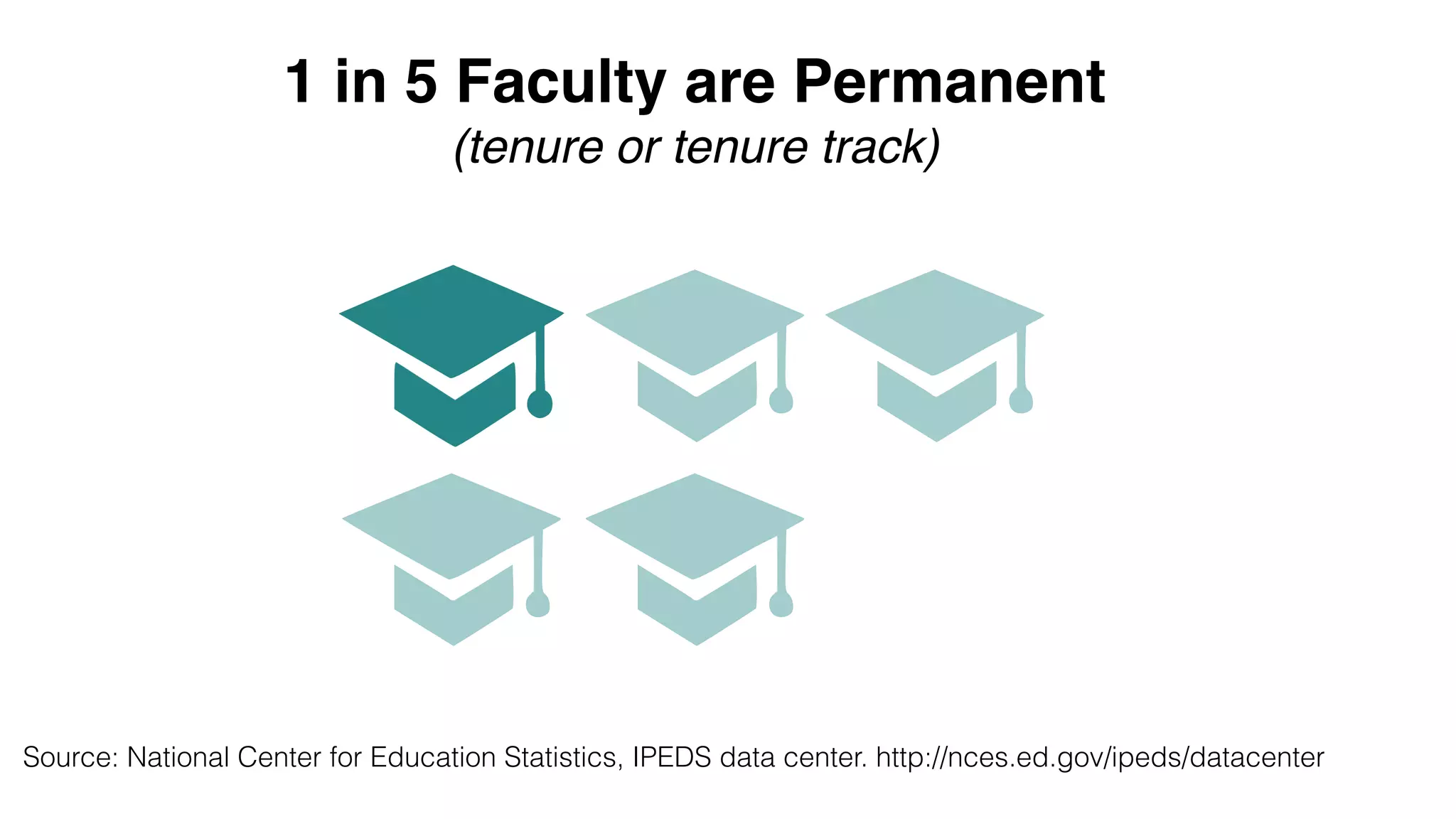
1 in 5 Faculty are Permanent
(tenure or tenure track)
Department of Education, National Center for Education Statistics, Higher Education General Information Survey (HEGIS), Employees in Institutions of Higher Education, 1970 and 1972, and
"Staff Survey" 1976; Projections of Education Statistics to 2000; Integrated Postsecondary Education Data System (IPEDS), "Fall Staff Survey" (IPEDS-S:87-99); IPEDS Winter 2001-02 through
Winter 2011-12, Human Resources component, Fall Staff section; IPEDS Spring 2014, Human Resources component, Fall Staff section; and U.S. Equal Employment Opportunity
Commission, Higher Education Staff Information Survey (EEO-6), 1977, 1981, and 1983.
Source: National Center for Education Statistics, IPEDS data center. http://nces.ed.gov/ipeds/datacenter
Slide by Michelle Pacansky-Brock
ONLINE &
BLENDED
LEARNING
Slide by Michelle Pacansky-Brock
SHIFT
FROMTEACHING TO
LEARNING
Slide by Michelle Pacansky-Brock
THE LMS
MAINSTREAM?
WHAT IS
Slide by Michelle Pacansky-Brock
49%
58%
60%
74%
77%Posting content
Receiving course
assignments
Managing assignments
Entering progress info
Engaging in meaningful
interaction with students
Faculty Satisfaction with LMS Features
Slide by Michelle Pacansky-BrockSource: ECAR LMS Report
LMS Features Students Are Least Satisfied With
Engaging in meaningful
interaction with instructors
Engaging in meaningful
interaction with other students
Collaborating on projects for
study groups with other students
LOSERS
3BIGGEST
Slide by Michelle Pacansky-BrockSource: ECAR LMS Report
USE OF
SOCIAL
TECHNOLOGIES
Seaman, J.; Tinti-Kane. H. (2013). Social media for teaching and learning.Pearson Learning Solutions and Babson
Survey Research Group.
FACULTY
Slide by Michelle Pacansky-Brock
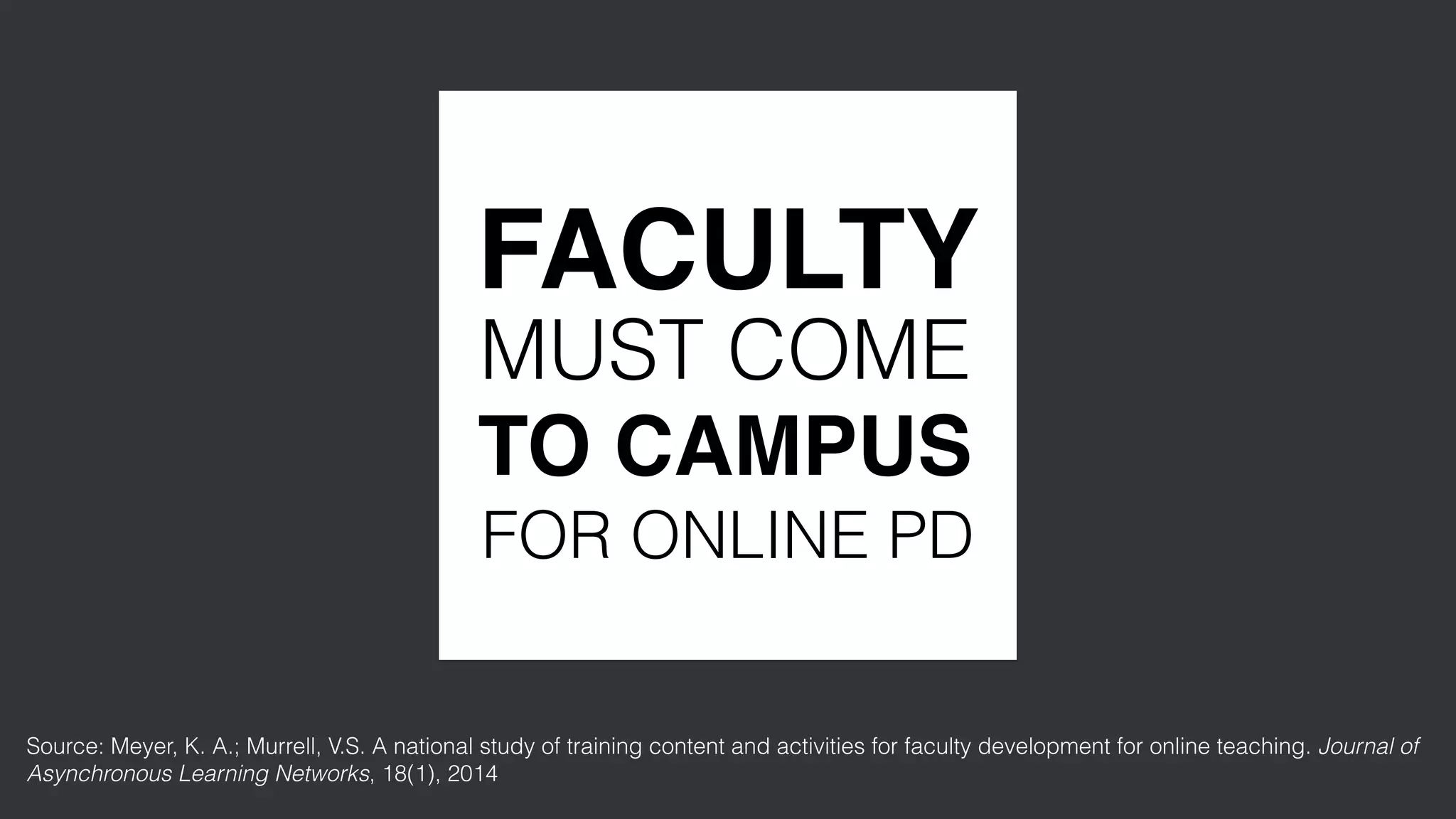
MUST COME
TO CAMPUS
FOR ONLINE PD
FACULTY
Source: Meyer, K. A.; Murrell, V.S. A national study of training content and activities for faculty development for online teaching. Journal of Asynchronous
Learning Networks, 18(1), 2014
Slide by Michelle Pacansky-Brock
9 out of 10
institutions provide
professional
development for
online instructors
through face-to-
face delivery
Source: Meyer, K. A.; Murrell, V.S. A national study of training content and
activities for faculty development for online teaching. Journal of
Asynchronous Learning Networks, 18(1), 2014
Slide by Michelle Pacansky-Brock
Visualization of LinkedIn network created at: http://inmaps.linkedinlabs.com/ Slide by Michelle Pacansky-Brock
Identifying shared values among
ecosystem partners moves us from
fragmentation to relatedness.
(Senge, 2008, 2009)
Slide by Michelle Pacansky-Brock
CO-CREATION
collaboratively build
solutions to shared
problems
+
community
Hangouts+
group
conferences
book
Slide by Michelle Pacansky-Brock
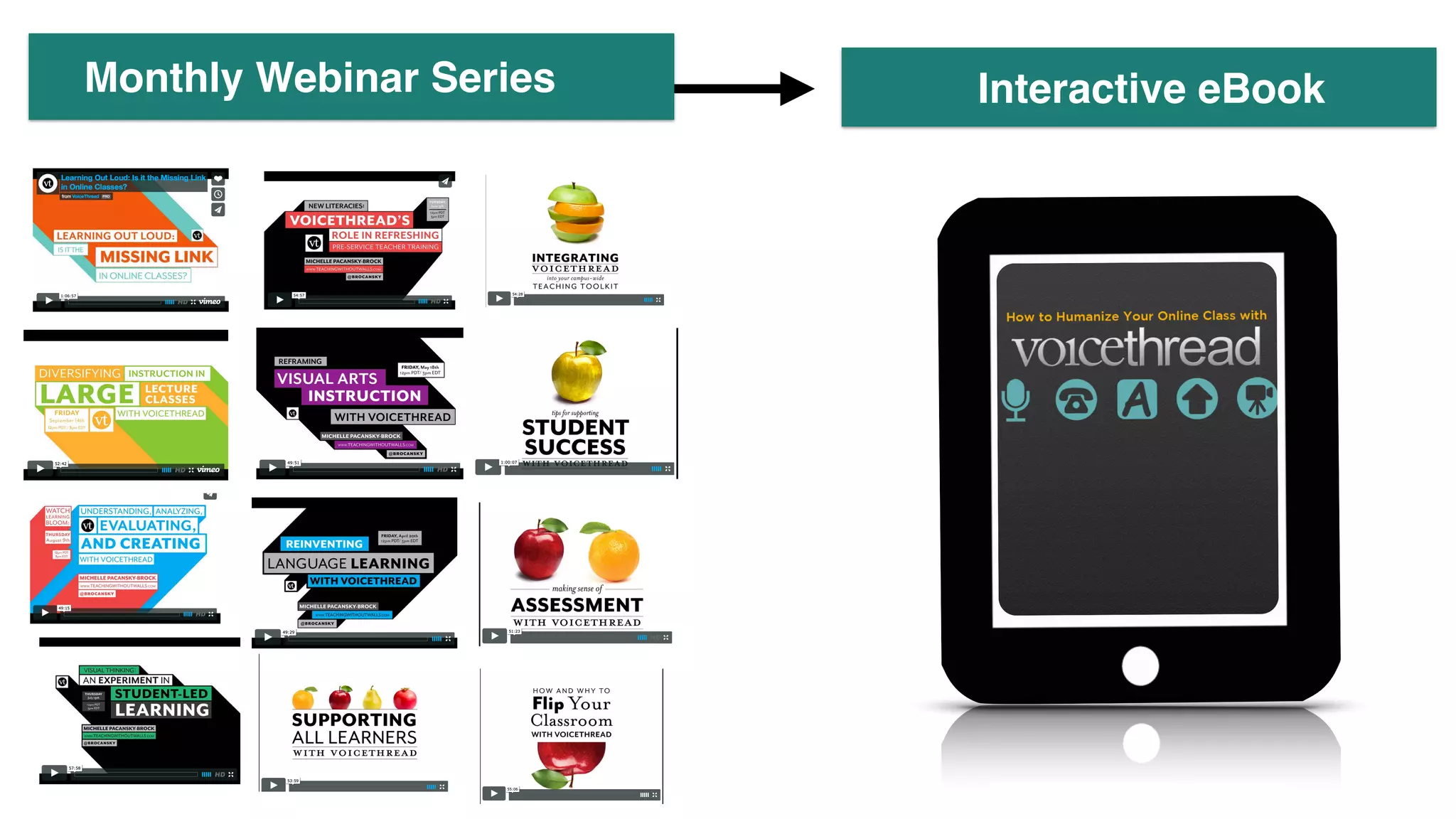
Webinar Series (Archived)Monthly Webinar Series Interactive eBook
Slide by Michelle Pacansky-Brock
Faculty-authored
eBooks for faculty
support across
institutions?
Slide by Michelle Pacansky-Brock
CONTENT
What do
faculty
want in
an
eBook?
FORMAT
• learning theory
• teaching examples
• instructional design tips
• student perspective
• interactive
• videos
• illustrations
• visual icons
• clear organization
• support for multiple
devices
n=24
Pacansky-Brock, M. (2015). Examining the effects of an eBook to support faculty who teach with VoiceThread: An action research study. (Doctoral dissertation).
What are the support needs of faculty
who teach with VoiceThread?
1. Just-in-time resources
2. Non-linear PD experiences
3. Community
4. Funding for accounts
5. LMS Integration
n=50
2-yr and 4-yr faculty with
a VoiceThread account
Pacansky-Brock, M. (2015). Examining the effects of an eBook to support faculty who teach with VoiceThread: An action research study. (Doctoral dissertation).
JUST-IN-TIME
PROFESIONAL DEVELOPMENT
“I didn’t have to go anywhere. I had more freedom”
“I am at the center. In a workshop, I’m passive most of the time.”
“I could only attend a face-to-face event at one of the
three institutions [at which I teach].”
Pacansky-Brock, M. (2015). Examining the effects of an eBook to support faculty who teach with VoiceThread: An action research study. (Doctoral dissertation).
Lukas Kastner CC-BY
How are faculty adapting and changing
in the digital/connected age?
Leafstedt, J.; Pacansky-Brock, M.; Hoffman, J. (2015)
WHAT?
1 2
3 4
How has
technology
impacted your
professional
identity?
How has
technology
impacted your
teaching?
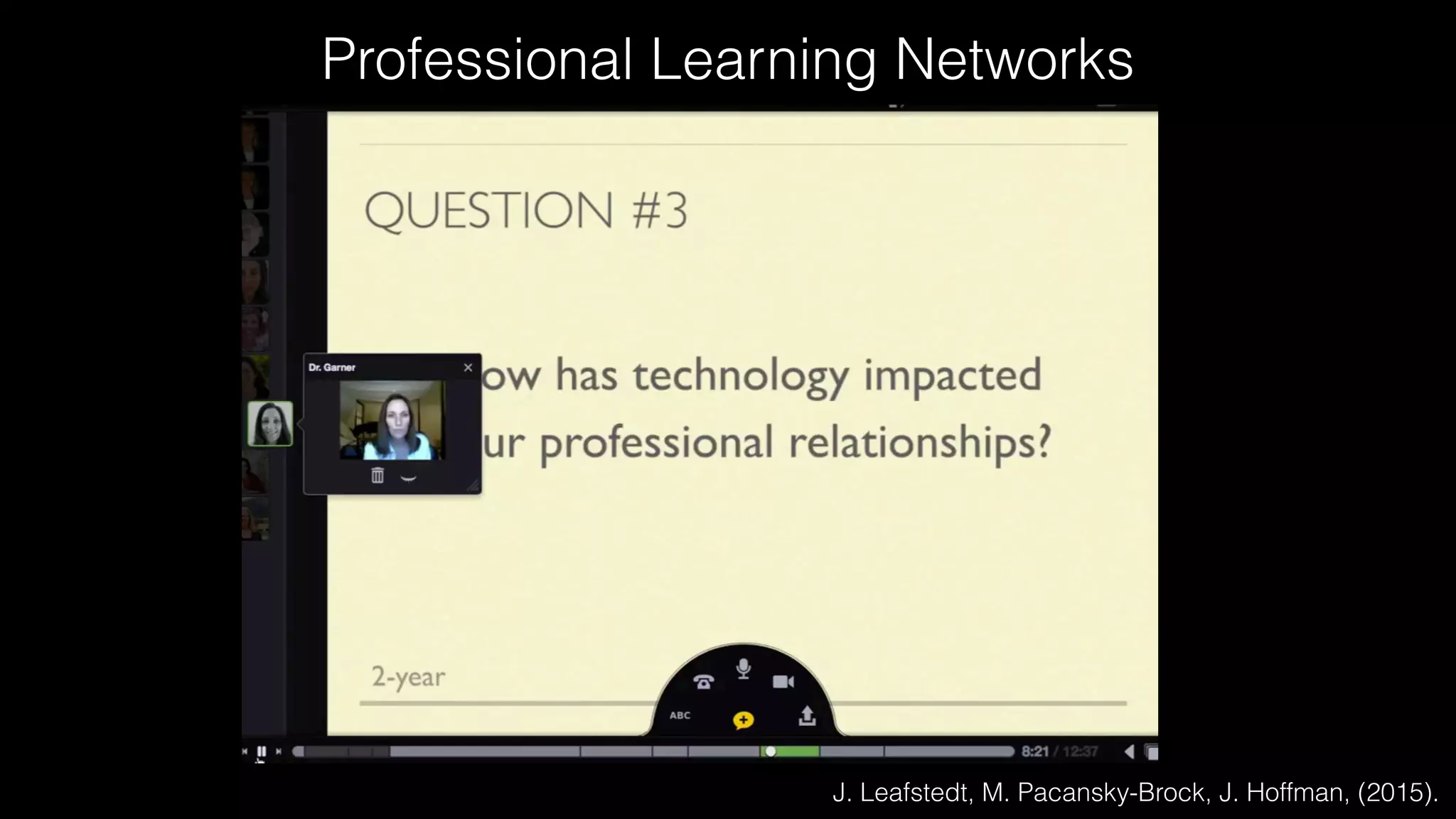
How has
technology
impacted your
professional
relationships?
How has
technology
impacted your
interactions with
students?
J. Leafstedt, M. Pacansky-Brock, J. Hoffman, (2015).
Data Collection
Data Collection
J. Leafstedt, M. Pacansky-Brock, J. Hoffman, (2015).
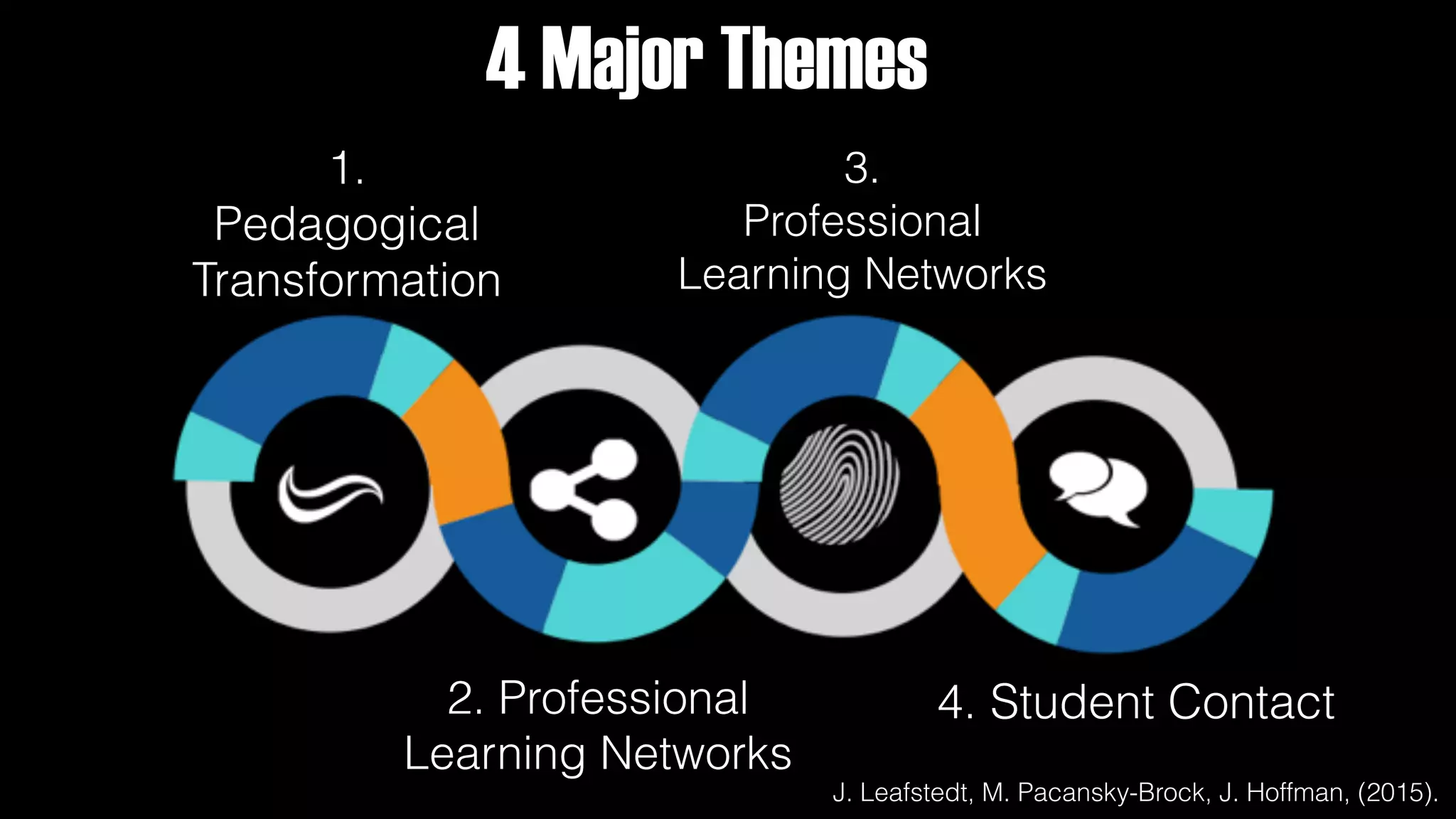
1.

Pedagogical
Transformation
2. Professional
Learning Networks
3.
Professional
Identity
4. Student Contact
4 Major Themes
J. Leafstedt, M. Pacansky-Brock, J. Hoffman, (2015).
2. Personal Learning Networks
continuous, informal
learning with
interdisciplinary peers
virtual
extension of
formal
connections
formal: on-
campus/
conferences
J. Leafstedt, M. Pacansky-Brock, J. Hoffman, (2015).
Professional Learning Networks
“Technology has given me
my professional identity.”
Lori,
PT, multiple community colleges
J. Leafstedt, M. Pacansky-Brock, J. Hoffman, (2015).
Professional Learning Networks
J. Leafstedt, M. Pacansky-Brock, J. Hoffman, (2015).
To foster pedagogical innovation through
technology, organizations must support the
cultivation of #ConnectedEducators.
Slide by Michelle Pacansky-Brock
photo by Kodomut CC-BY
“Those who don’t
jump will never fly.”
-Leena Ahmad Almashat
Slide by Michelle Pacansky-Brock
photo by Kim Seng CC-BY-NC-ND Slide by Michelle Pacansky-Brock
Photo by Sharon Terry CC-BY Slide by Michelle Pacansky-Brock
Michelle Pacansky-Brock
TeachingWithoutWalls.com
TLInnovations.cikeys.com

Straddling The Chasm: Rethinking Faculty Support

  • 1.
    ..Rethinking Faculty Support THE CHASM STRADDLINGSTRADDLING THE CHASM RethinkingFaculty Support photo by Hugo Stephen CC-BY Michelle Pacansky-Brock @brocansky CSU Channel Islands #NUTN15 Savannah, GA
  • 3.
    Slide by MichellePacansky-Brock
  • 4.
    “We must support bothsides of the chasm.” - Phil Hill Slide by Michelle Pacansky-BrockPhoto by Neil Roger, CC-BY-NC-ND
  • 5.
    Professional development and trainingare major factors affecting technological innovation within higher education organizations. Austin, A. E., & Sorcinelli, M. D. (2013). The future of faculty development: Where are we going?. New Directions for Teaching and Learning, 2013(133), 85-97. Slide by Michelle Pacansky-Brockphoto by Sharon Mollerus CC-BY
  • 6.
    HOW? Slide by MichellePacansky-Brock
  • 7.
    WHAT DO WE KNOW? Slide byMichelle Pacansky-Brock
  • 8.
    1 in 5Faculty are Permanent (tenure or tenure track) Department of Education, National Center for Education Statistics, Higher Education General Information Survey (HEGIS), Employees in Institutions of Higher Education, 1970 and 1972, and "Staff Survey" 1976; Projections of Education Statistics to 2000; Integrated Postsecondary Education Data System (IPEDS), "Fall Staff Survey" (IPEDS-S:87-99); IPEDS Winter 2001-02 through Winter 2011-12, Human Resources component, Fall Staff section; IPEDS Spring 2014, Human Resources component, Fall Staff section; and U.S. Equal Employment Opportunity Commission, Higher Education Staff Information Survey (EEO-6), 1977, 1981, and 1983. Source: National Center for Education Statistics, IPEDS data center. http://nces.ed.gov/ipeds/datacenter Slide by Michelle Pacansky-Brock
  • 9.
    ONLINE & BLENDED LEARNING Slide byMichelle Pacansky-Brock
  • 10.
  • 11.
    THE LMS MAINSTREAM? WHAT IS Slideby Michelle Pacansky-Brock
  • 12.
    49% 58% 60% 74% 77%Posting content Receiving course assignments Managingassignments Entering progress info Engaging in meaningful interaction with students Faculty Satisfaction with LMS Features Slide by Michelle Pacansky-BrockSource: ECAR LMS Report
  • 13.
    LMS Features StudentsAre Least Satisfied With Engaging in meaningful interaction with instructors Engaging in meaningful interaction with other students Collaborating on projects for study groups with other students LOSERS 3BIGGEST Slide by Michelle Pacansky-BrockSource: ECAR LMS Report
  • 14.
    USE OF SOCIAL TECHNOLOGIES Seaman, J.;Tinti-Kane. H. (2013). Social media for teaching and learning.Pearson Learning Solutions and Babson Survey Research Group. FACULTY Slide by Michelle Pacansky-Brock
  • 16.
    MUST COME TO CAMPUS FORONLINE PD FACULTY Source: Meyer, K. A.; Murrell, V.S. A national study of training content and activities for faculty development for online teaching. Journal of Asynchronous Learning Networks, 18(1), 2014 Slide by Michelle Pacansky-Brock
  • 17.
    9 out of10 institutions provide professional development for online instructors through face-to- face delivery Source: Meyer, K. A.; Murrell, V.S. A national study of training content and activities for faculty development for online teaching. Journal of Asynchronous Learning Networks, 18(1), 2014 Slide by Michelle Pacansky-Brock
  • 18.
    Visualization of LinkedInnetwork created at: http://inmaps.linkedinlabs.com/ Slide by Michelle Pacansky-Brock
  • 19.
    Visualization of LinkedInnetwork created at: http://inmaps.linkedinlabs.com/ Slide by Michelle Pacansky-Brock
  • 21.
    Identifying shared valuesamong ecosystem partners moves us from fragmentation to relatedness. (Senge, 2008, 2009) Slide by Michelle Pacansky-Brock
  • 23.
  • 24.
  • 25.
    Webinar Series (Archived)MonthlyWebinar Series Interactive eBook Slide by Michelle Pacansky-Brock
  • 26.
    Faculty-authored eBooks for faculty supportacross institutions? Slide by Michelle Pacansky-Brock
  • 27.
    CONTENT What do faculty want in an eBook? FORMAT •learning theory • teaching examples • instructional design tips • student perspective • interactive • videos • illustrations • visual icons • clear organization • support for multiple devices n=24 Pacansky-Brock, M. (2015). Examining the effects of an eBook to support faculty who teach with VoiceThread: An action research study. (Doctoral dissertation).
  • 28.
    What are thesupport needs of faculty who teach with VoiceThread? 1. Just-in-time resources 2. Non-linear PD experiences 3. Community 4. Funding for accounts 5. LMS Integration n=50 2-yr and 4-yr faculty with a VoiceThread account Pacansky-Brock, M. (2015). Examining the effects of an eBook to support faculty who teach with VoiceThread: An action research study. (Doctoral dissertation).
  • 29.
    JUST-IN-TIME PROFESIONAL DEVELOPMENT “I didn’thave to go anywhere. I had more freedom” “I am at the center. In a workshop, I’m passive most of the time.” “I could only attend a face-to-face event at one of the three institutions [at which I teach].” Pacansky-Brock, M. (2015). Examining the effects of an eBook to support faculty who teach with VoiceThread: An action research study. (Doctoral dissertation).
  • 31.
    Lukas Kastner CC-BY Howare faculty adapting and changing in the digital/connected age? Leafstedt, J.; Pacansky-Brock, M.; Hoffman, J. (2015)
  • 32.
    WHAT? 1 2 3 4 Howhas technology impacted your professional identity? How has technology impacted your teaching? How has technology impacted your professional relationships? How has technology impacted your interactions with students? J. Leafstedt, M. Pacansky-Brock, J. Hoffman, (2015).
  • 33.
    Data Collection Data Collection J.Leafstedt, M. Pacansky-Brock, J. Hoffman, (2015).
  • 34.
    J. Leafstedt, M.Pacansky-Brock, J. Hoffman, (2015).
  • 35.
    1.
 Pedagogical Transformation 2. Professional Learning Networks 3. Professional Identity 4.Student Contact 4 Major Themes J. Leafstedt, M. Pacansky-Brock, J. Hoffman, (2015).
  • 36.
    2. Personal LearningNetworks continuous, informal learning with interdisciplinary peers virtual extension of formal connections formal: on- campus/ conferences J. Leafstedt, M. Pacansky-Brock, J. Hoffman, (2015). Professional Learning Networks
  • 37.
    “Technology has givenme my professional identity.” Lori, PT, multiple community colleges J. Leafstedt, M. Pacansky-Brock, J. Hoffman, (2015).
  • 38.
    Professional Learning Networks J.Leafstedt, M. Pacansky-Brock, J. Hoffman, (2015).
  • 39.
    To foster pedagogicalinnovation through technology, organizations must support the cultivation of #ConnectedEducators. Slide by Michelle Pacansky-Brock
  • 41.
    photo by KodomutCC-BY “Those who don’t jump will never fly.” -Leena Ahmad Almashat Slide by Michelle Pacansky-Brock
  • 42.
    photo by KimSeng CC-BY-NC-ND Slide by Michelle Pacansky-Brock
  • 43.
    Photo by SharonTerry CC-BY Slide by Michelle Pacansky-Brock Michelle Pacansky-Brock TeachingWithoutWalls.com TLInnovations.cikeys.com