


Uncovering
the Possibilities of
Virtual Schooling
for EFL
IATEFL LTSIG
Research Book Conference, 2021
Susana Galante
Digital Pedagogy Consultant
EFL Teacher Trainer
Kibbutzim College of Education
The start of a
journey
Back in 2017…
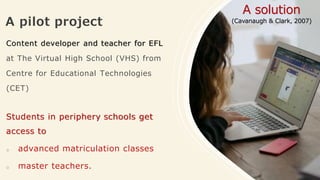
A pilot project
Content developer and teacher for EFL
at The Virtual High School (VHS) from
Centre for Educational Technologies
(CET)
Students in periphery schools get
access to
o advanced matriculation classes
o master teachers.
A solution
(Cavanaugh & Clark, 2007)
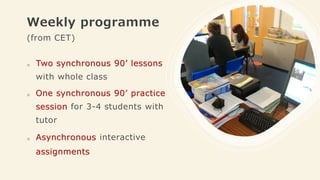
Weekly programme
(from CET)
o Two synchronous 90’ lessons
with whole class
o One synchronous 90’ practice
session for 3-4 students with
tutor
o Asynchronous interactive
assignments
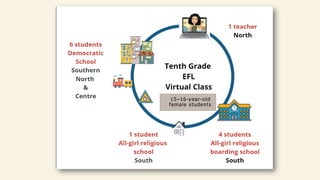
15–16-year-old
female students
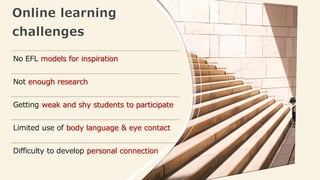
Online learning
challenges
No EFL models for inspiration
Not enough research
Getting weak and shy students to participate
Limited use of body language & eye contact
Difficulty to develop personal connection
My
concerns
Mission impossible?
How to promote
active learning
How to foster
collaboration
Teaching EFL for
communication
Design
A knowledge-building computer-
supported collaborative learning
)CSCL) environment
(Scardamalia & Bereiter, 2007; Bielaczyck,2006)
with focus on social presence
(Garrison, 2007)
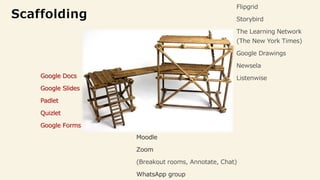
Scaffolding
Moodle
Zoom
(Breakout rooms, Annotate, Chat)
WhatsApp group
Google Docs
Google Slides
Padlet
Quizlet
Google Forms
Flipgrid
Storybird
The Learning Network
(The New York Times)
Google Drawings
Newsela
Listenwise
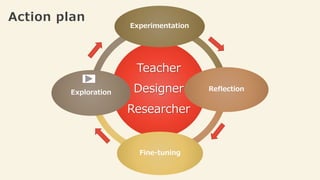
Teacher
Designer
Researcher
Experimentation
Reflection
Fine-tuning
Exploration
Action plan
Action
Research
Looking for answers…
Research
Goals
To understand and describe what
happened to EFL High School
students in the virtual learning
environment (VLE)
Focus on the adoption of a new
culture of learning and teaching and
the perceived benefits of the VLE
Method &
Data
Sources
Qualitative research (Straus & Corbin,
1990)
Students’ reflections in surveys
Focus on 4 students who completed
the programme (from Democratic School)
For further validation and enrichment:
video recordings of sessions
research journal
group summative reflective discussion
students’ letters to teacher
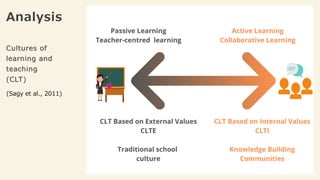
Analysis
Cultures of
learning and
teaching
(CLT)
(Sagy et al., 2011)
Findings
The building goes on against the
odds…
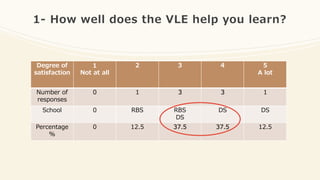
1- How well does the VLE help you learn?
Degree of
satisfaction
1
Not at all
2 3 4 5
A lot
Number of
responses
0 1 3 3 1
School 0 RBS RBS
DS
DS DS
Percentage
%
0 12.5 37.5 37.5 12.5
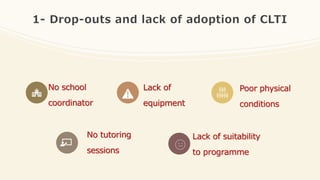
1- Drop-outs and lack of adoption of CLTI
No school
coordinator
Lack of
equipment
Poor physical
conditions
No tutoring
sessions
Lack of suitability
to programme
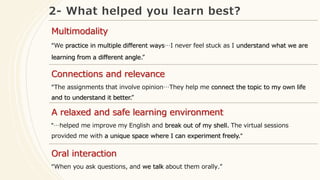
2- What helped you learn best?
Multimodality
“We practice in multiple different ways…I never feel stuck as I understand what we are
learning from a different angle.”
Connections and relevance
“The assignments that involve opinion…They help me connect the topic to my own life
and to understand it better.”
A relaxed and safe learning environment
"…helped me improve my English and break out of my shell. The virtual sessions
provided me with a unique space where I can experiment freely."
Oral interaction
“When you ask questions, and we talk about them orally.”
Benefits of the VLE
Interaction
individual exposure allowed for active
participation and growth
Focus
visual stimulation and reduction of
distractions
Autonomous learning
accessibility and flexibility facilitated
self-paced learning
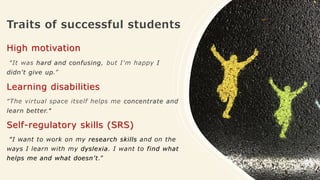
Traits of successful students
High motivation
“It was hard and confusing, but I'm happy I
didn't give up.”
Learning disabilities
“The virtual space itself helps me concentrate and
learn better."
Self-regulatory skills (SRS)
“I want to work on my research skills and on the
ways I learn with my dyslexia. I want to find what
helps me and what doesn’t.”
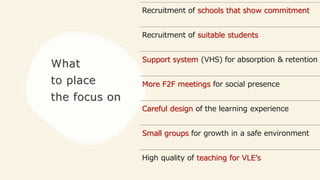
What
to place
the focus on
Recruitment of schools that show commitment
Recruitment of suitable students
Support system (VHS) for absorption & retention
More F2F meetings for social presence
Careful design of the learning experience
Small groups for growth in a safe environment
High quality of teaching for VLE’s
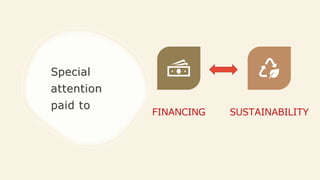
Special
attention
paid to
FINANCING SUSTAINABILITY
Through
a new lens
A year into the pandemic…
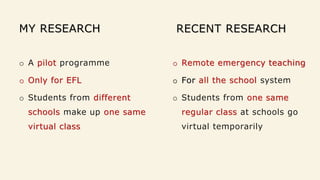
MY RESEARCH
o A pilot programme
o Only for EFL
o Students from different
schools make up one same
virtual class
RECENT RESEARCH
o Remote emergency teaching
o For all the school system
o Students from one same
regular class at schools go
virtual temporarily
Blended models for
EFL are necessary…
for the ever-changing
necessities of an interconnected
and multimodal world
for effective learning in flexible
school systems that provide
solutions and options.
Thank You!
Susana Galante
email: susyyalo@gmail.com
Twitter: @SusanaGalante5
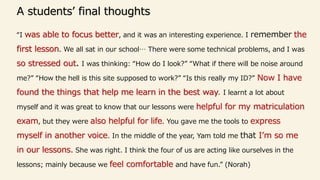
A students’ final thoughts
“I was able to focus better, and it was an interesting experience. I remember the
first lesson. We all sat in our school… There were some technical problems, and I was
so stressed out. I was thinking: “How do I look?” “What if there will be noise around
me?” “How the hell is this site supposed to work?” “Is this really my ID?” Now I have
found the things that help me learn in the best way. I learnt a lot about
myself and it was great to know that our lessons were helpful for my matriculation
exam, but they were also helpful for life. You gave me the tools to express
myself in another voice. In the middle of the year, Yam told me that I’m so me
in our lessons. She was right. I think the four of us are acting like ourselves in the
lessons; mainly because we feel comfortable and have fun.” (Norah)
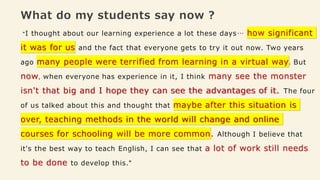
What do my students say now ?
"I thought about our learning experience a lot these days… how significant
it was for us and the fact that everyone gets to try it out now. Two years
ago many people were terrified from learning in a virtual way. But
now, when everyone has experience in it, I think many see the monster
isn't that big and I hope they can see the advantages of it. The four
of us talked about this and thought that maybe after this situation is
over, teaching methods in the world will change and online
courses for schooling will be more common. Although I believe that
it's the best way to teach English, I can see that a lot of work still needs
to be done to develop this."
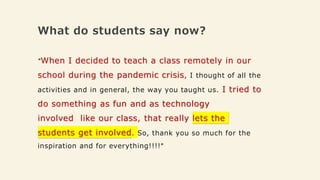
What do students say now?
"When I decided to teach a class remotely in our
school during the pandemic crisis, I thought of all the
activities and in general, the way you taught us. I tried to
do something as fun and as technology
involved like our class, that really lets the
students get involved. So, thank you so much for the
inspiration and for everything!!!!"
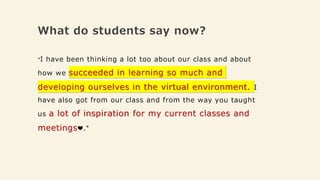
What do students say now?
"I have been thinking a lot too about our class and about
how we succeeded in learning so much and
developing ourselves in the virtual environment. I
have also got from our class and from the way you taught
us a lot of inspiration for my current classes and
meetings❤️."
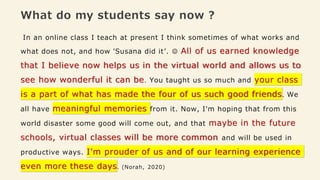
What do my students say now ?
In an online class I teach at present I think sometimes of what works and
what does not, and how 'Susana did it’. ☺️ All of us earned knowledge
that I believe now helps us in the virtual world and allows us to
see how wonderful it can be. You taught us so much and your class
is a part of what has made the four of us such good friends. We
all have meaningful memories from it. Now, I'm hoping that from this
world disaster some good will come out, and that maybe in the future
schools, virtual classes will be more common and will be used in
productive ways. I'm prouder of us and of our learning experience
even more these days. (Norah, 2020)

Virtual Schooling in EFL

  • 1.
    Uncovering the Possibilities of VirtualSchooling for EFL IATEFL LTSIG Research Book Conference, 2021 Susana Galante Digital Pedagogy Consultant EFL Teacher Trainer Kibbutzim College of Education
  • 2.
    The start ofa journey Back in 2017…
  • 3.
    A pilot project Contentdeveloper and teacher for EFL at The Virtual High School (VHS) from Centre for Educational Technologies (CET) Students in periphery schools get access to o advanced matriculation classes o master teachers. A solution (Cavanaugh & Clark, 2007)
  • 4.
    Weekly programme (from CET) oTwo synchronous 90’ lessons with whole class o One synchronous 90’ practice session for 3-4 students with tutor o Asynchronous interactive assignments
  • 5.
  • 6.
    Online learning challenges No EFLmodels for inspiration Not enough research Getting weak and shy students to participate Limited use of body language & eye contact Difficulty to develop personal connection
  • 7.
    My concerns Mission impossible? How topromote active learning How to foster collaboration Teaching EFL for communication
  • 8.
    Design A knowledge-building computer- supportedcollaborative learning )CSCL) environment (Scardamalia & Bereiter, 2007; Bielaczyck,2006) with focus on social presence (Garrison, 2007)
  • 9.
    Scaffolding Moodle Zoom (Breakout rooms, Annotate,Chat) WhatsApp group Google Docs Google Slides Padlet Quizlet Google Forms Flipgrid Storybird The Learning Network (The New York Times) Google Drawings Newsela Listenwise
  • 10.
  • 11.
  • 12.
    Research Goals To understand anddescribe what happened to EFL High School students in the virtual learning environment (VLE) Focus on the adoption of a new culture of learning and teaching and the perceived benefits of the VLE
  • 13.
    Method & Data Sources Qualitative research(Straus & Corbin, 1990) Students’ reflections in surveys Focus on 4 students who completed the programme (from Democratic School) For further validation and enrichment: video recordings of sessions research journal group summative reflective discussion students’ letters to teacher
  • 14.
  • 15.
    Findings The building goeson against the odds…
  • 16.
    1- How welldoes the VLE help you learn? Degree of satisfaction 1 Not at all 2 3 4 5 A lot Number of responses 0 1 3 3 1 School 0 RBS RBS DS DS DS Percentage % 0 12.5 37.5 37.5 12.5
  • 17.
    1- Drop-outs andlack of adoption of CLTI No school coordinator Lack of equipment Poor physical conditions No tutoring sessions Lack of suitability to programme
  • 18.
    2- What helpedyou learn best? Multimodality “We practice in multiple different ways…I never feel stuck as I understand what we are learning from a different angle.” Connections and relevance “The assignments that involve opinion…They help me connect the topic to my own life and to understand it better.” A relaxed and safe learning environment "…helped me improve my English and break out of my shell. The virtual sessions provided me with a unique space where I can experiment freely." Oral interaction “When you ask questions, and we talk about them orally.”
  • 19.
    Benefits of theVLE Interaction individual exposure allowed for active participation and growth Focus visual stimulation and reduction of distractions Autonomous learning accessibility and flexibility facilitated self-paced learning
  • 20.
    Traits of successfulstudents High motivation “It was hard and confusing, but I'm happy I didn't give up.” Learning disabilities “The virtual space itself helps me concentrate and learn better." Self-regulatory skills (SRS) “I want to work on my research skills and on the ways I learn with my dyslexia. I want to find what helps me and what doesn’t.”
  • 21.
    What to place the focuson Recruitment of schools that show commitment Recruitment of suitable students Support system (VHS) for absorption & retention More F2F meetings for social presence Careful design of the learning experience Small groups for growth in a safe environment High quality of teaching for VLE’s
  • 22.
  • 23.
    Through a new lens Ayear into the pandemic…
  • 24.
    MY RESEARCH o Apilot programme o Only for EFL o Students from different schools make up one same virtual class RECENT RESEARCH o Remote emergency teaching o For all the school system o Students from one same regular class at schools go virtual temporarily
  • 25.
    Blended models for EFLare necessary… for the ever-changing necessities of an interconnected and multimodal world for effective learning in flexible school systems that provide solutions and options.
  • 26.
    Thank You! Susana Galante email:susyyalo@gmail.com Twitter: @SusanaGalante5
  • 27.
    A students’ finalthoughts “I was able to focus better, and it was an interesting experience. I remember the first lesson. We all sat in our school… There were some technical problems, and I was so stressed out. I was thinking: “How do I look?” “What if there will be noise around me?” “How the hell is this site supposed to work?” “Is this really my ID?” Now I have found the things that help me learn in the best way. I learnt a lot about myself and it was great to know that our lessons were helpful for my matriculation exam, but they were also helpful for life. You gave me the tools to express myself in another voice. In the middle of the year, Yam told me that I’m so me in our lessons. She was right. I think the four of us are acting like ourselves in the lessons; mainly because we feel comfortable and have fun.” (Norah)
  • 28.
    What do mystudents say now ? "I thought about our learning experience a lot these days… how significant it was for us and the fact that everyone gets to try it out now. Two years ago many people were terrified from learning in a virtual way. But now, when everyone has experience in it, I think many see the monster isn't that big and I hope they can see the advantages of it. The four of us talked about this and thought that maybe after this situation is over, teaching methods in the world will change and online courses for schooling will be more common. Although I believe that it's the best way to teach English, I can see that a lot of work still needs to be done to develop this."
  • 29.
    What do studentssay now? "When I decided to teach a class remotely in our school during the pandemic crisis, I thought of all the activities and in general, the way you taught us. I tried to do something as fun and as technology involved like our class, that really lets the students get involved. So, thank you so much for the inspiration and for everything!!!!"
  • 30.
    What do studentssay now? "I have been thinking a lot too about our class and about how we succeeded in learning so much and developing ourselves in the virtual environment. I have also got from our class and from the way you taught us a lot of inspiration for my current classes and meetings❤️."
  • 31.
    What do mystudents say now ? In an online class I teach at present I think sometimes of what works and what does not, and how 'Susana did it’. ☺️ All of us earned knowledge that I believe now helps us in the virtual world and allows us to see how wonderful it can be. You taught us so much and your class is a part of what has made the four of us such good friends. We all have meaningful memories from it. Now, I'm hoping that from this world disaster some good will come out, and that maybe in the future schools, virtual classes will be more common and will be used in productive ways. I'm prouder of us and of our learning experience even more these days. (Norah, 2020)