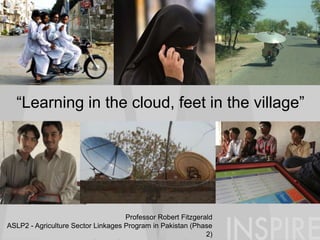
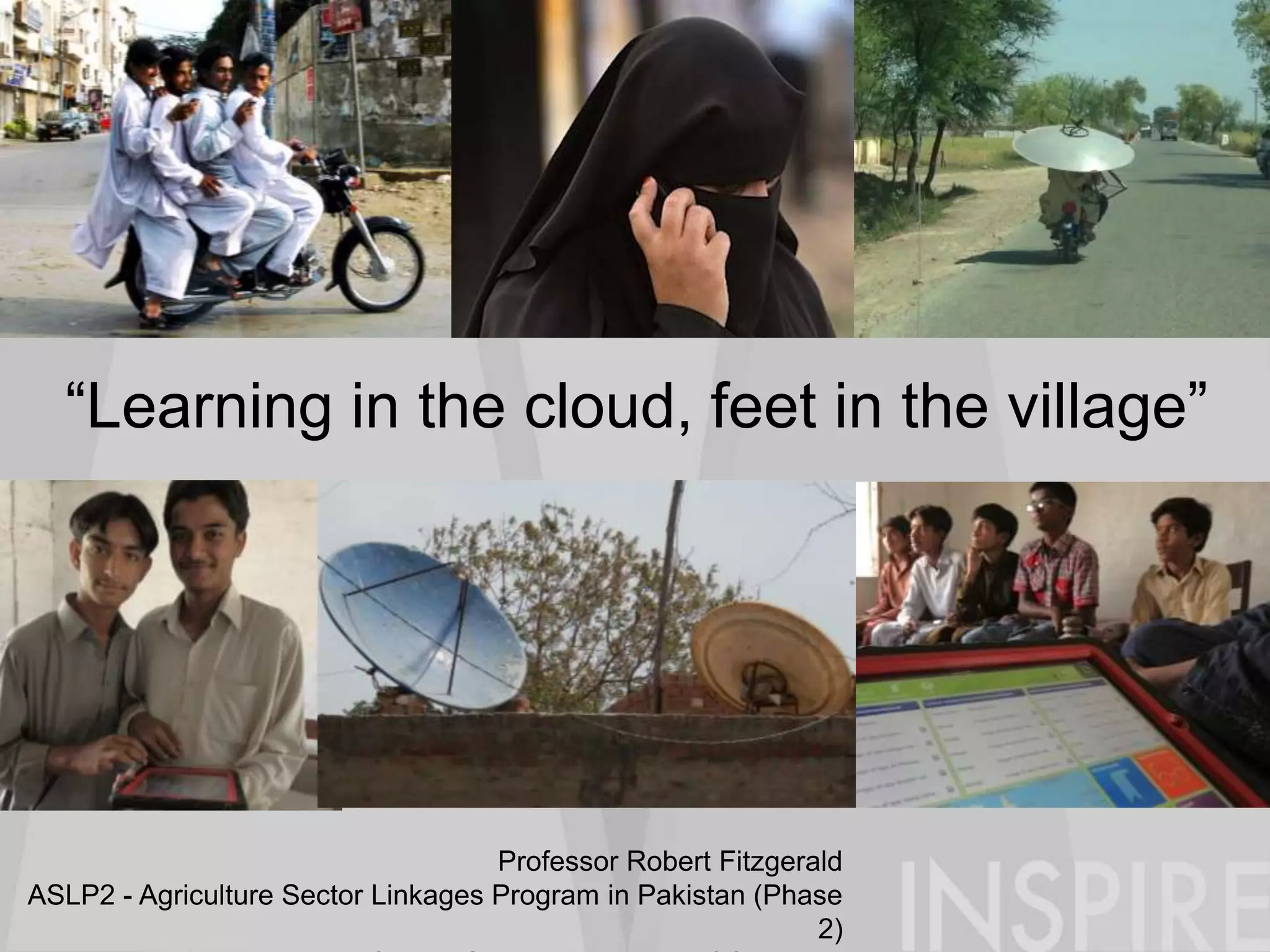
“Learning in the cloud, feet in the village”
Professor Robert Fitzgerald
ASLP2 - Agriculture Sector Linkages Program in Pakistan (Phase
2)
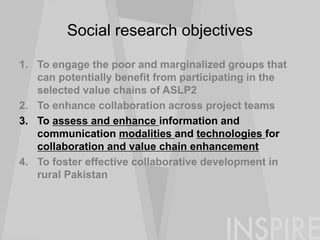
Social research objectives
1. To engage the poor and marginalized groups that
can potentially benefit from participating in the
selected value chains of ASLP2
2. To enhance collaboration across project teams
3. To assess and enhance information and
communication modalities and technologies for
collaboration and value chain enhancement
4. To foster effective collaborative development in
rural Pakistan
Baseline Survey: Implications
• Good access to mobile phones but they are
personal not business devices
• Limited use of SMS, mainly for recreation.
• Limited access to computers and internet
• Low literacy levels - consider the demonstration
effect – pictures & videos to tell a story
• Regional differences, no one size solution will fit all
• Consider different approaches, modalities and
technologies
• Need to address different languages: English, Urdu
and Sindhi
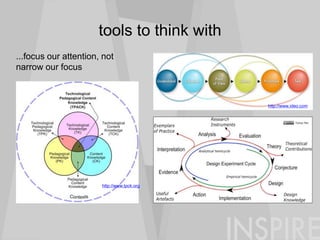
tools to think with
...focus our attention, not
narrow our focus
http://www.ideo.com
http://www.tpck.org
ICT4D
• Augment - increase the size, amount or
value of something
• From passive to active
• Multi modal, multimedia, multi-user
• Addressing diversity – literacy and
language
• From problem solving to problem design
• AR - beginning with simple marker-based
projects e.g. labels, images, packing
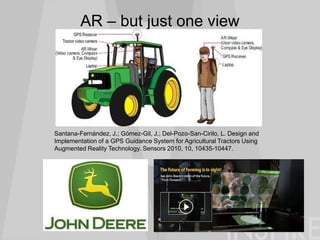
AR – but just one view
Santana-Fernández, J.; Gómez-Gil, J.; Del-Pozo-San-Cirilo, L. Design and
Implementation of a GPS Guidance System for Agricultural Tractors Using
Augmented Reality Technology. Sensors 2010, 10, 10435-10447.
Robust but lite AR
• Life is a bit messier where we work
• Wide range of users
• Wide range of mobile technologies
• Limited internet connectivity – but
expanding
• Connect up and integrate existing work
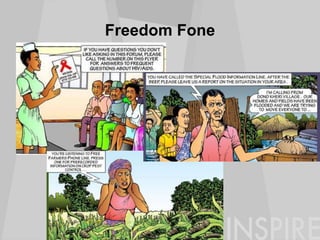
Freedom Fone
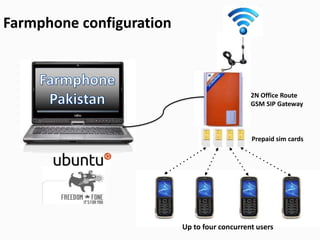
Farmphone configuration
Up to four concurrent users
Prepaid sim cards
2N Office Route
GSM SIP Gateway
“Seeing is Believing” (SIB)
app
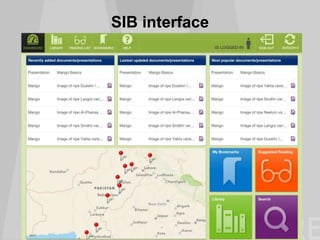
• SIB is an iPad app linked to a web database that
allows extension workers to quickly locate and
present high quality extension material
• SIB is based on the following principles:
– Applying research methodologies to application,
design and replication
– Best practice in extension of agricultural research
methodologies
– A review and evaluation cycle
SIB interface
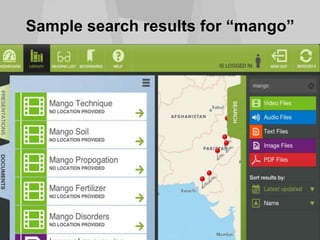
Sample search results for “mango”
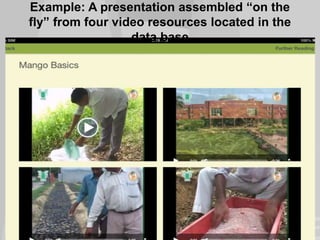
Example: A presentation assembled “on the
fly” from four video resources located in the
data base
Approach: Users in context
• Our approach to exploring possible applications of low-cost
ICTs is participatory – we use the same basic participatory
approach as we do in our research – to ensure the technology
is useful and used
• We focus on flexible, two-way communication systems that
can be adapted by different communities of users to meet
their particular information and communication needs
• Developing more complex and nuanced understandings of
how ICTs work to reconfigure social relationships and
networks will allow us to move beyond simple technical
impact studies and understand the device in context
• Question everything!
Neil Postman
“Anyone who has studied the history of technology knows
that technological change is always a Faustian bargain:
Technology giveth and technology taketh away, and not
always in equal measure. A new technology sometimes
creates more than it destroys. Sometimes, it destroys more
than it creates. But it is never one-sided.”
Six “design” questions (Postman)
What is the problem to which this technology is the solution
Whose problem is it
Which people and what institutions might be most seriously harmed by a
technological solution
What new problems might be created because we have solved this
problem
What sort of people and institutions might acquire special economic and
political power because of technological change
What changes in language are being enforced by new technologies, and
what is being gained and lost by such changes

Learning in the cloud, feet in the village

  • 1.
    “Learning in thecloud, feet in the village” Professor Robert Fitzgerald ASLP2 - Agriculture Sector Linkages Program in Pakistan (Phase 2)
  • 3.
    Social research objectives 1.To engage the poor and marginalized groups that can potentially benefit from participating in the selected value chains of ASLP2 2. To enhance collaboration across project teams 3. To assess and enhance information and communication modalities and technologies for collaboration and value chain enhancement 4. To foster effective collaborative development in rural Pakistan
  • 4.
    Baseline Survey: Implications •Good access to mobile phones but they are personal not business devices • Limited use of SMS, mainly for recreation. • Limited access to computers and internet • Low literacy levels - consider the demonstration effect – pictures & videos to tell a story • Regional differences, no one size solution will fit all • Consider different approaches, modalities and technologies • Need to address different languages: English, Urdu and Sindhi
  • 5.
    tools to thinkwith ...focus our attention, not narrow our focus http://www.ideo.com http://www.tpck.org
  • 6.
    ICT4D • Augment -increase the size, amount or value of something • From passive to active • Multi modal, multimedia, multi-user • Addressing diversity – literacy and language • From problem solving to problem design • AR - beginning with simple marker-based projects e.g. labels, images, packing
  • 7.
    AR – butjust one view Santana-Fernández, J.; Gómez-Gil, J.; Del-Pozo-San-Cirilo, L. Design and Implementation of a GPS Guidance System for Agricultural Tractors Using Augmented Reality Technology. Sensors 2010, 10, 10435-10447.
  • 8.
    Robust but liteAR • Life is a bit messier where we work • Wide range of users • Wide range of mobile technologies • Limited internet connectivity – but expanding • Connect up and integrate existing work
  • 9.
  • 10.
    Farmphone configuration Up tofour concurrent users Prepaid sim cards 2N Office Route GSM SIP Gateway
  • 11.
    “Seeing is Believing”(SIB) app • SIB is an iPad app linked to a web database that allows extension workers to quickly locate and present high quality extension material • SIB is based on the following principles: – Applying research methodologies to application, design and replication – Best practice in extension of agricultural research methodologies – A review and evaluation cycle
  • 12.
  • 13.
    Sample search resultsfor “mango”
  • 14.
    Example: A presentationassembled “on the fly” from four video resources located in the data base
  • 15.
    Approach: Users incontext • Our approach to exploring possible applications of low-cost ICTs is participatory – we use the same basic participatory approach as we do in our research – to ensure the technology is useful and used • We focus on flexible, two-way communication systems that can be adapted by different communities of users to meet their particular information and communication needs • Developing more complex and nuanced understandings of how ICTs work to reconfigure social relationships and networks will allow us to move beyond simple technical impact studies and understand the device in context • Question everything!
  • 16.
    Neil Postman “Anyone whohas studied the history of technology knows that technological change is always a Faustian bargain: Technology giveth and technology taketh away, and not always in equal measure. A new technology sometimes creates more than it destroys. Sometimes, it destroys more than it creates. But it is never one-sided.”
  • 17.
    Six “design” questions(Postman) What is the problem to which this technology is the solution Whose problem is it Which people and what institutions might be most seriously harmed by a technological solution What new problems might be created because we have solved this problem What sort of people and institutions might acquire special economic and political power because of technological change What changes in language are being enforced by new technologies, and what is being gained and lost by such changes

Editor's Notes

  • #6 Education still needs to address the challenge of ICT integration in teaching and learning. Too much emphasis on “online” education and too little on the effective integration of technology. At INSPIRE we are interested in practical research that follows an iterative design process. “There is nothing as practical as good theory” - Kurt Lewin