LEARNING COMMUNITIESOpportunities for network learning and connected knowledgeProfessor Robert FitzgeraldInspire Centre for ICT Pedagogy and PracticeUniversity of CanberraCreating and Supporting Online and Dispersed Communities, 4 May 2011, Burton & Garran Hall, ANU
Key ideasICT for … learning; communication; collaboration; developmentSocial learning – supporting different connections between people and knowledge; from user to producerTechnology as an “object to think with” (Seymour Papert); an “evocative object” (Sherry Turkle)2
“The learning process is about learning-to-be a practitioner rather than just learning about....”“…we need not simply more information, but people to assimilate, understand, and make sense of it.”“…we must develop not only the technical capability but also the intellectual capacity for transforming tacit pedagogical knowledge into commonly usable and visible knowledge”“We have an opportunity to change the way we create and exchange information, knowledge, and culture [and offer greater] opportunities for cultural self-reflection and human connection.”
Supporting informal learning"The worst thing a kid can say about homework is that it is too hard. The worst thing a kid can say about a game is it's too easy." Henry Jenkins BUT“quick, somebody turn something on… I'm starting to think.” Homer Simpson4
Key ideasLearning communities – based on interest where learning is more like a hobbyBoundary crossing and expansive learning (Engestrom)Blurring the edges – expert/novice, professional/personal, pro am revolution, fandom, citizen journalismTechnology as an amplifierCan we become more human…realer than real (cf Brian Massumi, 1987)5
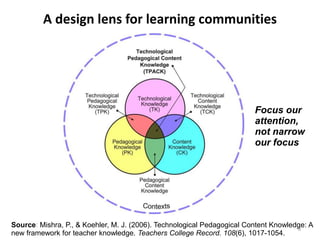
A design lens for learning communitiesFocus our attention, not narrow our focusSource: Mishra, P., & Koehler, M. J. (2006). Technological Pedagogical Content Knowledge: A new framework for teacher knowledge. Teachers College Record. 108(6), 1017-1054. 6
ConclusionAs you consider ways to create and support online and dispersed communities, keep in mind how you will:Balance technology, knowledge and learning (cf TPACK)Value diversity and see “difference” as a resource for your communityDistribute leadership and administrationRemain alert to the “tragedy of the commons”And remember…Never doubt that a small group of thoughtful, committed citizens can change the world. Indeed, it is the only thing that ever has. Margaret Mead7

Learning Communities

  • 1.
    LEARNING COMMUNITIESOpportunities fornetwork learning and connected knowledgeProfessor Robert FitzgeraldInspire Centre for ICT Pedagogy and PracticeUniversity of CanberraCreating and Supporting Online and Dispersed Communities, 4 May 2011, Burton & Garran Hall, ANU
  • 2.
    Key ideasICT for… learning; communication; collaboration; developmentSocial learning – supporting different connections between people and knowledge; from user to producerTechnology as an “object to think with” (Seymour Papert); an “evocative object” (Sherry Turkle)2
  • 3.
    “The learning processis about learning-to-be a practitioner rather than just learning about....”“…we need not simply more information, but people to assimilate, understand, and make sense of it.”“…we must develop not only the technical capability but also the intellectual capacity for transforming tacit pedagogical knowledge into commonly usable and visible knowledge”“We have an opportunity to change the way we create and exchange information, knowledge, and culture [and offer greater] opportunities for cultural self-reflection and human connection.”
  • 4.
    Supporting informal learning"Theworst thing a kid can say about homework is that it is too hard. The worst thing a kid can say about a game is it's too easy." Henry Jenkins BUT“quick, somebody turn something on… I'm starting to think.” Homer Simpson4
  • 5.
    Key ideasLearning communities– based on interest where learning is more like a hobbyBoundary crossing and expansive learning (Engestrom)Blurring the edges – expert/novice, professional/personal, pro am revolution, fandom, citizen journalismTechnology as an amplifierCan we become more human…realer than real (cf Brian Massumi, 1987)5
  • 6.
    A design lensfor learning communitiesFocus our attention, not narrow our focusSource: Mishra, P., & Koehler, M. J. (2006). Technological Pedagogical Content Knowledge: A new framework for teacher knowledge. Teachers College Record. 108(6), 1017-1054. 6
  • 7.
    ConclusionAs you considerways to create and support online and dispersed communities, keep in mind how you will:Balance technology, knowledge and learning (cf TPACK)Value diversity and see “difference” as a resource for your communityDistribute leadership and administrationRemain alert to the “tragedy of the commons”And remember…Never doubt that a small group of thoughtful, committed citizens can change the world. Indeed, it is the only thing that ever has. Margaret Mead7