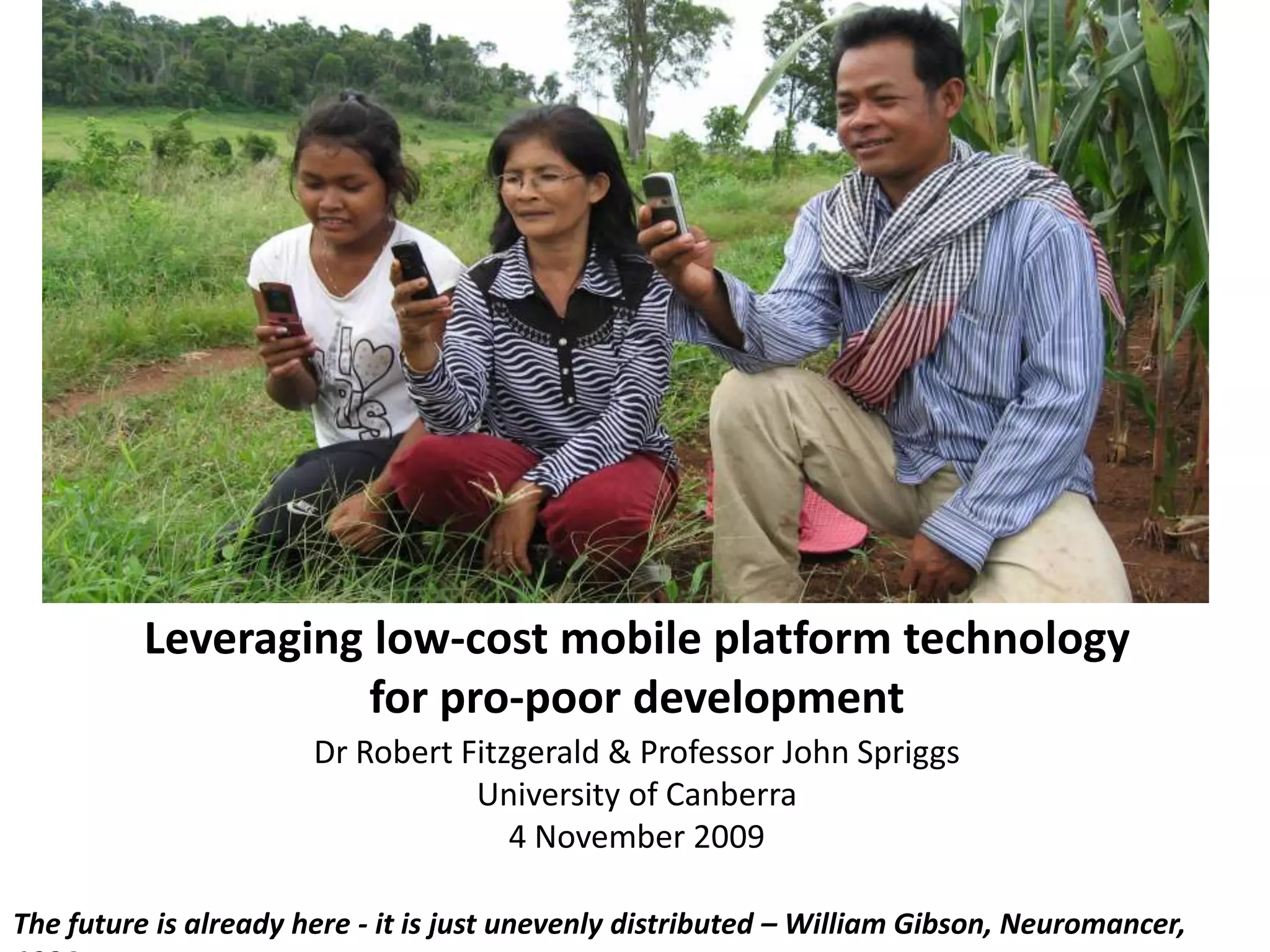

Leveraging low-cost mobile platform technology for pro-poor development Dr Robert Fitzgerald & Professor John SpriggsUniversity of Canberra4 November 2009The future is already here - it is just unevenly distributed – William Gibson, Neuromancer, 1984
ICT in Rural Areas“Rural areas in developing countries are confronted by many challenges when it comes to information access and participation in knowledge networks” “Obvious challenges are low connectivity particularly in rural areas, low literacy rate, lack of media competence to use the web and well function models to provide and target information” New approaches to use information and communication technologies for development (ICT4D)Over a billion phones in the developing worldSource: GTZ Report The Participatory Web - New Potentials of ICT in Rural Areas
Mobile phone impactStudy of how fishermen and wholesalers from Southern India used mobile phones to address gaps in the market information system (Jensen, 2007)Data collected over a five year period showed the use of mobile phones worked to reduce price dispersion and increase fishermen's profits by facilitating timely access to market information resulting in benefits for both producers and trader“Mobile services, followed by ‘house to house’, word of mouth, and letters, emerged as the highest scoring media for disseminating information” (Informatics for Rural Empowerment and Community Health – iREACH, Cambodia)
CambodiaAccess to accurate market information is fundamental to the operation of equitable and efficient marketing systemsIn western Cambodia maize and soy bean farmers and traders suffer from poor communications between different levels of the supply chain.Low-cost, reliable and accessible solutions that we match to simple training programs. Our focus on flexible two-way communication systems that can be adapted by different communities of users to meet their particular information and communication needs.
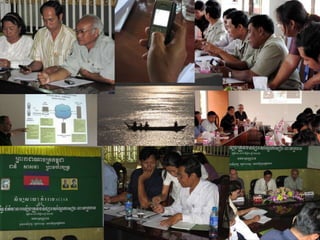
SMSLow-cost mobile messaging system with good coverage in CambodiaSMS server can be available 24 hours/7 daysSupport for push and pull services Push: SMS server can send messages to phone userPull: a user can request information (Information on demand) from SMS serverSupport for users to contribute (e.g. submit price information) and participate (e.g. complete surveys & ask questions/seek advice)
SMSThere is a body of literature on text messaging in non-ICT4D contexts which has explored its role in: building ‘presence’ amongst physically separated groupsenhancing the connectivity of social networks creating new media formsenabling private communication especially the covert exchanges necessary to many forms of social actionElectronic Marketing Communication System (EMCS) evaluation showed that value chain participants and administrators are not only interested in the system but also keen to use it for both price collection and dissemination
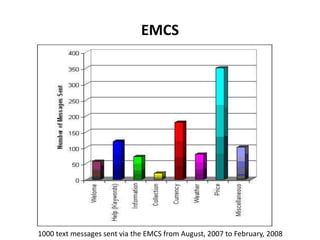
EMCS1000 text messages sent via the EMCS from August, 2007 to February, 2008
Research NeedsIncrease integration between ICTD and non-ICTD studies - Donner sees much of this work as involving a tighter integration between development work (ICTD) and the communication/recreational use of mobiles work (non-ICTD)Understand linkages between richer and poorer communities - Comparing and contrasting the ways rich and poor use text messaging in order to understand the linkages and opportunitiesDisaggregate the artifact - Looking both within and around the handset can yield a better understanding of the mobile as a complex technology. Developing more complex and nuanced understandings of how mobile phones work to reconfigure social relationships and networksDonner, Jonathan (2008) 'Research Approaches to Mobile Use in the Developing World: A Review of the Literature', The Information Society, 24:3, 140 — 159
An approachDeveloping countries offer an ideal location to conduct applied research into the possible applications of low-cost ICT because of the wide use of mobile phones and the potential to use virtually costless SMS technologyIn many ways, this type of research is like the challenge of new product development where one has to consider what is technically possible (supply) and match that with what users want (potential demand)Possible applications in agricultural value chains include providing market information, collecting information from traders, providing extension advice, conducting small financial transactions etc
Users in contextOur approach to exploring possible applications of low-cost ICT is participatory – we use the same basic participatory approach as we do in other situations – to ensure the technology is useful and used  While we have begun the exploration of these technologies for agricultural value chains in Cambodia, there is much more to doOur focus on flexible two-way communication systems that can be adapted by different communities of users to meet their particular information and communication needs
Researchable areasOne of the researchable areas relates to bringing together the communication ‘use’ studies together with socio-economic studies It is our view that developing more complex and nuanced understandings of how mobile phones work to reconfigure social relationships and networks will allow us to move beyond simple technical impact studies and understand the device in context We can expect that some applications will find a “market” while others will not
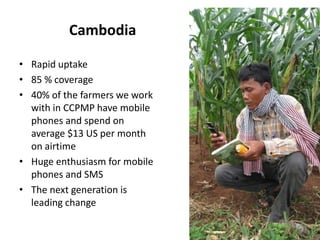
CambodiaRapid uptake85 % coverage40% of the farmers we work with in CCPMP have mobile phones and spend on average $13 US per month on airtimeHuge enthusiasm for mobile phones and SMSThe next generation is leading change
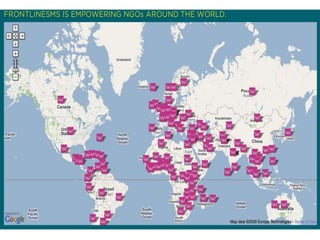
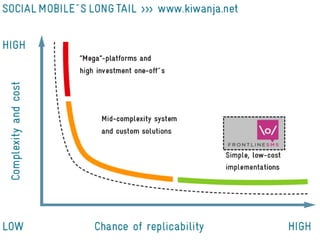
FrontlineSMSPlug-and-play texting solution for NGOs and others which requires them to have little or no technical expertise FrontlineSMS is the "Swiss Army Knife" of SMS applicationsFrontlineSMS has been used by NGOs in over fifty countries for a wide range of activities including: the capture and exchange of vegetable (and coffee) price informationthe distribution of weather forecaststhe carrying out of surveys and the reporting and monitoring of disease outbreaks
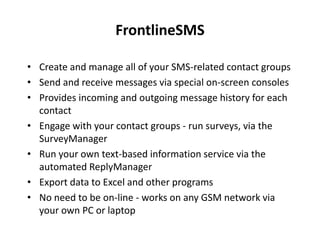
FrontlineSMSCreate and manage all of your SMS-related contact groupsSend and receive messages via special on-screen consolesProvides incoming and outgoing message history for each contactEngage with your contact groups - run surveys, via the SurveyManagerRun your own text-based information service via the automated ReplyManagerExport data to Excel and other programsNo need to be on-line - works on any GSM network via your own PC or laptop
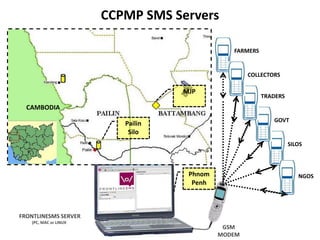
CCPMP SMS ServersFARMERSCOLLECTORSMJPTRADERSCAMBODIAGOVTPailin SiloSILOSPhnomPenhNGOSFRONTLINESMS SERVER(PC, MAC or LINUX)GSMMODEM
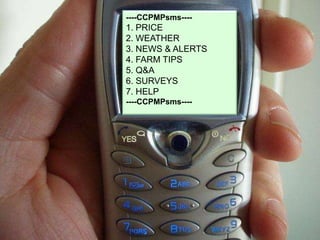
Example 1----CCPMPsms----1. PRICE2. WEATHER3. NEWS & ALERTS4. FARM TIPS5. Q&A6. SURVEYS7. HELP----CCPMPsms----
Information Services (1)Stage 1Price and market information by regionConnect to Cambodian Agricultural Market Information System (CAMIS) database via SMSFarm tips - crop/production informationWeather, news and alerts – e.g. TB warningsRequests for information (fax back or mail out)Price submission
Information Services (2)Stage 2Question and answer services (FAQs)Send PEST – autoreply with pest information Send ‘What is the green worm?’ Extension Officer reply ‘Most likely podsucker. Contact XXX and treat with YYY’Surveys and pollsFarmer survey: Rate your maize crop from 1 – 5Farmer sends: MAIZECROP 3  Trader survey: Rate soy bean quality from 1 – 5Trader sends: SBQUALITY 3  Link buyers and sellers by regionSMS MAIZEBUYERMr Teo – 012 345 678Ms Rattanak – 017 324 999Local service directories
Mobile ApplicationsA comprehensive ‘integrated” agricultural information system accessible by mobile and other channels such as interactive voice responseLocal interactive field communications systems e.g. FrontlineSMSA mobile agricultural surveillance and monitoring system – Using rapid response applications such as GEOCHATPeer to peer micro payment systems that could support micro finance transactions (e.g MHITS)
Infomediaries e.g. MobilED can query Wikipedia via SMS messages (b) hear the results of the query played back to them as audio text and (c) post new entries to a wiki by recording audio off their handsets.Research AreasSocio-economic impacts (Direct and Indirect)Infomediaries (The role of information services & learning) Impact on the community’s information ecology Non-users and barriers to useWillingness to pay for servicesCollaborative knowledge sharingValue of non-instrumental uses (Recreational uses)
Pakistan: HumariAwazTheUS is supporting the establishment of Pakistan’s first mobile phone-based social network, Humari Awaz (“Our Voice”)"95 million Pakistanis use mobile phones, a number far greater than those who have computer and Internet access. Humari Awaz will use SMS technology to allow Pakistanis to build interactive networks around interests and subjects of their choice, with the option to identify themselves or remain anonymous."Source: U.S. Secretary of State Encourages Use of New Media Communications in Pakistan: 'Our Voice' Cell Phone Social Networking on #7111http://www.state.gov/r/pa/prs/ps/2009/oct/131042.htm
HumariAwazTheUS will support the costs of the first 24 million messages“In addition to linking friends and families, the network will also help a range of other users — from farmers and resellers who want to share market prices, to businesses that wish to communicate with their staff on the road, to news outlets that want to share information with targeted groups,” the note said.Source: U.S. Secretary of State Encourages Use of New Media Communications in Pakistan: 'Our Voice' Cell Phone Social Networking on #7111http://www.state.gov/r/pa/prs/ps/2009/oct/131042.htm
ConclusionOur work continues to be motivated by the need to develop more transformative understandings of users and technologies in context and ensure mobile phones and SMS applications make a difference to lives of those in greatest needNeed to ensure we don’t “crowd out” different solutions – centralised (e.g. Telco operated) and de-centralised systems (e.g FrontlineSMS) can co-existIt is our contention that there are significant benefits to be realised in terms of agricultural development by leveraging mobile platform technology for pro-poor development
Leveraging low-cost mobile platform technology for pro-poor development

Leveraging low-cost mobile platform technology for pro-poor development

  • 1.
    Leveraging low-cost mobileplatform technology for pro-poor development Dr Robert Fitzgerald & Professor John SpriggsUniversity of Canberra4 November 2009The future is already here - it is just unevenly distributed – William Gibson, Neuromancer, 1984
  • 2.
    ICT in RuralAreas“Rural areas in developing countries are confronted by many challenges when it comes to information access and participation in knowledge networks” “Obvious challenges are low connectivity particularly in rural areas, low literacy rate, lack of media competence to use the web and well function models to provide and target information” New approaches to use information and communication technologies for development (ICT4D)Over a billion phones in the developing worldSource: GTZ Report The Participatory Web - New Potentials of ICT in Rural Areas
  • 3.
    Mobile phone impactStudyof how fishermen and wholesalers from Southern India used mobile phones to address gaps in the market information system (Jensen, 2007)Data collected over a five year period showed the use of mobile phones worked to reduce price dispersion and increase fishermen's profits by facilitating timely access to market information resulting in benefits for both producers and trader“Mobile services, followed by ‘house to house’, word of mouth, and letters, emerged as the highest scoring media for disseminating information” (Informatics for Rural Empowerment and Community Health – iREACH, Cambodia)
  • 4.
    CambodiaAccess to accuratemarket information is fundamental to the operation of equitable and efficient marketing systemsIn western Cambodia maize and soy bean farmers and traders suffer from poor communications between different levels of the supply chain.Low-cost, reliable and accessible solutions that we match to simple training programs. Our focus on flexible two-way communication systems that can be adapted by different communities of users to meet their particular information and communication needs.
  • 5.
    SMSLow-cost mobile messagingsystem with good coverage in CambodiaSMS server can be available 24 hours/7 daysSupport for push and pull services Push: SMS server can send messages to phone userPull: a user can request information (Information on demand) from SMS serverSupport for users to contribute (e.g. submit price information) and participate (e.g. complete surveys & ask questions/seek advice)
  • 7.
    SMSThere is abody of literature on text messaging in non-ICT4D contexts which has explored its role in: building ‘presence’ amongst physically separated groupsenhancing the connectivity of social networks creating new media formsenabling private communication especially the covert exchanges necessary to many forms of social actionElectronic Marketing Communication System (EMCS) evaluation showed that value chain participants and administrators are not only interested in the system but also keen to use it for both price collection and dissemination
  • 8.
    EMCS1000 text messagessent via the EMCS from August, 2007 to February, 2008
  • 9.
    Research NeedsIncrease integrationbetween ICTD and non-ICTD studies - Donner sees much of this work as involving a tighter integration between development work (ICTD) and the communication/recreational use of mobiles work (non-ICTD)Understand linkages between richer and poorer communities - Comparing and contrasting the ways rich and poor use text messaging in order to understand the linkages and opportunitiesDisaggregate the artifact - Looking both within and around the handset can yield a better understanding of the mobile as a complex technology. Developing more complex and nuanced understandings of how mobile phones work to reconfigure social relationships and networksDonner, Jonathan (2008) 'Research Approaches to Mobile Use in the Developing World: A Review of the Literature', The Information Society, 24:3, 140 — 159
  • 10.
    An approachDeveloping countriesoffer an ideal location to conduct applied research into the possible applications of low-cost ICT because of the wide use of mobile phones and the potential to use virtually costless SMS technologyIn many ways, this type of research is like the challenge of new product development where one has to consider what is technically possible (supply) and match that with what users want (potential demand)Possible applications in agricultural value chains include providing market information, collecting information from traders, providing extension advice, conducting small financial transactions etc
  • 11.
    Users in contextOurapproach to exploring possible applications of low-cost ICT is participatory – we use the same basic participatory approach as we do in other situations – to ensure the technology is useful and used While we have begun the exploration of these technologies for agricultural value chains in Cambodia, there is much more to doOur focus on flexible two-way communication systems that can be adapted by different communities of users to meet their particular information and communication needs
  • 12.
    Researchable areasOne ofthe researchable areas relates to bringing together the communication ‘use’ studies together with socio-economic studies It is our view that developing more complex and nuanced understandings of how mobile phones work to reconfigure social relationships and networks will allow us to move beyond simple technical impact studies and understand the device in context We can expect that some applications will find a “market” while others will not
  • 13.
    CambodiaRapid uptake85 %coverage40% of the farmers we work with in CCPMP have mobile phones and spend on average $13 US per month on airtimeHuge enthusiasm for mobile phones and SMSThe next generation is leading change
  • 14.
    FrontlineSMSPlug-and-play texting solutionfor NGOs and others which requires them to have little or no technical expertise FrontlineSMS is the "Swiss Army Knife" of SMS applicationsFrontlineSMS has been used by NGOs in over fifty countries for a wide range of activities including: the capture and exchange of vegetable (and coffee) price informationthe distribution of weather forecaststhe carrying out of surveys and the reporting and monitoring of disease outbreaks
  • 16.
    FrontlineSMSCreate and manageall of your SMS-related contact groupsSend and receive messages via special on-screen consolesProvides incoming and outgoing message history for each contactEngage with your contact groups - run surveys, via the SurveyManagerRun your own text-based information service via the automated ReplyManagerExport data to Excel and other programsNo need to be on-line - works on any GSM network via your own PC or laptop
  • 17.
    CCPMP SMS ServersFARMERSCOLLECTORSMJPTRADERSCAMBODIAGOVTPailinSiloSILOSPhnomPenhNGOSFRONTLINESMS SERVER(PC, MAC or LINUX)GSMMODEM
  • 19.
    Example 1----CCPMPsms----1. PRICE2.WEATHER3. NEWS & ALERTS4. FARM TIPS5. Q&A6. SURVEYS7. HELP----CCPMPsms----
  • 20.
    Information Services (1)Stage1Price and market information by regionConnect to Cambodian Agricultural Market Information System (CAMIS) database via SMSFarm tips - crop/production informationWeather, news and alerts – e.g. TB warningsRequests for information (fax back or mail out)Price submission
  • 21.
    Information Services (2)Stage2Question and answer services (FAQs)Send PEST – autoreply with pest information Send ‘What is the green worm?’ Extension Officer reply ‘Most likely podsucker. Contact XXX and treat with YYY’Surveys and pollsFarmer survey: Rate your maize crop from 1 – 5Farmer sends: MAIZECROP 3 Trader survey: Rate soy bean quality from 1 – 5Trader sends: SBQUALITY 3 Link buyers and sellers by regionSMS MAIZEBUYERMr Teo – 012 345 678Ms Rattanak – 017 324 999Local service directories
  • 22.
    Mobile ApplicationsA comprehensive‘integrated” agricultural information system accessible by mobile and other channels such as interactive voice responseLocal interactive field communications systems e.g. FrontlineSMSA mobile agricultural surveillance and monitoring system – Using rapid response applications such as GEOCHATPeer to peer micro payment systems that could support micro finance transactions (e.g MHITS)
  • 23.
    Infomediaries e.g. MobilEDcan query Wikipedia via SMS messages (b) hear the results of the query played back to them as audio text and (c) post new entries to a wiki by recording audio off their handsets.Research AreasSocio-economic impacts (Direct and Indirect)Infomediaries (The role of information services & learning) Impact on the community’s information ecology Non-users and barriers to useWillingness to pay for servicesCollaborative knowledge sharingValue of non-instrumental uses (Recreational uses)
  • 24.
    Pakistan: HumariAwazTheUS issupporting the establishment of Pakistan’s first mobile phone-based social network, Humari Awaz (“Our Voice”)"95 million Pakistanis use mobile phones, a number far greater than those who have computer and Internet access. Humari Awaz will use SMS technology to allow Pakistanis to build interactive networks around interests and subjects of their choice, with the option to identify themselves or remain anonymous."Source: U.S. Secretary of State Encourages Use of New Media Communications in Pakistan: 'Our Voice' Cell Phone Social Networking on #7111http://www.state.gov/r/pa/prs/ps/2009/oct/131042.htm
  • 25.
    HumariAwazTheUS will supportthe costs of the first 24 million messages“In addition to linking friends and families, the network will also help a range of other users — from farmers and resellers who want to share market prices, to businesses that wish to communicate with their staff on the road, to news outlets that want to share information with targeted groups,” the note said.Source: U.S. Secretary of State Encourages Use of New Media Communications in Pakistan: 'Our Voice' Cell Phone Social Networking on #7111http://www.state.gov/r/pa/prs/ps/2009/oct/131042.htm
  • 26.
    ConclusionOur work continuesto be motivated by the need to develop more transformative understandings of users and technologies in context and ensure mobile phones and SMS applications make a difference to lives of those in greatest needNeed to ensure we don’t “crowd out” different solutions – centralised (e.g. Telco operated) and de-centralised systems (e.g FrontlineSMS) can co-existIt is our contention that there are significant benefits to be realised in terms of agricultural development by leveraging mobile platform technology for pro-poor development