Digital learning futures: Communication and collaboration ACT Principals Conference 201117 August 2011Professor Robert FitzgeraldUniversity of Canberra
Time to rethinkThe emerging forms of interactive media, information communication technologies and social networking are reshaping almost every aspect of our work and social lifeThese new practices and literacieschallenge our traditional ideas about the form and function of educationNew opportunities for participation and interactionare arising from virtual communities of interest where users are active content creators re-mixing, re-purposing and re-distributing contentTechnology is quite clearly much more than just a tool but can be an evocative object to think with and an engine of social and cultural change 2
Waves of changeSource: Findlay, J. (2008). Learning as a game: exploring cultural differences between teachers and learners using a team learning system, PhD thesis, School of Economics and Information Systems, University of Wollongong.3
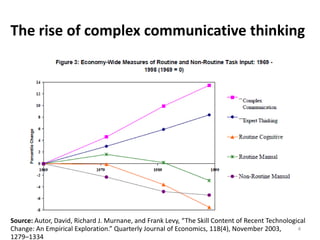
The rise of complex communicative thinkingSource: Autor, David, Richard J. Murnane, and Frank Levy, “The Skill Content of Recent TechnologicalChange: An Empirical Exploration.” Quarterly Journal of Economics, 118(4), November 2003,1279–13344
ICT & The Goldilocks Principle (Just right)Index of ICT Internet/entertainment useIndex of ICT program/software useStudents reporting a moderate use of computers to perform a range of tasksSource: OECD (2005) Are students ready for a technology-rich world? What PISA studies tell us, Figure 4.6, p.65.
Other leaders have said similar …6
“Quick, turn something on…I’m starting to think”Homer Simpson7
We need imaginative pedagogy & designIt is “flexible purposing” that characterizes imaginative pedagogy, with its openness to discovery unpredictability and surprise (Eisner, 2009, p.8). Process is valued over outcomesTeachers help students to “work at the edge of incompetence” and to view their work as “temporary experimental accomplishments” (Eisner, 2003, p.379)“Flexible purposing is opportunistic; it capitalizes on the emergent features appearing within a field of relationships. It is not rigidly attached to predefined aims when the possibility of better ones emerges” [Dewey (1938) quoted in Eisner, 2003, p.378]8
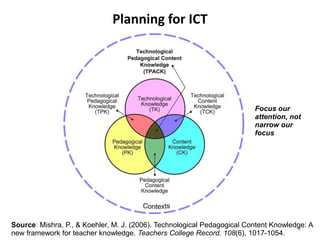
Planning for ICTFocus our attention, not narrow our focusSource: Mishra, P., & Koehler, M. J. (2006). Technological Pedagogical Content Knowledge: A new framework for teacher knowledge. Teachers College Record. 108(6), 1017-1054. 9
INSPIREA Centre for ICT in Education: Pedagogy, Practice and Research
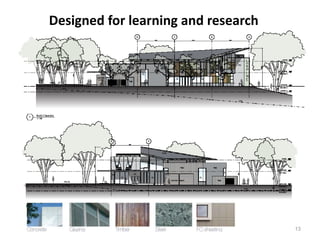
INSPIREThe University of Canberra has received a $7.2 million grant to establish the INSPIRE Centrea centre to advance research and development on the innovative application of information and communications in formal and informal educational settings $5 million grant from the Capital Development Pool program (DEEWR)a joint venture between the University of Canberra, ACTDET and ACT GovernmentEngaged multi award-winning architects Cox Humphries MossProject managed by ManteenaPromoting a vision for educating with technology in the 21st Century 11
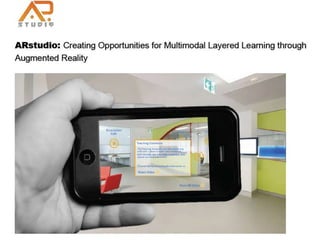
INSPIREINSPIRE will focus on innovative, good practice pedagogy that utilises ICT to enhance student learning outcomesOur research will inform a range of professional learning programs for both pre service and practising teachers Research themes will be further developed in conjunction with ACTDET but will include: development of virtual learning environments and mobile learning applicationdevelopment of frameworks to support the pedagogical applications of ICT (e.g. TPACK)application of ICT to support design thinking and educational designthe use of ICT to support collaborative knowledge building in professional learning and educational leadershipwork on mobile learning, designing agile learning spaces and augmented reality applications (New grant recently awarded – ARStudio)12
13Designed for learning and research
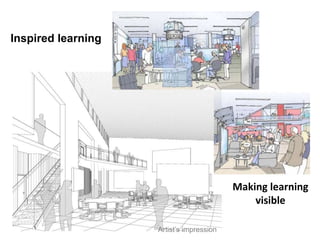
Inspired learningMaking learning visibleArtist’s impression
A collaborative space
A research commons
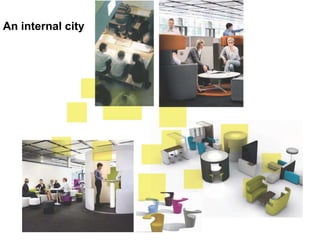
An internal city
Exhibition: Past, present and future
INSPIRE building progressview photostreampics by munnerley
NW View of INSPIREpics by munnerley
Collaborative & flexi-spaceAlso visible is the flight lounge mezzaninepics by munnerley
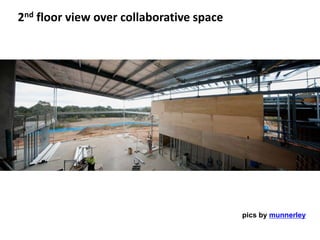
2nd floor view over collaborative spacepics by munnerley
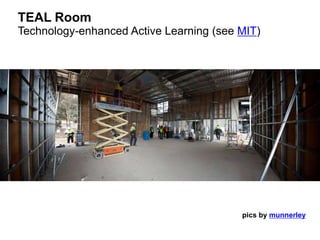
TEAL RoomTechnology-enhanced Active Learning (see MIT)pics by munnerley
The future is here…its just not evenly distributed yetWilliam Gibson author of Neuromancer (1984)
http://www.slideshare.net/rfitzgerald/orhttp://tinyurl.com/3h5qfn4
More informationProfessor Robert Fitzgerald PhdDirector INSPIRE Centre for ICT in EducationOffice of Deputy Vice-Chancellor (Education)University of Canberra Bruce ACT 2600 AUSTRALIAPhone +61 417023539Email robert.fitzgerald@canberra.edu.auMark ChristianManager, Educational DevelopmentPhone  +61 418267757Email mark.christian@canberra.edu.au   Jacinta SpinksProject OfficerOffice of the Deputy Vice Chancellor (Education)University of Canberra, Australia, 2601Phone +61 26206 3965Email  jacinta.spinks@canberra.edu.auJessica SchumannCommunications OfficerOffice of Deputy Vice-Chancellor (Education)Phone +61 2 6201 5047 Email jessica.schumann@canberra.edu.au  

Digital learning futures: Communication and collaboration

  • 1.
    Digital learning futures:Communication and collaboration ACT Principals Conference 201117 August 2011Professor Robert FitzgeraldUniversity of Canberra
  • 2.
    Time to rethinkTheemerging forms of interactive media, information communication technologies and social networking are reshaping almost every aspect of our work and social lifeThese new practices and literacieschallenge our traditional ideas about the form and function of educationNew opportunities for participation and interactionare arising from virtual communities of interest where users are active content creators re-mixing, re-purposing and re-distributing contentTechnology is quite clearly much more than just a tool but can be an evocative object to think with and an engine of social and cultural change 2
  • 3.
    Waves of changeSource:Findlay, J. (2008). Learning as a game: exploring cultural differences between teachers and learners using a team learning system, PhD thesis, School of Economics and Information Systems, University of Wollongong.3
  • 4.
    The rise ofcomplex communicative thinkingSource: Autor, David, Richard J. Murnane, and Frank Levy, “The Skill Content of Recent TechnologicalChange: An Empirical Exploration.” Quarterly Journal of Economics, 118(4), November 2003,1279–13344
  • 5.
    ICT & TheGoldilocks Principle (Just right)Index of ICT Internet/entertainment useIndex of ICT program/software useStudents reporting a moderate use of computers to perform a range of tasksSource: OECD (2005) Are students ready for a technology-rich world? What PISA studies tell us, Figure 4.6, p.65.
  • 6.
    Other leaders havesaid similar …6
  • 7.
    “Quick, turn somethingon…I’m starting to think”Homer Simpson7
  • 8.
    We need imaginativepedagogy & designIt is “flexible purposing” that characterizes imaginative pedagogy, with its openness to discovery unpredictability and surprise (Eisner, 2009, p.8). Process is valued over outcomesTeachers help students to “work at the edge of incompetence” and to view their work as “temporary experimental accomplishments” (Eisner, 2003, p.379)“Flexible purposing is opportunistic; it capitalizes on the emergent features appearing within a field of relationships. It is not rigidly attached to predefined aims when the possibility of better ones emerges” [Dewey (1938) quoted in Eisner, 2003, p.378]8
  • 9.
    Planning for ICTFocusour attention, not narrow our focusSource: Mishra, P., & Koehler, M. J. (2006). Technological Pedagogical Content Knowledge: A new framework for teacher knowledge. Teachers College Record. 108(6), 1017-1054. 9
  • 10.
    INSPIREA Centre forICT in Education: Pedagogy, Practice and Research
  • 11.
    INSPIREThe University ofCanberra has received a $7.2 million grant to establish the INSPIRE Centrea centre to advance research and development on the innovative application of information and communications in formal and informal educational settings $5 million grant from the Capital Development Pool program (DEEWR)a joint venture between the University of Canberra, ACTDET and ACT GovernmentEngaged multi award-winning architects Cox Humphries MossProject managed by ManteenaPromoting a vision for educating with technology in the 21st Century 11
  • 12.
    INSPIREINSPIRE will focuson innovative, good practice pedagogy that utilises ICT to enhance student learning outcomesOur research will inform a range of professional learning programs for both pre service and practising teachers Research themes will be further developed in conjunction with ACTDET but will include: development of virtual learning environments and mobile learning applicationdevelopment of frameworks to support the pedagogical applications of ICT (e.g. TPACK)application of ICT to support design thinking and educational designthe use of ICT to support collaborative knowledge building in professional learning and educational leadershipwork on mobile learning, designing agile learning spaces and augmented reality applications (New grant recently awarded – ARStudio)12
  • 13.
  • 14.
    Inspired learningMaking learningvisibleArtist’s impression
  • 15.
  • 16.
  • 17.
  • 20.
  • 21.
    INSPIRE building progressviewphotostreampics by munnerley
  • 22.
    NW View ofINSPIREpics by munnerley
  • 23.
    Collaborative & flexi-spaceAlsovisible is the flight lounge mezzaninepics by munnerley
  • 24.
    2nd floor viewover collaborative spacepics by munnerley
  • 25.
    TEAL RoomTechnology-enhanced ActiveLearning (see MIT)pics by munnerley
  • 30.
    The future ishere…its just not evenly distributed yetWilliam Gibson author of Neuromancer (1984)
  • 31.
  • 32.
    More informationProfessor RobertFitzgerald PhdDirector INSPIRE Centre for ICT in EducationOffice of Deputy Vice-Chancellor (Education)University of Canberra Bruce ACT 2600 AUSTRALIAPhone +61 417023539Email robert.fitzgerald@canberra.edu.auMark ChristianManager, Educational DevelopmentPhone +61 418267757Email mark.christian@canberra.edu.au   Jacinta SpinksProject OfficerOffice of the Deputy Vice Chancellor (Education)University of Canberra, Australia, 2601Phone +61 26206 3965Email  jacinta.spinks@canberra.edu.auJessica SchumannCommunications OfficerOffice of Deputy Vice-Chancellor (Education)Phone +61 2 6201 5047 Email jessica.schumann@canberra.edu.au