Learning in an open world Research Programme

                                   Gráinne Conole


Vision

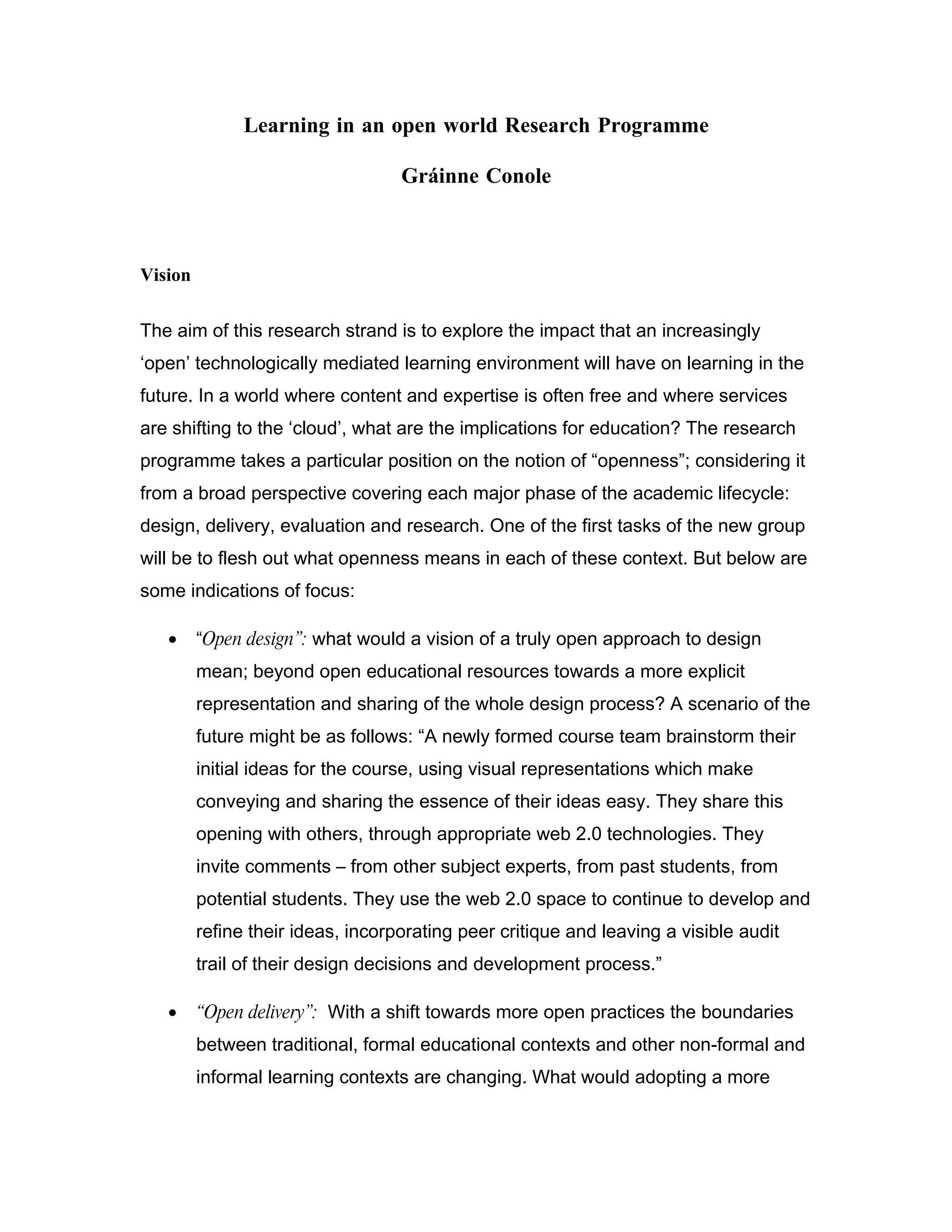
The aim of this research strand is to explore the impact that an increasingly
‘open’ technologically mediated learning environment will have on learning in the
future. In a world where content and expertise is often free and where services
are shifting to the ‘cloud’, what are the implications for education? The research
programme takes a particular position on the notion of “openness”; considering it
from a broad perspective covering each major phase of the academic lifecycle:
design, delivery, evaluation and research. One of the first tasks of the new group
will be to flesh out what openness means in each of these context. But below are
some indications of focus:

   •     “Open design”: what would a vision of a truly open approach to design
         mean; beyond open educational resources towards a more explicit
         representation and sharing of the whole design process? A scenario of the
         future might be as follows: “A newly formed course team brainstorm their
         initial ideas for the course, using visual representations which make
         conveying and sharing the essence of their ideas easy. They share this
         opening with others, through appropriate web 2.0 technologies. They
         invite comments – from other subject experts, from past students, from
         potential students. They use the web 2.0 space to continue to develop and
         refine their ideas, incorporating peer critique and leaving a visible audit
         trail of their design decisions and development process.”

   •     “Open delivery”: With a shift towards more open practices the boundaries
         between traditional, formal educational contexts and other non-formal and
         informal learning contexts are changing. What would adopting a more
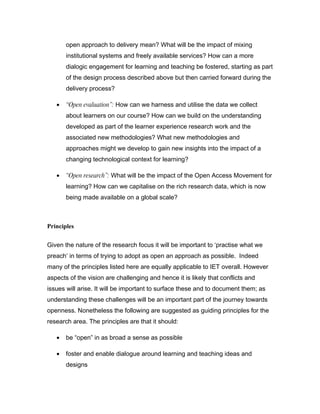
open approach to delivery mean? What will be the impact of mixing
       institutional systems and freely available services? How can a more
       dialogic engagement for learning and teaching be fostered, starting as part
       of the design process described above but then carried forward during the
       delivery process?

   •   “Open evaluation”: How can we harness and utilise the data we collect
       about learners on our course? How can we build on the understanding
       developed as part of the learner experience research work and the
       associated new methodologies? What new methodologies and
       approaches might we develop to gain new insights into the impact of a
       changing technological context for learning?

   •   “Open research”: What will be the impact of the Open Access Movement for
       learning? How can we capitalise on the rich research data, which is now
       being made available on a global scale?


Principles

Given the nature of the research focus it will be important to ‘practise what we
preach’ in terms of trying to adopt as open an approach as possible. Indeed
many of the principles listed here are equally applicable to IET overall. However
aspects of the vision are challenging and hence it is likely that conflicts and
issues will arise. It will be important to surface these and to document them; as
understanding these challenges will be an important part of the journey towards
openness. Nonetheless the following are suggested as guiding principles for the
research area. The principles are that it should:

   •   be “open” in as broad a sense as possible

   •   foster and enable dialogue around learning and teaching ideas and
       designs
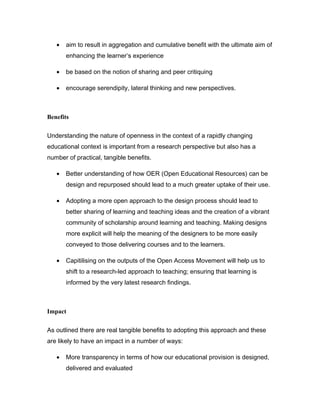
•   aim to result in aggregation and cumulative benefit with the ultimate aim of
       enhancing the learner’s experience

   •   be based on the notion of sharing and peer critiquing

   •   encourage serendipity, lateral thinking and new perspectives.


Benefits

Understanding the nature of openness in the context of a rapidly changing
educational context is important from a research perspective but also has a
number of practical, tangible benefits.

   •   Better understanding of how OER (Open Educational Resources) can be
       design and repurposed should lead to a much greater uptake of their use.

   •   Adopting a more open approach to the design process should lead to
       better sharing of learning and teaching ideas and the creation of a vibrant
       community of scholarship around learning and teaching. Making designs
       more explicit will help the meaning of the designers to be more easily
       conveyed to those delivering courses and to the learners.

   •   Capitilising on the outputs of the Open Access Movement will help us to
       shift to a research-led approach to teaching; ensuring that learning is
       informed by the very latest research findings.


Impact

As outlined there are real tangible benefits to adopting this approach and these
are likely to have an impact in a number of ways:

   •   More transparency in terms of how our educational provision is designed,
       delivered and evaluated
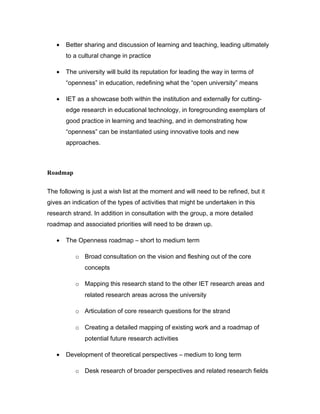
•   Better sharing and discussion of learning and teaching, leading ultimately
       to a cultural change in practice

   •   The university will build its reputation for leading the way in terms of
       “openness” in education, redefining what the “open university” means

   •   IET as a showcase both within the institution and externally for cutting-
       edge research in educational technology, in foregrounding exemplars of
       good practice in learning and teaching, and in demonstrating how
       “openness” can be instantiated using innovative tools and new
       approaches.


Roadmap

The following is just a wish list at the moment and will need to be refined, but it
gives an indication of the types of activities that might be undertaken in this
research strand. In addition in consultation with the group, a more detailed
roadmap and associated priorities will need to be drawn up.

   •   The Openness roadmap – short to medium term

          o Broad consultation on the vision and fleshing out of the core
              concepts

          o Mapping this research stand to the other IET research areas and
              related research areas across the university

          o Articulation of core research questions for the strand

          o Creating a detailed mapping of existing work and a roadmap of
              potential future research activities

   •   Development of theoretical perspectives – medium to long term

          o Desk research of broader perspectives and related research fields
o Clearer articulation of the different kinds of mediating artefacts (and
           in particular visual representations) which will be needed to support
           adopting an open approach

       o Continued work on consolidating our understanding of the different
           representations of design (and in particular visualisation)

       o Clarification of theoretical basis, starting from a socio-cultural
           approach

       o (Socio-cultural and design perspectives in terms of theoretical
           perspectives)

•   Collaboration and partnerships (identify potential projects) medium to long
    term

       o Identifying connections with related research centres and forging of
           strategic alliances

       o Opportunistic partnership through relevant funding calls

       o Strategic involvement in relevant national and international events

•   Events and community engagement - throughout

       o A mixture of real and virtual event delivered both internally and
           externally, which demonstrate our approach. Some will focus on
           capacity building, whilst others will be more research orientated

       o Consolidation of OULDI work to date – development of a
           comprehensive set of resources and guidelines and a roadshow
           (series of awareness raising events and workshops); a series of
           longitudinal intervention case studies of application of OULDI tools
           and resources in consultation with faculty reps and aligning with
           institutional/faculty priorities
o Roll out and embedding of Cloudworks within IET and the institution
          more widely

       o Building on the CompendiumLD work, consensus on what is
          needed in terms of tools for visualisation

       o Development of guidelines and support mechanisms to help people
          adopt a more open approach and take up some of the outputs of
          the research work in their practice

       o Development of an IER showcase of learning and teaching and of
          educational technology research

•   Empirical evidence - throughout

       o Evaluating case studies within the OU demonstrating the
          application of the outputs from the research work – for example
          application of the learning design and OER work

•   Alignment of existing projects – short to medium term

       o Continuation of OULDI – through ring fencing of relevant staff time

       o OLnet (March 09 – March 12)

       o HE Academy – OER and Cloudworks case study (July 09-March
          10)

       o OULDI-JISC Curriculum Design project (Sept 08-March 12)

       o X-Delia (March 09-Feb 12)

       o EU-funded OPAL OER project (Jan 10 – Dec 11)

       o EU-funded Cyprus/Greece OULDI project (Oct 09-Oct 11)

       o Personal Inquiry
o English in action

   •   Potential new projects

            o Development of a web-based visualisation tool

            o Applying “openness” to the student context


Resources

Whilst clearly a major focus needs to be on securing external funding, the
success of the OULDI strategically funded work over the last two years
demonstrates the value of allocating internal resources to the research strands to
ensure that they are grounded, are strategically aligned and have institutional
impact.

Learning In An Open World Vision Statement 25 Nov

  • 1.
    Learning in anopen world Research Programme Gráinne Conole Vision The aim of this research strand is to explore the impact that an increasingly ‘open’ technologically mediated learning environment will have on learning in the future. In a world where content and expertise is often free and where services are shifting to the ‘cloud’, what are the implications for education? The research programme takes a particular position on the notion of “openness”; considering it from a broad perspective covering each major phase of the academic lifecycle: design, delivery, evaluation and research. One of the first tasks of the new group will be to flesh out what openness means in each of these context. But below are some indications of focus: • “Open design”: what would a vision of a truly open approach to design mean; beyond open educational resources towards a more explicit representation and sharing of the whole design process? A scenario of the future might be as follows: “A newly formed course team brainstorm their initial ideas for the course, using visual representations which make conveying and sharing the essence of their ideas easy. They share this opening with others, through appropriate web 2.0 technologies. They invite comments – from other subject experts, from past students, from potential students. They use the web 2.0 space to continue to develop and refine their ideas, incorporating peer critique and leaving a visible audit trail of their design decisions and development process.” • “Open delivery”: With a shift towards more open practices the boundaries between traditional, formal educational contexts and other non-formal and informal learning contexts are changing. What would adopting a more
  • 2.
    open approach todelivery mean? What will be the impact of mixing institutional systems and freely available services? How can a more dialogic engagement for learning and teaching be fostered, starting as part of the design process described above but then carried forward during the delivery process? • “Open evaluation”: How can we harness and utilise the data we collect about learners on our course? How can we build on the understanding developed as part of the learner experience research work and the associated new methodologies? What new methodologies and approaches might we develop to gain new insights into the impact of a changing technological context for learning? • “Open research”: What will be the impact of the Open Access Movement for learning? How can we capitalise on the rich research data, which is now being made available on a global scale? Principles Given the nature of the research focus it will be important to ‘practise what we preach’ in terms of trying to adopt as open an approach as possible. Indeed many of the principles listed here are equally applicable to IET overall. However aspects of the vision are challenging and hence it is likely that conflicts and issues will arise. It will be important to surface these and to document them; as understanding these challenges will be an important part of the journey towards openness. Nonetheless the following are suggested as guiding principles for the research area. The principles are that it should: • be “open” in as broad a sense as possible • foster and enable dialogue around learning and teaching ideas and designs
  • 3.
    aim to result in aggregation and cumulative benefit with the ultimate aim of enhancing the learner’s experience • be based on the notion of sharing and peer critiquing • encourage serendipity, lateral thinking and new perspectives. Benefits Understanding the nature of openness in the context of a rapidly changing educational context is important from a research perspective but also has a number of practical, tangible benefits. • Better understanding of how OER (Open Educational Resources) can be design and repurposed should lead to a much greater uptake of their use. • Adopting a more open approach to the design process should lead to better sharing of learning and teaching ideas and the creation of a vibrant community of scholarship around learning and teaching. Making designs more explicit will help the meaning of the designers to be more easily conveyed to those delivering courses and to the learners. • Capitilising on the outputs of the Open Access Movement will help us to shift to a research-led approach to teaching; ensuring that learning is informed by the very latest research findings. Impact As outlined there are real tangible benefits to adopting this approach and these are likely to have an impact in a number of ways: • More transparency in terms of how our educational provision is designed, delivered and evaluated
  • 4.
    Better sharing and discussion of learning and teaching, leading ultimately to a cultural change in practice • The university will build its reputation for leading the way in terms of “openness” in education, redefining what the “open university” means • IET as a showcase both within the institution and externally for cutting- edge research in educational technology, in foregrounding exemplars of good practice in learning and teaching, and in demonstrating how “openness” can be instantiated using innovative tools and new approaches. Roadmap The following is just a wish list at the moment and will need to be refined, but it gives an indication of the types of activities that might be undertaken in this research strand. In addition in consultation with the group, a more detailed roadmap and associated priorities will need to be drawn up. • The Openness roadmap – short to medium term o Broad consultation on the vision and fleshing out of the core concepts o Mapping this research stand to the other IET research areas and related research areas across the university o Articulation of core research questions for the strand o Creating a detailed mapping of existing work and a roadmap of potential future research activities • Development of theoretical perspectives – medium to long term o Desk research of broader perspectives and related research fields
  • 5.
    o Clearer articulationof the different kinds of mediating artefacts (and in particular visual representations) which will be needed to support adopting an open approach o Continued work on consolidating our understanding of the different representations of design (and in particular visualisation) o Clarification of theoretical basis, starting from a socio-cultural approach o (Socio-cultural and design perspectives in terms of theoretical perspectives) • Collaboration and partnerships (identify potential projects) medium to long term o Identifying connections with related research centres and forging of strategic alliances o Opportunistic partnership through relevant funding calls o Strategic involvement in relevant national and international events • Events and community engagement - throughout o A mixture of real and virtual event delivered both internally and externally, which demonstrate our approach. Some will focus on capacity building, whilst others will be more research orientated o Consolidation of OULDI work to date – development of a comprehensive set of resources and guidelines and a roadshow (series of awareness raising events and workshops); a series of longitudinal intervention case studies of application of OULDI tools and resources in consultation with faculty reps and aligning with institutional/faculty priorities
  • 6.
    o Roll outand embedding of Cloudworks within IET and the institution more widely o Building on the CompendiumLD work, consensus on what is needed in terms of tools for visualisation o Development of guidelines and support mechanisms to help people adopt a more open approach and take up some of the outputs of the research work in their practice o Development of an IER showcase of learning and teaching and of educational technology research • Empirical evidence - throughout o Evaluating case studies within the OU demonstrating the application of the outputs from the research work – for example application of the learning design and OER work • Alignment of existing projects – short to medium term o Continuation of OULDI – through ring fencing of relevant staff time o OLnet (March 09 – March 12) o HE Academy – OER and Cloudworks case study (July 09-March 10) o OULDI-JISC Curriculum Design project (Sept 08-March 12) o X-Delia (March 09-Feb 12) o EU-funded OPAL OER project (Jan 10 – Dec 11) o EU-funded Cyprus/Greece OULDI project (Oct 09-Oct 11) o Personal Inquiry
  • 7.
    o English inaction • Potential new projects o Development of a web-based visualisation tool o Applying “openness” to the student context Resources Whilst clearly a major focus needs to be on securing external funding, the success of the OULDI strategically funded work over the last two years demonstrates the value of allocating internal resources to the research strands to ensure that they are grounded, are strategically aligned and have institutional impact.