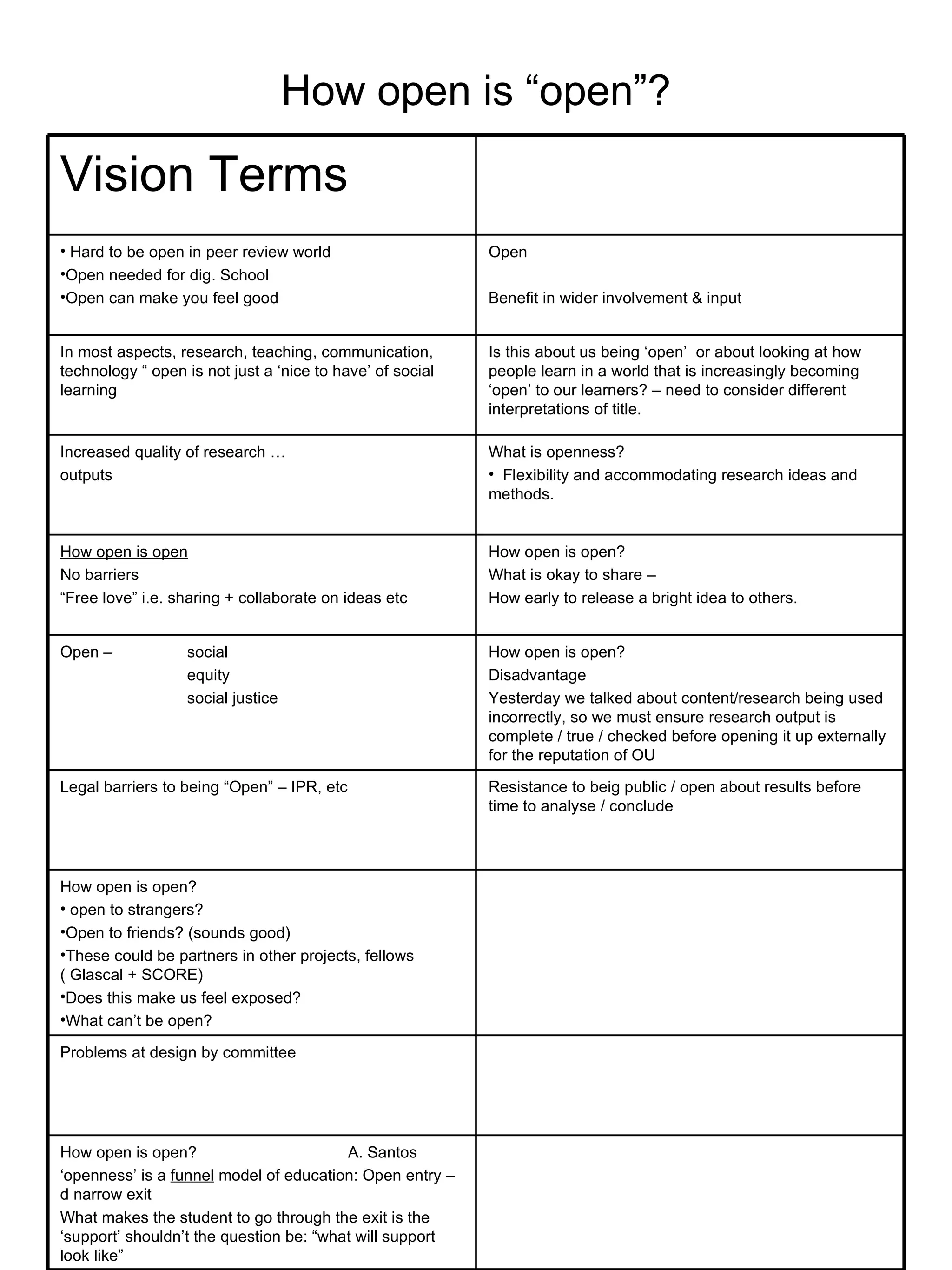
How open is “open”? Vision Terms Hard to be open in peer review world Open needed for dig. School Open can make you feel good Open Benefit in wider involvement & input In most aspects, research, teaching, communication, technology “ open is not just a ‘nice to have’ of social learning Is this about us being ‘open’  or about looking at how people learn in a world that is increasingly becoming ‘open’ to our learners? – need to consider different interpretations of title. Increased quality of research … outputs What is openness? Flexibility and accommodating research ideas and methods. How open is open No barriers “ Free love” i.e. sharing + collaborate on ideas etc How open is open? What is okay to share –  How early to release a bright idea to others. Open –  social equity social justice How open is open? Disadvantage Yesterday we talked about content/research being used incorrectly, so we must ensure research output is complete / true / checked before opening it up externally for the reputation of OU Legal barriers to being “Open” – IPR, etc Resistance to beig public / open about results before time to analyse / conclude How open is open? open to strangers? Open to friends? (sounds good) These could be partners in other projects, fellows ( Glascal + SCORE) Does this make us feel exposed? What can’t be open? Problems at design by committee How open is open?  A. Santos ‘ openness’ is a  funnel  model of education: Open entry – d narrow exit What makes the student to go through the exit is the ‘support’ shouldn’t the question be: “what will support look like”
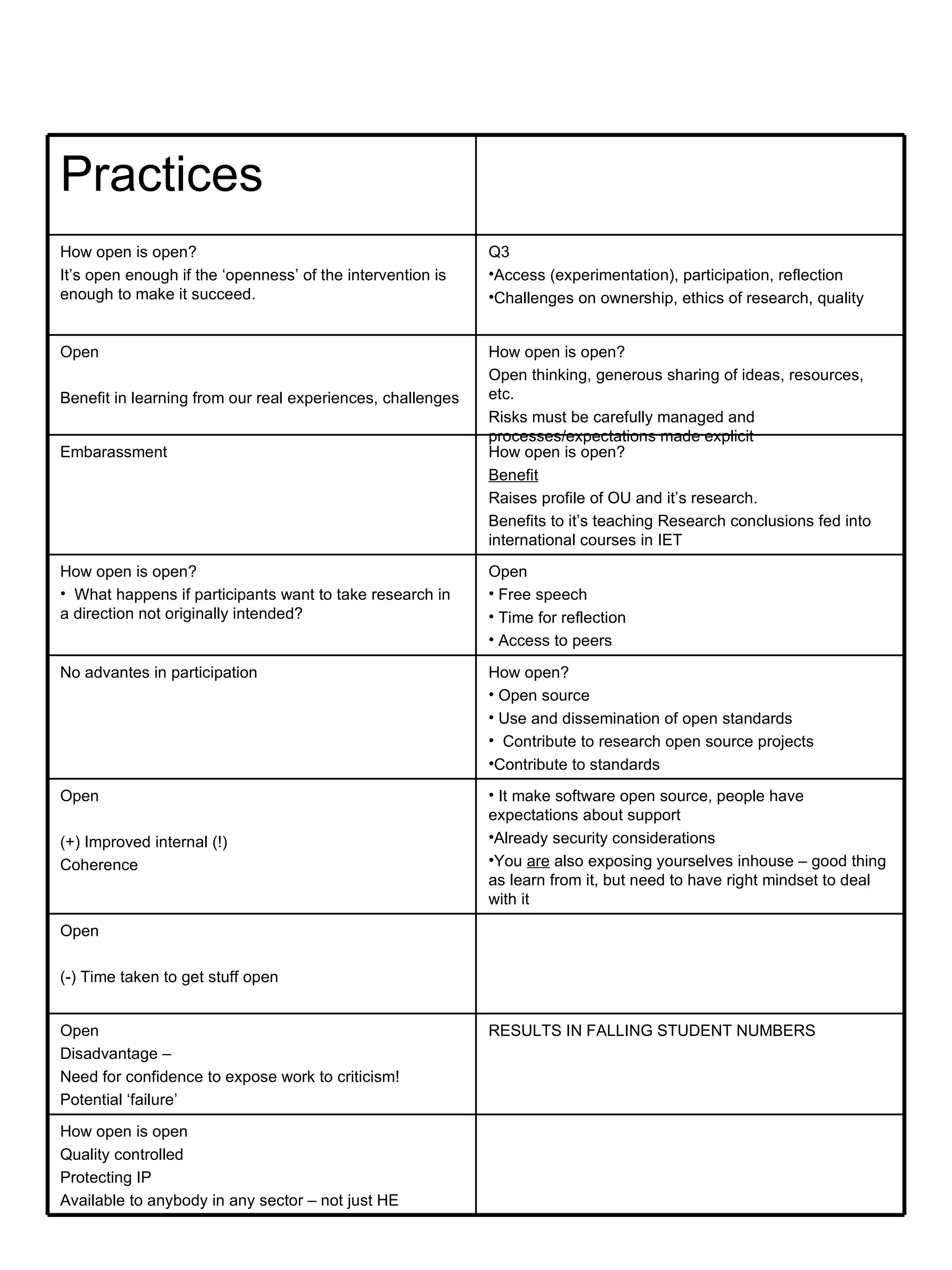
Practices How open is open? It’s open enough if the ‘openness’ of the intervention is enough to make it succeed. Q3 Access (experimentation), participation, reflection Challenges on ownership, ethics of research, quality Open Benefit in learning from our real experiences, challenges How open is open? Open thinking, generous sharing of ideas, resources, etc. Risks must be carefully managed and processes/expectations made explicit Embarassment How open is open? Benefit Raises profile of OU and it’s research. Benefits to it’s teaching Research conclusions fed into international courses in IET How open is open? What happens if participants want to take research in a direction not originally intended? Open Free speech Time for reflection Access to peers No advantes in participation How open? Open source Use and dissemination of open standards Contribute to research open source projects Contribute to standards Open (+) Improved internal (!) Coherence It make software open source, people have expectations about support Already security considerations You  are  also exposing yourselves inhouse – good thing as learn from it, but need to have right mindset to deal with it Open (-) Time taken to get stuff open Open Disadvantage – Need for confidence to expose work to criticism!  Potential ‘failure’ RESULTS IN FALLING STUDENT NUMBERS How open is open Quality controlled Protecting IP Available to anybody in any sector – not just HE
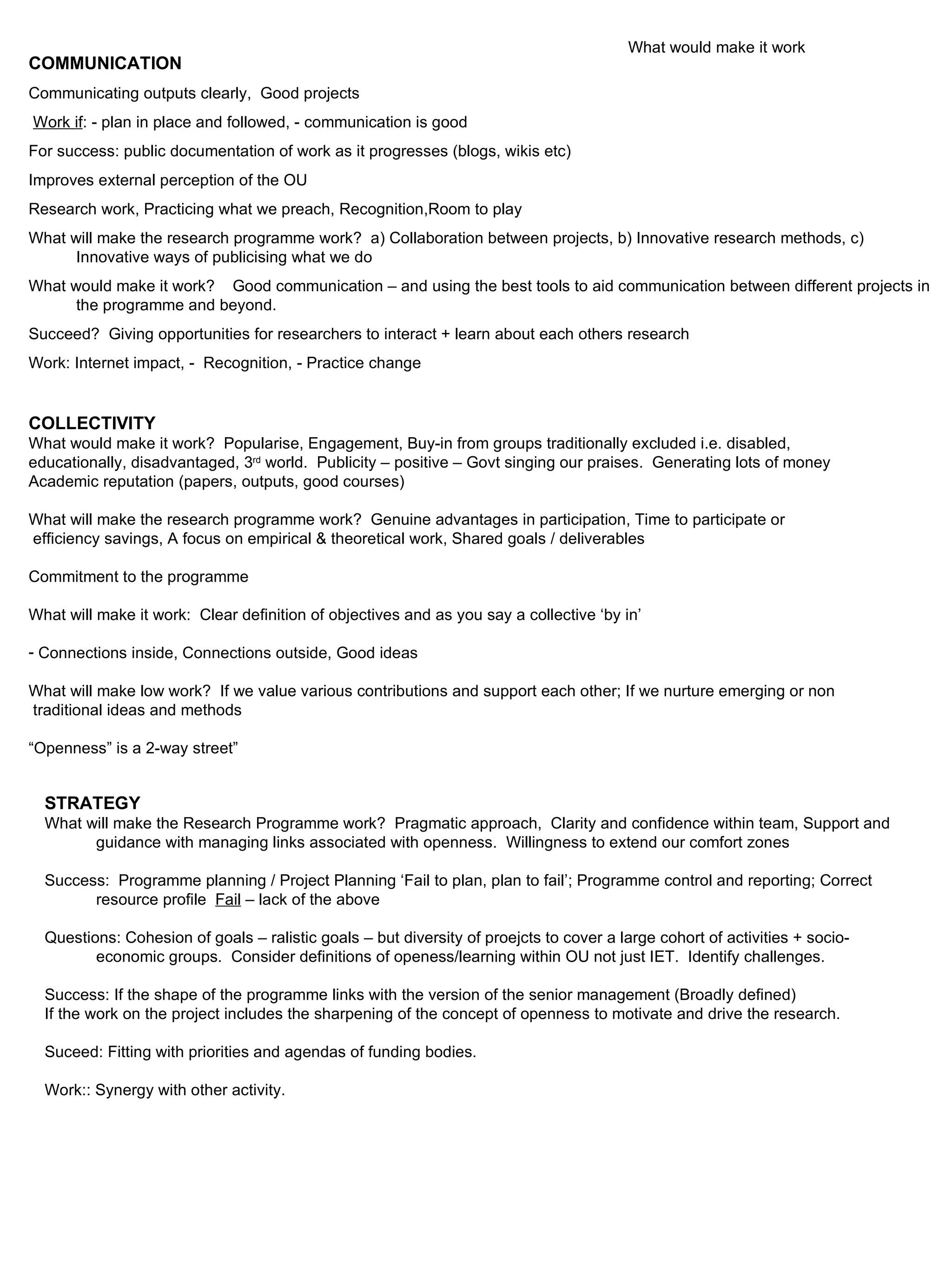
COMMUNICATION Communicating outputs clearly,  Good projects Work if : - plan in place and followed, - communication is good For success: public documentation of work as it progresses (blogs, wikis etc) Improves external perception of the OU Research work, Practicing what we preach, Recognition,Room to play What will make the research programme work?  a) Collaboration between projects, b) Innovative research methods, c) Innovative ways of publicising what we do What would make it work?  Good communication – and using the best tools to aid communication between different projects in the programme and beyond. Succeed?  Giving opportunities for researchers to interact + learn about each others research Work: Internet impact, -  Recognition, - Practice change COLLECTIVITY What would make it work?  Popularise, Engagement, Buy-in from groups traditionally excluded i.e. disabled,  educationally, disadvantaged, 3 rd  world.  Publicity – positive – Govt singing our praises.  Generating lots of money Academic reputation (papers, outputs, good courses) What will make the research programme work?  Genuine advantages in participation, Time to participate or efficiency savings, A focus on empirical & theoretical work, Shared goals / deliverables Commitment to the programme What will make it work:  Clear definition of objectives and as you say a collective ‘by in’ Connections inside, Connections outside, Good ideas What will make low work?  If we value various contributions and support each other; If we nurture emerging or non traditional ideas and methods “ Openness” is a 2-way street” What would make it work STRATEGY What will make the Research Programme work?  Pragmatic approach,  Clarity and confidence within team, Support and guidance with managing links associated with openness.  Willingness to extend our comfort zones Success:  Programme planning / Project Planning ‘Fail to plan, plan to fail’; Programme control and reporting; Correct resource profile  Fail  – lack of the above Questions: Cohesion of goals – ralistic goals – but diversity of proejcts to cover a large cohort of activities + socio-economic groups.  Consider definitions of openess/learning within OU not just IET.  Identify challenges. Success: If the shape of the programme links with the version of the senior management (Broadly defined) If the work on the project includes the sharpening of the concept of openness to motivate and drive the research. Suceed: Fitting with priorities and agendas of funding bodies. Work:: Synergy with other activity.
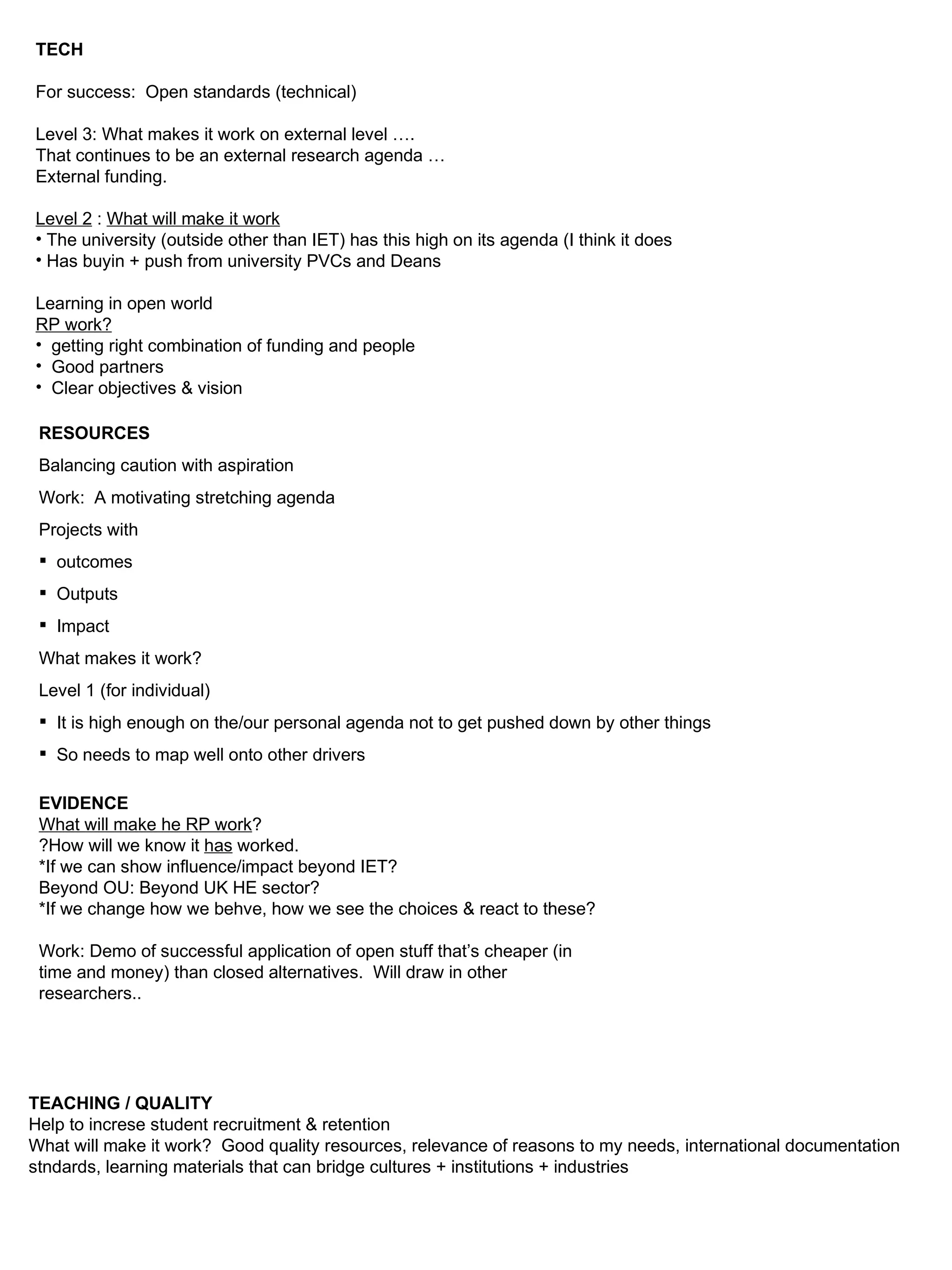
TECH For success:  Open standards (technical) Level 3: What makes it work on external level …. That continues to be an external research agenda … External funding. Level 2  :  What will make it work The university (outside other than IET) has this high on its agenda (I think it does Has buyin + push from university PVCs and Deans Learning in open world RP work? getting right combination of funding and people Good partners Clear objectives & vision RESOURCES Balancing caution with aspiration Work:  A motivating stretching agenda Projects with outcomes Outputs Impact What makes it work?  Level 1 (for individual) It is high enough on the/our personal agenda not to get pushed down by other things So needs to map well onto other drivers EVIDENCE What will make he RP work ? ?How will we know it  has  worked. *If we can show influence/impact beyond IET? Beyond OU: Beyond UK HE sector? *If we change how we behve, how we see the choices & react to these? Work: Demo of successful application of open stuff that’s cheaper (in time and money) than closed alternatives.  Will draw in other researchers.. TEACHING / QUALITY Help to increse student recruitment & retention What will make it work?  Good quality resources, relevance of reasons to my needs, international documentation stndards, learning materials that can bridge cultures + institutions + industries
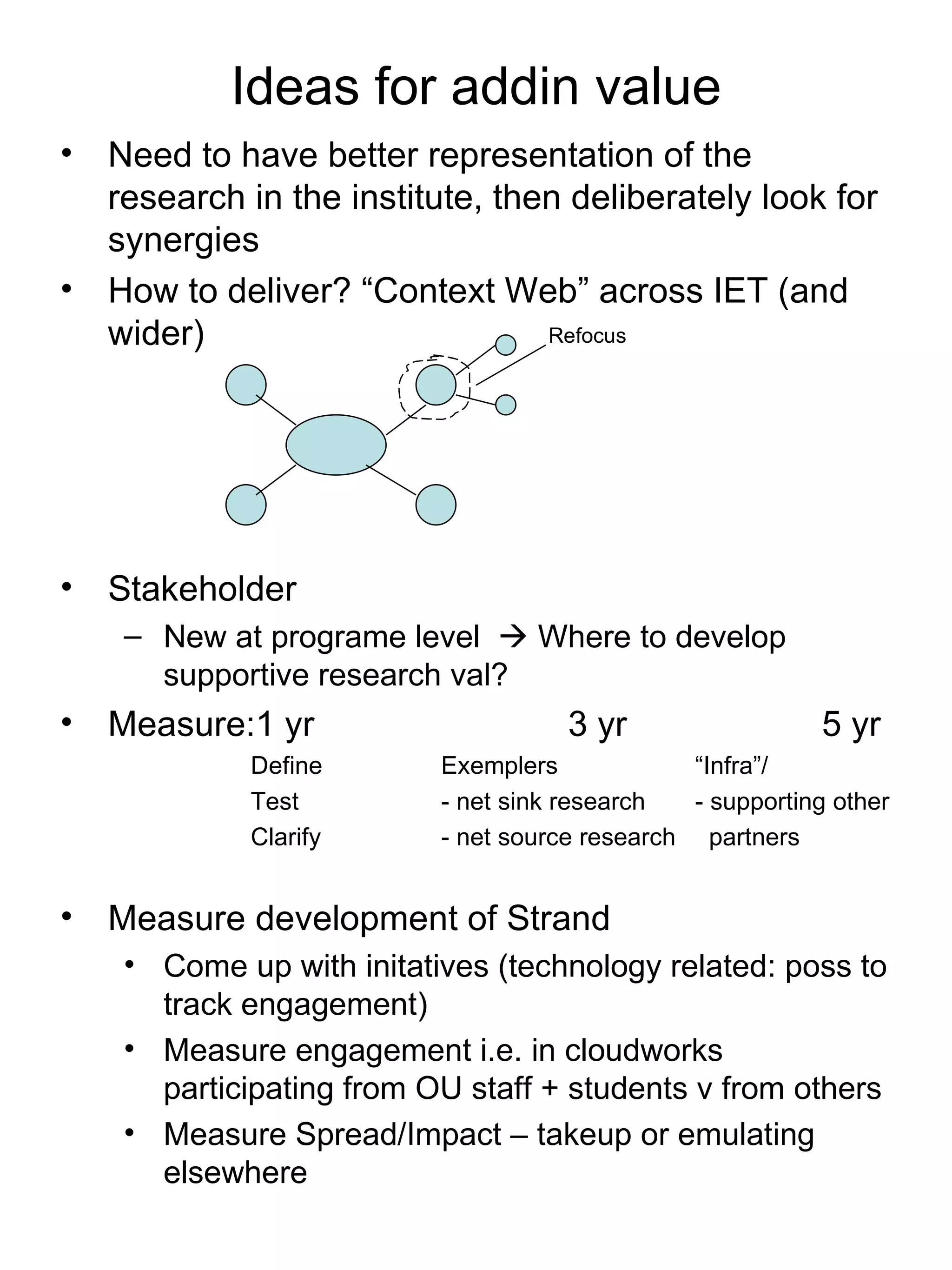
Ideas for addin value Need to have better representation of the research in the institute, then deliberately look for synergies How to deliver? “Context Web” across IET (and wider)  Stakeholder  New at programe level    Where to develop supportive research val? Measure:1 yr 3 yr 5 yr Define Exemplers “Infra”/ Test - net sink research - supporting other Clarify  - net source research   partners Measure development of Strand Come up with initatives (technology related: poss to track engagement) Measure engagement i.e. in cloudworks participating from OU staff + students v from others Measure Spread/Impact – takeup or emulating elsewhere Refocus
Ideas for adding value Joint research bid around the notion of Open Design Adding value: efficient collaboration via tools like Cloudworks  Put all WIP papers on the theme in a shared space Value: Build on Open Work, make open a thing to all our work Good flexible dynamic representation of projects + works Yr 1 – activity Yr 2 – money Yr 3 – publications Use Cloudworks effectively Collaborative network is OLNET, this is OLNET’s future
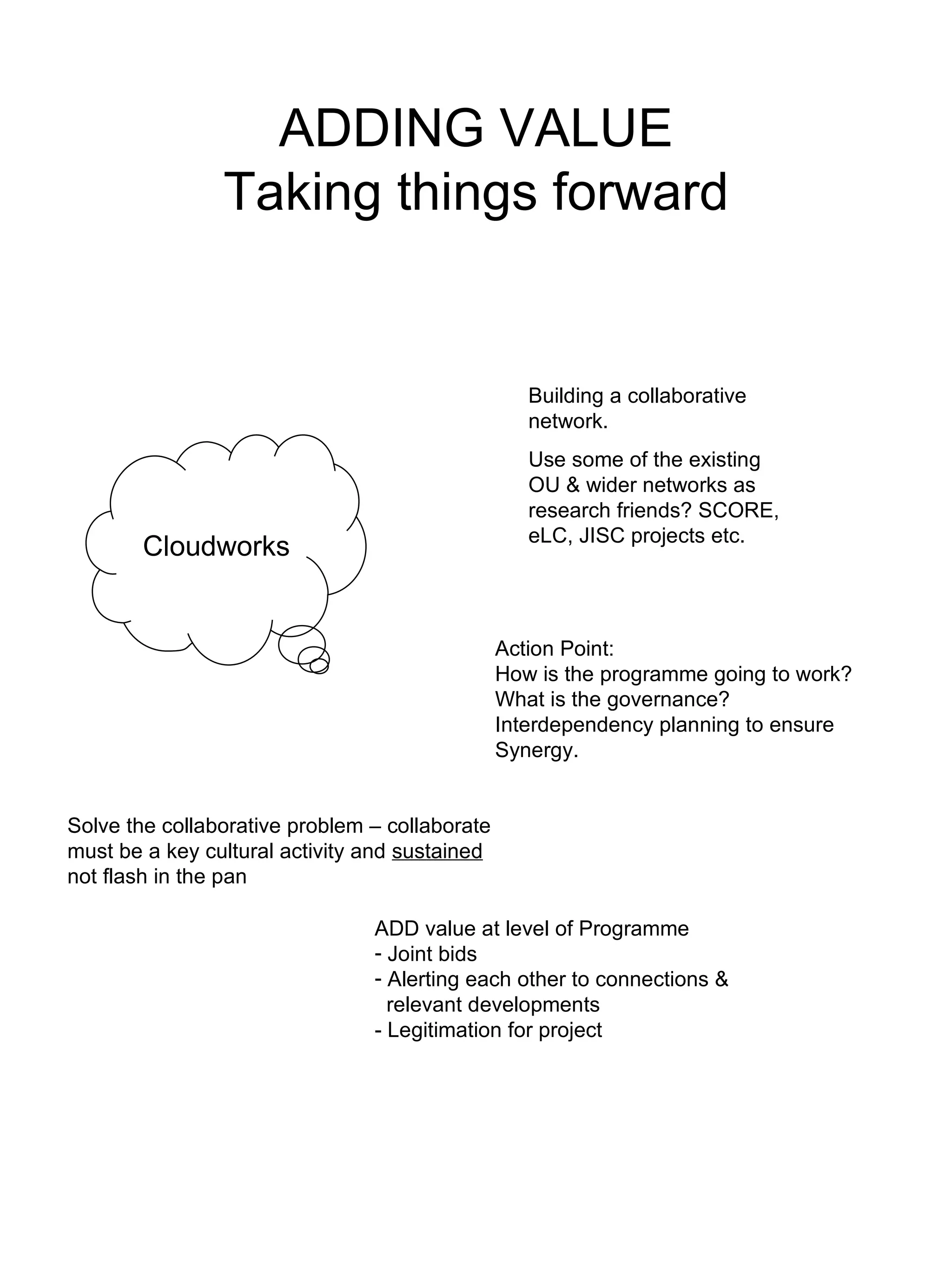
ADDING VALUE Taking things forward Cloudworks Building a collaborative network. Use some of the existing OU & wider networks as research friends? SCORE, eLC, JISC projects etc. Action Point: How is the programme going to work? What is the governance? Interdependency planning to ensure  Synergy. Solve the collaborative problem – collaborate  must be a key cultural activity and  sustained   not flash in the pan ADD value at level of Programme Joint bids Alerting each other to connections & relevant developments - Legitimation for project
OPEN DESIGN Mapping existing projects OULDI Cloudworks? PI Socialearn OLNET (Design) ( Open Ed) EU4All  (Flosscom) ?Design for openness or Open Design Processes Issues for Students & staff + ‘openness’ can exclude those outside OU
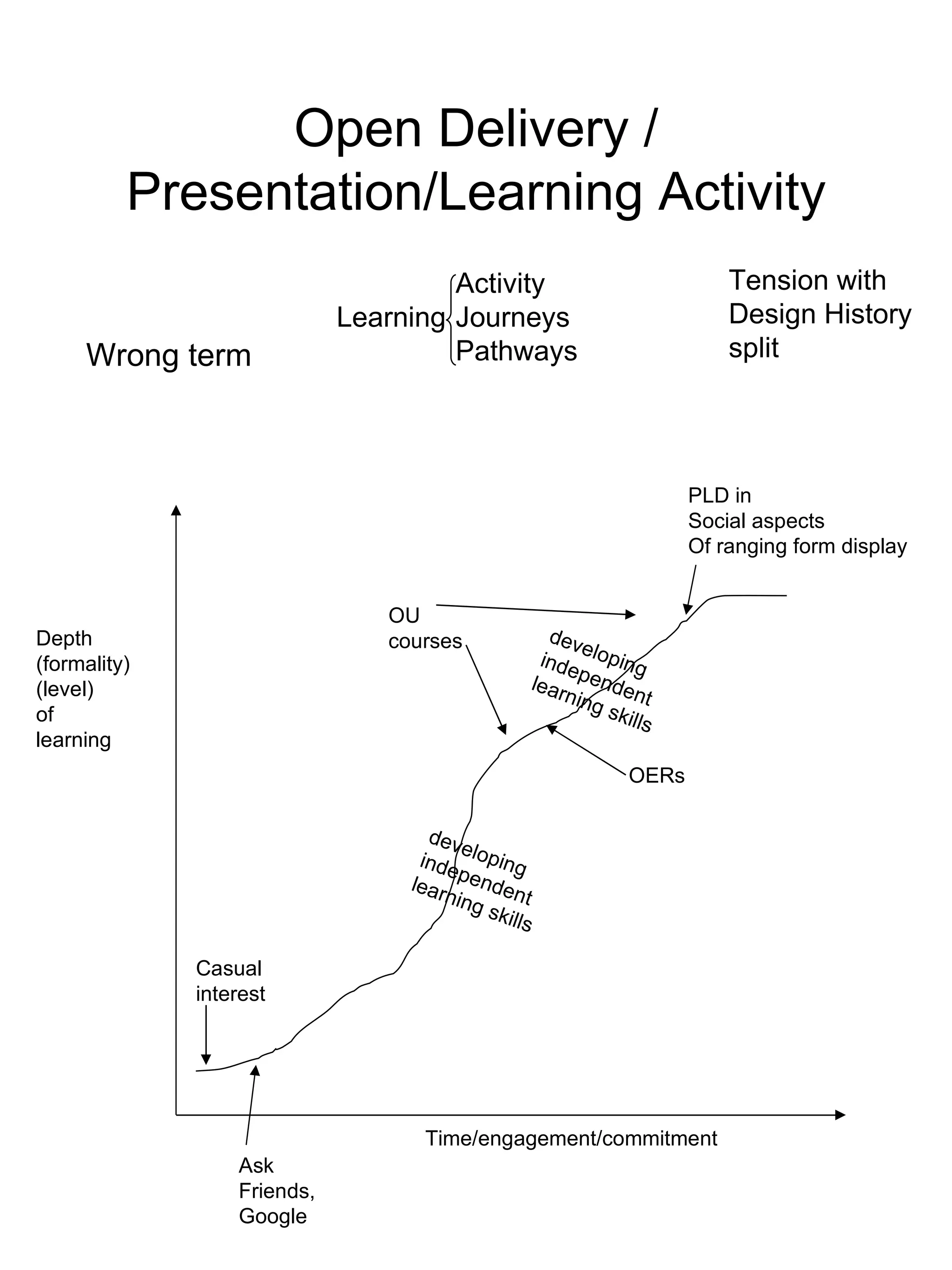
Open Delivery / Presentation/Learning Activity Activity Learning  Journeys Pathways Wrong term Tension with  Design History  split Depth (formality) (level) of learning Casual interest Ask Friends, Google Time/engagement/commitment developing independent learning skills developing independent learning skills OU  courses PLD in Social aspects  Of ranging form display OERs
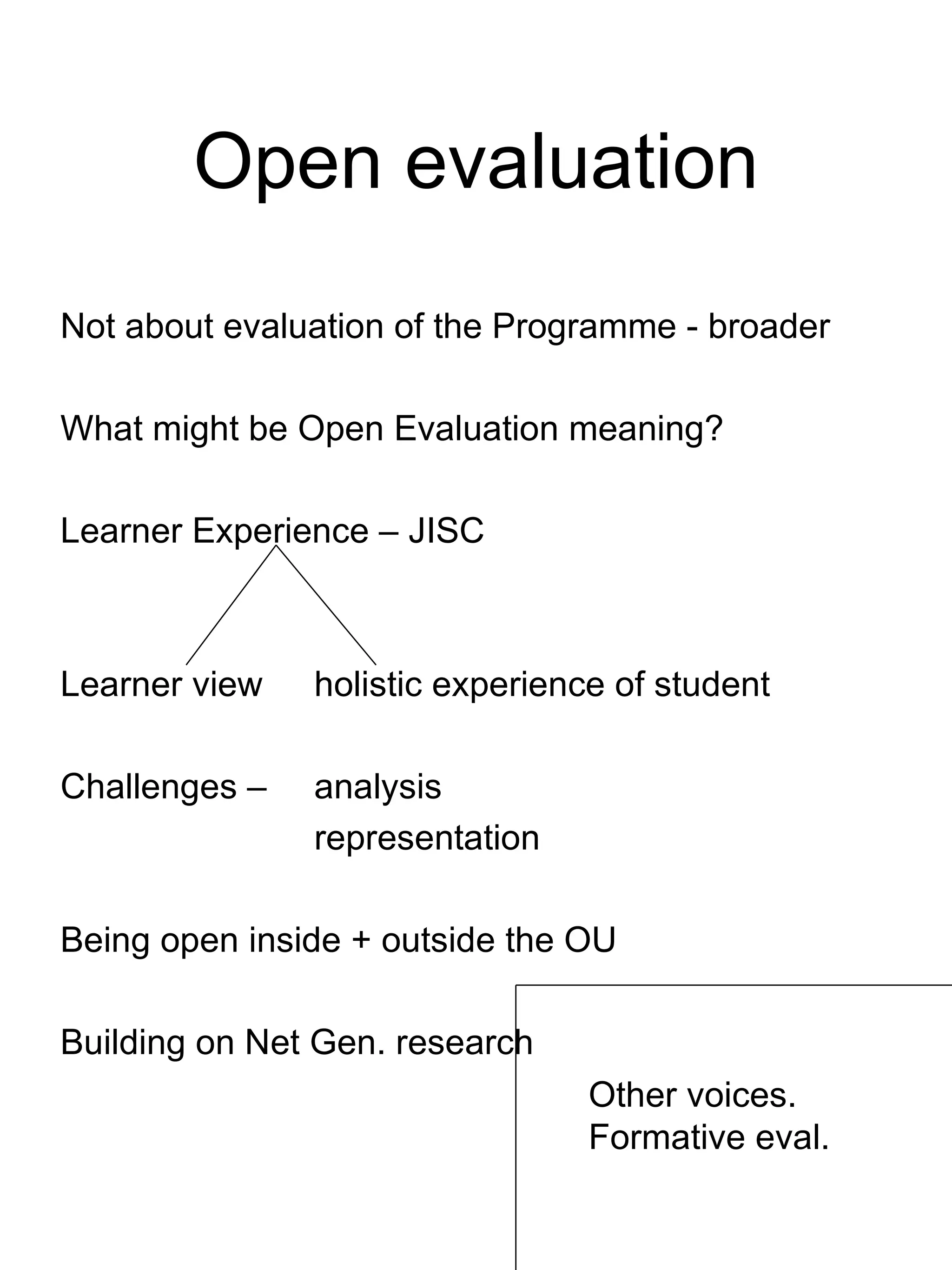
Open evaluation Not about evaluation of the Programme - broader What might be Open Evaluation meaning? Learner Experience – JISC Learner view holistic experience of student Challenges –  analysis representation Being open inside + outside the OU Building on Net Gen. research Other voices. Formative eval.
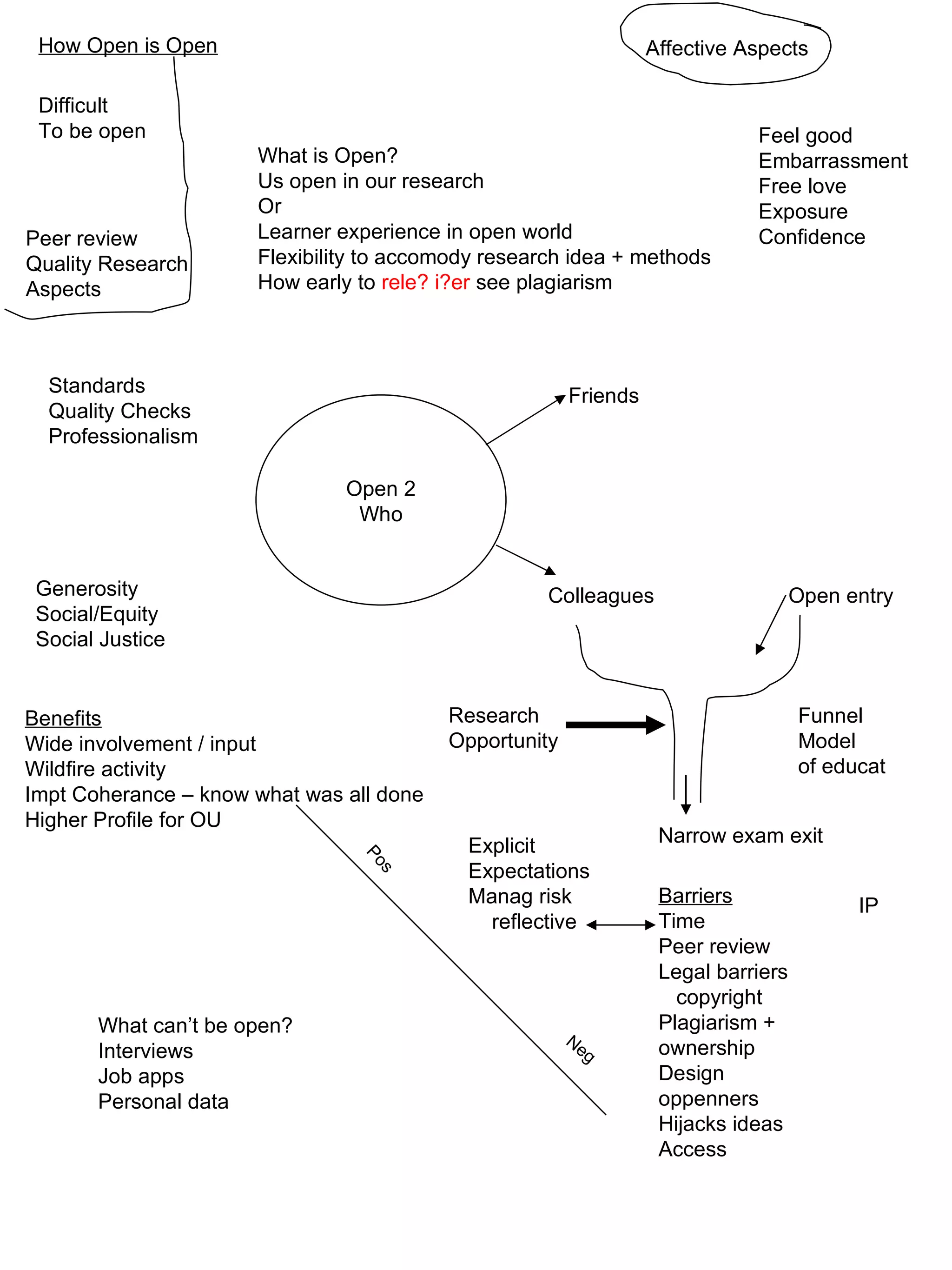
How Open is Open What is Open? Us open in our research Or Learner experience in open world Flexibility to accomody research idea + methods How early to  rele? i?er  see plagiarism Affective Aspects Difficult To be open Peer review Quality Research  Aspects Feel good Embarrassment Free love Exposure Confidence Open 2 Who Friends Colleagues Standards Quality Checks Professionalism Generosity Social/Equity Social Justice Research Opportunity Open entry Funnel  Model of educat Explicit  Expectations Manag risk reflective Barriers Time Peer review Legal barriers copyright Plagiarism + ownership Design oppenners Hijacks ideas Access IP Benefits Wide involvement / input Wildfire activity Impt Coherance – know what was all done Higher Profile for OU What can’t be open? Interviews Job apps Personal data Pos Neg Narrow exam exit
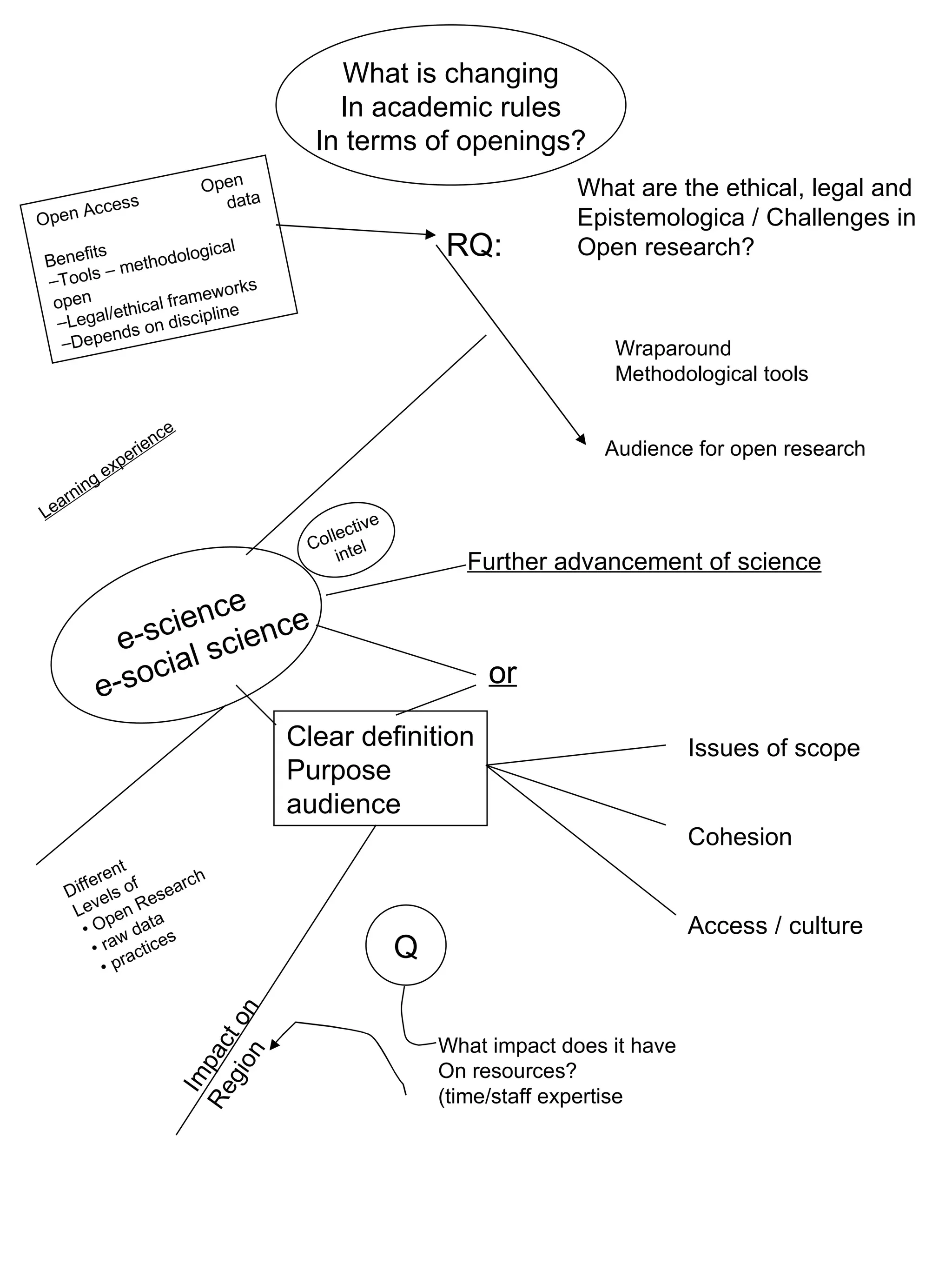
What are the ethical, legal and  Epistemologica / Challenges in Open research? Wraparound Methodological tools Audience for open research RQ: Open Access  Open   data Benefits Tools – methodological open Legal/ethical frameworks Depends on discipline Further advancement of science Clear definition Purpose audience Issues of scope Cohesion Access / culture or Learning experience Different Levels of Open Research raw data practices What impact does it have On resources? (time/staff expertise Q Impact on Region What is changing In academic rules In terms of openings? e-science e-social science Collective intel
Research Questions Barriers to participation in formal learning Transition from informal, casual learning How the resources that we have got are being used and where Relationship between participating in formal and informal activities Access to learning – audience Widening participation How do people structure their learning Confidence Technical skills Resources people use and how they use them Intention for study – why do they study
RQs How can Open Design work  - across cultures? - internationally Is there such a thing as open craft? What is a taxonomy of open design? (agile … What does open design enable? What are the barriers/ tradeoff
What will make the programme fail? Lack of  RESOURCES – time, people, money ATTITUDES – lack of staff engagement, fear of openness, lack of ‘buy in’ by senior management – being over-ambitious, paying lip service to ‘open’, lack of encouragement/feedback, habit, perfectionism, distraction. LACK OF INFRASTRUCTURE – quality, planning, connections, communication, dissemination EXTERNAL FACTORS – Marginalisation, wider interest/funding moving on, focus on REF, others steal & do it better, funders reluctance, devalued by poor thinking LACK OF DEFINITION – unclear goals + deliverables, about research or encouraging openness, losing initiative/direction
Make Research Programme Fail? Resources Attitudes & behaviours Lack of programme /  project infrastructure External factors Lack of definition
CAN OF WORMS? Openness of candid Of Public gaffs Improvable objects Language of cultural values Imbalance of researchers
Synergies All Funders Foundations EU JISC EXSRC
WORKSHOP FEEDBACK EVALUATION LIKE Interactive Mixing with colleagues Participation Exposure to a wider group within IET Activities generated a great number of ideas Workshop generated a 109 ideas: Challenge is to make sense of it all Workshop:  Liked  working with IET colleagues I don’t normally work with and finding out about their work, expertise and interests. Good busy time Evaluating this workshop! Workshop – worked fine.  Do in 2 hours next time   DISLIKE Workshop fatigue (lots of them!) Lack of reference to original concepts of openness- no continuity Venue – noise Free love agenda RT@jamesaczel meeting room fine apart from lighting, noise, temperature & lack of display screens. Intensive + short break would have been refreshing
Evaluation What worked Group work + changing around the groups Engagement / contribution across groups Post its are good Break down in groups allow further discussion Free tea + biscuits Brainstorming collaboration What didn’t Workshop too hot    Too noisy We did not get to far as to ‘actions’ Too many topics + activities – not much time for action points Clear structure  Diversity of themes Idea: develop theories and methodologies for articulating and representing existing as emerging practice of learning in an open world Measure 1 (year) research question + project   3 – 5 years  methods   theories Action points Grainne to synthesize + feedback collaborative outputs    VISIBILITY  To do: Document current “open practices” in IET Research & publish implictions of (potensially massive) open data sets:  - for human resources - for tools Add value: Joint bid ideas + - paper writing (e.g. e-science/learning/pathways - collaborative networks + synergies with existing networks on e-social science/e-humanities
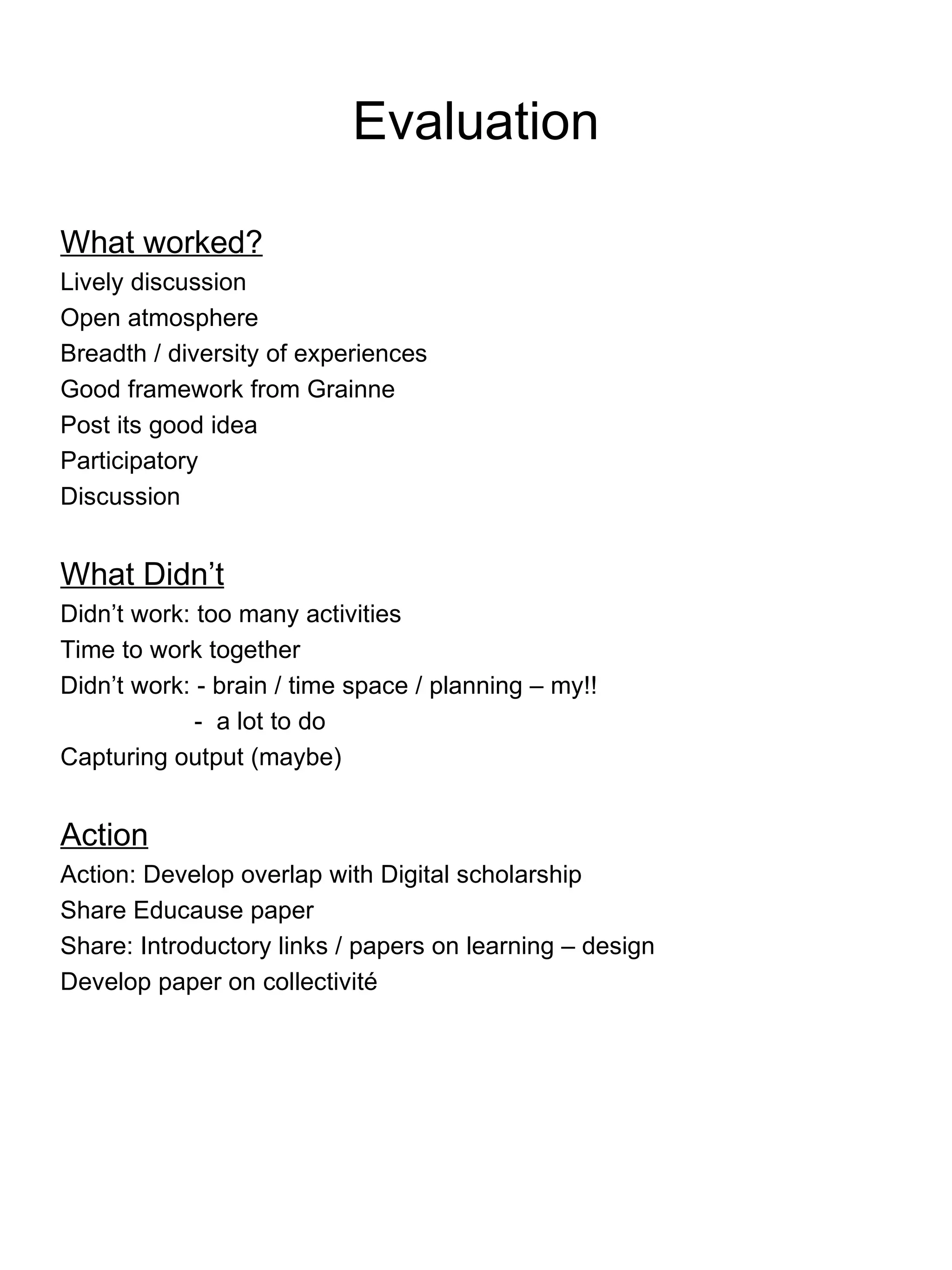
Evaluation What worked? Lively discussion Open atmosphere Breadth / diversity of experiences Good framework from Grainne Post its good idea Participatory Discussion What Didn’t Didn’t work: too many activities Time to work together Didn’t work: - brain / time space / planning – my!!   -  a lot to do Capturing output (maybe) Action Action: Develop overlap with Digital scholarship Share Educause paper Share: Introductory links / papers on learning – design Develop paper on collectivit é

Li Ow Workshop 26 02 10

  • 1.
    How open is“open”? Vision Terms Hard to be open in peer review world Open needed for dig. School Open can make you feel good Open Benefit in wider involvement & input In most aspects, research, teaching, communication, technology “ open is not just a ‘nice to have’ of social learning Is this about us being ‘open’ or about looking at how people learn in a world that is increasingly becoming ‘open’ to our learners? – need to consider different interpretations of title. Increased quality of research … outputs What is openness? Flexibility and accommodating research ideas and methods. How open is open No barriers “ Free love” i.e. sharing + collaborate on ideas etc How open is open? What is okay to share – How early to release a bright idea to others. Open – social equity social justice How open is open? Disadvantage Yesterday we talked about content/research being used incorrectly, so we must ensure research output is complete / true / checked before opening it up externally for the reputation of OU Legal barriers to being “Open” – IPR, etc Resistance to beig public / open about results before time to analyse / conclude How open is open? open to strangers? Open to friends? (sounds good) These could be partners in other projects, fellows ( Glascal + SCORE) Does this make us feel exposed? What can’t be open? Problems at design by committee How open is open? A. Santos ‘ openness’ is a funnel model of education: Open entry – d narrow exit What makes the student to go through the exit is the ‘support’ shouldn’t the question be: “what will support look like”
  • 2.
    Practices How openis open? It’s open enough if the ‘openness’ of the intervention is enough to make it succeed. Q3 Access (experimentation), participation, reflection Challenges on ownership, ethics of research, quality Open Benefit in learning from our real experiences, challenges How open is open? Open thinking, generous sharing of ideas, resources, etc. Risks must be carefully managed and processes/expectations made explicit Embarassment How open is open? Benefit Raises profile of OU and it’s research. Benefits to it’s teaching Research conclusions fed into international courses in IET How open is open? What happens if participants want to take research in a direction not originally intended? Open Free speech Time for reflection Access to peers No advantes in participation How open? Open source Use and dissemination of open standards Contribute to research open source projects Contribute to standards Open (+) Improved internal (!) Coherence It make software open source, people have expectations about support Already security considerations You are also exposing yourselves inhouse – good thing as learn from it, but need to have right mindset to deal with it Open (-) Time taken to get stuff open Open Disadvantage – Need for confidence to expose work to criticism! Potential ‘failure’ RESULTS IN FALLING STUDENT NUMBERS How open is open Quality controlled Protecting IP Available to anybody in any sector – not just HE
  • 3.
    COMMUNICATION Communicating outputsclearly, Good projects Work if : - plan in place and followed, - communication is good For success: public documentation of work as it progresses (blogs, wikis etc) Improves external perception of the OU Research work, Practicing what we preach, Recognition,Room to play What will make the research programme work? a) Collaboration between projects, b) Innovative research methods, c) Innovative ways of publicising what we do What would make it work? Good communication – and using the best tools to aid communication between different projects in the programme and beyond. Succeed? Giving opportunities for researchers to interact + learn about each others research Work: Internet impact, - Recognition, - Practice change COLLECTIVITY What would make it work? Popularise, Engagement, Buy-in from groups traditionally excluded i.e. disabled, educationally, disadvantaged, 3 rd world. Publicity – positive – Govt singing our praises. Generating lots of money Academic reputation (papers, outputs, good courses) What will make the research programme work? Genuine advantages in participation, Time to participate or efficiency savings, A focus on empirical & theoretical work, Shared goals / deliverables Commitment to the programme What will make it work: Clear definition of objectives and as you say a collective ‘by in’ Connections inside, Connections outside, Good ideas What will make low work? If we value various contributions and support each other; If we nurture emerging or non traditional ideas and methods “ Openness” is a 2-way street” What would make it work STRATEGY What will make the Research Programme work? Pragmatic approach, Clarity and confidence within team, Support and guidance with managing links associated with openness. Willingness to extend our comfort zones Success: Programme planning / Project Planning ‘Fail to plan, plan to fail’; Programme control and reporting; Correct resource profile Fail – lack of the above Questions: Cohesion of goals – ralistic goals – but diversity of proejcts to cover a large cohort of activities + socio-economic groups. Consider definitions of openess/learning within OU not just IET. Identify challenges. Success: If the shape of the programme links with the version of the senior management (Broadly defined) If the work on the project includes the sharpening of the concept of openness to motivate and drive the research. Suceed: Fitting with priorities and agendas of funding bodies. Work:: Synergy with other activity.
  • 4.
    TECH For success: Open standards (technical) Level 3: What makes it work on external level …. That continues to be an external research agenda … External funding. Level 2 : What will make it work The university (outside other than IET) has this high on its agenda (I think it does Has buyin + push from university PVCs and Deans Learning in open world RP work? getting right combination of funding and people Good partners Clear objectives & vision RESOURCES Balancing caution with aspiration Work: A motivating stretching agenda Projects with outcomes Outputs Impact What makes it work? Level 1 (for individual) It is high enough on the/our personal agenda not to get pushed down by other things So needs to map well onto other drivers EVIDENCE What will make he RP work ? ?How will we know it has worked. *If we can show influence/impact beyond IET? Beyond OU: Beyond UK HE sector? *If we change how we behve, how we see the choices & react to these? Work: Demo of successful application of open stuff that’s cheaper (in time and money) than closed alternatives. Will draw in other researchers.. TEACHING / QUALITY Help to increse student recruitment & retention What will make it work? Good quality resources, relevance of reasons to my needs, international documentation stndards, learning materials that can bridge cultures + institutions + industries
  • 5.
    Ideas for addinvalue Need to have better representation of the research in the institute, then deliberately look for synergies How to deliver? “Context Web” across IET (and wider) Stakeholder New at programe level  Where to develop supportive research val? Measure:1 yr 3 yr 5 yr Define Exemplers “Infra”/ Test - net sink research - supporting other Clarify - net source research partners Measure development of Strand Come up with initatives (technology related: poss to track engagement) Measure engagement i.e. in cloudworks participating from OU staff + students v from others Measure Spread/Impact – takeup or emulating elsewhere Refocus
  • 6.
    Ideas for addingvalue Joint research bid around the notion of Open Design Adding value: efficient collaboration via tools like Cloudworks Put all WIP papers on the theme in a shared space Value: Build on Open Work, make open a thing to all our work Good flexible dynamic representation of projects + works Yr 1 – activity Yr 2 – money Yr 3 – publications Use Cloudworks effectively Collaborative network is OLNET, this is OLNET’s future
  • 7.
    ADDING VALUE Takingthings forward Cloudworks Building a collaborative network. Use some of the existing OU & wider networks as research friends? SCORE, eLC, JISC projects etc. Action Point: How is the programme going to work? What is the governance? Interdependency planning to ensure Synergy. Solve the collaborative problem – collaborate must be a key cultural activity and sustained not flash in the pan ADD value at level of Programme Joint bids Alerting each other to connections & relevant developments - Legitimation for project
  • 8.
    OPEN DESIGN Mappingexisting projects OULDI Cloudworks? PI Socialearn OLNET (Design) ( Open Ed) EU4All (Flosscom) ?Design for openness or Open Design Processes Issues for Students & staff + ‘openness’ can exclude those outside OU
  • 9.
    Open Delivery /Presentation/Learning Activity Activity Learning Journeys Pathways Wrong term Tension with Design History split Depth (formality) (level) of learning Casual interest Ask Friends, Google Time/engagement/commitment developing independent learning skills developing independent learning skills OU courses PLD in Social aspects Of ranging form display OERs
  • 10.
    Open evaluation Notabout evaluation of the Programme - broader What might be Open Evaluation meaning? Learner Experience – JISC Learner view holistic experience of student Challenges – analysis representation Being open inside + outside the OU Building on Net Gen. research Other voices. Formative eval.
  • 11.
    How Open isOpen What is Open? Us open in our research Or Learner experience in open world Flexibility to accomody research idea + methods How early to rele? i?er see plagiarism Affective Aspects Difficult To be open Peer review Quality Research Aspects Feel good Embarrassment Free love Exposure Confidence Open 2 Who Friends Colleagues Standards Quality Checks Professionalism Generosity Social/Equity Social Justice Research Opportunity Open entry Funnel Model of educat Explicit Expectations Manag risk reflective Barriers Time Peer review Legal barriers copyright Plagiarism + ownership Design oppenners Hijacks ideas Access IP Benefits Wide involvement / input Wildfire activity Impt Coherance – know what was all done Higher Profile for OU What can’t be open? Interviews Job apps Personal data Pos Neg Narrow exam exit
  • 12.
    What are theethical, legal and Epistemologica / Challenges in Open research? Wraparound Methodological tools Audience for open research RQ: Open Access Open data Benefits Tools – methodological open Legal/ethical frameworks Depends on discipline Further advancement of science Clear definition Purpose audience Issues of scope Cohesion Access / culture or Learning experience Different Levels of Open Research raw data practices What impact does it have On resources? (time/staff expertise Q Impact on Region What is changing In academic rules In terms of openings? e-science e-social science Collective intel
  • 13.
    Research Questions Barriersto participation in formal learning Transition from informal, casual learning How the resources that we have got are being used and where Relationship between participating in formal and informal activities Access to learning – audience Widening participation How do people structure their learning Confidence Technical skills Resources people use and how they use them Intention for study – why do they study
  • 14.
    RQs How canOpen Design work - across cultures? - internationally Is there such a thing as open craft? What is a taxonomy of open design? (agile … What does open design enable? What are the barriers/ tradeoff
  • 15.
    What will makethe programme fail? Lack of RESOURCES – time, people, money ATTITUDES – lack of staff engagement, fear of openness, lack of ‘buy in’ by senior management – being over-ambitious, paying lip service to ‘open’, lack of encouragement/feedback, habit, perfectionism, distraction. LACK OF INFRASTRUCTURE – quality, planning, connections, communication, dissemination EXTERNAL FACTORS – Marginalisation, wider interest/funding moving on, focus on REF, others steal & do it better, funders reluctance, devalued by poor thinking LACK OF DEFINITION – unclear goals + deliverables, about research or encouraging openness, losing initiative/direction
  • 16.
    Make Research ProgrammeFail? Resources Attitudes & behaviours Lack of programme / project infrastructure External factors Lack of definition
  • 17.
    CAN OF WORMS?Openness of candid Of Public gaffs Improvable objects Language of cultural values Imbalance of researchers
  • 18.
    Synergies All FundersFoundations EU JISC EXSRC
  • 19.
    WORKSHOP FEEDBACK EVALUATIONLIKE Interactive Mixing with colleagues Participation Exposure to a wider group within IET Activities generated a great number of ideas Workshop generated a 109 ideas: Challenge is to make sense of it all Workshop: Liked working with IET colleagues I don’t normally work with and finding out about their work, expertise and interests. Good busy time Evaluating this workshop! Workshop – worked fine. Do in 2 hours next time  DISLIKE Workshop fatigue (lots of them!) Lack of reference to original concepts of openness- no continuity Venue – noise Free love agenda RT@jamesaczel meeting room fine apart from lighting, noise, temperature & lack of display screens. Intensive + short break would have been refreshing
  • 20.
    Evaluation What workedGroup work + changing around the groups Engagement / contribution across groups Post its are good Break down in groups allow further discussion Free tea + biscuits Brainstorming collaboration What didn’t Workshop too hot  Too noisy We did not get to far as to ‘actions’ Too many topics + activities – not much time for action points Clear structure Diversity of themes Idea: develop theories and methodologies for articulating and representing existing as emerging practice of learning in an open world Measure 1 (year) research question + project 3 – 5 years methods theories Action points Grainne to synthesize + feedback collaborative outputs  VISIBILITY  To do: Document current “open practices” in IET Research & publish implictions of (potensially massive) open data sets: - for human resources - for tools Add value: Joint bid ideas + - paper writing (e.g. e-science/learning/pathways - collaborative networks + synergies with existing networks on e-social science/e-humanities
  • 21.
    Evaluation What worked?Lively discussion Open atmosphere Breadth / diversity of experiences Good framework from Grainne Post its good idea Participatory Discussion What Didn’t Didn’t work: too many activities Time to work together Didn’t work: - brain / time space / planning – my!! - a lot to do Capturing output (maybe) Action Action: Develop overlap with Digital scholarship Share Educause paper Share: Introductory links / papers on learning – design Develop paper on collectivit é