The Kern Entrepreneurial Engineering Network, supported by the Kern Family Foundation
CAREER ADVANCEMENT
FOR AMPLIFYING KEEN
KEEN Winter Meeting
January 6, 2015
Facilitator - Donald D. Carpenter
Lawrence Technological University
The Kern Entrepreneurial Engineering Network, supported by the Kern Family Foundation
Description
• When young faculty members focus on KEEN,
what is the early career impact? {Faculty}
• Can leveraging tenure and promotion policies on
your campus amplify KEEN efforts? {Institution}
• Can participating in KEEN early in a faculty
career be a “win-win-win” for the faculty, the
institution, and the Network? {All}
The Kern Entrepreneurial Engineering Network, supported by the Kern Family Foundation
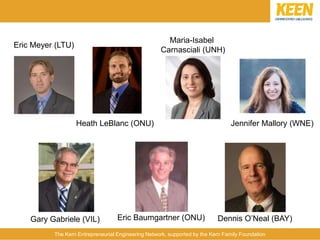
Eric Meyer (LTU)
Jennifer Mallory (WNE)
Gary Gabriele (VIL)
Heath LeBlanc (ONU)
Maria-Isabel
Carnasciali (UNH)
Eric Baumgartner (ONU) Dennis O’Neal (BAY)
The Kern Entrepreneurial Engineering Network, supported by the Kern Family Foundation
Session Outline
• Brief Introduction to the Topic – 10 minutes
• Faculty Panel – 30 minutes
• Dean’s Panel – 30 minutes
• Q & A – 15 minutes
The Kern Entrepreneurial Engineering Network, supported by the Kern Family Foundation
Exercise – 4” x 6” Card
• Does participating in KEEN activities (on and off
campus) “count” towards T&P or Annual
Performance Review (APR) at your Institution?
• Y/N
• If Yes, rate on a scale of 1 (very little) to 5 (a lot)
• Does pedagogical scholarship (i.e. the
scholarship of teaching and learning) “count”
towards T&P or APR at your Institution?
• Y/N
• If Yes, rate on a scale of 1 (very little) to 5 (a lot)
The Kern Entrepreneurial Engineering Network, supported by the Kern Family Foundation
Interviews
• Interviews Conducted with Dean’s and PIs at 20
KEEN Institutions
• Faculty Development Opportunities (KEEN and non-KEEN)
• Course and Module Development Expectations and Efforts
• APR and T&P Policies
• Best Practices and Gap Analysis
• Individuals involved included 15 Center Directors, 16
KEEN PIs & Co-PIs (not Deans), and 10 Administrators
(Deans, Provosts, Associates, etc.)
The Kern Entrepreneurial Engineering Network, supported by the Kern Family Foundation
Interview Results
• Terminology
• Teaching, Research, and Service
• Teaching, Professional Development, and Service
• Teaching, Professional Development/Scholarship, and
Service/Advising
• Teaching, Curriculum Development, and R&D
• Teaching, Research & Scholarship, and Service
• Teaching, Service, and Scholarship
• Continuous Course Improvement
• Academic Citizenship or Collegiality
The Kern Entrepreneurial Engineering Network, supported by the Kern Family Foundation
Interview Results
• 14 of 20 had a broad acceptance of KEEN-related
activities towards T&P and APR
• Statistics for Faculty Development (towards T&P)
• KEEN-related Faculty Development “Counts” @ 12
• KEEN-related Faculty Development indirectly “Counts” @ 5
• 3 indicated “No”
• 13 of 20 accept pedagogical scholarship towards T&P and
APR
The Kern Entrepreneurial Engineering Network, supported by the Kern Family Foundation
Interview Results
• Ranked Perceived Value
• Pedagogical (Instruction)
• Pedagogical Research (SoTL)
• EML and Discipline Specific Connections
• Faculty Engagement In Process
• Service
• To Profession and To University
The Kern Entrepreneurial Engineering Network, supported by the Kern Family Foundation
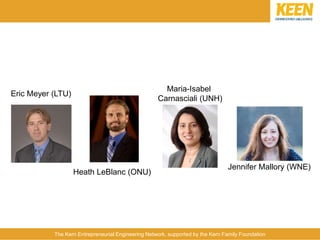
Eric Meyer (LTU)
Jennifer Mallory (WNE)
Heath LeBlanc (ONU)
Maria-Isabel
Carnasciali (UNH)
Eric G. Meyer, PhD
Assistant Professor
Biomedical Engineering
Lawrence Technological University
Background
 Attended Shaping Entrepreneurial Engineers at 2011 KEEN Winter
Meeting
 LTU KEEN Innovative Teaching workshops on PBL and ACL 2011-2013
 Attended KEEN Topical Grant Workshop with Doug Melton at Fall
Meeting in 2013
 Awarded KEEN Topical Grant (PI) Fostering the entrepreneurial
mindset through development of multidisciplinary engineering learning
modules based on the “Quantified Self” social movement 2013-2014
 Publication and presentation at 2015 ASEE Conference.
 Awarded KEEN Topical Network Grant (Co-PI) Building a Network for
Faculty Collaboration on Entrepreneurship by means of a “Quantified-
Self Roadshow” 2014-present
 Delivered QS4EML webinar and Roadshows at LTU and Bucknell (also
with Kettering, Ohio Northern and Western New England) in 2015
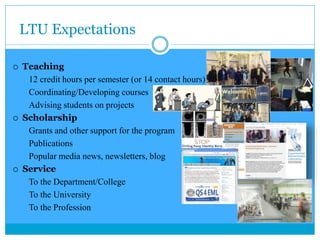
LTU Expectations
 Teaching
12 credit hours per semester (or 14 contact hours)
Coordinating/Developing courses
Advising students on projects
 Scholarship
Grants and other support for the program
Publications
Popular media news, newsletters, blog
 Service
To the Department/College
To the University
To the Profession
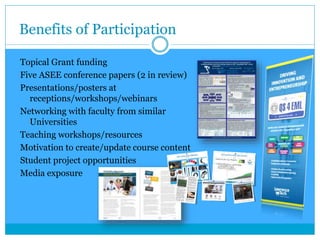
Topical Grant funding
Five ASEE conference papers (2 in review)
Presentations/posters at
receptions/workshops/webinars
Networking with faculty from similar
Universities
Teaching workshops/resources
Motivation to create/update course content
Student project opportunities
Media exposure
Benefits of Participation
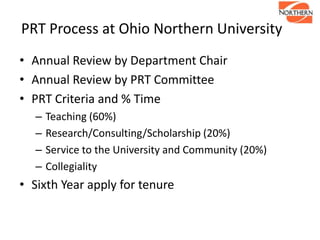
PRT Process at Ohio Northern University
• Annual Review by Department Chair
• Annual Review by PRT Committee
• PRT Criteria and % Time
– Teaching (60%)
– Research/Consulting/Scholarship (20%)
– Service to the University and Community (20%)
– Collegiality
• Sixth Year apply for tenure
Detailed PRT Criteria: Teaching & Research
• Teaching (60%)
– Nominal teaching load is 16 credit hours & 20 contact
hours per year (sum over 2 semesters)
– Need strong student evaluations
• > 4.0 out of 5.0 on average
– Must maintain labs and integrate active learning
• Research/Consulting/Scholarship (20%)
– External funding
• Must submit earnest grant proposals
– Publishing
• 1 Journal article every 2 or 3 years
• 1-3 conference papers every year
Detailed PRT Criteria: Service & Collegiality
• Service to the University and Community (20%)
– University Service
• At least 1 or 2 university-level committees
• Faculty mentor for student groups
– College Service
• Undergrad Recruitment
– Department Service
• Advising & Curriculum Development
– Professional Service
• Collegiality
– Mentoring
– Substitute for instructors when they travel
– Cross-disciplinary teaching and research initiatives
– General friendliness/politeness/etiquette
Leveraging KEEN toward PRT Success
• Teaching
– Electric Circuits EML Modules (over 3 years)
– System Design EML Modules
– Engineering Economy EML/Co-Curricular Structure
• Research/Consulting/Scholarship (20%)
– External funding
– Publications (6 conference papers + 2 in progress)
• Service
– KEEN Committee
• Collegiality
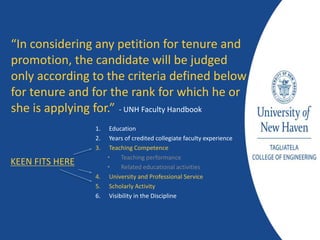
1. Education
2. Years of credited collegiate faculty experience
3. Teaching Competence
• Teaching performance
• Related educational activities
4. University and Professional Service
5. Scholarly Activity
6. Visibility in the Discipline
“In considering any petition for tenure and
promotion, the candidate will be judged
only according to the criteria defined below
for tenure and for the rank for which he or
she is applying for.” - UNH Faculty Handbook
KEEN FITS HERE
“ … candidate must present the following: [ … ]
elements such as syllabi, exams and/or assignments,
that can serve as evidence of teaching proficiency. …”
Easy to leverage KEEN work towards
 3. Teaching Competence
Topical Grant Modules PBL/EML Workshop
Modules
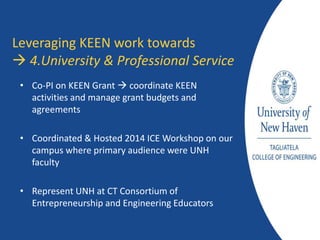
• Co-PI on KEEN Grant  coordinate KEEN
activities and manage grant budgets and
agreements
• Coordinated & Hosted 2014 ICE Workshop on our
campus where primary audience were UNH
faculty
• Represent UNH at CT Consortium of
Entrepreneurship and Engineering Educators
Leveraging KEEN work towards
 4.University & Professional Service
Boyer’s model of scholarship broadens the definition
of scholarship to include the systematic study of
teaching and learning processes.
Leveraging KEEN work towards
 5. Scholarly Activity
 Assessment work
towards quantifying
and characterizing an
engineering mindset
Conference presentations
and proceedings 
KEEN’s Impact on the
Tenure and Promotion Process
By: Jennifer Mallory
Assistant Professor of Mechanical Engineering
Western New England University
Department of Mechanical Engineering
Springfield, MA 01119
Tenure and Promotion at WNE
1. Teaching – 60%
• Student evaluations
• Recommendation letters focused on teaching effectiveness
2. Professional Development / Scholarship – 20%
• Publications and presentations
• Written proposals (funded and unfunded)
• Professional work (course development, significant course
revisions, unpublished research, etc.)
• Consulting
3. Governance / University Service / Advising – 20%
• Number of advisees
• Committees
• On-campus activities2
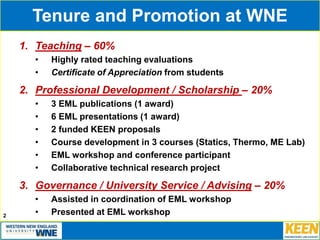
Tenure and Promotion at WNE
1. Teaching – 60%
• Highly rated teaching evaluations
• Certificate of Appreciation from students
2. Professional Development / Scholarship – 20%
• 3 EML publications (1 award)
• 6 EML presentations (1 award)
• 2 funded KEEN proposals
• Course development in 3 courses (Statics, Thermo, ME Lab)
• EML workshop and conference participant
• Collaborative technical research project
3. Governance / University Service / Advising – 20%
• Assisted in coordination of EML workshop
• Presented at EML workshop2
The Kern Entrepreneurial Engineering Network, supported by the Kern Family Foundation
Gary Gabriele (VIL) Eric Baumgartner (ONU) Dennis O’Neal (BAY)
Gary A. Gabriele, PhD
Drosdick Endowed Dean
Tenure and Promotion @ Villanova
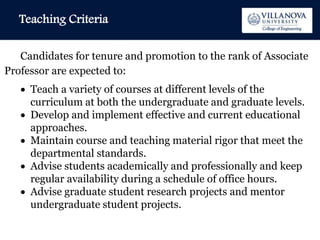
Teaching Criteria
Candidates for tenure and promotion to the rank of Associate
Professor are expected to:
 Teach a variety of courses at different levels of the
curriculum at both the undergraduate and graduate levels.
 Develop and implement effective and current educational
approaches.
 Maintain course and teaching material rigor that meet the
departmental standards.
 Advise students academically and professionally and keep
regular availability during a schedule of office hours.
 Advise graduate student research projects and mentor
undergraduate student projects.
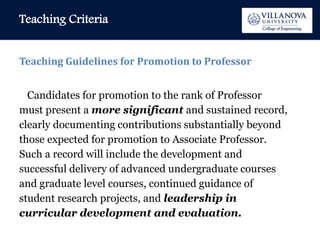
Teaching Criteria
Teaching Guidelines for Promotion to Professor
Candidates for promotion to the rank of Professor
must present a more significant and sustained record,
clearly documenting contributions substantially beyond
those expected for promotion to Associate Professor.
Such a record will include the development and
successful delivery of advanced undergraduate courses
and graduate level courses, continued guidance of
student research projects, and leadership in
curricular development and evaluation.
KEEN Activities for Faculty
Participation in the Engineering Entrepreneurship Minor
Faculty Deep Dive Workshop
Classroom visits by PI’s
Regular meeting of faculty participants to review results
KEEN Impact on Faculty
Evaluations at ONU
Faculty Evaluations
• All faculty are evaluated annually by their
department chair
• Tenure-track faculty are evaluated
annually by the college’s Promotion &
Tenure (P&T) Committee
– Faculty produce P&T binder, meet with P&T
Committee members plus Dean and Dept.
Chair, and receive written feedback
• Faculty document their activities within the
tool called Digital Measures
Teaching
• “You included entrepreneurial content into
two courses from KEEN grants. You are
integrating active learning styles in the
classroom.”
• “In an effort to move the class to project
based, I added two new projects that focus
on different modules. One of the projects
included entrepreneurial mindset.”
Scholarship
• “[Faculty] is collaborating . . . through a KEEN
Topical Grant to build course modules on the
topic of . . .”
• “Immersive Learning Methods of Delivery and
Entrepreneurial Minded Learning”, Kern
Family Foundation, $39,566
• “Blending Entrepreneurship and Design in an
Immersive Environment,” ASEE Annual
Conference, 2015
Professional Development
• “[Faculty] attended . . . KEEN Fall Meeting,
one technical conference, one educational
conference, and two KEEN webinar
workshops.”
• Attended “Nurturing Curiosity in the
Classroom and Beyond,” KEEN/ University
of Dayton, April 30 - May 1, 2015
Service
• Member, ONU KEEN Committee, ME
Department Representative, April 2012 -
present
– Organize KEEN Innovation Challenges, solicit
and evaluate internal proposals for KEEN-
funded teaching grants, monitor and guide
grant progress
Tenure and Promotion at Baylor
University
Dennis L. O’Neal, Ph.D., P.E.
Dean
2016 KEEN Winter Meeting
Tenure and Promotion Process at
Baylor
• Annual review by the tenured faculty of the
candidate
– Candidate’s “tenure” notebook
– Summary teaching evaluation
• Peer review reports
• Student evaluation forms
• Candidates reflective summaries
• Standard evaluation in the 6th year
Candidate’s tenure notebook includes a
“letter” explaining the case for tenure
• Teaching effectiveness
• Scholarship
• Professional and university service
• Community and religious service
• Interpersonal relationships – collegiality
• Statement of how the candidate support the goals and
mission of the university
Other items in the tenure notebook
• Annual evaluation reports
• Teaching
– Classes taught
– Evaluations – peer and student
– Teaching improvement
• Graduate students supervised
• Supporting materials for scholarly and
creative work
Where does KEEN fit into the tenure
process?
• Teaching
– Creation of new course content through integration of
KEEN concepts into existing classes
– Development of new classes
– Attending pedagogy workshops
• Scholarship
– ASEE educational papers related to integration of KEEN
concepts in the classroom
• University service
– Student engagement
• Small group book reviews
• Teal residential college program
The Kern Entrepreneurial Engineering Network, supported by the Kern Family Foundation
excited
EML makes
sense!
The Kern Entrepreneurial Engineering Network, supported by the Kern Family Foundation
Questions or Comments?
The Kern Entrepreneurial Engineering Network, supported by the Kern Family Foundation
Exercise – 4” x 6” Card
• Has your answer or perception of the value of
KEEN changed based on the panel?
• What are your personal action items when you
return to campus (based on this session)?

Career Advancement for Amplifying KEEN

  • 1.
    The Kern EntrepreneurialEngineering Network, supported by the Kern Family Foundation CAREER ADVANCEMENT FOR AMPLIFYING KEEN KEEN Winter Meeting January 6, 2015 Facilitator - Donald D. Carpenter Lawrence Technological University
  • 2.
    The Kern EntrepreneurialEngineering Network, supported by the Kern Family Foundation Description • When young faculty members focus on KEEN, what is the early career impact? {Faculty} • Can leveraging tenure and promotion policies on your campus amplify KEEN efforts? {Institution} • Can participating in KEEN early in a faculty career be a “win-win-win” for the faculty, the institution, and the Network? {All}
  • 3.
    The Kern EntrepreneurialEngineering Network, supported by the Kern Family Foundation Eric Meyer (LTU) Jennifer Mallory (WNE) Gary Gabriele (VIL) Heath LeBlanc (ONU) Maria-Isabel Carnasciali (UNH) Eric Baumgartner (ONU) Dennis O’Neal (BAY)
  • 4.
    The Kern EntrepreneurialEngineering Network, supported by the Kern Family Foundation Session Outline • Brief Introduction to the Topic – 10 minutes • Faculty Panel – 30 minutes • Dean’s Panel – 30 minutes • Q & A – 15 minutes
  • 5.
    The Kern EntrepreneurialEngineering Network, supported by the Kern Family Foundation Exercise – 4” x 6” Card • Does participating in KEEN activities (on and off campus) “count” towards T&P or Annual Performance Review (APR) at your Institution? • Y/N • If Yes, rate on a scale of 1 (very little) to 5 (a lot) • Does pedagogical scholarship (i.e. the scholarship of teaching and learning) “count” towards T&P or APR at your Institution? • Y/N • If Yes, rate on a scale of 1 (very little) to 5 (a lot)
  • 6.
    The Kern EntrepreneurialEngineering Network, supported by the Kern Family Foundation Interviews • Interviews Conducted with Dean’s and PIs at 20 KEEN Institutions • Faculty Development Opportunities (KEEN and non-KEEN) • Course and Module Development Expectations and Efforts • APR and T&P Policies • Best Practices and Gap Analysis • Individuals involved included 15 Center Directors, 16 KEEN PIs & Co-PIs (not Deans), and 10 Administrators (Deans, Provosts, Associates, etc.)
  • 7.
    The Kern EntrepreneurialEngineering Network, supported by the Kern Family Foundation Interview Results • Terminology • Teaching, Research, and Service • Teaching, Professional Development, and Service • Teaching, Professional Development/Scholarship, and Service/Advising • Teaching, Curriculum Development, and R&D • Teaching, Research & Scholarship, and Service • Teaching, Service, and Scholarship • Continuous Course Improvement • Academic Citizenship or Collegiality
  • 8.
    The Kern EntrepreneurialEngineering Network, supported by the Kern Family Foundation Interview Results • 14 of 20 had a broad acceptance of KEEN-related activities towards T&P and APR • Statistics for Faculty Development (towards T&P) • KEEN-related Faculty Development “Counts” @ 12 • KEEN-related Faculty Development indirectly “Counts” @ 5 • 3 indicated “No” • 13 of 20 accept pedagogical scholarship towards T&P and APR
  • 9.
    The Kern EntrepreneurialEngineering Network, supported by the Kern Family Foundation Interview Results • Ranked Perceived Value • Pedagogical (Instruction) • Pedagogical Research (SoTL) • EML and Discipline Specific Connections • Faculty Engagement In Process • Service • To Profession and To University
  • 10.
    The Kern EntrepreneurialEngineering Network, supported by the Kern Family Foundation
  • 11.
    The Kern EntrepreneurialEngineering Network, supported by the Kern Family Foundation Eric Meyer (LTU) Jennifer Mallory (WNE) Heath LeBlanc (ONU) Maria-Isabel Carnasciali (UNH)
  • 12.
    Eric G. Meyer,PhD Assistant Professor Biomedical Engineering Lawrence Technological University
  • 13.
    Background  Attended ShapingEntrepreneurial Engineers at 2011 KEEN Winter Meeting  LTU KEEN Innovative Teaching workshops on PBL and ACL 2011-2013  Attended KEEN Topical Grant Workshop with Doug Melton at Fall Meeting in 2013  Awarded KEEN Topical Grant (PI) Fostering the entrepreneurial mindset through development of multidisciplinary engineering learning modules based on the “Quantified Self” social movement 2013-2014  Publication and presentation at 2015 ASEE Conference.  Awarded KEEN Topical Network Grant (Co-PI) Building a Network for Faculty Collaboration on Entrepreneurship by means of a “Quantified- Self Roadshow” 2014-present  Delivered QS4EML webinar and Roadshows at LTU and Bucknell (also with Kettering, Ohio Northern and Western New England) in 2015
  • 14.
    LTU Expectations  Teaching 12credit hours per semester (or 14 contact hours) Coordinating/Developing courses Advising students on projects  Scholarship Grants and other support for the program Publications Popular media news, newsletters, blog  Service To the Department/College To the University To the Profession
  • 15.
    Topical Grant funding FiveASEE conference papers (2 in review) Presentations/posters at receptions/workshops/webinars Networking with faculty from similar Universities Teaching workshops/resources Motivation to create/update course content Student project opportunities Media exposure Benefits of Participation
  • 16.
    PRT Process atOhio Northern University • Annual Review by Department Chair • Annual Review by PRT Committee • PRT Criteria and % Time – Teaching (60%) – Research/Consulting/Scholarship (20%) – Service to the University and Community (20%) – Collegiality • Sixth Year apply for tenure
  • 17.
    Detailed PRT Criteria:Teaching & Research • Teaching (60%) – Nominal teaching load is 16 credit hours & 20 contact hours per year (sum over 2 semesters) – Need strong student evaluations • > 4.0 out of 5.0 on average – Must maintain labs and integrate active learning • Research/Consulting/Scholarship (20%) – External funding • Must submit earnest grant proposals – Publishing • 1 Journal article every 2 or 3 years • 1-3 conference papers every year
  • 18.
    Detailed PRT Criteria:Service & Collegiality • Service to the University and Community (20%) – University Service • At least 1 or 2 university-level committees • Faculty mentor for student groups – College Service • Undergrad Recruitment – Department Service • Advising & Curriculum Development – Professional Service • Collegiality – Mentoring – Substitute for instructors when they travel – Cross-disciplinary teaching and research initiatives – General friendliness/politeness/etiquette
  • 19.
    Leveraging KEEN towardPRT Success • Teaching – Electric Circuits EML Modules (over 3 years) – System Design EML Modules – Engineering Economy EML/Co-Curricular Structure • Research/Consulting/Scholarship (20%) – External funding – Publications (6 conference papers + 2 in progress) • Service – KEEN Committee • Collegiality
  • 20.
    1. Education 2. Yearsof credited collegiate faculty experience 3. Teaching Competence • Teaching performance • Related educational activities 4. University and Professional Service 5. Scholarly Activity 6. Visibility in the Discipline “In considering any petition for tenure and promotion, the candidate will be judged only according to the criteria defined below for tenure and for the rank for which he or she is applying for.” - UNH Faculty Handbook KEEN FITS HERE
  • 21.
    “ … candidatemust present the following: [ … ] elements such as syllabi, exams and/or assignments, that can serve as evidence of teaching proficiency. …” Easy to leverage KEEN work towards  3. Teaching Competence Topical Grant Modules PBL/EML Workshop Modules
  • 22.
    • Co-PI onKEEN Grant  coordinate KEEN activities and manage grant budgets and agreements • Coordinated & Hosted 2014 ICE Workshop on our campus where primary audience were UNH faculty • Represent UNH at CT Consortium of Entrepreneurship and Engineering Educators Leveraging KEEN work towards  4.University & Professional Service
  • 23.
    Boyer’s model ofscholarship broadens the definition of scholarship to include the systematic study of teaching and learning processes. Leveraging KEEN work towards  5. Scholarly Activity  Assessment work towards quantifying and characterizing an engineering mindset Conference presentations and proceedings 
  • 24.
    KEEN’s Impact onthe Tenure and Promotion Process By: Jennifer Mallory Assistant Professor of Mechanical Engineering Western New England University Department of Mechanical Engineering Springfield, MA 01119
  • 25.
    Tenure and Promotionat WNE 1. Teaching – 60% • Student evaluations • Recommendation letters focused on teaching effectiveness 2. Professional Development / Scholarship – 20% • Publications and presentations • Written proposals (funded and unfunded) • Professional work (course development, significant course revisions, unpublished research, etc.) • Consulting 3. Governance / University Service / Advising – 20% • Number of advisees • Committees • On-campus activities2
  • 26.
    Tenure and Promotionat WNE 1. Teaching – 60% • Highly rated teaching evaluations • Certificate of Appreciation from students 2. Professional Development / Scholarship – 20% • 3 EML publications (1 award) • 6 EML presentations (1 award) • 2 funded KEEN proposals • Course development in 3 courses (Statics, Thermo, ME Lab) • EML workshop and conference participant • Collaborative technical research project 3. Governance / University Service / Advising – 20% • Assisted in coordination of EML workshop • Presented at EML workshop2
  • 27.
    The Kern EntrepreneurialEngineering Network, supported by the Kern Family Foundation Gary Gabriele (VIL) Eric Baumgartner (ONU) Dennis O’Neal (BAY)
  • 28.
    Gary A. Gabriele,PhD Drosdick Endowed Dean Tenure and Promotion @ Villanova
  • 29.
    Teaching Criteria Candidates fortenure and promotion to the rank of Associate Professor are expected to:  Teach a variety of courses at different levels of the curriculum at both the undergraduate and graduate levels.  Develop and implement effective and current educational approaches.  Maintain course and teaching material rigor that meet the departmental standards.  Advise students academically and professionally and keep regular availability during a schedule of office hours.  Advise graduate student research projects and mentor undergraduate student projects.
  • 30.
    Teaching Criteria Teaching Guidelinesfor Promotion to Professor Candidates for promotion to the rank of Professor must present a more significant and sustained record, clearly documenting contributions substantially beyond those expected for promotion to Associate Professor. Such a record will include the development and successful delivery of advanced undergraduate courses and graduate level courses, continued guidance of student research projects, and leadership in curricular development and evaluation.
  • 31.
    KEEN Activities forFaculty Participation in the Engineering Entrepreneurship Minor Faculty Deep Dive Workshop Classroom visits by PI’s Regular meeting of faculty participants to review results
  • 32.
    KEEN Impact onFaculty Evaluations at ONU
  • 33.
    Faculty Evaluations • Allfaculty are evaluated annually by their department chair • Tenure-track faculty are evaluated annually by the college’s Promotion & Tenure (P&T) Committee – Faculty produce P&T binder, meet with P&T Committee members plus Dean and Dept. Chair, and receive written feedback • Faculty document their activities within the tool called Digital Measures
  • 34.
    Teaching • “You includedentrepreneurial content into two courses from KEEN grants. You are integrating active learning styles in the classroom.” • “In an effort to move the class to project based, I added two new projects that focus on different modules. One of the projects included entrepreneurial mindset.”
  • 35.
    Scholarship • “[Faculty] iscollaborating . . . through a KEEN Topical Grant to build course modules on the topic of . . .” • “Immersive Learning Methods of Delivery and Entrepreneurial Minded Learning”, Kern Family Foundation, $39,566 • “Blending Entrepreneurship and Design in an Immersive Environment,” ASEE Annual Conference, 2015
  • 36.
    Professional Development • “[Faculty]attended . . . KEEN Fall Meeting, one technical conference, one educational conference, and two KEEN webinar workshops.” • Attended “Nurturing Curiosity in the Classroom and Beyond,” KEEN/ University of Dayton, April 30 - May 1, 2015
  • 37.
    Service • Member, ONUKEEN Committee, ME Department Representative, April 2012 - present – Organize KEEN Innovation Challenges, solicit and evaluate internal proposals for KEEN- funded teaching grants, monitor and guide grant progress
  • 38.
    Tenure and Promotionat Baylor University Dennis L. O’Neal, Ph.D., P.E. Dean 2016 KEEN Winter Meeting
  • 39.
    Tenure and PromotionProcess at Baylor • Annual review by the tenured faculty of the candidate – Candidate’s “tenure” notebook – Summary teaching evaluation • Peer review reports • Student evaluation forms • Candidates reflective summaries • Standard evaluation in the 6th year
  • 40.
    Candidate’s tenure notebookincludes a “letter” explaining the case for tenure • Teaching effectiveness • Scholarship • Professional and university service • Community and religious service • Interpersonal relationships – collegiality • Statement of how the candidate support the goals and mission of the university
  • 41.
    Other items inthe tenure notebook • Annual evaluation reports • Teaching – Classes taught – Evaluations – peer and student – Teaching improvement • Graduate students supervised • Supporting materials for scholarly and creative work
  • 42.
    Where does KEENfit into the tenure process? • Teaching – Creation of new course content through integration of KEEN concepts into existing classes – Development of new classes – Attending pedagogy workshops • Scholarship – ASEE educational papers related to integration of KEEN concepts in the classroom • University service – Student engagement • Small group book reviews • Teal residential college program
  • 43.
    The Kern EntrepreneurialEngineering Network, supported by the Kern Family Foundation excited EML makes sense!
  • 44.
    The Kern EntrepreneurialEngineering Network, supported by the Kern Family Foundation Questions or Comments?
  • 45.
    The Kern EntrepreneurialEngineering Network, supported by the Kern Family Foundation Exercise – 4” x 6” Card • Has your answer or perception of the value of KEEN changed based on the panel? • What are your personal action items when you return to campus (based on this session)?