www.hamk.fi
International teacher training in BRICS
countries - successful case examples
from HAMK Finland
Dr. Seija Mahlamäki-Kultanen, Dean
Häme University of Applied Sciences (HAMK)
School of Professional Teacher Education
FINLAND
www.hamk.fi
Global challenges for the universities
• Increasing demands for universities call for teacher development
• International cooperation
• Modern pedagogical approaches
• Digitalisation
• Innovation and entrepreneurship
• Relationships with the world of work
• Sustainable development
www.hamk.fi
Why Finland?
• International benchmark in Pisa and PIAAC
• High prestige of vocational and professional education
• Competence-based curricula
• Teachers´ autonomy and appreciation
• Relevance for the world of work in university education
• Responsiveness for the globalization of labour markets
• Consensus over the importance of education
• Evidence and research-based education, transparency and institutional
QA
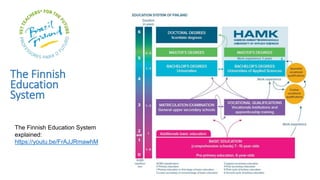
The Finnish
Education
System
The Finnish Education System
explained:
https://youtu.be/FrAJJRmawhM
www.hamk.fi
• International benchmark in Pisa and PIAAC
• High prestige of vocational and professional education
• Competence-based curricula
• Teachers´ autonomy and appreciation
• Relevance for the world of work in university education
• Responsiveness for the globalization of labour markets
• Consensus over the importance of education
• Evidence and research-based education, transparency and institutional
QA
•VET Teachers for the Future (Professores para o
Futuro) professional development certificate,
Brazil
•Short study visits; China, South Africa
Strategic aims of the VET Teachers for
the Future programme
• Based on national strategic areas of innovation and technology (In
case Brazil they were agriculture, food processing, automotive
industry, biotechnology, building, creative economy, renewable
energy, education technology, information and communication
technologies, technologies for sustainability.
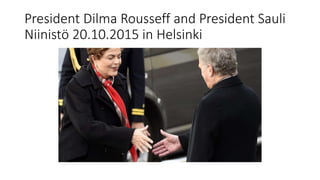
• Support from the highest possible level (even Presidential visit
20.10.2015)
• Institutional targets
• Participant targets
President Dilma Rousseff and President Sauli
Niinistö 20.10.2015 in Helsinki
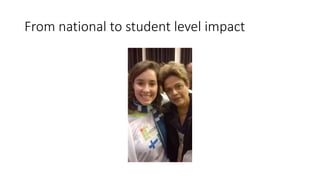
From national to student level impact
Case: Pilot 1 and 2
• Altogether 60 VET Teachers for the Future participants from Brazil
• Autumn 2014, Spring 2015 cohorts, both in two groups, Hämeenlinna
and Tampere
• Design-based research and programme development
• Intensive quality work
• Emphasis on impact in the target country, relevance testing and
transfer of innovations and best practices from a country to another
Innovative training models for
University -Business collaboration
• Teacher training needs to reflect the widening understanding of
learning and learning environments
• International networks provide a fruitful ground for innovations and
learning
• There is the need for alternative theories and models for international
teacher training which take into account all forms of learning (formal,
non-formal, informal)
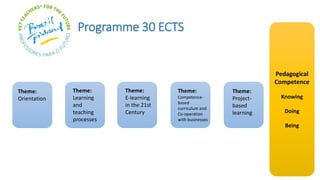
Programme 30 ECTS
Theme:
Orientation
Theme:
Learning
and
teaching
processes
Theme:
E-learning
in the 21st
Century
Theme:
Competence-
based
curriculum and
Co-operation
with businesses
Theme:
Project-
based
learning
Pedagogical
Competence
Knowing
Doing
Being
VET Teachers for the Future Brazil
partners
Programme is administered and coordinated by Häme University of
Applied Sciences (HAMK) and implemented also in Tampere University
of Applied Sciences (TAMK)
Institutos Federal
• Ministry of Education, Brazil MEC/SETEC
• CNPq
• Embassy of Finland and Brazil
TESTING CLIPBOARD ACCESS
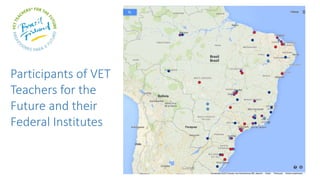
Participants of VET
Teachers for the
Future and their
Federal Institutes
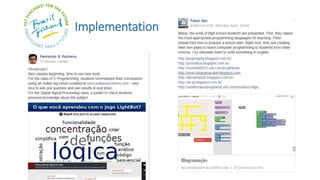
Implementation
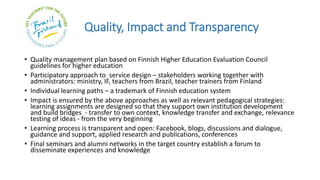
Quality, Impact and Transparency
• Quality management plan based on Finnish Higher Education Evaluation Council
guidelines for higher education
• Participatory approach to service design – stakeholders working together with
administrators: ministry, IF, teachers from Brazil, teacher trainers from Finland
• Individual learning paths – a trademark of Finnish education system
• Impact is ensured by the above approaches as well as relevant pedagogical strategies:
learning assignments are designed so that they support own institution development
and build bridges - transfer to own context, knowledge transfer and exchange, relevance
testing of ideas - from the very beginning
• Learning process is transparent and open: Facebook, blogs, discussions and dialogue,
guidance and support, applied research and publications, conferences
• Final seminars and alumni networks in the target country establish a forum to
disseminate experiences and knowledge
QA Findings
• https://www.theseus.fi/bitstream/handle/10024/97697/HAMK_VETt
eachers_cohort1_2015_ebook.pdf?sequence=1
• Feedback collected by surveys and interviews
• The programme objectives proven relevant, participant satisfaction
high: in a scale of 1-4 on the level 3,7-3,9 depending on the group
• Critical points
• More personal councelling and guidance in home country
• Teachers as learners - a change in the mindset
• The importance of reality testing of innovative pedagogical methods before participants
Theory development
• A learning group (Compare with Poikela & Poikela (2012,12)
• A group of foreign, adult teacher-participants in a new country, in a new
culture, in new kinds of schools and learning environments
• The teacher-participants have to change perspectives from teachers to
learners
• The group explores actions, listens, participates, does and learns together
Theory development
• Everyday life (Compare with Poikela & Poikela (2012,12)
• Acting as well in schools as well as outside schools, in public and private life
• How and when do local people do things and perform acts in schools
• How does the society and community deal with education?
• What do the people do in practice?
• How do they interact?
Theory development
• History and perspectives for the future (Compare with Poikela &
Poikela (2012,12)
• Refers to people´s action and context
• How and by whom was the educational system constructed?
• What did the infrastructure look like before?
• What legends about education and learning do the people share?
• Are Finnish teacher autonomy, safety, school success, equality, welfare,
functionality true in Finland
• How did they become into existence?
• Are they there also in the future?
Theory development
• Constructing a common narrative (Compare with Poikela & Poikela
(2012,12)
• Communicative actions of the teacher training participants in all forms
• The narrative is constantly constructed, made visible and accessible by
expressions in digital and other formats, “ digital postcards” to home and to
peers
• Sharing and interpreting experiences together, enhanced by guides, teacher
trainers
Theory development
• Constructing individual narratives ( Compare with Poikela & Poikela
(2012,12)
• Own professional identity formation
• Support from the peer group in Finland
• Initial testing of ideas into the own context by digital tools, making
comparisons with the peers and planning the final implementation of newly
learned teaching methods in home country of origin and home institution
New competence needs for teacher
trainers (compare with Poikela & Poikela 2012)
• Connected to entrepreneurship
• Organizing several services
• Entrepreneurial skills
• Leadership
• Innovativeness
• Cultural and social competences
• Connected to learning
• Ability to exploit existing
knowledge in the community
• Ability to recognize tacit
knowledge
• Teaching and learning on-the-job
• Self-development
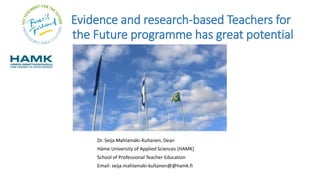
Evidence and research-based Teachers for
the Future programme has great potential
Dr. Seija Mahlamäki-Kultanen, Dean
Häme University of Applied Sciences (HAMK)
School of Professional Teacher Education
Email: seija.mahlamaki-kultanen@@hamk.fi
Study visits from China and South Africa
• There is a growing interest in China for developing more competence-
based curricula and strategies in universities and construct a system
of Universities of Applied Sciences
• Efficient models for teacher and manager development -> Targeted
study visits, 1-2 weeks
• References:
• Jianxi (China)
• Services SETA, MERSETA (South Africa)
Study visits from China and South Africa
• There is a growing interest in China for developing more competence-
based curricula and strategies in universities and construct a system
of Universities of Applied Sciences
• Efficient models for teacher and manager development -> Targeted
study visits, 1-2 weeks
• References:
• Jianxi (China)
• Services SETA, MERSETA (South Africa)

Brics summit mahlamaki kultanen 27.10.2015

  • 1.
    www.hamk.fi International teacher trainingin BRICS countries - successful case examples from HAMK Finland Dr. Seija Mahlamäki-Kultanen, Dean Häme University of Applied Sciences (HAMK) School of Professional Teacher Education FINLAND
  • 2.
    www.hamk.fi Global challenges forthe universities • Increasing demands for universities call for teacher development • International cooperation • Modern pedagogical approaches • Digitalisation • Innovation and entrepreneurship • Relationships with the world of work • Sustainable development
  • 3.
    www.hamk.fi Why Finland? • Internationalbenchmark in Pisa and PIAAC • High prestige of vocational and professional education • Competence-based curricula • Teachers´ autonomy and appreciation • Relevance for the world of work in university education • Responsiveness for the globalization of labour markets • Consensus over the importance of education • Evidence and research-based education, transparency and institutional QA
  • 4.
    The Finnish Education System The FinnishEducation System explained: https://youtu.be/FrAJJRmawhM
  • 5.
    www.hamk.fi • International benchmarkin Pisa and PIAAC • High prestige of vocational and professional education • Competence-based curricula • Teachers´ autonomy and appreciation • Relevance for the world of work in university education • Responsiveness for the globalization of labour markets • Consensus over the importance of education • Evidence and research-based education, transparency and institutional QA
  • 6.
    •VET Teachers forthe Future (Professores para o Futuro) professional development certificate, Brazil •Short study visits; China, South Africa
  • 7.
    Strategic aims ofthe VET Teachers for the Future programme • Based on national strategic areas of innovation and technology (In case Brazil they were agriculture, food processing, automotive industry, biotechnology, building, creative economy, renewable energy, education technology, information and communication technologies, technologies for sustainability. • Support from the highest possible level (even Presidential visit 20.10.2015) • Institutional targets • Participant targets
  • 8.
    President Dilma Rousseffand President Sauli Niinistö 20.10.2015 in Helsinki
  • 9.
    From national tostudent level impact
  • 10.
    Case: Pilot 1and 2 • Altogether 60 VET Teachers for the Future participants from Brazil • Autumn 2014, Spring 2015 cohorts, both in two groups, Hämeenlinna and Tampere • Design-based research and programme development • Intensive quality work • Emphasis on impact in the target country, relevance testing and transfer of innovations and best practices from a country to another
  • 11.
    Innovative training modelsfor University -Business collaboration • Teacher training needs to reflect the widening understanding of learning and learning environments • International networks provide a fruitful ground for innovations and learning • There is the need for alternative theories and models for international teacher training which take into account all forms of learning (formal, non-formal, informal)
  • 12.
    Programme 30 ECTS Theme: Orientation Theme: Learning and teaching processes Theme: E-learning inthe 21st Century Theme: Competence- based curriculum and Co-operation with businesses Theme: Project- based learning Pedagogical Competence Knowing Doing Being
  • 13.
    VET Teachers forthe Future Brazil partners Programme is administered and coordinated by Häme University of Applied Sciences (HAMK) and implemented also in Tampere University of Applied Sciences (TAMK) Institutos Federal • Ministry of Education, Brazil MEC/SETEC • CNPq • Embassy of Finland and Brazil TESTING CLIPBOARD ACCESS
  • 14.
    Participants of VET Teachersfor the Future and their Federal Institutes
  • 15.
  • 19.
    Quality, Impact andTransparency • Quality management plan based on Finnish Higher Education Evaluation Council guidelines for higher education • Participatory approach to service design – stakeholders working together with administrators: ministry, IF, teachers from Brazil, teacher trainers from Finland • Individual learning paths – a trademark of Finnish education system • Impact is ensured by the above approaches as well as relevant pedagogical strategies: learning assignments are designed so that they support own institution development and build bridges - transfer to own context, knowledge transfer and exchange, relevance testing of ideas - from the very beginning • Learning process is transparent and open: Facebook, blogs, discussions and dialogue, guidance and support, applied research and publications, conferences • Final seminars and alumni networks in the target country establish a forum to disseminate experiences and knowledge
  • 20.
    QA Findings • https://www.theseus.fi/bitstream/handle/10024/97697/HAMK_VETt eachers_cohort1_2015_ebook.pdf?sequence=1 •Feedback collected by surveys and interviews • The programme objectives proven relevant, participant satisfaction high: in a scale of 1-4 on the level 3,7-3,9 depending on the group • Critical points • More personal councelling and guidance in home country • Teachers as learners - a change in the mindset • The importance of reality testing of innovative pedagogical methods before participants
  • 21.
    Theory development • Alearning group (Compare with Poikela & Poikela (2012,12) • A group of foreign, adult teacher-participants in a new country, in a new culture, in new kinds of schools and learning environments • The teacher-participants have to change perspectives from teachers to learners • The group explores actions, listens, participates, does and learns together
  • 22.
    Theory development • Everydaylife (Compare with Poikela & Poikela (2012,12) • Acting as well in schools as well as outside schools, in public and private life • How and when do local people do things and perform acts in schools • How does the society and community deal with education? • What do the people do in practice? • How do they interact?
  • 23.
    Theory development • Historyand perspectives for the future (Compare with Poikela & Poikela (2012,12) • Refers to people´s action and context • How and by whom was the educational system constructed? • What did the infrastructure look like before? • What legends about education and learning do the people share? • Are Finnish teacher autonomy, safety, school success, equality, welfare, functionality true in Finland • How did they become into existence? • Are they there also in the future?
  • 24.
    Theory development • Constructinga common narrative (Compare with Poikela & Poikela (2012,12) • Communicative actions of the teacher training participants in all forms • The narrative is constantly constructed, made visible and accessible by expressions in digital and other formats, “ digital postcards” to home and to peers • Sharing and interpreting experiences together, enhanced by guides, teacher trainers
  • 25.
    Theory development • Constructingindividual narratives ( Compare with Poikela & Poikela (2012,12) • Own professional identity formation • Support from the peer group in Finland • Initial testing of ideas into the own context by digital tools, making comparisons with the peers and planning the final implementation of newly learned teaching methods in home country of origin and home institution
  • 26.
    New competence needsfor teacher trainers (compare with Poikela & Poikela 2012) • Connected to entrepreneurship • Organizing several services • Entrepreneurial skills • Leadership • Innovativeness • Cultural and social competences • Connected to learning • Ability to exploit existing knowledge in the community • Ability to recognize tacit knowledge • Teaching and learning on-the-job • Self-development
  • 27.
    Evidence and research-basedTeachers for the Future programme has great potential Dr. Seija Mahlamäki-Kultanen, Dean Häme University of Applied Sciences (HAMK) School of Professional Teacher Education Email: seija.mahlamaki-kultanen@@hamk.fi
  • 28.
    Study visits fromChina and South Africa • There is a growing interest in China for developing more competence- based curricula and strategies in universities and construct a system of Universities of Applied Sciences • Efficient models for teacher and manager development -> Targeted study visits, 1-2 weeks • References: • Jianxi (China) • Services SETA, MERSETA (South Africa)
  • 29.
    Study visits fromChina and South Africa • There is a growing interest in China for developing more competence- based curricula and strategies in universities and construct a system of Universities of Applied Sciences • Efficient models for teacher and manager development -> Targeted study visits, 1-2 weeks • References: • Jianxi (China) • Services SETA, MERSETA (South Africa)