~Lalit Kishore
Learning Disabilities
Learning disabilities are neurological conditions that
affect the brain's ability or individual’s cognitive
functions to receive, process,
analyze, or retain information for children with
average and above average IQ.
Neurological conditions: Brain Areas Damage; Central
Nervous System Dysfunction; Heredity
Results into: IQ-Achievement Discrepancy
LDs in general
 A heterogeneous group of disorders manifested by
significant difficulties in the acquisition and use of:
 Listening and speaking
 Reading
 Writing
 Cognitive skills
 Reasoning or higher order thinking
 Mathematical abilities.
INCIDENT RATE
 Estimated 15 % of over the total population
 6 % to 8 % of school age population (3-11 years)
 Reading disorder is most common : Around 70% of
learning disabled get visibly marked by:
 facial grimacing / tenseness
 squinting
 head tilting
 eye rubbing
 close working distance
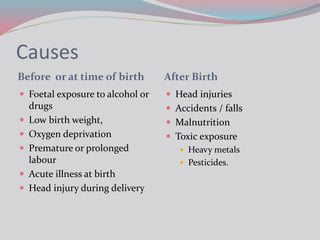
Causes
Before or at time of birth After Birth
 Foetal exposure to alcohol or
drugs
 Low birth weight,
 Oxygen deprivation
 Premature or prolonged
labour
 Acute illness at birth
 Head injury during delivery
 Head injuries
 Accidents / falls
 Malnutrition
 Toxic exposure
 Heavy metals
 Pesticides.
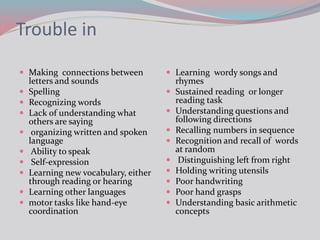
Trouble in
 Making connections between
letters and sounds
 Spelling
 Recognizing words
 Lack of understanding what
others are saying
 organizing written and spoken
language
 Ability to speak
 Self-expression
 Learning new vocabulary, either
through reading or hearing
 Learning other languages
 motor tasks like hand-eye
coordination
 Learning wordy songs and
rhymes
 Sustained reading or longer
reading task
 Understanding questions and
following directions
 Recalling numbers in sequence
 Recognition and recall of words
at random
 Distinguishing left from right
 Holding writing utensils
 Poor handwriting
 Poor hand grasps
 Understanding basic arithmetic
concepts
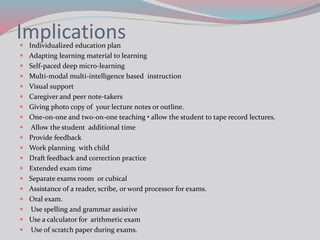
Implications
 Individualized education plan
 Adapting learning material to learning
 Self-paced deep micro-learning
 Multi-modal multi-intelligence based instruction
 Visual support
 Caregiver and peer note-takers
 Giving photo copy of your lecture notes or outline.
 One-on-one and two-on-one teaching • allow the student to tape record lectures.
 Allow the student additional time
 Provide feedback
 Work planning with child
 Draft feedback and correction practice
 Extended exam time
 Separate exams room or cubical
 Assistance of a reader, scribe, or word processor for exams.
 Oral exam.
 Use spelling and grammar assistive
 Use a calculator for arithmetic exam
 Use of scratch paper during exams.

Learning Disability: Conditions and causes.pptx

  • 1.
  • 2.
    Learning Disabilities Learning disabilitiesare neurological conditions that affect the brain's ability or individual’s cognitive functions to receive, process, analyze, or retain information for children with average and above average IQ. Neurological conditions: Brain Areas Damage; Central Nervous System Dysfunction; Heredity Results into: IQ-Achievement Discrepancy
  • 3.
    LDs in general A heterogeneous group of disorders manifested by significant difficulties in the acquisition and use of:  Listening and speaking  Reading  Writing  Cognitive skills  Reasoning or higher order thinking  Mathematical abilities.
  • 4.
    INCIDENT RATE  Estimated15 % of over the total population  6 % to 8 % of school age population (3-11 years)  Reading disorder is most common : Around 70% of learning disabled get visibly marked by:  facial grimacing / tenseness  squinting  head tilting  eye rubbing  close working distance
  • 5.
    Causes Before or attime of birth After Birth  Foetal exposure to alcohol or drugs  Low birth weight,  Oxygen deprivation  Premature or prolonged labour  Acute illness at birth  Head injury during delivery  Head injuries  Accidents / falls  Malnutrition  Toxic exposure  Heavy metals  Pesticides.
  • 6.
    Trouble in  Makingconnections between letters and sounds  Spelling  Recognizing words  Lack of understanding what others are saying  organizing written and spoken language  Ability to speak  Self-expression  Learning new vocabulary, either through reading or hearing  Learning other languages  motor tasks like hand-eye coordination  Learning wordy songs and rhymes  Sustained reading or longer reading task  Understanding questions and following directions  Recalling numbers in sequence  Recognition and recall of words at random  Distinguishing left from right  Holding writing utensils  Poor handwriting  Poor hand grasps  Understanding basic arithmetic concepts
  • 7.
    Implications  Individualized educationplan  Adapting learning material to learning  Self-paced deep micro-learning  Multi-modal multi-intelligence based instruction  Visual support  Caregiver and peer note-takers  Giving photo copy of your lecture notes or outline.  One-on-one and two-on-one teaching • allow the student to tape record lectures.  Allow the student additional time  Provide feedback  Work planning with child  Draft feedback and correction practice  Extended exam time  Separate exams room or cubical  Assistance of a reader, scribe, or word processor for exams.  Oral exam.  Use spelling and grammar assistive  Use a calculator for arithmetic exam  Use of scratch paper during exams.