DIGIGOGY
A DIGITAL PEDAGOGY
Dr N V Prem Kumar
Principal
Andhra Muslim College Of Education
GUNTUR
E-Mail: premnandigam@gmail.com
Ph.No: 9440214685
Introduction:
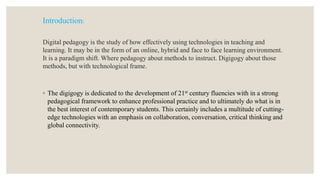
Digital pedagogy is the study of how effectively using technologies in teaching and
learning. It may be in the form of an online, hybrid and face to face learning environment.
It is a paradigm shift. Where pedagogy about methods to instruct. Digigogy about those
methods, but with technological frame.
◦ The digigogy is dedicated to the development of 21st century fluencies with in a strong
pedagogical framework to enhance professional practice and to ultimately do what is in
the best interest of contemporary students. This certainly includes a multitude of cutting-
edge technologies with an emphasis on collaboration, conversation, critical thinking and
global connectivity.
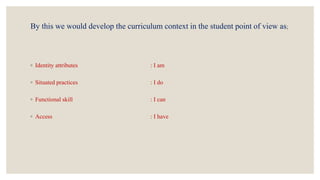
By this we would develop the curriculum context in the student point of view as;
◦ Identity attributes : I am
◦ Situated practices : I do
◦ Functional skill : I can
◦ Access : I have
Techno – Pedagogy
Flipped Classroom:
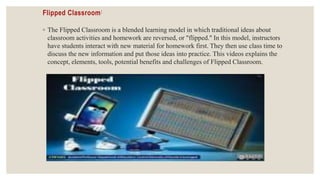
◦ The Flipped Classroom is a blended learning model in which traditional ideas about
classroom activities and homework are reversed, or "flipped." In this model, instructors
have students interact with new material for homework first. They then use class time to
discuss the new information and put those ideas into practice. This videos explains the
concept, elements, tools, potential benefits and challenges of Flipped Classroom.
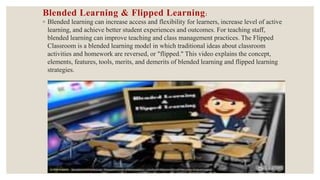
Blended Learning & Flipped Learning:
◦ Blended learning can increase access and flexibility for learners, increase level of active
learning, and achieve better student experiences and outcomes. For teaching staff,
blended learning can improve teaching and class management practices. The Flipped
Classroom is a blended learning model in which traditional ideas about classroom
activities and homework are reversed, or "flipped." This video explains the concept,
elements, features, tools, merits, and demerits of blended learning and flipped learning
strategies.
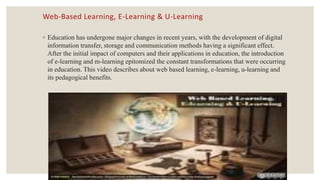
Web-Based Learning, E-Learning & U-Learning
◦ Education has undergone major changes in recent years, with the development of digital
information transfer, storage and communication methods having a significant effect.
After the initial impact of computers and their applications in education, the introduction
of e-learning and m-learning epitomized the constant transformations that were occurring
in education. This video describes about web based learning, e-learning, u-learning and
its pedagogical benefits.
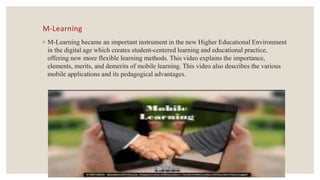
M-Learning
◦ M-Learning became an important instrument in the new Higher Educational Environment
in the digital age which creates student-centered learning and educational practice,
offering new more flexible learning methods. This video explains the importance,
elements, merits, and demerits of mobile learning. This video also describes the various
mobile applications and its pedagogical advantages.
E-Assessment
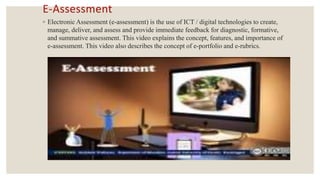
◦ Electronic Assessment (e-assessment) is the use of ICT / digital technologies to create,
manage, deliver, and assess and provide immediate feedback for diagnostic, formative,
and summative assessment. This video explains the concept, features, and importance of
e-assessment. This video also describes the concept of e-portfolio and e-rubrics.
Video Conferencing Etiquette
◦ This presentation describes the digital etiquettes of video conferencing ethics and manners.
https://drive.google.com/file/d/1yxWi-
UxUaRAfJnY56R7B0oA8IIGnzUIO/view?usp=sharing
Interactive Presentation Tool
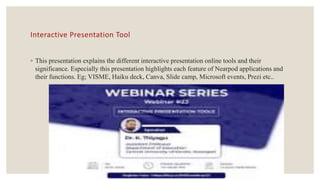
◦ This presentation explains the different interactive presentation online tools and their
significance. Especially this presentation highlights each feature of Nearpod applications and
their functions. Eg; VISME, Haiku deck, Canva, Slide camp, Microsoft events, Prezi etc..
Classroom Management Tool
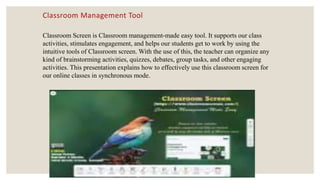
Classroom Screen is Classroom management-made easy tool. It supports our class
activities, stimulates engagement, and helps our students get to work by using the
intuitive tools of Classroom screen. With the use of this, the teacher can organize any
kind of brainstorming activities, quizzes, debates, group tasks, and other engaging
activities. This presentation explains how to effectively use this classroom screen for
our online classes in synchronous mode.
Artificial Intelligence (AI) in Education
◦ Artificial Intelligence (AI) refers to the ability of machines to
perform cognitive tasks like thinking, perceiving, learning,
problem-solving and decision making; it is inspired by the ways
people use their brains to perceive, learn, reason out and decide
the action. Especially, AI makes a lot of footprints in education
such as automated feedback, Intelligent tutoring, learning
analytics, virtual agents, virtual reality, and an online proctored
examination. This presentation describes the concept of Artificial
intelligence and its pedagogical practices.
Techno-Phobia
◦ Technophobia is described as abnormal anxiety or fear related to the effects of technology.
EdTech Trends
This video describes the different educational technology trends of 2023
and their salient features. Similarly, this video gives a view of the
different digital pedagogical frameworks. Eg; Tech enabled immersive
learning, innovative K-12 home schooling startups, E-learning, accessible
education, AI enabled adoptive learning, Gamification eg; mine craft etc..
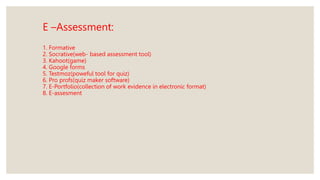
E –Assessment:
1. Formative
2. Socrative(web- based assessment tool)
3. Kahoot(game)
4. Google forms
5. Testmoz(poweful tool for quiz)
6. Pro profs(quiz maker software)
7. E-Portfolio(collection of work evidence in electronic format)
8. E-assesment
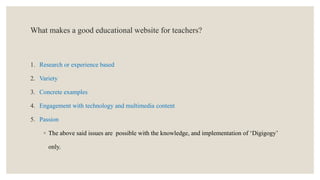
What makes a good educational website for teachers?
1. Research or experience based
2. Variety
3. Concrete examples
4. Engagement with technology and multimedia content
5. Passion
◦ The above said issues are possible with the knowledge, and implementation of ‘Digigogy’
only.
instructure.com
byjus.com
quizlet.com
udemy.com
toppr.com
scribd.com
blackboard.com
boun.edu.tr
duolingo.com
gdz.ru
grammarly.com
schoology.com
quizizz.com
librus.pl
brainly.co.id
academia.edu
clever.com
coursera.org
chegg.com
vedantu.com
index-education.net
pearson.com
uchi.ru brainly.in
learncbse.in
khanacademy.org
studocu.com
ruangguru.com
unam.mx
myflixer.to
pdfdrive.com
dnevnik.ru
coursehero.com
brainly.lat
study.com
mheducation.com
vietjack.com
jagranjosh.com
examinationservices.nic.in
benesse.ne.jp
education.gouv.fr
school.mosreg.ru
wordwall.net
brainly.com
brightspace.com
k12.com
liveworksheets.com
powerschool.com
mathway.com
cengage.com
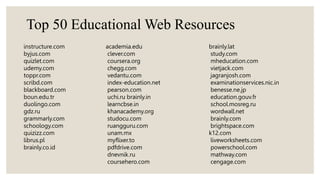
Top 50 Educational Web Resources
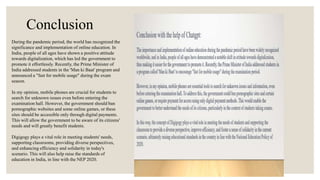
During the pandemic period, the world has recognized the
significance and implementation of online education. In
India, people of all ages have shown a positive attitude
towards digitalization, which has led the government to
promote it effortlessly. Recently, the Prime Minister of
India addressed students in the 'Man ki Baat' program and
announced a "fast for mobile usage" during the exam
season.
In my opinion, mobile phones are crucial for students to
search for unknown issues even before entering the
examination hall. However, the government should ban
pornographic websites and some online games, or these
sites should be accessible only through digital payments.
This will allow the government to be aware of its citizens'
needs and will greatly benefit students.
Digigogy plays a vital role in meeting students' needs,
supporting classrooms, providing diverse perspectives,
and enhancing efficiency and solidarity in today's
scenario. This will also help raise the standards of
education in India, in line with the NEP 2020.
Conclusion
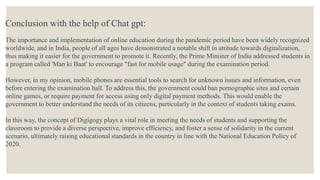
Conclusion with the help of Chat gpt:
The importance and implementation of online education during the pandemic period have been widely recognized
worldwide, and in India, people of all ages have demonstrated a notable shift in attitude towards digitalization,
thus making it easier for the government to promote it. Recently, the Prime Minister of India addressed students in
a program called 'Man ki Baat' to encourage "fast for mobile usage" during the examination period.
However, in my opinion, mobile phones are essential tools to search for unknown issues and information, even
before entering the examination hall. To address this, the government could ban pornographic sites and certain
online games, or require payment for access using only digital payment methods. This would enable the
government to better understand the needs of its citizens, particularly in the context of students taking exams.
In this way, the concept of Digigogy plays a vital role in meeting the needs of students and supporting the
classroom to provide a diverse perspective, improve efficiency, and foster a sense of solidarity in the current
scenario, ultimately raising educational standards in the country in line with the National Education Policy of
2020.
Thank You

PPT OF DIGIGOGY.pptx

  • 1.
  • 2.
    Dr N VPrem Kumar Principal Andhra Muslim College Of Education GUNTUR E-Mail: premnandigam@gmail.com Ph.No: 9440214685
  • 3.
    Introduction: Digital pedagogy isthe study of how effectively using technologies in teaching and learning. It may be in the form of an online, hybrid and face to face learning environment. It is a paradigm shift. Where pedagogy about methods to instruct. Digigogy about those methods, but with technological frame. ◦ The digigogy is dedicated to the development of 21st century fluencies with in a strong pedagogical framework to enhance professional practice and to ultimately do what is in the best interest of contemporary students. This certainly includes a multitude of cutting- edge technologies with an emphasis on collaboration, conversation, critical thinking and global connectivity.
  • 4.
    By this wewould develop the curriculum context in the student point of view as; ◦ Identity attributes : I am ◦ Situated practices : I do ◦ Functional skill : I can ◦ Access : I have
  • 5.
  • 6.
    Flipped Classroom: ◦ TheFlipped Classroom is a blended learning model in which traditional ideas about classroom activities and homework are reversed, or "flipped." In this model, instructors have students interact with new material for homework first. They then use class time to discuss the new information and put those ideas into practice. This videos explains the concept, elements, tools, potential benefits and challenges of Flipped Classroom.
  • 7.
    Blended Learning &Flipped Learning: ◦ Blended learning can increase access and flexibility for learners, increase level of active learning, and achieve better student experiences and outcomes. For teaching staff, blended learning can improve teaching and class management practices. The Flipped Classroom is a blended learning model in which traditional ideas about classroom activities and homework are reversed, or "flipped." This video explains the concept, elements, features, tools, merits, and demerits of blended learning and flipped learning strategies.
  • 8.
    Web-Based Learning, E-Learning& U-Learning ◦ Education has undergone major changes in recent years, with the development of digital information transfer, storage and communication methods having a significant effect. After the initial impact of computers and their applications in education, the introduction of e-learning and m-learning epitomized the constant transformations that were occurring in education. This video describes about web based learning, e-learning, u-learning and its pedagogical benefits.
  • 9.
    M-Learning ◦ M-Learning becamean important instrument in the new Higher Educational Environment in the digital age which creates student-centered learning and educational practice, offering new more flexible learning methods. This video explains the importance, elements, merits, and demerits of mobile learning. This video also describes the various mobile applications and its pedagogical advantages.
  • 10.
    E-Assessment ◦ Electronic Assessment(e-assessment) is the use of ICT / digital technologies to create, manage, deliver, and assess and provide immediate feedback for diagnostic, formative, and summative assessment. This video explains the concept, features, and importance of e-assessment. This video also describes the concept of e-portfolio and e-rubrics.
  • 11.
    Video Conferencing Etiquette ◦This presentation describes the digital etiquettes of video conferencing ethics and manners. https://drive.google.com/file/d/1yxWi- UxUaRAfJnY56R7B0oA8IIGnzUIO/view?usp=sharing
  • 12.
    Interactive Presentation Tool ◦This presentation explains the different interactive presentation online tools and their significance. Especially this presentation highlights each feature of Nearpod applications and their functions. Eg; VISME, Haiku deck, Canva, Slide camp, Microsoft events, Prezi etc..
  • 13.
    Classroom Management Tool ClassroomScreen is Classroom management-made easy tool. It supports our class activities, stimulates engagement, and helps our students get to work by using the intuitive tools of Classroom screen. With the use of this, the teacher can organize any kind of brainstorming activities, quizzes, debates, group tasks, and other engaging activities. This presentation explains how to effectively use this classroom screen for our online classes in synchronous mode.
  • 14.
    Artificial Intelligence (AI)in Education ◦ Artificial Intelligence (AI) refers to the ability of machines to perform cognitive tasks like thinking, perceiving, learning, problem-solving and decision making; it is inspired by the ways people use their brains to perceive, learn, reason out and decide the action. Especially, AI makes a lot of footprints in education such as automated feedback, Intelligent tutoring, learning analytics, virtual agents, virtual reality, and an online proctored examination. This presentation describes the concept of Artificial intelligence and its pedagogical practices.
  • 17.
    Techno-Phobia ◦ Technophobia isdescribed as abnormal anxiety or fear related to the effects of technology.
  • 18.
    EdTech Trends This videodescribes the different educational technology trends of 2023 and their salient features. Similarly, this video gives a view of the different digital pedagogical frameworks. Eg; Tech enabled immersive learning, innovative K-12 home schooling startups, E-learning, accessible education, AI enabled adoptive learning, Gamification eg; mine craft etc..
  • 19.
    E –Assessment: 1. Formative 2.Socrative(web- based assessment tool) 3. Kahoot(game) 4. Google forms 5. Testmoz(poweful tool for quiz) 6. Pro profs(quiz maker software) 7. E-Portfolio(collection of work evidence in electronic format) 8. E-assesment
  • 20.
    What makes agood educational website for teachers? 1. Research or experience based 2. Variety 3. Concrete examples 4. Engagement with technology and multimedia content 5. Passion ◦ The above said issues are possible with the knowledge, and implementation of ‘Digigogy’ only.
  • 21.
  • 22.
    During the pandemicperiod, the world has recognized the significance and implementation of online education. In India, people of all ages have shown a positive attitude towards digitalization, which has led the government to promote it effortlessly. Recently, the Prime Minister of India addressed students in the 'Man ki Baat' program and announced a "fast for mobile usage" during the exam season. In my opinion, mobile phones are crucial for students to search for unknown issues even before entering the examination hall. However, the government should ban pornographic websites and some online games, or these sites should be accessible only through digital payments. This will allow the government to be aware of its citizens' needs and will greatly benefit students. Digigogy plays a vital role in meeting students' needs, supporting classrooms, providing diverse perspectives, and enhancing efficiency and solidarity in today's scenario. This will also help raise the standards of education in India, in line with the NEP 2020. Conclusion
  • 23.
    Conclusion with thehelp of Chat gpt: The importance and implementation of online education during the pandemic period have been widely recognized worldwide, and in India, people of all ages have demonstrated a notable shift in attitude towards digitalization, thus making it easier for the government to promote it. Recently, the Prime Minister of India addressed students in a program called 'Man ki Baat' to encourage "fast for mobile usage" during the examination period. However, in my opinion, mobile phones are essential tools to search for unknown issues and information, even before entering the examination hall. To address this, the government could ban pornographic sites and certain online games, or require payment for access using only digital payment methods. This would enable the government to better understand the needs of its citizens, particularly in the context of students taking exams. In this way, the concept of Digigogy plays a vital role in meeting the needs of students and supporting the classroom to provide a diverse perspective, improve efficiency, and foster a sense of solidarity in the current scenario, ultimately raising educational standards in the country in line with the National Education Policy of 2020.
  • 24.

Editor's Notes

  • #2 Okay, so DIGIGOGY is all about using the latest tech to give students the skills they need for the 21st century. We're talking teamwork, critical thinking, and staying connected to the whole world. It's not just about how we teach, but also about how we use technology to make it even better. DIGIGOGY is a whole new way of doing things that requires us to throw out the old rulebook and start fresh. It's not just about sitting at a desk - it's about getting out there and exploring everything the world has to offer. So get ready, because the future of learning is already here!