Roles and Functions of
Educational Technology
in 21st Century
• The Roles of Educational Technology
in Learning
• Traditional
• Delivery Vehicles for instructional
plan
• Source and presenter of knowledge
• Constructivist
• Partners
• Learning tools that learners learn with
• Constructivist Perspective
The Role of Technology in 21st
Century Learning
The role of technology in the
classroom is rapidly changing and
creating a new atmosphere of
learning.
With different platforms such as
Youtube and Instagram, students are
able to be creative and innovative.
 The goal of the flipped classroom should be to shift lessons
from “consumables” to “produceables.” (Okay, I realize I just
made that word up, but I hope my meaning is clear.)
Students today must be generators and producers. They
must be able to question, problem solve, think outside of the
box, and create innovative solutions to be competitive and
successful in our rapidly changing global economy.
 Blake-Plock makes a strong point when he says we learn by
“doing.” He points out that many of the lessons students are
given are “consumables” and this is my concern about the
current language being used to describe the flipped
classroom. Too often the flipped classroom requires students
to watch videos, which is passive learning, but what are they
asked to do with this information?
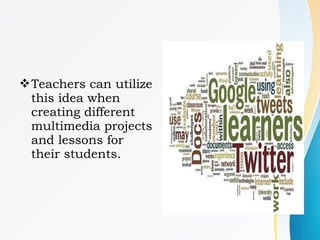
Teachers can utilize
this idea when
creating different
multimedia projects
and lessons for
their students.
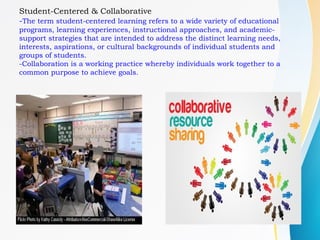
Student-Centered & Collaborative
-The term student-centered learning refers to a wide variety of educational
programs, learning experiences, instructional approaches, and academic-
support strategies that are intended to address the distinct learning needs,
interests, aspirations, or cultural backgrounds of individual students and
groups of students.
-Collaboration is a working practice whereby individuals work together to a
common purpose to achieve goals.
The role of Technology in 21st
Century Learning
Technology allows for 24/7 access to
information
Constant social interaction, and
Easily created and shared digital
content.
• Educational Technology (Information
Technology) according to International
Technology Education Association
• Teaches with technology (uses
technology as a tool)
• Primarily concerned with the narrow
spectrum of information and
communication technologies
• Primary goal: To enhance the teaching
and learning process
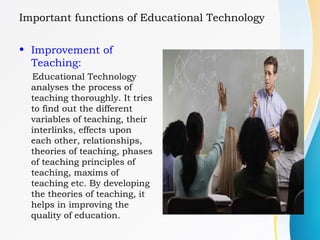
Important functions of Educational Technology
• Improvement of
Teaching:
Educational Technology
analyses the process of
teaching thoroughly. It tries
to find out the different
variables of teaching, their
interlinks, effects upon
each other, relationships,
theories of teaching, phases
of teaching principles of
teaching, maxims of
teaching etc. By developing
the theories of teaching, it
helps in improving the
quality of education.
Goals of Educational Technology
Educational technology research always had an
ambitious agenda. Sometimes it only aims at
increased efficiency or effectiveness of current
practise, but frequently it aims at pedagogical
change.
While it can be considered as a design science it
also addresses fundamental issues of learning,
teaching and social organization and therefore
makes use of the full range of modern social
science and life sciences methodology.
Analysis of the Teaching-Learning Process:
Educational Technology aims at analysing the
process of teaching-learning thoroughly. It tries to
find out the different variables of teaching their
interlinks effects upon each other, relationship
etc.
• Generally speaking knowledge of
computers can propel ones career in
the right direction. Computers area
part of almost every industry today.
• They are no longer limited any specific
field. Theyare used in networking, for
information access and data storage
and also in theprocessing and
presentation of information.

Febie 2

  • 1.
    Roles and Functionsof Educational Technology in 21st Century
  • 2.
    • The Rolesof Educational Technology in Learning • Traditional • Delivery Vehicles for instructional plan • Source and presenter of knowledge • Constructivist • Partners • Learning tools that learners learn with • Constructivist Perspective
  • 3.
    The Role ofTechnology in 21st Century Learning The role of technology in the classroom is rapidly changing and creating a new atmosphere of learning. With different platforms such as Youtube and Instagram, students are able to be creative and innovative.
  • 4.
     The goalof the flipped classroom should be to shift lessons from “consumables” to “produceables.” (Okay, I realize I just made that word up, but I hope my meaning is clear.) Students today must be generators and producers. They must be able to question, problem solve, think outside of the box, and create innovative solutions to be competitive and successful in our rapidly changing global economy.  Blake-Plock makes a strong point when he says we learn by “doing.” He points out that many of the lessons students are given are “consumables” and this is my concern about the current language being used to describe the flipped classroom. Too often the flipped classroom requires students to watch videos, which is passive learning, but what are they asked to do with this information?
  • 5.
    Teachers can utilize thisidea when creating different multimedia projects and lessons for their students.
  • 6.
    Student-Centered & Collaborative -Theterm student-centered learning refers to a wide variety of educational programs, learning experiences, instructional approaches, and academic- support strategies that are intended to address the distinct learning needs, interests, aspirations, or cultural backgrounds of individual students and groups of students. -Collaboration is a working practice whereby individuals work together to a common purpose to achieve goals.
  • 7.
    The role ofTechnology in 21st Century Learning Technology allows for 24/7 access to information Constant social interaction, and Easily created and shared digital content.
  • 8.
    • Educational Technology(Information Technology) according to International Technology Education Association • Teaches with technology (uses technology as a tool) • Primarily concerned with the narrow spectrum of information and communication technologies • Primary goal: To enhance the teaching and learning process
  • 9.
    Important functions ofEducational Technology • Improvement of Teaching: Educational Technology analyses the process of teaching thoroughly. It tries to find out the different variables of teaching, their interlinks, effects upon each other, relationships, theories of teaching, phases of teaching principles of teaching, maxims of teaching etc. By developing the theories of teaching, it helps in improving the quality of education.
  • 10.
    Goals of EducationalTechnology Educational technology research always had an ambitious agenda. Sometimes it only aims at increased efficiency or effectiveness of current practise, but frequently it aims at pedagogical change. While it can be considered as a design science it also addresses fundamental issues of learning, teaching and social organization and therefore makes use of the full range of modern social science and life sciences methodology. Analysis of the Teaching-Learning Process: Educational Technology aims at analysing the process of teaching-learning thoroughly. It tries to find out the different variables of teaching their interlinks effects upon each other, relationship etc.
  • 11.
    • Generally speakingknowledge of computers can propel ones career in the right direction. Computers area part of almost every industry today. • They are no longer limited any specific field. Theyare used in networking, for information access and data storage and also in theprocessing and presentation of information.