Memory
Memory refers to the processes that are used to
acquire, store, retain, and later retrieve information.
Human memory involves the ability to both preserve
and recover information we have learned or
experienced. However, this is not a flawless process.
Sometimes we forget or misremember things.
There are several factors responsible which are as follows :
• Memory Process :
▪ Encoding : It is the method to convert knowledge into useful format in order to build new thoughts.
▪ Storage : After the data has been successfully encoded, it should be saved in brain for subsequent
use which is called as Storage.
▪ Retrieval : It allows us to bring stored memories into conscious awareness.
• Type of Memory :
▪ Sensory Memory : It is the earliest age of memory where information is stored for a very brief
period.
▪ Short Term Memory : Also known as active memory, It contains the information we are currently
aware of or thinking about. It keeps information for approximately 20 to 30 seconds.
▪ Long Term Memory : It is the process of storing information indefinitely. Some of the knowledge is
quite easy to recollect while other are considerably more challenging. It appears to have nearly
limitless capacity.
How Brain Functions ?
It refers to loss of information from long term memory. There are mainly 4 types of factors
responsible which are as follows :
• Failure to keep : These are the memories which are not stored properly in the long-term
memory called as failure to store or keep memories.
• Failure to Retrieve : Retrieval Failure is where the information is in long term memory but
cannot be accessed.
• Forgotten for a purpose : We may purposefully forget memories at times. This is especially true
when recalling traumatic or distressing events or experiences.
• Interference : The information which has been restricted or interrupted while attempting to
store is called interference.
What is Forgetting?
What is Aging or Memory loss ?
Memory loss as people become older is common. It should not prevent someone from leading
a full and fruitful life. Memory changes are usually controllable and don’t interfere with your
ability to study, lead a normal life, or build healthy relationships.
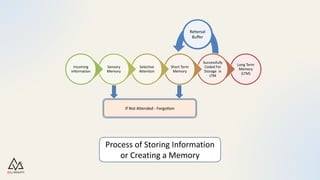
Long Term
Memory
(LTM)
Successfully
Coded For
Storage in
LTM
Short Term
Memory
Selective
Attention
Sensory
Memory
Incoming
Information
Rehersal
Buffer
If Not Attended - Forgotton
Process of Storing Information
or Creating a Memory
Tips to make Memory Stronger
No matter how great your memory is, there are probably a few things you can do to make it even better.
• Jot it down. The act of writing with a pen and paper helps implant the memory into your brain—and
can also serve as a reminder or reference later.
• Attach meaning to it. You can remember something more easily if you attach meaning to it. For
instance, if you associate a person, you just meet with someone you already know, you may be able to
remember their name easier.
• Repeat it. Repetition helps the memory become encoded beyond your short-term memory.
• Group it. Information that is categorized becomes easier to remember and recall. For example, consider
the following group of words: Desk, apple, bookshelf, red, plum, table, green, pineapple, purple, chair,
peach, yellow. Spend a few seconds reading them, then look away and try to recall and list these words.
• In addition, keeping your brain healthy by exercising regularly, maintaining social connections,
managing stress, and performing challenging activities (like doing crossword puzzles or playing an
instrument) have been proven to help boost memory.
❖Human memory is a complex process that researchers are still trying to better understand. Our memories
make us who we are, yet the process is not perfect. While we can remember an astonishing amount of
information, we are also susceptible to mistakes and errors.
Please visit our webpage @
www.eduminatti.com

How memory works?

  • 2.
    Memory Memory refers tothe processes that are used to acquire, store, retain, and later retrieve information. Human memory involves the ability to both preserve and recover information we have learned or experienced. However, this is not a flawless process. Sometimes we forget or misremember things.
  • 3.
    There are severalfactors responsible which are as follows : • Memory Process : ▪ Encoding : It is the method to convert knowledge into useful format in order to build new thoughts. ▪ Storage : After the data has been successfully encoded, it should be saved in brain for subsequent use which is called as Storage. ▪ Retrieval : It allows us to bring stored memories into conscious awareness. • Type of Memory : ▪ Sensory Memory : It is the earliest age of memory where information is stored for a very brief period. ▪ Short Term Memory : Also known as active memory, It contains the information we are currently aware of or thinking about. It keeps information for approximately 20 to 30 seconds. ▪ Long Term Memory : It is the process of storing information indefinitely. Some of the knowledge is quite easy to recollect while other are considerably more challenging. It appears to have nearly limitless capacity. How Brain Functions ?
  • 4.
    It refers toloss of information from long term memory. There are mainly 4 types of factors responsible which are as follows : • Failure to keep : These are the memories which are not stored properly in the long-term memory called as failure to store or keep memories. • Failure to Retrieve : Retrieval Failure is where the information is in long term memory but cannot be accessed. • Forgotten for a purpose : We may purposefully forget memories at times. This is especially true when recalling traumatic or distressing events or experiences. • Interference : The information which has been restricted or interrupted while attempting to store is called interference. What is Forgetting? What is Aging or Memory loss ? Memory loss as people become older is common. It should not prevent someone from leading a full and fruitful life. Memory changes are usually controllable and don’t interfere with your ability to study, lead a normal life, or build healthy relationships.
  • 5.
    Long Term Memory (LTM) Successfully Coded For Storagein LTM Short Term Memory Selective Attention Sensory Memory Incoming Information Rehersal Buffer If Not Attended - Forgotton Process of Storing Information or Creating a Memory
  • 6.
    Tips to makeMemory Stronger No matter how great your memory is, there are probably a few things you can do to make it even better. • Jot it down. The act of writing with a pen and paper helps implant the memory into your brain—and can also serve as a reminder or reference later. • Attach meaning to it. You can remember something more easily if you attach meaning to it. For instance, if you associate a person, you just meet with someone you already know, you may be able to remember their name easier. • Repeat it. Repetition helps the memory become encoded beyond your short-term memory. • Group it. Information that is categorized becomes easier to remember and recall. For example, consider the following group of words: Desk, apple, bookshelf, red, plum, table, green, pineapple, purple, chair, peach, yellow. Spend a few seconds reading them, then look away and try to recall and list these words. • In addition, keeping your brain healthy by exercising regularly, maintaining social connections, managing stress, and performing challenging activities (like doing crossword puzzles or playing an instrument) have been proven to help boost memory. ❖Human memory is a complex process that researchers are still trying to better understand. Our memories make us who we are, yet the process is not perfect. While we can remember an astonishing amount of information, we are also susceptible to mistakes and errors.
  • 7.
    Please visit ourwebpage @ www.eduminatti.com