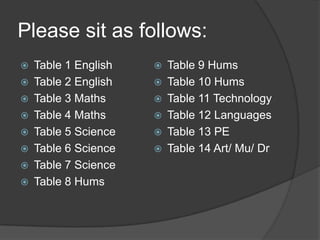
Please sit as follows:
   Table 1 English      Table 9 Hums
   Table 2 English      Table 10 Hums
   Table 3 Maths        Table 11 Technology
   Table 4 Maths        Table 12 Languages
   Table 5 Science      Table 13 PE
   Table 6 Science      Table 14 Art/ Mu/ Dr
   Table 7 Science
   Table 8 Hums
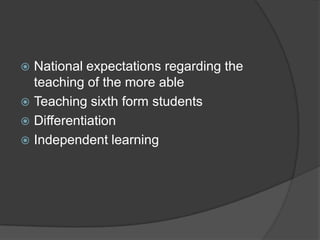
 National expectations regarding the
  teaching of the more able
 Teaching sixth form students
 Differentiation
 Independent learning
Year 10 Newton
1.There are 90 students in 10n. How
  many have the lowest average EPSIU
  score for:
 Behaviour
 Effort
 Homework?
2. How many said that their target grades
   are too high?
3. How many complained about getting
   too much homework?
Good
The teaching is consistently effective in
ensuring that pupils are motivated and engaged.
The great majority of teaching is securing good
progress and learning. Teachers generally have
strong subject knowledge which enthuses and
challenges most pupils and contributes to their
good progress. Good and imaginative use is
made of resources, including new technology to
enhance learning…. Teachers listen to, observe
and question groups of pupils during lessons in
order to reshape tasks and explanations to
improve learning.
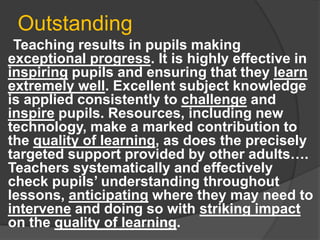
Outstanding
 Teaching results in pupils making
exceptional progress. It is highly effective in
inspiring pupils and ensuring that they learn
extremely well. Excellent subject knowledge
is applied consistently to challenge and
inspire pupils. Resources, including new
technology, make a marked contribution to
the quality of learning, as does the precisely
targeted support provided by other adults….
Teachers systematically and effectively
check pupils’ understanding throughout
lessons, anticipating where they may need to
intervene and doing so with striking impact
on the quality of learning.
   NAGTY                  Schools responsible
   YG&T                    for provision
   Hubs – Excellence
    East
“Very able pupils in maintained primary
   and secondary schools are often
   insufficiently challenged by the work
   they are set” (HMI, 1992).
and
“In the majority of schools the expectations
   of very able pupils are not sufficiently
   high. The provision for these pupils is
   patchy and is not often seen as a
   priority” (HMI, 1992).
Ofsted – 22% of secondary schools do an
  “adequate” job with their most able
  students
Conditions for Learning

 A variety in provision and activities
 Tasks are varied, customised and well
  paced
Development for Learning
 Activities are tailored to meet different
  learning styles and interests
 Learners are enabled to take charge of
  their own learning through:
 Structured independent and group
  learning opportunities
 Learning about learning
 Systematic self-evaluation to improve
  personal performance
Knowledge of Subjects/
Themes
   Subject expertise stimulates and challenges
    through sharing passion for the subject
   Passion for the subject pervades the learning
   The curriculum addresses the needs of
    individuals through:
   Working with learners to identify their needs
   Adapting to meet those needs
   Linking with personal interests and making
    skilful use of grouping
   Using a wide range of individual resources and
    activities to ensure differentiation
Understanding Learners’
Needs
   Recognising that G&T learners need a
    different starting point for their work
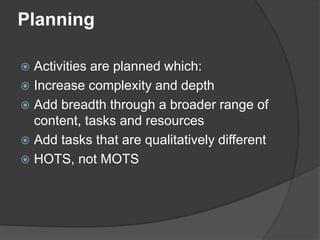
Planning

 Activities are planned which:
 Increase complexity and depth
 Add breadth through a broader range of
  content, tasks and resources
 Add tasks that are qualitatively different
 HOTS, not MOTS
Engagement with learning
and learners
 Teachers deploy a wide repertoire of
  skills and resources to raise
  achievement
 Grouping allows for interaction and
  independence
Links beyond the
classroom
   Homework extends interest and raises
    achievement
National Quality Standards
Effective Teaching and Learning Strategies
 Entry – Teaching and learning are differentiated;
   curriculum organisation is flexible with built-in choice,
   enrichment and guidance.
 Developing – Teaching and learning are diverse and
   flexible; lesson plans contain strategies for challenge;
   independent learning skills are developed; curriculum
   offers opportunities to work beyond age group, at
   greater speed, across curriculum subjects, according to
   interest/ aptitudes
 Exemplary – teaching and learning are challenging and
   varied; independent learning is integral to in-class
   provision; curriculum offers personalised learning
   pathways to maximise individual potential.
 Think of something that first awoke your
  passion for your subject
 Think of something that still makes you
  passionate about your subject
 Think of something that is good about
  teaching
When did you last share those things with
 the students you teach?
Teaching Sixth Form
 Use of different text books
 Questioning
 Independent work, including research
 High levels of support
 Modifying and adapting lesson plans
 Setting learning goals for individuals
Teaching Sixth Form
 Every Child Matters – “we must focus on
  enjoying and achieving as a key
  outcome”
 Focus on different groups of students
 A*?
Quality of Provision
 Results
 Students’ work
 Progress within a lesson
 Progress over time
 Teaching and learning
 Curriculum
 Guidance and support
> How the above meet the needs of the
  most able
Villiers Park – common
problems
 Underestimating the          Lack of time invested in
  ability of students           developing students as
 Excessive focus on            learners and in inspiring
  specification                 passion for the subject
 Seeing provision for the     Students too dependent
  More Able as extra-           on teachers,
  curricular                    unaccustomed to
 Staff (and thus students)
                                challenge
  being trapped in the         Lack of engagement,
  exam results/ targets         lack of independence,
  cycle                         lack of motivation
                               Mediocre results >
                                cyclical process
Villiers Park – the way forward
1.   Activate your most able students
2.   Don’t allow provision for the more able to be an
     optional extra
3.   Reawaken teachers’ passion for their subject
4.   Focus on teams
5.   Develop your students as independent learners
In successful schools/
classrooms …
Students will:               Ask about studying
 Ask questions about         the subject at
   the work covered in        university
   the lesson                Ask about careers
 Go one step beyond          related to that subject
   the specification         Tell teachers about
 Ask for more feedback       their extra-curricular
   on how to improve          activities
 Ask for pointers to        Show the passion for
   more resources             the subject that the
                              teacher shows them
Ideas
   Find ways to incorporate
    extension work into lessons
   School should support
    subject-specific teacher CPD,
    not just specification-specific
   Use occasional lessons, or        Improves motivation
    untaughts, or a specific week,
    to do something “different” –
    eg independent research/          Improves attainment
    project work
   Teachers should show their        Improves engagement
    passion for their subject, not
    their hatred of the
    specification                     Improves independence
   Present the sixth form as a
    fresh start, where all students
    are able and motivated and
    can become more so
Primary school model
   What are the      Individual
    barriers?         Subject/ Faculty
                      Whole School
   I like independent work best.
   Why?
   Because you can get on with your work and you
    don’t have to listen to the teacher and wait for
    them to finish.
Independence
   Independent students will work when the teacher is not there
   Independent students produce better homework
   Independent students release the teacher to provide more
    individual extension and support
   Plan activities that give students an element of control and
    individual choice – increase the amount of this over time
   Peer- and self-assessment foster independence when used
    effectively
   To be independent, students need to understand how to learn
   Ensure that students always reflect on their independent
    learning – use this reflection to plan
Confidence is key to
success
Students need to be      Students should not be
  confident…               confident …
 that they can           that they will
  succeed                  succeed
 that they can           that their ability will
  become more able         never diminish
 that work will bring    that intelligence
  learning and             means progress
  progress
Independence, motivation and
rewards
Extrinsic Motivation      Intrinsic Motivation
 The learner relies on    The learner is driven
  external agents to         by curiosity, passion
  keep their focus.          for knowledge and
  These agents               skills and the sense
  include grades,            of making progress.
  praise and rewards.        Learning is valued.
  Their focus is on          Their focus is on the
  outcomes and               process, which
  products.                  brings its own
                             rewards.
Independence in the most able
   Does not happen              You don’t stop
    automatically – they          spoonfeeding by
    need support,                 taking the spoon away
    guidance. Again and           – you have to teach
    again, they ask for           the child how to use it
    more advice on how            themselves
    to get top grades,
    more teacher time,
    better resources, clear
    information about
    what is expected of
    them, examples of top
    grade work
London Gifted and Talented
The more able want:        Findings:
 To make choices             Planning for the more
  about their learning         able and
 To be given genuinely        differentiating
  investigative tasks          downwards raises
 To see the big picture
                               standards most
                               effectively
 To work with
  stimulating learning        Focusing on the more
  materials                    able drives whole
                               school improvement
London G&T – Effective
Provision
   Independent                Intellectual curiosity
    learning                   High challenge
   Effective questioning      Critical and creative
   Development of              thinking
    expertise                  Interdependent skills
   Higher order               Real world issues
    thinking
   Big ideas and
    concepts
Personalised Learning –
The National Strategy
   “tailoring teaching and learning to individual need”
   “Planning for progression and differentiation are
    fundamental”
   “teaching and learning is characterised by
    ambitious objectives, challenging personal targets,
    rapid intervention and rigorous assessment to
    check and maintain pupil progress.”
MI, etc.
Gardner                     Left and Right Brain
   Linguistic                Theory
   Logical/ mathematical
   Spatial
   Musical
                            Gregorc
   Kinaesthetic             Concrete random
   Interpersonal            Concrete sequential
   Intrapersonal            Abstract random
   Naturalistic
                             Abstract sequential

VAK
                            Kolb
Differentiated Provision –
Westminster Institute of
Education
1.   By level – the level should be high enough to
     interest and challenge
2.   By pace – the pace should be adjusted to suit the
     learner and the level of challenge
3.   By complexity – this should reflect the capacity of
     the learner and should encourage creative rather
     than linear thought
4.   By depth – this should enable the most able to
     pursue areas of particular interest to the level of
     an expert.
Activities for the more able should:
    Allow individual         Open up opportunities
     response                  for research
    Encourage creativity     Involve abstract
     and imagination           concepts
    Meet developmental       Involve problem
     stage rather than         solving and decision
     chronological age         making
    Stress process rather    Encourage empathy
     than content             Provide opportunities
    Encourage higher          for leadership
     level thinking skills    Be difficult
    Provide open-ended       Build in failure
     situations
Differentiation
   By task – higher level materials and activities
   By outcome – students respond to the same task
    at different levels
   By pace – able students can complete tasks at
    greater speed
   By grouping of students within the classroom
Types of Differentiation
1.   By outcome – same task,       8.  By use of research tasks – open
     different results                 tasks that students have to
2.   By task – more able               negotiate their way through
     students work on higher       9. By dialogue/ language – the
     level tasks                       exchanges between student and
3.   By resource – an open task        teacher or student and student
     that can be accessed at           operate at a higher level
     different levels, resources   10. By grouping – able students
     determine the level               together, or as leaders
4.   By assessment mode/ level,    11. By choice – building in choice
     eg assessing Year 9 against       within tasks and choice about
     GCSE criteria                     how students can approach them
5.   By pace – able students       12. By self-direction – encourage
     complete work faster              greater independence by
6.   By support – able students        allowing the more able to
     are more independent and          propose ways to differentiate a
     can provide support               task
7.   By extension – HOTS, not      13. By questioning – deeper, more
     MOTS; depth or breadth            open questions for the more able

Learning

  • 1.
    Please sit asfollows:  Table 1 English  Table 9 Hums  Table 2 English  Table 10 Hums  Table 3 Maths  Table 11 Technology  Table 4 Maths  Table 12 Languages  Table 5 Science  Table 13 PE  Table 6 Science  Table 14 Art/ Mu/ Dr  Table 7 Science  Table 8 Hums
  • 2.
     National expectationsregarding the teaching of the more able  Teaching sixth form students  Differentiation  Independent learning
  • 3.
    Year 10 Newton 1.Thereare 90 students in 10n. How many have the lowest average EPSIU score for:  Behaviour  Effort  Homework?
  • 4.
    2. How manysaid that their target grades are too high? 3. How many complained about getting too much homework?
  • 5.
    Good The teaching isconsistently effective in ensuring that pupils are motivated and engaged. The great majority of teaching is securing good progress and learning. Teachers generally have strong subject knowledge which enthuses and challenges most pupils and contributes to their good progress. Good and imaginative use is made of resources, including new technology to enhance learning…. Teachers listen to, observe and question groups of pupils during lessons in order to reshape tasks and explanations to improve learning.
  • 6.
    Outstanding Teaching resultsin pupils making exceptional progress. It is highly effective in inspiring pupils and ensuring that they learn extremely well. Excellent subject knowledge is applied consistently to challenge and inspire pupils. Resources, including new technology, make a marked contribution to the quality of learning, as does the precisely targeted support provided by other adults…. Teachers systematically and effectively check pupils’ understanding throughout lessons, anticipating where they may need to intervene and doing so with striking impact on the quality of learning.
  • 7.
    NAGTY  Schools responsible  YG&T for provision  Hubs – Excellence East
  • 8.
    “Very able pupilsin maintained primary and secondary schools are often insufficiently challenged by the work they are set” (HMI, 1992). and “In the majority of schools the expectations of very able pupils are not sufficiently high. The provision for these pupils is patchy and is not often seen as a priority” (HMI, 1992).
  • 9.
    Ofsted – 22%of secondary schools do an “adequate” job with their most able students
  • 10.
    Conditions for Learning A variety in provision and activities  Tasks are varied, customised and well paced
  • 11.
    Development for Learning Activities are tailored to meet different learning styles and interests  Learners are enabled to take charge of their own learning through:  Structured independent and group learning opportunities  Learning about learning  Systematic self-evaluation to improve personal performance
  • 12.
    Knowledge of Subjects/ Themes  Subject expertise stimulates and challenges through sharing passion for the subject  Passion for the subject pervades the learning  The curriculum addresses the needs of individuals through:  Working with learners to identify their needs  Adapting to meet those needs  Linking with personal interests and making skilful use of grouping  Using a wide range of individual resources and activities to ensure differentiation
  • 13.
    Understanding Learners’ Needs  Recognising that G&T learners need a different starting point for their work
  • 14.
    Planning  Activities areplanned which:  Increase complexity and depth  Add breadth through a broader range of content, tasks and resources  Add tasks that are qualitatively different  HOTS, not MOTS
  • 15.
    Engagement with learning andlearners  Teachers deploy a wide repertoire of skills and resources to raise achievement  Grouping allows for interaction and independence
  • 16.
    Links beyond the classroom  Homework extends interest and raises achievement
  • 17.
    National Quality Standards EffectiveTeaching and Learning Strategies  Entry – Teaching and learning are differentiated; curriculum organisation is flexible with built-in choice, enrichment and guidance.  Developing – Teaching and learning are diverse and flexible; lesson plans contain strategies for challenge; independent learning skills are developed; curriculum offers opportunities to work beyond age group, at greater speed, across curriculum subjects, according to interest/ aptitudes  Exemplary – teaching and learning are challenging and varied; independent learning is integral to in-class provision; curriculum offers personalised learning pathways to maximise individual potential.
  • 18.
     Think ofsomething that first awoke your passion for your subject  Think of something that still makes you passionate about your subject  Think of something that is good about teaching
  • 19.
    When did youlast share those things with the students you teach?
  • 20.
    Teaching Sixth Form Use of different text books  Questioning  Independent work, including research  High levels of support  Modifying and adapting lesson plans  Setting learning goals for individuals
  • 21.
    Teaching Sixth Form Every Child Matters – “we must focus on enjoying and achieving as a key outcome”  Focus on different groups of students  A*?
  • 22.
    Quality of Provision Results  Students’ work  Progress within a lesson  Progress over time  Teaching and learning  Curriculum  Guidance and support > How the above meet the needs of the most able
  • 23.
    Villiers Park –common problems  Underestimating the  Lack of time invested in ability of students developing students as  Excessive focus on learners and in inspiring specification passion for the subject  Seeing provision for the  Students too dependent More Able as extra- on teachers, curricular unaccustomed to  Staff (and thus students) challenge being trapped in the  Lack of engagement, exam results/ targets lack of independence, cycle lack of motivation  Mediocre results > cyclical process
  • 24.
    Villiers Park –the way forward 1. Activate your most able students 2. Don’t allow provision for the more able to be an optional extra 3. Reawaken teachers’ passion for their subject 4. Focus on teams 5. Develop your students as independent learners
  • 25.
    In successful schools/ classrooms… Students will:  Ask about studying  Ask questions about the subject at the work covered in university the lesson  Ask about careers  Go one step beyond related to that subject the specification  Tell teachers about  Ask for more feedback their extra-curricular on how to improve activities  Ask for pointers to  Show the passion for more resources the subject that the teacher shows them
  • 26.
    Ideas  Find ways to incorporate extension work into lessons  School should support subject-specific teacher CPD, not just specification-specific  Use occasional lessons, or Improves motivation untaughts, or a specific week, to do something “different” – eg independent research/ Improves attainment project work  Teachers should show their Improves engagement passion for their subject, not their hatred of the specification Improves independence  Present the sixth form as a fresh start, where all students are able and motivated and can become more so
  • 27.
    Primary school model  What are the  Individual barriers?  Subject/ Faculty  Whole School
  • 28.
    I like independent work best.  Why?  Because you can get on with your work and you don’t have to listen to the teacher and wait for them to finish.
  • 29.
    Independence  Independent students will work when the teacher is not there  Independent students produce better homework  Independent students release the teacher to provide more individual extension and support  Plan activities that give students an element of control and individual choice – increase the amount of this over time  Peer- and self-assessment foster independence when used effectively  To be independent, students need to understand how to learn  Ensure that students always reflect on their independent learning – use this reflection to plan
  • 30.
    Confidence is keyto success Students need to be Students should not be confident… confident …  that they can  that they will succeed succeed  that they can  that their ability will become more able never diminish  that work will bring  that intelligence learning and means progress progress
  • 31.
    Independence, motivation and rewards ExtrinsicMotivation Intrinsic Motivation  The learner relies on  The learner is driven external agents to by curiosity, passion keep their focus. for knowledge and These agents skills and the sense include grades, of making progress. praise and rewards. Learning is valued. Their focus is on Their focus is on the outcomes and process, which products. brings its own rewards.
  • 32.
    Independence in themost able  Does not happen  You don’t stop automatically – they spoonfeeding by need support, taking the spoon away guidance. Again and – you have to teach again, they ask for the child how to use it more advice on how themselves to get top grades, more teacher time, better resources, clear information about what is expected of them, examples of top grade work
  • 33.
    London Gifted andTalented The more able want: Findings:  To make choices  Planning for the more about their learning able and  To be given genuinely differentiating investigative tasks downwards raises  To see the big picture standards most effectively  To work with stimulating learning  Focusing on the more materials able drives whole school improvement
  • 34.
    London G&T –Effective Provision  Independent  Intellectual curiosity learning  High challenge  Effective questioning  Critical and creative  Development of thinking expertise  Interdependent skills  Higher order  Real world issues thinking  Big ideas and concepts
  • 35.
    Personalised Learning – TheNational Strategy  “tailoring teaching and learning to individual need”  “Planning for progression and differentiation are fundamental”  “teaching and learning is characterised by ambitious objectives, challenging personal targets, rapid intervention and rigorous assessment to check and maintain pupil progress.”
  • 36.
    MI, etc. Gardner Left and Right Brain  Linguistic Theory  Logical/ mathematical  Spatial  Musical Gregorc  Kinaesthetic  Concrete random  Interpersonal  Concrete sequential  Intrapersonal  Abstract random  Naturalistic  Abstract sequential VAK Kolb
  • 37.
    Differentiated Provision – WestminsterInstitute of Education 1. By level – the level should be high enough to interest and challenge 2. By pace – the pace should be adjusted to suit the learner and the level of challenge 3. By complexity – this should reflect the capacity of the learner and should encourage creative rather than linear thought 4. By depth – this should enable the most able to pursue areas of particular interest to the level of an expert.
  • 38.
    Activities for themore able should:  Allow individual  Open up opportunities response for research  Encourage creativity  Involve abstract and imagination concepts  Meet developmental  Involve problem stage rather than solving and decision chronological age making  Stress process rather  Encourage empathy than content  Provide opportunities  Encourage higher for leadership level thinking skills  Be difficult  Provide open-ended  Build in failure situations
  • 39.
    Differentiation  By task – higher level materials and activities  By outcome – students respond to the same task at different levels  By pace – able students can complete tasks at greater speed  By grouping of students within the classroom
  • 40.
    Types of Differentiation 1. By outcome – same task, 8. By use of research tasks – open different results tasks that students have to 2. By task – more able negotiate their way through students work on higher 9. By dialogue/ language – the level tasks exchanges between student and 3. By resource – an open task teacher or student and student that can be accessed at operate at a higher level different levels, resources 10. By grouping – able students determine the level together, or as leaders 4. By assessment mode/ level, 11. By choice – building in choice eg assessing Year 9 against within tasks and choice about GCSE criteria how students can approach them 5. By pace – able students 12. By self-direction – encourage complete work faster greater independence by 6. By support – able students allowing the more able to are more independent and propose ways to differentiate a can provide support task 7. By extension – HOTS, not 13. By questioning – deeper, more MOTS; depth or breadth open questions for the more able