2018
Keti Tsertsvadze
Contents
1. Introduction
2. The Big Five
3. Classroom Interaction
4. Sample of Rules
5. Tier 1, Tier 2
6. Recommendations for teachers
7. Sources
Introduction
Management is a deliberate and coordinated action of some people.
In the classroom classroom, there are rules that will give teachers and
students the opportunity act decisively and deliberately.
The goal of the school is to give the pupil the knowledge, for
which there is a good learning environment and atmosphere. Studies
show that in order to manage the class and general order, 5 main
issues to be addressed are: The Big Five.
1. Rules: Establish and teach classroom rules to communicate
expectations for behavior.
2. Routines: Build structure and establish routines to help
guide students in a wide variety of situations.
3. Praise: Reinforce positive behavior using praise and
other means.
4. Misbehavior: Consistently impose consequences for
misbehavior
5. Engagement: Foster and maintain student engagement
by teaching interesting lessons that include opportunities
for active student participation.
General Strategies
THE BIG FIVE
Classroom management
is a plan where the
rules, norms and
behavior of the class are
clearly established.
THE BIG FIVE
These strategies are so strongly supported by research that we refer to them here as the ―Big
Five.‖
1. RULES
Teachers (or teachers and students collaboratively) should develop a limited set of positively
stated expectations for behavior. These expectations should not simply be posted in the
classroom; rather, they should be explicitly taught by discussion and practice and applied
transparently and equitably. Rules should be not same for middle school students and for
elementary or secondary.
Middle school, Elementary Rules for secondary students
 Don’t be late
 Have a book, notebook, pen, pencil
 Respect each other and school
 Don’t eat and cry on lesson…

 Don’t late
 Be ready for lesson
 Speak and discuss anything in law voice
 …
2. ROUTINES
Teachers should teach routines and procedures, including specific guidelines for how to act in a
variety of situations (e.g., arriving in the classroom, handing in homework, working in groups).
These routines should be taught at the beginning of the school year and then revisited
periodically throughout the year. In turn, teachers should sustain momentum for instruction by
orchestrating the management of time and materials by themselves and students, especially in
transitions between activities.
NOTE: Understanding importance of the rules and routine, in general, it's very important for
students. For example - Traffic Rules. Driving a motor vehicle is dangerous business. Traffic
accidents usually rank in the top ten causes of death or damage annually. This is because many
people don't understand the importance of General Road Rules. Most of people knows rules and
don't follow to rules, that's why there are so many car accidents during the year.
Knowledge of the rules and transition to the following habit (Rutina) is a very important feature
that must be learnt by students from school age and students should analyse this.
THE BIG FIVE
3. PRAISE
Teachers should reinforce positive behavior using praise and other rewards. Intangible rewards
such as praise10 should be specific (e.g., ―Good job finding your seat quickly,‖ ―Great work
sharing your pencil,‖ ―John, Neery, and Dominic all have their homework ready to turn in —
well done‖) and abundant.11 Rewards also may be tangible (e.g., a prize like a sticker or pencil,
or a privilege like extra free time). Rewards can be used for individual or group behavior and
may be phased out over time as students’ behavior improves by habit.12 (See the textbox below
for more on praise.)
4. MISBEHAVIOR
Just as every parent learns that children will not always follow rules and has in mind
consequences for noncompliance, so, too, do teachers need to determine the appropriate
consequences for misbehavior and apply these consequences consistently. Consequences
generally follow different levels of severity, escalating to one-on-one conferences with the
teacher, detentions, meetings with parents or guardians, and so on.
5. ENGAGEMENT
This technique is closely linked to the quality of instruction. Teachers should constantly engage
students in the lesson, whether through creating an interesting lesson that holds students’
attention or through building in frequent opportunities for student participation. Students who
are involved in the lesson generally have less inclination to act out.
Classroom Interaction
For involving of students are some techniques and questions, there are some patterns in
Classroom interaction:
Turn-Taking pattern
Question types
Contextualization cues
Narrative - or telling a story
Participation Structures
In much of classroom interaction, one of the most recognizable turn-taking patterns is the
initiation response evaluation sequence, or IRE. There are mostly two types of question, Know
answer questions and open-ended questions.
IRE- Initiation-Response-Evaluation Open-Ended Questions
IRE- Initiation-Response-Evaluation- model of
questioning when answers are clear – Known
Answer Questions, Prototypical known answer
questions has one and only one right answer
usually,
Mainly IRE questions are Known answer
questions types are:
 Display questions
 Convergent question
 Guess what I am thinking questions
 Known-answer questions:
Functions of IRE are:
 Test question (testing what students have
learned)
 Focusing students attention
 Learning about previous knowledge
 Prompting conversation
1. open-ended questions – questions when
answers are not obvious, open-ended questions
are more likely to lead to discussion between
teachers and students
Types of those questions are:
 Genuine questions
 Authentic questions
 Information-seeking questions
 Divergent questions
 Wh-questions
open - ended questions are more likely to lead
to discussion between teachers and students,
for debates and etc
Participation Structure Review and Reflect
Ways of arranging verbal interaction
with students:
 Group check in
 Small – groups
 Whole group discussion
 Individual quick writes
 Group sharing
Features of classroom interaction:
 Turn – Taking
 Question types
 Contextualization Cues
 Narrative
 Participation Structures
.It’s very important to go from evaluation to feedback
1.Feedback better than evaluation
2.Wondering better than telling
Math Lesson
Evaluation Feedback
That’s correct … could instead
formulate as …
That’s correct,
How did you get
That answer?
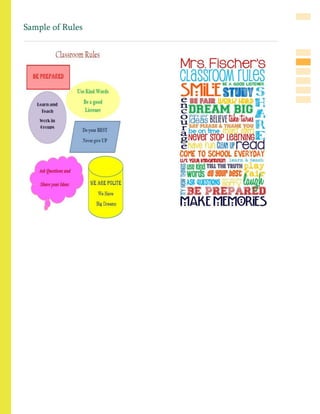
Sample of Rules
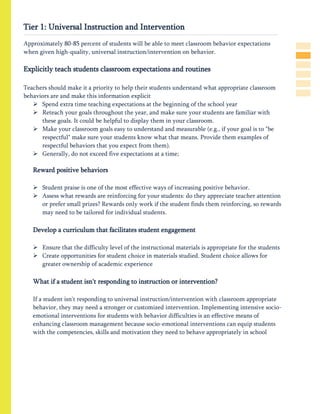
Tier 1: Universal Instruction and Intervention
Approximately 80-85 percent of students will be able to meet classroom behavior expectations
when given high-quality, universal instruction/intervention on behavior.
Explicitly teach students classroom expectations and routines
Teachers should make it a priority to help their students understand what appropriate classroom
behaviors are and make this information explicit
 Spend extra time teaching expectations at the beginning of the school year
 Reteach your goals throughout the year, and make sure your students are familiar with
these goals. It could be helpful to display them in your classroom.
 Make your classroom goals easy to understand and measurable (e.g., if your goal is to "be
respectful" make sure your students know what that means. Provide them examples of
respectful behaviors that you expect from them).
 Generally, do not exceed five expectations at a time;
Reward positive behaviors
 Student praise is one of the most effective ways of increasing positive behavior.
 Assess what rewards are reinforcing for your students: do they appreciate teacher attention
or prefer small prizes? Rewards only work if the student finds them reinforcing, so rewards
may need to be tailored for individual students.
Develop a curriculum that facilitates student engagement
 Ensure that the difficulty level of the instructional materials is appropriate for the students
 Create opportunities for student choice in materials studied. Student choice allows for
greater ownership of academic experience
What if a student isn't responding to instruction or intervention?
If a student isn't responding to universal instruction/intervention with classroom appropriate
behavior, they may need a stronger or customized intervention. Implementing intensive socio-
emotional interventions for students with behavior difficulties is an effective means of
enhancing classroom management because socio-emotional interventions can equip students
with the competencies, skills and motivation they need to behave appropriately in school
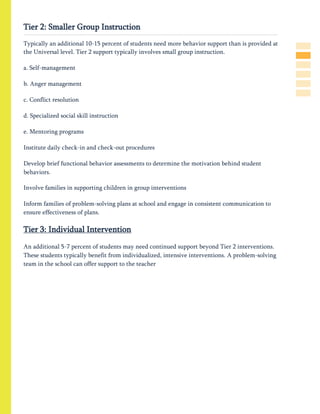
Tier 2: Smaller Group Instruction
Typically an additional 10-15 percent of students need more behavior support than is provided at
the Universal level. Tier 2 support typically involves small group instruction.
a. Self-management
b. Anger management
c. Conflict resolution
d. Specialized social skill instruction
e. Mentoring programs
Institute daily check-in and check-out procedures
Develop brief functional behavior assessments to determine the motivation behind student
behaviors.
Involve families in supporting children in group interventions
Inform families of problem-solving plans at school and engage in consistent communication to
ensure effectiveness of plans.
Tier 3: Individual Intervention
An additional 5-7 percent of students may need continued support beyond Tier 2 interventions.
These students typically benefit from individualized, intensive interventions. A problem-solving
team in the school can offer support to the teacher
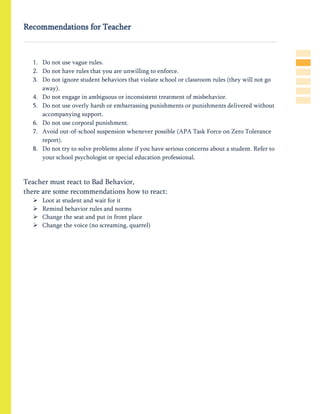
Recommendations for Teacher
1. Do not use vague rules.
2. Do not have rules that you are unwilling to enforce.
3. Do not ignore student behaviors that violate school or classroom rules (they will not go
away).
4. Do not engage in ambiguous or inconsistent treatment of misbehavior.
5. Do not use overly harsh or embarrassing punishments or punishments delivered without
accompanying support.
6. Do not use corporal punishment.
7. Avoid out-of-school suspension whenever possible (APA Task Force on Zero Tolerance
report).
8. Do not try to solve problems alone if you have serious concerns about a student. Refer to
your school psychologist or special education professional.
Teacher must react to Bad Behavior,
there are some recommendations how to react:
 Loot at student and wait for it
 Remind behavior rules and norms
 Change the seat and put in front place
 Change the voice (no screaming, quarrel)
Sources
1. Kratochwill , Thomas R., and Rachel DeRoos . ―Classroom Management
Teachers Modules.‖ Pardon Our Interruption, American Psychological
Association www.apa.org/education/k12/classroom-mgmt.aspx.
2. National Council on Teachers Quality – “Classroom Management”
www.nctq.org
3. PennX- University of Pennsylvania, ―Understanding Classroom Interaction‖
Education & Teacher Training, 5 Week Online Course.
www.courses.edx.org
4. Michigan State University – College of Education
―Best Practice in Classroom Management
5. Links From PennX – Understanding Classroom Interaction
https://www.youtube.com/watch?v=kOc2zwfxyFE&feature=youtu.be
https://youtu.be/9_nJCLybKbs
https://youtu.be/V7qjnVwQHPY
https://youtu.be/fPyIT6OJFnM

Classroom Management

  • 1.
  • 2.
    Contents 1. Introduction 2. TheBig Five 3. Classroom Interaction 4. Sample of Rules 5. Tier 1, Tier 2 6. Recommendations for teachers 7. Sources
  • 3.
    Introduction Management is adeliberate and coordinated action of some people. In the classroom classroom, there are rules that will give teachers and students the opportunity act decisively and deliberately. The goal of the school is to give the pupil the knowledge, for which there is a good learning environment and atmosphere. Studies show that in order to manage the class and general order, 5 main issues to be addressed are: The Big Five. 1. Rules: Establish and teach classroom rules to communicate expectations for behavior. 2. Routines: Build structure and establish routines to help guide students in a wide variety of situations. 3. Praise: Reinforce positive behavior using praise and other means. 4. Misbehavior: Consistently impose consequences for misbehavior 5. Engagement: Foster and maintain student engagement by teaching interesting lessons that include opportunities for active student participation. General Strategies THE BIG FIVE Classroom management is a plan where the rules, norms and behavior of the class are clearly established.
  • 4.
    THE BIG FIVE Thesestrategies are so strongly supported by research that we refer to them here as the ―Big Five.‖ 1. RULES Teachers (or teachers and students collaboratively) should develop a limited set of positively stated expectations for behavior. These expectations should not simply be posted in the classroom; rather, they should be explicitly taught by discussion and practice and applied transparently and equitably. Rules should be not same for middle school students and for elementary or secondary. Middle school, Elementary Rules for secondary students  Don’t be late  Have a book, notebook, pen, pencil  Respect each other and school  Don’t eat and cry on lesson…   Don’t late  Be ready for lesson  Speak and discuss anything in law voice  … 2. ROUTINES Teachers should teach routines and procedures, including specific guidelines for how to act in a variety of situations (e.g., arriving in the classroom, handing in homework, working in groups). These routines should be taught at the beginning of the school year and then revisited periodically throughout the year. In turn, teachers should sustain momentum for instruction by orchestrating the management of time and materials by themselves and students, especially in transitions between activities. NOTE: Understanding importance of the rules and routine, in general, it's very important for students. For example - Traffic Rules. Driving a motor vehicle is dangerous business. Traffic accidents usually rank in the top ten causes of death or damage annually. This is because many people don't understand the importance of General Road Rules. Most of people knows rules and don't follow to rules, that's why there are so many car accidents during the year. Knowledge of the rules and transition to the following habit (Rutina) is a very important feature that must be learnt by students from school age and students should analyse this.
  • 5.
    THE BIG FIVE 3.PRAISE Teachers should reinforce positive behavior using praise and other rewards. Intangible rewards such as praise10 should be specific (e.g., ―Good job finding your seat quickly,‖ ―Great work sharing your pencil,‖ ―John, Neery, and Dominic all have their homework ready to turn in — well done‖) and abundant.11 Rewards also may be tangible (e.g., a prize like a sticker or pencil, or a privilege like extra free time). Rewards can be used for individual or group behavior and may be phased out over time as students’ behavior improves by habit.12 (See the textbox below for more on praise.) 4. MISBEHAVIOR Just as every parent learns that children will not always follow rules and has in mind consequences for noncompliance, so, too, do teachers need to determine the appropriate consequences for misbehavior and apply these consequences consistently. Consequences generally follow different levels of severity, escalating to one-on-one conferences with the teacher, detentions, meetings with parents or guardians, and so on. 5. ENGAGEMENT This technique is closely linked to the quality of instruction. Teachers should constantly engage students in the lesson, whether through creating an interesting lesson that holds students’ attention or through building in frequent opportunities for student participation. Students who are involved in the lesson generally have less inclination to act out. Classroom Interaction For involving of students are some techniques and questions, there are some patterns in Classroom interaction: Turn-Taking pattern Question types Contextualization cues Narrative - or telling a story Participation Structures In much of classroom interaction, one of the most recognizable turn-taking patterns is the initiation response evaluation sequence, or IRE. There are mostly two types of question, Know answer questions and open-ended questions.
  • 6.
    IRE- Initiation-Response-Evaluation Open-EndedQuestions IRE- Initiation-Response-Evaluation- model of questioning when answers are clear – Known Answer Questions, Prototypical known answer questions has one and only one right answer usually, Mainly IRE questions are Known answer questions types are:  Display questions  Convergent question  Guess what I am thinking questions  Known-answer questions: Functions of IRE are:  Test question (testing what students have learned)  Focusing students attention  Learning about previous knowledge  Prompting conversation 1. open-ended questions – questions when answers are not obvious, open-ended questions are more likely to lead to discussion between teachers and students Types of those questions are:  Genuine questions  Authentic questions  Information-seeking questions  Divergent questions  Wh-questions open - ended questions are more likely to lead to discussion between teachers and students, for debates and etc Participation Structure Review and Reflect Ways of arranging verbal interaction with students:  Group check in  Small – groups  Whole group discussion  Individual quick writes  Group sharing Features of classroom interaction:  Turn – Taking  Question types  Contextualization Cues  Narrative  Participation Structures .It’s very important to go from evaluation to feedback 1.Feedback better than evaluation 2.Wondering better than telling Math Lesson Evaluation Feedback That’s correct … could instead formulate as … That’s correct, How did you get That answer?
  • 7.
  • 8.
    Tier 1: UniversalInstruction and Intervention Approximately 80-85 percent of students will be able to meet classroom behavior expectations when given high-quality, universal instruction/intervention on behavior. Explicitly teach students classroom expectations and routines Teachers should make it a priority to help their students understand what appropriate classroom behaviors are and make this information explicit  Spend extra time teaching expectations at the beginning of the school year  Reteach your goals throughout the year, and make sure your students are familiar with these goals. It could be helpful to display them in your classroom.  Make your classroom goals easy to understand and measurable (e.g., if your goal is to "be respectful" make sure your students know what that means. Provide them examples of respectful behaviors that you expect from them).  Generally, do not exceed five expectations at a time; Reward positive behaviors  Student praise is one of the most effective ways of increasing positive behavior.  Assess what rewards are reinforcing for your students: do they appreciate teacher attention or prefer small prizes? Rewards only work if the student finds them reinforcing, so rewards may need to be tailored for individual students. Develop a curriculum that facilitates student engagement  Ensure that the difficulty level of the instructional materials is appropriate for the students  Create opportunities for student choice in materials studied. Student choice allows for greater ownership of academic experience What if a student isn't responding to instruction or intervention? If a student isn't responding to universal instruction/intervention with classroom appropriate behavior, they may need a stronger or customized intervention. Implementing intensive socio- emotional interventions for students with behavior difficulties is an effective means of enhancing classroom management because socio-emotional interventions can equip students with the competencies, skills and motivation they need to behave appropriately in school
  • 9.
    Tier 2: SmallerGroup Instruction Typically an additional 10-15 percent of students need more behavior support than is provided at the Universal level. Tier 2 support typically involves small group instruction. a. Self-management b. Anger management c. Conflict resolution d. Specialized social skill instruction e. Mentoring programs Institute daily check-in and check-out procedures Develop brief functional behavior assessments to determine the motivation behind student behaviors. Involve families in supporting children in group interventions Inform families of problem-solving plans at school and engage in consistent communication to ensure effectiveness of plans. Tier 3: Individual Intervention An additional 5-7 percent of students may need continued support beyond Tier 2 interventions. These students typically benefit from individualized, intensive interventions. A problem-solving team in the school can offer support to the teacher
  • 10.
    Recommendations for Teacher 1.Do not use vague rules. 2. Do not have rules that you are unwilling to enforce. 3. Do not ignore student behaviors that violate school or classroom rules (they will not go away). 4. Do not engage in ambiguous or inconsistent treatment of misbehavior. 5. Do not use overly harsh or embarrassing punishments or punishments delivered without accompanying support. 6. Do not use corporal punishment. 7. Avoid out-of-school suspension whenever possible (APA Task Force on Zero Tolerance report). 8. Do not try to solve problems alone if you have serious concerns about a student. Refer to your school psychologist or special education professional. Teacher must react to Bad Behavior, there are some recommendations how to react:  Loot at student and wait for it  Remind behavior rules and norms  Change the seat and put in front place  Change the voice (no screaming, quarrel)
  • 11.
    Sources 1. Kratochwill ,Thomas R., and Rachel DeRoos . ―Classroom Management Teachers Modules.‖ Pardon Our Interruption, American Psychological Association www.apa.org/education/k12/classroom-mgmt.aspx. 2. National Council on Teachers Quality – “Classroom Management” www.nctq.org 3. PennX- University of Pennsylvania, ―Understanding Classroom Interaction‖ Education & Teacher Training, 5 Week Online Course. www.courses.edx.org 4. Michigan State University – College of Education ―Best Practice in Classroom Management 5. Links From PennX – Understanding Classroom Interaction https://www.youtube.com/watch?v=kOc2zwfxyFE&feature=youtu.be https://youtu.be/9_nJCLybKbs https://youtu.be/V7qjnVwQHPY https://youtu.be/fPyIT6OJFnM