The Perfect (Ofsted) lesson? – meeting the new criteria and delivering progress in learning

How can you make sure in the brief time that an inspector (or other assessor) spends in your
classroom – that your lesson ticks enough boxes to impress - and gain that outstanding grade?

Sharing the criteria for success is essential for any learning experience – if you (or your students) do
not know what they are expected to strive for – how do you (or they) know that they have achieved
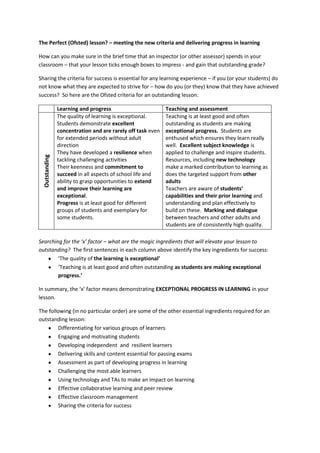
success? So here are the Ofsted criteria for an outstanding lesson:

                Learning and progress                        Teaching and assessment
                The quality of learning is exceptional.      Teaching is at least good and often
                Students demonstrate excellent               outstanding as students are making
                concentration and are rarely off task even   exceptional progress. Students are
                for extended periods without adult           enthused which ensures they learn really
                direction                                    well. Excellent subject knowledge is
                They have developed a resilience when        applied to challenge and inspire students.
  Outstanding


                tackling challenging activities              Resources, including new technology
                Their keenness and commitment to             make a marked contribution to learning as
                succeed in all aspects of school life and    does the targeted support from other
                ability to grasp opportunities to extend     adults
                and improve their learning are               Teachers are aware of students’
                exceptional.                                 capabilities and their prior learning and
                Progress is at least good for different      understanding and plan effectively to
                groups of students and exemplary for         build on these. Marking and dialogue
                some students.                               between teachers and other adults and
                                                             students are of consistently high quality.

Searching for the ‘x’ factor – what are the magic ingredients that will elevate your lesson to
outstanding? The first sentences in each column above identify the key ingredients for success:
        ‘The quality of the learning is exceptional’
        ‘Teaching is at least good and often outstanding as students are making exceptional
        progress.’

In summary, the ‘x’ factor means demonstrating EXCEPTIONAL PROGRESS IN LEARNING in your
lesson.

The following (in no particular order) are some of the other essential ingredients required for an
outstanding lesson:
        Differentiating for various groups of learners
        Engaging and motivating students
        Developing independent and resilient learners
        Delivering skills and content essential for passing exams
        Assessment as part of developing progress in learning
        Challenging the most able learners
        Using technology and TAs to make an impact on learning
        Effective collaborative learning and peer review
        Effective classroom management
        Sharing the criteria for success
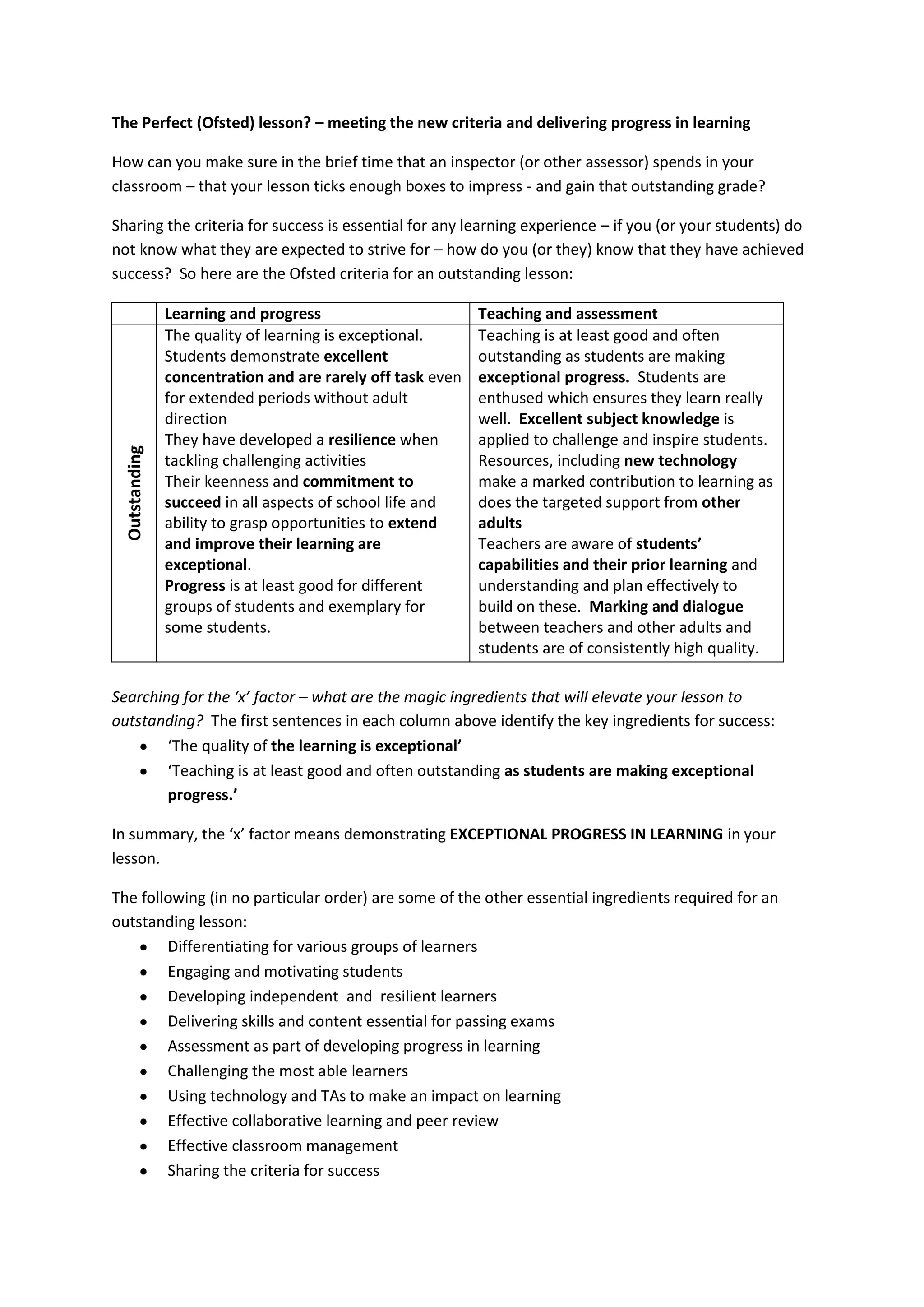
So how can you make sure you demonstrate the above when being observed? Follow these 6 steps:


Step one – Be in control, right from the start

Set up the learning environment

E.g. The music-challenge-reward

Students should expect to start something as soon as they come into the classroom without you
even directing them. This strategy should cover the time it takes for all the students to arrive. It
neatly shows how you are completely and effortlessly in control and makes a great impression on
that extra (Ofsted) visitor!

Get the students in the habit of doing this in every lesson by setting little challenges, questions or
tasks to do on the board that they KNOW they are expected to get on with. These can be anagrams,
puzzles, true or false statements, recaps of the previous lesson, unexpected questions for debate etc
etc. Reward effort for these tasks by giving out points.

The tasks could also link explicitly to one of the Personal, Learning and Thinking skills and success
could earn points that accumulate over time and earn rewards. Some examples of tasks involving
the PLTs could be:


Personal, Learning and Thinking skill                                 Task

                                        Draw a face that depicts the different moods you have
Self manager
                                        experienced today so far.
                                        Write down ten things you will do this lesson to help others
Effective participator
                                        learn
                                        Design a logo and slogan for this subject/lesson
Creative thinker
                                        Create a mind map of what we did last lesson
Reflective learner
                                        Write three questions you need to ask about what we did last
Independent Enquirer
                                        lesson
                                        Think of three promises you will make to your team to help it
Team worker
                                        work well.


Whilst the students are completing the tasks smile, greet them individually by name and make them
feel welcome. You could get the students to assess each other’s work if appropriate.

Also it is a good idea to have music on as they come in and are getting on with the little tasks. Then,
when you switch it off, the students know it is time to start the lesson proper.

This will mean that you can start the lesson proper when YOU are ready and useful work is still
taking place.
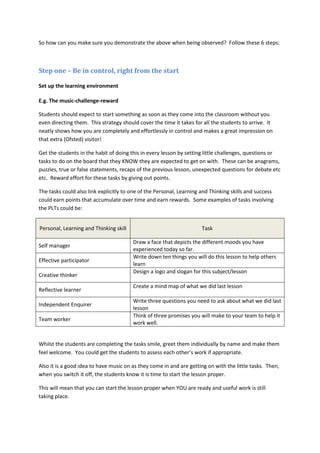
Step 2. The starter.

A starter should stimulate curiosity and open mindedness and prepare the brain for learning.
These can be random or linked to the subject.

A starter can be a thunk, a curiosity or a challenge.

A thunk
This is a question that has no right or wrong answer but makes you think! This prepares a student to
be open minded and consider various options.

For example:
       If you always got what you wished for would you always be happy?
       Where does the sky begin?
       What has the most freedom an ant or a school child?
       Is a person who has a face transplant still the same person?
       Which is heavier an inflated or deflated balloon?

(Thunks from ‘The Little Book of Thunks’ by Ian Gilbert (Crownhouse)

Students can think of the next question or make up their own thunks as part of the starter.

A curiosity
For example
       A box, which they have to guess the contents of
       A wig or hat that someone can try on and guess the character it belongs to
       A message in a bottle. Students have to guess the message and who sent it

A Creative Challenge in pairs (tuning up the connections in the brain )
        First pop song you ever heard and the one you heard most recently
        The 3 most popular babies’ names in 1999 and the three that will be most popular in 2020
        Guess the most common and least common food that everyone in the class had for
        breakfast

Snog, marry, avoid
A fun task that helps students understand personal preferences. What would you do with the
following famous names and why?
                                                                           TOP TIP
Prince William, John Terry, Russell Brand
                                                                Be energetic and enthusiastic.
Cheryl Cole, Davina McCall, Ferne Britton                      Channel any nerves into passion!
Nick Clegg, Gordon Brown, David Cameron
Step 3. Set objectives or learning outcomes – engage them in the learning

Describe, simply and EXACTLY what you want the students to be able to do by the end of the
lesson. Do this at two levels (at least) for differentiation.

This is the crucial moment when you engage the students in the exciting task ahead and explain that
this will make a difference to them personally. To succeed you must communicate your expectation
of success and your personal excitement about what they can achieve and why it is important.

How can you convince the students that learning is a journey and that they have an amazing capacity
to progress during this lesson? There are three parts to doing this:
    1. Explain (with passion!) what success in achieving the objectives will look and feel like. (The
        ‘brilliant outcome.’)
    2. Showing them that achieving the objectives is part of a learning journey by using a
        continuum line.
    3. By also setting one or more personal skills objective

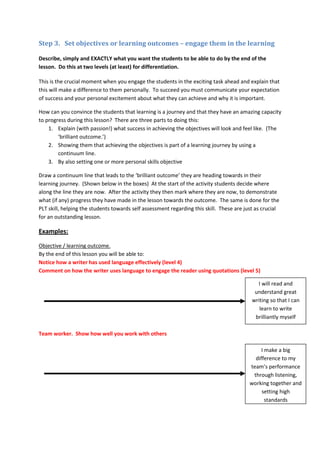
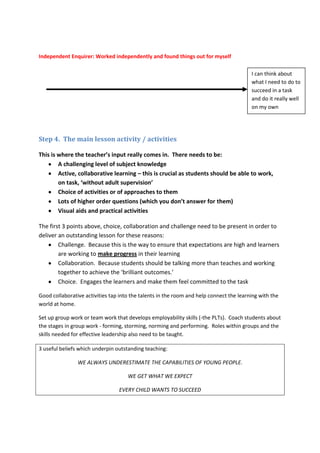
Draw a continuum line that leads to the ‘brilliant outcome’ they are heading towards in their
learning journey. (Shown below in the boxes) At the start of the activity students decide where
along the line they are now. After the activity they then mark where they are now, to demonstrate
what (if any) progress they have made in the lesson towards the outcome. The same is done for the
PLT skill, helping the students towards self assessment regarding this skill. These are just as crucial
for an outstanding lesson.

Examples:

Objective / learning outcome.
By the end of this lesson you will be able to:
Notice how a writer has used language effectively (level 4)
Comment on how the writer uses language to engage the reader using quotations (level 5)

                                                                                             I will read and
                                                                                            understand great
                                                                                           writing so that I can
                                                                                              learn to write
                                                                                            brilliantly myself

Team worker. Show how well you work with others

                                                                                               I make a big
                                                                                            difference to my
                                                                                          team’s performance
                                                                                           through listening,
                                                                                          working together and
                                                                                               setting high
                                                                                                 standards
Independent Enquirer: Worked independently and found things out for myself

                                                                                         I can think about
                                                                                         what I need to do to
                                                                                         succeed in a task
                                                                                         and do it really well
                                                                                         on my own


Step 4. The main lesson activity / activities

This is where the teacher’s input really comes in. There needs to be:
        A challenging level of subject knowledge
        Active, collaborative learning – this is crucial as students should be able to work,
        on task, ‘without adult supervision’
        Choice of activities or of approaches to them
        Lots of higher order questions (which you don’t answer for them)
        Visual aids and practical activities

The first 3 points above, choice, collaboration and challenge need to be present in order to
deliver an outstanding lesson for these reasons:
        Challenge. Because this is the way to ensure that expectations are high and learners
        are working to make progress in their learning
        Collaboration. Because students should be talking more than teaches and working
        together to achieve the ‘brilliant outcomes.’
        Choice. Engages the learners and make them feel committed to the task

Good collaborative activities tap into the talents in the room and help connect the learning with the
world at home.

Set up group work or team work that develops employability skills (-the PLTs). Coach students about
the stages in group work - forming, storming, norming and performing. Roles within groups and the
skills needed for effective leadership also need to be taught.

3 useful beliefs which underpin outstanding teaching:

                WE ALWAYS UNDERESTIMATE THE CAPABILITIES OF YOUNG PEOPLE.

                                     WE GET WHAT WE EXPECT

                                 EVERY CHILD WANTS TO SUCCEED
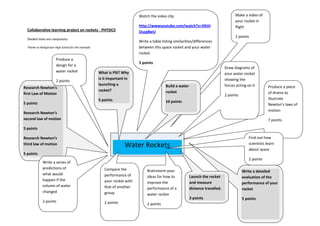
Collaborative project examples.

Note that these have some CHOICE in the tasks and an onus on completing the work as a group. The
outcomes should be presented by the group and, as far as is possible, quality control should be given
to the team. An element of competition can be added by allocating points to different tasks.
Watch the video clip                                        Make a video of
                                                                                                                                        your rocket in
                                                                            http://wwwyoutube.com/watch?v=XKtH                          flight
  Collaborative learning project on rockets - PHYSICS                       Ouzg8wU
                                                                                                                                        2 points
  Shaded tasks are compulsory
                                                                            Write a table listing similarities/differences
  Thanks to Wolgarston High School for this example                         between this space rocket and your water
                                                                            rocket.
                        Produce a
                                                                            5 points
                        design for a
                                                                                                                                  Draw diagrams of
                        water rocket                  What is PSI? Why                                                            your water rocket
                                                      is it important in                                                          showing the
                        2 points
                                                      launching a                           Build a water                         forces acting on it
Research Newton’s                                                                                                                                            Produce a piece
                   2 points                           rocket?                               rocket
first Law of Motion                                                                                                                                          of drama to
                                                                                                                                  2 points
                                                      5 points                                                                                               illustrate
5 points                                                                                    10 points
                                                                                                                                                             Newton’s laws of
                                                                                                                                                             motion
Research Newton’s
second law of motion                                                                                                                                         7 points

5 points

Research Newton’s                                                                                                                                Find out how
third law of motion                                                  Water Rockets                                                               scientists learn
                                                                                                                                                 about space
5 points
                                                                                                                                                 2 points
             Write a series of
             predictions of                              Compare the             Brainstorm your                                             Write a detailed
             what would                                  performance of          ideas for how to           Launch the rocket                evaluation of the
             happen if the                               your rocket with        improve the                and measure                      performance of your
             volume of water                             that of another         performance of a           distance travelled.              rocket
             changed                                     group                   water rocket
                                                                                                            3 points                         5 points
             2 points                                    2 points                2 points
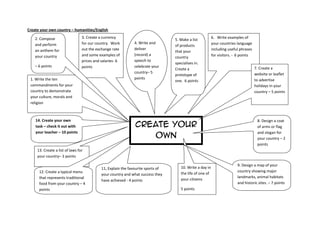
Create your own country – humanities/English

    2. Compose                   3. Create a currency                                                     6. Write examples of
                                                                                  5. Make a list
    and perform                  for our country. Work        4. Write and                                your countries language
                                                                                  of products
    an anthem for                out the exchange rate        deliver                                     including useful phrases
                                                                                  that your
    your country                 and some examples of         (record) a                                  for visitors. - 6 points
                                                                                  country
                                 prices and salaries- 6       speech to
                                                                                  specialises in.
    – 6 points                   points                       celebrate your                                                         7. Create a
                                                                                  Create a
                                                              country– 5                                                             website or leaflet
                                                                                  prototype of
 1. Write the ten                                             points                                                                 to advertise
                                                                                  one. 6 points
 commandments for your                                                                                                               holidays in your
 country to demonstrate                                                                                                              country – 5 points
 your culture, morals and
 religion


    14. Create your own                                                                                                               8. Design a coat
    task – check it out with                                   Create your                                                            of arms or flag

                                                                   own
    your teacher – 10 points                                                                                                          and slogan for
                                                                                                                                      your country – 2

     13. Create a list of laws for
                                                                 country                                                              points

     your country– 3 points

                                                                                                                         9. Design a map of your
                                            11, Explain the favourite sports of      10. Write a day in
      12. Create a typical menu                                                                                          country showing major
                                            your country and what success they       the life of one of
      that represents traditional                                                                                        landmarks, animal habitats
                                            have achieved - 4 points                 your citizens
      food from your country – 4                                                                                         and historic sites. – 7 points
      points                                                                         5 points


                                                                                     – 5 points
Step 5. Dish up the DIRT...... often!

DIRT = Dedicated Improvement and Reflection Time through assessment AS learning. As the
process of learning is a journey, it is essential to raise awareness about this process by reminding
students frequently to check their learning process and progress. What have you learnt, how far
have you travelled towards the learning outcome? There should be regular checkpoints which then
become assessment AS part of the learning process.

Reviewing and reflecting.

As students know what the success criteria is and are aware of the need to continue to gauge their
progress there is also a need to focus on the quality of the work produced. This is the quality control
moment when students work on their own or together to improve their work. A checklist that
relates to success criteria could be helpful here. You could use APP (assessment of pupil progress)
student sheets to enable students to start to self or peer assess the work produced. Working to
redraft, improve and amend following constructive criticism is a vital part of the learning journey. It
also gives the students more control and responsibility for the outcomes. This prevents marking
being a mysterious process that goes on in the teacher’s head. Assessment becomes part of the
learning process.

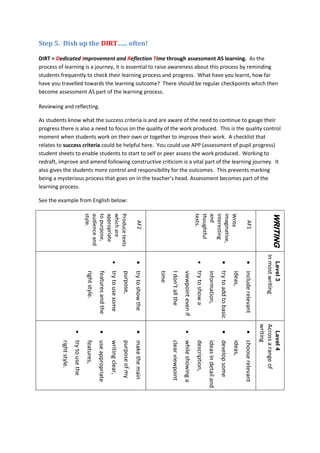
See the example from English below:
                                         style.
                                         audience and
                                         to purpose,
                                         appropriate
                                         which are
                                         Produce texts


                                                                                                                                                                            texts.
                                                                                                                                                                            thoughtful
                                                                                                                                                                            and
                                                                                                                                                                            interesting
                                                                                                                                                                            imaginative,
                                                                                                                                                                            Write


                                                                                                                                                                                                                                                                                          WRITING
                                                                                                               AF2


                                                                                                                                                                                                                                                   AF1


                                                                                                                                                                                                                                                                             In most writing
                                                                                                                                                                                                                                                                                               Level 3
                                         right style.
                                                        features and the
                                                                           try to use some
                                                                                             purpose,
                                                                                                             try to show the


                                                                                                                               time
                                                                                                                                      I don’t all the
                                                                                                                                                        viewpoint even if
                                                                                                                                                                            try to show a
                                                                                                                                                                                            information,
                                                                                                                                                                                                                  try to add to basic
                                                                                                                                                                                                                                        ideas,
                                                                                                                                                                                                                                                 include relevant

                                                                                                                                                                                                                                                                    writing
                                                                                                                                                                                                                                                                    Across a range of
                                                                                                                                                                                                                                                                                               Level 4
         right style.
                        try to use the
                                         features,
                                                        use appropriate
                                                                           writing clear,
                                                                                             purpose of my
                                                                                                             make the main


                                                                                                                                      clear viewpoint
                                                                                                                                                        while showing a
                                                                                                                                                                            description,
                                                                                                                                                                                            ideas in detail and
                                                                                                                                                                                                                  develop some
                                                                                                                                                                                                                                        ideas,
                                                                                                                                                                                                                                                 choose relevant
writing I
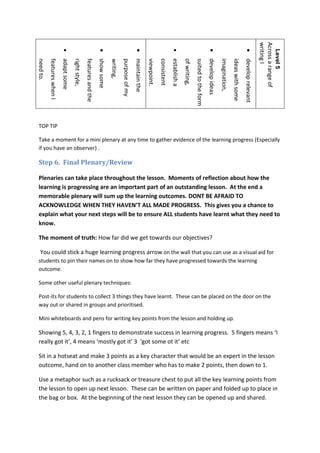
                                                                                                                                                                                                                                                                                 Across a range of
                                                                                                                                                                                                                                                                                                     Level 5
need to.
           features when I
                             adapt some
                                          right style,
                                                         features and the
                                                                            show some
                                                                                        writing,
                                                                                                   purpose of my
                                                                                                                   maintain the
                                                                                                                                  viewpoint.
                                                                                                                                               consistent
                                                                                                                                                            establish a
                                                                                                                                                                          of writing,
                                                                                                                                                                                        suited to the form
                                                                                                                                                                                                             develop ideas
                                                                                                                                                                                                                             imagination,
                                                                                                                                                                                                                                            ideas with some
                                                                                                                                                                                                                                                              develop relevant
 TOP TIP

 Take a moment for a mini plenary at any time to gather evidence of the learning progress (Especially
 if you have an observer) .

 Step 6. Final Plenary/Review

 Plenaries can take place throughout the lesson. Moments of reflection about how the
 learning is progressing are an important part of an outstanding lesson. At the end a
 memorable plenary will sum up the learning outcomes. DONT BE AFRAID TO
 ACKNOWLEDGE WHEN THEY HAVEN’T ALL MADE PROGRESS. This gives you a chance to
 explain what your next steps will be to ensure ALL students have learnt what they need to
 know.

 The moment of truth: How far did we get towards our objectives?

  You could stick a huge learning progress arrow on the wall that you can use as a visual aid for
 students to pin their names on to show how far they have progressed towards the learning
 outcome.

 Some other useful plenary techniques:

 Post-its for students to collect 3 things they have learnt. These can be placed on the door on the
 way out or shared in groups and prioritised.

 Mini whiteboards and pens for writing key points from the lesson and holding up.

 Showing 5, 4, 3, 2, 1 fingers to demonstrate success in learning progress. 5 fingers means ‘I
 really got it’, 4 means ‘mostly got it’ 3 ‘got some ot it’ etc

 Sit in a hotseat and make 3 points as a key character that would be an expert in the lesson
 outcome, hand on to another class member who has to make 2 points, then down to 1.

 Use a metaphor such as a rucksack or treasure chest to put all the key learning points from
 the lesson to open up next lesson. These can be written on paper and folded up to place in
 the bag or box. At the beginning of the next lesson they can be opened up and shared.
Write newspaper headlines – summarising your key learning in a headline. Useful to have some
mock up newpapers made with blank headlines.

ALWAYS FINISH ON TIME SO THAT YOU DONT MISS OUT THE PLENARY IN YOUR LESSON PLAN. CUT
SHORT OTHER ACTIVITIES BUT MAKE SURE YOU DEMONSTRATE THE LEARNIGN AT THE END AND
MAKE YOUR OWN ASSESSMENT ABOUT WHETHER YOU HAVE SUCCEEDED IN ACHEIVING THE
LEARNING OUTCOME.

It should be very clear to any observer that students have made progress in learning and
can demonstrate it. Where insufficient progress has been made it should be clear what
the plan of action will be to address this next lesson. One of the most common criticisms
is that teachers don’t use assessment outcomes to inform future planning. Make it clear
that you can see what each and every student has learnt and what the next steps are to
secure progress.

Finish the lesson by setting the scene for the next exciting learning experience that will build
on the lesson today.


Jackie Beere OBE, author, trainer, AST and SIP


This article is an extract from Jackie Beere’s new book the ‘Little Book of the Perfect (Ofsted)
Lesson.’ Published by Crownhouse Publishing. In this she will be exploring homework, use
of Teacher Assistants, behaviour management and creativity amongst other aspects of
classroom practice.

The perfect ofsted_lesson_-_article

  • 1.
    The Perfect (Ofsted)lesson? – meeting the new criteria and delivering progress in learning How can you make sure in the brief time that an inspector (or other assessor) spends in your classroom – that your lesson ticks enough boxes to impress - and gain that outstanding grade? Sharing the criteria for success is essential for any learning experience – if you (or your students) do not know what they are expected to strive for – how do you (or they) know that they have achieved success? So here are the Ofsted criteria for an outstanding lesson: Learning and progress Teaching and assessment The quality of learning is exceptional. Teaching is at least good and often Students demonstrate excellent outstanding as students are making concentration and are rarely off task even exceptional progress. Students are for extended periods without adult enthused which ensures they learn really direction well. Excellent subject knowledge is They have developed a resilience when applied to challenge and inspire students. Outstanding tackling challenging activities Resources, including new technology Their keenness and commitment to make a marked contribution to learning as succeed in all aspects of school life and does the targeted support from other ability to grasp opportunities to extend adults and improve their learning are Teachers are aware of students’ exceptional. capabilities and their prior learning and Progress is at least good for different understanding and plan effectively to groups of students and exemplary for build on these. Marking and dialogue some students. between teachers and other adults and students are of consistently high quality. Searching for the ‘x’ factor – what are the magic ingredients that will elevate your lesson to outstanding? The first sentences in each column above identify the key ingredients for success: ‘The quality of the learning is exceptional’ ‘Teaching is at least good and often outstanding as students are making exceptional progress.’ In summary, the ‘x’ factor means demonstrating EXCEPTIONAL PROGRESS IN LEARNING in your lesson. The following (in no particular order) are some of the other essential ingredients required for an outstanding lesson: Differentiating for various groups of learners Engaging and motivating students Developing independent and resilient learners Delivering skills and content essential for passing exams Assessment as part of developing progress in learning Challenging the most able learners Using technology and TAs to make an impact on learning Effective collaborative learning and peer review Effective classroom management Sharing the criteria for success
  • 2.
    So how canyou make sure you demonstrate the above when being observed? Follow these 6 steps: Step one – Be in control, right from the start Set up the learning environment E.g. The music-challenge-reward Students should expect to start something as soon as they come into the classroom without you even directing them. This strategy should cover the time it takes for all the students to arrive. It neatly shows how you are completely and effortlessly in control and makes a great impression on that extra (Ofsted) visitor! Get the students in the habit of doing this in every lesson by setting little challenges, questions or tasks to do on the board that they KNOW they are expected to get on with. These can be anagrams, puzzles, true or false statements, recaps of the previous lesson, unexpected questions for debate etc etc. Reward effort for these tasks by giving out points. The tasks could also link explicitly to one of the Personal, Learning and Thinking skills and success could earn points that accumulate over time and earn rewards. Some examples of tasks involving the PLTs could be: Personal, Learning and Thinking skill Task Draw a face that depicts the different moods you have Self manager experienced today so far. Write down ten things you will do this lesson to help others Effective participator learn Design a logo and slogan for this subject/lesson Creative thinker Create a mind map of what we did last lesson Reflective learner Write three questions you need to ask about what we did last Independent Enquirer lesson Think of three promises you will make to your team to help it Team worker work well. Whilst the students are completing the tasks smile, greet them individually by name and make them feel welcome. You could get the students to assess each other’s work if appropriate. Also it is a good idea to have music on as they come in and are getting on with the little tasks. Then, when you switch it off, the students know it is time to start the lesson proper. This will mean that you can start the lesson proper when YOU are ready and useful work is still taking place.
  • 3.
    Step 2. Thestarter. A starter should stimulate curiosity and open mindedness and prepare the brain for learning. These can be random or linked to the subject. A starter can be a thunk, a curiosity or a challenge. A thunk This is a question that has no right or wrong answer but makes you think! This prepares a student to be open minded and consider various options. For example: If you always got what you wished for would you always be happy? Where does the sky begin? What has the most freedom an ant or a school child? Is a person who has a face transplant still the same person? Which is heavier an inflated or deflated balloon? (Thunks from ‘The Little Book of Thunks’ by Ian Gilbert (Crownhouse) Students can think of the next question or make up their own thunks as part of the starter. A curiosity For example A box, which they have to guess the contents of A wig or hat that someone can try on and guess the character it belongs to A message in a bottle. Students have to guess the message and who sent it A Creative Challenge in pairs (tuning up the connections in the brain ) First pop song you ever heard and the one you heard most recently The 3 most popular babies’ names in 1999 and the three that will be most popular in 2020 Guess the most common and least common food that everyone in the class had for breakfast Snog, marry, avoid A fun task that helps students understand personal preferences. What would you do with the following famous names and why? TOP TIP Prince William, John Terry, Russell Brand Be energetic and enthusiastic. Cheryl Cole, Davina McCall, Ferne Britton Channel any nerves into passion! Nick Clegg, Gordon Brown, David Cameron
  • 4.
    Step 3. Setobjectives or learning outcomes – engage them in the learning Describe, simply and EXACTLY what you want the students to be able to do by the end of the lesson. Do this at two levels (at least) for differentiation. This is the crucial moment when you engage the students in the exciting task ahead and explain that this will make a difference to them personally. To succeed you must communicate your expectation of success and your personal excitement about what they can achieve and why it is important. How can you convince the students that learning is a journey and that they have an amazing capacity to progress during this lesson? There are three parts to doing this: 1. Explain (with passion!) what success in achieving the objectives will look and feel like. (The ‘brilliant outcome.’) 2. Showing them that achieving the objectives is part of a learning journey by using a continuum line. 3. By also setting one or more personal skills objective Draw a continuum line that leads to the ‘brilliant outcome’ they are heading towards in their learning journey. (Shown below in the boxes) At the start of the activity students decide where along the line they are now. After the activity they then mark where they are now, to demonstrate what (if any) progress they have made in the lesson towards the outcome. The same is done for the PLT skill, helping the students towards self assessment regarding this skill. These are just as crucial for an outstanding lesson. Examples: Objective / learning outcome. By the end of this lesson you will be able to: Notice how a writer has used language effectively (level 4) Comment on how the writer uses language to engage the reader using quotations (level 5) I will read and understand great writing so that I can learn to write brilliantly myself Team worker. Show how well you work with others I make a big difference to my team’s performance through listening, working together and setting high standards
  • 5.
    Independent Enquirer: Workedindependently and found things out for myself I can think about what I need to do to succeed in a task and do it really well on my own Step 4. The main lesson activity / activities This is where the teacher’s input really comes in. There needs to be: A challenging level of subject knowledge Active, collaborative learning – this is crucial as students should be able to work, on task, ‘without adult supervision’ Choice of activities or of approaches to them Lots of higher order questions (which you don’t answer for them) Visual aids and practical activities The first 3 points above, choice, collaboration and challenge need to be present in order to deliver an outstanding lesson for these reasons: Challenge. Because this is the way to ensure that expectations are high and learners are working to make progress in their learning Collaboration. Because students should be talking more than teaches and working together to achieve the ‘brilliant outcomes.’ Choice. Engages the learners and make them feel committed to the task Good collaborative activities tap into the talents in the room and help connect the learning with the world at home. Set up group work or team work that develops employability skills (-the PLTs). Coach students about the stages in group work - forming, storming, norming and performing. Roles within groups and the skills needed for effective leadership also need to be taught. 3 useful beliefs which underpin outstanding teaching: WE ALWAYS UNDERESTIMATE THE CAPABILITIES OF YOUNG PEOPLE. WE GET WHAT WE EXPECT EVERY CHILD WANTS TO SUCCEED
  • 6.
    Collaborative project examples. Notethat these have some CHOICE in the tasks and an onus on completing the work as a group. The outcomes should be presented by the group and, as far as is possible, quality control should be given to the team. An element of competition can be added by allocating points to different tasks.
  • 7.
    Watch the videoclip Make a video of your rocket in http://wwwyoutube.com/watch?v=XKtH flight Collaborative learning project on rockets - PHYSICS Ouzg8wU 2 points Shaded tasks are compulsory Write a table listing similarities/differences Thanks to Wolgarston High School for this example between this space rocket and your water rocket. Produce a 5 points design for a Draw diagrams of water rocket What is PSI? Why your water rocket is it important in showing the 2 points launching a Build a water forces acting on it Research Newton’s Produce a piece 2 points rocket? rocket first Law of Motion of drama to 2 points 5 points illustrate 5 points 10 points Newton’s laws of motion Research Newton’s second law of motion 7 points 5 points Research Newton’s Find out how third law of motion Water Rockets scientists learn about space 5 points 2 points Write a series of predictions of Compare the Brainstorm your Write a detailed what would performance of ideas for how to Launch the rocket evaluation of the happen if the your rocket with improve the and measure performance of your volume of water that of another performance of a distance travelled. rocket changed group water rocket 3 points 5 points 2 points 2 points 2 points
  • 8.
    Create your owncountry – humanities/English 2. Compose 3. Create a currency 6. Write examples of 5. Make a list and perform for our country. Work 4. Write and your countries language of products an anthem for out the exchange rate deliver including useful phrases that your your country and some examples of (record) a for visitors. - 6 points country prices and salaries- 6 speech to specialises in. – 6 points points celebrate your 7. Create a Create a country– 5 website or leaflet prototype of 1. Write the ten points to advertise one. 6 points commandments for your holidays in your country to demonstrate country – 5 points your culture, morals and religion 14. Create your own 8. Design a coat task – check it out with Create your of arms or flag own your teacher – 10 points and slogan for your country – 2 13. Create a list of laws for country points your country– 3 points 9. Design a map of your 11, Explain the favourite sports of 10. Write a day in 12. Create a typical menu country showing major your country and what success they the life of one of that represents traditional landmarks, animal habitats have achieved - 4 points your citizens food from your country – 4 and historic sites. – 7 points points 5 points – 5 points
  • 9.
    Step 5. Dishup the DIRT...... often! DIRT = Dedicated Improvement and Reflection Time through assessment AS learning. As the process of learning is a journey, it is essential to raise awareness about this process by reminding students frequently to check their learning process and progress. What have you learnt, how far have you travelled towards the learning outcome? There should be regular checkpoints which then become assessment AS part of the learning process. Reviewing and reflecting. As students know what the success criteria is and are aware of the need to continue to gauge their progress there is also a need to focus on the quality of the work produced. This is the quality control moment when students work on their own or together to improve their work. A checklist that relates to success criteria could be helpful here. You could use APP (assessment of pupil progress) student sheets to enable students to start to self or peer assess the work produced. Working to redraft, improve and amend following constructive criticism is a vital part of the learning journey. It also gives the students more control and responsibility for the outcomes. This prevents marking being a mysterious process that goes on in the teacher’s head. Assessment becomes part of the learning process. See the example from English below: style. audience and to purpose, appropriate which are Produce texts texts. thoughtful and interesting imaginative, Write WRITING AF2 AF1 In most writing Level 3 right style. features and the try to use some purpose, try to show the time I don’t all the viewpoint even if try to show a information, try to add to basic ideas, include relevant writing Across a range of Level 4 right style. try to use the features, use appropriate writing clear, purpose of my make the main clear viewpoint while showing a description, ideas in detail and develop some ideas, choose relevant
  • 10.
    writing I Across a range of Level 5 need to. features when I adapt some right style, features and the show some writing, purpose of my maintain the viewpoint. consistent establish a of writing, suited to the form develop ideas imagination, ideas with some develop relevant TOP TIP Take a moment for a mini plenary at any time to gather evidence of the learning progress (Especially if you have an observer) . Step 6. Final Plenary/Review Plenaries can take place throughout the lesson. Moments of reflection about how the learning is progressing are an important part of an outstanding lesson. At the end a memorable plenary will sum up the learning outcomes. DONT BE AFRAID TO ACKNOWLEDGE WHEN THEY HAVEN’T ALL MADE PROGRESS. This gives you a chance to explain what your next steps will be to ensure ALL students have learnt what they need to know. The moment of truth: How far did we get towards our objectives? You could stick a huge learning progress arrow on the wall that you can use as a visual aid for students to pin their names on to show how far they have progressed towards the learning outcome. Some other useful plenary techniques: Post-its for students to collect 3 things they have learnt. These can be placed on the door on the way out or shared in groups and prioritised. Mini whiteboards and pens for writing key points from the lesson and holding up. Showing 5, 4, 3, 2, 1 fingers to demonstrate success in learning progress. 5 fingers means ‘I really got it’, 4 means ‘mostly got it’ 3 ‘got some ot it’ etc Sit in a hotseat and make 3 points as a key character that would be an expert in the lesson outcome, hand on to another class member who has to make 2 points, then down to 1. Use a metaphor such as a rucksack or treasure chest to put all the key learning points from the lesson to open up next lesson. These can be written on paper and folded up to place in the bag or box. At the beginning of the next lesson they can be opened up and shared.
  • 11.
    Write newspaper headlines– summarising your key learning in a headline. Useful to have some mock up newpapers made with blank headlines. ALWAYS FINISH ON TIME SO THAT YOU DONT MISS OUT THE PLENARY IN YOUR LESSON PLAN. CUT SHORT OTHER ACTIVITIES BUT MAKE SURE YOU DEMONSTRATE THE LEARNIGN AT THE END AND MAKE YOUR OWN ASSESSMENT ABOUT WHETHER YOU HAVE SUCCEEDED IN ACHEIVING THE LEARNING OUTCOME. It should be very clear to any observer that students have made progress in learning and can demonstrate it. Where insufficient progress has been made it should be clear what the plan of action will be to address this next lesson. One of the most common criticisms is that teachers don’t use assessment outcomes to inform future planning. Make it clear that you can see what each and every student has learnt and what the next steps are to secure progress. Finish the lesson by setting the scene for the next exciting learning experience that will build on the lesson today. Jackie Beere OBE, author, trainer, AST and SIP This article is an extract from Jackie Beere’s new book the ‘Little Book of the Perfect (Ofsted) Lesson.’ Published by Crownhouse Publishing. In this she will be exploring homework, use of Teacher Assistants, behaviour management and creativity amongst other aspects of classroom practice.