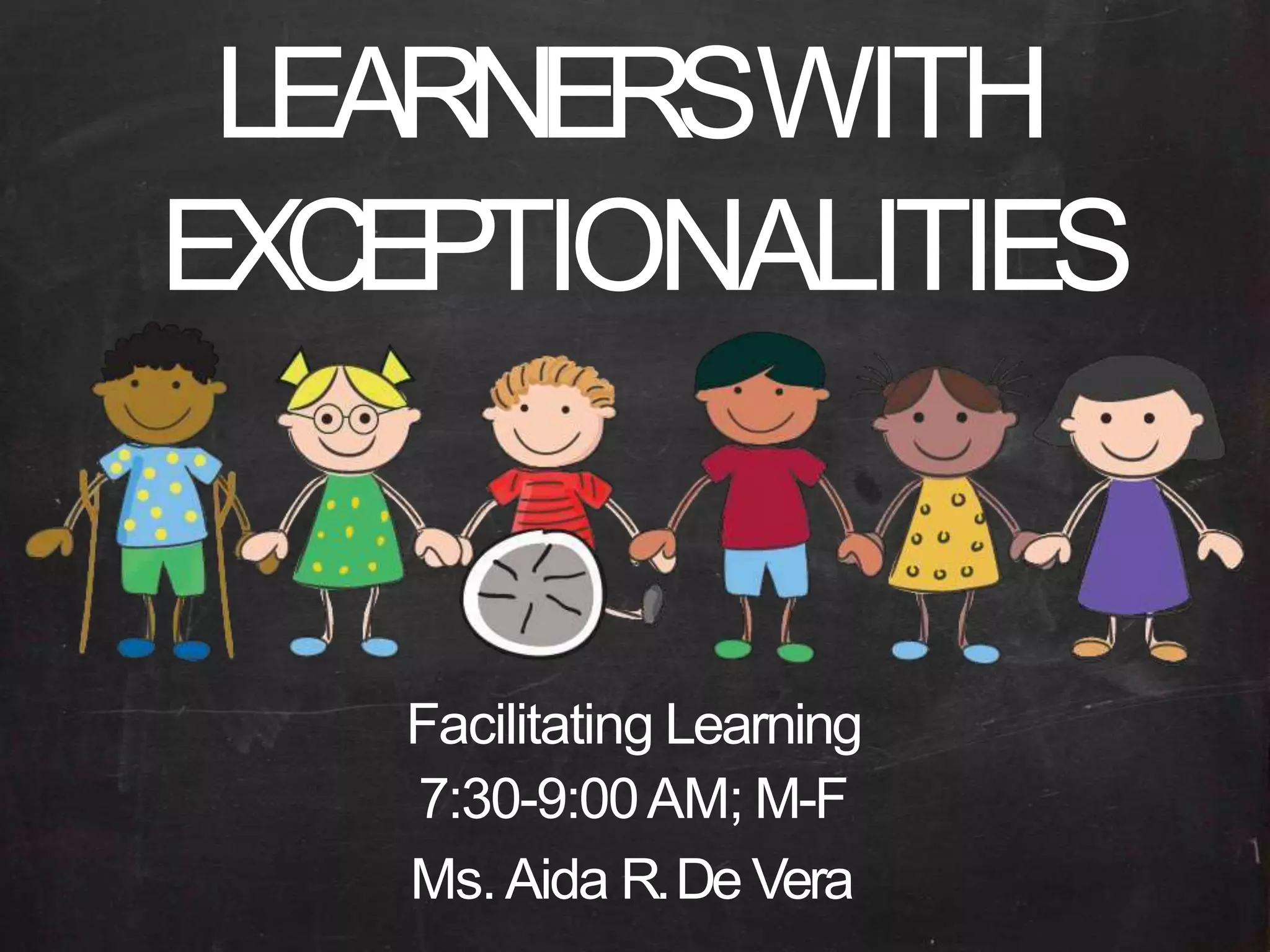
LEARNERSWITH
EXCEPTIONALITIES
Facilitating Learning
7:30-9:00AM; M-F
Ms.Aida R.De Vera
TERMINOLOGIES:
World Health Organization:
- 3-tier terms:
(a) Impairment
- loss or abnormality of psychological,
physiological or anatomical structureor
function
- intrinsic to theindividual
- “…when the individual with an impairmentwas
expected to carry out regular or routine tasks
that relied on the useof skills or knowledge in
the area(s), affected by theimpairment..”
…TERMINOLOGIES
(b) Disability
- measurable impairment or
limitation that “interferes witha
person’s ability, for example, to
walk, lift, hear, or learn. It may
refer to aphysical, sensory, or
mental condition”.
(Schiefelbusch Institute, 1996)
(c) Handicap
- disadvantage that occurs asa
result of adisability.
…TERMINOLOGIES
Disability has become more
accepted and used,replacing
“handicap”.
**In the USA, “disability” is
used in its federal laws,such
as Individuals with
Disabilities Act(IDEA).
**In the Philippine Constitution,
Article XIV, Section 2:
“…provide adult citizens, the
disabled, and out-of-school
youth withtraining…
 Exceptional learners
- Learners who are different
from “normal” or “average”
learners, needing special
needs suchrelated to
cognitive abilities, behavior,
social functioning, physical
and sensory impairments,
emotional disturbances, and
giftedness.
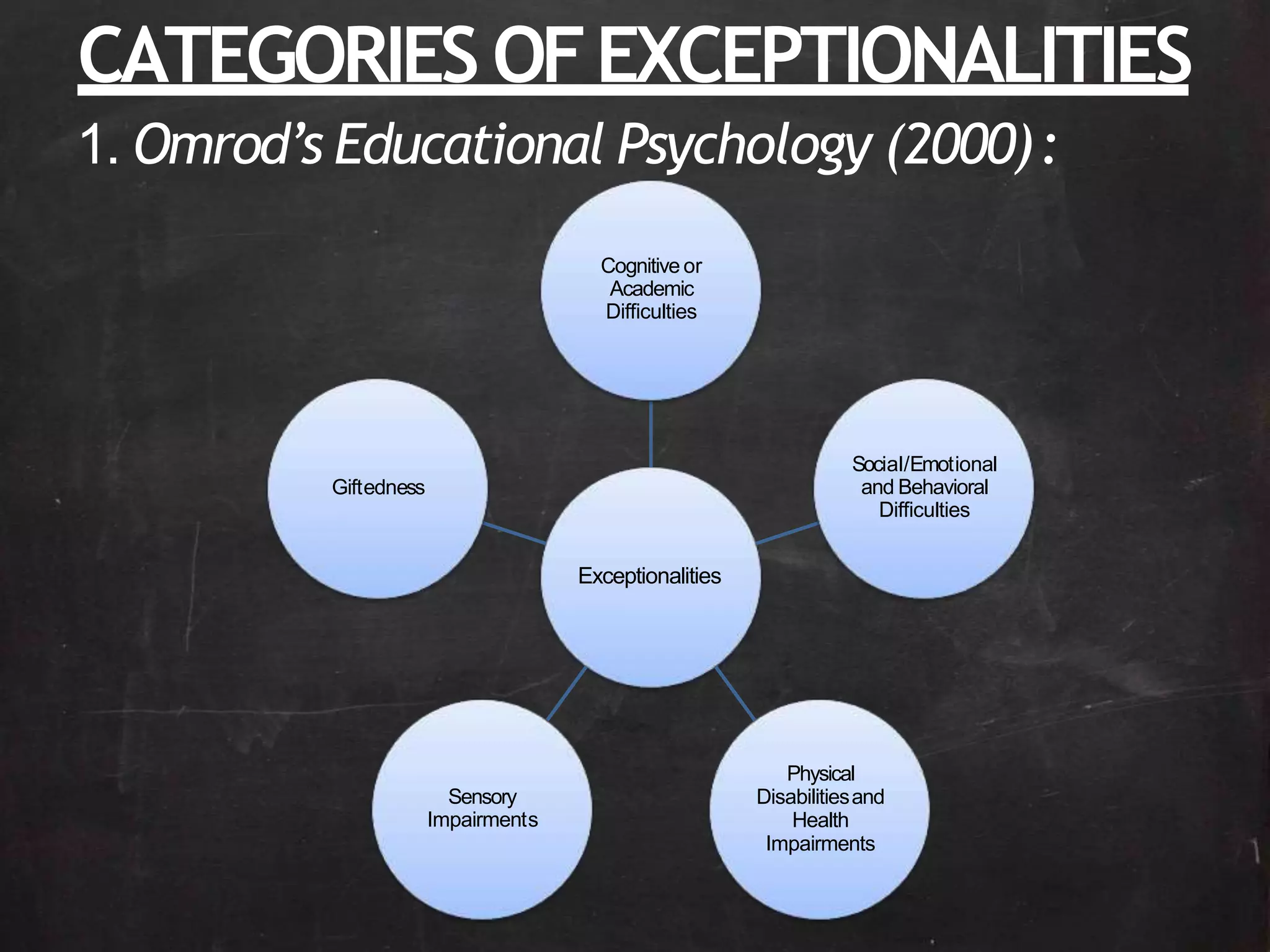
CATEGORIES OFEXCEPTIONALITIES
1. Omrod’s Educational Psychology (2000):
Exceptionalities
Cognitive or
Academic
Difficulties
Social/Emotional
and Behavioral
Difficulties
Physical
Disabilitiesand
Health
Impairments
Sensory
Impairments
Giftedness
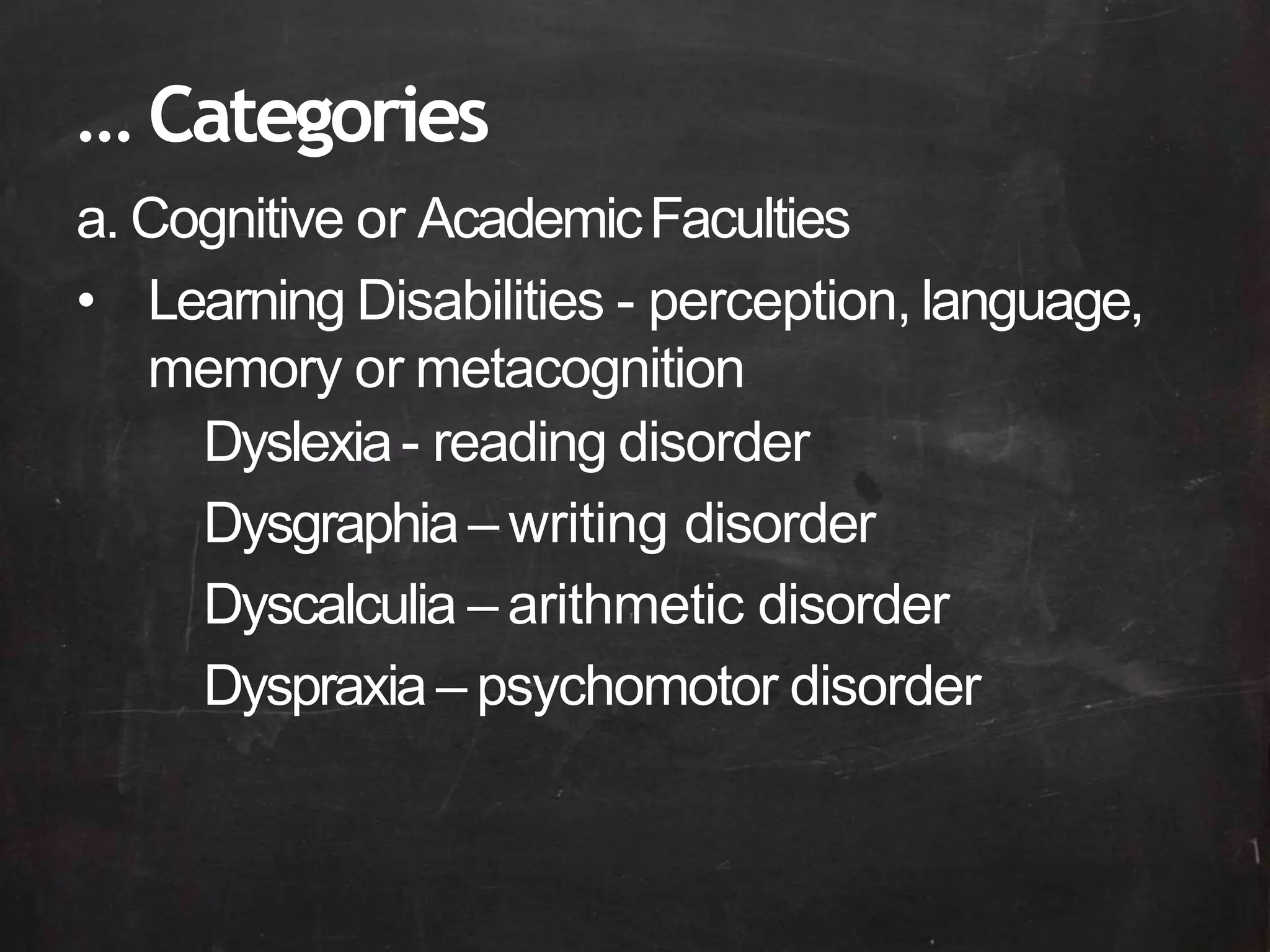
… Categories
a. Cognitive or AcademicFaculties
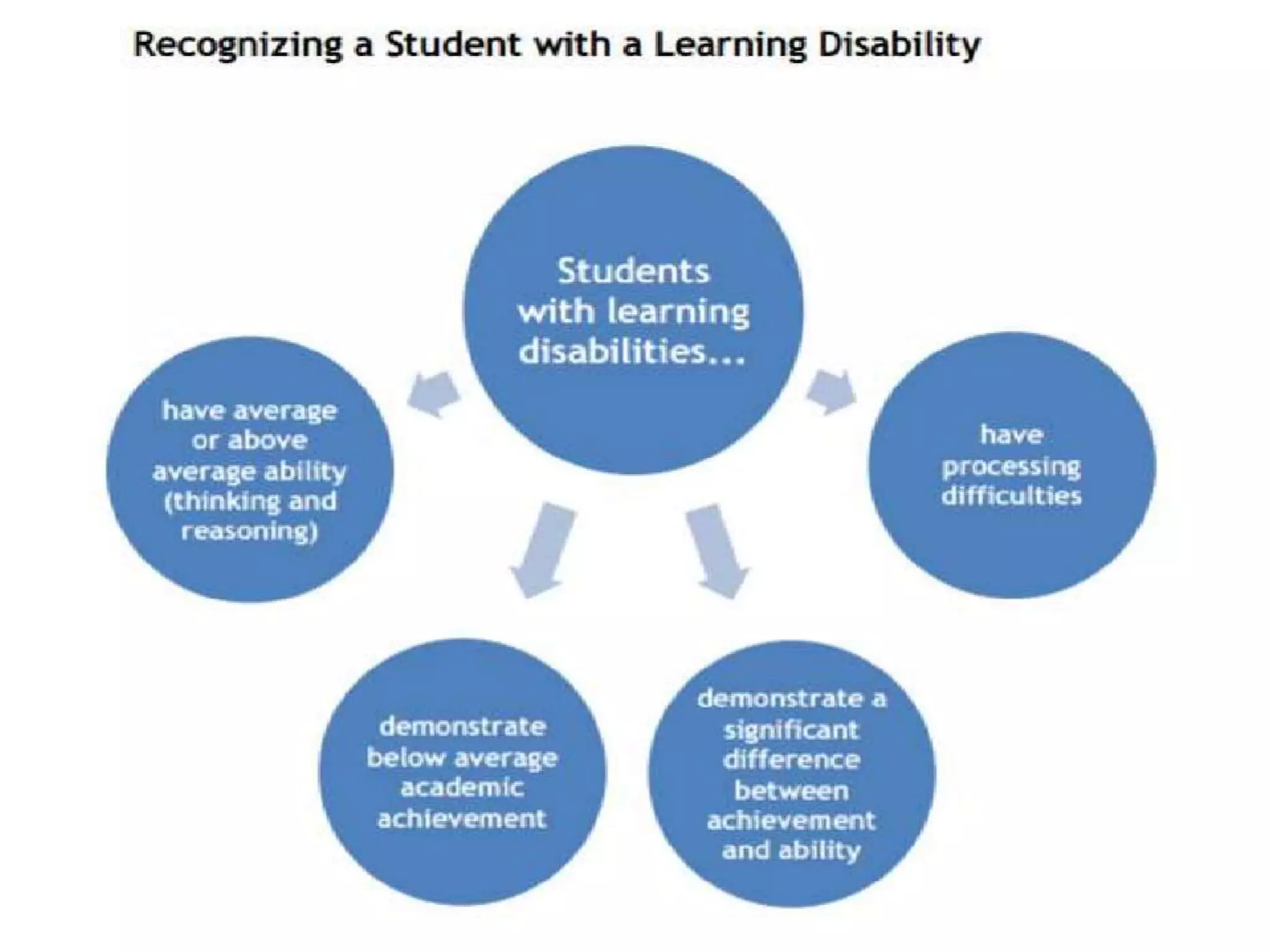
• Learning Disabilities - perception, language,
memory or metacognition
Dyslexia- reading disorder
Dysgraphia– writing disorder
Dyscalculia – arithmetic disorder
Dyspraxia – psychomotor disorder
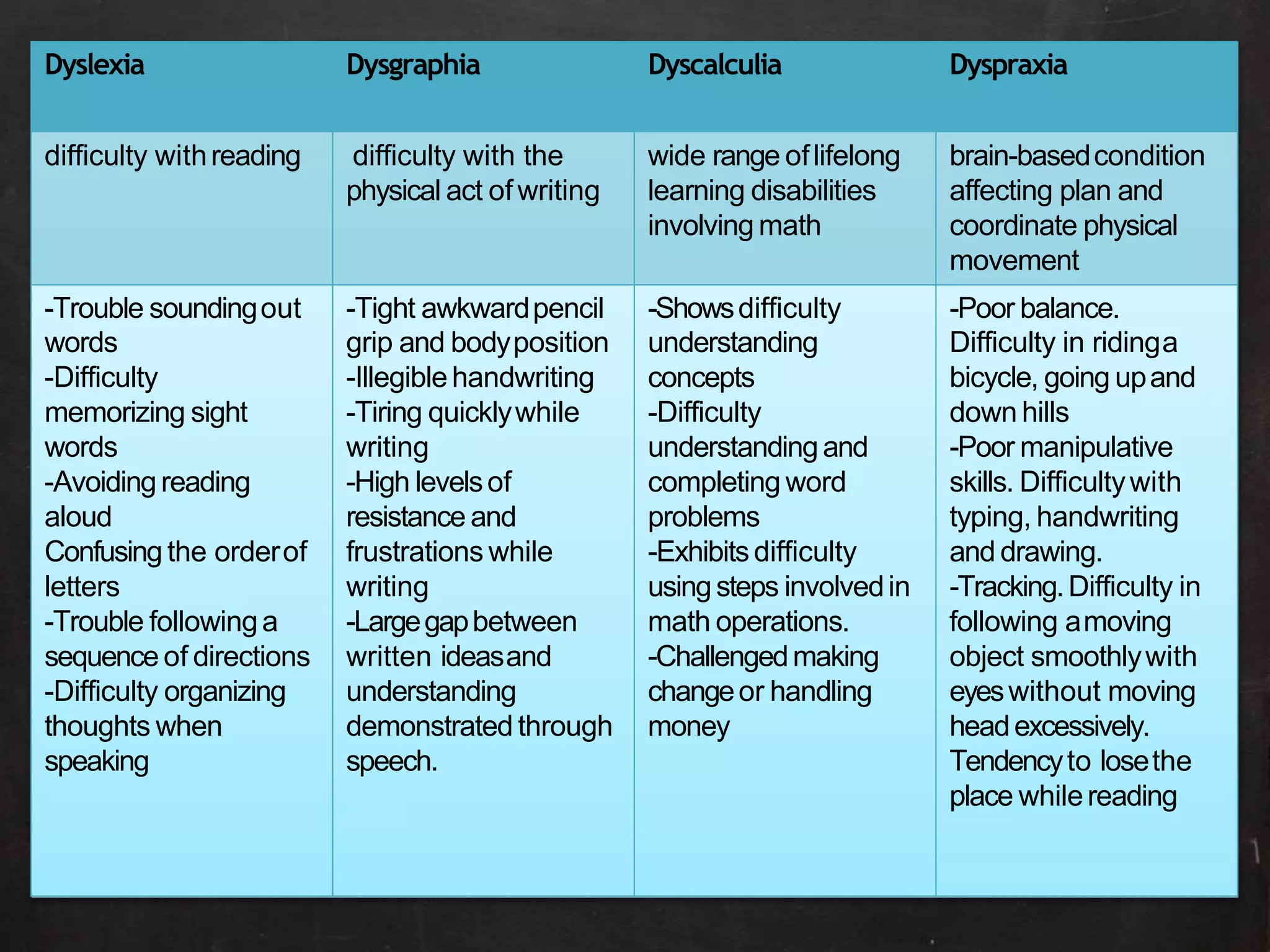
Dyslexia Dysgraphia Dyscalculia Dyspraxia
difficulty withreading difficulty with the
physical act ofwriting
wide range oflifelong
learning disabilities
involving math
brain-basedcondition
affecting plan and
coordinate physical
movement
-Trouble soundingout -Tight awkwardpencil -Showsdifficulty -Poor balance.
words grip and bodyposition understanding Difficulty in ridinga
-Difficulty -Illegiblehandwriting concepts bicycle, going upand
memorizing sight -Tiring quicklywhile -Difficulty down hills
words writing understandingand -Poor manipulative
-Avoidingreading -High levelsof completing word skills. Difficultywith
aloud resistance and problems typing, handwriting
Confusing the orderof frustrations while -Exhibitsdifficulty and drawing.
letters writing usingsteps involvedin -Tracking.Difficulty in
-Trouble followinga -Largegapbetween math operations. following amoving
sequence of directions written ideasand -Challengedmaking object smoothlywith
-Difficulty organizing understanding changeor handling eyeswithout moving
thoughts when demonstrated through money headexcessively.
speaking speech. Tendencyto losethe
place whilereading
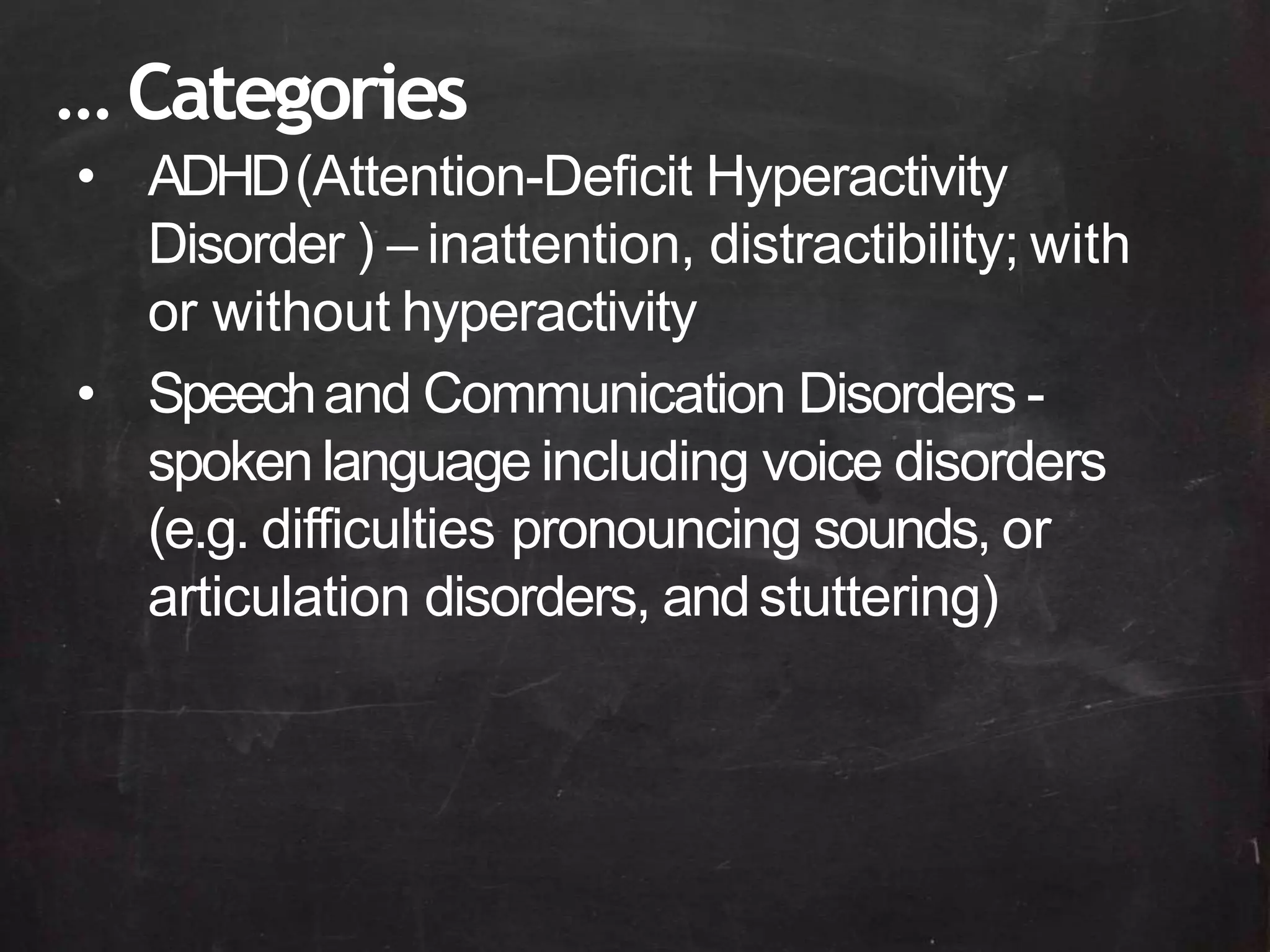
• ADHD(Attention-Deficit Hyperactivity
Disorder ) – inattention, distractibility; with
or without hyperactivity
• Speechand Communication Disorders -
spokenlanguage including voice disorders
(e.g. difficulties pronouncing sounds, or
articulation disorders, andstuttering)
… Categories
b. Social/Emotional and BehavioralDifficulties
• Autism - social skills, repetitive behaviors, speechand
nonverbal communication
• Mental Retardation - sub-averageintelligence and deficitsin
adaptive behavior
- imbecile
• Emotional / Conduct Disorders - presence of emotional states
like depression and aggressiondisturbing learning and
performance in school
c. Physical Disabilities and HealthImpairments
• Physicaland health impairments – affect individual’senergy
and strength, mental alertness and musclecontrol
• Severeand multiple disabilities - presence of two or more
different types of disabilities
… Categories
… Categories
d.Sensory Impairments
• Visual Impairments - malfunction of theeyesor
optic nerves that prevent normal visioneven
- myopia (farsightedness)
- hyperopia (nearsightedness)
- astigmatism
• Hearing Impairments (otherwise known as
hearing loss) - malfunction of the ear or auditory
nerves that hinders perception of sounds within
the frequency range of normalspeech
e. Giftedness
e.Giftedness
 speaksof talent, which includes all areas of achild’s life:
academic, artistic, athletic, and social. (USDepartmentof
Education, 1993)
 involves significantly high levels of cognitive
development
 performance and accomplishment
 Identification:
- Ability vs.Achievement
- Testsvs. Grades
- StandardizedTesting
- Ability
- IQ
- Creative and Critical Thinking Achievement
 Twice Exceptional Learners
…Giftedness
 Sixareas where giftedness could be found: (a) creative
thinking, (b) leadership, (c) general intellectual ability,(d)
psychomotor, (e) specific academic ability and (f) visual/
performing arts.
 Characteristics:
a. Perfectionist andidealistic
b. Heightened sensitivity to their own expectations and
those of others
c. Maturity beyondage
d. Problem solvers
e. Abstract thinkers
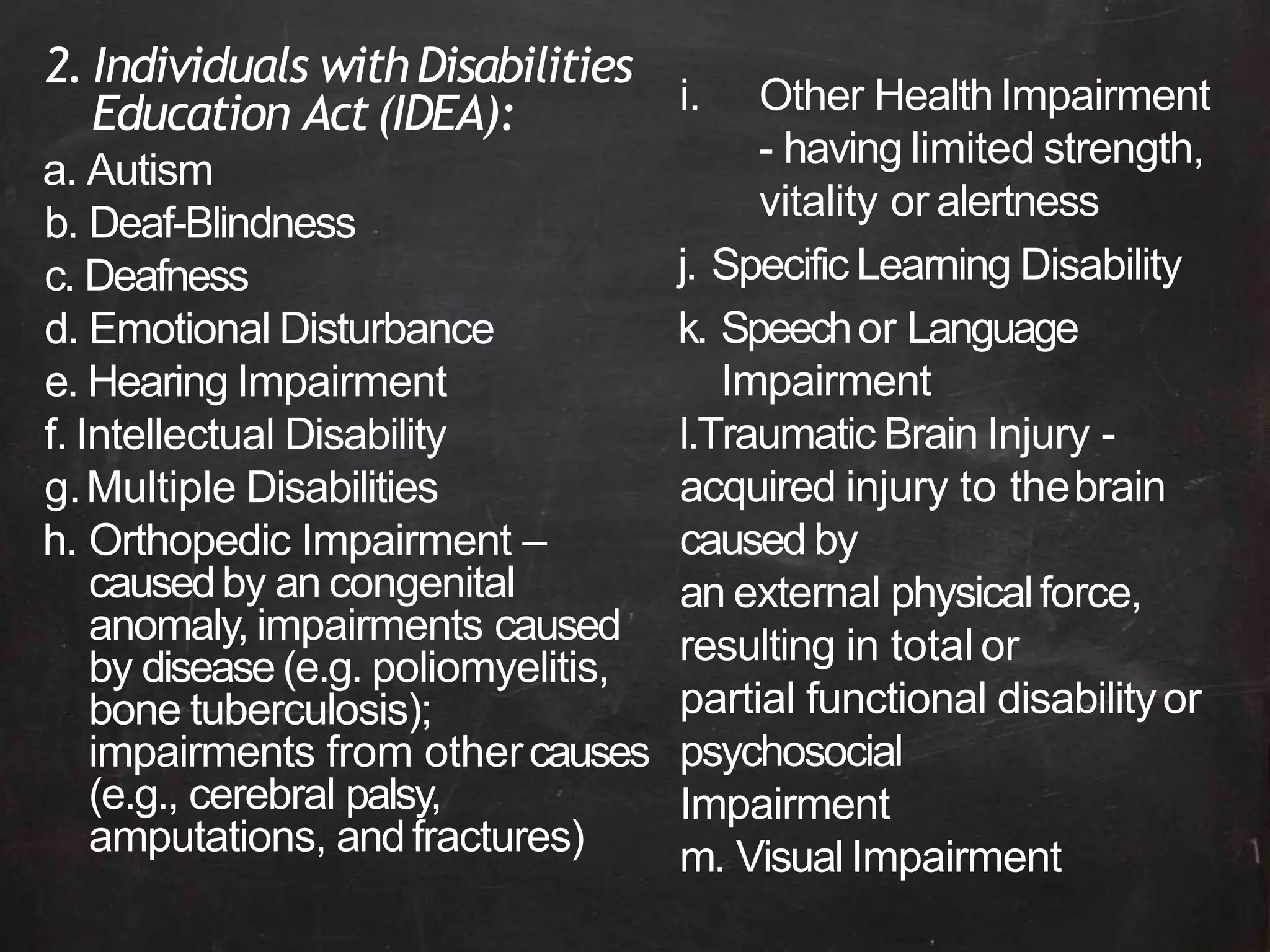
2. Individuals withDisabilities
Education Act(IDEA):
a. Autism
b. Deaf-Blindness
c. Deafness
d. Emotional Disturbance
e. Hearing Impairment
f. Intellectual Disability
g.Multiple Disabilities
h. Orthopedic Impairment –
causedby an congenital
anomaly, impairments caused
by disease (e.g. poliomyelitis,
bone tuberculosis);
impairments from othercauses
(e.g., cerebral palsy,
amputations, andfractures)
i. Other HealthImpairment
- having limited strength,
vitality or alertness
j. Specific Learning Disability
k. Speechor Language
Impairment
l.Traumatic Brain Injury -
acquired injury to thebrain
caused by
an external physicalforce,
resulting in total or
partial functional disabilityor
psychosocial
Impairment
m. Visual Impairment
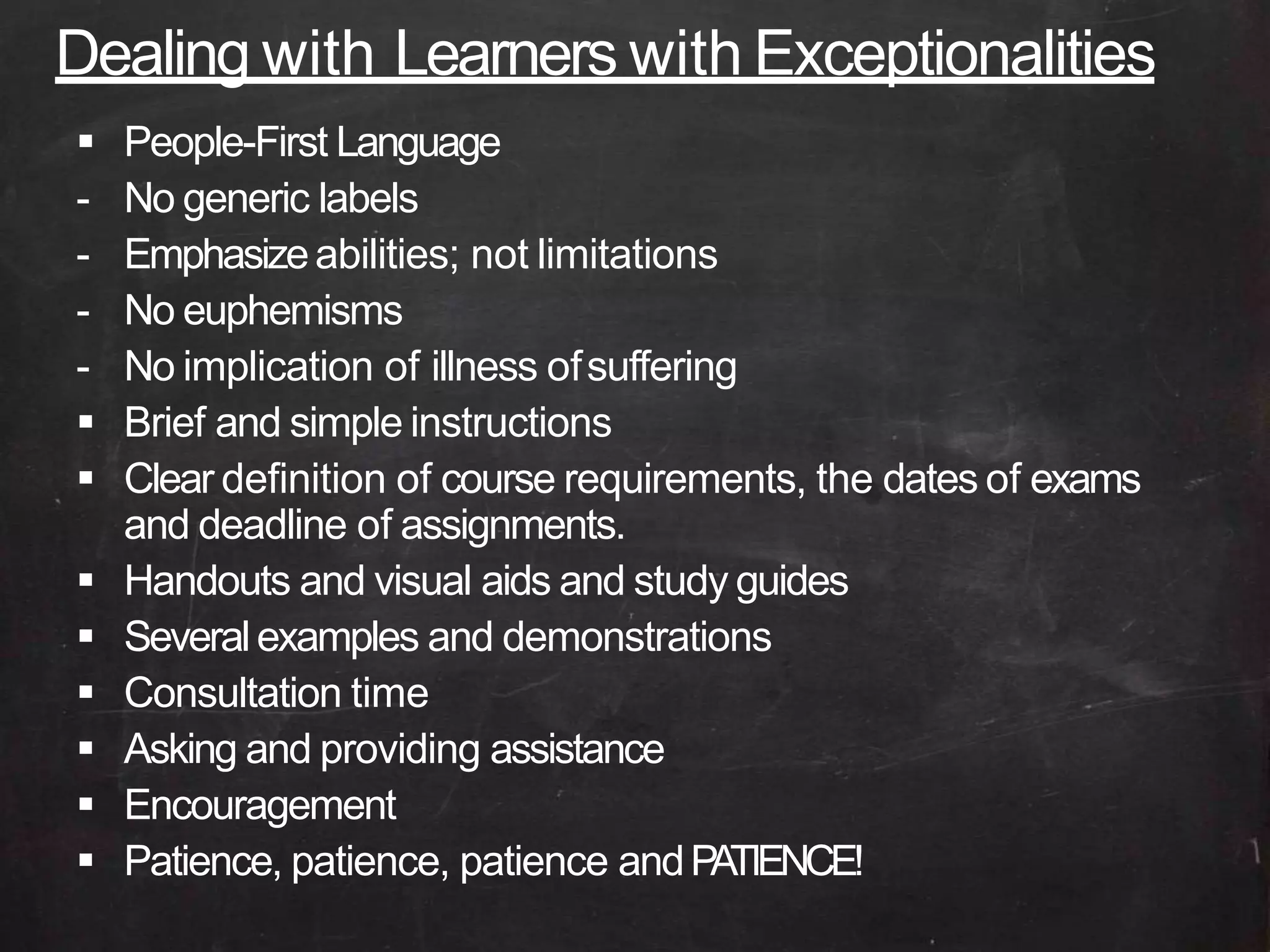
Dealing with Learners with Exceptionalities
 People-First Language
- No generic labels
- Emphasizeabilities; not limitations
- No euphemisms
- No implication of illness ofsuffering
 Brief and simple instructions
 Clear definition of course requirements, the dates of exams
and deadline of assignments.
 Handouts and visual aids and study guides
 Severalexamples and demonstrations
 Consultation time
 Asking and providing assistance
 Encouragement
 Patience, patience, patience andPATIENCE!
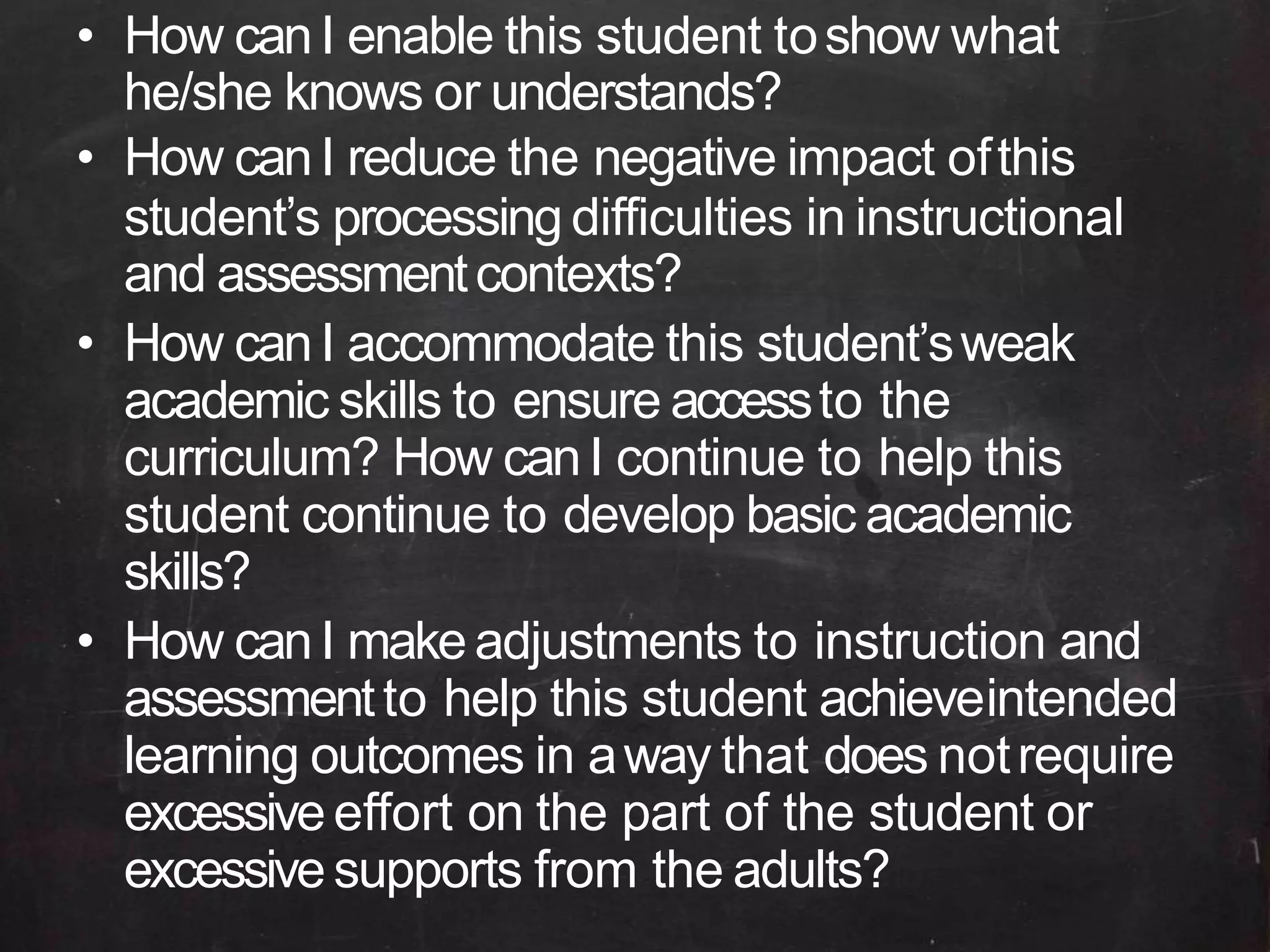
• How canI enable this student toshow what
he/she knows or understands?
• How canI reduce the negative impact ofthis
student’s processing difficulties in instructional
and assessmentcontexts?
• How canI accommodate this student’sweak
academic skills to ensure accessto the
curriculum? How canI continue to help this
student continue to develop basic academic
skills?
• How canI makeadjustments to instruction and
assessmentto help this student achieveintended
learning outcomes in away that does notrequire
excessiveeffort on the part of the student or
excessivesupports from the adults?
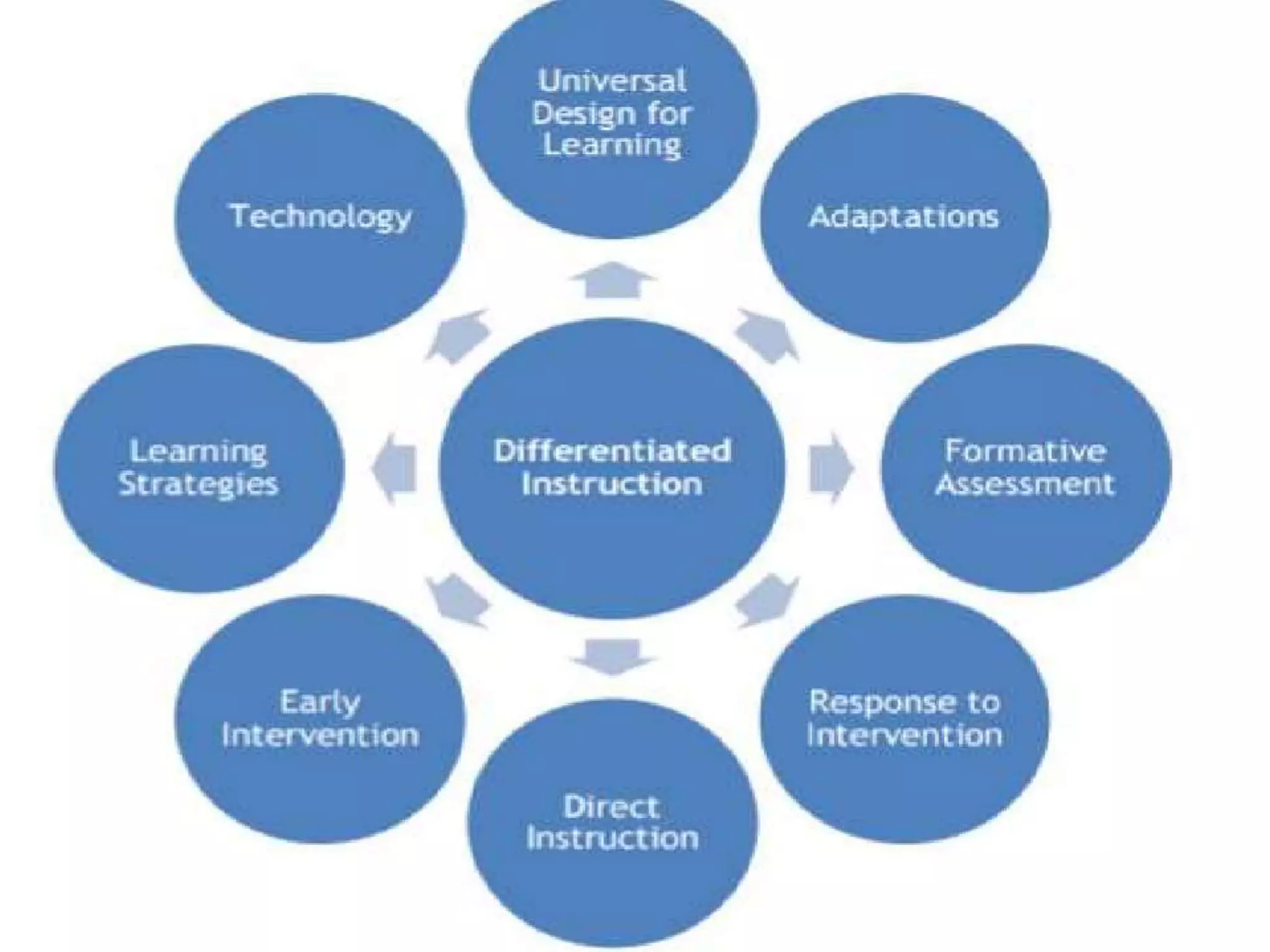
• Universal Designfor Learning - recognizes and
accommodates varied learning styles focusing on
social participation and inclusion
• Adaptations - designed to accommodate astudent’s
needs
• Early Intervention - monitoring student responseto
instruction and documenting difficulties
• Direct Instruction - particular skill or content to be
learned is presented explicitly
• Learning Strategies - maximize student strengths and
provide structures
• Technologies - personalize the learningexperience
• FormativeAssessment - usesfeedback from the
continuous monitoring of studentprogress
THANKYOUFORNOT
SLEEPING!
Ad astra per aspera.
To the stars through difficulties.
Arough road leads to thestars.

Learners with exceptionalities

  • 1.
  • 2.
    TERMINOLOGIES: World Health Organization: -3-tier terms: (a) Impairment - loss or abnormality of psychological, physiological or anatomical structureor function - intrinsic to theindividual - “…when the individual with an impairmentwas expected to carry out regular or routine tasks that relied on the useof skills or knowledge in the area(s), affected by theimpairment..”
  • 3.
    …TERMINOLOGIES (b) Disability - measurableimpairment or limitation that “interferes witha person’s ability, for example, to walk, lift, hear, or learn. It may refer to aphysical, sensory, or mental condition”. (Schiefelbusch Institute, 1996) (c) Handicap - disadvantage that occurs asa result of adisability.
  • 4.
    …TERMINOLOGIES Disability has becomemore accepted and used,replacing “handicap”. **In the USA, “disability” is used in its federal laws,such as Individuals with Disabilities Act(IDEA). **In the Philippine Constitution, Article XIV, Section 2: “…provide adult citizens, the disabled, and out-of-school youth withtraining…  Exceptional learners - Learners who are different from “normal” or “average” learners, needing special needs suchrelated to cognitive abilities, behavior, social functioning, physical and sensory impairments, emotional disturbances, and giftedness.
  • 5.
    CATEGORIES OFEXCEPTIONALITIES 1. Omrod’sEducational Psychology (2000): Exceptionalities Cognitive or Academic Difficulties Social/Emotional and Behavioral Difficulties Physical Disabilitiesand Health Impairments Sensory Impairments Giftedness
  • 6.
    … Categories a. Cognitiveor AcademicFaculties • Learning Disabilities - perception, language, memory or metacognition Dyslexia- reading disorder Dysgraphia– writing disorder Dyscalculia – arithmetic disorder Dyspraxia – psychomotor disorder
  • 7.
    Dyslexia Dysgraphia DyscalculiaDyspraxia difficulty withreading difficulty with the physical act ofwriting wide range oflifelong learning disabilities involving math brain-basedcondition affecting plan and coordinate physical movement -Trouble soundingout -Tight awkwardpencil -Showsdifficulty -Poor balance. words grip and bodyposition understanding Difficulty in ridinga -Difficulty -Illegiblehandwriting concepts bicycle, going upand memorizing sight -Tiring quicklywhile -Difficulty down hills words writing understandingand -Poor manipulative -Avoidingreading -High levelsof completing word skills. Difficultywith aloud resistance and problems typing, handwriting Confusing the orderof frustrations while -Exhibitsdifficulty and drawing. letters writing usingsteps involvedin -Tracking.Difficulty in -Trouble followinga -Largegapbetween math operations. following amoving sequence of directions written ideasand -Challengedmaking object smoothlywith -Difficulty organizing understanding changeor handling eyeswithout moving thoughts when demonstrated through money headexcessively. speaking speech. Tendencyto losethe place whilereading
  • 8.
    • ADHD(Attention-Deficit Hyperactivity Disorder) – inattention, distractibility; with or without hyperactivity • Speechand Communication Disorders - spokenlanguage including voice disorders (e.g. difficulties pronouncing sounds, or articulation disorders, andstuttering) … Categories
  • 9.
    b. Social/Emotional andBehavioralDifficulties • Autism - social skills, repetitive behaviors, speechand nonverbal communication • Mental Retardation - sub-averageintelligence and deficitsin adaptive behavior - imbecile • Emotional / Conduct Disorders - presence of emotional states like depression and aggressiondisturbing learning and performance in school c. Physical Disabilities and HealthImpairments • Physicaland health impairments – affect individual’senergy and strength, mental alertness and musclecontrol • Severeand multiple disabilities - presence of two or more different types of disabilities … Categories
  • 10.
    … Categories d.Sensory Impairments •Visual Impairments - malfunction of theeyesor optic nerves that prevent normal visioneven - myopia (farsightedness) - hyperopia (nearsightedness) - astigmatism • Hearing Impairments (otherwise known as hearing loss) - malfunction of the ear or auditory nerves that hinders perception of sounds within the frequency range of normalspeech e. Giftedness
  • 11.
    e.Giftedness  speaksof talent,which includes all areas of achild’s life: academic, artistic, athletic, and social. (USDepartmentof Education, 1993)  involves significantly high levels of cognitive development  performance and accomplishment  Identification: - Ability vs.Achievement - Testsvs. Grades - StandardizedTesting - Ability - IQ - Creative and Critical Thinking Achievement  Twice Exceptional Learners
  • 12.
    …Giftedness  Sixareas wheregiftedness could be found: (a) creative thinking, (b) leadership, (c) general intellectual ability,(d) psychomotor, (e) specific academic ability and (f) visual/ performing arts.  Characteristics: a. Perfectionist andidealistic b. Heightened sensitivity to their own expectations and those of others c. Maturity beyondage d. Problem solvers e. Abstract thinkers
  • 13.
    2. Individuals withDisabilities EducationAct(IDEA): a. Autism b. Deaf-Blindness c. Deafness d. Emotional Disturbance e. Hearing Impairment f. Intellectual Disability g.Multiple Disabilities h. Orthopedic Impairment – causedby an congenital anomaly, impairments caused by disease (e.g. poliomyelitis, bone tuberculosis); impairments from othercauses (e.g., cerebral palsy, amputations, andfractures) i. Other HealthImpairment - having limited strength, vitality or alertness j. Specific Learning Disability k. Speechor Language Impairment l.Traumatic Brain Injury - acquired injury to thebrain caused by an external physicalforce, resulting in total or partial functional disabilityor psychosocial Impairment m. Visual Impairment
  • 15.
    Dealing with Learnerswith Exceptionalities  People-First Language - No generic labels - Emphasizeabilities; not limitations - No euphemisms - No implication of illness ofsuffering  Brief and simple instructions  Clear definition of course requirements, the dates of exams and deadline of assignments.  Handouts and visual aids and study guides  Severalexamples and demonstrations  Consultation time  Asking and providing assistance  Encouragement  Patience, patience, patience andPATIENCE!
  • 17.
    • How canIenable this student toshow what he/she knows or understands? • How canI reduce the negative impact ofthis student’s processing difficulties in instructional and assessmentcontexts? • How canI accommodate this student’sweak academic skills to ensure accessto the curriculum? How canI continue to help this student continue to develop basic academic skills? • How canI makeadjustments to instruction and assessmentto help this student achieveintended learning outcomes in away that does notrequire excessiveeffort on the part of the student or excessivesupports from the adults?
  • 19.
    • Universal DesignforLearning - recognizes and accommodates varied learning styles focusing on social participation and inclusion • Adaptations - designed to accommodate astudent’s needs • Early Intervention - monitoring student responseto instruction and documenting difficulties • Direct Instruction - particular skill or content to be learned is presented explicitly • Learning Strategies - maximize student strengths and provide structures • Technologies - personalize the learningexperience • FormativeAssessment - usesfeedback from the continuous monitoring of studentprogress
  • 20.
    THANKYOUFORNOT SLEEPING! Ad astra peraspera. To the stars through difficulties. Arough road leads to thestars.