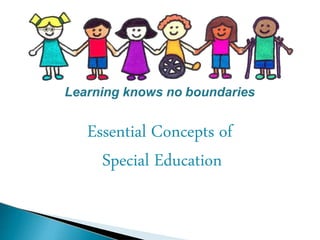
Learning knows no boundaries
Essential Concepts of
Special Education
OUTLINE
• OBJECTIVES OF
SPECIAL EDUCATION
• CATEGORIES OF
EXCEPTIONALITIES
• INDIVIDUAL
PROGRAMS AND
PLANS (IEP)
• An educational
program/service designed to
meet the needs of children
with special needs who
cannot profit from general or
regular education because of
disabilities or exceptional
abilities.
SPECIAL EDUCATION
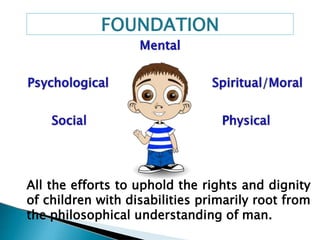
All the efforts to uphold the rights and dignity
of children with disabilities primarily root from
the philosophical understanding of man.
FOUNDATION
Special Education Division Philippines Memorandum:
Special education refers to the education of persons
who are GIFTED OR TALENTED and those who have
PHYSICAL, MENTAL, SOCIAL OR SENSORY IMPAIRMENT AND
CULTURAL DIFFERENCES so as to require modifications of
the school curricula, programs and special services
and physical facilities to develop them to their
maximum capacity
These persons may be gifted/talented, fast learner,
mentally retarded, visually impaired, hearing
impaired, with behavior problems, orthopedically
handicapped, with special health problems, learning
disabled, speech impaired or multiply handicapped.
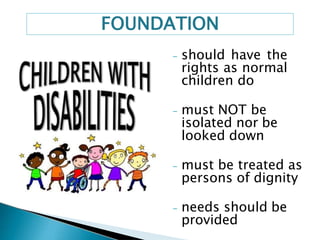
- should have the
rights as normal
children do
- must NOT be
isolated nor be
looked down
- must be treated as
persons of dignity
- needs should be
provided
FOUNDATION
“Every child with special needs has a
right to an educational program that
is suitable to his needs.”
“Special education shares with regular
education basic responsibilities of the
educational system to fulfill the right
of the child to develop to his full
potential.”
BASIC PHILOSOPHY OF
SPECIAL EDUCATION
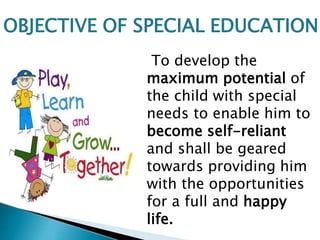
To develop the
maximum potential of
the child with special
needs to enable him to
become self-reliant
and shall be geared
towards providing him
with the opportunities
for a full and happy
life.
OBJECTIVE OF SPECIAL EDUCATION
SPECIFIC OBJECTIVE OF
SPECIAL EDUCATION
The development and maximization of
learning competencies, as well as the
inculcation of values to make the
learners with special needs as useful
and effective members of society.
ULTIMATE GOAL OF
SPECIAL EDUCATION
The integration or mainstreaming of
learners with special needs into the
regular school system and
eventually into the community.
EXCEPTIONALITY
An individual or a child who has an exceptionality
has some area of functioning in which he or she is
significantly different from an established norm.
This definition includes both students with
disabilities and those with special gifts or talents.
•learning disabilities
•developmental delays
•emotional and behavioral disorders
•communication disorders
•hearing disabilities
•visual impairments
•physical disabilities
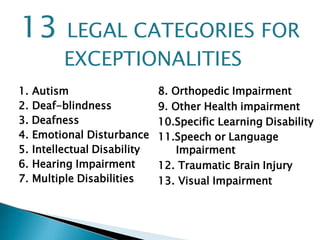
1. Autism
2. Deaf-blindness
3. Deafness
5. Intellectual Disability
6. Hearing Impairment
7. Multiple Disabilities
13 LEGAL CATEGORIES FOR
EXCEPTIONALITIES
8. Orthopedic Impairment
9. Other Health impairment
10.Specific Learning Disability
4. Emotional Disturbance 11.Speech or Language
Impairment
12. Traumatic Brain Injury
13. Visual Impairment
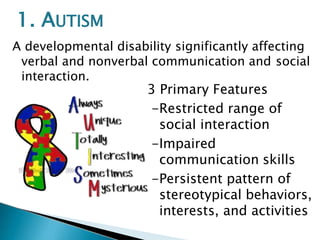
A developmental disability significantly affecting
verbal and nonverbal communication and social
interaction.
3 Primary Features
-Restricted range of
social interaction
-Impaired
communication skills
-Persistent pattern of
stereotypical behaviors,
interests, and activities
1. AUTISM
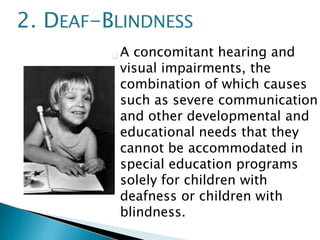
A concomitant hearing and
visual impairments, the
combination of which causes
such as severe communication
and other developmental and
educational needs that they
cannot be accommodated in
special education programs
solely for children with
deafness or children with
blindness.
2. DEAF-BLINDNESS
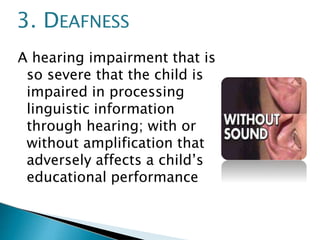
A hearing impairment that is
so severe that the child is
impaired in processing
linguistic information
through hearing; with or
without amplification that
adversely affects a child’s
educational performance
3. DEAFNESS
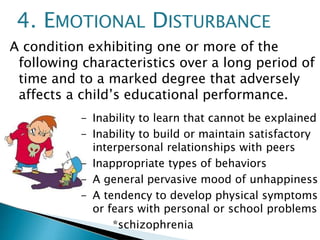
A condition exhibiting one or more of the
following characteristics over a long period of
time and to a marked degree that adversely
affects a child’s educational performance.
- Inability to learn that cannot be explained
- Inability to build or maintain satisfactory
interpersonal relationships with peers
- Inappropriate types of behaviors
- A general pervasive mood of unhappiness
- A tendency to develop physical symptoms
or fears with personal or school problems
*schizophrenia
4. EMOTIONAL DISTURBANCE
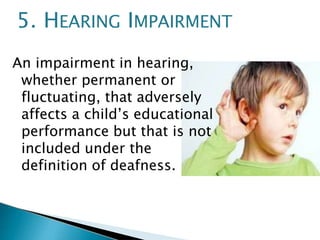
An impairment in hearing,
whether permanent or
fluctuating, that adversely
affects a child’s educational
performance but that is not
included under the
definition of deafness.
5. HEARING IMPAIRMENT
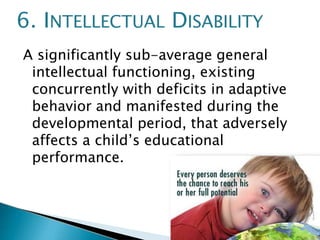
A significantly sub-average general
intellectual functioning, existing
concurrently with deficits in adaptive
behavior and manifested during the
developmental period, that adversely
affects a child’s educational
performance.
6. INTELLECTUAL DISABILITY
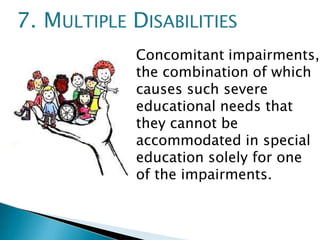
Concomitant impairments,
the combination of which
causes such severe
educational needs that
they cannot be
accommodated in special
education solely for one
of the impairments.
7. MULTIPLE DISABILITIES
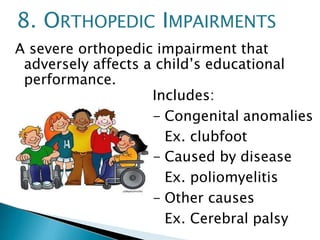
A severe orthopedic impairment that
adversely affects a child’s educational
performance.
Includes:
- Congenital anomalies
Ex. clubfoot
- Caused by disease
Ex. poliomyelitis
- Other causes
Ex. Cerebral palsy
8. ORTHOPEDIC IMPAIRMENTS
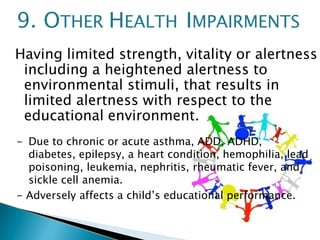
Having limited strength, vitality or alertness
including a heightened alertness to
environmental stimuli, that results in
limited alertness with respect to the
educational environment.
- Due to chronic or acute asthma, ADD, ADHD,
diabetes, epilepsy, a heart condition, hemophilia, lead
poisoning, leukemia, nephritis, rheumatic fever, and
sickle cell anemia.
- Adversely affects a child’s educational performance.
9. OTHER HEALTH IMPAIRMENTS
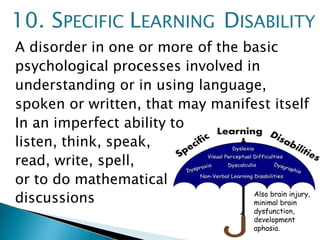
A disorder in one or more of the basic
psychological processes involved in
understanding or in using language,
spoken or written, that may manifest itself
In an imperfect ability to
listen, think, speak,
read, write, spell,
or to do mathematical
discussions
10. SPECIFIC LEARNING DISABILITY
Also brain injury,
minimal brain
dysfunction,
development
aphasia.
A communication
disorder, such as
stuttering, impaired
articulation, language
impairment, or a voice
impairment, that
adversely affects a
child’s educational
performance.
11. SPEECH OR LANGUAGE IMPAIRMENT
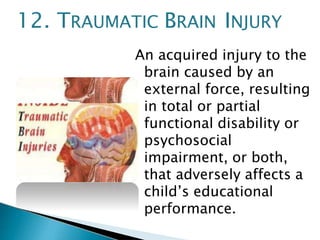
An acquired injury to the
brain caused by an
external force, resulting
in total or partial
functional disability or
psychosocial
impairment, or both,
that adversely affects a
child’s educational
performance.
12. TRAUMATIC BRAIN INJURY
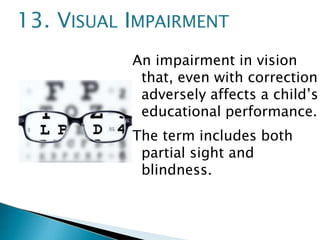
An impairment in vision
that, even with correction
adversely affects a child’s
educational performance.
The term includes both
partial sight and
blindness.
13. VISUAL IMPAIRMENT
INDIVIDUAL PROGRAMS
AND PLANS
The IEP is a document
developed by a team of
persons from the child’s
attending school system
who have a direct
relationship to helping the
student with special needs
to be able to reach his full
potential.
INDIVIDUALIZED EDUCATIONAL
PROGRAM (IEP)
Must include information
about students functional
ability to perform & academic
levels
Must include measurable
yearly goals that are academic
and functional
Parents to be provided
progress reports
IEP AMENDED 2004 (IDEA)
A local representative from
the school agency
The child's teacher.
One or both of the child's
parents or responsible party
The child, where appropriate
Other individuals at the
discretion of the parent or
agency.
MEMBERS OF IEP TEAM
- Transportation
- Speech-language pathology
- Audiologist services
- Interpreting services
- Psychological services
- Physical therapy
- Occupational therapy
- Recreation, including therapeutic recreation
- Social work services
- School nurse services
- Counseling services, including rehabilitation
counseling
TYPES OF RELATED SERVICES
WHAT KIND OF
SERVICES
WILL HELP ME?
Assessment of Students
needs (identify strengths
and weaknesses)
Details of disability that
are being addressed
Individualization of IEP
◦ Classification
◦ Parental involvement
◦ Teacher involvement
◦ Collaboration of what best suites
student’s needs
CONSIDERATIONS IN DEVELOPING
THE IEP
-To include ACCOMMODATIONS
-To include MODIFICATIONS on class work
- To use a different assessment
tool if needed to measure child’s
academic abilities
-Teacher shall be an active part
of the child’s planning and must
use modifications
IEP IN THE CLASSROOM
• Parents are to be included as a member
of IEP
• Placement decisions cannot be reached
without IEP team agreement.
• Parent and team consensus about
aspects relative to child’s needs and
placement
PLACEMENT DECISIONS
Reviewed yearly
Reassess annual goals
Revise the IEP to address:
- any lack of expected progress
- results of any re-evaluation
- info provided by the parents
- anticipated needs
REVIEWING AND REVISING IEP
Special Education Law Resource File. Website:
http://emquinlansped.weebly.com/index.html
Department of Education, Philippines. http://www.deped.gov.ph/
http://www.scribd.com/doc/21371406/Special-Education-Division-
Philippines-Memorandum
http://idea.ed.gov/explore/home
http://www.annikeris.com/special_education_faq.html#What_is_an_IEP
National Information Center for Children and Youth with disabilities
Web site: http://www.nichcy.org/trainpkg/traintxt/7addonly.htm
Wright, P. D., & Wright, P. D. (1998-2006). Road Map to IDEA 2004: What You
Need to Know about IEPs, IEP Teams, IEP Meetings. In P. Wright & P. Wright
(Eds.), Individuals with Disabilities Education Improvement Act (IDEA 2004)
Website: www.wrightslaw.com/idea/art/iep.roadmap.htm
REFERENCES
Learning knows no boundaries

essential concepts

  • 1.
    Learning knows noboundaries Essential Concepts of Special Education
  • 2.
    OUTLINE • OBJECTIVES OF SPECIALEDUCATION • CATEGORIES OF EXCEPTIONALITIES • INDIVIDUAL PROGRAMS AND PLANS (IEP)
  • 3.
    • An educational program/servicedesigned to meet the needs of children with special needs who cannot profit from general or regular education because of disabilities or exceptional abilities. SPECIAL EDUCATION
  • 4.
    All the effortsto uphold the rights and dignity of children with disabilities primarily root from the philosophical understanding of man. FOUNDATION
  • 5.
    Special Education DivisionPhilippines Memorandum: Special education refers to the education of persons who are GIFTED OR TALENTED and those who have PHYSICAL, MENTAL, SOCIAL OR SENSORY IMPAIRMENT AND CULTURAL DIFFERENCES so as to require modifications of the school curricula, programs and special services and physical facilities to develop them to their maximum capacity These persons may be gifted/talented, fast learner, mentally retarded, visually impaired, hearing impaired, with behavior problems, orthopedically handicapped, with special health problems, learning disabled, speech impaired or multiply handicapped.
  • 6.
    - should havethe rights as normal children do - must NOT be isolated nor be looked down - must be treated as persons of dignity - needs should be provided FOUNDATION
  • 7.
    “Every child withspecial needs has a right to an educational program that is suitable to his needs.” “Special education shares with regular education basic responsibilities of the educational system to fulfill the right of the child to develop to his full potential.” BASIC PHILOSOPHY OF SPECIAL EDUCATION
  • 8.
    To develop the maximumpotential of the child with special needs to enable him to become self-reliant and shall be geared towards providing him with the opportunities for a full and happy life. OBJECTIVE OF SPECIAL EDUCATION
  • 9.
    SPECIFIC OBJECTIVE OF SPECIALEDUCATION The development and maximization of learning competencies, as well as the inculcation of values to make the learners with special needs as useful and effective members of society.
  • 10.
    ULTIMATE GOAL OF SPECIALEDUCATION The integration or mainstreaming of learners with special needs into the regular school system and eventually into the community.
  • 11.
    EXCEPTIONALITY An individual ora child who has an exceptionality has some area of functioning in which he or she is significantly different from an established norm. This definition includes both students with disabilities and those with special gifts or talents. •learning disabilities •developmental delays •emotional and behavioral disorders •communication disorders •hearing disabilities •visual impairments •physical disabilities
  • 12.
    1. Autism 2. Deaf-blindness 3.Deafness 5. Intellectual Disability 6. Hearing Impairment 7. Multiple Disabilities 13 LEGAL CATEGORIES FOR EXCEPTIONALITIES 8. Orthopedic Impairment 9. Other Health impairment 10.Specific Learning Disability 4. Emotional Disturbance 11.Speech or Language Impairment 12. Traumatic Brain Injury 13. Visual Impairment
  • 13.
    A developmental disabilitysignificantly affecting verbal and nonverbal communication and social interaction. 3 Primary Features -Restricted range of social interaction -Impaired communication skills -Persistent pattern of stereotypical behaviors, interests, and activities 1. AUTISM
  • 14.
    A concomitant hearingand visual impairments, the combination of which causes such as severe communication and other developmental and educational needs that they cannot be accommodated in special education programs solely for children with deafness or children with blindness. 2. DEAF-BLINDNESS
  • 15.
    A hearing impairmentthat is so severe that the child is impaired in processing linguistic information through hearing; with or without amplification that adversely affects a child’s educational performance 3. DEAFNESS
  • 16.
    A condition exhibitingone or more of the following characteristics over a long period of time and to a marked degree that adversely affects a child’s educational performance. - Inability to learn that cannot be explained - Inability to build or maintain satisfactory interpersonal relationships with peers - Inappropriate types of behaviors - A general pervasive mood of unhappiness - A tendency to develop physical symptoms or fears with personal or school problems *schizophrenia 4. EMOTIONAL DISTURBANCE
  • 17.
    An impairment inhearing, whether permanent or fluctuating, that adversely affects a child’s educational performance but that is not included under the definition of deafness. 5. HEARING IMPAIRMENT
  • 18.
    A significantly sub-averagegeneral intellectual functioning, existing concurrently with deficits in adaptive behavior and manifested during the developmental period, that adversely affects a child’s educational performance. 6. INTELLECTUAL DISABILITY
  • 19.
    Concomitant impairments, the combinationof which causes such severe educational needs that they cannot be accommodated in special education solely for one of the impairments. 7. MULTIPLE DISABILITIES
  • 20.
    A severe orthopedicimpairment that adversely affects a child’s educational performance. Includes: - Congenital anomalies Ex. clubfoot - Caused by disease Ex. poliomyelitis - Other causes Ex. Cerebral palsy 8. ORTHOPEDIC IMPAIRMENTS
  • 21.
    Having limited strength,vitality or alertness including a heightened alertness to environmental stimuli, that results in limited alertness with respect to the educational environment. - Due to chronic or acute asthma, ADD, ADHD, diabetes, epilepsy, a heart condition, hemophilia, lead poisoning, leukemia, nephritis, rheumatic fever, and sickle cell anemia. - Adversely affects a child’s educational performance. 9. OTHER HEALTH IMPAIRMENTS
  • 22.
    A disorder inone or more of the basic psychological processes involved in understanding or in using language, spoken or written, that may manifest itself In an imperfect ability to listen, think, speak, read, write, spell, or to do mathematical discussions 10. SPECIFIC LEARNING DISABILITY Also brain injury, minimal brain dysfunction, development aphasia.
  • 23.
    A communication disorder, suchas stuttering, impaired articulation, language impairment, or a voice impairment, that adversely affects a child’s educational performance. 11. SPEECH OR LANGUAGE IMPAIRMENT
  • 24.
    An acquired injuryto the brain caused by an external force, resulting in total or partial functional disability or psychosocial impairment, or both, that adversely affects a child’s educational performance. 12. TRAUMATIC BRAIN INJURY
  • 25.
    An impairment invision that, even with correction adversely affects a child’s educational performance. The term includes both partial sight and blindness. 13. VISUAL IMPAIRMENT
  • 26.
  • 27.
    The IEP isa document developed by a team of persons from the child’s attending school system who have a direct relationship to helping the student with special needs to be able to reach his full potential. INDIVIDUALIZED EDUCATIONAL PROGRAM (IEP)
  • 28.
    Must include information aboutstudents functional ability to perform & academic levels Must include measurable yearly goals that are academic and functional Parents to be provided progress reports IEP AMENDED 2004 (IDEA)
  • 29.
    A local representativefrom the school agency The child's teacher. One or both of the child's parents or responsible party The child, where appropriate Other individuals at the discretion of the parent or agency. MEMBERS OF IEP TEAM
  • 30.
    - Transportation - Speech-languagepathology - Audiologist services - Interpreting services - Psychological services - Physical therapy - Occupational therapy - Recreation, including therapeutic recreation - Social work services - School nurse services - Counseling services, including rehabilitation counseling TYPES OF RELATED SERVICES WHAT KIND OF SERVICES WILL HELP ME?
  • 31.
    Assessment of Students needs(identify strengths and weaknesses) Details of disability that are being addressed Individualization of IEP ◦ Classification ◦ Parental involvement ◦ Teacher involvement ◦ Collaboration of what best suites student’s needs CONSIDERATIONS IN DEVELOPING THE IEP
  • 32.
    -To include ACCOMMODATIONS -Toinclude MODIFICATIONS on class work - To use a different assessment tool if needed to measure child’s academic abilities -Teacher shall be an active part of the child’s planning and must use modifications IEP IN THE CLASSROOM
  • 33.
    • Parents areto be included as a member of IEP • Placement decisions cannot be reached without IEP team agreement. • Parent and team consensus about aspects relative to child’s needs and placement PLACEMENT DECISIONS
  • 34.
    Reviewed yearly Reassess annualgoals Revise the IEP to address: - any lack of expected progress - results of any re-evaluation - info provided by the parents - anticipated needs REVIEWING AND REVISING IEP
  • 35.
    Special Education LawResource File. Website: http://emquinlansped.weebly.com/index.html Department of Education, Philippines. http://www.deped.gov.ph/ http://www.scribd.com/doc/21371406/Special-Education-Division- Philippines-Memorandum http://idea.ed.gov/explore/home http://www.annikeris.com/special_education_faq.html#What_is_an_IEP National Information Center for Children and Youth with disabilities Web site: http://www.nichcy.org/trainpkg/traintxt/7addonly.htm Wright, P. D., & Wright, P. D. (1998-2006). Road Map to IDEA 2004: What You Need to Know about IEPs, IEP Teams, IEP Meetings. In P. Wright & P. Wright (Eds.), Individuals with Disabilities Education Improvement Act (IDEA 2004) Website: www.wrightslaw.com/idea/art/iep.roadmap.htm REFERENCES
  • 36.