Learners with
Exceptionalities
Take the challenge!
In this Module, challenge yourself to attain the
following learning outcomes.
•Descirbe the basic categories of exceptional
learners.
•Define and distinguish the terms disability and
handicap.
•Demonstrate “people first” langage when
referring to exceptional learners and advocates
for it's use.
One significant factor that highlights
individual differences and diversity in
learning is the presence of exceptionalities.
We commonly refer to learners with
exceptionalities as persons who are different
in some way from the "normal" or "average".
The term "exceptional learners" includes
those with special needs related to cognitive
abilities, behavior, social functioning,
physical and sensory impairments,emotional
disturbances, and giftedness. Most of these
learners require a lot of understanding and
patience as well as special education and
related services if they are to reach their full
potential of development.
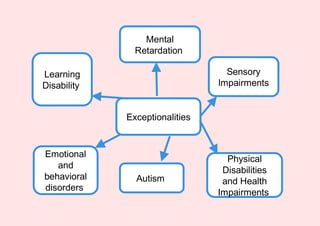
Exceptionalities
Mental
Retardation
Sensory
Impairments
Physical
Disabilities
and Health
Impairments
Autism
Emotional
and
behavioral
disorders
Learning
Disability
Engaged!
Watch any of the following flims
°The Rain Man
°I am Sam
°Son-rise a Miracle of love
°The life ofHellen Keler
Explore
1.Describe the main character of the
movie you watched.
2.What was his / her exceptionality? Describe.
3.What problems/difficulties did the main character
experience?
4.Who provided support ? What support did he/she get from
his/her environment?
From the movie you watched you saw the challenges that
confront a person with special needs. The person's
adjustment entails the support of the people around him.
As a future teacher, you would probably encounter
learners with special needs, more so if special education
is your major. It is therefore necessary that you have both
the right information and proper attitude in dealing with
special learners. This will help you perform your task to
facilitate learning. Let us begin by differentiating the words
disability and handicap.
Explain!
Disability. A disability is a measurable impairment or limitation
that "interferes with a person's ability, for example, to walk, lift,
hear, or learn. It may refer to a physical, sensory, or mental
condition" (Schiefelbusch Institute, 1996). The word disability
has become the more accepted term, having replaced the
word handicap in federal laws in the US, one of which is the
Individuals with Disabilities Education Act (IDEA). IDEA is the
law that provides comprehensive service and support for
exceptional learners. Our very own 1987 Philippine
Constitution, Article XIV, Sec. 2, uses the word "disabled" in
paragraph (5) "Provide adule citizens, the disabled, and out-
of-school youth with training...
Handicap. The word handicap does not have the same
meaning as disability. A handicap is a disadvantage that
occurs as a result of a disability or impairments .
The degree of disadvantage ( or the extent of the
handicap ) is often dependent on the adjustment made
by both the person and his environment. Therefore, the
extent to which a disability handicaps an individual can
vary greatly. Two persons may have the same disability
but not the same degree of being handicapped. For
example, they both have a hearing impairment, one
knows sign language and can read lips while the other
cannot. The first individual would not have as much
handicap as the second one. Another example, two
persons who move around on a wheel chair, the one
studying in a school campus with wheelchair
accessibility in all areas would be less handicapped
than one in a school without wheel chair accessibility.
Categories of Disabilities
°There are different ways of presenting categories of
exceptionalities.
Special education practitioners would have varying terms and
categories. For this short introduction of categories, we are
basing it on the categories found in Omrod's Educational
Psychology (2000).
Specific Cognitive or Academic Difficulties
Learning Disability - involve difficulties her
in specific cognitive processes like perception, language,
memory or metacognition that are not due to other disabilities
like mental retardation, emotional or behavioral disorders, or
sensory
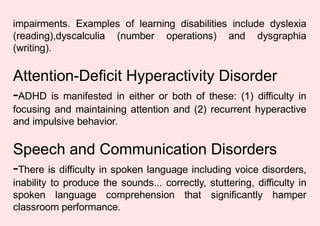
impairments. Examples of learning disabilities include dyslexia
(reading),dyscalculia (number operations) and dysgraphia
(writing).
Attention-Deficit Hyperactivity Disorder
-ADHD is manifested in either or both of these: (1) difficulty in
focusing and maintaining attention and (2) recurrent hyperactive
and impulsive behavior.
Speech and Communication Disorders
-There is difficulty in spoken language including voice disorders,
inability to produce the sounds... correctly, stuttering, difficulty in
spoken language comprehension that significantly hamper
classroom performance.
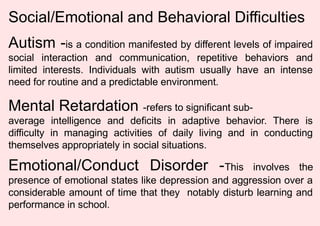
Social/Emotional and Behavioral Difficulties
Autism -is a condition manifested by different levels of impaired
social interaction and communication, repetitive behaviors and
limited interests. Individuals with autism usually have an intense
need for routine and a predictable environment.
Mental Retardation -refers to significant sub-
average intelligence and deficits in adaptive behavior. There is
difficulty in managing activities of daily living and in conducting
themselves appropriately in social situations.
Emotional/Conduct Disorder -This involves the
presence of emotional states like depression and aggression over a
considerable amount of time that they notably disturb learning and
performance in school.
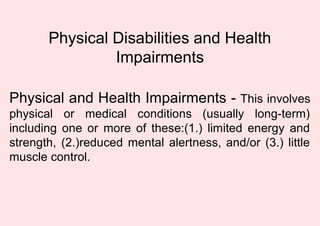
Physical Disabilities and Health
Impairments
Physical and Health Impairments - This involves
physical or medical conditions (usually long-term)
including one or more of these:(1.) limited energy and
strength, (2.)reduced mental alertness, and/or (3.) little
muscle control.
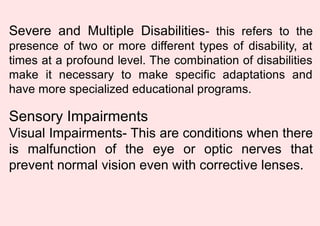
Severe and Multiple Disabilities- this refers to the
presence of two or more different types of disability, at
times at a profound level. The combination of disabilities
make it necessary to make specific adaptations and
have more specialized educational programs.
Sensory Impairments
Visual Impairments- This are conditions when there
is malfunction of the eye or optic nerves that
prevent normal vision even with corrective lenses.
Hearing Impairments-These involved
malfunction of the ear or auditory nerves
that hinders perception of sounds within the
frequency range of normal speech.
Giftedness-These involved significantly high
level of cognitive development. There is
unusually high ability or aptitude in one or
more of these aspects: intellectual ability,
aptitude in academic subjects, creativity,
visual or performing arts or leadership.
People-First Language
What is People-First Language? Just
as the term would imply, this language
trend involves putting the person first, not
the disability (e.g., a person with a
disability, not a disabled person). Thus,
people-first language tells us what
conditions people have, not what they are
(Schiefelbusch Institute, 1996). This is
similar to saying "person with AIDS, rather
than "AIDS victim". Other suggestions for
referring to those with disabilities include:
⚫ avoiding generic labels (people with mental retardation is preferable to
the mentally retarded);
⚫ emphasizing abilities, not limitations (for instance, uses a wheelchair is
preferable to confined to a wheelchair);
• avoiding euphemisms (such as physically-challenged) which are
regarded as condescending and avoid the real issues that result from a
disability; and
⚫ avoiding implying illness or suffering (had polio is preferable to is a polio
victim, and has multiple sclerosis is preferable to suffers from multiple
sclerosis) (Department of Physical Medicine and Rehabilitation 2000;
Schiefelbusch Institute, 1996).
Using people-first language and applying the guidelines above will remind
you to have a more respectful and accepting attitude toward learners with
exceptionalities. The presence of impairments requires them to exert more
effort to do things that others like us find quite easy to do. They are
learners who may turn to you for assistance. Beginning with the right
attitude, one of
W hat ar e the com m on W OR K E T H IC S that you should
rem em ber?
A . For A TT EN D A NC E
B . C H A R AC T E R
1. hones
t y
2. punctualit y
3. int egrity and loyalty
4. teamwork
5. pr oduct iv
it y
6. reliability
7. comm
itment to excellence
8. pr of ess
ionalis
m
9. at tit ude
10.cooper at ion
compassion (not of pity nor ridicule), will make you a more effective
teacher, one with the hand and the heart who can facilitate that learning
and adjustment.
EXTEND WITH SYNAPSE STRENGTHENERS
1. Make a collection of teaching guidelines or tips on how to work with
students with exceptionalities. Follow the categories shown in this Module.
Present your guidelines/tips in bulleted form.
2. Advocate for people-first language by telling at least 5 people about
how to use people-first language when referring to learners with
exceptionalities.
3. Surf the internet for the Son-Rise Program for autism. It is based on the
life-changing experience of Ron Kauffman who had autism but recovered.
Most practitioners believe that autism is incurable, but the son-rise
program has another approach. Read about it and write a reaction paper
on it.
Reporting-in-Facilities-1.pptx school purposes

  • 1.
  • 2.
    Take the challenge! Inthis Module, challenge yourself to attain the following learning outcomes. •Descirbe the basic categories of exceptional learners. •Define and distinguish the terms disability and handicap. •Demonstrate “people first” langage when referring to exceptional learners and advocates for it's use.
  • 3.
    One significant factorthat highlights individual differences and diversity in learning is the presence of exceptionalities. We commonly refer to learners with exceptionalities as persons who are different in some way from the "normal" or "average". The term "exceptional learners" includes those with special needs related to cognitive abilities, behavior, social functioning, physical and sensory impairments,emotional disturbances, and giftedness. Most of these learners require a lot of understanding and patience as well as special education and related services if they are to reach their full potential of development.
  • 4.
  • 5.
    Engaged! Watch any ofthe following flims °The Rain Man °I am Sam °Son-rise a Miracle of love °The life ofHellen Keler Explore 1.Describe the main character of the movie you watched.
  • 6.
    2.What was his/ her exceptionality? Describe. 3.What problems/difficulties did the main character experience? 4.Who provided support ? What support did he/she get from his/her environment?
  • 7.
    From the movieyou watched you saw the challenges that confront a person with special needs. The person's adjustment entails the support of the people around him. As a future teacher, you would probably encounter learners with special needs, more so if special education is your major. It is therefore necessary that you have both the right information and proper attitude in dealing with special learners. This will help you perform your task to facilitate learning. Let us begin by differentiating the words disability and handicap. Explain!
  • 8.
    Disability. A disabilityis a measurable impairment or limitation that "interferes with a person's ability, for example, to walk, lift, hear, or learn. It may refer to a physical, sensory, or mental condition" (Schiefelbusch Institute, 1996). The word disability has become the more accepted term, having replaced the word handicap in federal laws in the US, one of which is the Individuals with Disabilities Education Act (IDEA). IDEA is the law that provides comprehensive service and support for exceptional learners. Our very own 1987 Philippine Constitution, Article XIV, Sec. 2, uses the word "disabled" in paragraph (5) "Provide adule citizens, the disabled, and out- of-school youth with training... Handicap. The word handicap does not have the same meaning as disability. A handicap is a disadvantage that occurs as a result of a disability or impairments .
  • 9.
    The degree ofdisadvantage ( or the extent of the handicap ) is often dependent on the adjustment made by both the person and his environment. Therefore, the extent to which a disability handicaps an individual can vary greatly. Two persons may have the same disability but not the same degree of being handicapped. For example, they both have a hearing impairment, one knows sign language and can read lips while the other cannot. The first individual would not have as much handicap as the second one. Another example, two persons who move around on a wheel chair, the one studying in a school campus with wheelchair accessibility in all areas would be less handicapped than one in a school without wheel chair accessibility.
  • 10.
    Categories of Disabilities °Thereare different ways of presenting categories of exceptionalities. Special education practitioners would have varying terms and categories. For this short introduction of categories, we are basing it on the categories found in Omrod's Educational Psychology (2000). Specific Cognitive or Academic Difficulties Learning Disability - involve difficulties her in specific cognitive processes like perception, language, memory or metacognition that are not due to other disabilities like mental retardation, emotional or behavioral disorders, or sensory
  • 11.
    impairments. Examples oflearning disabilities include dyslexia (reading),dyscalculia (number operations) and dysgraphia (writing). Attention-Deficit Hyperactivity Disorder -ADHD is manifested in either or both of these: (1) difficulty in focusing and maintaining attention and (2) recurrent hyperactive and impulsive behavior. Speech and Communication Disorders -There is difficulty in spoken language including voice disorders, inability to produce the sounds... correctly, stuttering, difficulty in spoken language comprehension that significantly hamper classroom performance.
  • 12.
    Social/Emotional and BehavioralDifficulties Autism -is a condition manifested by different levels of impaired social interaction and communication, repetitive behaviors and limited interests. Individuals with autism usually have an intense need for routine and a predictable environment. Mental Retardation -refers to significant sub- average intelligence and deficits in adaptive behavior. There is difficulty in managing activities of daily living and in conducting themselves appropriately in social situations. Emotional/Conduct Disorder -This involves the presence of emotional states like depression and aggression over a considerable amount of time that they notably disturb learning and performance in school.
  • 13.
    Physical Disabilities andHealth Impairments Physical and Health Impairments - This involves physical or medical conditions (usually long-term) including one or more of these:(1.) limited energy and strength, (2.)reduced mental alertness, and/or (3.) little muscle control.
  • 14.
    Severe and MultipleDisabilities- this refers to the presence of two or more different types of disability, at times at a profound level. The combination of disabilities make it necessary to make specific adaptations and have more specialized educational programs. Sensory Impairments Visual Impairments- This are conditions when there is malfunction of the eye or optic nerves that prevent normal vision even with corrective lenses.
  • 15.
    Hearing Impairments-These involved malfunctionof the ear or auditory nerves that hinders perception of sounds within the frequency range of normal speech. Giftedness-These involved significantly high level of cognitive development. There is unusually high ability or aptitude in one or more of these aspects: intellectual ability, aptitude in academic subjects, creativity, visual or performing arts or leadership.
  • 16.
    People-First Language What isPeople-First Language? Just as the term would imply, this language trend involves putting the person first, not the disability (e.g., a person with a disability, not a disabled person). Thus, people-first language tells us what conditions people have, not what they are (Schiefelbusch Institute, 1996). This is similar to saying "person with AIDS, rather than "AIDS victim". Other suggestions for referring to those with disabilities include:
  • 17.
    ⚫ avoiding genericlabels (people with mental retardation is preferable to the mentally retarded); ⚫ emphasizing abilities, not limitations (for instance, uses a wheelchair is preferable to confined to a wheelchair); • avoiding euphemisms (such as physically-challenged) which are regarded as condescending and avoid the real issues that result from a disability; and ⚫ avoiding implying illness or suffering (had polio is preferable to is a polio victim, and has multiple sclerosis is preferable to suffers from multiple sclerosis) (Department of Physical Medicine and Rehabilitation 2000; Schiefelbusch Institute, 1996). Using people-first language and applying the guidelines above will remind you to have a more respectful and accepting attitude toward learners with exceptionalities. The presence of impairments requires them to exert more effort to do things that others like us find quite easy to do. They are learners who may turn to you for assistance. Beginning with the right attitude, one of W hat ar e the com m on W OR K E T H IC S that you should rem em ber? A . For A TT EN D A NC E B . C H A R AC T E R 1. hones t y 2. punctualit y 3. int egrity and loyalty 4. teamwork 5. pr oduct iv it y 6. reliability 7. comm itment to excellence 8. pr of ess ionalis m 9. at tit ude 10.cooper at ion
  • 18.
    compassion (not ofpity nor ridicule), will make you a more effective teacher, one with the hand and the heart who can facilitate that learning and adjustment. EXTEND WITH SYNAPSE STRENGTHENERS 1. Make a collection of teaching guidelines or tips on how to work with students with exceptionalities. Follow the categories shown in this Module. Present your guidelines/tips in bulleted form. 2. Advocate for people-first language by telling at least 5 people about how to use people-first language when referring to learners with exceptionalities. 3. Surf the internet for the Son-Rise Program for autism. It is based on the life-changing experience of Ron Kauffman who had autism but recovered. Most practitioners believe that autism is incurable, but the son-rise program has another approach. Read about it and write a reaction paper on it.