Learners with
Exceptionalities
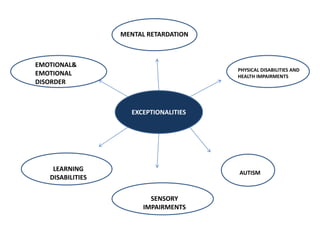
EXCEPTIONALITIES
MENTAL RETARDATION
PHYSICAL DISABILITIES AND
HEALTH IMPAIRMENTS
AUTISM
SENSORY
IMPAIRMENTS
LEARNING
DISABILITIES
EMOTIONAL&
EMOTIONAL
DISORDER
Disability-Measurable impairments or
limitation that interferes with a persons
ability. It may refer to a physical, sensory, or
mental conditions.
Handicap-a disadvantage that occurs as a
result of a disability or impairment.
Omrod- proposed this theory.
CATEGORIES OF EXCEPTIONALITIES
Specific Cognitive or Academic Difficulties
 Learning disabilities-involves difficulties in specific cognitive
process, like dyslexia(reading), dyscalculia(number operation),
and dysgraphia(writing).
 ADHD- Attention Deficit Hyperactive Disorder
a.)Difficulty in focusing and maintaining attention.
b.)Recurrent hyperactive and impulsive behavior.
 Speech and Communication Disorder- difficulties in spoken
language like voice disorder, inability to produce the sounds
correctly, stuttering.
Social/Emotional and Behavioral
 Autism- a condition manifested by different levels of
impaired s0cial interaction and communication ,
repetitive behavior and limited interest feel alone.
 Mental Retardation – it refers to significant sub-
average intelligence and deficits in adaptive behavior.
 Emotional/Conduct Disorder- this involves the
presence of emotional.
Physical Disabilities and Health Impairments
 Physical and Health Impairments- involves physical or medical
condition including one or more of this:
a. Limited energy and strength
b. Reduced mental alertness
c. Little muscle control
 Severe and Multiple Disabilities- this refer to the presence of
two or more different types of disability, at times at a
profound level.
Sensory Impairments
a. Visual Impairments-those involves
malfunction of the eyes.
b. Hearing Impairments-these involves
malfunction of the ear.
c. Giftedness- involves a significantly high
level of cognitive development.
THANK YOU
GODBLESS

Learners with exceptionalities

  • 1.
  • 2.
    EXCEPTIONALITIES MENTAL RETARDATION PHYSICAL DISABILITIESAND HEALTH IMPAIRMENTS AUTISM SENSORY IMPAIRMENTS LEARNING DISABILITIES EMOTIONAL& EMOTIONAL DISORDER
  • 3.
    Disability-Measurable impairments or limitationthat interferes with a persons ability. It may refer to a physical, sensory, or mental conditions. Handicap-a disadvantage that occurs as a result of a disability or impairment. Omrod- proposed this theory.
  • 4.
    CATEGORIES OF EXCEPTIONALITIES SpecificCognitive or Academic Difficulties  Learning disabilities-involves difficulties in specific cognitive process, like dyslexia(reading), dyscalculia(number operation), and dysgraphia(writing).  ADHD- Attention Deficit Hyperactive Disorder a.)Difficulty in focusing and maintaining attention. b.)Recurrent hyperactive and impulsive behavior.  Speech and Communication Disorder- difficulties in spoken language like voice disorder, inability to produce the sounds correctly, stuttering.
  • 5.
    Social/Emotional and Behavioral Autism- a condition manifested by different levels of impaired s0cial interaction and communication , repetitive behavior and limited interest feel alone.  Mental Retardation – it refers to significant sub- average intelligence and deficits in adaptive behavior.  Emotional/Conduct Disorder- this involves the presence of emotional.
  • 6.
    Physical Disabilities andHealth Impairments  Physical and Health Impairments- involves physical or medical condition including one or more of this: a. Limited energy and strength b. Reduced mental alertness c. Little muscle control  Severe and Multiple Disabilities- this refer to the presence of two or more different types of disability, at times at a profound level.
  • 7.
    Sensory Impairments a. VisualImpairments-those involves malfunction of the eyes. b. Hearing Impairments-these involves malfunction of the ear. c. Giftedness- involves a significantly high level of cognitive development.
  • 8.