OBJECTIVES
In the end of chapter, students will be able to
1. Identify the 12 Learners with Exceptionalities
2. Define the individuals with disabilities education act and
individualize education program
3. Understand about how to teach students with special needs
Exceptional children
and youth
 Are all those who receive special
education services in the school.
Special Education
 Is the set of services designed to meet
the unique needs of Exceptional
Students
Learning with
Disabilities
 Is a general term for a diverse group of
disorders characterized by significant
difficulties in the acquisition and use of
listening, speaking, reading, writing,
reasoning, or computing. These
disorders stem from the individual and
may occur across the life span.
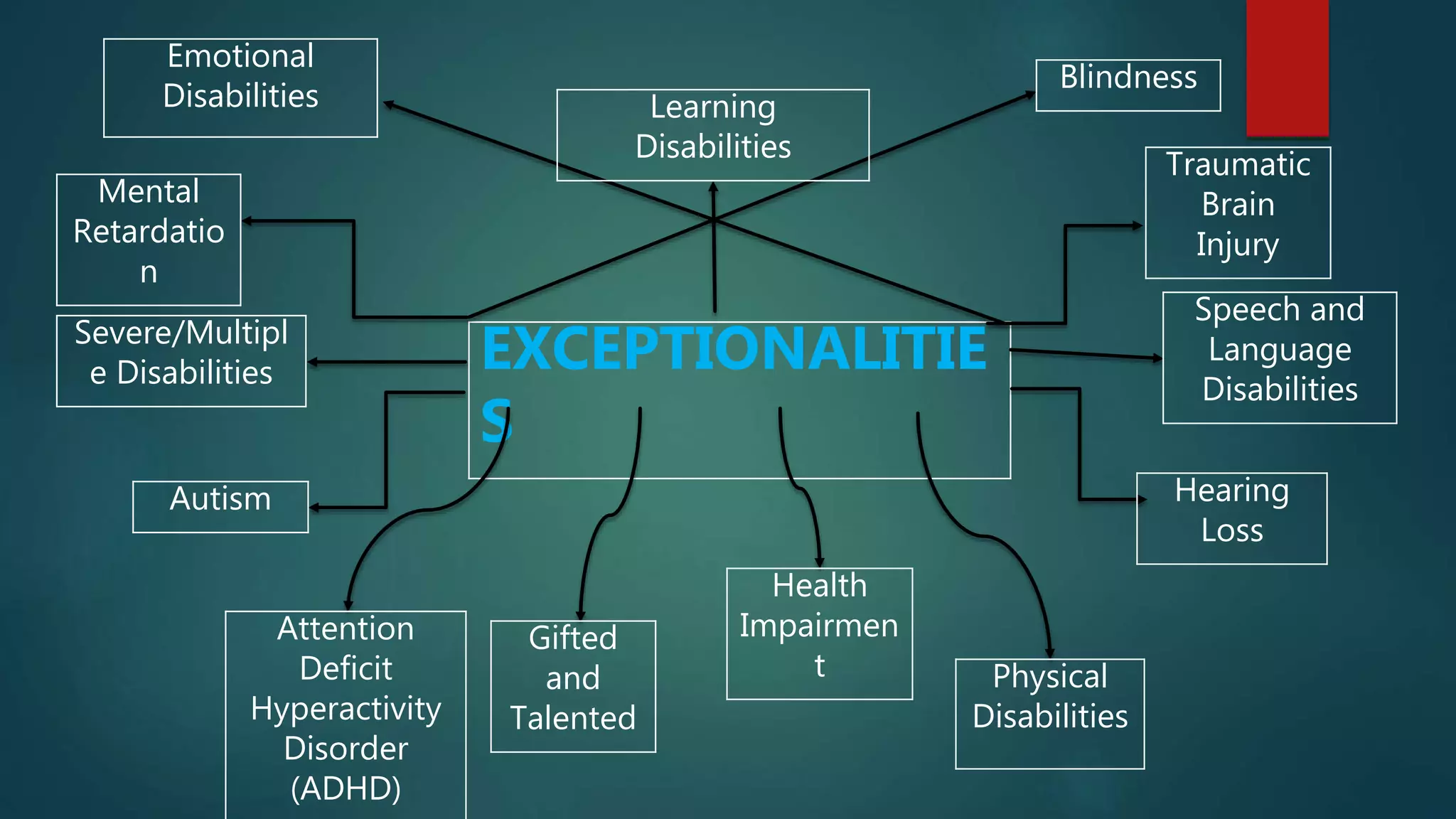
EXCEPTIONALITIE
S
Mental
Retardation
Severe/Multiple
Disabilities
Autism
Learning
Disabilities
Emotional
Disabilities
Blindness
Traumatic
Brain Injury
Speech/Language
Disabilities
Hearing
Loss
Attention
Deficit
Hyperactivity
Disorder
(ADHD)
Gifted
and
Talented
Health
Impairment
Physical
Disabilities
Learning disabilities
 Is a neurological disorder. In simple terms, a learning disability results from a
difference in the way a person's brain is "wired." Children with learning
disabilities are as smart or smarter than their peers. But they may have
difficulty reading, writing, spelling, reasoning, recalling and/or organizing
information if left to figure things out by themselves or if taught in
conventional ways.
CLASSIFICATION
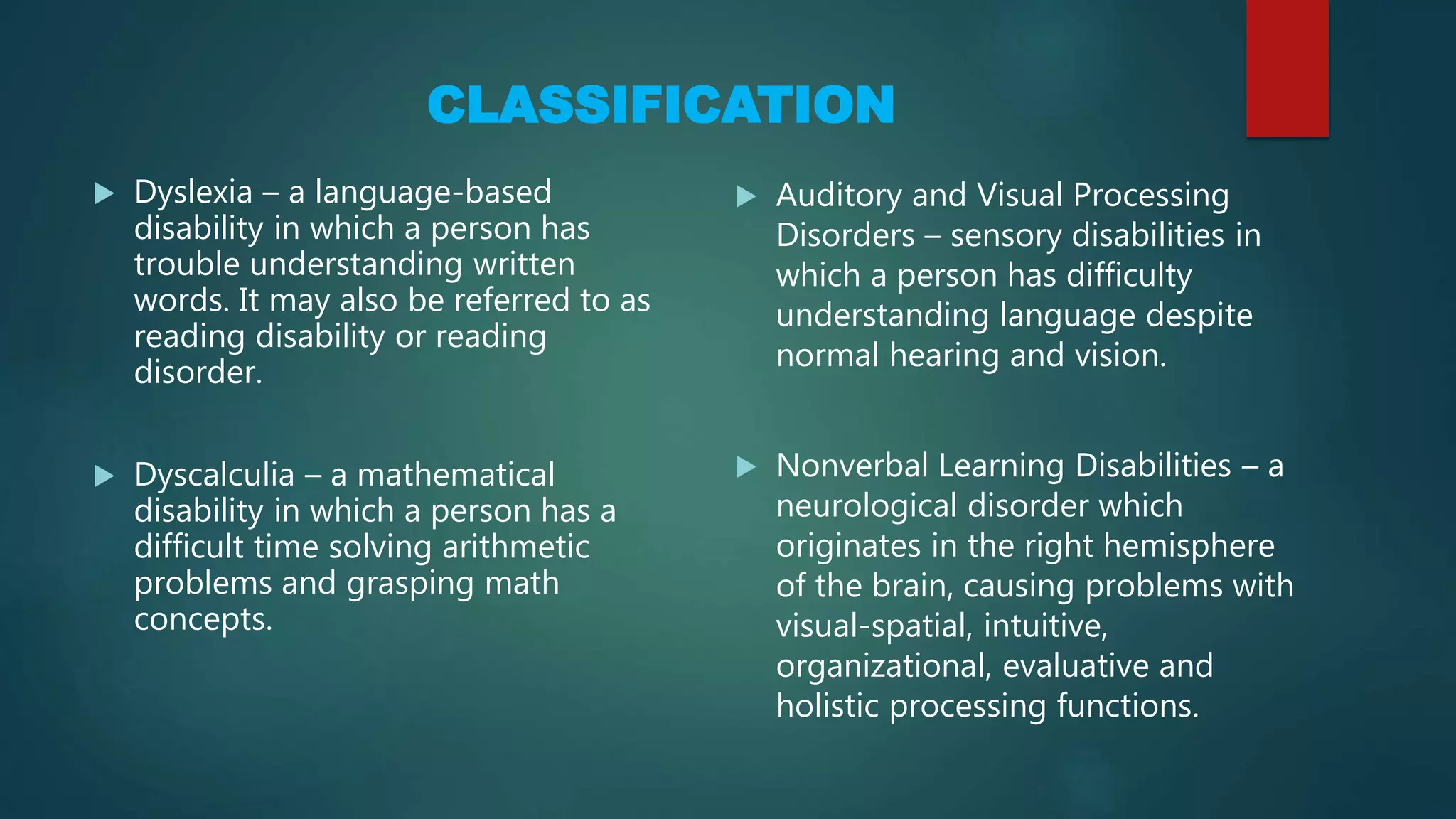
 Dyslexia – a language-based
disability in which a person has
trouble understanding written
words. It may also be referred to as
reading disability or reading
disorder.
 Dyscalculia – a mathematical
disability in which a person has a
difficult time solving arithmetic
problems and grasping math
concepts.
 Auditory and Visual Processing
Disorders – sensory disabilities in
which a person has difficulty
understanding language despite
normal hearing and vision.
 Nonverbal Learning Disabilities – a
neurological disorder which
originates in the right hemisphere
of the brain, causing problems with
visual-spatial, intuitive,
organizational, evaluative and
holistic processing functions.
CHARACTERISTICS OF LEARNING
DISABILITIES
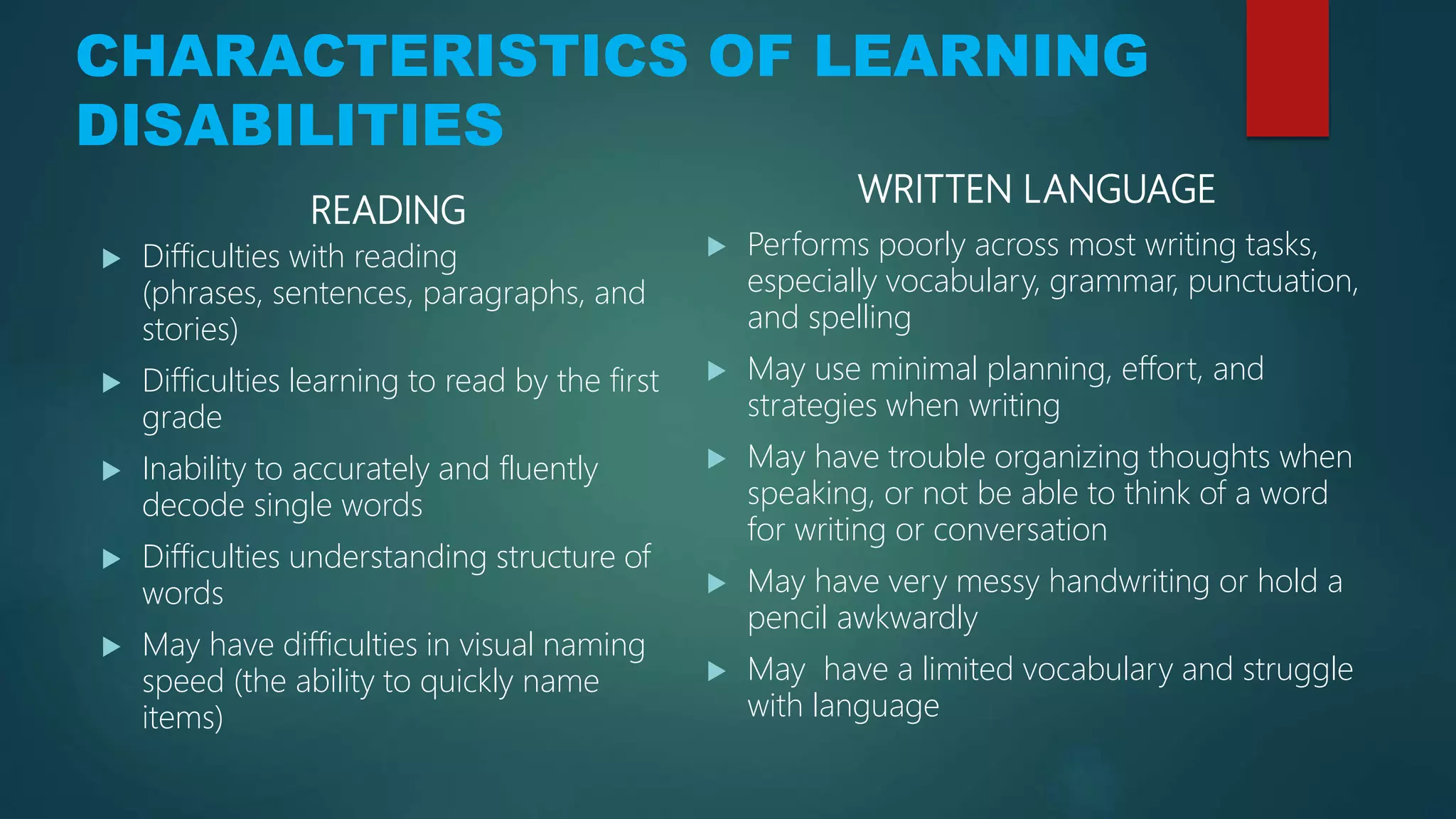
READING
 Difficulties with reading
(phrases, sentences, paragraphs, and
stories)
 Difficulties learning to read by the first
grade
 Inability to accurately and fluently
decode single words
 Difficulties understanding structure of
words
 May have difficulties in visual naming
speed (the ability to quickly name
items)
WRITTEN LANGUAGE
 Performs poorly across most writing tasks,
especially vocabulary, grammar, punctuation,
and spelling
 May use minimal planning, effort, and
strategies when writing
 May have trouble organizing thoughts when
speaking, or not be able to think of a word
for writing or conversation
 May have very messy handwriting or hold a
pencil awkwardly
 May have a limited vocabulary and struggle
with language
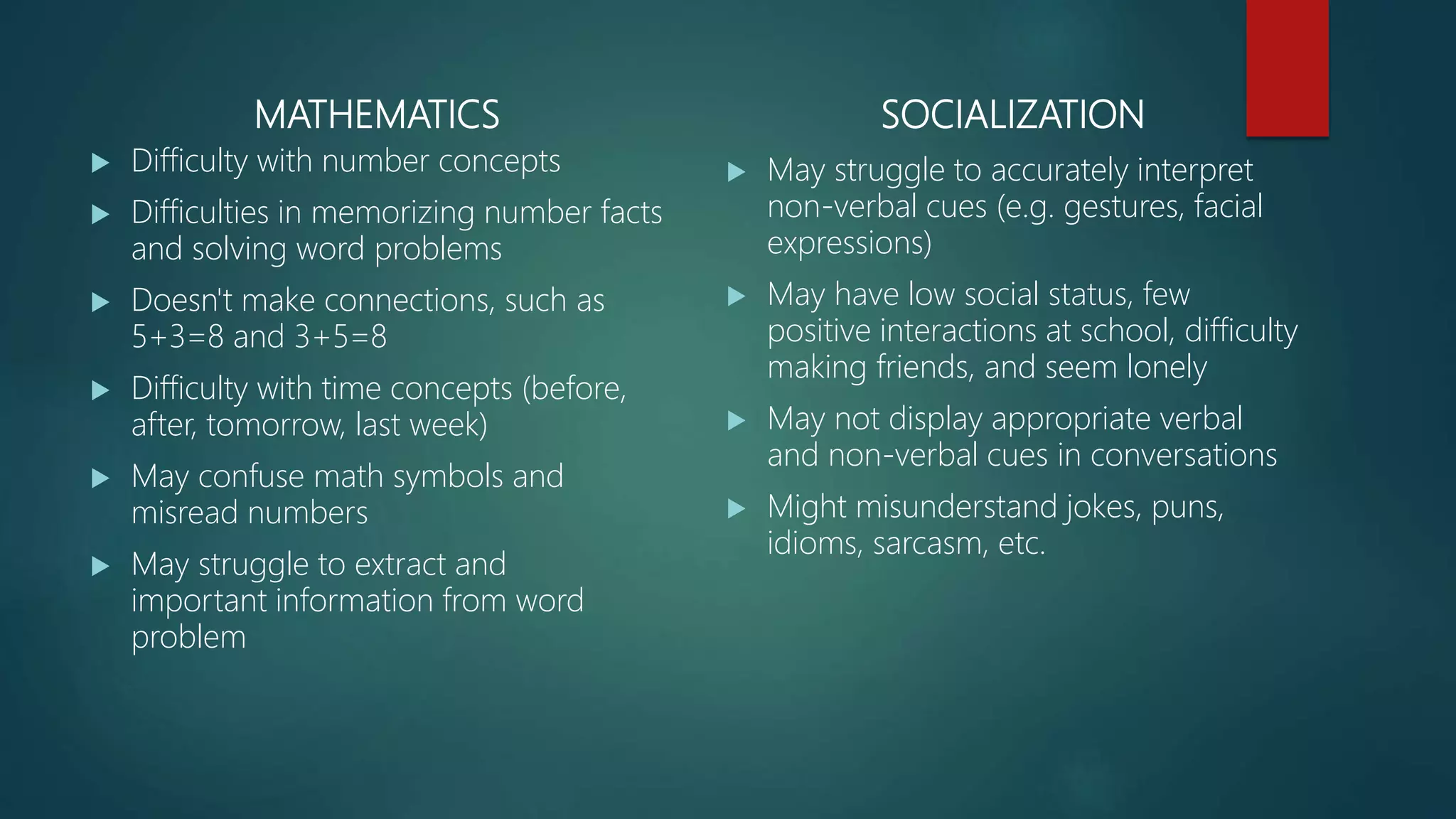
MATHEMATICS
 Difficulty with number concepts
 Difficulties in memorizing number facts
and solving word problems
 Doesn't make connections, such as
5+3=8 and 3+5=8
 Difficulty with time concepts (before,
after, tomorrow, last week)
 May confuse math symbols and
misread numbers
 May struggle to extract and
important information from word
problem
SOCIALIZATION
 May struggle to accurately interpret
non-verbal cues (e.g. gestures, facial
expressions)
 May have low social status, few
positive interactions at school, difficulty
making friends, and seem lonely
 May not display appropriate verbal
and non-verbal cues in conversations
 Might misunderstand jokes, puns,
idioms, sarcasm, etc.
Emotional disabilities
 A condition exhibiting one or more of the following characteristics over a long period
of time and to a marked degree that adversely affects a child’s educational
performance:
(A) An inability to learn that cannot be explained by intellectual, sensory, or health
factors.
(B) An inability to build or maintain satisfactory interpersonal relationships with peers
and teachers.
(C) Inappropriate types of behavior or feelings under normal circumstances.
(D) A general pervasive mood of unhappiness or depression.
(E) A tendency to develop physical symptoms or fears associated with personal or school
problems.
CLASSIFICATION OF
Emotional Disability
 Anxiety Disorder
 Bipolar Disorder
 Conduct Disorder
 Eating Disorder
 Obsessive Compulsive Disorder
 Psychotic Disorder
CHARACTERISTICS
 Hyperactivity (short attention span,
impulsiveness)
 Aggression or self-injurious behavior
(acting out, fighting)
 Withdrawal (not interacting socially
with others, excessive fear or anxiety)
 Immaturity (inappropriate crying,
temper tantrums, poor coping skills)
 Learning difficulties (academically
performing below grade level).
PHYSICAL DISABILITIES
COMMON
TYPES
 Is a limitation on a person's physical functioning,
mobility, dexterity or stamina. A person can be
physically disabled due to two reasons:
Congenital/Hereditary – the person has physical
disability since birth or the disability developed at a
later stage due to genetic problems, problems with
muscle cells or injury during birth. Acquired – the
person acquired the physical disability through road
or industrial accidents, infections such as polio or
diseases and disorders such as stroke or cancer.
 Brittle Bone Disease
 Cerebral Palsy
 Muscular Dystrophy
 Spina Bifida
 Friedreich's Ataxia
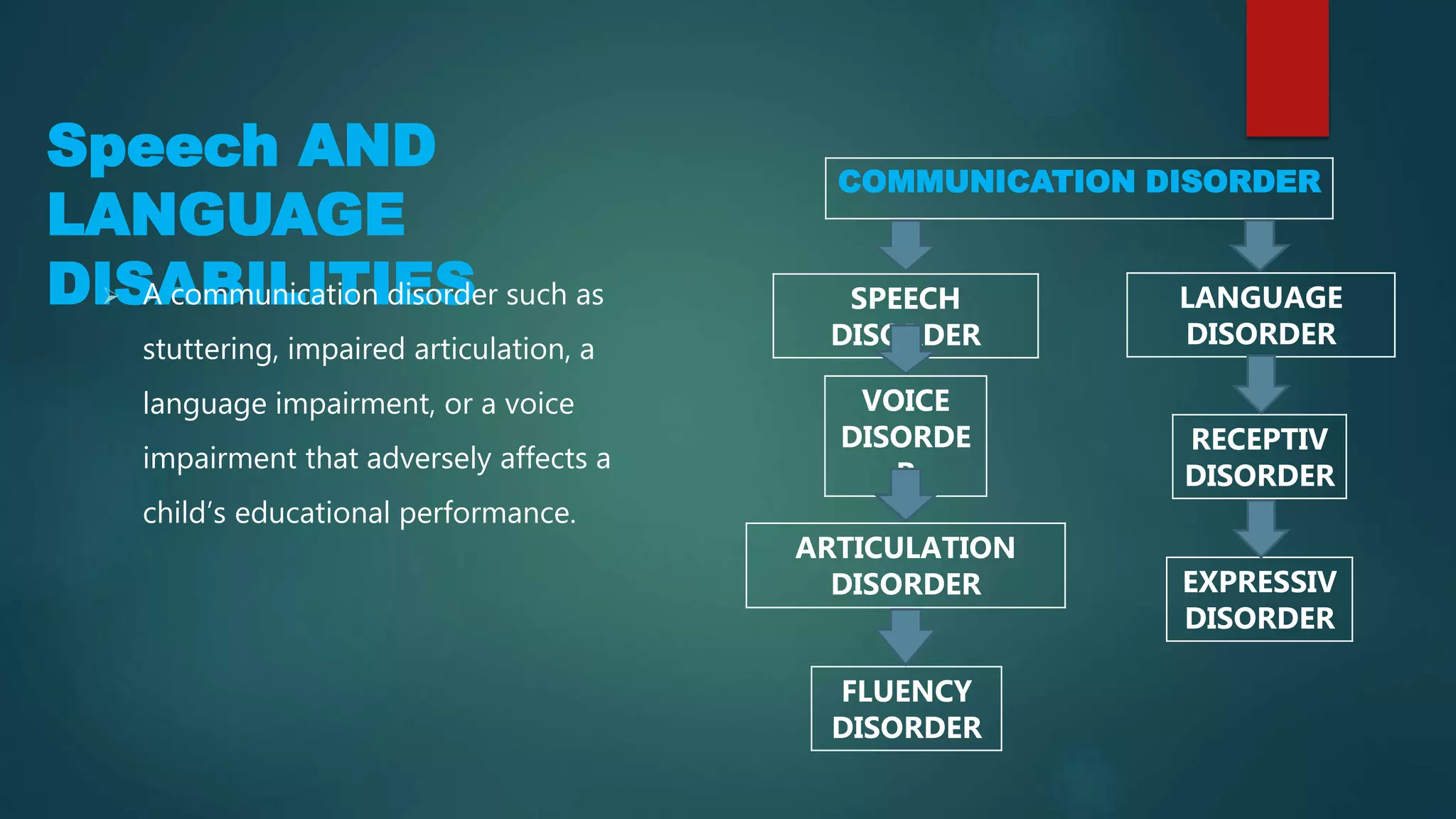
Speech/Language
DISABILITIES
 A communication disorder such as
stuttering, impaired articulation, a
language impairment, or a voice
impairment that adversely affects a
child’s educational performance.
SPEECH
DISORDER
VOICE
DISORDER
ARTICULATION
DISORDER
FLUENCY
DISORDER
LANGUAGE
DISORDER
COMMUNICATION DISORDER
RECEPTIV
DISORDER
EXPRESSIVE
DISORDER
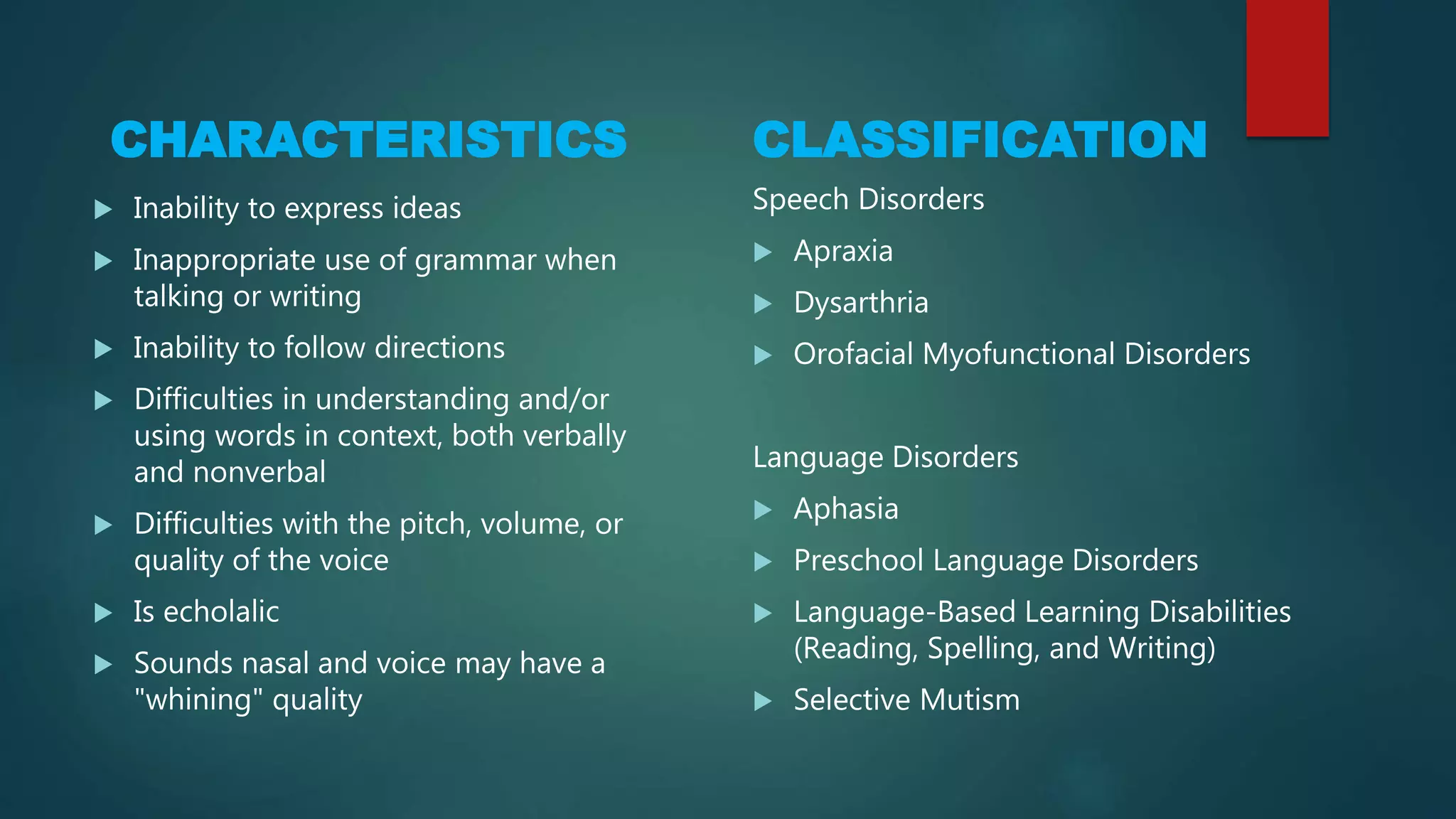
CHARACTERISTICS
 Inability to express ideas
 Inappropriate use of grammar when
talking or writing
 Inability to follow directions
 Difficulties in understanding and/or
using words in context, both verbally
and nonverbal
 Difficulties with the pitch, volume, or
quality of the voice
 Is echolalic
 Sounds nasal and voice may have a
"whining" quality
CLASSIFICATION
Speech Disorders
 Apraxia
 Dysarthria
 Orofacial Myofunctional Disorders
Language Disorders
 Aphasia
 Preschool Language Disorders
 Language-Based Learning Disabilities
(Reading, Spelling, and Writing)
 Selective Mutism
SEVERE/MULTIPLE
DISABILITIES CHARACTERISTICS
 Refers to “concomitant [simultaneous]
impairments (such as intellectual
disability-blindness, intellectual
disability-orthopedic impairment, etc.),
the combination of which causes such
severe educational needs that they
cannot be accommodated in a special
education program solely for one of
the impairments. The term does not
include deaf-blindness.”
 Problems transferring learning from
one situation to another, one setting to
another and one skill to another
 Limited communication skill
 Difficulties with memory
 Need for service from many different
related service providers
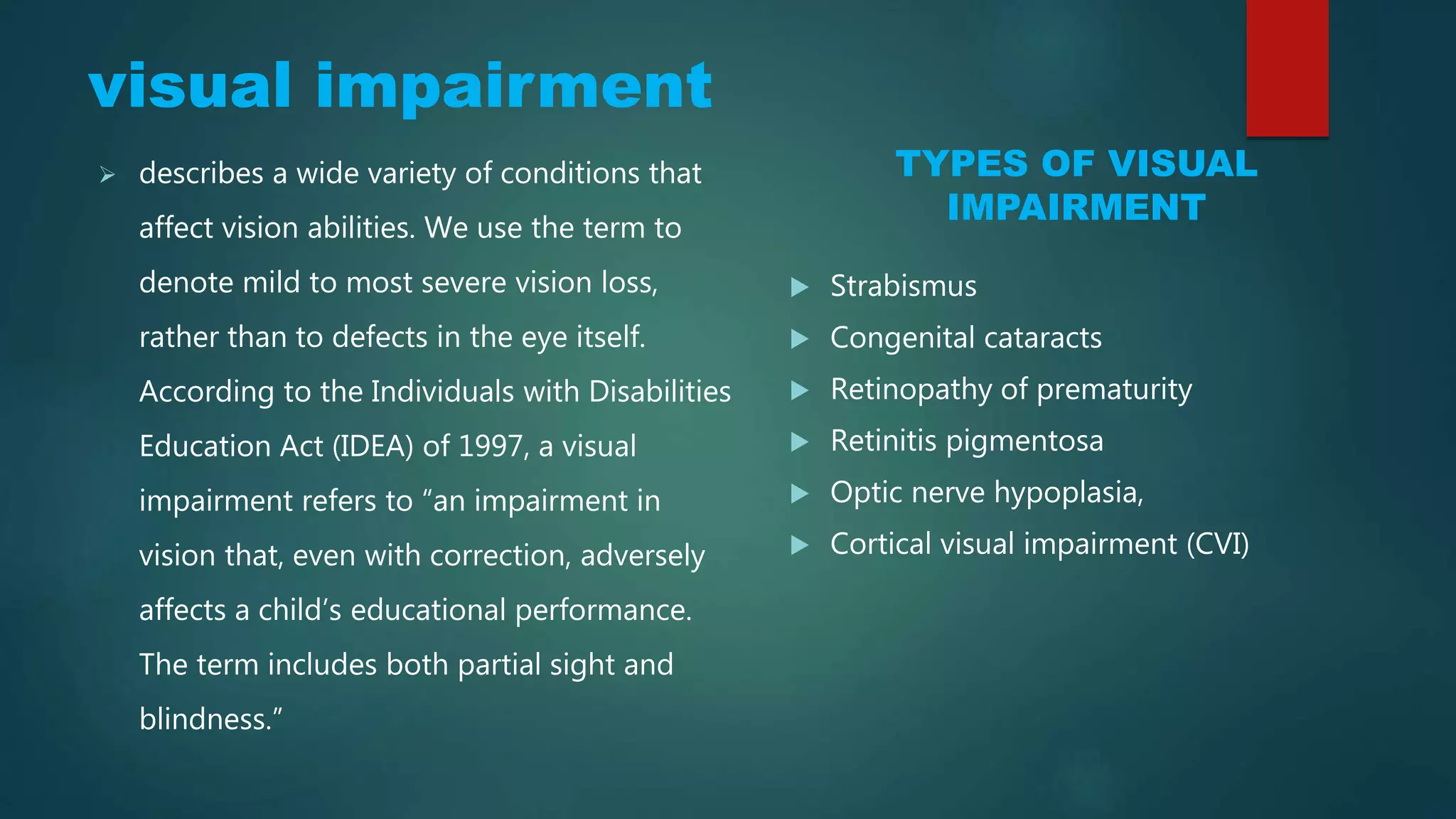
Visual Impairment
TYPES OF VISUAL
IMPAIRMENT
 describes a wide variety of conditions that
affect vision abilities. We use the term to
denote mild to most severe vision loss,
rather than to defects in the eye itself.
According to the Individuals with Disabilities
Education Act (IDEA) of 1997, a visual
impairment refers to “an impairment in
vision that, even with correction, adversely
affects a child’s educational performance.
The term includes both partial sight and
blindness.”
 Strabismus
 Congenital cataracts
 Retinopathy of prematurity
 Retinitis pigmentosa
 Optic nerve hypoplasia,
 Cortical visual impairment (CVI)
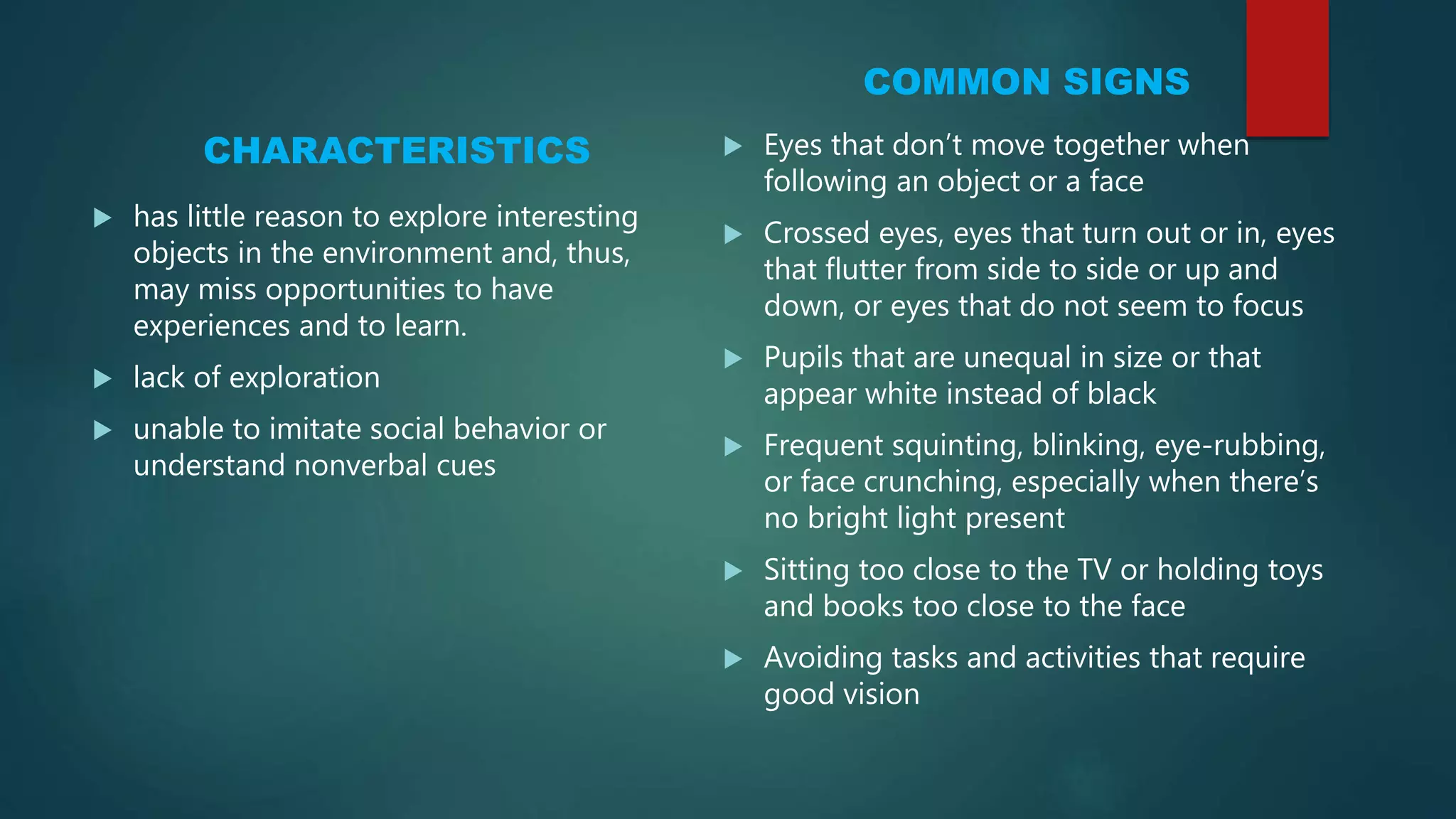
CHARACTERISTICS
 has little reason to explore interesting
objects in the environment and, thus,
may miss opportunities to have
experiences and to learn.
 lack of exploration
 unable to imitate social behavior or
understand nonverbal cues
COMMON SIGNS
 Eyes that don’t move together when
following an object or a face
 Crossed eyes, eyes that turn out or in, eyes
that flutter from side to side or up and
down, or eyes that do not seem to focus
 Pupils that are unequal in size or that
appear white instead of black
 Frequent squinting, blinking, eye-rubbing,
or face crunching, especially when there’s
no bright light present
 Sitting too close to the TV or holding toys
and books too close to the face
 Avoiding tasks and activities that require
good vision
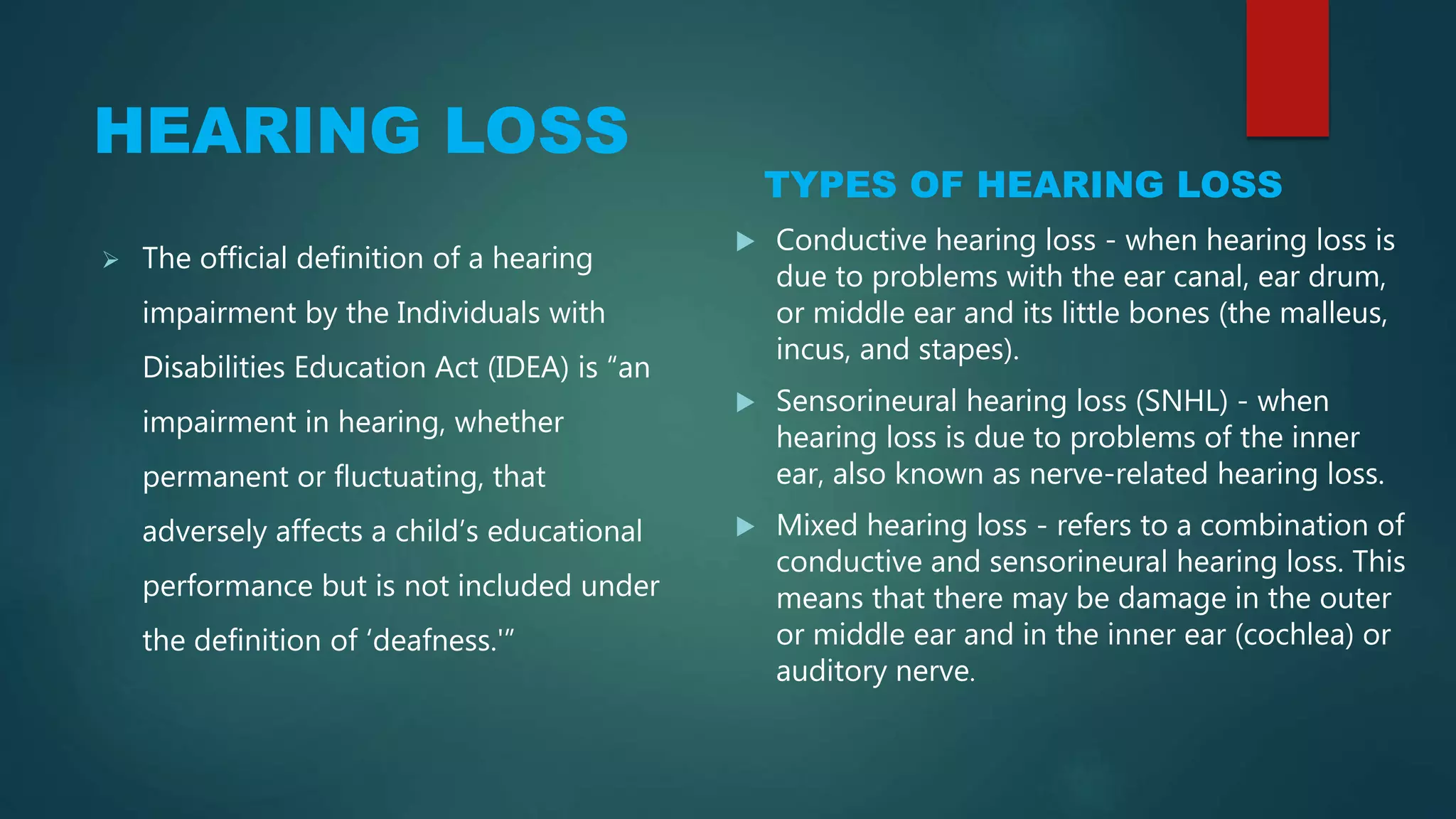
HEARING LOSS
TYPES OF HEARING LOSS
 The official definition of a hearing
impairment by the Individuals with
Disabilities Education Act (IDEA) is “an
impairment in hearing, whether
permanent or fluctuating, that
adversely affects a child’s educational
performance but is not included under
the definition of ‘deafness.'”
 Conductive hearing loss - when hearing loss is
due to problems with the ear canal, ear drum,
or middle ear and its little bones (the malleus,
incus, and stapes).
 Sensorineural hearing loss (SNHL) - when
hearing loss is due to problems of the inner
ear, also known as nerve-related hearing loss.
 Mixed hearing loss - refers to a combination of
conductive and sensorineural hearing loss. This
means that there may be damage in the outer
or middle ear and in the inner ear (cochlea) or
auditory nerve.
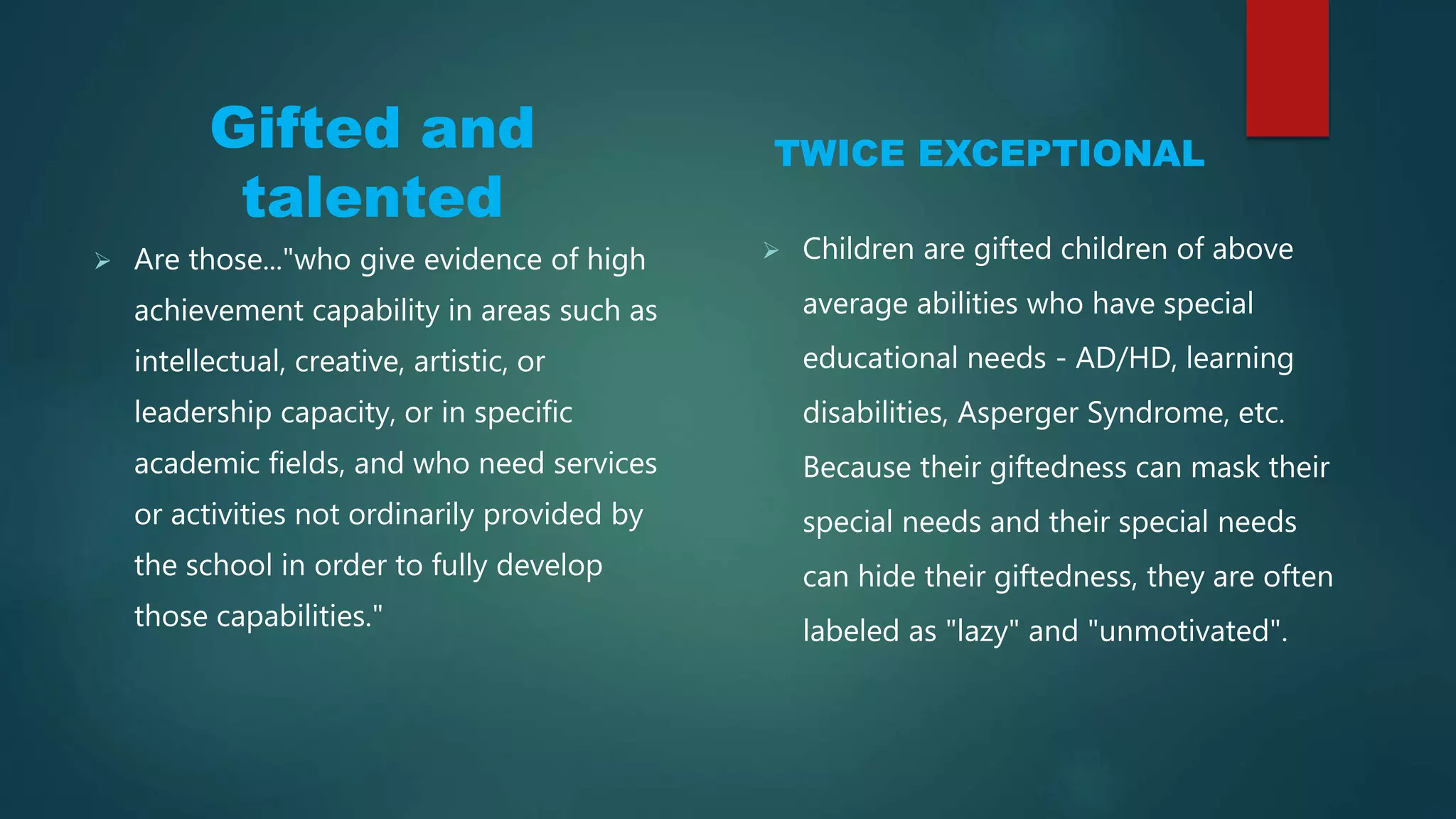
Gifted and
talented
TWICE EXCEPTIONAL
 Are those..."who give evidence of high
achievement capability in areas such as
intellectual, creative, artistic, or
leadership capacity, or in specific
academic fields, and who need services
or activities not ordinarily provided by
the school in order to fully develop
those capabilities."
 Children are gifted children of above
average abilities who have special
educational needs - AD/HD, learning
disabilities, Asperger Syndrome, etc.
Because their giftedness can mask their
special needs and their special needs
can hide their giftedness, they are often
labeled as "lazy" and "unmotivated".
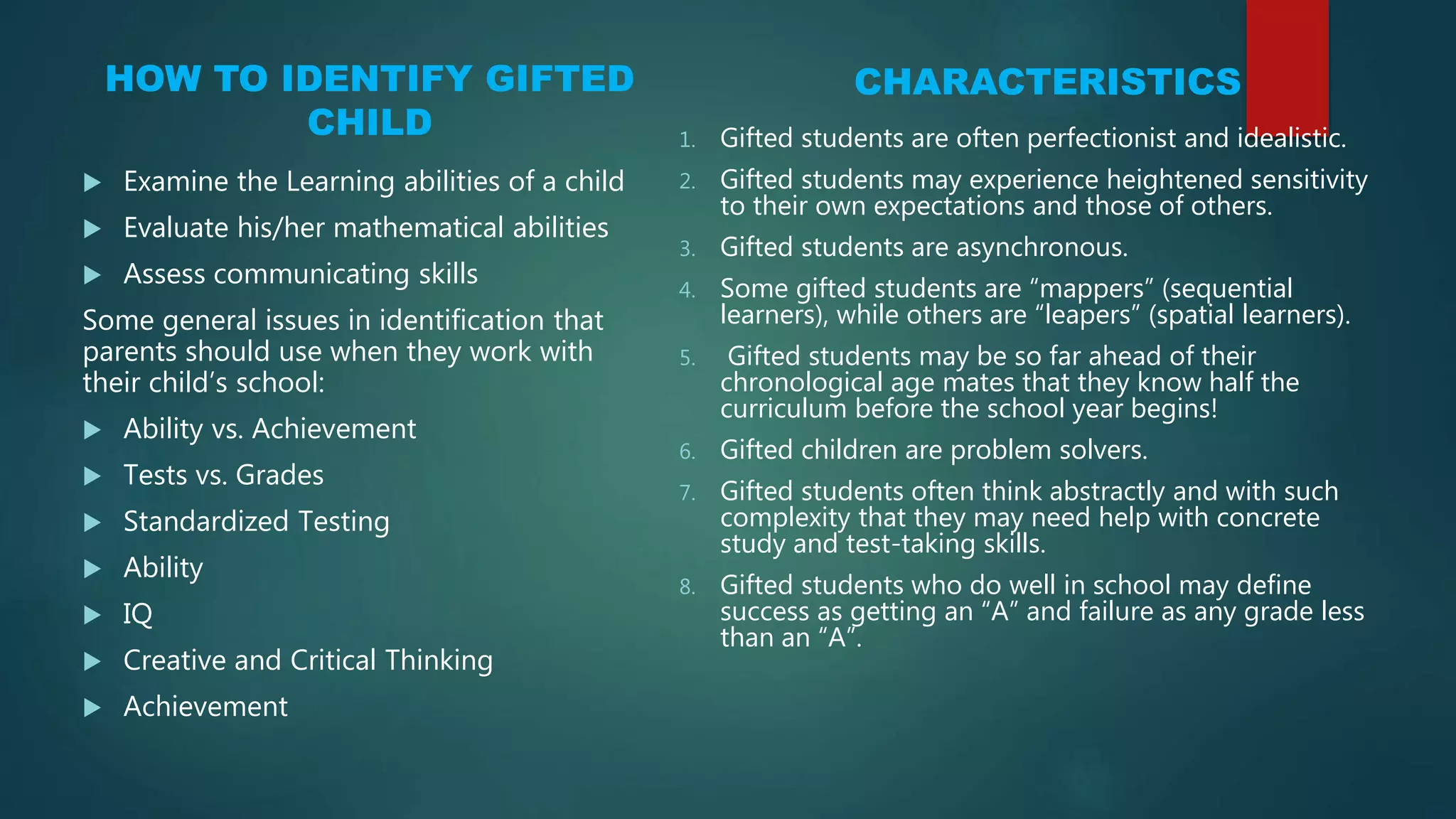
HOW TO IDENTIFY GIFTED
CHILD
 Examine the Learning abilities of a child
 Evaluate his/her mathematical abilities
 Assess communicating skills
Some general issues in identification that
parents should use when they work with
their child’s school:
 Ability vs. Achievement
 Tests vs. Grades
 Standardized Testing
 Ability
 IQ
 Creative and Critical Thinking
 Achievement
CHARACTERISTICS
1. Gifted students are often perfectionist and idealistic.
2. Gifted students may experience heightened sensitivity
to their own expectations and those of others.
3. Gifted students are asynchronous.
4. Some gifted students are “mappers” (sequential
learners), while others are “leapers” (spatial learners).
5. Gifted students may be so far ahead of their
chronological age mates that they know half the
curriculum before the school year begins!
6. Gifted children are problem solvers.
7. Gifted students often think abstractly and with such
complexity that they may need help with concrete
study and test-taking skills.
8. Gifted students who do well in school may define
success as getting an “A” and failure as any grade less
than an “A”.
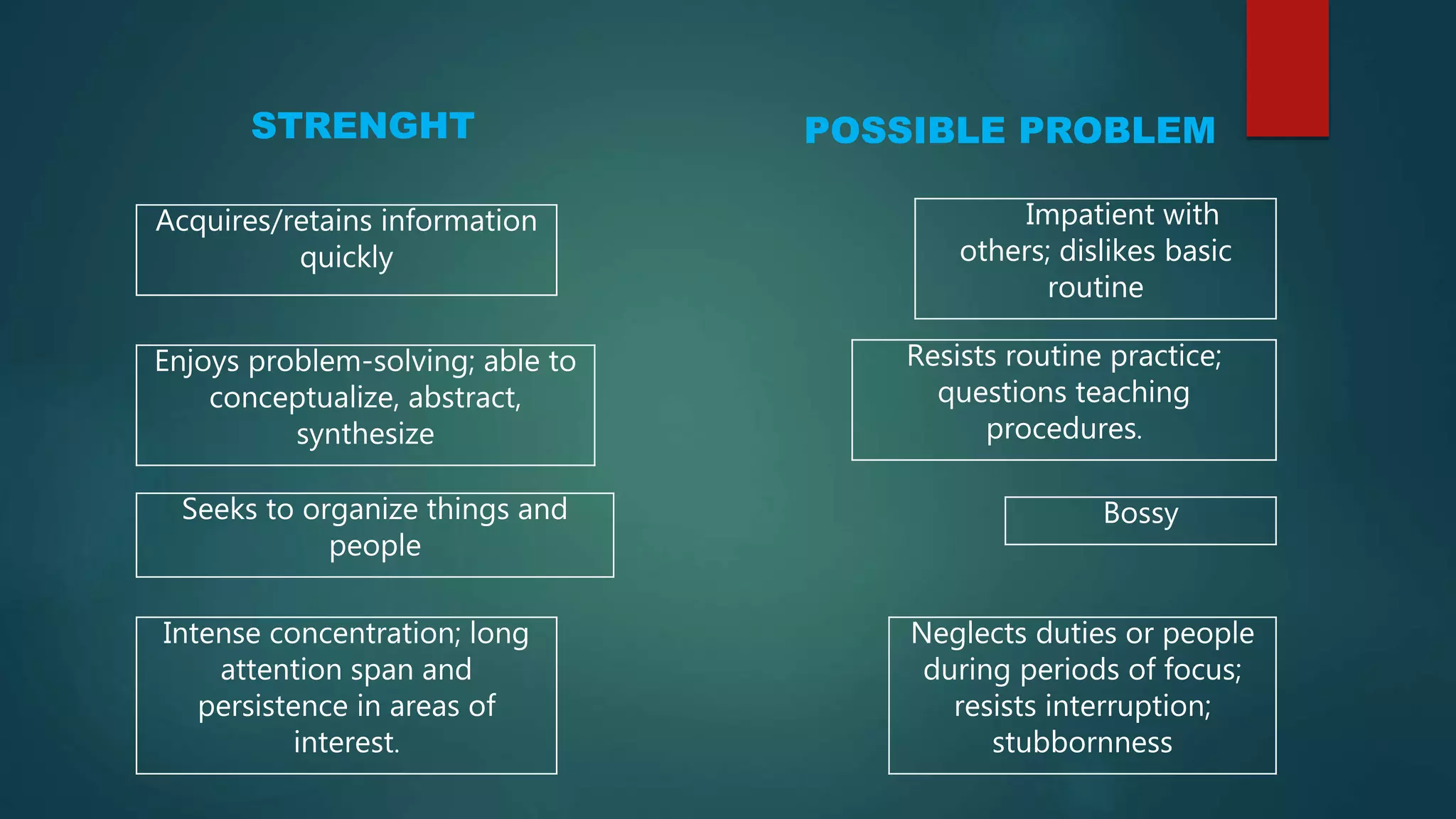
STRENGHT
Acquires/retains information
quickly
POSSIBLE PROBLEM
Enjoys problem-solving; able to
conceptualize, abstract,
synthesize
Seeks to organize things and
people
Intense concentration; long
attention span and
persistence in areas of
interest.
Impatient with
others; dislikes basic
routine
Resists routine practice;
questions teaching
procedures.
Bossy
Neglects duties or people
during periods of focus;
resists interruption;
stubbornness
Intellectual disability (MR)
 Defined by the Individuals with Disabilities
Education Act (IDEA) as “significantly sub-
average general intellectual functioning,
existing concurrently [at the same time] with
deficits in adaptive behavior and manifested
during the developmental period, that
adversely affects a child’s educational
performance.”
Mental retardation varies in severity. The Diagnostic and Statistical Manual of Mental Disorders ,
fourth edition, text revision ( DSM-IV-TR ), which is the diagnostic standard for mental health care
professionals in the United States, classifies four different degrees of mental retardation: mild,
moderate, severe , and profound . These categories are based on the person's level of functioning.
 Mild mr - Their IQ score ranges from 50–70, and they can often acquire academic skills up to
about the sixth-grade level. They can become fairly self-sufficient and in some cases live
independently, with community and social support.
 Moderate mr - Moderately retarded persons have IQ scores ranging from 35–55. They can carry
out work and self-care tasks with moderate supervision. They typically acquire communication
skills in childhood and are able to live and function successfully within the community in such
supervised environments as group homes .
 Severe mr - About 3–4% of the mentally retarded population is severely retarded. Severely
retarded persons have IQ scores of 20–40. They may master very basic self-care skills and some
communication skills. Many severely retarded individuals are able to live in a group home.
 Profound mr - Only 1–2% of the mentally retarded population is classified as profoundly retarded.
Profoundly retarded individuals have IQ scores under 20–25. They may be able to develop basic
self-care and communication skills with appropriate support and training.
What is DSM?
 is used by clinicians and psychiatrists to diagnose psychiatric illnesses. In 2013, a new version
known as the DSM-5 was released. The DSM is published by the American Psychiatric Association
and covers all categories of mental health disorders for both adults and children. The DSM is
utilized widely in the United States for psychiatric diagnosis, treatment recommendations and
insurance coverage purposes. Mental health providers used the manual to better understand a
client's potential needs as well as a tool for assessment and diagnosis.
Learning Characteristics of a Person with
Mental Retardation
1. Slow rate of learning - Person has the ability to learn, but takes longer to do so
2. Thinks in a concrete way - Has difficulty with abstract thinking
3. Difficulties generalizing - Cannot take knowledge learned in one situation and apply it to another
4. Needs to be taught how to make choices - Has difficulty weighing pros and cons, and applying
past experiences to present decision-making
5. Challenges in setting goals and problem solving - Needs help to figure out problems and
determine steps required to reach goals. Tasks that many people learn without instruction may
need to be structured or broken down into small steps.
6. Memory problems - Has difficulty remembering how to complete tasks that take several steps, or
that are not routine; training needs to include lots of opportunities for practice and repetition.
7. Short attention span - Has trouble sticking with an activity or focusing attention for long periods
of time
8. Expressive language - Has difficulty conveying ideas and feelings to other people; explaining that
he/she doesn’t understand something; and asking questions
Attention Deficit Hyperactivity
Disorder (ADHD)
 is a mental disorder of the neurodevelopmental type. It is characterized by problems paying
attention, excessive activity, or difficulty controlling behavior which is not appropriate for a
person's age.[3] These symptoms begin by age six to twelve, are present for more than six
months, and cause problems in at least two settings (such as school, home, or recreational
activities).
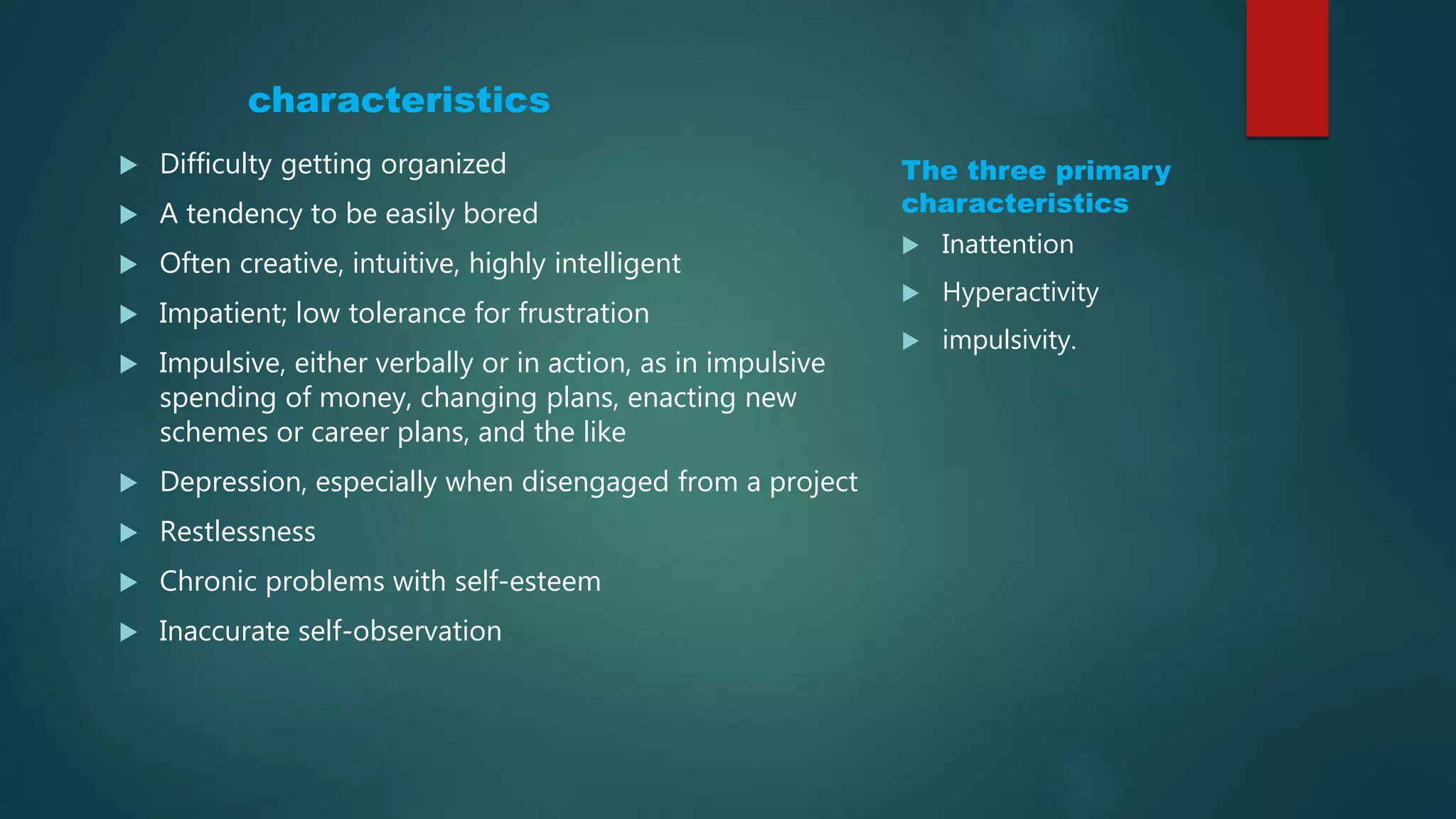
characteristics
The three primary
characteristics
 Inattention
 Hyperactivity
 impulsivity.
 Difficulty getting organized
 A tendency to be easily bored
 Often creative, intuitive, highly intelligent
 Impatient; low tolerance for frustration
 Impulsive, either verbally or in action, as in impulsive
spending of money, changing plans, enacting new
schemes or career plans, and the like
 Depression, especially when disengaged from a project
 Restlessness
 Chronic problems with self-esteem
 Inaccurate self-observation
Autism
 A developmental disability significantly affecting verbal and nonverbal communication and social
interaction, generally present before age three that adversely affects a child’s educational
performance.
 Other characteristics often associated with autism are engaging in repetitive activities and
stereotyped movements, resistance to environmental change or change in daily routines, and
unusual responses to sensory experiences.
 The term autism does not apply if the child’s educational performance is adversely affected
primarily because the child has an emotional disturbance
 A child who shows the characteristics of autism after age 3 could be diagnosed as having autism
if the criteria above are satisfied.
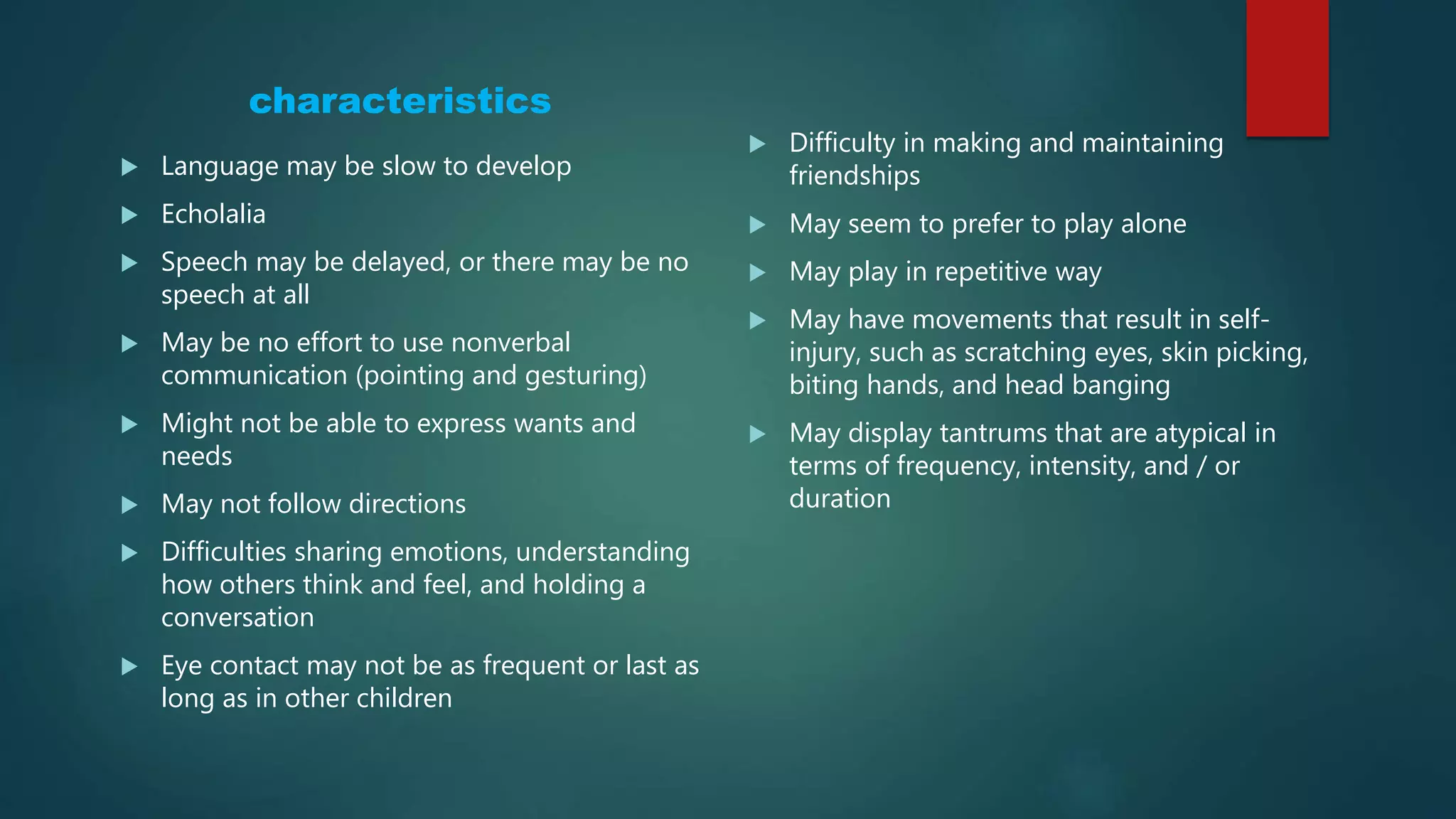
characteristics
 Language may be slow to develop
 Echolalia
 Speech may be delayed, or there may be no
speech at all
 May be no effort to use nonverbal
communication (pointing and gesturing)
 Might not be able to express wants and
needs
 May not follow directions
 Difficulties sharing emotions, understanding
how others think and feel, and holding a
conversation
 Eye contact may not be as frequent or last as
long as in other children
 Difficulty in making and maintaining
friendships
 May seem to prefer to play alone
 May play in repetitive way
 May have movements that result in self-
injury, such as scratching eyes, skin picking,
biting hands, and head banging
 May display tantrums that are atypical in
terms of frequency, intensity, and / or
duration
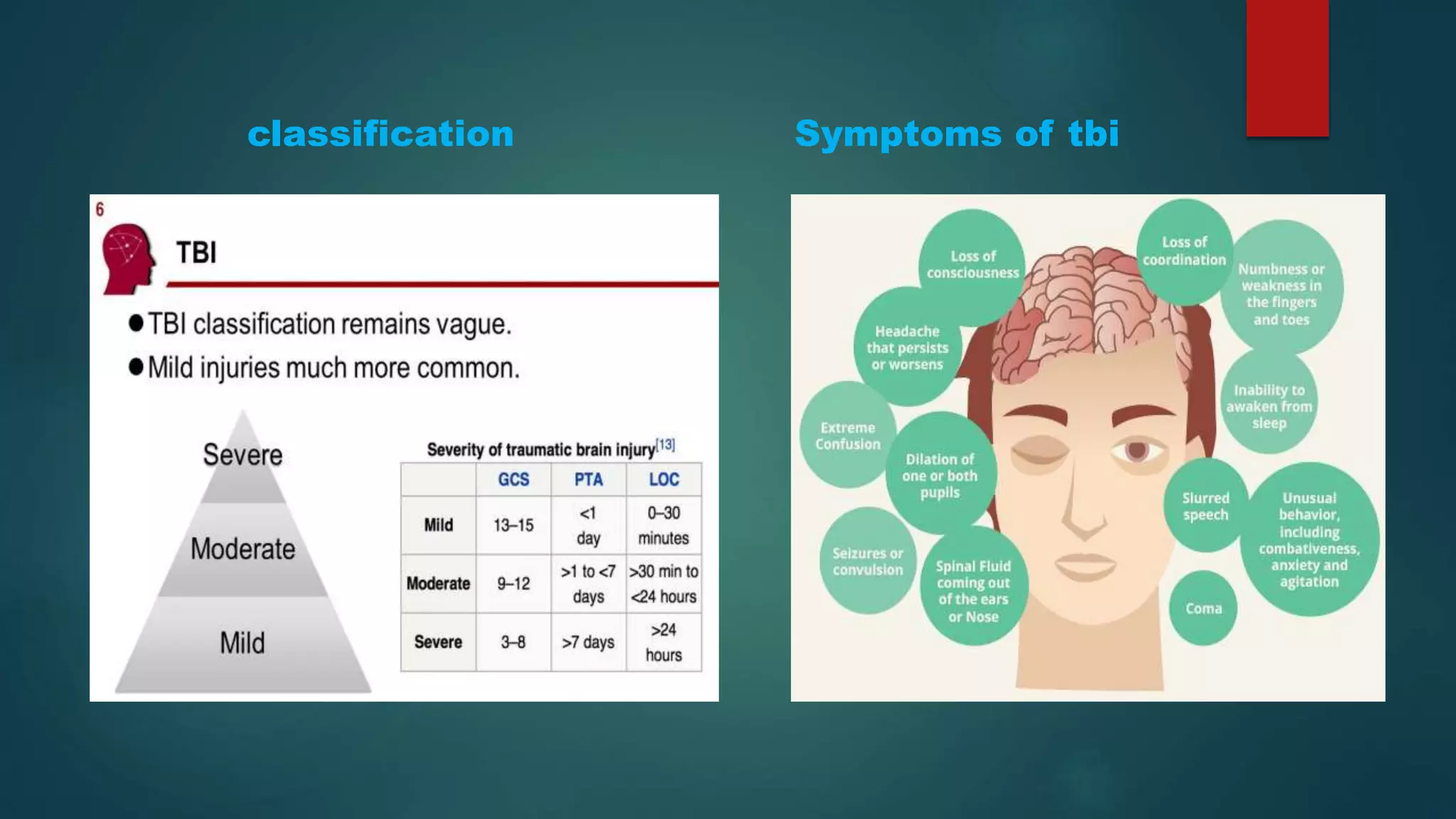
Traumatic brain injury
 The Individuals with Disabilities Education Act (IDEA) outlines the conditions that fall within this
classification, formally defining TBI as “an acquired injury to the brain caused by an external
physical force, resulting in total or partial functional disability or psychosocial impairment, or
both, that adversely affects a child’s educational performance.”
classification Symptoms of tbi
Other health impairments
 An umbrella term, “other health impairment” (OHI) encompasses a range of conditions. The
Individuals with Disabilities Education Act (IDEA) names several such disorders in OHI’s official
definition: “having limited strength, vitality, or alertness, including a heightened alertness to
environmental stimuli, that results in limited alertness with respect to the educational
environment, that— (a) is due to chronic or acute health problems such as asthma, attention
deficit disorder or attention deficit hyperactivity disorder, diabetes, epilepsy, a heart condition,
hemophilia, lead poisoning, leukemia, nephritis [a kidney disorder], rheumatic fever, sickle cell
anemia, and Tourette syndrome; and (b) adversely affects a child’s educational performance.”
characteristics
 Unexplained tiredness
 Unusual moodiness
 Agitation
 pale
 Weakness
 Breathing problem
 seizure
classification
 Asthma
 Epilepsy
 Diabetes
 Sickle cell anemia
 Tourette syndrome
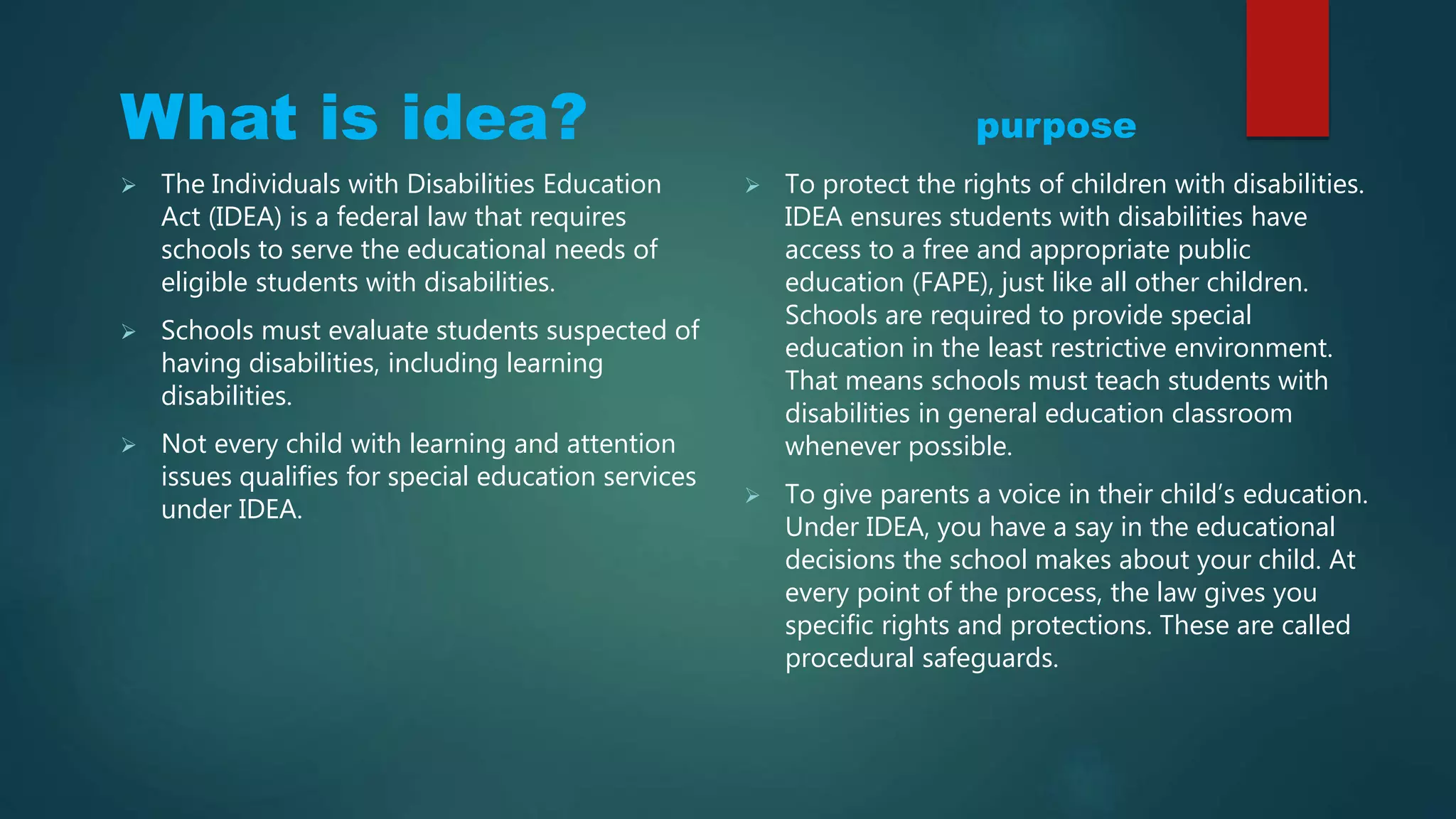
What is IDEA? purpose
 The Individuals with Disabilities Education
Act (IDEA) is a federal law that requires
schools to serve the educational needs of
eligible students with disabilities.
 Schools must evaluate students suspected of
having disabilities, including learning
disabilities.
 Not every child with learning and attention
issues qualifies for special education services
under IDEA.
 To protect the rights of children with disabilities.
IDEA ensures students with disabilities have
access to a free and appropriate public
education (FAPE), just like all other children.
Schools are required to provide special
education in the least restrictive environment.
That means schools must teach students with
disabilities in general education classroom
whenever possible.
 To give parents a voice in their child’s education.
Under IDEA, you have a say in the educational
decisions the school makes about your child. At
every point of the process, the law gives you
specific rights and protections. These are called
procedural safeguards.
What is Individual Education Program?
 A federal law called the Individuals with Disabilities Education Act (IDEA) requires that public
schools create an IEP for every child receiving special education services. Kids from age 3
through high school graduation or a maximum age of 22 (whichever comes first) may be eligible
for an IEP.
 The IEP is meant to address each child’s unique learning issues and include specific educational
goals. It is a legally binding document. The school must provide everything it promises in the
IEP.
Here’s a quick look at what an IEP must include, by law:
 A statement of your child’s present level of performance (PLOP)—this is how your child is doing
in school now
 Your child’s annual educational goals
 Special education supports and services that
the school will provide to help your child
reach goals
 Modifications and accommodations the
school will provide to help your child make
progress
 Accommodations your child will be allowed
when taking standardized tests
 How and when the school will measure your
child’s progress toward annual goals
 Transition planning that prepares teens for
life after high school
504 plan:
A plan that lists the accommodations a school will
provide, such as audiobooks, note-taking aids or
extended time to complete tests, so that a student
with a disability has equal access to the general
education curriculum.
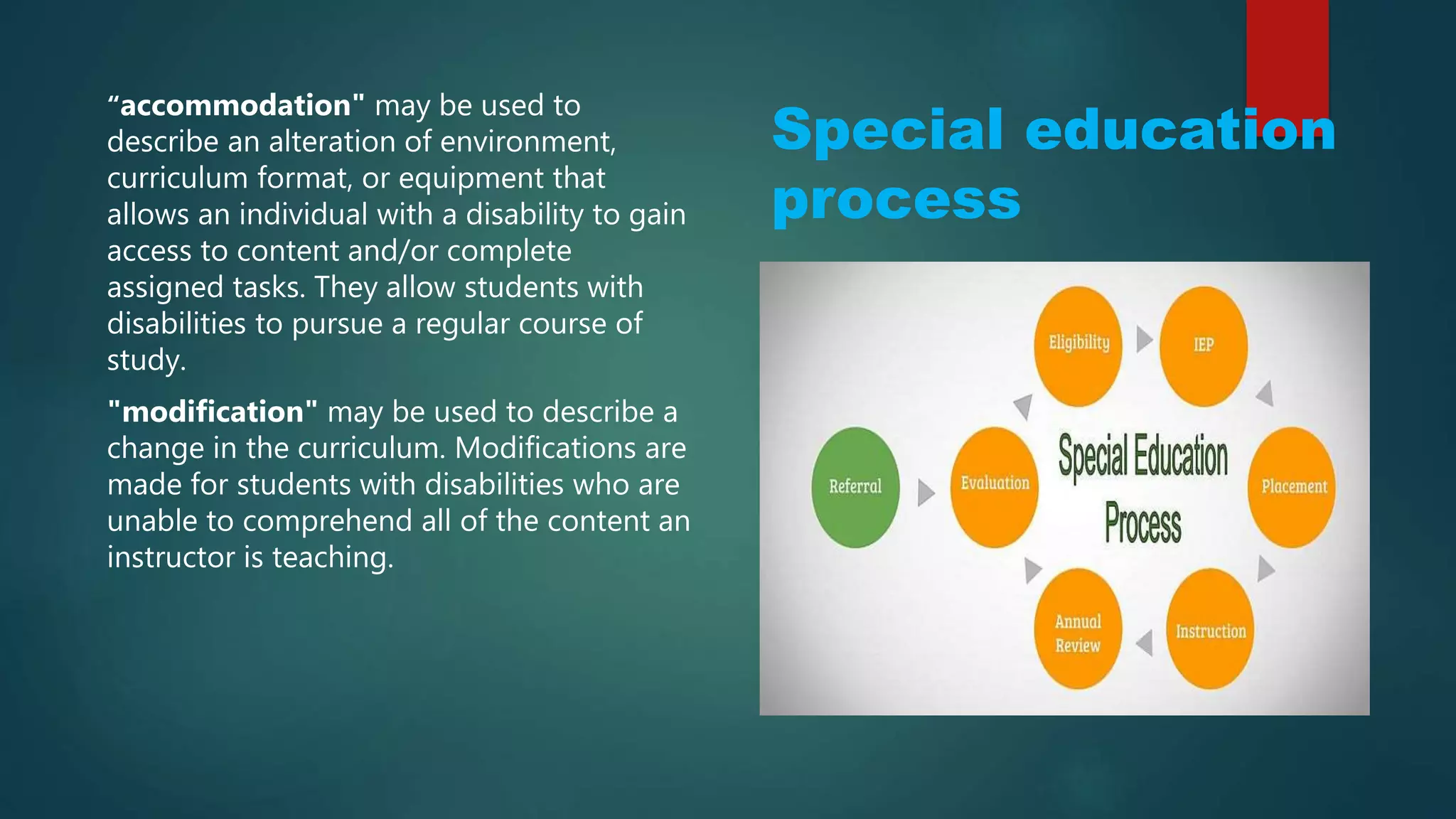
Special education
process
“accommodation" may be used to
describe an alteration of environment,
curriculum format, or equipment that
allows an individual with a disability to gain
access to content and/or complete
assigned tasks. They allow students with
disabilities to pursue a regular course of
study.
"modification" may be used to describe a
change in the curriculum. Modifications are
made for students with disabilities who are
unable to comprehend all of the content an
instructor is teaching.
Four Approaches
 Inclusion - is an approach to educating students with special educational needs.
 Mainstreaming - refers to the practice of educating students with special needs in classes
with non-disabled students during specific time periods based on their skills
 Segregation - In this model, students with special needs do not attend classes with non-
disabled students.
 Exclusion - A student who does not receive instruction in any school is excluded from school
Teaching Strategies
 Differentiated instruction is a teaching method for
groups of students.
 individualized instruction focuses on the needs of the
individual student.
 Multisensory instruction is a term schools use to
describe ways of teaching that engage more than
sense at a time
 Instructional scaffolding is a process through which a
teacher adds supports for students in order to
enhance learning and aid in the mastery of tasks.
If the student has difficulty learning by
listening, then try…
Before the lesson:
 Pre-teach difficult vocabulary and
concepts
 State the objective, providing a reason
for listening
 Provide study guides/worksheets
 Provide script of film
 Provide lecture outlines
During the lesson:
 Provide visuals via the board or
overhead
 Use flash cards
 Have the student close his eyes and try
to visualize the information
 Have the student take notes and use
colored markers to highlight
 Teach the use of acronyms to help visualize
lists (Roy G. Biv for the colors of the
spectrum: red, orange, yellow, green, blue,
indigo, violet)
 Give explanations in small, distinct steps
 Provide written as well as oral directions
 Have the student repeat directions
 When giving directions to the class, leave a
pause between each step so student can
carry out the process in his mind
 Shorten the listening time required
 Provide written and manipulative tasks
 Be concise with verbal information: "Jane,
please sit." instead of "Jane, would you
please sit down in your chair."
If the student has difficulty expressing himself
verbally, then try…
 To accept an alternate form of
sharing, such as the following:
Written report
Artistic creation
Exhibit or showcase
Chart, graph, or table
Photo essay
Map
Review of films
Charade or pantomime
Demonstration
Taped report
 Ask questions requiring short answers
 Provide a prompt, such as beginning the
sentence for the student or giving a
picture cue
 Give the rules for class discussion (e.g.,
hand raising)
 Give points for oral contributions and
preparing the student individually
 Teach the student to ask questions in class
 Specifically teach body and language
expression
 Wait for students to respond — don't call
on the first student to raise his hand
 First ask questions at the information level
— giving facts and asking for facts back;
then have the student break in gradually
by speaking in smaller groups and then in
larger groups
If the student has difficulty reading written
material, then try…
 Find a text written at lower level
 Provide highlighted material
 Rewrite the student's text
 Tape the student's text
 Allow a peer or parent to read text
to student
 Shorten the amount of required
 Look for same content in another
medium (movie, filmstrip, tape)
 Provide alternative methods for student
to contribute to the group, such as role
playing or dramatizing (oral reading
should be optional)
 Allow extra time for reading
 Omit or shortening the reading
required
 Motivate the student, interesting him
 Provide questions before student reads
a selection (include page and
paragraph numbers)
 Type material for easier reading
 Use larger type
 Be more concrete-using pictures and
manipulatives
 Reduce the amount of new ideas
 Provide experience before and after
reading as a frame of reference for new
concepts
 State the objective and relating it to
previous experiences
 Help the student visualize what is read
If the student has difficulty writing legibly,
then try…
 Use a format requiring little writing
Multiple-choice
Programmed material
True/false
Matching
 Use manipulatives such as letters from a
Scrabble™ game or writing letters on
small ceramic tiles
 Reduce or omit assignments requiring
copying
 Encourage shared note-taking
 Allow the use of a tape recorder, a
typewriter, or a computer
 Teach writing directly
Trace letters or writing in clay
Verbalize strokes on tape recorder
Use a marker to space between words
Tape the alphabet to student's desk
Provide a wallet-size alphabet card
Provide courses in graph analysis or
calligraphy as a motivator
 Use graph paper to help space letters
and numbers in math
 Use manuscript or lined ditto paper as a
motivation technique (brainstorm the
advantages of legibility with the class)
If the student has difficulty expressing
himself in writing, then try…
 Accepting alternate forms of reports:
Oral reports
Tape-recorded report
Tape of an interview
Collage, cartoon, or other art
Maps
Diorama, 3-D materials, showcase
exhibits
Photographic essay
Panel discussion
Mock debate
Review of films and presentation of
appropriate one to the class
 Have the student dictate work to
someone else (an older student, aide,
or friend) and then copy it himself
 Allow more time
 Shorten the written assignment
(preparing an outline or summary)
 Provide a sample of what the finished
paper should look like to help him
organize the parts of the assignment
 Provide practice using:
Story starters
Open-ended stories
Oral responses (try some oral spelling
tests)
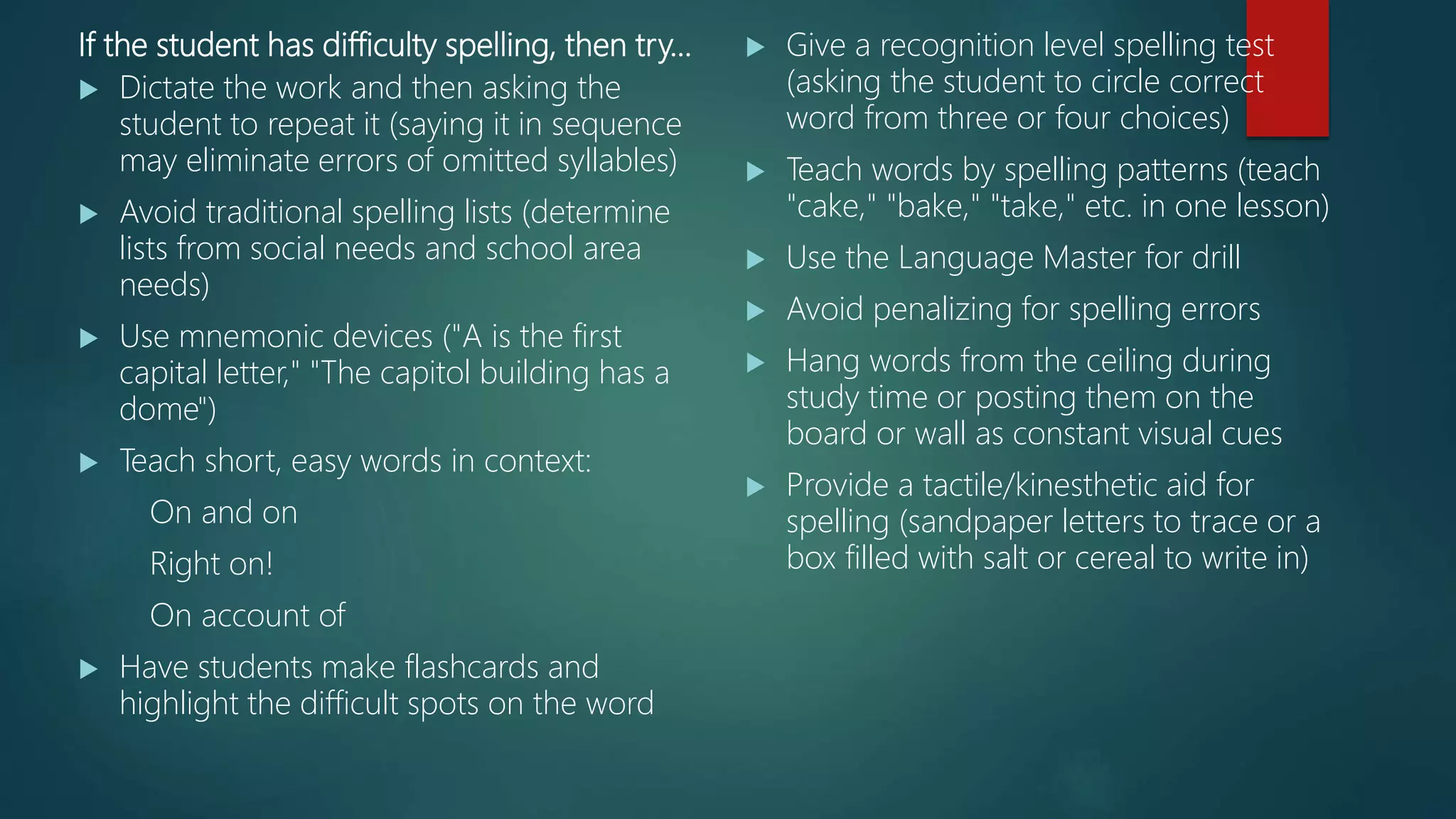
If the student has difficulty spelling, then try…
 Dictate the work and then asking the
student to repeat it (saying it in sequence
may eliminate errors of omitted syllables)
 Avoid traditional spelling lists (determine
lists from social needs and school area
needs)
 Use mnemonic devices ("A is the first
capital letter," "The capitol building has a
dome")
 Teach short, easy words in context:
On and on
Right on!
On account of
 Have students make flashcards and
highlight the difficult spots on the word
 Give a recognition level spelling test
(asking the student to circle correct
word from three or four choices)
 Teach words by spelling patterns (teach
"cake," "bake," "take," etc. in one lesson)
 Use the Language Master for drill
 Avoid penalizing for spelling errors
 Hang words from the ceiling during
study time or posting them on the
board or wall as constant visual cues
 Provide a tactile/kinesthetic aid for
spelling (sandpaper letters to trace or a
box filled with salt or cereal to write in)
Presented by: Ella Rose F. De Guzman RN
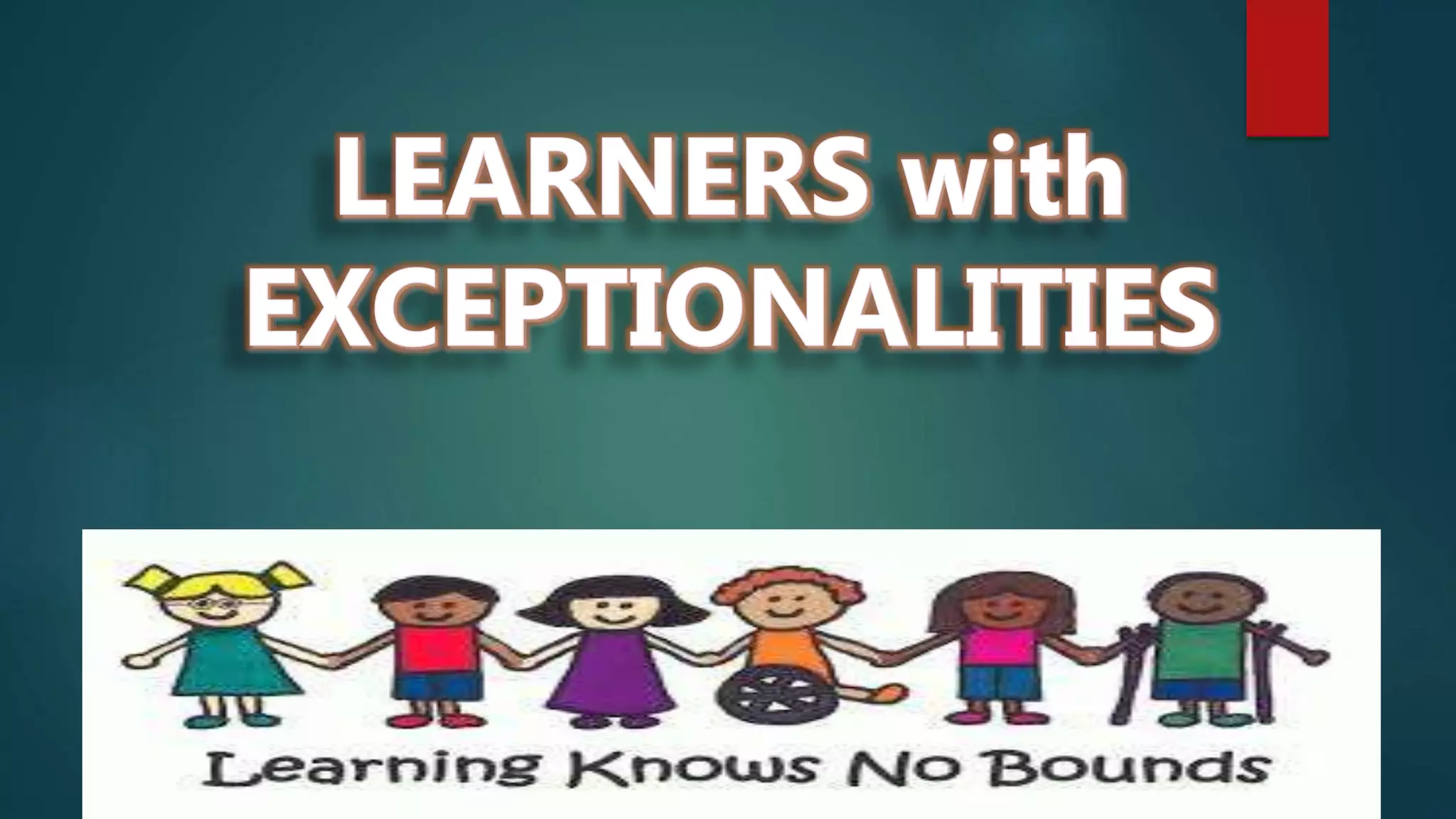
Learners with exceptionalities

Learners with exceptionalities

  • 1.
    OBJECTIVES In the endof chapter, students will be able to 1. Identify the 12 Learners with Exceptionalities 2. Define the individuals with disabilities education act and individualize education program 3. Understand about how to teach students with special needs
  • 3.
    Exceptional children and youth Are all those who receive special education services in the school. Special Education  Is the set of services designed to meet the unique needs of Exceptional Students Learning with Disabilities  Is a general term for a diverse group of disorders characterized by significant difficulties in the acquisition and use of listening, speaking, reading, writing, reasoning, or computing. These disorders stem from the individual and may occur across the life span.
  • 4.
  • 5.
    Learning disabilities  Isa neurological disorder. In simple terms, a learning disability results from a difference in the way a person's brain is "wired." Children with learning disabilities are as smart or smarter than their peers. But they may have difficulty reading, writing, spelling, reasoning, recalling and/or organizing information if left to figure things out by themselves or if taught in conventional ways.
  • 6.
    CLASSIFICATION  Dyslexia –a language-based disability in which a person has trouble understanding written words. It may also be referred to as reading disability or reading disorder.  Dyscalculia – a mathematical disability in which a person has a difficult time solving arithmetic problems and grasping math concepts.  Auditory and Visual Processing Disorders – sensory disabilities in which a person has difficulty understanding language despite normal hearing and vision.  Nonverbal Learning Disabilities – a neurological disorder which originates in the right hemisphere of the brain, causing problems with visual-spatial, intuitive, organizational, evaluative and holistic processing functions.
  • 7.
    CHARACTERISTICS OF LEARNING DISABILITIES READING Difficulties with reading (phrases, sentences, paragraphs, and stories)  Difficulties learning to read by the first grade  Inability to accurately and fluently decode single words  Difficulties understanding structure of words  May have difficulties in visual naming speed (the ability to quickly name items) WRITTEN LANGUAGE  Performs poorly across most writing tasks, especially vocabulary, grammar, punctuation, and spelling  May use minimal planning, effort, and strategies when writing  May have trouble organizing thoughts when speaking, or not be able to think of a word for writing or conversation  May have very messy handwriting or hold a pencil awkwardly  May have a limited vocabulary and struggle with language
  • 8.
    MATHEMATICS  Difficulty withnumber concepts  Difficulties in memorizing number facts and solving word problems  Doesn't make connections, such as 5+3=8 and 3+5=8  Difficulty with time concepts (before, after, tomorrow, last week)  May confuse math symbols and misread numbers  May struggle to extract and important information from word problem SOCIALIZATION  May struggle to accurately interpret non-verbal cues (e.g. gestures, facial expressions)  May have low social status, few positive interactions at school, difficulty making friends, and seem lonely  May not display appropriate verbal and non-verbal cues in conversations  Might misunderstand jokes, puns, idioms, sarcasm, etc.
  • 9.
    Emotional disabilities  Acondition exhibiting one or more of the following characteristics over a long period of time and to a marked degree that adversely affects a child’s educational performance: (A) An inability to learn that cannot be explained by intellectual, sensory, or health factors. (B) An inability to build or maintain satisfactory interpersonal relationships with peers and teachers. (C) Inappropriate types of behavior or feelings under normal circumstances. (D) A general pervasive mood of unhappiness or depression. (E) A tendency to develop physical symptoms or fears associated with personal or school problems.
  • 10.
    CLASSIFICATION OF Emotional Disability Anxiety Disorder  Bipolar Disorder  Conduct Disorder  Eating Disorder  Obsessive Compulsive Disorder  Psychotic Disorder CHARACTERISTICS  Hyperactivity (short attention span, impulsiveness)  Aggression or self-injurious behavior (acting out, fighting)  Withdrawal (not interacting socially with others, excessive fear or anxiety)  Immaturity (inappropriate crying, temper tantrums, poor coping skills)  Learning difficulties (academically performing below grade level).
  • 11.
    PHYSICAL DISABILITIES COMMON TYPES  Isa limitation on a person's physical functioning, mobility, dexterity or stamina. A person can be physically disabled due to two reasons: Congenital/Hereditary – the person has physical disability since birth or the disability developed at a later stage due to genetic problems, problems with muscle cells or injury during birth. Acquired – the person acquired the physical disability through road or industrial accidents, infections such as polio or diseases and disorders such as stroke or cancer.  Brittle Bone Disease  Cerebral Palsy  Muscular Dystrophy  Spina Bifida  Friedreich's Ataxia
  • 12.
    Speech/Language DISABILITIES  A communicationdisorder such as stuttering, impaired articulation, a language impairment, or a voice impairment that adversely affects a child’s educational performance. SPEECH DISORDER VOICE DISORDER ARTICULATION DISORDER FLUENCY DISORDER LANGUAGE DISORDER COMMUNICATION DISORDER RECEPTIV DISORDER EXPRESSIVE DISORDER
  • 13.
    CHARACTERISTICS  Inability toexpress ideas  Inappropriate use of grammar when talking or writing  Inability to follow directions  Difficulties in understanding and/or using words in context, both verbally and nonverbal  Difficulties with the pitch, volume, or quality of the voice  Is echolalic  Sounds nasal and voice may have a "whining" quality CLASSIFICATION Speech Disorders  Apraxia  Dysarthria  Orofacial Myofunctional Disorders Language Disorders  Aphasia  Preschool Language Disorders  Language-Based Learning Disabilities (Reading, Spelling, and Writing)  Selective Mutism
  • 14.
    SEVERE/MULTIPLE DISABILITIES CHARACTERISTICS  Refersto “concomitant [simultaneous] impairments (such as intellectual disability-blindness, intellectual disability-orthopedic impairment, etc.), the combination of which causes such severe educational needs that they cannot be accommodated in a special education program solely for one of the impairments. The term does not include deaf-blindness.”  Problems transferring learning from one situation to another, one setting to another and one skill to another  Limited communication skill  Difficulties with memory  Need for service from many different related service providers
  • 15.
    Visual Impairment TYPES OFVISUAL IMPAIRMENT  describes a wide variety of conditions that affect vision abilities. We use the term to denote mild to most severe vision loss, rather than to defects in the eye itself. According to the Individuals with Disabilities Education Act (IDEA) of 1997, a visual impairment refers to “an impairment in vision that, even with correction, adversely affects a child’s educational performance. The term includes both partial sight and blindness.”  Strabismus  Congenital cataracts  Retinopathy of prematurity  Retinitis pigmentosa  Optic nerve hypoplasia,  Cortical visual impairment (CVI)
  • 16.
    CHARACTERISTICS  has littlereason to explore interesting objects in the environment and, thus, may miss opportunities to have experiences and to learn.  lack of exploration  unable to imitate social behavior or understand nonverbal cues COMMON SIGNS  Eyes that don’t move together when following an object or a face  Crossed eyes, eyes that turn out or in, eyes that flutter from side to side or up and down, or eyes that do not seem to focus  Pupils that are unequal in size or that appear white instead of black  Frequent squinting, blinking, eye-rubbing, or face crunching, especially when there’s no bright light present  Sitting too close to the TV or holding toys and books too close to the face  Avoiding tasks and activities that require good vision
  • 17.
    HEARING LOSS TYPES OFHEARING LOSS  The official definition of a hearing impairment by the Individuals with Disabilities Education Act (IDEA) is “an impairment in hearing, whether permanent or fluctuating, that adversely affects a child’s educational performance but is not included under the definition of ‘deafness.'”  Conductive hearing loss - when hearing loss is due to problems with the ear canal, ear drum, or middle ear and its little bones (the malleus, incus, and stapes).  Sensorineural hearing loss (SNHL) - when hearing loss is due to problems of the inner ear, also known as nerve-related hearing loss.  Mixed hearing loss - refers to a combination of conductive and sensorineural hearing loss. This means that there may be damage in the outer or middle ear and in the inner ear (cochlea) or auditory nerve.
  • 18.
    Gifted and talented TWICE EXCEPTIONAL Are those..."who give evidence of high achievement capability in areas such as intellectual, creative, artistic, or leadership capacity, or in specific academic fields, and who need services or activities not ordinarily provided by the school in order to fully develop those capabilities."  Children are gifted children of above average abilities who have special educational needs - AD/HD, learning disabilities, Asperger Syndrome, etc. Because their giftedness can mask their special needs and their special needs can hide their giftedness, they are often labeled as "lazy" and "unmotivated".
  • 19.
    HOW TO IDENTIFYGIFTED CHILD  Examine the Learning abilities of a child  Evaluate his/her mathematical abilities  Assess communicating skills Some general issues in identification that parents should use when they work with their child’s school:  Ability vs. Achievement  Tests vs. Grades  Standardized Testing  Ability  IQ  Creative and Critical Thinking  Achievement CHARACTERISTICS 1. Gifted students are often perfectionist and idealistic. 2. Gifted students may experience heightened sensitivity to their own expectations and those of others. 3. Gifted students are asynchronous. 4. Some gifted students are “mappers” (sequential learners), while others are “leapers” (spatial learners). 5. Gifted students may be so far ahead of their chronological age mates that they know half the curriculum before the school year begins! 6. Gifted children are problem solvers. 7. Gifted students often think abstractly and with such complexity that they may need help with concrete study and test-taking skills. 8. Gifted students who do well in school may define success as getting an “A” and failure as any grade less than an “A”.
  • 21.
    STRENGHT Acquires/retains information quickly POSSIBLE PROBLEM Enjoysproblem-solving; able to conceptualize, abstract, synthesize Seeks to organize things and people Intense concentration; long attention span and persistence in areas of interest. Impatient with others; dislikes basic routine Resists routine practice; questions teaching procedures. Bossy Neglects duties or people during periods of focus; resists interruption; stubbornness
  • 22.
    Intellectual disability (MR) Defined by the Individuals with Disabilities Education Act (IDEA) as “significantly sub- average general intellectual functioning, existing concurrently [at the same time] with deficits in adaptive behavior and manifested during the developmental period, that adversely affects a child’s educational performance.”
  • 23.
    Mental retardation variesin severity. The Diagnostic and Statistical Manual of Mental Disorders , fourth edition, text revision ( DSM-IV-TR ), which is the diagnostic standard for mental health care professionals in the United States, classifies four different degrees of mental retardation: mild, moderate, severe , and profound . These categories are based on the person's level of functioning.  Mild mr - Their IQ score ranges from 50–70, and they can often acquire academic skills up to about the sixth-grade level. They can become fairly self-sufficient and in some cases live independently, with community and social support.  Moderate mr - Moderately retarded persons have IQ scores ranging from 35–55. They can carry out work and self-care tasks with moderate supervision. They typically acquire communication skills in childhood and are able to live and function successfully within the community in such supervised environments as group homes .  Severe mr - About 3–4% of the mentally retarded population is severely retarded. Severely retarded persons have IQ scores of 20–40. They may master very basic self-care skills and some communication skills. Many severely retarded individuals are able to live in a group home.  Profound mr - Only 1–2% of the mentally retarded population is classified as profoundly retarded. Profoundly retarded individuals have IQ scores under 20–25. They may be able to develop basic self-care and communication skills with appropriate support and training.
  • 24.
    What is DSM? is used by clinicians and psychiatrists to diagnose psychiatric illnesses. In 2013, a new version known as the DSM-5 was released. The DSM is published by the American Psychiatric Association and covers all categories of mental health disorders for both adults and children. The DSM is utilized widely in the United States for psychiatric diagnosis, treatment recommendations and insurance coverage purposes. Mental health providers used the manual to better understand a client's potential needs as well as a tool for assessment and diagnosis.
  • 25.
    Learning Characteristics ofa Person with Mental Retardation 1. Slow rate of learning - Person has the ability to learn, but takes longer to do so 2. Thinks in a concrete way - Has difficulty with abstract thinking 3. Difficulties generalizing - Cannot take knowledge learned in one situation and apply it to another 4. Needs to be taught how to make choices - Has difficulty weighing pros and cons, and applying past experiences to present decision-making 5. Challenges in setting goals and problem solving - Needs help to figure out problems and determine steps required to reach goals. Tasks that many people learn without instruction may need to be structured or broken down into small steps.
  • 26.
    6. Memory problems- Has difficulty remembering how to complete tasks that take several steps, or that are not routine; training needs to include lots of opportunities for practice and repetition. 7. Short attention span - Has trouble sticking with an activity or focusing attention for long periods of time 8. Expressive language - Has difficulty conveying ideas and feelings to other people; explaining that he/she doesn’t understand something; and asking questions
  • 27.
    Attention Deficit Hyperactivity Disorder(ADHD)  is a mental disorder of the neurodevelopmental type. It is characterized by problems paying attention, excessive activity, or difficulty controlling behavior which is not appropriate for a person's age.[3] These symptoms begin by age six to twelve, are present for more than six months, and cause problems in at least two settings (such as school, home, or recreational activities).
  • 28.
    characteristics The three primary characteristics Inattention  Hyperactivity  impulsivity.  Difficulty getting organized  A tendency to be easily bored  Often creative, intuitive, highly intelligent  Impatient; low tolerance for frustration  Impulsive, either verbally or in action, as in impulsive spending of money, changing plans, enacting new schemes or career plans, and the like  Depression, especially when disengaged from a project  Restlessness  Chronic problems with self-esteem  Inaccurate self-observation
  • 29.
    Autism  A developmentaldisability significantly affecting verbal and nonverbal communication and social interaction, generally present before age three that adversely affects a child’s educational performance.  Other characteristics often associated with autism are engaging in repetitive activities and stereotyped movements, resistance to environmental change or change in daily routines, and unusual responses to sensory experiences.  The term autism does not apply if the child’s educational performance is adversely affected primarily because the child has an emotional disturbance  A child who shows the characteristics of autism after age 3 could be diagnosed as having autism if the criteria above are satisfied.
  • 30.
    characteristics  Language maybe slow to develop  Echolalia  Speech may be delayed, or there may be no speech at all  May be no effort to use nonverbal communication (pointing and gesturing)  Might not be able to express wants and needs  May not follow directions  Difficulties sharing emotions, understanding how others think and feel, and holding a conversation  Eye contact may not be as frequent or last as long as in other children  Difficulty in making and maintaining friendships  May seem to prefer to play alone  May play in repetitive way  May have movements that result in self- injury, such as scratching eyes, skin picking, biting hands, and head banging  May display tantrums that are atypical in terms of frequency, intensity, and / or duration
  • 31.
    Traumatic brain injury The Individuals with Disabilities Education Act (IDEA) outlines the conditions that fall within this classification, formally defining TBI as “an acquired injury to the brain caused by an external physical force, resulting in total or partial functional disability or psychosocial impairment, or both, that adversely affects a child’s educational performance.”
  • 32.
  • 33.
    Other health impairments An umbrella term, “other health impairment” (OHI) encompasses a range of conditions. The Individuals with Disabilities Education Act (IDEA) names several such disorders in OHI’s official definition: “having limited strength, vitality, or alertness, including a heightened alertness to environmental stimuli, that results in limited alertness with respect to the educational environment, that— (a) is due to chronic or acute health problems such as asthma, attention deficit disorder or attention deficit hyperactivity disorder, diabetes, epilepsy, a heart condition, hemophilia, lead poisoning, leukemia, nephritis [a kidney disorder], rheumatic fever, sickle cell anemia, and Tourette syndrome; and (b) adversely affects a child’s educational performance.”
  • 34.
    characteristics  Unexplained tiredness Unusual moodiness  Agitation  pale  Weakness  Breathing problem  seizure classification  Asthma  Epilepsy  Diabetes  Sickle cell anemia  Tourette syndrome
  • 35.
    What is IDEA?purpose  The Individuals with Disabilities Education Act (IDEA) is a federal law that requires schools to serve the educational needs of eligible students with disabilities.  Schools must evaluate students suspected of having disabilities, including learning disabilities.  Not every child with learning and attention issues qualifies for special education services under IDEA.  To protect the rights of children with disabilities. IDEA ensures students with disabilities have access to a free and appropriate public education (FAPE), just like all other children. Schools are required to provide special education in the least restrictive environment. That means schools must teach students with disabilities in general education classroom whenever possible.  To give parents a voice in their child’s education. Under IDEA, you have a say in the educational decisions the school makes about your child. At every point of the process, the law gives you specific rights and protections. These are called procedural safeguards.
  • 36.
    What is IndividualEducation Program?  A federal law called the Individuals with Disabilities Education Act (IDEA) requires that public schools create an IEP for every child receiving special education services. Kids from age 3 through high school graduation or a maximum age of 22 (whichever comes first) may be eligible for an IEP.  The IEP is meant to address each child’s unique learning issues and include specific educational goals. It is a legally binding document. The school must provide everything it promises in the IEP. Here’s a quick look at what an IEP must include, by law:  A statement of your child’s present level of performance (PLOP)—this is how your child is doing in school now
  • 37.
     Your child’sannual educational goals  Special education supports and services that the school will provide to help your child reach goals  Modifications and accommodations the school will provide to help your child make progress  Accommodations your child will be allowed when taking standardized tests  How and when the school will measure your child’s progress toward annual goals  Transition planning that prepares teens for life after high school 504 plan: A plan that lists the accommodations a school will provide, such as audiobooks, note-taking aids or extended time to complete tests, so that a student with a disability has equal access to the general education curriculum.
  • 38.
    Special education process “accommodation" maybe used to describe an alteration of environment, curriculum format, or equipment that allows an individual with a disability to gain access to content and/or complete assigned tasks. They allow students with disabilities to pursue a regular course of study. "modification" may be used to describe a change in the curriculum. Modifications are made for students with disabilities who are unable to comprehend all of the content an instructor is teaching.
  • 39.
    Four Approaches  Inclusion- is an approach to educating students with special educational needs.  Mainstreaming - refers to the practice of educating students with special needs in classes with non-disabled students during specific time periods based on their skills  Segregation - In this model, students with special needs do not attend classes with non- disabled students.  Exclusion - A student who does not receive instruction in any school is excluded from school
  • 40.
    Teaching Strategies  Differentiatedinstruction is a teaching method for groups of students.  individualized instruction focuses on the needs of the individual student.  Multisensory instruction is a term schools use to describe ways of teaching that engage more than sense at a time  Instructional scaffolding is a process through which a teacher adds supports for students in order to enhance learning and aid in the mastery of tasks.
  • 41.
    If the studenthas difficulty learning by listening, then try… Before the lesson:  Pre-teach difficult vocabulary and concepts  State the objective, providing a reason for listening  Provide study guides/worksheets  Provide script of film  Provide lecture outlines During the lesson:  Provide visuals via the board or overhead  Use flash cards  Have the student close his eyes and try to visualize the information  Have the student take notes and use colored markers to highlight  Teach the use of acronyms to help visualize lists (Roy G. Biv for the colors of the spectrum: red, orange, yellow, green, blue, indigo, violet)  Give explanations in small, distinct steps  Provide written as well as oral directions  Have the student repeat directions  When giving directions to the class, leave a pause between each step so student can carry out the process in his mind  Shorten the listening time required  Provide written and manipulative tasks  Be concise with verbal information: "Jane, please sit." instead of "Jane, would you please sit down in your chair."
  • 42.
    If the studenthas difficulty expressing himself verbally, then try…  To accept an alternate form of sharing, such as the following: Written report Artistic creation Exhibit or showcase Chart, graph, or table Photo essay Map Review of films Charade or pantomime Demonstration Taped report  Ask questions requiring short answers  Provide a prompt, such as beginning the sentence for the student or giving a picture cue  Give the rules for class discussion (e.g., hand raising)  Give points for oral contributions and preparing the student individually  Teach the student to ask questions in class  Specifically teach body and language expression  Wait for students to respond — don't call on the first student to raise his hand  First ask questions at the information level — giving facts and asking for facts back; then have the student break in gradually by speaking in smaller groups and then in larger groups
  • 43.
    If the studenthas difficulty reading written material, then try…  Find a text written at lower level  Provide highlighted material  Rewrite the student's text  Tape the student's text  Allow a peer or parent to read text to student  Shorten the amount of required  Look for same content in another medium (movie, filmstrip, tape)  Provide alternative methods for student to contribute to the group, such as role playing or dramatizing (oral reading should be optional)  Allow extra time for reading  Omit or shortening the reading required  Motivate the student, interesting him  Provide questions before student reads a selection (include page and paragraph numbers)  Type material for easier reading  Use larger type  Be more concrete-using pictures and manipulatives  Reduce the amount of new ideas  Provide experience before and after reading as a frame of reference for new concepts  State the objective and relating it to previous experiences  Help the student visualize what is read
  • 44.
    If the studenthas difficulty writing legibly, then try…  Use a format requiring little writing Multiple-choice Programmed material True/false Matching  Use manipulatives such as letters from a Scrabble™ game or writing letters on small ceramic tiles  Reduce or omit assignments requiring copying  Encourage shared note-taking  Allow the use of a tape recorder, a typewriter, or a computer  Teach writing directly Trace letters or writing in clay Verbalize strokes on tape recorder Use a marker to space between words Tape the alphabet to student's desk Provide a wallet-size alphabet card Provide courses in graph analysis or calligraphy as a motivator  Use graph paper to help space letters and numbers in math  Use manuscript or lined ditto paper as a motivation technique (brainstorm the advantages of legibility with the class)
  • 45.
    If the studenthas difficulty expressing himself in writing, then try…  Accepting alternate forms of reports: Oral reports Tape-recorded report Tape of an interview Collage, cartoon, or other art Maps Diorama, 3-D materials, showcase exhibits Photographic essay Panel discussion Mock debate Review of films and presentation of appropriate one to the class  Have the student dictate work to someone else (an older student, aide, or friend) and then copy it himself  Allow more time  Shorten the written assignment (preparing an outline or summary)  Provide a sample of what the finished paper should look like to help him organize the parts of the assignment  Provide practice using: Story starters Open-ended stories Oral responses (try some oral spelling tests)
  • 46.
    If the studenthas difficulty spelling, then try…  Dictate the work and then asking the student to repeat it (saying it in sequence may eliminate errors of omitted syllables)  Avoid traditional spelling lists (determine lists from social needs and school area needs)  Use mnemonic devices ("A is the first capital letter," "The capitol building has a dome")  Teach short, easy words in context: On and on Right on! On account of  Have students make flashcards and highlight the difficult spots on the word  Give a recognition level spelling test (asking the student to circle correct word from three or four choices)  Teach words by spelling patterns (teach "cake," "bake," "take," etc. in one lesson)  Use the Language Master for drill  Avoid penalizing for spelling errors  Hang words from the ceiling during study time or posting them on the board or wall as constant visual cues  Provide a tactile/kinesthetic aid for spelling (sandpaper letters to trace or a box filled with salt or cereal to write in)
  • 47.
    Presented by: EllaRose F. De Guzman RN