Antonio Delgado, BSEd II
This type is used with poetry which contains
   lines or verses which are repeated.
Originally, such poems are recited with a
   minstrel saying the verses and the audience
   reciting the refrains and choruses.
The narrative can be recited by a solo voice or
   a smaller group of voices and entire group
   responds by giving the refrain.
Ballads are suitable for this type of
   arrangement.
It is good for beginners.
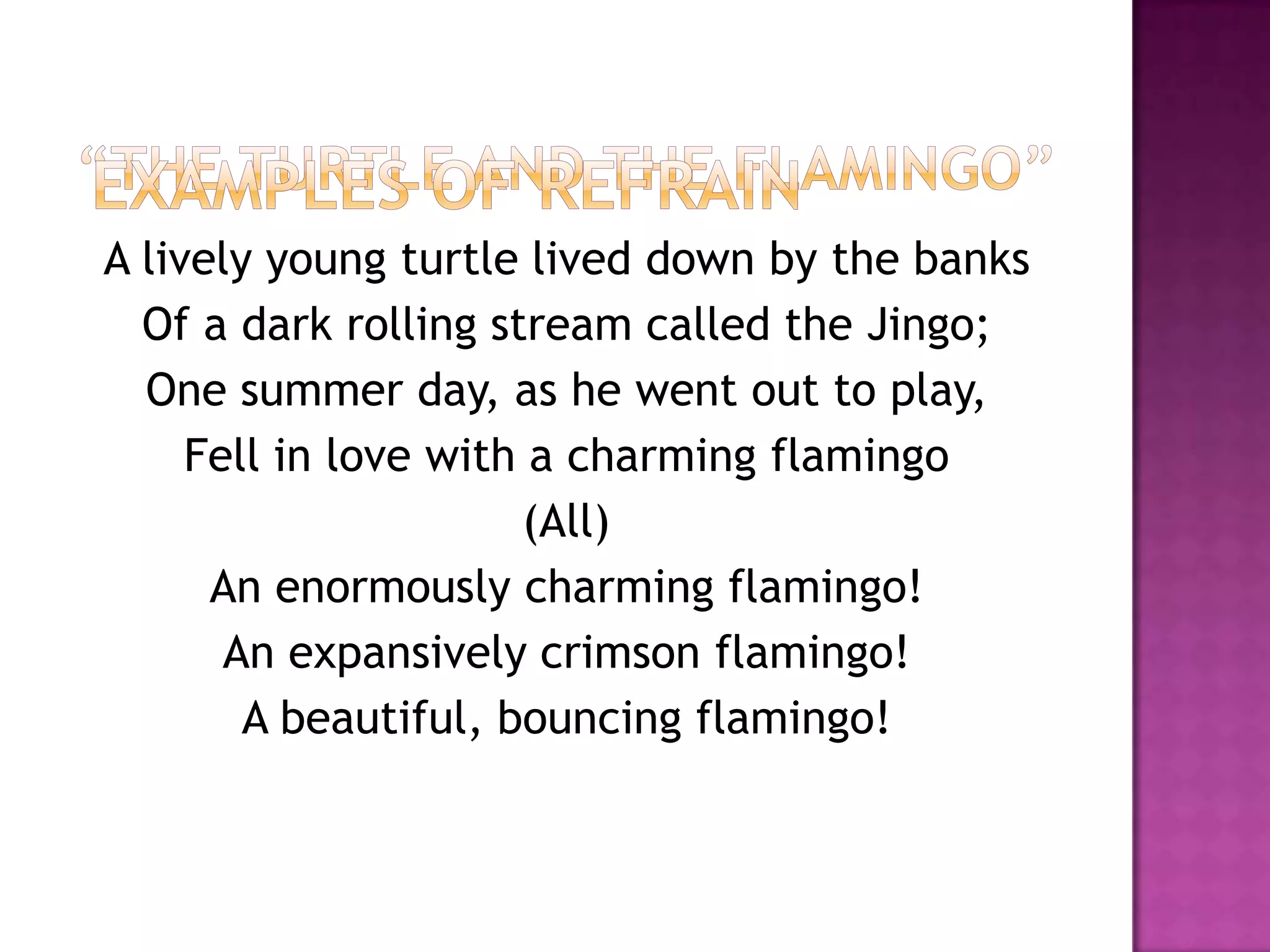
A lively young turtle lived down by the banks
  Of a dark rolling stream called the Jingo;
  One summer day, as he went out to play,
     Fell in love with a charming flamingo
                      (All)
      An enormously charming flamingo!
       An expansively crimson flamingo!
        A beautiful, bouncing flamingo!
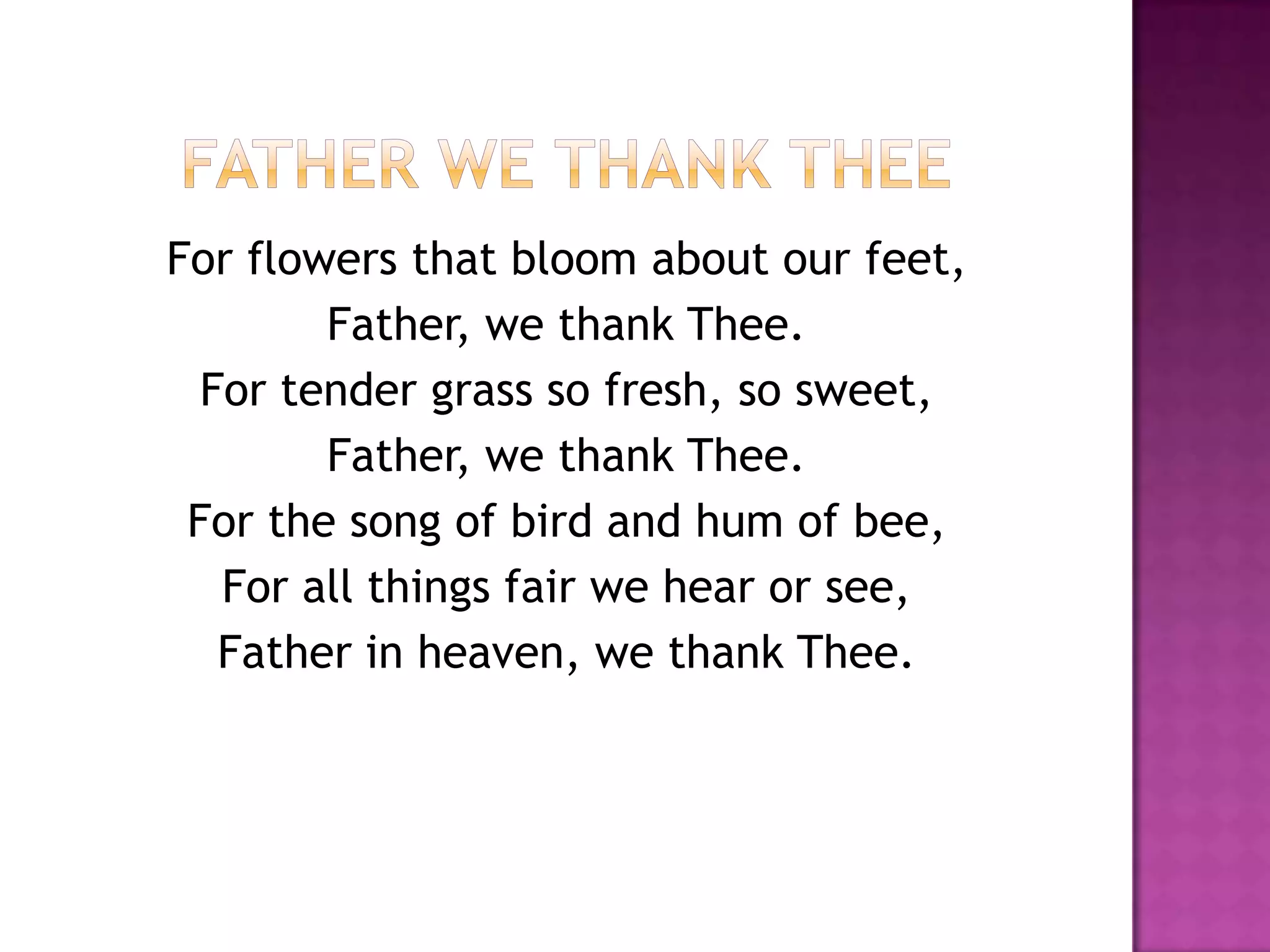
For flowers that bloom about our feet,
        Father, we thank Thee.
  For tender grass so fresh, so sweet,
        Father, we thank Thee.
 For the song of bird and hum of bee,
   For all things fair we hear or see,
   Father in heaven, we thank Thee.
For blue of stream and blue of sky,
         Father, we thank Thee.
  For pleasant shade of branches high,
         Father, we thank Thee.
  For fragrant air and cooling breeze,
   For beauty of the blooming trees,
   Father in heaven, we thank Thee.

   For this new morning with its light,
         Father, we thank Thee.
    For rest and shelter of the night,
          Father, we thank Thee
For health and food, for love and friends,
   For everything Thy goodness sends,
    Father in heaven, we thank Thee.
“ Pitter patter!” falls the rain
On the schoolroom window pane.
Such a splashing! such a dashing!
    Will it e ’er be dry again?
 Down the gutter rolls a flood,
And the crossing ’s deep in mud;
And the puddles! oh, the puddles
 Are a sight to stir one ’s blood!
But let it rain Tree-toads and frogs
Muskets and pitchforks Kittens and dogs!
Dash away! splash away! Who is afraid?
  Here we go, The umbrella brigade!
      Pull the boots up the knee!
       Tie the hoods on merrily!
Such a hustling! such a jostling!
  Out of breath with fun are we,
 Clatter, clatter down the street,
   Greeting everyone we meet,
With our laughing and our chaffing
Which the laughing drops repeat.
   Pitter patter! pitter patter!
   Pitter patter! pitter patter!
This type is best employed in poems which
 develop its thought into a strong climax, or
 which two lines are cumulative in response.
The solo voices and the semi-choruses take
 turns saying the lines and then the entire
 chorus enters to build a climax and an
 impressive finale.
“This is the House that Jack built,”
             a Mother Goose rhyme
“The Creation” by James Weldon Johnson
“Trees” by Joyce Kilmer
“Sounds in the Morning” by Eleanor Farjeon
“Brotherhood” by Edwin Markham
The antiphon is a traditional form of reciting
 Biblical verses; thus many of the Psalms such
 as “The Lord is My Shepherd” and passages
 like “The Beatitudes” are best interpreted by
 using the antiphonal or two-part response.
In this type of arrangement, one group
  responds to another – boys to girls, children
  in one row to another, with light voices to
  another group with dark voices, or children
  with high voices to another group with low
  voices.
This is the most dramatic arrangement because
  it makes use of contrasting voices. It is good
  for poems which have questions and answers.
“The Wind” by Robert Louis Stevenson
“The Little Brook” by Lagrimas del Mundo
“Little Boy Blue,” a Mother Goose rhyme
And one called out to another and said,
“Holy, Holy, Holy is the Lord of hosts, the
 whole earth is full of His Glory.”
And the four living creatures, each one of
 them having six wings, are full of eyes
 around and within; and day and night they do
 not cease to sat, “Holy, Holy, Holy is the Lord
 God, The Almighty, who was and who is and
 who is to come.
“I will tell of Your Name to my brethren; in the
  midst of the assembly will I praise You.”
“I will HALAL You”. “I will sing Halal to Yah!”
- That is, HALLELUYAH!
Poems expressing strong and powerful
  emotions are best interpreted by the whole
  speaking group rather than by part groupings
  or the semi-choruses.
This is the most difficult type since it requires
  the ability to speak together at the same
  time with perfect timing, proper control and
  volume of voice.
“The Mysterious Cat” by Vachel Lindsay
“Sweet and Low” by Alfred Tennyson
“The Owl and the Pussy Cat” by Edward Lear
Each line of a poem is read by a different
  child.
“Solomon Grundy”
Prepared by:
“Live to express, not to impress.”

Types of choral speaking arrangement

  • 1.
  • 2.
    This type isused with poetry which contains lines or verses which are repeated. Originally, such poems are recited with a minstrel saying the verses and the audience reciting the refrains and choruses. The narrative can be recited by a solo voice or a smaller group of voices and entire group responds by giving the refrain. Ballads are suitable for this type of arrangement. It is good for beginners.
  • 3.
    A lively youngturtle lived down by the banks Of a dark rolling stream called the Jingo; One summer day, as he went out to play, Fell in love with a charming flamingo (All) An enormously charming flamingo! An expansively crimson flamingo! A beautiful, bouncing flamingo!
  • 4.
    For flowers thatbloom about our feet, Father, we thank Thee. For tender grass so fresh, so sweet, Father, we thank Thee. For the song of bird and hum of bee, For all things fair we hear or see, Father in heaven, we thank Thee.
  • 5.
    For blue ofstream and blue of sky, Father, we thank Thee. For pleasant shade of branches high, Father, we thank Thee. For fragrant air and cooling breeze, For beauty of the blooming trees, Father in heaven, we thank Thee. For this new morning with its light, Father, we thank Thee. For rest and shelter of the night, Father, we thank Thee For health and food, for love and friends, For everything Thy goodness sends, Father in heaven, we thank Thee.
  • 6.
    “ Pitter patter!”falls the rain On the schoolroom window pane. Such a splashing! such a dashing! Will it e ’er be dry again? Down the gutter rolls a flood, And the crossing ’s deep in mud; And the puddles! oh, the puddles Are a sight to stir one ’s blood!
  • 7.
    But let itrain Tree-toads and frogs Muskets and pitchforks Kittens and dogs! Dash away! splash away! Who is afraid? Here we go, The umbrella brigade! Pull the boots up the knee! Tie the hoods on merrily!
  • 8.
    Such a hustling!such a jostling! Out of breath with fun are we, Clatter, clatter down the street, Greeting everyone we meet, With our laughing and our chaffing Which the laughing drops repeat. Pitter patter! pitter patter! Pitter patter! pitter patter!
  • 9.
    This type isbest employed in poems which develop its thought into a strong climax, or which two lines are cumulative in response. The solo voices and the semi-choruses take turns saying the lines and then the entire chorus enters to build a climax and an impressive finale.
  • 10.
    “This is theHouse that Jack built,” a Mother Goose rhyme “The Creation” by James Weldon Johnson “Trees” by Joyce Kilmer “Sounds in the Morning” by Eleanor Farjeon “Brotherhood” by Edwin Markham
  • 11.
    The antiphon isa traditional form of reciting Biblical verses; thus many of the Psalms such as “The Lord is My Shepherd” and passages like “The Beatitudes” are best interpreted by using the antiphonal or two-part response.
  • 12.
    In this typeof arrangement, one group responds to another – boys to girls, children in one row to another, with light voices to another group with dark voices, or children with high voices to another group with low voices. This is the most dramatic arrangement because it makes use of contrasting voices. It is good for poems which have questions and answers.
  • 13.
    “The Wind” byRobert Louis Stevenson “The Little Brook” by Lagrimas del Mundo “Little Boy Blue,” a Mother Goose rhyme
  • 14.
    And one calledout to another and said, “Holy, Holy, Holy is the Lord of hosts, the whole earth is full of His Glory.”
  • 15.
    And the fourliving creatures, each one of them having six wings, are full of eyes around and within; and day and night they do not cease to sat, “Holy, Holy, Holy is the Lord God, The Almighty, who was and who is and who is to come.
  • 16.
    “I will tellof Your Name to my brethren; in the midst of the assembly will I praise You.” “I will HALAL You”. “I will sing Halal to Yah!” - That is, HALLELUYAH!
  • 17.
    Poems expressing strongand powerful emotions are best interpreted by the whole speaking group rather than by part groupings or the semi-choruses. This is the most difficult type since it requires the ability to speak together at the same time with perfect timing, proper control and volume of voice.
  • 18.
    “The Mysterious Cat”by Vachel Lindsay “Sweet and Low” by Alfred Tennyson “The Owl and the Pussy Cat” by Edward Lear
  • 19.
    Each line ofa poem is read by a different child.
  • 20.
  • 21.
    Prepared by: “Live toexpress, not to impress.”