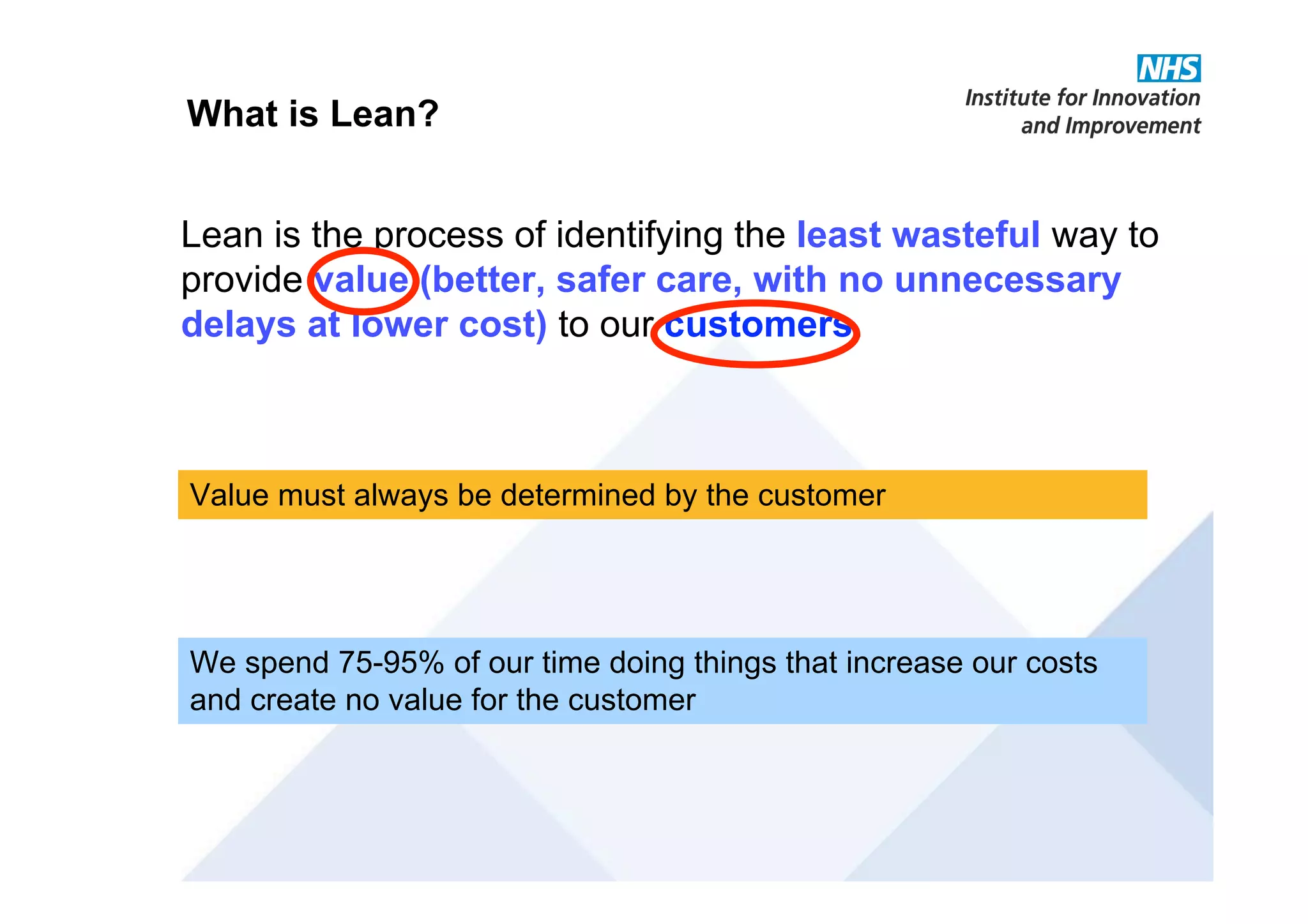
We spend 75-95% of our time doing things that increase our costs
and create no value for the customer
What is Lean?
Lean is the process of identifying the least wasteful way to
provide value (better, safer care, with no unnecessary
delays at lower cost) to our customers.
Value must always be determined by the customer
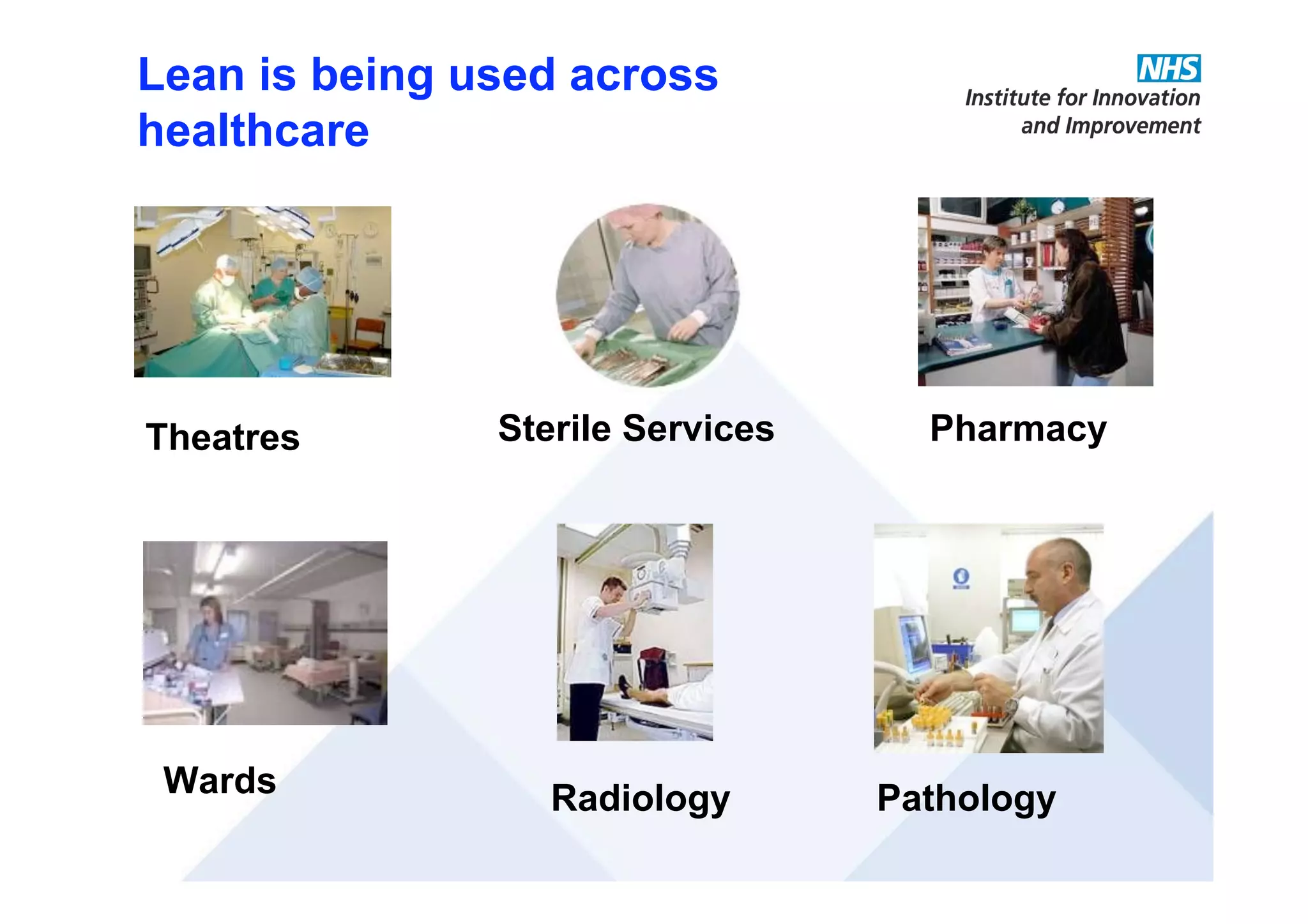
Lean is being used across
healthcare
Pathology
Theatres PharmacySterile Services
RadiologyWards
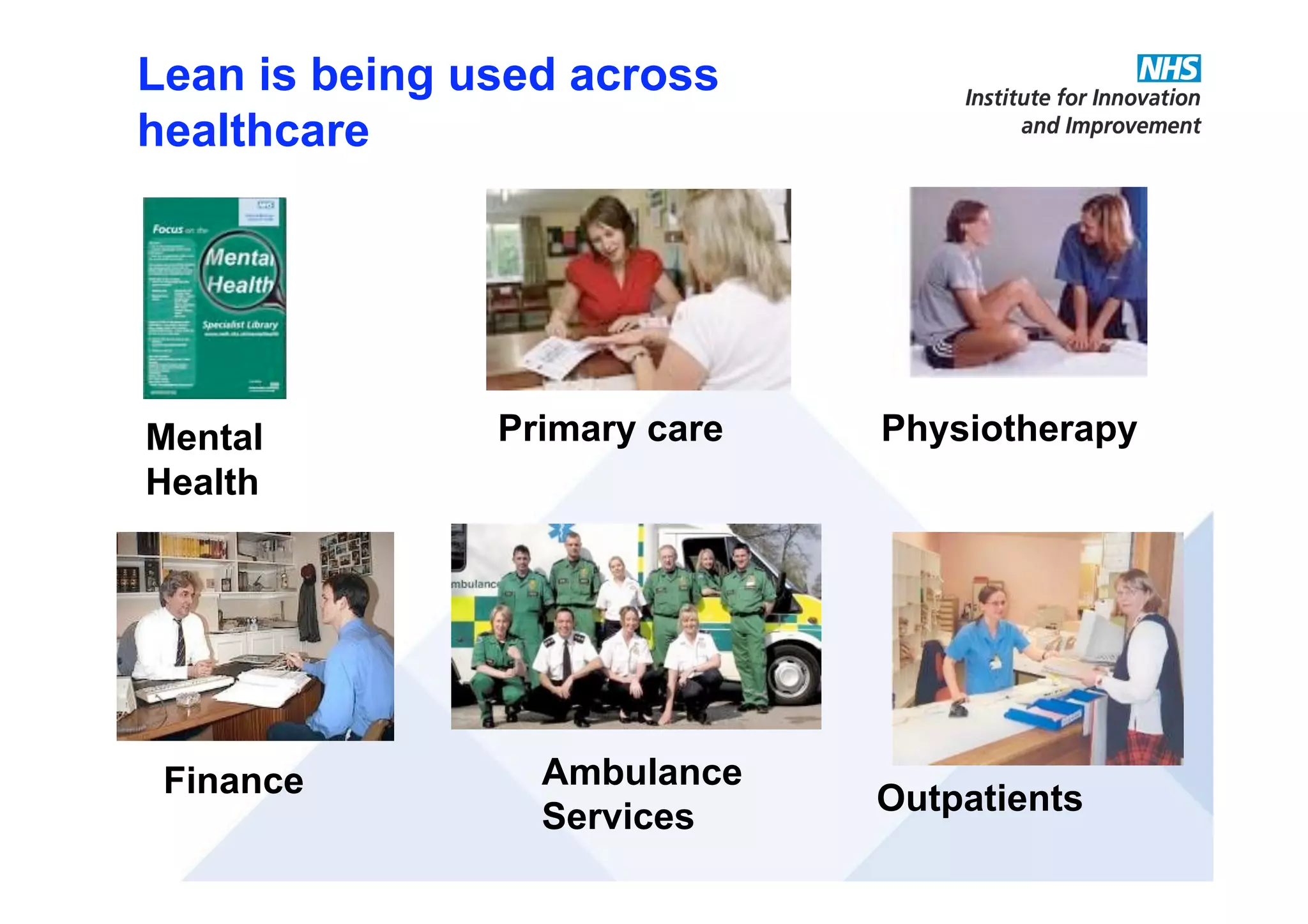
Lean is being used across
healthcare
Outpatients
Mental
Health
PhysiotherapyPrimary care
Ambulance
Services
Finance
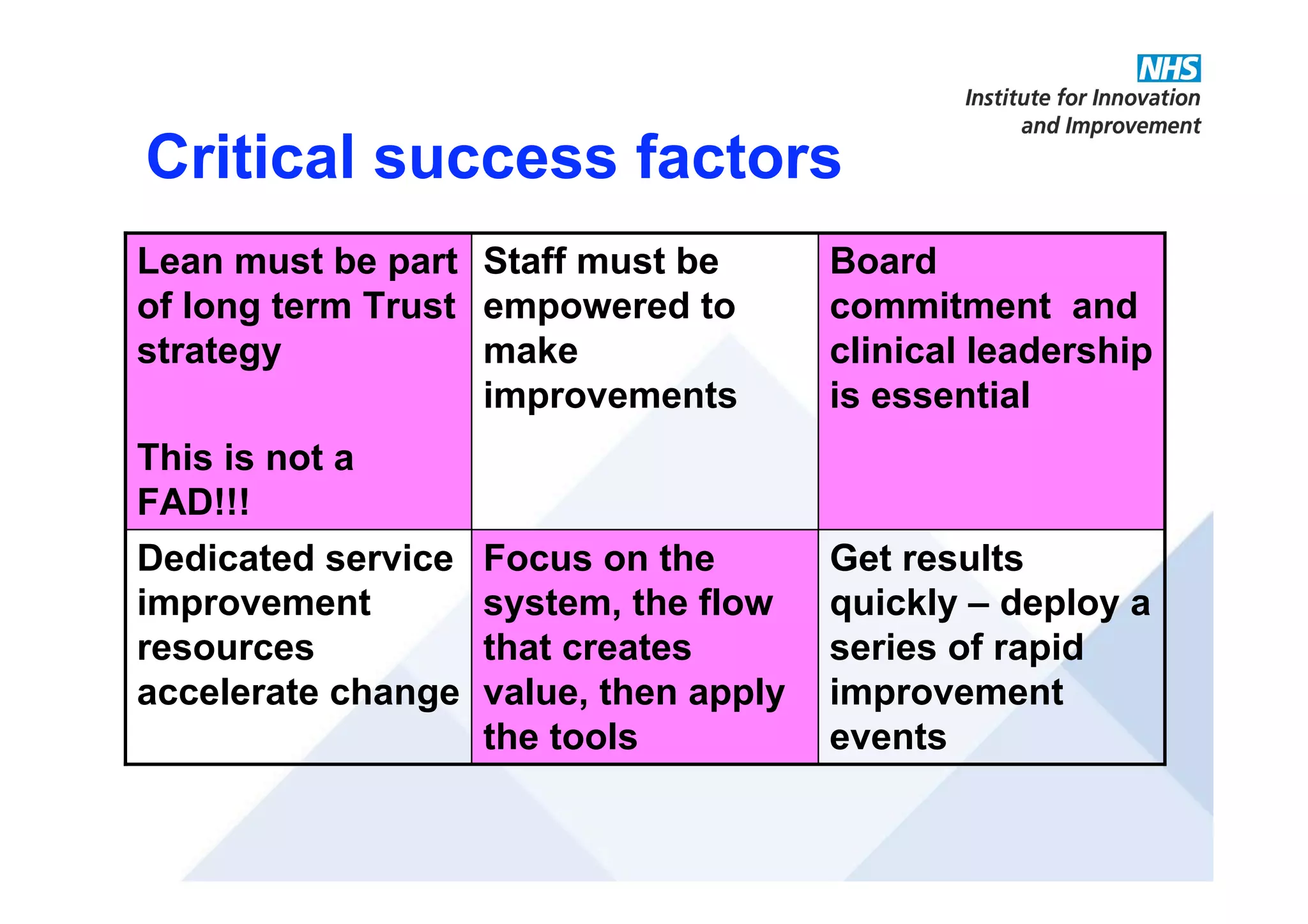
Critical success factors
Get results
quickly – deploy a
series of rapid
improvement
events
Focus on the
system, the flow
that creates
value, then apply
the tools
Dedicated service
improvement
resources
accelerate change
Board
commitment and
clinical leadership
is essential
Staff must be
empowered to
make
improvements
Lean must be part
of long term Trust
strategy
This is not a
FAD!!!
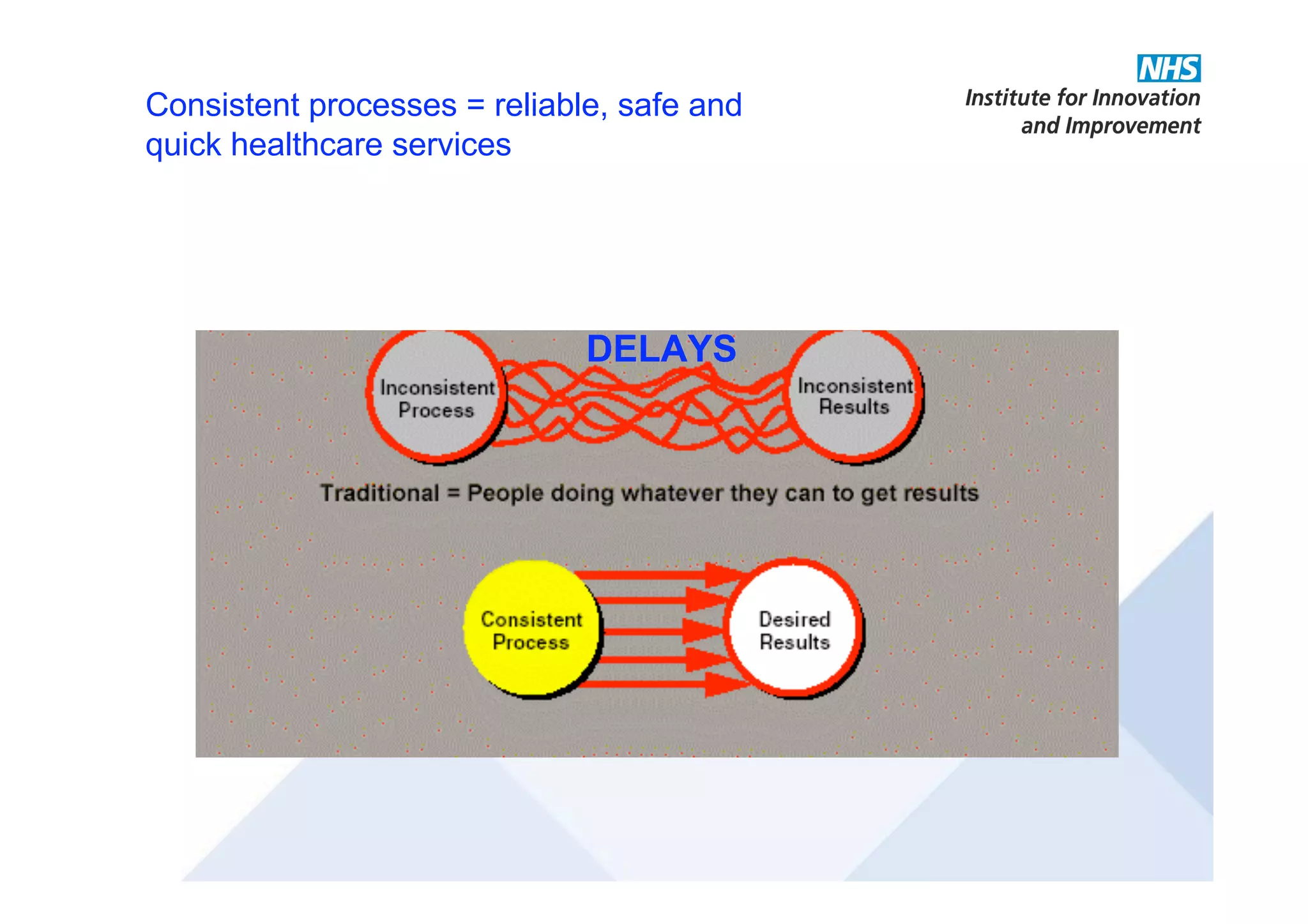
Consistent processes = reliable, safe and
quick healthcare services
DELAYS
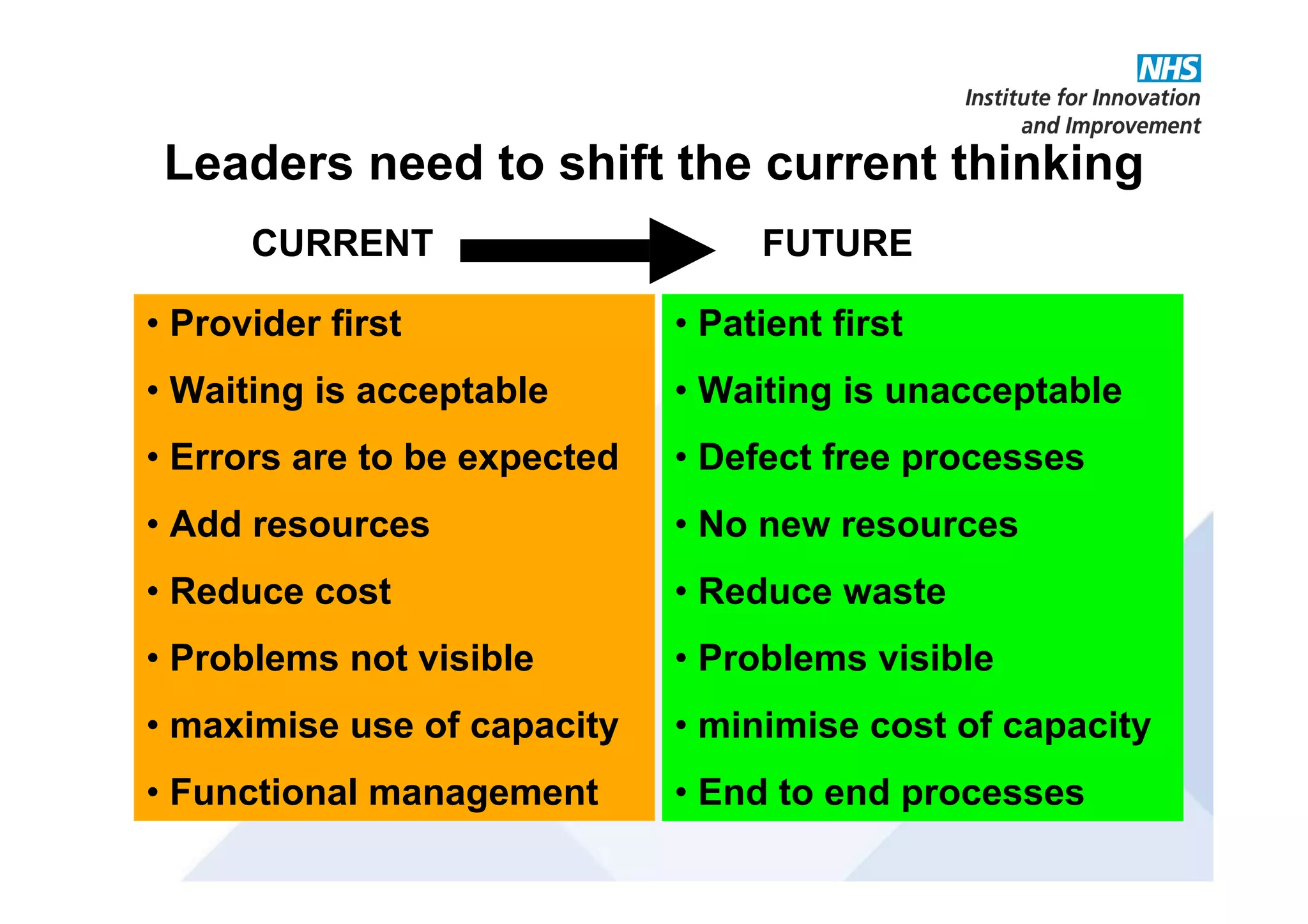
• Provider first
• Waiting is acceptable
• Errors are to be expected
• Add resources
• Reduce cost
• Problems not visible
• maximise use of capacity
• Functional management
• Patient first
• Waiting is unacceptable
• Defect free processes
• No new resources
• Reduce waste
• Problems visible
• minimise cost of capacity
• End to end processes
Leaders need to shift the current thinking
CURRENT FUTURE
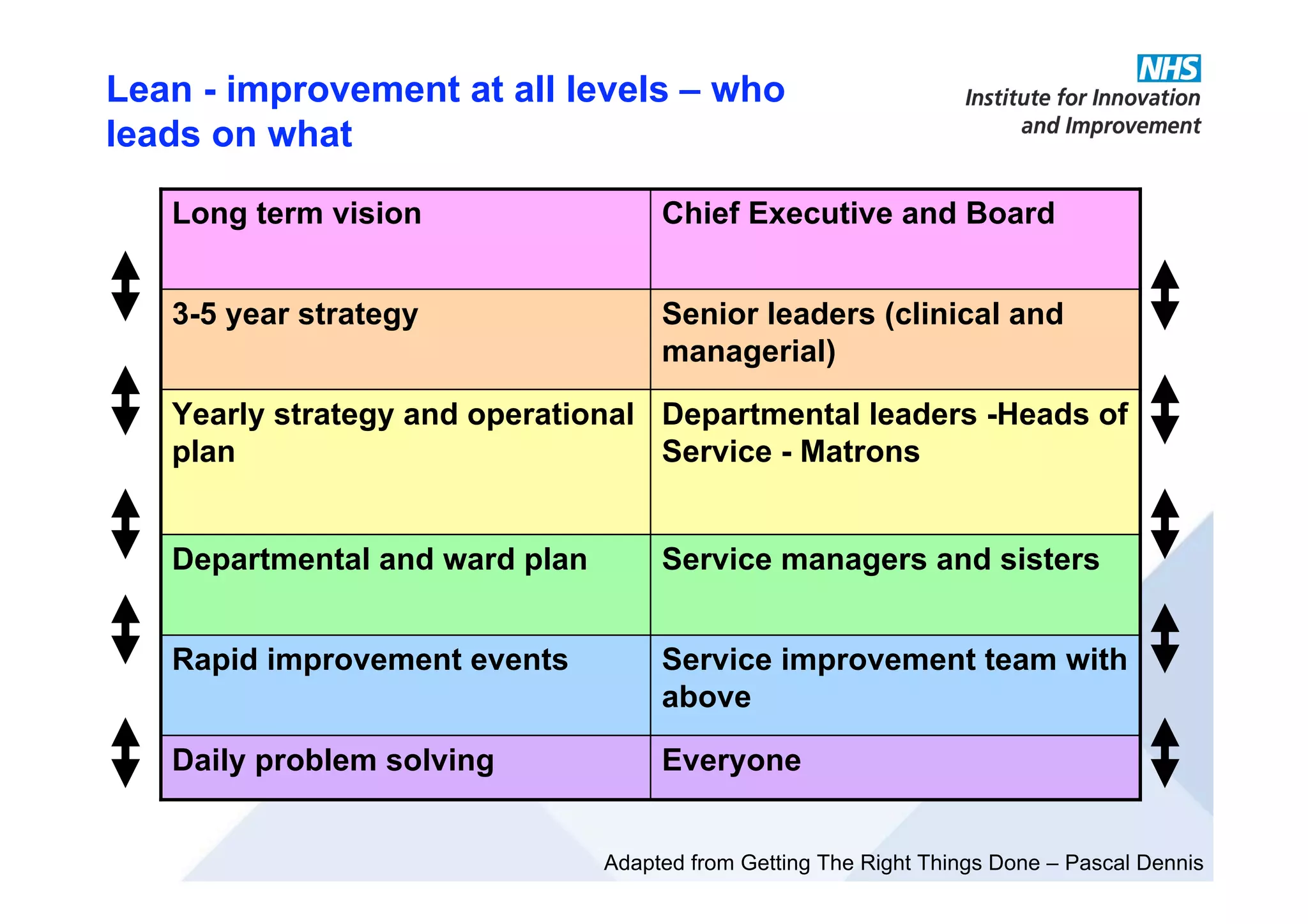
Lean - improvement at all levels – who
leads on what
EveryoneDaily problem solving
Service improvement team with
above
Rapid improvement events
Service managers and sistersDepartmental and ward plan
Departmental leaders -Heads of
Service - Matrons
Yearly strategy and operational
plan
Senior leaders (clinical and
managerial)
3-5 year strategy
Chief Executive and BoardLong term vision
Adapted from Getting The Right Things Done – Pascal Dennis
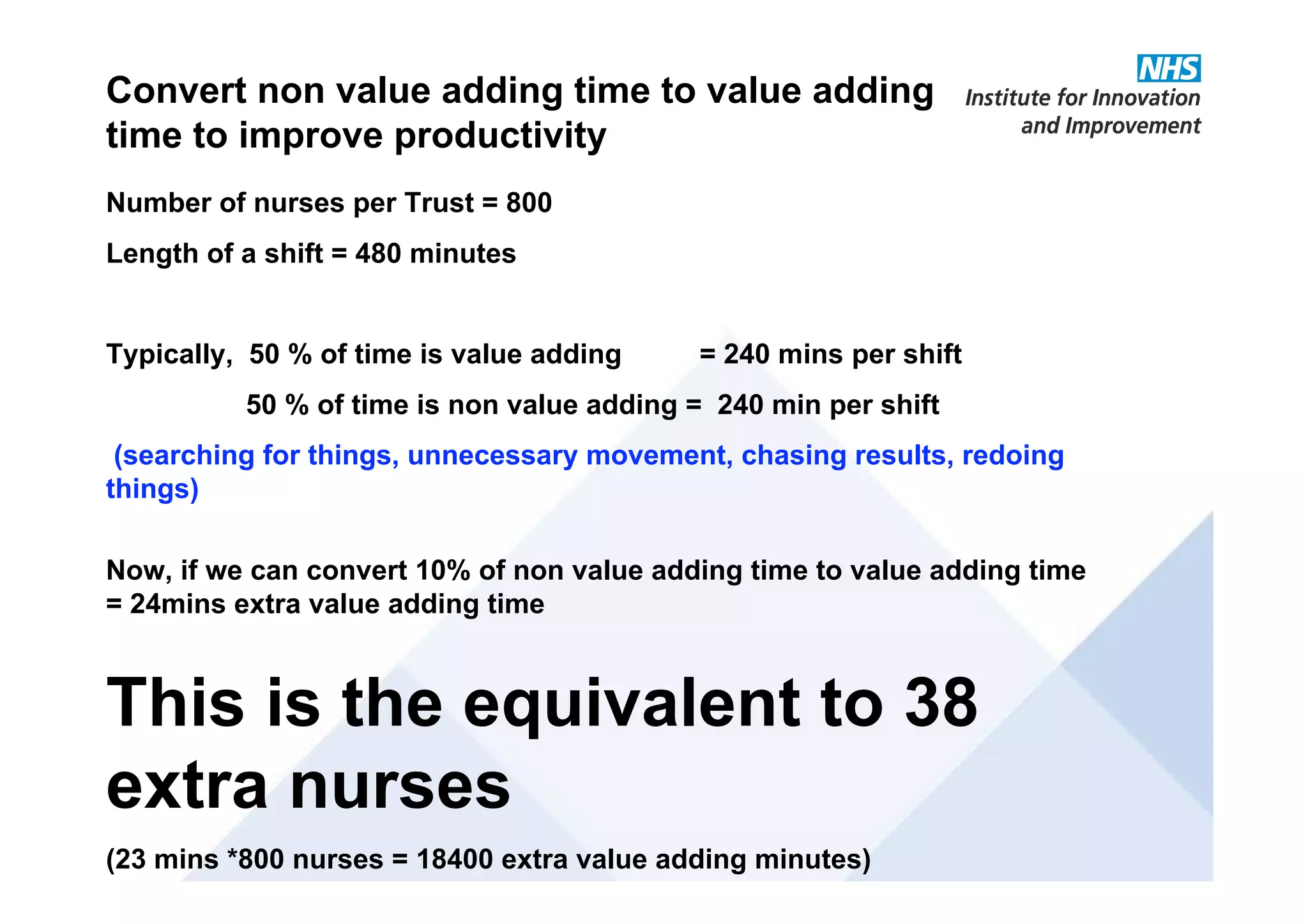
Number of nurses per Trust = 800
Length of a shift = 480 minutes
Typically, 50 % of time is value adding = 240 mins per shift
50 % of time is non value adding = 240 min per shift
(searching for things, unnecessary movement, chasing results, redoing
things)
Now, if we can convert 10% of non value adding time to value adding time
= 24mins extra value adding time
This is the equivalent to 38
extra nurses
(23 mins *800 nurses = 18400 extra value adding minutes)
Convert non value adding time to value adding
time to improve productivity
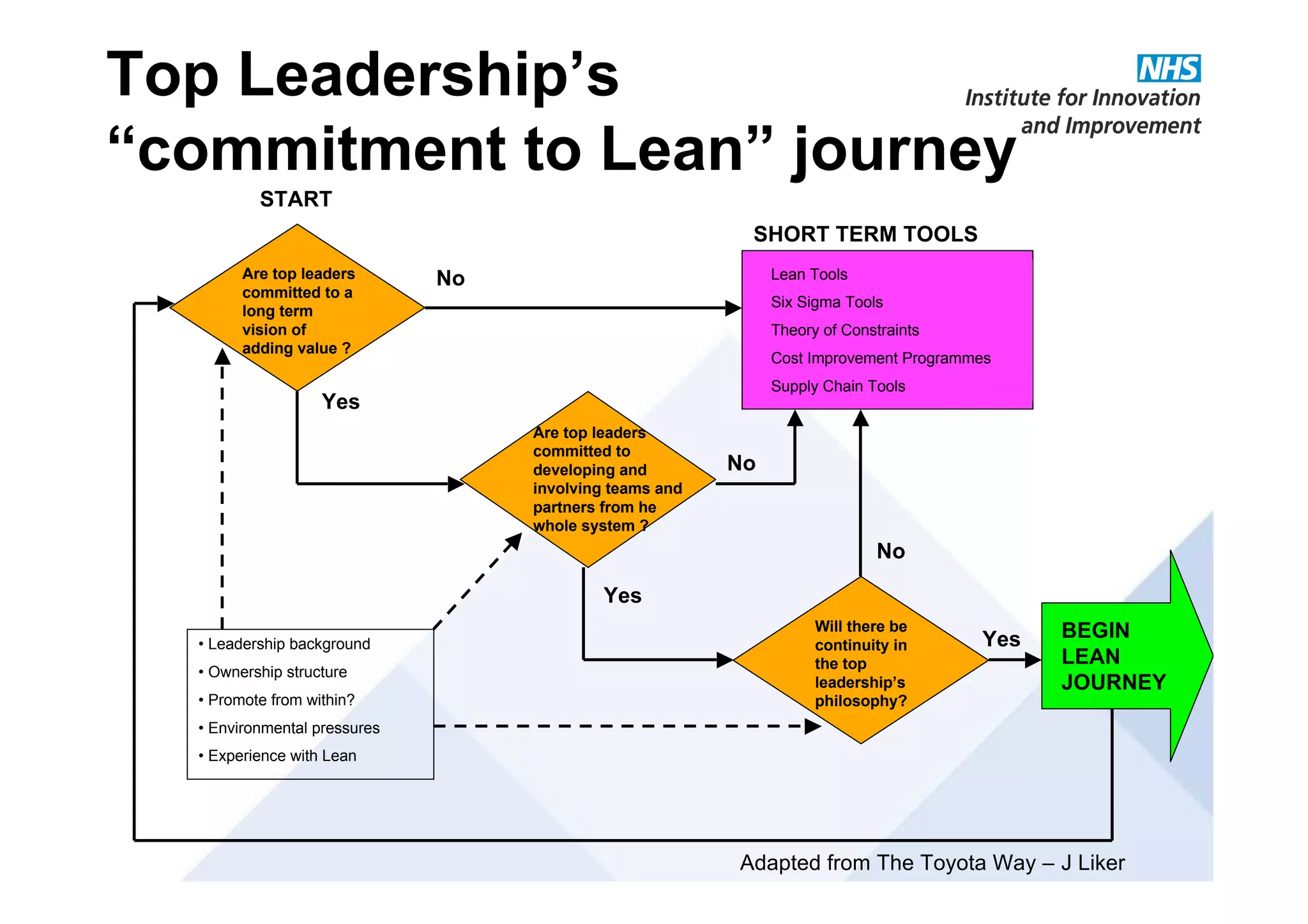
Top Leadership’s
“commitment to Lean” journey
Are top leaders
committed to a
long term
vision of
adding value ?
START
Lean Tools
Six Sigma Tools
Theory of Constraints
Cost Improvement Programmes
Supply Chain Tools
SHORT TERM TOOLS
Are top leaders
committed to
developing and
involving teams and
partners from he
whole system ?
Will there be
continuity in
the top
leadership’s
philosophy?
BEGIN
LEAN
JOURNEY
• Leadership background
• Ownership structure
• Promote from within?
• Environmental pressures
• Experience with Lean
No
No
No
Yes
Yes
Yes
Adapted from The Toyota Way – J Liker
What do Lean Leaders need to
do?
• 10 things to improve safety, improve quality,
eliminate delays and reduce length of stay –
and generate more income (profit) and lower
costs
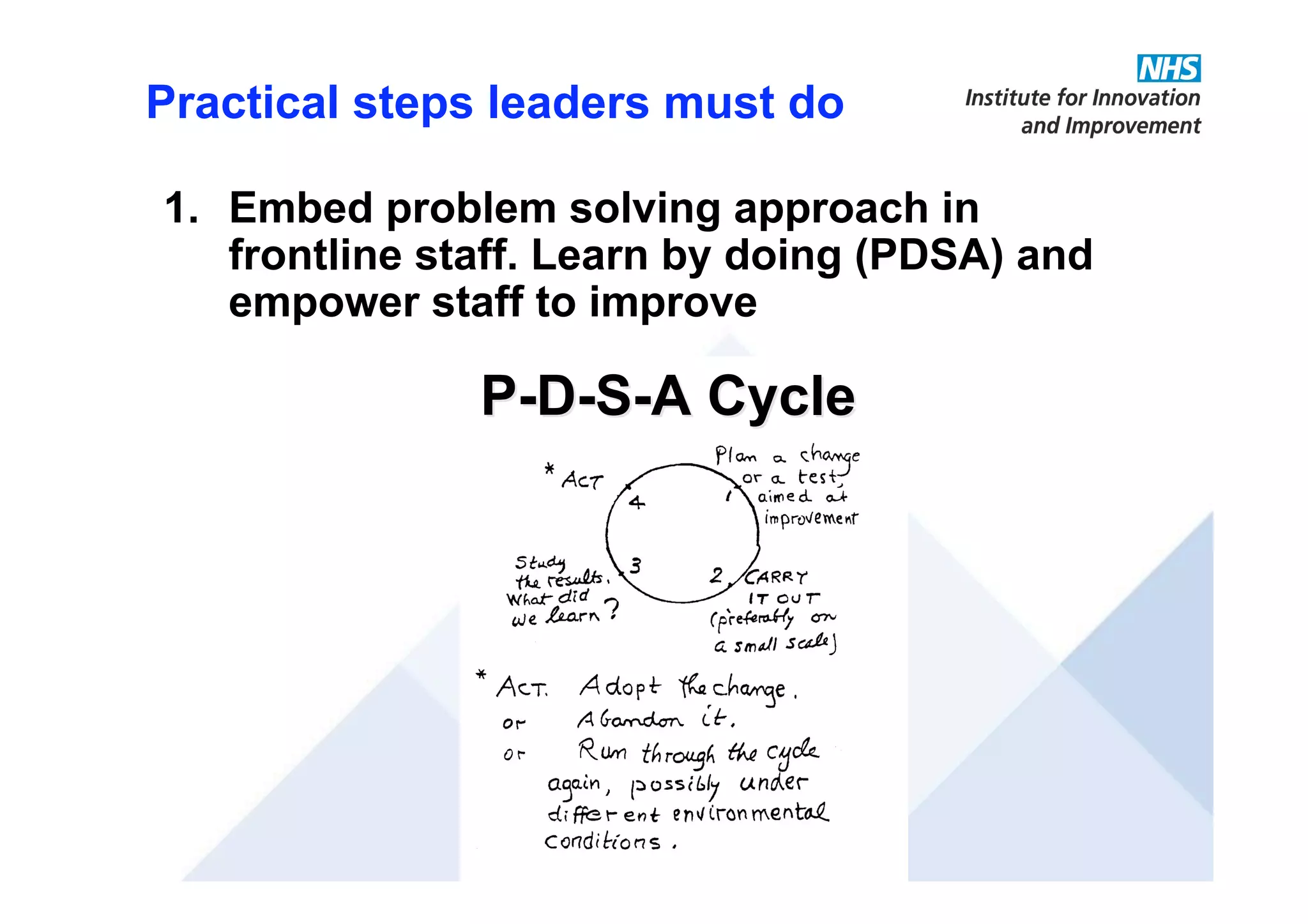
1. Embed problem solving approach in
frontline staff. Learn by doing (PDSA) and
empower staff to improve
Practical steps leaders must do
P-D-S-A CycleP-D-S-A Cycle
ER
&
EAU
GP
Radiology
Pathology
‘Tests’
Pharmacy or
elsewhere
Home
Follow up
Long term
care
Social
services
Specialist clinic
Specialist clinic
Specialist clinic
Specialist clinic
rehab > 3 / 52
theatre
1 to 10 days
Day case unit
(inc Endoscopy)
Pre
op
assess
Discharges Deaths
Quick
Sick: specialist ward
theatre
ITU
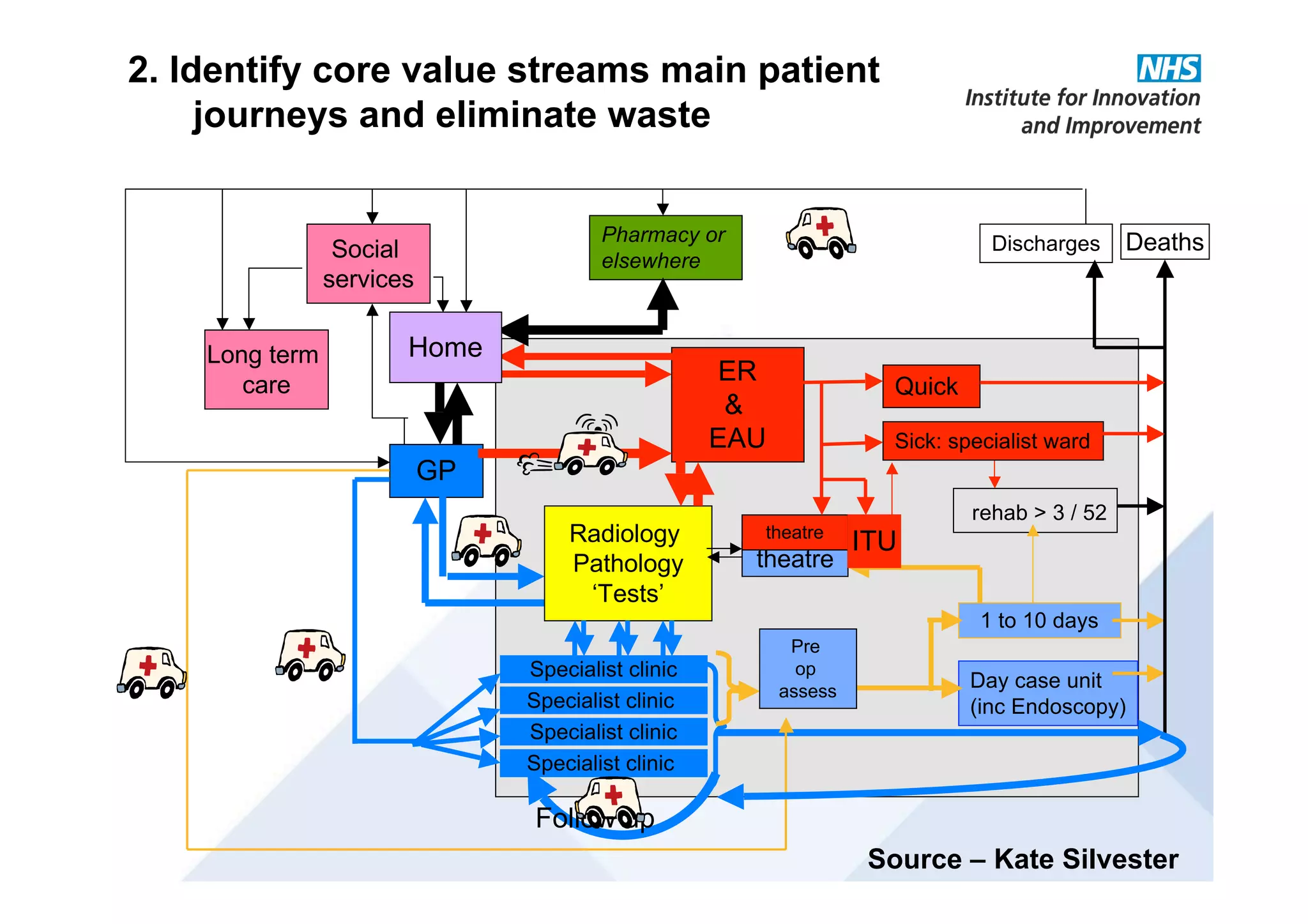
2. Identify core value streams main patient
journeys and eliminate waste
Source – Kate Silvester
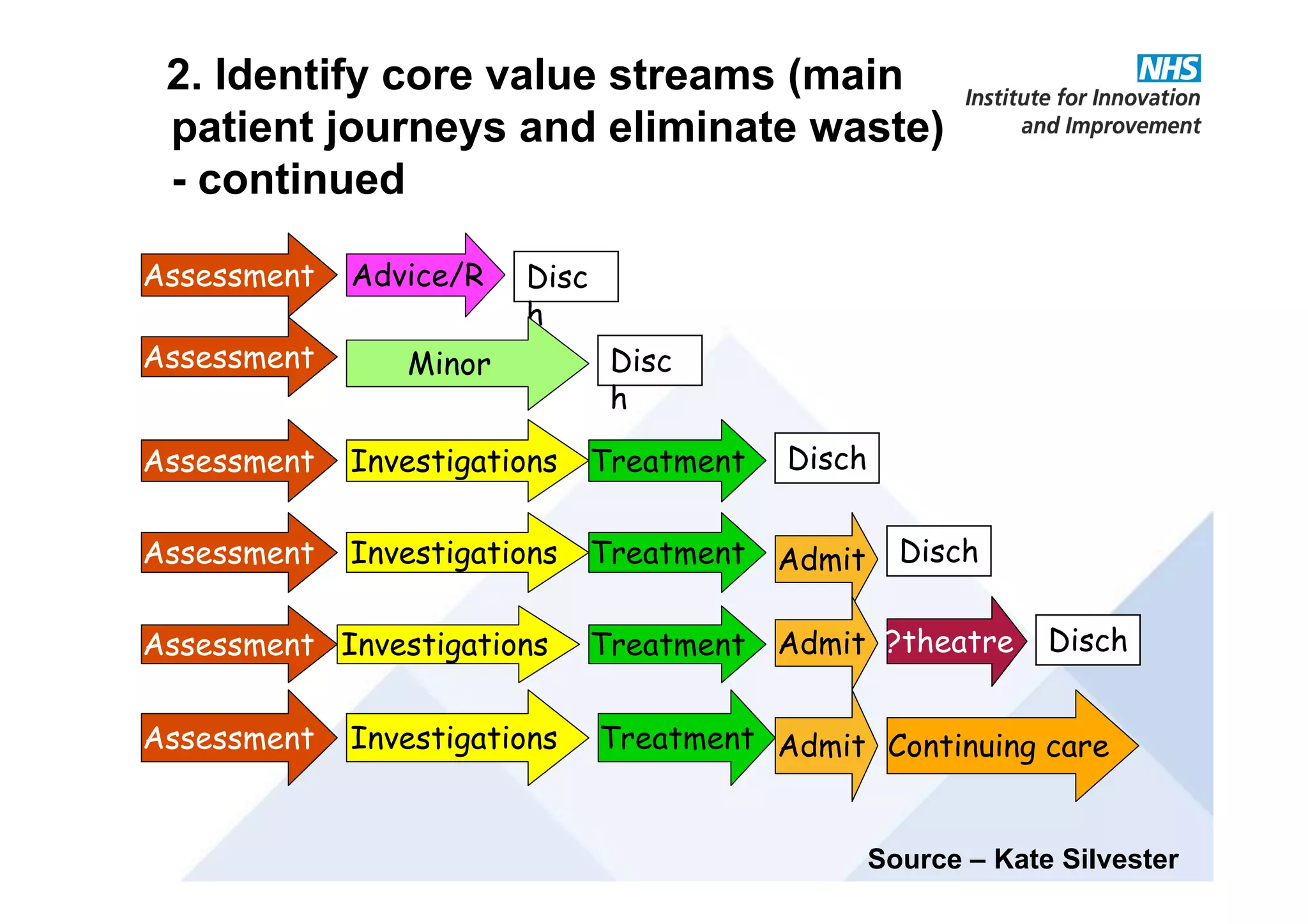
Admit DischTreatmentInvestigationsAssessment
TreatmentInvestigationsAssessment Admit Continuing care
Disc
h
Advice/RAssessment
Minor Disc
h
Assessment
DischTreatmentInvestigationsAssessment
?theatre DischTreatmentInvestigationsAssessment Admit
2. Identify core value streams (main
patient journeys and eliminate waste)
- continued
Source – Kate Silvester
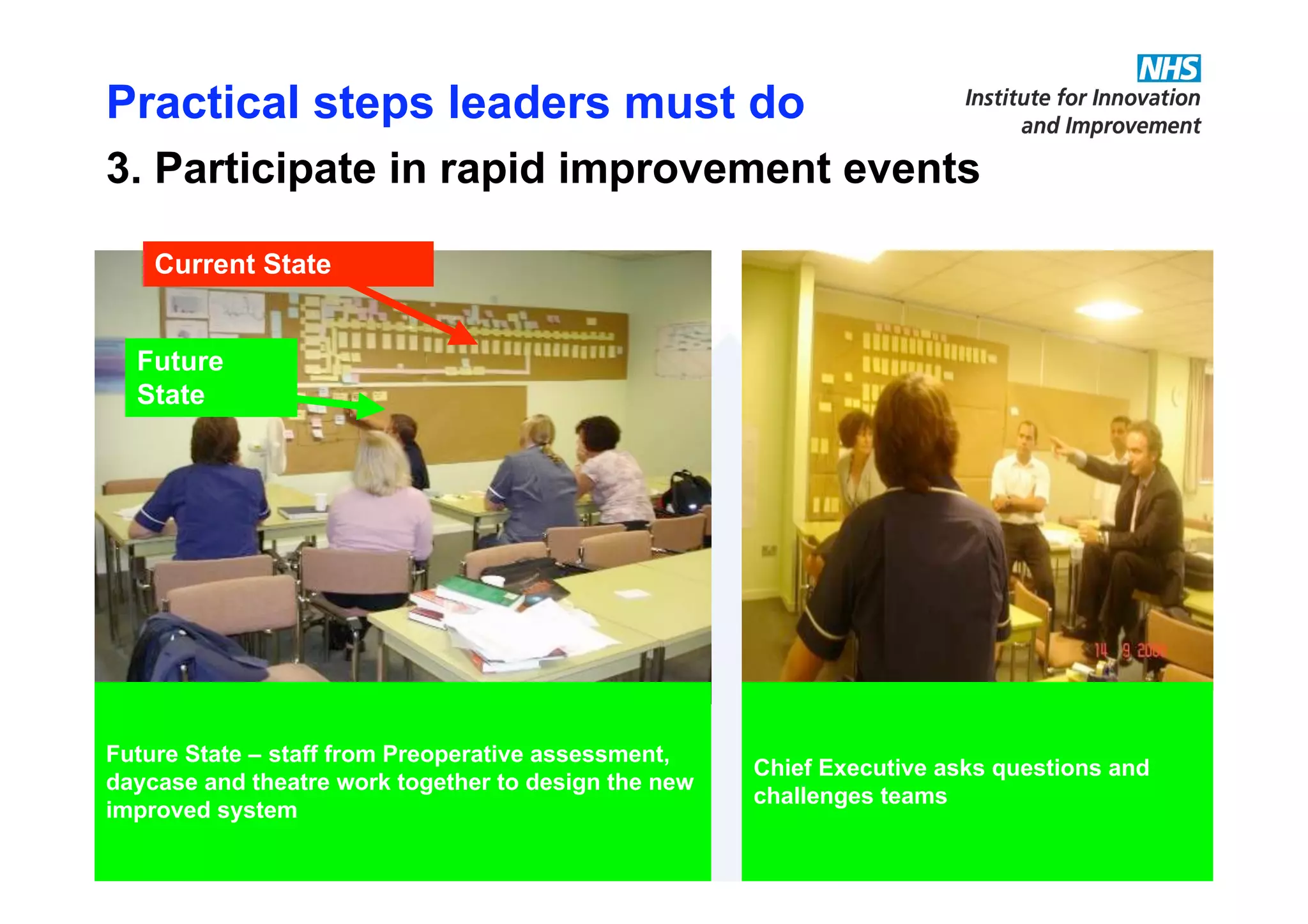
Future State – staff from Preoperative assessment,
daycase and theatre work together to design the new
improved system
Current State
Future
State
Chief Executive asks questions and
challenges teams
Practical steps leaders must do
3. Participate in rapid improvement events
Practical steps leaders must do
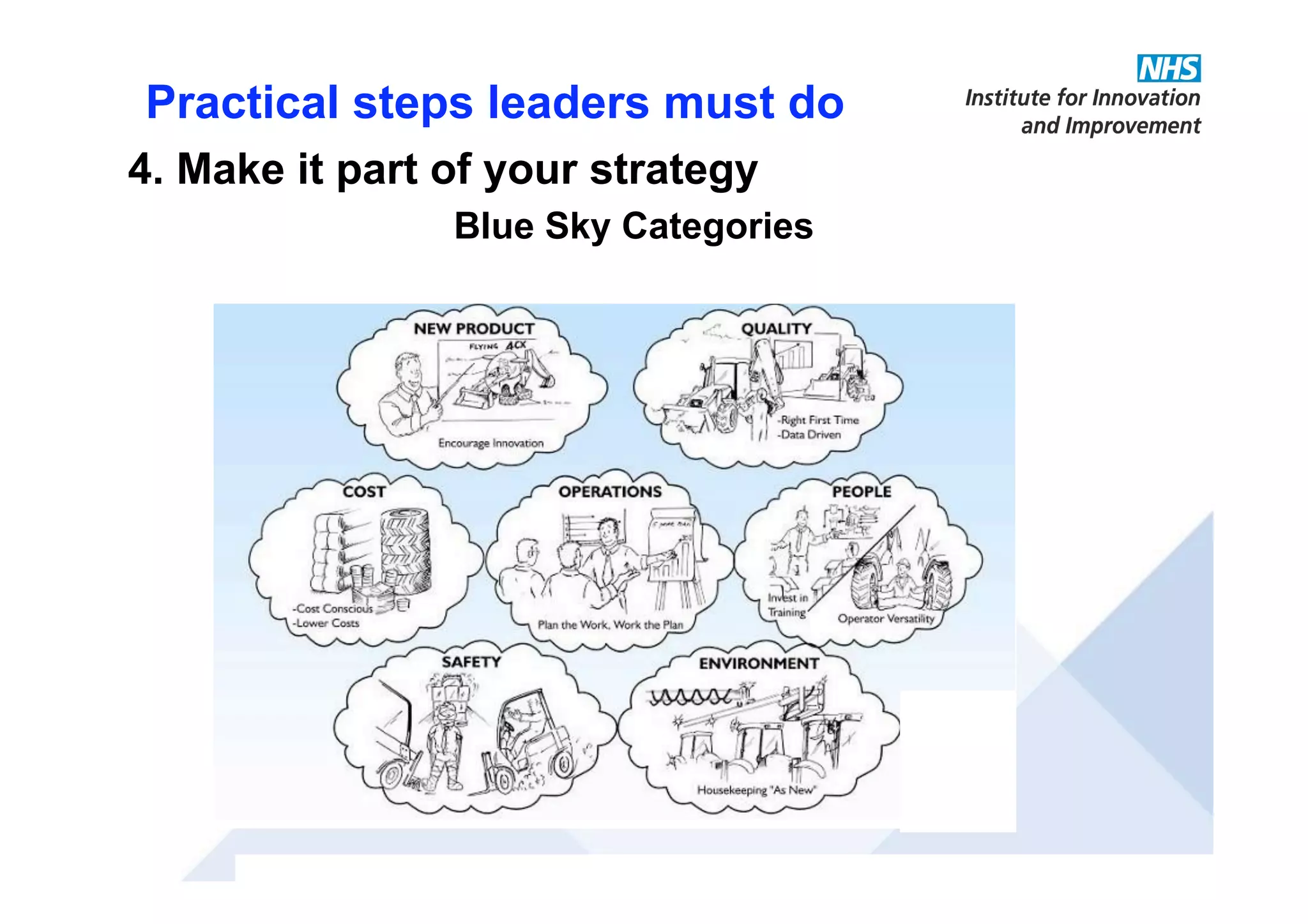
4. Make it part of your strategy
Blue Sky Categories
4. Make it part of strategy (continued)
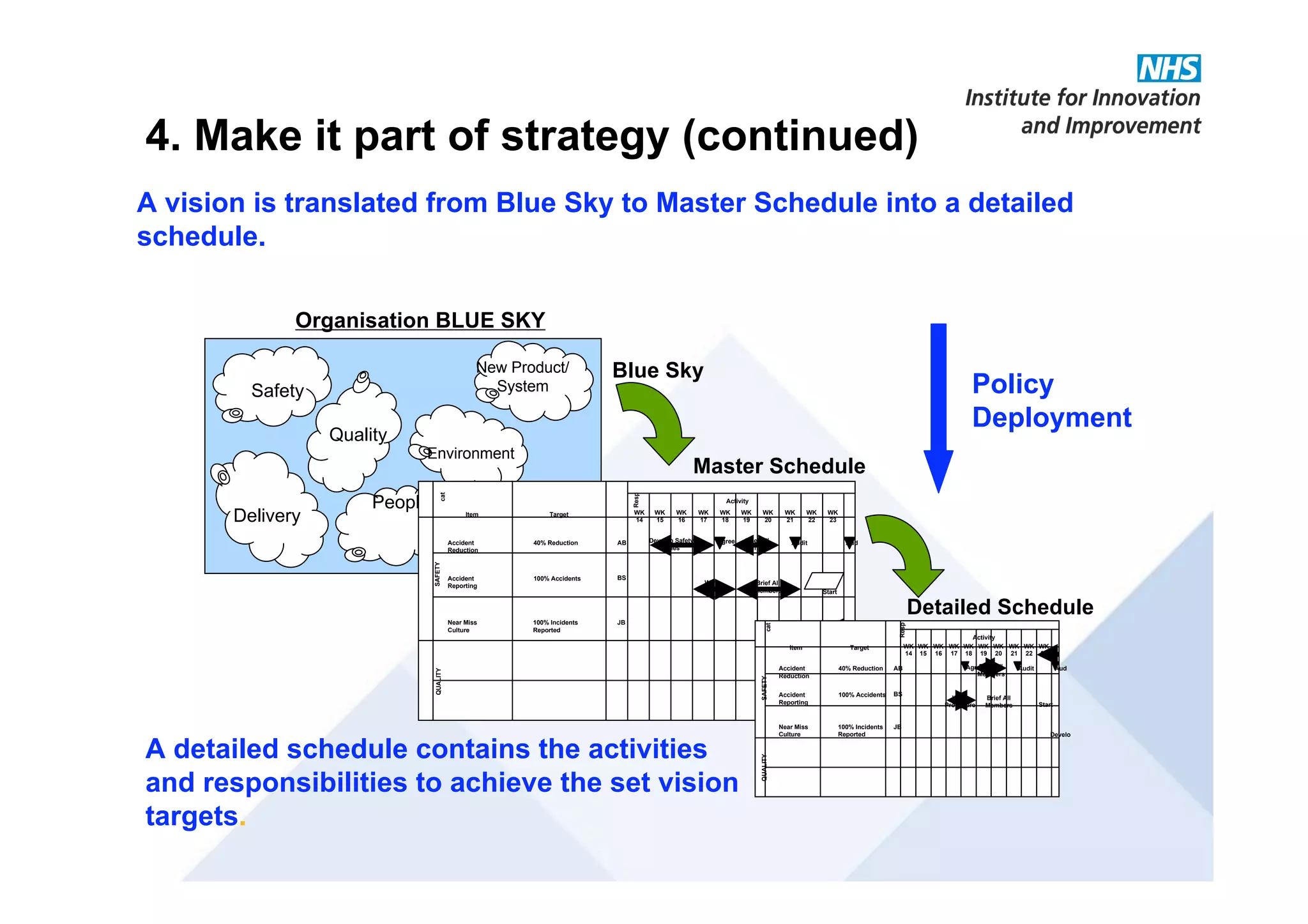
A vision is translated from Blue Sky to Master Schedule into a detailed
schedule.
Organisation BLUE SKY
Safety
Quality
Delivery
Cost
New Product/
System
People
Environment
cat
Item Target
Resp
Activity
WK
14
WK
15
WK
16
WK
17
WK
18
WK
19
WK
20
WK
21
WK
22
WK
23
SAFETYQUALITY
Accident
Reduction
40% Reduction AB
Accident
Reporting
Near Miss
Culture
100% Accidents
100% Incidents
Reported
BS
JB
Develo
Develop Safety
Rules
Agree Brief All
Members
Audit Aud
Write
Procedure
Brief All
Members Start
cat
Item Target
Resp
Activity
WK
14
WK
15
WK
16
WK
17
WK
18
WK
19
WK
20
WK
21
WK
22
WK
23
SAFETYQUALITY
Accident
Reduction
40% Reduction AB
Accident
Reporting
Near Miss
Culture
100% Accidents
100% Incidents
Reported
BS
JB
Develo
AgreeBrief All
Members
Audit Aud
Write
Procedure
Brief All
Members Start
Master Schedule
Detailed Schedule
Blue Sky
A detailed schedule contains the activities
and responsibilities to achieve the set vision
targets.
Policy
Deployment
Practical steps leaders must do
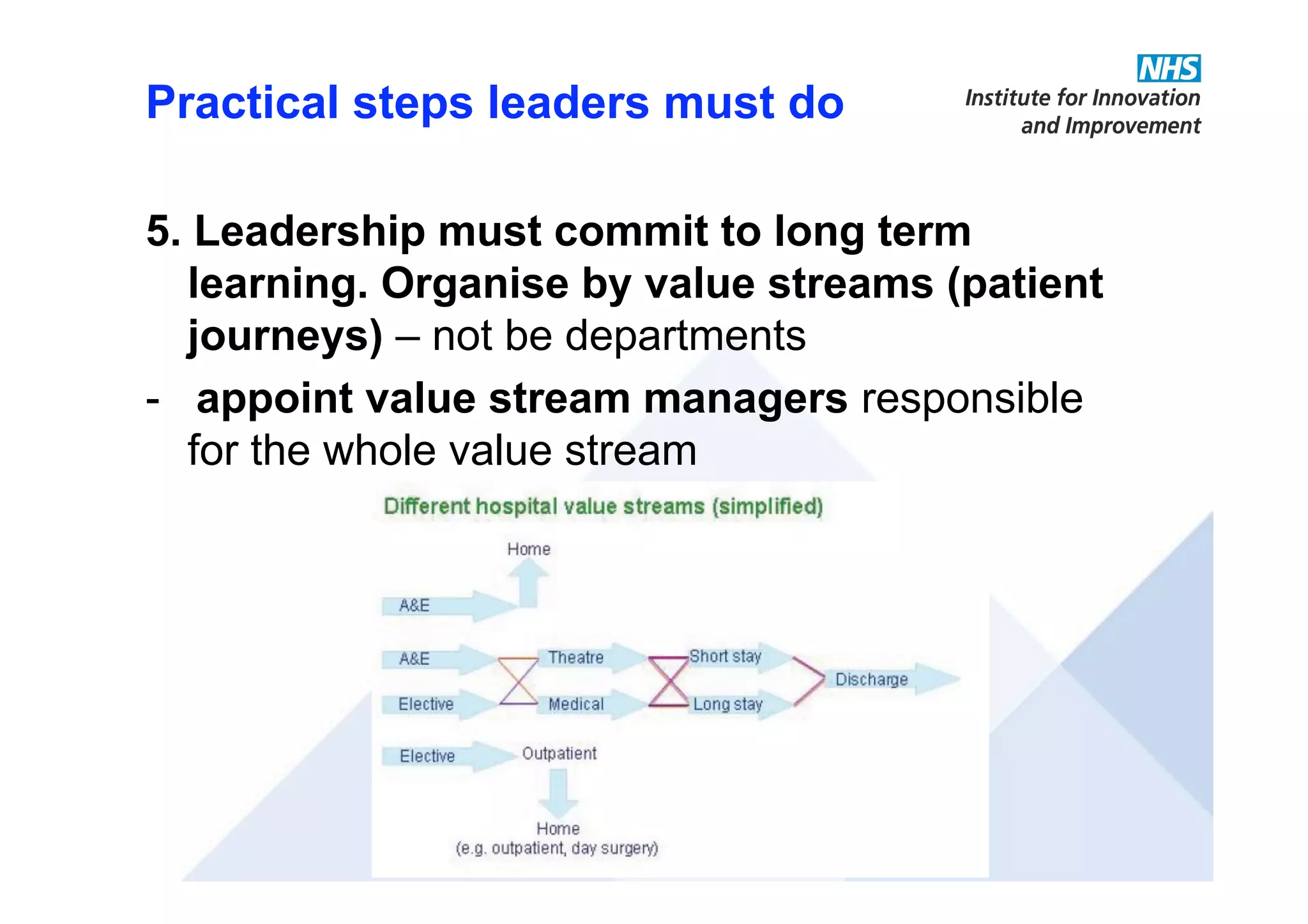
5. Leadership must commit to long term
learning. Organise by value streams (patient
journeys) – not be departments
- appoint value stream managers responsible
for the whole value stream
Practical steps leaders
must do
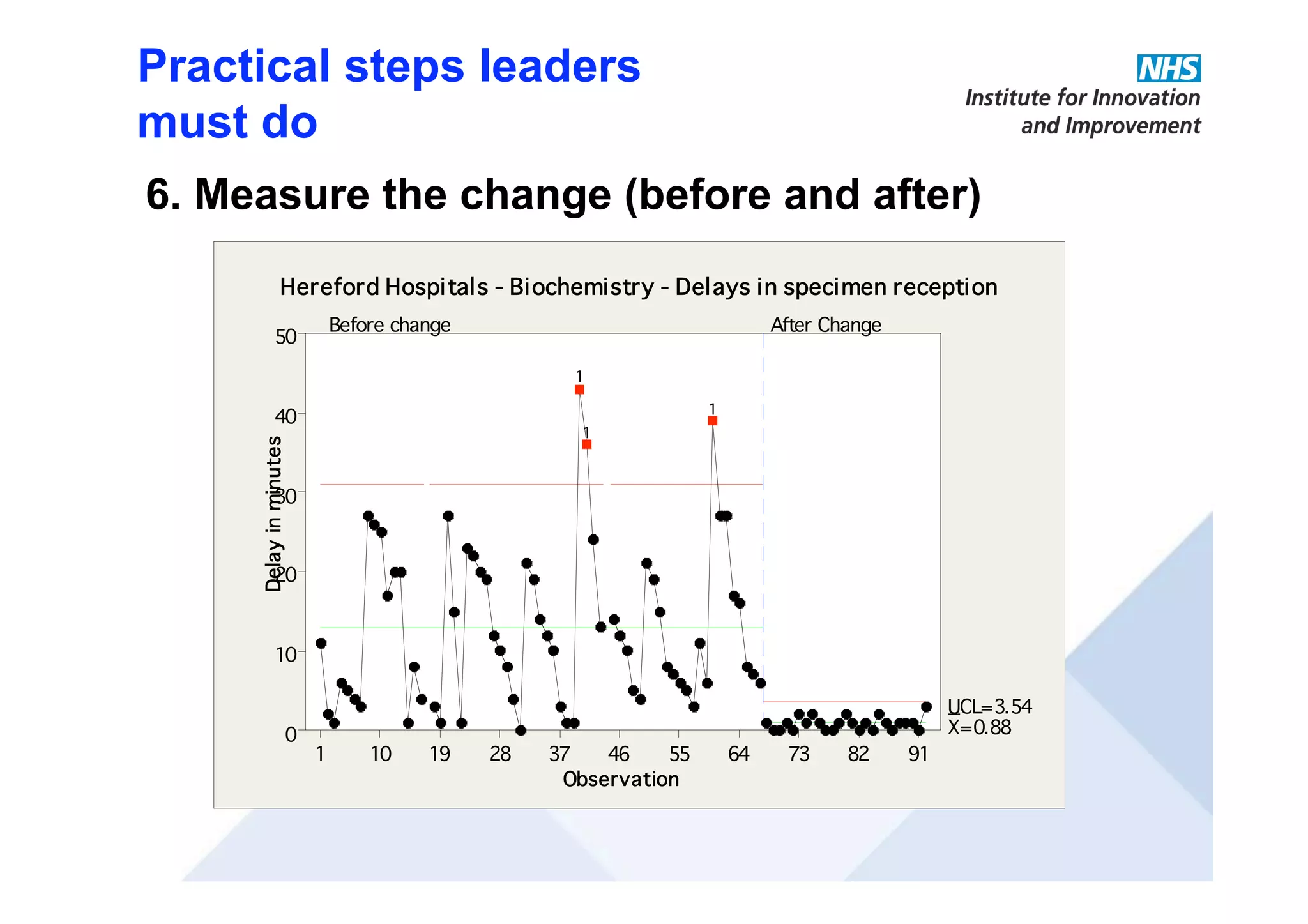
6. Measure the change (before and after)
Observation
Delayinminutes
918273645546372819101
50
40
30
20
10
0
_
X=0.88
UCL=3.54
Before change After Change
1
1
1
Hereford Hospitals - Biochemistry - Delays in specimen reception
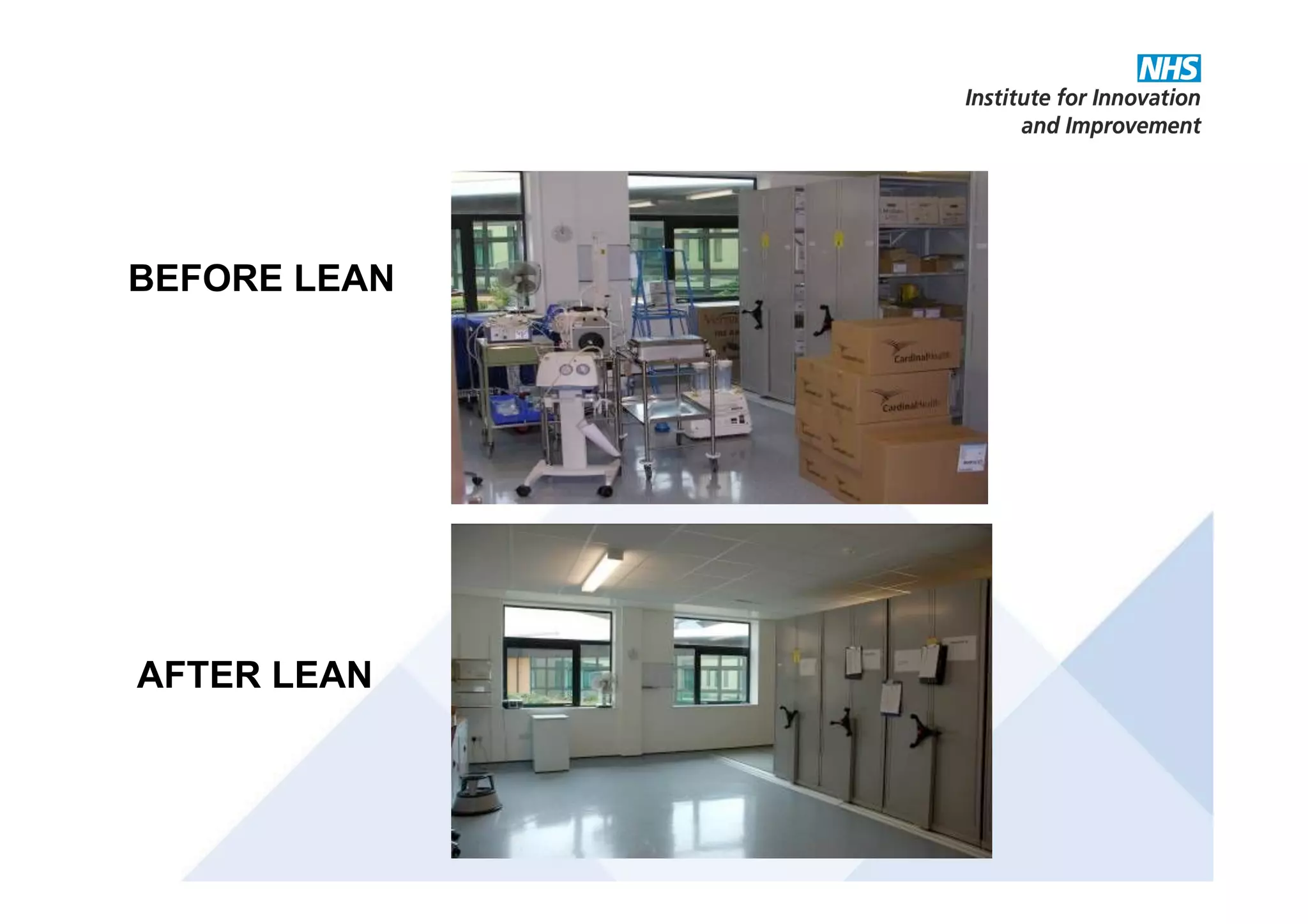
Theatre TE Case Study Background
BEFORE LEAN
AFTER LEAN
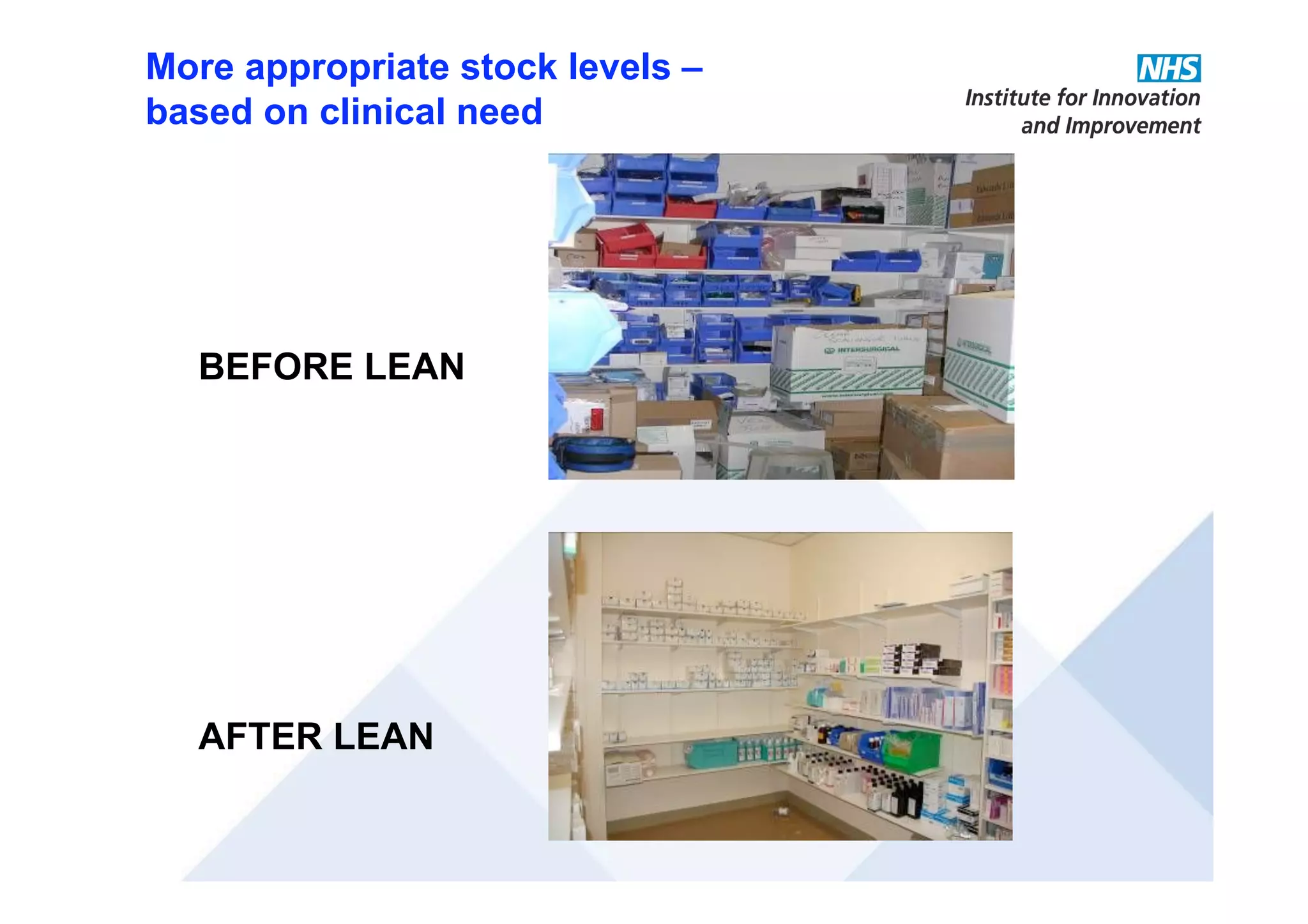
More appropriate stock levels –
based on clinical need
BEFORE LEAN
AFTER LEAN
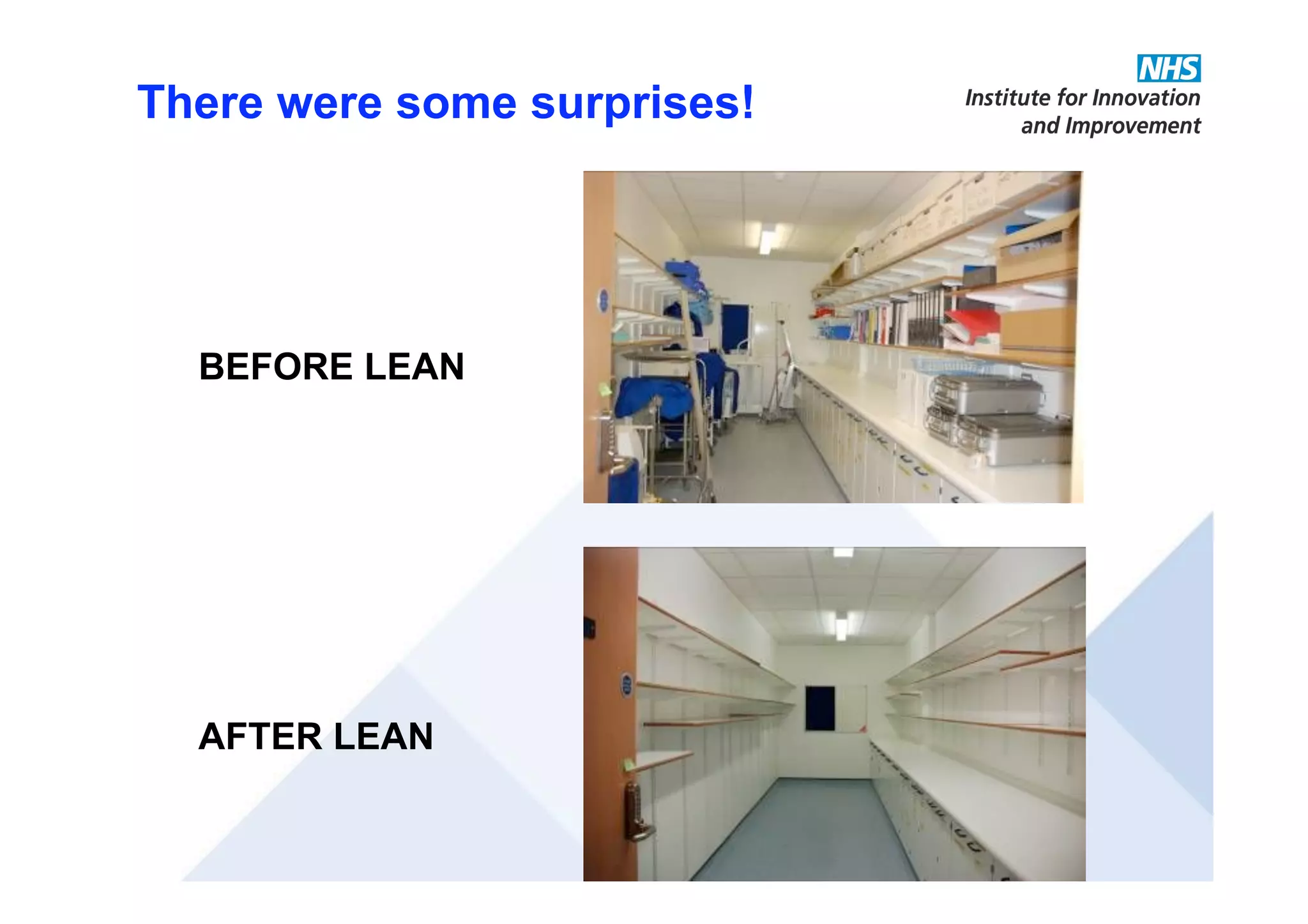
There were some surprises!
BEFORE LEAN
AFTER LEAN
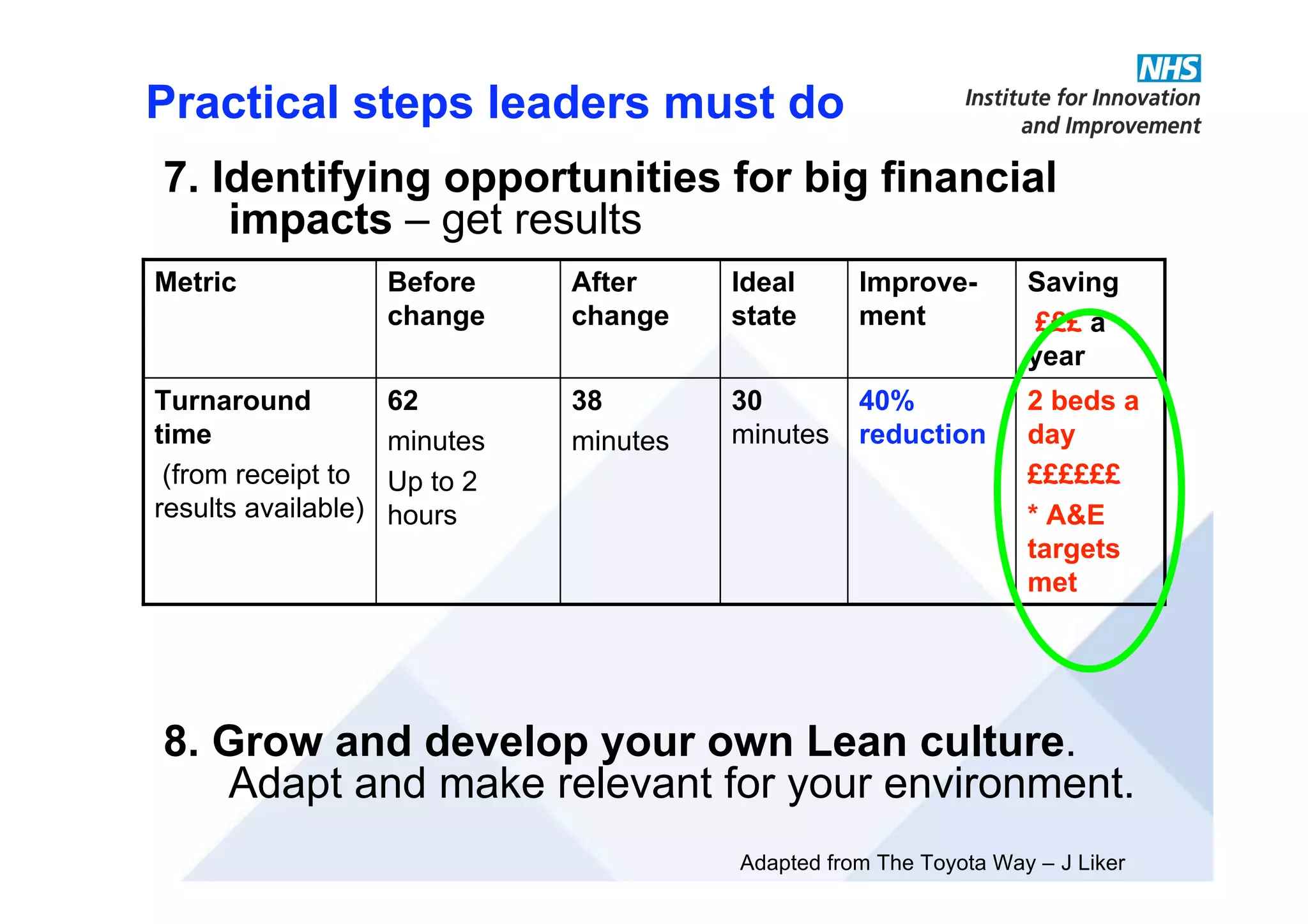
7. Identifying opportunities for big financial
impacts – get results
8. Grow and develop your own Lean culture.
Adapt and make relevant for your environment.
Adapted from The Toyota Way – J Liker
Practical steps leaders must do
40%
reduction
Improve-
ment
2 beds a
day
££££££
* A&E
targets
met
30
minutes
38
minutes
62
minutes
Up to 2
hours
Turnaround
time
(from receipt to
results available)
Saving
£££ a
year
Ideal
state
After
change
Before
change
Metric
Adapted from The Toyota Way – J Liker
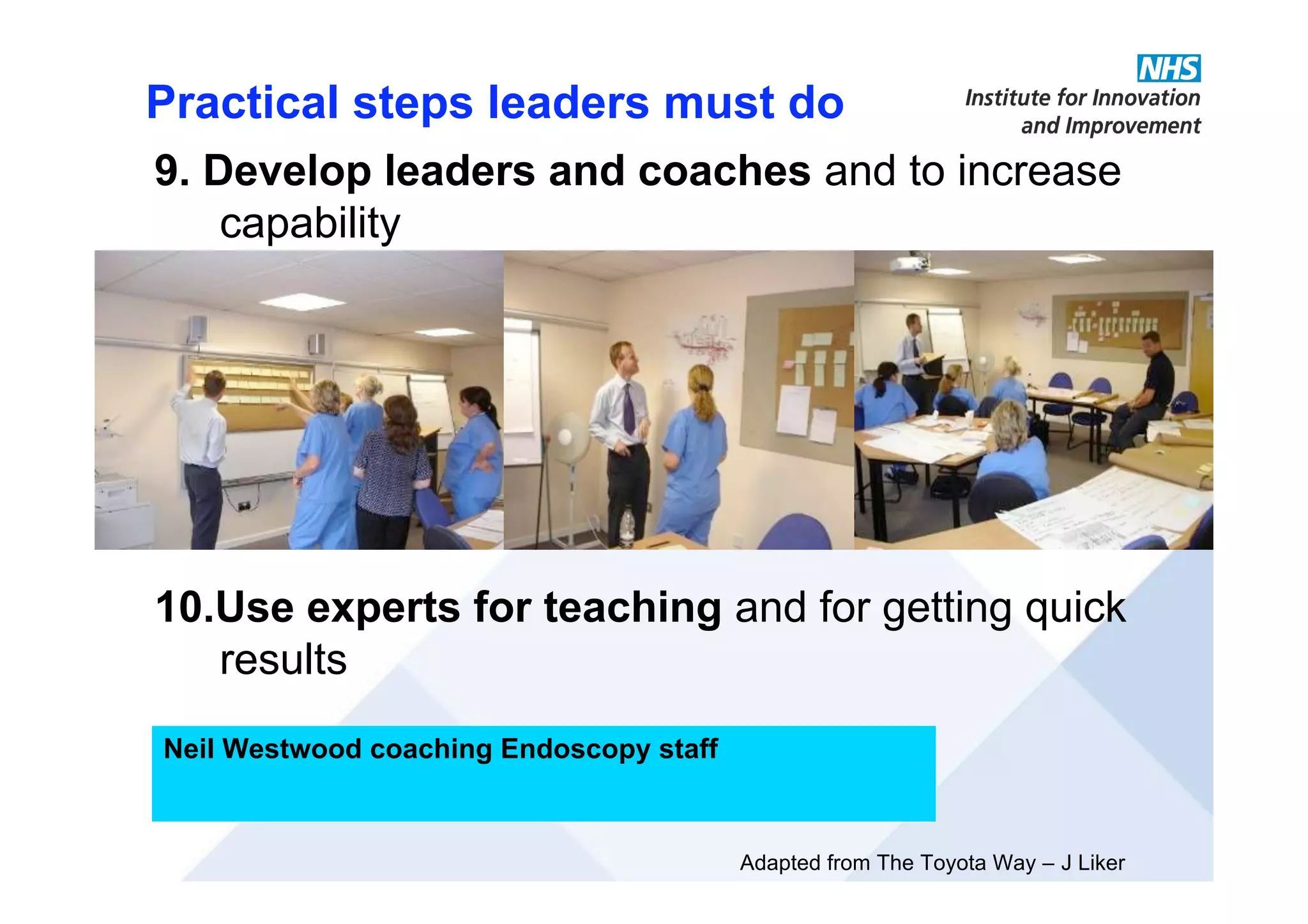
Practical steps leaders must do
Neil Westwood coaching Endoscopy staff
9. Develop leaders and coaches and to increase
capability
10.Use experts for teaching and for getting quick
results
3 Simple things for Leaders to do
Go See.
• Senior managers must spend time in the workplace –
listening and observing
Ask Why.
• Use the “Why?” technique daily
Show Respect.
• Respect your people – and people’s time!!
• Learn how the work gets done by getting involved and doing.
• Focus on the work and staff and ask questions
• Learn and revisit Standard Work.
• Use Value Stream Maps to expose the WASTE
• Think of yourself not as a firefighter, but as a teacher/coach and
process owner/designer.
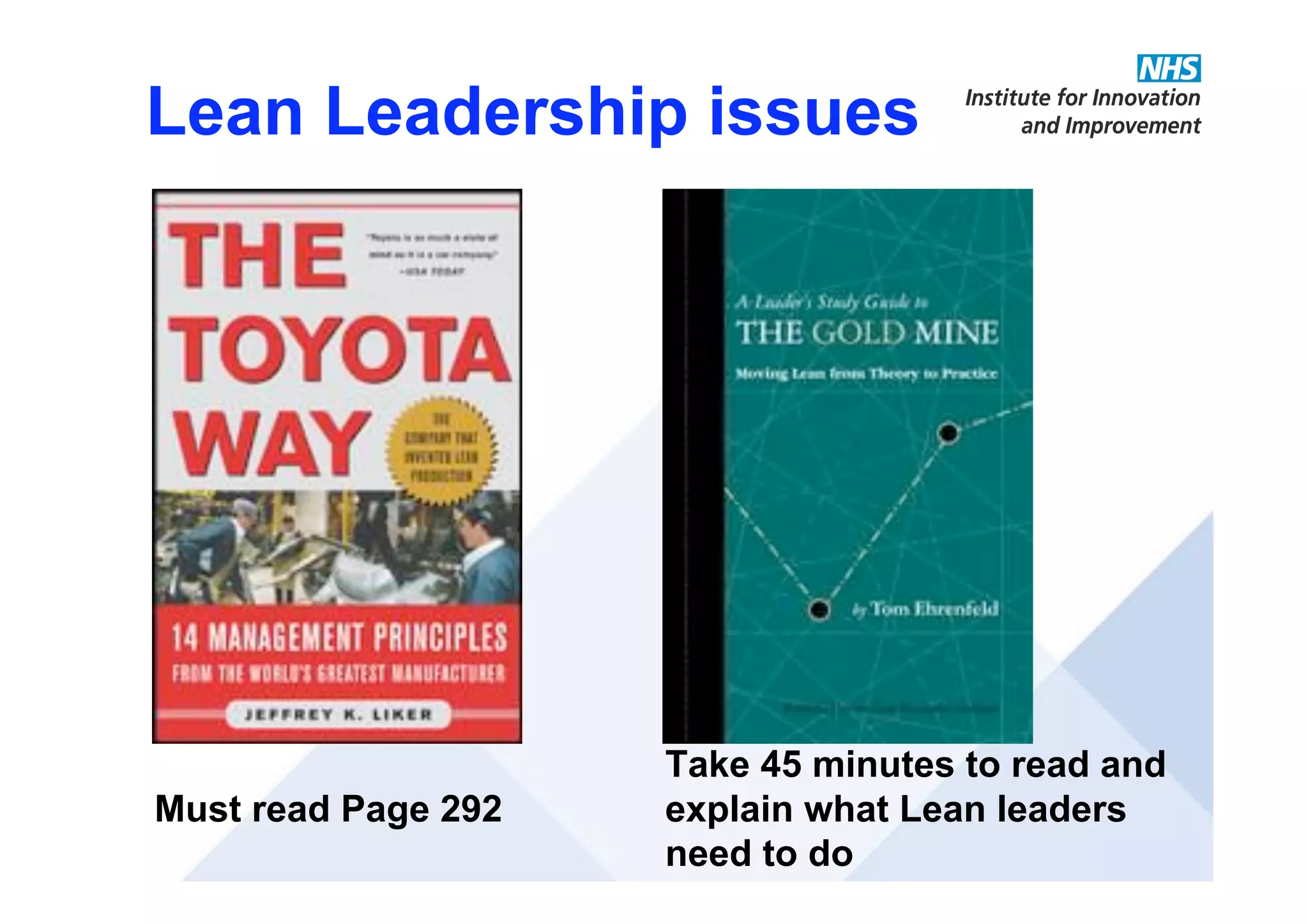
Lean Leadership issues
Must read Page 292
Take 45 minutes to read and
explain what Lean leaders
need to do

L03_10_Things_Leaders

  • 1.
    We spend 75-95%of our time doing things that increase our costs and create no value for the customer What is Lean? Lean is the process of identifying the least wasteful way to provide value (better, safer care, with no unnecessary delays at lower cost) to our customers. Value must always be determined by the customer
  • 2.
    Lean is beingused across healthcare Pathology Theatres PharmacySterile Services RadiologyWards
  • 3.
    Lean is beingused across healthcare Outpatients Mental Health PhysiotherapyPrimary care Ambulance Services Finance
  • 4.
    Critical success factors Getresults quickly – deploy a series of rapid improvement events Focus on the system, the flow that creates value, then apply the tools Dedicated service improvement resources accelerate change Board commitment and clinical leadership is essential Staff must be empowered to make improvements Lean must be part of long term Trust strategy This is not a FAD!!!
  • 5.
    Consistent processes =reliable, safe and quick healthcare services DELAYS
  • 6.
    • Provider first •Waiting is acceptable • Errors are to be expected • Add resources • Reduce cost • Problems not visible • maximise use of capacity • Functional management • Patient first • Waiting is unacceptable • Defect free processes • No new resources • Reduce waste • Problems visible • minimise cost of capacity • End to end processes Leaders need to shift the current thinking CURRENT FUTURE
  • 7.
    Lean - improvementat all levels – who leads on what EveryoneDaily problem solving Service improvement team with above Rapid improvement events Service managers and sistersDepartmental and ward plan Departmental leaders -Heads of Service - Matrons Yearly strategy and operational plan Senior leaders (clinical and managerial) 3-5 year strategy Chief Executive and BoardLong term vision Adapted from Getting The Right Things Done – Pascal Dennis
  • 8.
    Number of nursesper Trust = 800 Length of a shift = 480 minutes Typically, 50 % of time is value adding = 240 mins per shift 50 % of time is non value adding = 240 min per shift (searching for things, unnecessary movement, chasing results, redoing things) Now, if we can convert 10% of non value adding time to value adding time = 24mins extra value adding time This is the equivalent to 38 extra nurses (23 mins *800 nurses = 18400 extra value adding minutes) Convert non value adding time to value adding time to improve productivity
  • 9.
    Top Leadership’s “commitment toLean” journey Are top leaders committed to a long term vision of adding value ? START Lean Tools Six Sigma Tools Theory of Constraints Cost Improvement Programmes Supply Chain Tools SHORT TERM TOOLS Are top leaders committed to developing and involving teams and partners from he whole system ? Will there be continuity in the top leadership’s philosophy? BEGIN LEAN JOURNEY • Leadership background • Ownership structure • Promote from within? • Environmental pressures • Experience with Lean No No No Yes Yes Yes Adapted from The Toyota Way – J Liker
  • 10.
    What do LeanLeaders need to do? • 10 things to improve safety, improve quality, eliminate delays and reduce length of stay – and generate more income (profit) and lower costs
  • 11.
    1. Embed problemsolving approach in frontline staff. Learn by doing (PDSA) and empower staff to improve Practical steps leaders must do P-D-S-A CycleP-D-S-A Cycle
  • 12.
    ER & EAU GP Radiology Pathology ‘Tests’ Pharmacy or elsewhere Home Follow up Longterm care Social services Specialist clinic Specialist clinic Specialist clinic Specialist clinic rehab > 3 / 52 theatre 1 to 10 days Day case unit (inc Endoscopy) Pre op assess Discharges Deaths Quick Sick: specialist ward theatre ITU 2. Identify core value streams main patient journeys and eliminate waste Source – Kate Silvester
  • 13.
    Admit DischTreatmentInvestigationsAssessment TreatmentInvestigationsAssessment AdmitContinuing care Disc h Advice/RAssessment Minor Disc h Assessment DischTreatmentInvestigationsAssessment ?theatre DischTreatmentInvestigationsAssessment Admit 2. Identify core value streams (main patient journeys and eliminate waste) - continued Source – Kate Silvester
  • 14.
    Future State –staff from Preoperative assessment, daycase and theatre work together to design the new improved system Current State Future State Chief Executive asks questions and challenges teams Practical steps leaders must do 3. Participate in rapid improvement events
  • 15.
    Practical steps leadersmust do 4. Make it part of your strategy Blue Sky Categories
  • 16.
    4. Make itpart of strategy (continued) A vision is translated from Blue Sky to Master Schedule into a detailed schedule. Organisation BLUE SKY Safety Quality Delivery Cost New Product/ System People Environment cat Item Target Resp Activity WK 14 WK 15 WK 16 WK 17 WK 18 WK 19 WK 20 WK 21 WK 22 WK 23 SAFETYQUALITY Accident Reduction 40% Reduction AB Accident Reporting Near Miss Culture 100% Accidents 100% Incidents Reported BS JB Develo Develop Safety Rules Agree Brief All Members Audit Aud Write Procedure Brief All Members Start cat Item Target Resp Activity WK 14 WK 15 WK 16 WK 17 WK 18 WK 19 WK 20 WK 21 WK 22 WK 23 SAFETYQUALITY Accident Reduction 40% Reduction AB Accident Reporting Near Miss Culture 100% Accidents 100% Incidents Reported BS JB Develo AgreeBrief All Members Audit Aud Write Procedure Brief All Members Start Master Schedule Detailed Schedule Blue Sky A detailed schedule contains the activities and responsibilities to achieve the set vision targets. Policy Deployment
  • 17.
    Practical steps leadersmust do 5. Leadership must commit to long term learning. Organise by value streams (patient journeys) – not be departments - appoint value stream managers responsible for the whole value stream
  • 18.
    Practical steps leaders mustdo 6. Measure the change (before and after) Observation Delayinminutes 918273645546372819101 50 40 30 20 10 0 _ X=0.88 UCL=3.54 Before change After Change 1 1 1 Hereford Hospitals - Biochemistry - Delays in specimen reception
  • 19.
    Theatre TE CaseStudy Background BEFORE LEAN AFTER LEAN
  • 20.
    More appropriate stocklevels – based on clinical need BEFORE LEAN AFTER LEAN
  • 21.
    There were somesurprises! BEFORE LEAN AFTER LEAN
  • 22.
    7. Identifying opportunitiesfor big financial impacts – get results 8. Grow and develop your own Lean culture. Adapt and make relevant for your environment. Adapted from The Toyota Way – J Liker Practical steps leaders must do 40% reduction Improve- ment 2 beds a day ££££££ * A&E targets met 30 minutes 38 minutes 62 minutes Up to 2 hours Turnaround time (from receipt to results available) Saving £££ a year Ideal state After change Before change Metric
  • 23.
    Adapted from TheToyota Way – J Liker Practical steps leaders must do Neil Westwood coaching Endoscopy staff 9. Develop leaders and coaches and to increase capability 10.Use experts for teaching and for getting quick results
  • 24.
    3 Simple thingsfor Leaders to do Go See. • Senior managers must spend time in the workplace – listening and observing Ask Why. • Use the “Why?” technique daily Show Respect. • Respect your people – and people’s time!! • Learn how the work gets done by getting involved and doing. • Focus on the work and staff and ask questions • Learn and revisit Standard Work. • Use Value Stream Maps to expose the WASTE • Think of yourself not as a firefighter, but as a teacher/coach and process owner/designer.
  • 25.
    Lean Leadership issues Mustread Page 292 Take 45 minutes to read and explain what Lean leaders need to do