Lean London Forum
19 September 2013
Royal College of Surgeons
For more information, please email help@leanlondon.org.uk or telephone 0207 824 8448
- 2 -
Confidential not to be used without consent
We have some broad aims of the forum
• Create the environment where Lean Solutions in the NHS
are shared, discussed and acted upon by practitioners in
the health service
• Engage in a debate about strengths and weakness of
lean/service improvement methods in the current NHS
climate
– The QIPP agenda in reducing costs across the health system
– Clinical Commissioning Groups that will redefine ‘end to end’ health systems
processes
• To network with colleagues and friends
- 3 -
Confidential not to be used without consent
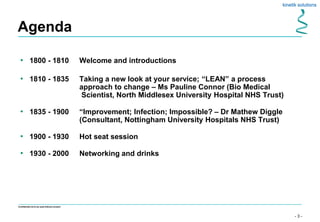
Agenda
• 1800 - 1810 Welcome and introductions
• 1810 - 1835 Taking a new look at your service; “LEAN” a process
approach to change – Ms Pauline Connor (Bio Medical
Scientist, North Middlesex University Hospital NHS Trust)
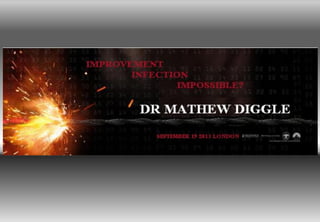
• 1835 - 1900 “Improvement; Infection; Impossible? – Dr Mathew Diggle
(Consultant, Nottingham University Hospitals NHS Trust)
• 1900 - 1930 Hot seat session
• 1930 - 2000 Networking and drinks
4
Taking a new look at your
service
“LEAN” a Process Approach to
Change
Pauline Connor
Chief Biomedical Scientist
5
Context
• Histopathology department at NMUH serves a medium
sized DGH, with approximately 10500 requests per
annum
• Increase in complexity of cases (reflected as increased
blocks and slides) by 49%
• Increased demands on Consultant reporting time, now
support 43 MDT meetings per month
• Biomedical, Clerical and Medical staffing levels stable, but
of 4.1 wte Consultants, only 1 is full time
• Opportunity to become one of nine pilot sites for NHS
Service Improvement project “Learning how to achieve a
7 day turnaround time in histopathology”
6
Target
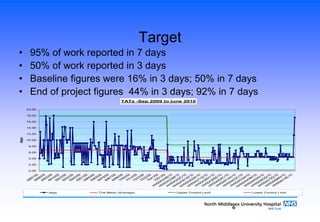
• 95% of work reported in 7 days
• 50% of work reported in 3 days
• Baseline figures were 16% in 3 days; 50% in 7 days
• End of project figures 44% in 3 days; 92% in 7 days
TATs -Sep 2009 to june 2010
0.00
2.00
4.00
6.00
8.00
10.00
12.00
14.00
16.00
18.00
20.00
6887/096896/096905/096914/096923/096932/096942/096951/096960/096969/096978/096987/096996/097005/097014/097023/097032/097041/097051/09
H
H
004324B
/10
H
H
004333M
/10
H
H
004342C
/10
H
H
004351W
/10
H
H
004362W
/10
H
H
004371Q
/10
H
H
004385Y
/10
H
H
004395E
/10
H
H
004404C
/10
H
H
004414A
/10
H
H
004423C
/10
H
H
004433A
/10
H
H
004443W
/10
H
H
004453H
/10
H
H
004463Q
/10
H
H
004475Q
/10
H
H
004486N
/10
H
H
004514E
/10
lab no
days
days The Mean (Average) Upper Control Limit Lower Control Limit
What is lean?
• A whole Management Philosophy
• Perfected by Toyota in the 1970’s
• Toyota Production System (TPS) focuses on:
– Improving flow (pull)
– Increase value for user
– Get rid of waste
– Get it right first time
– Continually improve
• Puts the customer at heart of the process
8
A process approach to change: taking the
pathology service apart and reassembling
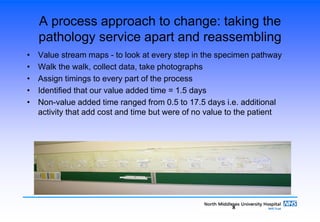
• Value stream maps - to look at every step in the specimen pathway
• Walk the walk, collect data, take photographs
• Assign timings to every part of the process
• Identified that our value added time = 1.5 days
• Non-value added time ranged from 0.5 to 17.5 days i.e. additional
activity that add cost and time but were of no value to the patient
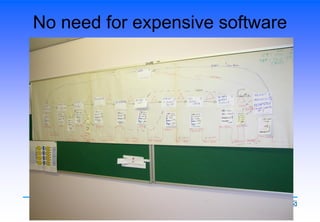
No need for expensive software
10
Taking the process apart: where to
spend the time
• We identified waste such as movement;
waiting; duplication of effort; excessive
checking; poor utilisation of skills;
overproduction
• Looked for waste at all stages using tools
such as the “5 Whys?”; Plan,Do,Study,Act
cycles; A3 problem solving techniques
11
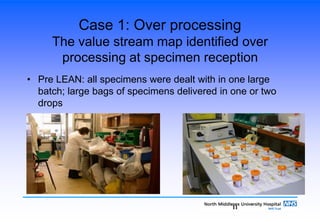
Case 1: Over processing
The value stream map identified over
processing at specimen reception
• Pre LEAN: all specimens were dealt with in one large
batch; large bags of specimens delivered in one or two
drops
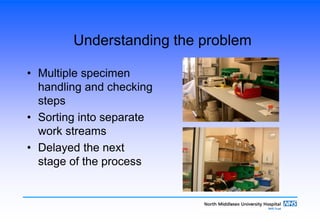
Understanding the problem
• Multiple specimen
handling and checking
steps
• Sorting into separate
work streams
• Delayed the next
stage of the process
Measurable outcome
• Removed separate work streams
• Introduced one piece flow in specimen reception
Task Pre LEAN Post LEAN % Reduced by
Specimen
checks
7 3 43%
Specimen
handling
6 3 50%
14
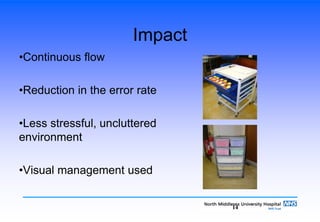
Impact
•Continuous flow
•Reduction in the error rate
•Less stressful, uncluttered
environment
•Visual management used
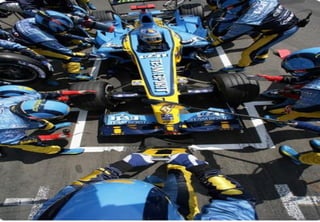
There is no point optimising a
process unless it is standardised
If the process changes depending on who
performs the work or other parameters,
measurement is meaningless
Create standardised work procedures to
produce process stability
Then Optimise
17
Case 2: Standardisation
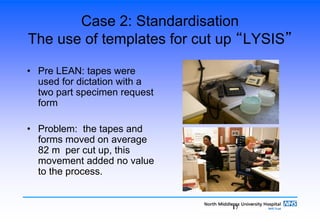
The use of templates for cut up “LYSIS”
• Pre LEAN: tapes were
used for dictation with a
two part specimen request
form
• Problem: the tapes and
forms moved on average
82 m per cut up, this
movement added no value
to the process.
18
Waste identified
• Movement - of forms and tapes
• Waiting – to be typed
• Re-duplication of effort – the same
description repeated again and again
• Errors: occasional tapes failed and some
were occasionally erased in error
19
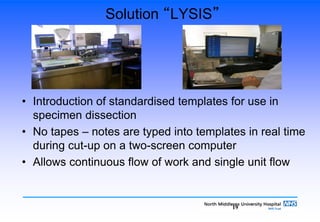
Solution “LYSIS”
• Introduction of standardised templates for use in
specimen dissection
• No tapes – notes are typed into templates in real time
during cut-up on a two-screen computer
• Allows continuous flow of work and single unit flow
20
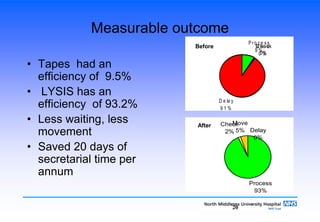
Measurable outcome
• Tapes had an
efficiency of 9.5%
• LYSIS has an
efficiency of 93.2%
• Less waiting, less
movement
• Saved 20 days of
secretarial time per
annum
1 1 1 .0 0
m inu te s
s o m e th in g h a p p e n s to m o ve it o n 1 6 0 .0 0 P ro c e ss
m a tio n /c o n tro ls /d e c isio n -m a kin g 3 .0 0 C h e ck
w ith o ut a n y th in g h ap p e n in g to it 7 .0 0 M o ve m e n t
is p re v e nte d fro m m o vin g fo rw a rd 1 ,5 1 5 .0 0 D e la y
1 ,6 8 5 .0 0
e ss C ycle Efficie n cy is 9 .5 % .
re 3 d e la ys w h ich p re ve n ted w o rkflo w fro m m o v in g fo rw a rd , a n
flo w m o ve d w ith o u t a n yth in g h a p p e n in g to it 3 tim e s, a n d tra ve
flo w w a s ch e cke d , o r h a d a d e cisio n m a d e a b o u t it 2 tim e s, a n
M o ve
7 5%
Pro ce ss
9 %
C he ck
0%
M o ve
0 %
D e la y
9 1 %
Metres
something happens to move it on 7.20 Process
mation/controls/decision-making - Check
thout anything happening to it 16.80 Movement
s prevented from moving forward - Delay
24.00
minutes
something happens to move it on 55.00 Process
mation/controls/decision-making 1.00 Check
thout anything happening to it 3.00 Movement
s prevented from moving forward - Delay
59.00
ess Cycle Efficiency is 93.2%.
Process
30%
Check
0%
Move
70%
Delay
0%
Process
93%
Check
2%
Move
5% Delay
0%
Before
After
21
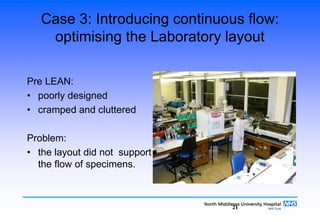
Case 3: Introducing continuous flow:
optimising the Laboratory layout
Pre LEAN:
• poorly designed
• cramped and cluttered
Problem:
• the layout did not support
the flow of specimens.
22
Analysis of the problem
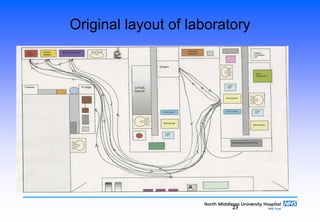
• Used spaghetti diagrams to map the path of
a case through the Laboratory
• Used process sequence charts to look at
distance, timings and efficiency of the
processes
23
Original layout of laboratory
24
What did we do ?
• Used future state mapping to plan our ideal
journey for a case
• Data collection before and after changes
• Data gave us the confidence to redesign the
Laboratory
25
Impact of optimising the layout
• Transposition of the two staining machines
has lead to a reduction in movement of
8463 m per annum
• Routine work cell has the added benefits of
reinforcing team work
26
Laboratory layout today
27
Case 4: Introduction of a “pull” system:
pooled Consultant reporting
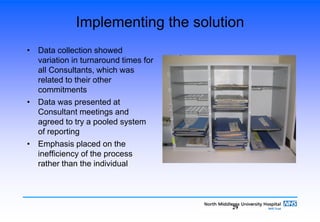
• Pre LEAN: all slides
processed from a day’s cut
up were allocated to a
single Pathologist
• Problem: this did not allow
for capacity and demand
issues
• Work was “pushed” into
their rooms and often sat
unreported due to other
commitments
28
Analysing the problem
• Waste: time spent in the Laboratory allocating
cases to individuals; time spent searching for
cases that were needed urgently
• Batch size: large - a whole day’s work to report
• No “first in, first out” – depended on Consultant
availability
29
Implementing the solution
• Data collection showed
variation in turnaround times for
all Consultants, which was
related to their other
commitments
• Data was presented at
Consultant meetings and
agreed to try a pooled system
of reporting
• Emphasis placed on the
inefficiency of the process
rather than the individual
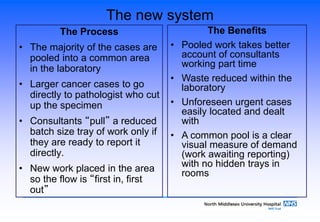
The Process
• The majority of the cases are
pooled into a common area
in the laboratory
• Larger cancer cases to go
directly to pathologist who cut
up the specimen
• Consultants “pull” a reduced
batch size tray of work only if
they are ready to report it
directly.
• New work placed in the area
so the flow is “first in, first
out”
The Benefits
• Pooled work takes better
account of consultants
working part time
• Waste reduced within the
laboratory
• Unforeseen urgent cases
easily located and dealt
with
• A common pool is a clear
visual measure of demand
(work awaiting reporting)
with no hidden trays in
rooms
The new system
31
Impact
• Improved turnaround times allows prompt
discussion of patients at MDT meetings
• Predictable turnaround times allows earlier follow
up clinic appointments for patients
• Better use of Consultant availability to maximise
reporting time
• Morale has improved; a common challenge
• Has been easily adapted to allow for sub
specialist reporting
32
:
Measurable outcomes
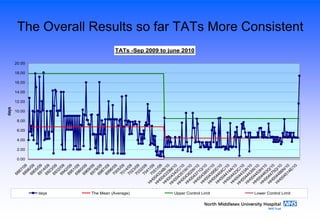
• Dramatic reduction in turnaround times
3 day turnaround improved from 19% to
40% (21% increase)
7 day turnaround improved from 56% to
95% (55% increase)
• Overall reduction in time taken to report by
Consultants has decreased from 4.5 days
to 1.8 days
The Overall Results so far TATs More Consistent
TATs -Sep 2009 to june 2010
0.00
2.00
4.00
6.00
8.00
10.00
12.00
14.00
16.00
18.00
20.00
6887/096896/096905/096914/096923/096932/096942/096951/096960/096969/096978/096987/096996/097005/097014/097023/097032/097041/097051/09
H
H
004324B/10
H
H
004333M
/10
H
H
004342C
/10
H
H
004351W
/10
H
H
004362W
/10
H
H
004371Q
/10
H
H
004385Y/10
H
H
004395E/10
H
H
004404C
/10
H
H
004414A/10
H
H
004423C
/10
H
H
004433A/10
H
H
004443W
/10
H
H
004453H
/10
H
H
004463Q
/10
H
H
004475Q
/10
H
H
004486N
/10
H
H
004514E/10
lab no
days
days The Mean (Average) Upper Control Limit Lower Control Limit
34
Where to spend the time:
Communication
• Laboratory huddles
• Time limited, no more than
10 minutes
• Review of that day’s
workload and staffing
• Laboratory dashboard – daily
targets, defects, interruptions
• LEAN project meetings –
twice monthly.
35
What do you need to do this?
• Equipment – NO – total cost of this project to date
has been approx £2000 – a few trolleys; cabling
• Increased staffing levels – NO – this has been
achieved with no increase in staff levels –
consultant vacancy since March 2010, despite an
increase of 20% in requests and 49% in work
units
• Time – YES – data collection; team meetings
• Motivation and perseverance - YES
36
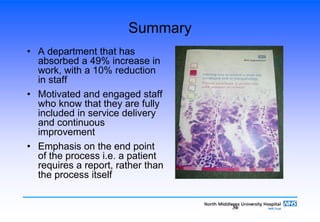
Summary
• A department that has
absorbed a 49% increase in
work, with a 10% reduction
in staff
• Motivated and engaged staff
who know that they are fully
included in service delivery
and continuous
improvement
• Emphasis on the end point
of the process i.e. a patient
requires a report, rather than
the process itself
Where?
Clinical Microbiology Department
Nottingham University Hospitals NHS Trust
Queens Medical Centre
Derby Road
Nottingham
UK
NG7 2UH
http://www.nuh.nhs.uk/microbiology/
The Nottingham Experience
• Diagnostic service: 24/7, 365 days per year
• Population served: >2.5 million (> 5 million)
• Workload: 970,000 pa (> 1.8 Million)
• Isolation, identification and detection of
• medically important bacteria,
• viruses and parasites.
And now for
something
completely
different...
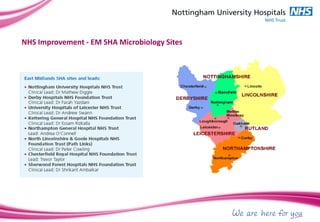
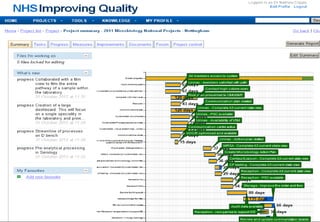
NHS Improvement - EM SHA Microbiology Sites
LEAN?
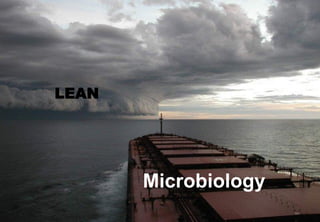
LEAN
Microbiology
What the…………….
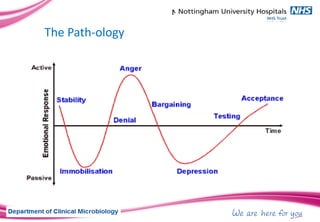
The Path-ology
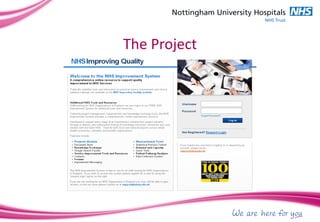
The Project
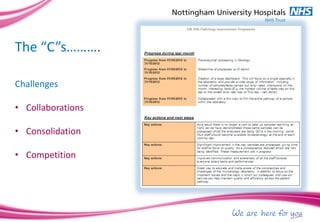
Challenges
• Collaborations
• Consolidation
• Competition
The “C”s……….
The Nottingham Experience
Challenges
• Developing a lean culture
• Find a champion
• Engagement of your staff
• What is engagement?
• Communication
• While under a seize mentality
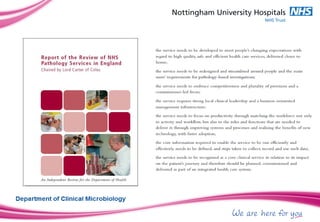
http://www.improvement.nhs.uk/documents/Microbiology_Guide.pdf
Thank you!
- 54 -
Confidential not to be used without consent
• Focus on Value from a Customer (Patient) point of view on every
step of process
• Obsession on removing waste within the ‘whole system’
• Bottom up approach in identifying value and waste – assumption
that much of waste and value is hidden
• A true lean system would “flow” and need little command and
control
Recap – What is Lean?
- 55 -
Confidential not to be used without consent
What’s Next?
• Today’s presentation and feedback survey sent out by email within
72 hours
• The Next Lean London Forum will be held on 5 March 2014.
– Register at www.leanlondon.org.uk
– We will send out reminders to all participants from today
– We have a Lean Midland Forum on 16 October 2013 taking place in Birmingham.
Register at www.leanmidland.org.uk
– If you’d like to take up one our presentation slots, please do let us know. We are keen
to hear from Community Trust and GP Groups
• Find us on and - LeanNHS
- 56 -
Confidential not to be used without consent
Past Presentations at the Forum
http://kinetik.uk.com/pdf/Lean
London.pdf
1. The 'Leaning' of Bedford Hospital - the story so far, Susan
Whittaker, Bedford Hospital
2. Future Developments in Lean, Rob Worth, Kinetik Solutions
3. Transformation of Camberwell Sexual Health Centre, Rachel
Paxford-Jenkins, Camberwell Sexual Heath Centre
4. Building Lean Expertise, Daniel McDonald, Lean Executives
5. Use of Data in Lean Projects, Andrew Castle
http://kinetik.uk.com/pdf/Lean_
London_Sep_09_web.pdf
1. Radiology Lean Review - The Journey has begun, Carol Darnell,
Bedford Hospital Trust
2. Recruiting for the Lean & Service Transformation, Daniel
McDonald, Lean Executives
3. Lean and Systems Thinking, Rob Worth, Kinetik Solutions
4. Don't water your weeds - starting afresh with Lean, Ian Greddor,
Cyril Swett
http://kinetik.uk.com/pdf/Lean
London_Feb.pdf
1. Challenges in Implementing Lean - A Clinical Perspective, Dr
Ahmed Chekairi, Whittington Hospital
2. A Better Definition of 'Value' in Lean, Ketan Varia, Kinetik Solutions
3. Lean in the pharmaceutical drugs supply process, Niall Ferguson,
Milton Keynes Hospital
- 57 -
Confidential not to be used without consent
Past Presentations at the Forum
http://kinetik.uk.com/pdf/leanlon
don_sep11.pdf
1. Transforming Surgical Productivity, Christopher Kennedy, Guy's
& St Thomas NHS Foundation Trust
2. Transforming Treatment Rooms, Dr Rebecca Hewitson, The
Whittington Hospital NHS Trust
http://kinetik.uk.com/pdf/leanlon
don_mar12_presentation.pdf
1. The Path-ology to Lean Thinking - Dr Mathew Diggle,
Nottingham Hospital Trust & Suzanne Horobin, NHS Improvement -
Diagnostics
2. Pre-Operative Health Evaluation - Engagement with Primary
Care, Dr Ahmed Chekairi, Whittington Hospital
http://kinetik.uk.com/pdf/leanmid
land0712.pdf
1. How many appointments do we need to make?, Kate Silvester,
South Warwickshire NHS Trust
2. The Path-ology to Lean Thinking - Dr Mathew Diggle,
Nottingham Hospital Trust
- 58 -
Confidential not to be used without consent
Past Presentations at the Forum
http://kinetik.uk.com/pdf/leanlo
ndon_sep12.pdf
1. Sleek & Slim Hearing for Children - Dr Sebastian Hendrick, Barnet
& Chase Farm Hospital
2. Developing value through transformation of care - What does it
take?, Peter Lachman, Great Ormond Hospital
http://kinetik.uk.com/pdf/kineti
k_dec_12.pdf
1. Network Improvement Services in Tower Hamlets, Florence Cantle,
Tower Hamlets NHS Trust
2. Using improvement science in Ambulatory Care, Simon Dodds,
Heart of England Trust
http://kinetik.uk.com/pdf/Lean
Midland_June11.pdf
1. Lean Transformation at Bedford Hospital, Susan Whittaker, Bedford
Hospital
2. How do drive change by understanding patient value?, Ketan Varia,
Kinetik Solutions
3. Global Lean Knowledge: The Effects of Culture, Maria Gilgeous,
Kinetik Solutions
- 59 -
Confidential not to be used without consent
Big Thanks To Our Presenters
Ms Pauline Connor
Dr Mathew Diggle
..and to you all for attending
- 60 -
Confidential not to be used without consent
Thanks to Our Sponsors
Assisting with Lean Transformations
in the health sector and beyond
www.kinetik.uk.com

Leanlondon 19sep13

  • 1.
    Lean London Forum 19September 2013 Royal College of Surgeons For more information, please email help@leanlondon.org.uk or telephone 0207 824 8448
  • 2.
    - 2 - Confidentialnot to be used without consent We have some broad aims of the forum • Create the environment where Lean Solutions in the NHS are shared, discussed and acted upon by practitioners in the health service • Engage in a debate about strengths and weakness of lean/service improvement methods in the current NHS climate – The QIPP agenda in reducing costs across the health system – Clinical Commissioning Groups that will redefine ‘end to end’ health systems processes • To network with colleagues and friends
  • 3.
    - 3 - Confidentialnot to be used without consent Agenda • 1800 - 1810 Welcome and introductions • 1810 - 1835 Taking a new look at your service; “LEAN” a process approach to change – Ms Pauline Connor (Bio Medical Scientist, North Middlesex University Hospital NHS Trust) • 1835 - 1900 “Improvement; Infection; Impossible? – Dr Mathew Diggle (Consultant, Nottingham University Hospitals NHS Trust) • 1900 - 1930 Hot seat session • 1930 - 2000 Networking and drinks
  • 4.
    4 Taking a newlook at your service “LEAN” a Process Approach to Change Pauline Connor Chief Biomedical Scientist
  • 5.
    5 Context • Histopathology departmentat NMUH serves a medium sized DGH, with approximately 10500 requests per annum • Increase in complexity of cases (reflected as increased blocks and slides) by 49% • Increased demands on Consultant reporting time, now support 43 MDT meetings per month • Biomedical, Clerical and Medical staffing levels stable, but of 4.1 wte Consultants, only 1 is full time • Opportunity to become one of nine pilot sites for NHS Service Improvement project “Learning how to achieve a 7 day turnaround time in histopathology”
  • 6.
    6 Target • 95% ofwork reported in 7 days • 50% of work reported in 3 days • Baseline figures were 16% in 3 days; 50% in 7 days • End of project figures 44% in 3 days; 92% in 7 days TATs -Sep 2009 to june 2010 0.00 2.00 4.00 6.00 8.00 10.00 12.00 14.00 16.00 18.00 20.00 6887/096896/096905/096914/096923/096932/096942/096951/096960/096969/096978/096987/096996/097005/097014/097023/097032/097041/097051/09 H H 004324B /10 H H 004333M /10 H H 004342C /10 H H 004351W /10 H H 004362W /10 H H 004371Q /10 H H 004385Y /10 H H 004395E /10 H H 004404C /10 H H 004414A /10 H H 004423C /10 H H 004433A /10 H H 004443W /10 H H 004453H /10 H H 004463Q /10 H H 004475Q /10 H H 004486N /10 H H 004514E /10 lab no days days The Mean (Average) Upper Control Limit Lower Control Limit
  • 7.
    What is lean? •A whole Management Philosophy • Perfected by Toyota in the 1970’s • Toyota Production System (TPS) focuses on: – Improving flow (pull) – Increase value for user – Get rid of waste – Get it right first time – Continually improve • Puts the customer at heart of the process
  • 8.
    8 A process approachto change: taking the pathology service apart and reassembling • Value stream maps - to look at every step in the specimen pathway • Walk the walk, collect data, take photographs • Assign timings to every part of the process • Identified that our value added time = 1.5 days • Non-value added time ranged from 0.5 to 17.5 days i.e. additional activity that add cost and time but were of no value to the patient
  • 9.
    No need forexpensive software
  • 10.
    10 Taking the processapart: where to spend the time • We identified waste such as movement; waiting; duplication of effort; excessive checking; poor utilisation of skills; overproduction • Looked for waste at all stages using tools such as the “5 Whys?”; Plan,Do,Study,Act cycles; A3 problem solving techniques
  • 11.
    11 Case 1: Overprocessing The value stream map identified over processing at specimen reception • Pre LEAN: all specimens were dealt with in one large batch; large bags of specimens delivered in one or two drops
  • 12.
    Understanding the problem •Multiple specimen handling and checking steps • Sorting into separate work streams • Delayed the next stage of the process
  • 13.
    Measurable outcome • Removedseparate work streams • Introduced one piece flow in specimen reception Task Pre LEAN Post LEAN % Reduced by Specimen checks 7 3 43% Specimen handling 6 3 50%
  • 14.
    14 Impact •Continuous flow •Reduction inthe error rate •Less stressful, uncluttered environment •Visual management used
  • 15.
    There is nopoint optimising a process unless it is standardised If the process changes depending on who performs the work or other parameters, measurement is meaningless Create standardised work procedures to produce process stability Then Optimise
  • 17.
    17 Case 2: Standardisation Theuse of templates for cut up “LYSIS” • Pre LEAN: tapes were used for dictation with a two part specimen request form • Problem: the tapes and forms moved on average 82 m per cut up, this movement added no value to the process.
  • 18.
    18 Waste identified • Movement- of forms and tapes • Waiting – to be typed • Re-duplication of effort – the same description repeated again and again • Errors: occasional tapes failed and some were occasionally erased in error
  • 19.
    19 Solution “LYSIS” • Introductionof standardised templates for use in specimen dissection • No tapes – notes are typed into templates in real time during cut-up on a two-screen computer • Allows continuous flow of work and single unit flow
  • 20.
    20 Measurable outcome • Tapeshad an efficiency of 9.5% • LYSIS has an efficiency of 93.2% • Less waiting, less movement • Saved 20 days of secretarial time per annum 1 1 1 .0 0 m inu te s s o m e th in g h a p p e n s to m o ve it o n 1 6 0 .0 0 P ro c e ss m a tio n /c o n tro ls /d e c isio n -m a kin g 3 .0 0 C h e ck w ith o ut a n y th in g h ap p e n in g to it 7 .0 0 M o ve m e n t is p re v e nte d fro m m o vin g fo rw a rd 1 ,5 1 5 .0 0 D e la y 1 ,6 8 5 .0 0 e ss C ycle Efficie n cy is 9 .5 % . re 3 d e la ys w h ich p re ve n ted w o rkflo w fro m m o v in g fo rw a rd , a n flo w m o ve d w ith o u t a n yth in g h a p p e n in g to it 3 tim e s, a n d tra ve flo w w a s ch e cke d , o r h a d a d e cisio n m a d e a b o u t it 2 tim e s, a n M o ve 7 5% Pro ce ss 9 % C he ck 0% M o ve 0 % D e la y 9 1 % Metres something happens to move it on 7.20 Process mation/controls/decision-making - Check thout anything happening to it 16.80 Movement s prevented from moving forward - Delay 24.00 minutes something happens to move it on 55.00 Process mation/controls/decision-making 1.00 Check thout anything happening to it 3.00 Movement s prevented from moving forward - Delay 59.00 ess Cycle Efficiency is 93.2%. Process 30% Check 0% Move 70% Delay 0% Process 93% Check 2% Move 5% Delay 0% Before After
  • 21.
    21 Case 3: Introducingcontinuous flow: optimising the Laboratory layout Pre LEAN: • poorly designed • cramped and cluttered Problem: • the layout did not support the flow of specimens.
  • 22.
    22 Analysis of theproblem • Used spaghetti diagrams to map the path of a case through the Laboratory • Used process sequence charts to look at distance, timings and efficiency of the processes
  • 23.
  • 24.
    24 What did wedo ? • Used future state mapping to plan our ideal journey for a case • Data collection before and after changes • Data gave us the confidence to redesign the Laboratory
  • 25.
    25 Impact of optimisingthe layout • Transposition of the two staining machines has lead to a reduction in movement of 8463 m per annum • Routine work cell has the added benefits of reinforcing team work
  • 26.
  • 27.
    27 Case 4: Introductionof a “pull” system: pooled Consultant reporting • Pre LEAN: all slides processed from a day’s cut up were allocated to a single Pathologist • Problem: this did not allow for capacity and demand issues • Work was “pushed” into their rooms and often sat unreported due to other commitments
  • 28.
    28 Analysing the problem •Waste: time spent in the Laboratory allocating cases to individuals; time spent searching for cases that were needed urgently • Batch size: large - a whole day’s work to report • No “first in, first out” – depended on Consultant availability
  • 29.
    29 Implementing the solution •Data collection showed variation in turnaround times for all Consultants, which was related to their other commitments • Data was presented at Consultant meetings and agreed to try a pooled system of reporting • Emphasis placed on the inefficiency of the process rather than the individual
  • 30.
    The Process • Themajority of the cases are pooled into a common area in the laboratory • Larger cancer cases to go directly to pathologist who cut up the specimen • Consultants “pull” a reduced batch size tray of work only if they are ready to report it directly. • New work placed in the area so the flow is “first in, first out” The Benefits • Pooled work takes better account of consultants working part time • Waste reduced within the laboratory • Unforeseen urgent cases easily located and dealt with • A common pool is a clear visual measure of demand (work awaiting reporting) with no hidden trays in rooms The new system
  • 31.
    31 Impact • Improved turnaroundtimes allows prompt discussion of patients at MDT meetings • Predictable turnaround times allows earlier follow up clinic appointments for patients • Better use of Consultant availability to maximise reporting time • Morale has improved; a common challenge • Has been easily adapted to allow for sub specialist reporting
  • 32.
    32 : Measurable outcomes • Dramaticreduction in turnaround times 3 day turnaround improved from 19% to 40% (21% increase) 7 day turnaround improved from 56% to 95% (55% increase) • Overall reduction in time taken to report by Consultants has decreased from 4.5 days to 1.8 days
  • 33.
    The Overall Resultsso far TATs More Consistent TATs -Sep 2009 to june 2010 0.00 2.00 4.00 6.00 8.00 10.00 12.00 14.00 16.00 18.00 20.00 6887/096896/096905/096914/096923/096932/096942/096951/096960/096969/096978/096987/096996/097005/097014/097023/097032/097041/097051/09 H H 004324B/10 H H 004333M /10 H H 004342C /10 H H 004351W /10 H H 004362W /10 H H 004371Q /10 H H 004385Y/10 H H 004395E/10 H H 004404C /10 H H 004414A/10 H H 004423C /10 H H 004433A/10 H H 004443W /10 H H 004453H /10 H H 004463Q /10 H H 004475Q /10 H H 004486N /10 H H 004514E/10 lab no days days The Mean (Average) Upper Control Limit Lower Control Limit
  • 34.
    34 Where to spendthe time: Communication • Laboratory huddles • Time limited, no more than 10 minutes • Review of that day’s workload and staffing • Laboratory dashboard – daily targets, defects, interruptions • LEAN project meetings – twice monthly.
  • 35.
    35 What do youneed to do this? • Equipment – NO – total cost of this project to date has been approx £2000 – a few trolleys; cabling • Increased staffing levels – NO – this has been achieved with no increase in staff levels – consultant vacancy since March 2010, despite an increase of 20% in requests and 49% in work units • Time – YES – data collection; team meetings • Motivation and perseverance - YES
  • 36.
    36 Summary • A departmentthat has absorbed a 49% increase in work, with a 10% reduction in staff • Motivated and engaged staff who know that they are fully included in service delivery and continuous improvement • Emphasis on the end point of the process i.e. a patient requires a report, rather than the process itself
  • 38.
    Where? Clinical Microbiology Department NottinghamUniversity Hospitals NHS Trust Queens Medical Centre Derby Road Nottingham UK NG7 2UH http://www.nuh.nhs.uk/microbiology/
  • 39.
    The Nottingham Experience •Diagnostic service: 24/7, 365 days per year • Population served: >2.5 million (> 5 million) • Workload: 970,000 pa (> 1.8 Million) • Isolation, identification and detection of • medically important bacteria, • viruses and parasites.
  • 40.
  • 41.
    NHS Improvement -EM SHA Microbiology Sites
  • 42.
  • 43.
  • 44.
  • 46.
  • 47.
  • 49.
    Challenges • Collaborations • Consolidation •Competition The “C”s……….
  • 50.
    The Nottingham Experience Challenges •Developing a lean culture • Find a champion • Engagement of your staff • What is engagement? • Communication • While under a seize mentality
  • 51.
  • 53.
  • 54.
    - 54 - Confidentialnot to be used without consent • Focus on Value from a Customer (Patient) point of view on every step of process • Obsession on removing waste within the ‘whole system’ • Bottom up approach in identifying value and waste – assumption that much of waste and value is hidden • A true lean system would “flow” and need little command and control Recap – What is Lean?
  • 55.
    - 55 - Confidentialnot to be used without consent What’s Next? • Today’s presentation and feedback survey sent out by email within 72 hours • The Next Lean London Forum will be held on 5 March 2014. – Register at www.leanlondon.org.uk – We will send out reminders to all participants from today – We have a Lean Midland Forum on 16 October 2013 taking place in Birmingham. Register at www.leanmidland.org.uk – If you’d like to take up one our presentation slots, please do let us know. We are keen to hear from Community Trust and GP Groups • Find us on and - LeanNHS
  • 56.
    - 56 - Confidentialnot to be used without consent Past Presentations at the Forum http://kinetik.uk.com/pdf/Lean London.pdf 1. The 'Leaning' of Bedford Hospital - the story so far, Susan Whittaker, Bedford Hospital 2. Future Developments in Lean, Rob Worth, Kinetik Solutions 3. Transformation of Camberwell Sexual Health Centre, Rachel Paxford-Jenkins, Camberwell Sexual Heath Centre 4. Building Lean Expertise, Daniel McDonald, Lean Executives 5. Use of Data in Lean Projects, Andrew Castle http://kinetik.uk.com/pdf/Lean_ London_Sep_09_web.pdf 1. Radiology Lean Review - The Journey has begun, Carol Darnell, Bedford Hospital Trust 2. Recruiting for the Lean & Service Transformation, Daniel McDonald, Lean Executives 3. Lean and Systems Thinking, Rob Worth, Kinetik Solutions 4. Don't water your weeds - starting afresh with Lean, Ian Greddor, Cyril Swett http://kinetik.uk.com/pdf/Lean London_Feb.pdf 1. Challenges in Implementing Lean - A Clinical Perspective, Dr Ahmed Chekairi, Whittington Hospital 2. A Better Definition of 'Value' in Lean, Ketan Varia, Kinetik Solutions 3. Lean in the pharmaceutical drugs supply process, Niall Ferguson, Milton Keynes Hospital
  • 57.
    - 57 - Confidentialnot to be used without consent Past Presentations at the Forum http://kinetik.uk.com/pdf/leanlon don_sep11.pdf 1. Transforming Surgical Productivity, Christopher Kennedy, Guy's & St Thomas NHS Foundation Trust 2. Transforming Treatment Rooms, Dr Rebecca Hewitson, The Whittington Hospital NHS Trust http://kinetik.uk.com/pdf/leanlon don_mar12_presentation.pdf 1. The Path-ology to Lean Thinking - Dr Mathew Diggle, Nottingham Hospital Trust & Suzanne Horobin, NHS Improvement - Diagnostics 2. Pre-Operative Health Evaluation - Engagement with Primary Care, Dr Ahmed Chekairi, Whittington Hospital http://kinetik.uk.com/pdf/leanmid land0712.pdf 1. How many appointments do we need to make?, Kate Silvester, South Warwickshire NHS Trust 2. The Path-ology to Lean Thinking - Dr Mathew Diggle, Nottingham Hospital Trust
  • 58.
    - 58 - Confidentialnot to be used without consent Past Presentations at the Forum http://kinetik.uk.com/pdf/leanlo ndon_sep12.pdf 1. Sleek & Slim Hearing for Children - Dr Sebastian Hendrick, Barnet & Chase Farm Hospital 2. Developing value through transformation of care - What does it take?, Peter Lachman, Great Ormond Hospital http://kinetik.uk.com/pdf/kineti k_dec_12.pdf 1. Network Improvement Services in Tower Hamlets, Florence Cantle, Tower Hamlets NHS Trust 2. Using improvement science in Ambulatory Care, Simon Dodds, Heart of England Trust http://kinetik.uk.com/pdf/Lean Midland_June11.pdf 1. Lean Transformation at Bedford Hospital, Susan Whittaker, Bedford Hospital 2. How do drive change by understanding patient value?, Ketan Varia, Kinetik Solutions 3. Global Lean Knowledge: The Effects of Culture, Maria Gilgeous, Kinetik Solutions
  • 59.
    - 59 - Confidentialnot to be used without consent Big Thanks To Our Presenters Ms Pauline Connor Dr Mathew Diggle ..and to you all for attending
  • 60.
    - 60 - Confidentialnot to be used without consent Thanks to Our Sponsors Assisting with Lean Transformations in the health sector and beyond www.kinetik.uk.com