
Using Quality Improvement Tools to Deliver Better Health carePU 5004 - Group 6 Presentation
                          MembersArnabComfort   MichaelSantoshStella Victor             Vishal
ContentIntroductionHistoryTriggersDimensionsPrinciplesStakeholdersProgress Challenges,  Critique, Conclusion
Introduction    Quality improvement is not only an important aspect of health care delivery; it is also used in other industries     Quality improvement - an active, continuous process by all stakeholders (patients, tax payers, healthcare providers) to improve the quality of health care     Different models(tools) have been developed overtime to effect quality improvement-    TQM,BPR,FADE,PDSA,SIGMA, ANDLEAN PRINCIPLES 
HistoryConceived in the automobile industry in 1950s Popularized in automobile industries by early 1980s Introduced into the  healthcare sector (U.K.USA, AUSTRALIA, EUROPEAN COUNTRIES) by 1990s Recently, in NHS, lean thinking is widely used by most hospitals. One of its early users is Royal Bolton Hospital Pathology department (August 2005)
TriggerInternal Increased incidence of hospital acquired infection and avoidable injuriesConstraint in hospital capacity and spaceExcess pressure on the staff leading to low moraleIncreasing waiting list and queues
TriggerExternalPolitical and public concerns
Economic- huge financial deficit incurred by NHS
Sociological
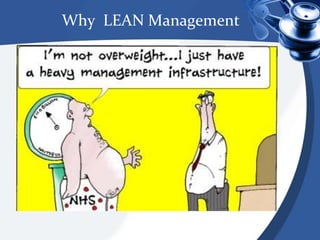
LegalWhy  LEAN Management
What is Lean?It is creating a culture of value and eliminating waste in order to maximize quality of service.
Lean process involves :    “…determining the value of any given process by distinguishing value-added steps from                       non-value-added steps and eliminating waste so that ultimately every step adds value to                                                the process” (Institute for Healthcare Improvement 2005: 2)
The    5     Lean principles               -     Value
               -     Value Stream
               -     Flow
               -     Pull
               -     PerfectionLean thinking categories of waste and health care examplesCorrection (defects): Adverse drug reactions Readmission because of inappropriate dischargeWaiting: Waiting for doctors to discharge patientsWaiting for test resultsTransportation: Central equipment stores rather than ward based stores for commonly used items
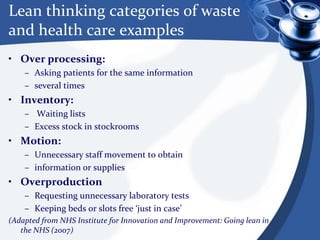
Lean thinking categories of waste and health care examplesOver processing:Asking patients for the same informationseveral timesInventory:Waiting listsExcess stock in stockroomsMotion: Unnecessary staff movement to obtaininformation or suppliesOverproduction Requesting unnecessary laboratory testsKeeping beds or slots free ‘just in case’(Adapted from NHS Institute for Innovation and Improvement: Going lean in the NHS (2007)
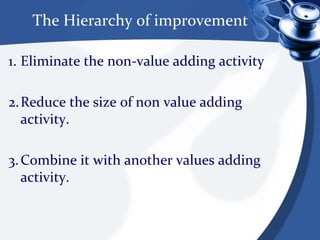
      The Hierarchy of improvementEliminate the non-value adding activityReduce the size of non value adding activity.Combine it with another values adding activity.
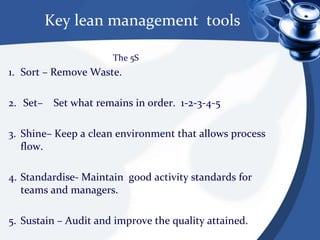
         Key lean management  tools                                               The 5SSort – Remove Waste. Set–    Set what remains in order.  1-2-3-4-5Shine– Keep a clean environment that allows process flow.Standardise- Maintain  good activity standards for  teams and managers.Sustain – Audit and improve the quality attained.
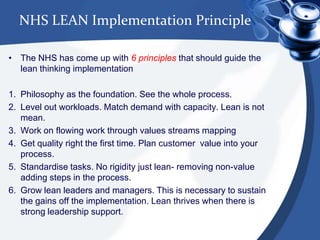
   NHS LEAN Implementation PrincipleThe NHS has come up with 6 principles that should guide the lean thinking implementationPhilosophy as the foundation. See the whole process.Level out workloads. Match demand with capacity. Lean is not mean.Work on flowing work through values streams mappingGet quality right the first time. Plan customer  value into your process.Standardise tasks. No rigidity just lean- removing non-value adding steps in the process.Grow lean leaders and managers. This is necessary to sustain the gains off the implementation. Lean thrives when there is strong leadership support.
             Value stream MappingThe following are the steps involved in mapping out values streams in an organisation so that lean principles can be appliedMap the process
Involve those who are involved in the process Ask why the queues and delay happens
Look to where demand is coming from and smooth it in to the process
Sustain value streams   Analysis of Organisational changeWhat is organisational Change?   According to Patrick Dawson, “it is a new way of thinking and working”(1994). This is exactly what lean management is about.
The five dimensions to  Organisational         Change   Content/ Character of Change of the change – TQM, Technological change, BPR, Cultural Change.Temporal Dimension – rate or pace of change.Scale of change – incremental or transformational.Political Dimension – Change contested or accepted?Intentionality.
LEAN as a tool for organisational change It is cultural change, with a view for total quality management.
It is slow pace but its gains appears soon
Incremental and transformational
It is political accepted tool in the NHS. Steve Mason, Audit Commission  during the Cranfield round Table shows its acceptance in other sectors and introduction to the NHS.
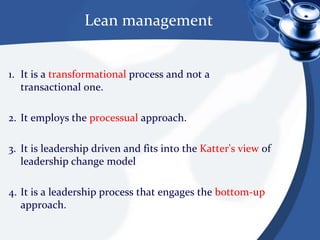
It is an intentional tool employed by change driversLean management It is a transformational process and not a transactional one.It employs the processualapproach.It is leadership driven and fits into the Katter's view of leadership change modelIt is a leadership process that engages the bottom-up approach.
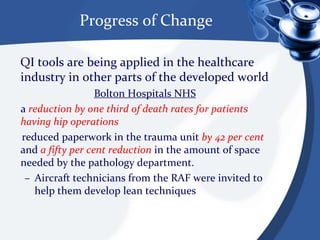
Progress of ChangeQI tools are being appliedin the healthcare industry in otherparts of the developed worldBolton Hospitals NHS a reduction by one third of death rates for patients having hip operations     reduced paperwork in the trauma unit by 42 per cent and a fifty per cent reduction in the amount of space needed by the pathology department. Aircraft technicians from the RAF were invited to help them develop lean techniques

Presentation

  • 1.
    Using Quality ImprovementTools to Deliver Better Health carePU 5004 - Group 6 Presentation
  • 2.
    MembersArnabComfort MichaelSantoshStella Victor Vishal
  • 3.
  • 4.
    Introduction Quality improvement is not only an important aspect of health care delivery; it is also used in other industries Quality improvement - an active, continuous process by all stakeholders (patients, tax payers, healthcare providers) to improve the quality of health care Different models(tools) have been developed overtime to effect quality improvement- TQM,BPR,FADE,PDSA,SIGMA, ANDLEAN PRINCIPLES 
  • 5.
    HistoryConceived in theautomobile industry in 1950s Popularized in automobile industries by early 1980s Introduced into the healthcare sector (U.K.USA, AUSTRALIA, EUROPEAN COUNTRIES) by 1990s Recently, in NHS, lean thinking is widely used by most hospitals. One of its early users is Royal Bolton Hospital Pathology department (August 2005)
  • 6.
    TriggerInternal Increased incidenceof hospital acquired infection and avoidable injuriesConstraint in hospital capacity and spaceExcess pressure on the staff leading to low moraleIncreasing waiting list and queues
  • 7.
  • 8.
    Economic- huge financialdeficit incurred by NHS
  • 9.
  • 10.
    LegalWhy LEANManagement
  • 11.
    What is Lean?Itis creating a culture of value and eliminating waste in order to maximize quality of service.
  • 12.
    Lean process involves: “…determining the value of any given process by distinguishing value-added steps from non-value-added steps and eliminating waste so that ultimately every step adds value to the process” (Institute for Healthcare Improvement 2005: 2)
  • 13.
    The 5 Lean principles - Value
  • 14.
    - Value Stream
  • 15.
    - Flow
  • 16.
    - Pull
  • 17.
    - PerfectionLean thinking categories of waste and health care examplesCorrection (defects): Adverse drug reactions Readmission because of inappropriate dischargeWaiting: Waiting for doctors to discharge patientsWaiting for test resultsTransportation: Central equipment stores rather than ward based stores for commonly used items
  • 18.
    Lean thinking categoriesof waste and health care examplesOver processing:Asking patients for the same informationseveral timesInventory:Waiting listsExcess stock in stockroomsMotion: Unnecessary staff movement to obtaininformation or suppliesOverproduction Requesting unnecessary laboratory testsKeeping beds or slots free ‘just in case’(Adapted from NHS Institute for Innovation and Improvement: Going lean in the NHS (2007)
  • 19.
    The Hierarchy of improvementEliminate the non-value adding activityReduce the size of non value adding activity.Combine it with another values adding activity.
  • 20.
    Key lean management tools The 5SSort – Remove Waste. Set– Set what remains in order. 1-2-3-4-5Shine– Keep a clean environment that allows process flow.Standardise- Maintain good activity standards for teams and managers.Sustain – Audit and improve the quality attained.
  • 21.
    NHS LEAN Implementation PrincipleThe NHS has come up with 6 principles that should guide the lean thinking implementationPhilosophy as the foundation. See the whole process.Level out workloads. Match demand with capacity. Lean is not mean.Work on flowing work through values streams mappingGet quality right the first time. Plan customer value into your process.Standardise tasks. No rigidity just lean- removing non-value adding steps in the process.Grow lean leaders and managers. This is necessary to sustain the gains off the implementation. Lean thrives when there is strong leadership support.
  • 22.
    Value stream MappingThe following are the steps involved in mapping out values streams in an organisation so that lean principles can be appliedMap the process
  • 23.
    Involve those whoare involved in the process Ask why the queues and delay happens
  • 24.
    Look to wheredemand is coming from and smooth it in to the process
  • 25.
    Sustain value streams Analysis of Organisational changeWhat is organisational Change? According to Patrick Dawson, “it is a new way of thinking and working”(1994). This is exactly what lean management is about.
  • 26.
    The five dimensionsto Organisational Change Content/ Character of Change of the change – TQM, Technological change, BPR, Cultural Change.Temporal Dimension – rate or pace of change.Scale of change – incremental or transformational.Political Dimension – Change contested or accepted?Intentionality.
  • 27.
    LEAN as atool for organisational change It is cultural change, with a view for total quality management.
  • 28.
    It is slowpace but its gains appears soon
  • 29.
  • 30.
    It is politicalaccepted tool in the NHS. Steve Mason, Audit Commission during the Cranfield round Table shows its acceptance in other sectors and introduction to the NHS.
  • 31.
    It is anintentional tool employed by change driversLean management It is a transformational process and not a transactional one.It employs the processualapproach.It is leadership driven and fits into the Katter's view of leadership change modelIt is a leadership process that engages the bottom-up approach.
  • 33.
    Progress of ChangeQItools are being appliedin the healthcare industry in otherparts of the developed worldBolton Hospitals NHS a reduction by one third of death rates for patients having hip operations reduced paperwork in the trauma unit by 42 per cent and a fifty per cent reduction in the amount of space needed by the pathology department. Aircraft technicians from the RAF were invited to help them develop lean techniques
  • 34.
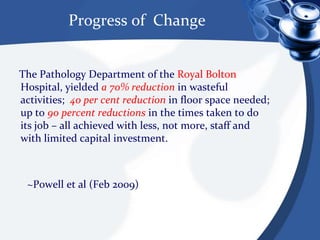
    Progress of ChangeThe Pathology Department of the Royal Bolton Hospital, yielded a 70% reduction in wasteful activities; 40 per cent reduction in floor space needed; up to 90 percent reductions in the times taken to do its job – all achieved with less, not more, staff and with limited capital investment. ~Powell et al (Feb 2009)
  • 35.
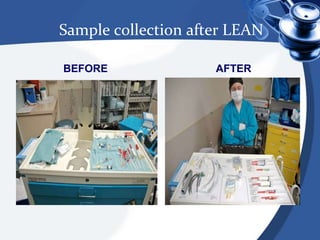
    Sample collection after LEAN BEFORE AFTER
  • 36.
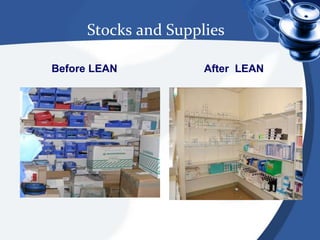
    Stocks and Supplies Before LEAN After LEAN
  • 37.
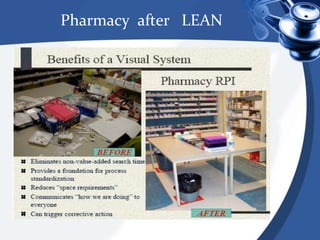
    Pharmacy after LEAN
  • 38.
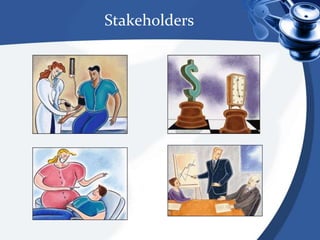
    Stakeholders
  • 39.
    Progress of ChangeThe NHS confederation/LEAN Enterprise Academy LEAN Healthcare Academy NHS Institute for Innovation and Improvement Lean Simulation SuitcaseNHS Lean Implementation handbook draftLean thinking plus Six Sigma.
  • 40.
    ChallengesSome challenges facing Lean have been identified (Young and Maclean 2009 )These areEvidenceValueMetricsResistance
  • 41.
    Conclusion But these challenges notwithstanding, many writers and journals have expressed optimism that Lean will not only work as a strategy but achieve better service delivery if fully implemented in the NHS
  • 42.
    LEAN IS NOT...LEAN is not Mean LEAN is not Cost cutting LEAN is not restructuring
  • 43.