LEAN Recruiting


 Eliminating waste and
improving process flow


         Cathy Henesey, SPHR
      Leader, Talent Acquisition
  Trane, a business of Ingersoll Rand
History of LEAN Manufacturing*

     Taiichi Ohno is regarded as the founder of the Toyota Production System (TPS) which was
      developed from 1950 following an excursion to the Rouge Ford plant in the US by Eiji Toyoda,
      a young engineer who reported his findings on the Ford system back to Ohno.

     In the English translation of his book ‘TPS – beyond large scale production’ Ohno (1988)
      describes how TPS evolved out of need, as the market place in post war Japan required small
      quantities of cars to be produced in many varieties. This was very different to the Ford
      principle of mass-producing the same Automobiles in large production runs.

     Womack, Jones and Roos (1990) coined the phrase ‘Lean Manufacturing’ to describe TPS
      when they printed the results of a five-year study into the automotive industry in the book
      ‘The Machine That Changed The World’. This gives a pretty good insight into The History Of
      Lean Manufacturing

     Even with the massive amount of research that has taken place into the Toyota Production
      System, fifty one years after it was born, Slack et al (2001, p481) still refer to Lean
      Manufacturing as a ‘radical departure from traditional operations practice’.

     Ohno (1998) describes the most important objective of the TPS as increasing production
      efficiency through consistently and thoroughly eliminating waste.

*Source: www.beyondlean.com
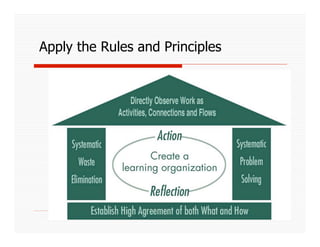
Apply the Rules and Principles
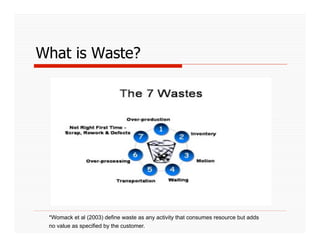
What is Waste?


 *Womack et al (2003) define waste as any activity that consumes resource but adds
 no value as specified by the customer.
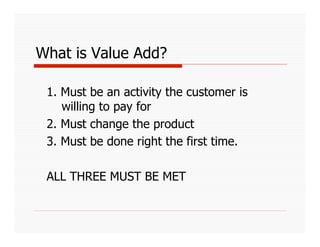
What is Value Add?

 1. Must be an activity the customer is
    willing to pay for
 2. Must change the product
 3. Must be done right the first time.

 ALL THREE MUST BE MET
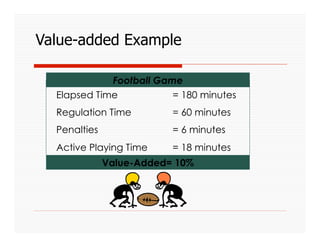
Value-added Example

             Football Game
  Elapsed Time           = 180 minutes
  Regulation Time         = 60 minutes
  Penalties               = 6 minutes
  Active Playing Time     = 18 minutes
              Value-Added= 10%
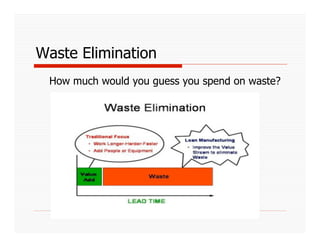
Waste Elimination
 How much would you guess you spend on waste?
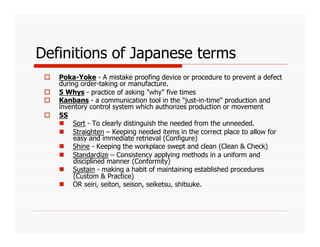
Definitions of Japanese terms
     Poka-Yoke - A mistake proofing device or procedure to prevent a defect
      during order-taking or manufacture.
     5 Whys - practice of asking "why" five times
     Kanbans - a communication tool in the "just-in-time" production and
      inventory control system which authorizes production or movement
     5S
        Sort - To clearly distinguish the needed from the unneeded.
        Straighten – Keeping needed items in the correct place to allow for
           easy and immediate retrieval (Configure)
        Shine - Keeping the workplace swept and clean (Clean & Check)
        Standardize – Consistency applying methods in a uniform and
           disciplined manner (Conformity)
        Sustain - making a habit of maintaining established procedures
           (Custom & Practice)
        OR seiri, seiton, seison, seiketsu, shitsuke.
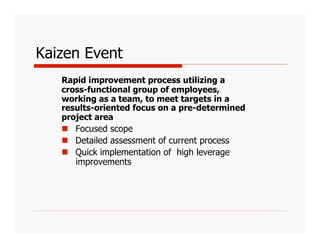
Kaizen Event
   Rapid improvement process utilizing a
   cross-functional group of employees,
   working as a team, to meet targets in a
   results-oriented focus on a pre-determined
   project area
     Focused scope
     Detailed assessment of current process
     Quick implementation of high leverage
      improvements
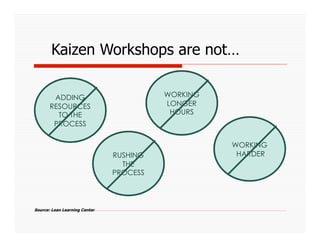
Kaizen Workshops are not…

        ADDING                           WORKING
       RESOURCES                         LONGER
         TO THE                           HOURS
        PROCESS

                                                   WORKING
                               RUSHING              HARDER
                                 THE
                               PROCESS


Source: Lean Learning Center
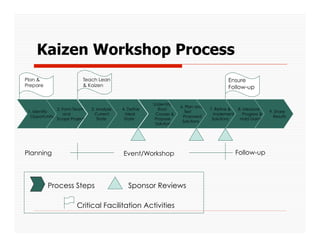
Kaizen Workshop Process
Plan &                    Teach Lean                                                      Ensure
Prepare                   & Kaizen                                                        Follow-up

                                                       5.Identify
                                                                    6. Plan and
              2. Form Team    3. Analyze   4. Define      Root                    7. Refine &   8. Measure
 1. Identify                                                          Test                                     9. Share
                 and            Current      Ideal      Causes &                    Implement     Progress &
  Opportunity                                                        Proposed                                    Results
              Scope Project      State      State       Propose                    Solutions     Hold Gains
                                                                     Solutions
                                                        Solutions


Planning                                   Event/Workshop                                       Follow-up


          Process Steps                       Sponsor Reviews

                       Critical Facilitation Activities
Trane TA Kaizen Event
   Improve the “Days to Fill” a Position
     Current Average “Days to Fill” = 92 Days
     Goal Average “Days to Fill” = 60 Days
        This is the industry standard
        Trane takes an average of 32 days longer
         than the industry standard
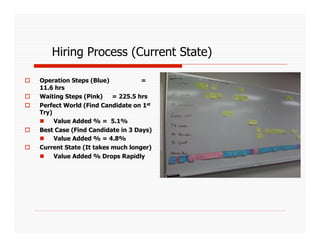
Hiring Process (Current State)

    Operation Steps (Blue)           =
     11.6 hrs
    Waiting Steps (Pink)    = 225.5 hrs
    Perfect World (Find Candidate on 1st
     Try)
       Value Added % = 5.1%
    Best Case (Find Candidate in 3 Days)
       Value Added % = 4.8%
    Current State (It takes much longer)
       Value Added % Drops Rapidly
Hiring State (Ideal)
    Minimum of 6 months headcount forecast
    Above Median to Market Leader in Compensation
       Currently Trane is in the 50th percentile of the Durable Goods Market
    14 Days to Fill Job
       Currently average 92 days to fill job
    Verbal Offer Extended at Face-To-Face Interview
    95% Offer Rate Per Face-To-Face Interview
       Current rate = 33%
    95% Offer Acceptance Rate
       Current rate = 90%
    Recruit from Pool (People Waiting to Work for Trane)
    25% Entry Level Positions
       Current percentage = 0.03%
    100% Reduction in Unqualified Resumes Reviewed
    Clear, Concise, Enticing Job Descriptions
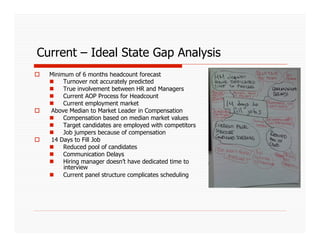
Current – Ideal State Gap Analysis
    Minimum of 6 months headcount forecast
       Turnover not accurately predicted
       True involvement between HR and Managers
       Current AOP Process for Headcount
       Current employment market
    Above Median to Market Leader in Compensation
       Compensation based on median market values
       Target candidates are employed with competitors
       Job jumpers because of compensation
    14 Days to Fill Job
       Reduced pool of candidates
       Communication Delays
       Hiring manager doesn’t have dedicated time to
          interview
       Current panel structure complicates scheduling
Current – Ideal State Gap Analysis

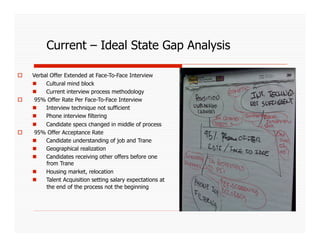
    Verbal Offer Extended at Face-To-Face Interview
         Cultural mind block
         Current interview process methodology
     95% Offer Rate Per Face-To-Face Interview
         Interview technique not sufficient
         Phone interview filtering
         Candidate specs changed in middle of process
     95% Offer Acceptance Rate
         Candidate understanding of job and Trane
         Geographical realization
         Candidates receiving other offers before one
          from Trane
         Housing market, relocation
         Talent Acquisition setting salary expectations at
          the end of the process not the beginning
Current – Ideal State Gap Analysis
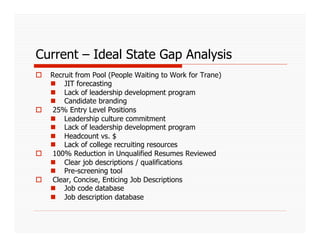
    Recruit from Pool (People Waiting to Work for Trane)
       JIT forecasting
       Lack of leadership development program
       Candidate branding
     25% Entry Level Positions
       Leadership culture commitment
       Lack of leadership development program
       Headcount vs. $
       Lack of college recruiting resources
     100% Reduction in Unqualified Resumes Reviewed
       Clear job descriptions / qualifications
       Pre-screening tool
     Clear, Concise, Enticing Job Descriptions
       Job code database
       Job description database
Information Discovered
  2007 Turnover Rate = 24%
     The cost of replacing someone (recruiting, relocation, and
       training) is not accounted for well in the AOP
     Need to have a report to understand the turnover rate
       better in order improve the AOP process
  Lead time in hiring process is reduced just by the hiring manager
   making the hiring process a high priority
     High Priority Managers Time To Fill = 37 Days
     Low Priority Managers Time To Fill = 223 Days
  Job Code Database cleanup is on hold right now
Standard Work for Hiring Process

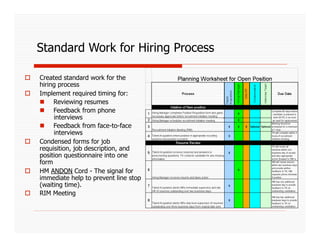
    Created standard work for the
     hiring process
    Implement required timing for:
       Reviewing resumes
       Feedback from phone
          interviews
       Feedback from face-to-face
          interviews
    Condensed forms for job
     requisition, job description, and
     position questionnaire into one
     form
    HM ANDON Cord - The signal for
     immediate help to prevent line stop
     (waiting time).
    RIM Meeting
Future Needs Identified
    Company Career Site – Enhanced
    Leadership Development Program for entry level candidates.
    Circulate final version of standard work to get buy-in
    Educate appropriate people on standard work for the hiring
     process.
    Educate appropriate people on pre-screening questions in
     ATS. Allows people that did not pass the pre-screening
     questions to be highlighted with a ‘KO’.
    Make the turnover rate report meaningful so it can be used
     for AOP.
    Develop ‘New Employee – Position Requirement’ template
     with drop down lists.
    Feasibility of Job Description Database.
    Feasibility of Candidate Recruitment Portal.
Communicate Results

       • Share results with team members, ad hoc
         team members, suppliers, etc.
       • Communicate results to organization using
         company newsletter, intranet, or e-mails
       • Build momentum and commitment for
         future Kaizen sessions
       • Communicate results to senior leadership
REFLECTION
  Reflect 30 days later on progress
  SO, Let’s Reflect……….
Contact Information
   Cathy Henesey
   Cathy.Henesey@trane.com
   903-581-9109 Work
   214-725-0710 Personal Cell
   Twitter name @cathyhenesey
   www.linkedin.com/in/cathyhenesey

Lean Methods In Recruiting

  • 1.
    LEAN Recruiting Eliminatingwaste and improving process flow Cathy Henesey, SPHR Leader, Talent Acquisition Trane, a business of Ingersoll Rand
  • 2.
    History of LEANManufacturing*   Taiichi Ohno is regarded as the founder of the Toyota Production System (TPS) which was developed from 1950 following an excursion to the Rouge Ford plant in the US by Eiji Toyoda, a young engineer who reported his findings on the Ford system back to Ohno.   In the English translation of his book ‘TPS – beyond large scale production’ Ohno (1988) describes how TPS evolved out of need, as the market place in post war Japan required small quantities of cars to be produced in many varieties. This was very different to the Ford principle of mass-producing the same Automobiles in large production runs.   Womack, Jones and Roos (1990) coined the phrase ‘Lean Manufacturing’ to describe TPS when they printed the results of a five-year study into the automotive industry in the book ‘The Machine That Changed The World’. This gives a pretty good insight into The History Of Lean Manufacturing   Even with the massive amount of research that has taken place into the Toyota Production System, fifty one years after it was born, Slack et al (2001, p481) still refer to Lean Manufacturing as a ‘radical departure from traditional operations practice’.   Ohno (1998) describes the most important objective of the TPS as increasing production efficiency through consistently and thoroughly eliminating waste. *Source: www.beyondlean.com
  • 3.
    Apply the Rulesand Principles
  • 4.
    What is Waste? *Womack et al (2003) define waste as any activity that consumes resource but adds no value as specified by the customer.
  • 5.
    What is ValueAdd? 1. Must be an activity the customer is willing to pay for 2. Must change the product 3. Must be done right the first time. ALL THREE MUST BE MET
  • 6.
    Value-added Example Football Game Elapsed Time = 180 minutes Regulation Time = 60 minutes Penalties = 6 minutes Active Playing Time = 18 minutes Value-Added= 10%
  • 7.
    Waste Elimination Howmuch would you guess you spend on waste?
  • 8.
    Definitions of Japaneseterms   Poka-Yoke - A mistake proofing device or procedure to prevent a defect during order-taking or manufacture.   5 Whys - practice of asking "why" five times   Kanbans - a communication tool in the "just-in-time" production and inventory control system which authorizes production or movement   5S   Sort - To clearly distinguish the needed from the unneeded.   Straighten – Keeping needed items in the correct place to allow for easy and immediate retrieval (Configure)   Shine - Keeping the workplace swept and clean (Clean & Check)   Standardize – Consistency applying methods in a uniform and disciplined manner (Conformity)   Sustain - making a habit of maintaining established procedures (Custom & Practice)   OR seiri, seiton, seison, seiketsu, shitsuke.
  • 9.
    Kaizen Event Rapid improvement process utilizing a cross-functional group of employees, working as a team, to meet targets in a results-oriented focus on a pre-determined project area   Focused scope   Detailed assessment of current process   Quick implementation of high leverage improvements
  • 10.
    Kaizen Workshops arenot… ADDING WORKING RESOURCES LONGER TO THE HOURS PROCESS WORKING RUSHING HARDER THE PROCESS Source: Lean Learning Center
  • 11.
    Kaizen Workshop Process Plan& Teach Lean Ensure Prepare & Kaizen Follow-up 5.Identify 6. Plan and 2. Form Team 3. Analyze 4. Define Root 7. Refine & 8. Measure 1. Identify Test 9. Share and Current Ideal Causes & Implement Progress & Opportunity Proposed Results Scope Project State State Propose Solutions Hold Gains Solutions Solutions Planning Event/Workshop Follow-up Process Steps Sponsor Reviews Critical Facilitation Activities
  • 12.
    Trane TA KaizenEvent   Improve the “Days to Fill” a Position   Current Average “Days to Fill” = 92 Days   Goal Average “Days to Fill” = 60 Days   This is the industry standard   Trane takes an average of 32 days longer than the industry standard
  • 13.
    Hiring Process (CurrentState)   Operation Steps (Blue) = 11.6 hrs   Waiting Steps (Pink) = 225.5 hrs   Perfect World (Find Candidate on 1st Try)   Value Added % = 5.1%   Best Case (Find Candidate in 3 Days)   Value Added % = 4.8%   Current State (It takes much longer)   Value Added % Drops Rapidly
  • 14.
    Hiring State (Ideal)   Minimum of 6 months headcount forecast   Above Median to Market Leader in Compensation   Currently Trane is in the 50th percentile of the Durable Goods Market   14 Days to Fill Job   Currently average 92 days to fill job   Verbal Offer Extended at Face-To-Face Interview   95% Offer Rate Per Face-To-Face Interview   Current rate = 33%   95% Offer Acceptance Rate   Current rate = 90%   Recruit from Pool (People Waiting to Work for Trane)   25% Entry Level Positions   Current percentage = 0.03%   100% Reduction in Unqualified Resumes Reviewed   Clear, Concise, Enticing Job Descriptions
  • 15.
    Current – IdealState Gap Analysis   Minimum of 6 months headcount forecast   Turnover not accurately predicted   True involvement between HR and Managers   Current AOP Process for Headcount   Current employment market   Above Median to Market Leader in Compensation   Compensation based on median market values   Target candidates are employed with competitors   Job jumpers because of compensation   14 Days to Fill Job   Reduced pool of candidates   Communication Delays   Hiring manager doesn’t have dedicated time to interview   Current panel structure complicates scheduling
  • 16.
    Current – IdealState Gap Analysis   Verbal Offer Extended at Face-To-Face Interview   Cultural mind block   Current interview process methodology   95% Offer Rate Per Face-To-Face Interview   Interview technique not sufficient   Phone interview filtering   Candidate specs changed in middle of process   95% Offer Acceptance Rate   Candidate understanding of job and Trane   Geographical realization   Candidates receiving other offers before one from Trane   Housing market, relocation   Talent Acquisition setting salary expectations at the end of the process not the beginning
  • 17.
    Current – IdealState Gap Analysis   Recruit from Pool (People Waiting to Work for Trane)   JIT forecasting   Lack of leadership development program   Candidate branding   25% Entry Level Positions   Leadership culture commitment   Lack of leadership development program   Headcount vs. $   Lack of college recruiting resources   100% Reduction in Unqualified Resumes Reviewed   Clear job descriptions / qualifications   Pre-screening tool   Clear, Concise, Enticing Job Descriptions   Job code database   Job description database
  • 18.
    Information Discovered   2007Turnover Rate = 24%   The cost of replacing someone (recruiting, relocation, and training) is not accounted for well in the AOP   Need to have a report to understand the turnover rate better in order improve the AOP process   Lead time in hiring process is reduced just by the hiring manager making the hiring process a high priority   High Priority Managers Time To Fill = 37 Days   Low Priority Managers Time To Fill = 223 Days   Job Code Database cleanup is on hold right now
  • 19.
    Standard Work forHiring Process   Created standard work for the hiring process   Implement required timing for:   Reviewing resumes   Feedback from phone interviews   Feedback from face-to-face interviews   Condensed forms for job requisition, job description, and position questionnaire into one form   HM ANDON Cord - The signal for immediate help to prevent line stop (waiting time).   RIM Meeting
  • 20.
    Future Needs Identified   Company Career Site – Enhanced   Leadership Development Program for entry level candidates.   Circulate final version of standard work to get buy-in   Educate appropriate people on standard work for the hiring process.   Educate appropriate people on pre-screening questions in ATS. Allows people that did not pass the pre-screening questions to be highlighted with a ‘KO’.   Make the turnover rate report meaningful so it can be used for AOP.   Develop ‘New Employee – Position Requirement’ template with drop down lists.   Feasibility of Job Description Database.   Feasibility of Candidate Recruitment Portal.
  • 21.
    Communicate Results • Share results with team members, ad hoc team members, suppliers, etc. • Communicate results to organization using company newsletter, intranet, or e-mails • Build momentum and commitment for future Kaizen sessions • Communicate results to senior leadership
  • 22.
    REFLECTION   Reflect 30days later on progress   SO, Let’s Reflect……….
  • 23.
    Contact Information  Cathy Henesey   Cathy.Henesey@trane.com   903-581-9109 Work   214-725-0710 Personal Cell   Twitter name @cathyhenesey   www.linkedin.com/in/cathyhenesey