24 October 2014 
Marius Meyer 
@SABPP1
Where can you get the slides? 
OPTION 1: FAST WAY 
•www.slideshare.net/SABPP 
•Twitter: @SABPP1 
•Blog: hrtoday.me 
OPTION 2: SLOW WAY 
•Via email on Monday
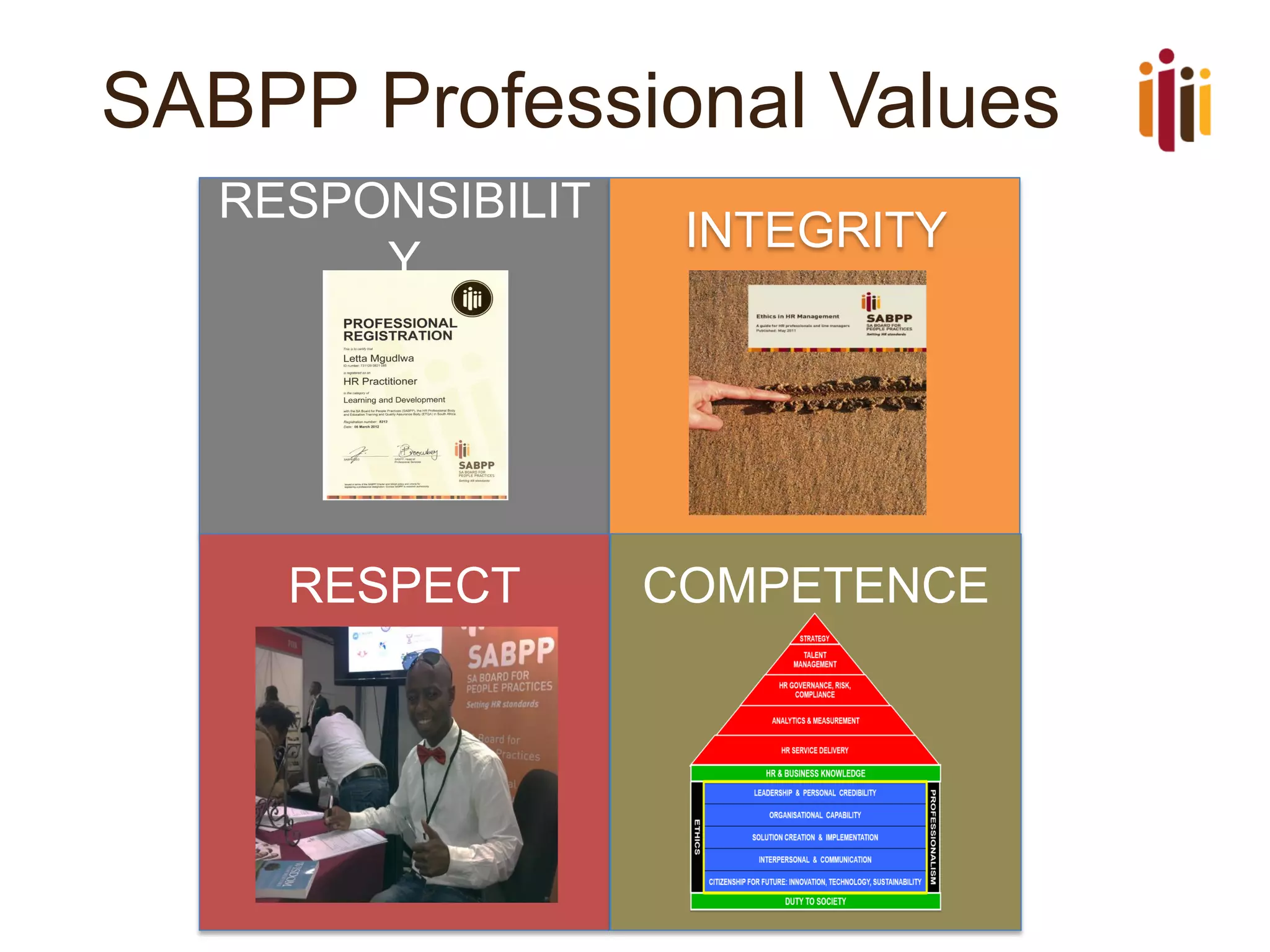
SABPP Professional Values 
RESPONSIBILITY 
I 
RESPECT 
INTEGRITY 
COMPETENCE
Importance of ethics for HR
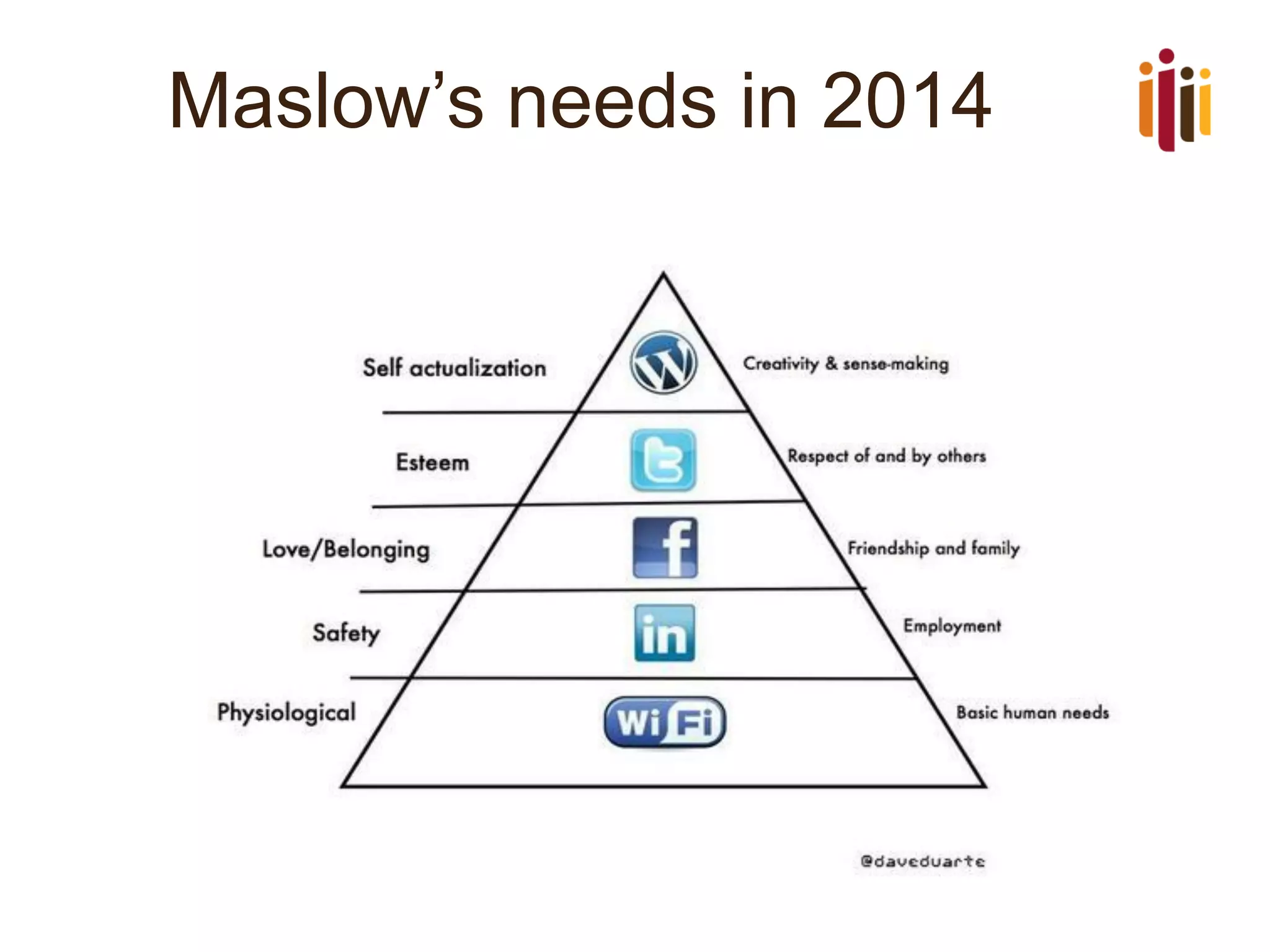
Maslow’s needs in 2014
New SABPP Model: HR Voice for Professionals 
Human resource development 
Research - info 
Value & visibility 
Openfor alliances 
Innovation 
CPD 
Excel- lence 
Quality 
assurance 
Learning growth & develop- ment 
Knowledge 
Self-governance 
Duty to society 
Ethics
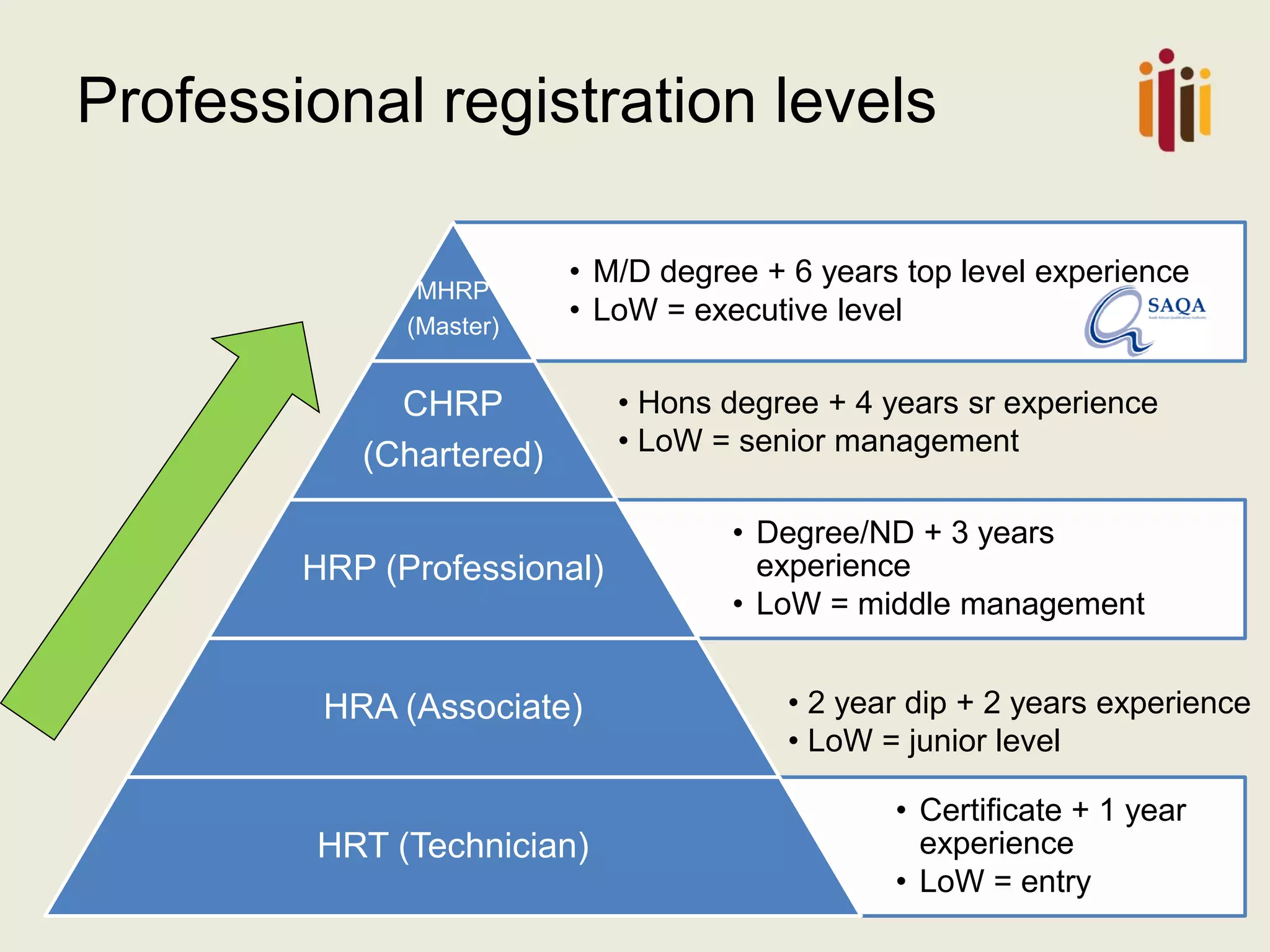
Professional registration levels 
•M/D degree + 6 years top level experience 
•LoW= executive level 
MHRP 
(Master) 
CHRP 
(Chartered) 
•Degree/ND + 3 years experience 
•LoW= middle management 
HRP (Professional) 
HRA (Associate) 
•Certificate + 1 year experience 
•LoW= entry 
HRT (Technician) 
•Hons degree + 4 years sr experience 
•LoW = senior management 
•2 year dip + 2 years experience 
•LoW = junior level
NEXT STEP –BECOME A REGISTERED HR PROFESSIONAL 
Apply to professional@sabpp.co.za so that we can register you as an HR professional in accordance with NQF Act (Act no 67 of 2008).
Marius Meyer, SABPP CEO receiving the SAQA certificate of professional body recognition from the Minister of Higher Education and Training, Dr Blade Nzimande.
SABPP BLOG 
For regular updates join our special 
HR Standards Blog: 
www.hrtoday.me
HR COMPETENCY HOUSE
SOUTH AFRICAN HR COMPETENCY MODEL 
STRATEGY 
TALENT MANAGEMENT 
HR GOVERNANCE, RISK, COMPLIANCE 
ANALYTICS & MEASUREMENT 
HR SERVICE DELIVERY 
5 HR 
CAPABILITIES 
LEADERSHIP & PERSONAL CREDIBILITY 
ORGANISATIONAL CAPABILITY 
SOLUTION CREATION & IMPLEMENTATION 
INTERPERSONAL & COMMUNICATION 
CITIZENSHIP FOR FUTURE: INNOVATION, TECHNOLOGY, SUSTAINABILITY 
CORE 
COMPETENCIES 
HR & BUSINESS KNOWLEDGE 
DUTY TO SOCIETY 
ETHICS 
PROFESSIONALISM 
4 PILLARS
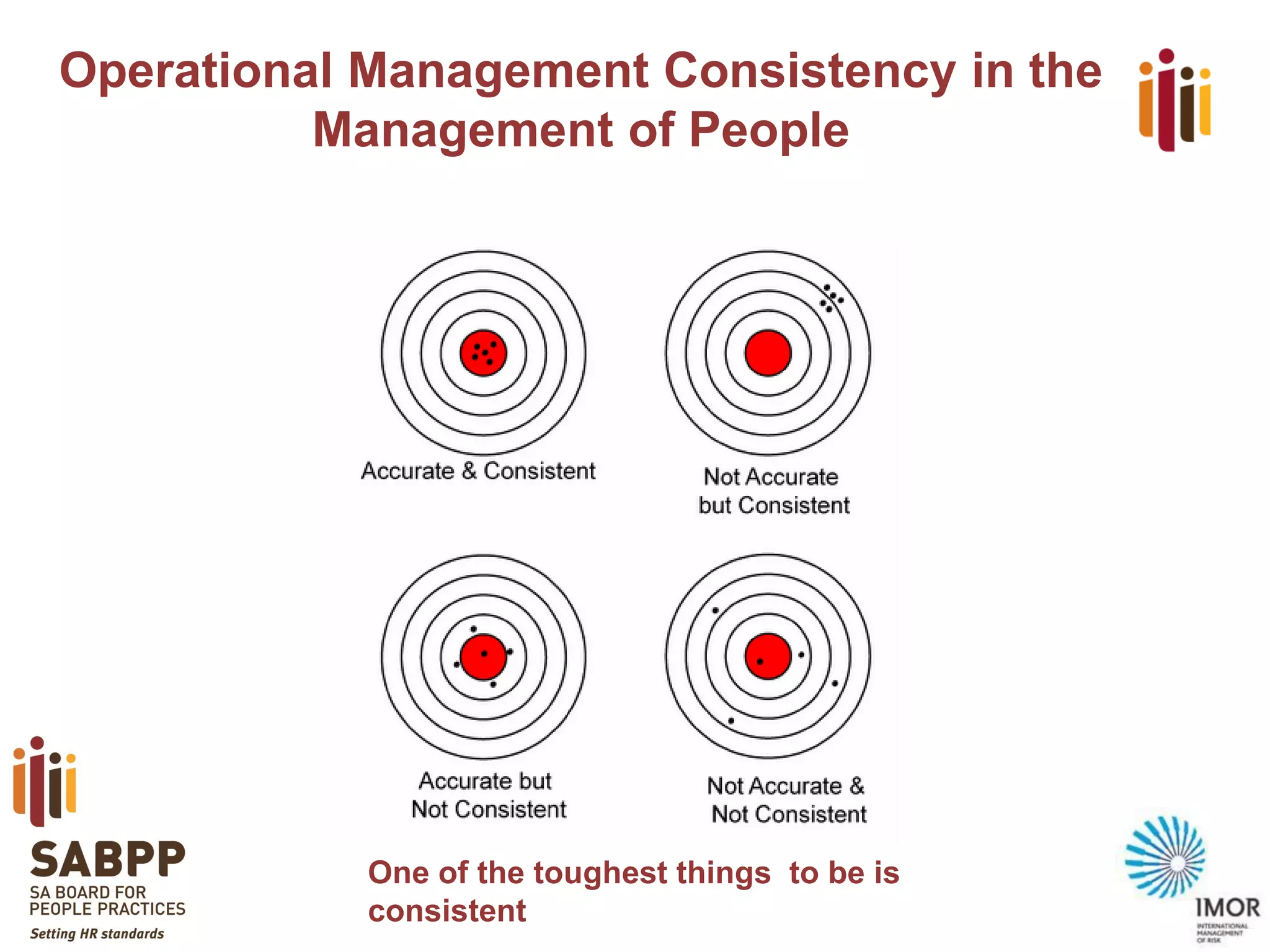
OperationalManagement Consistency in the Management of People 
One of the toughest things to be is consistent
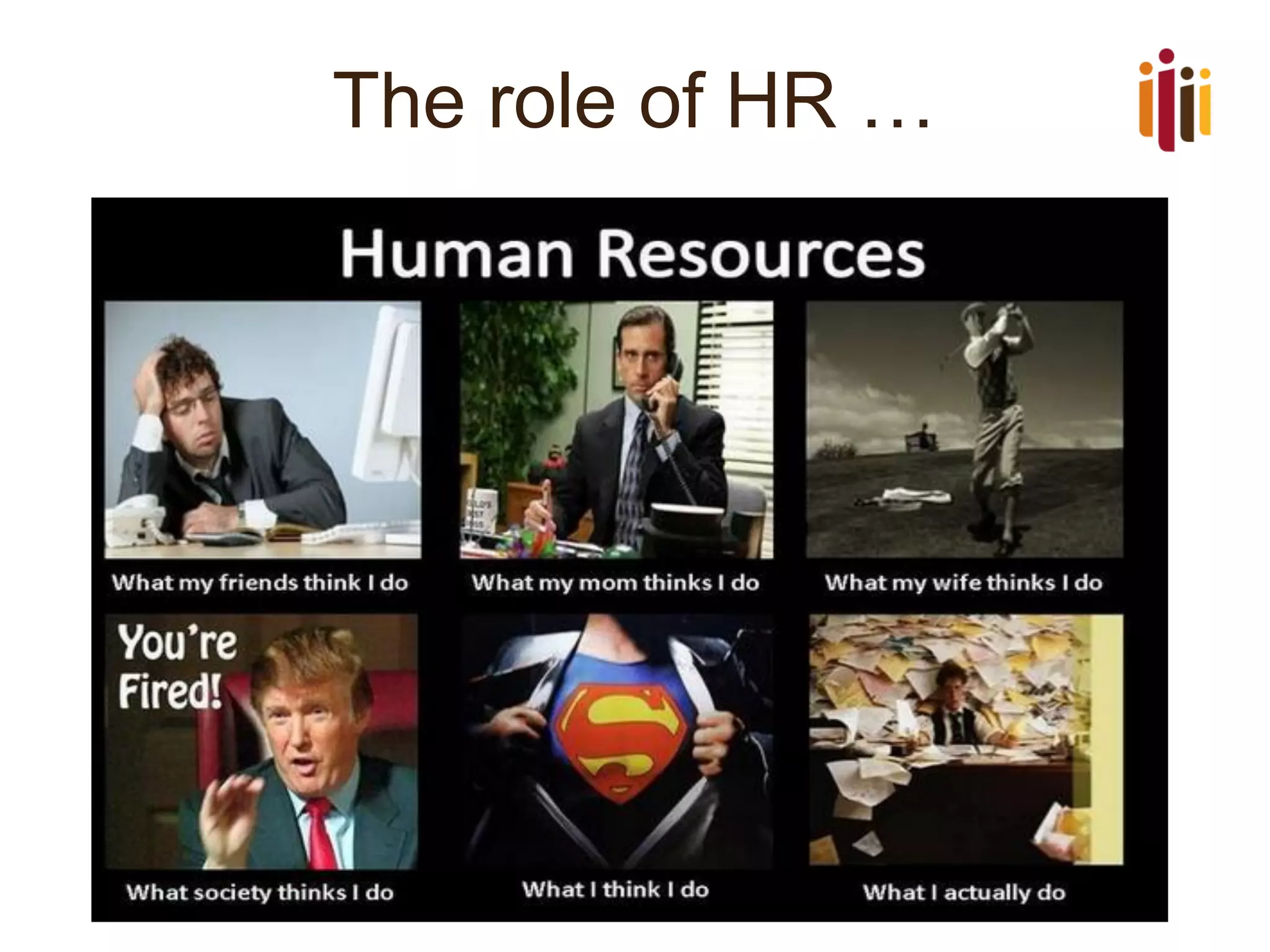
The role of HR …
Critical questions 
1.How many of you would like to eat in a restaurant without standards? 
2.Or stay in a hotel without standards? 
3.Or send your child to a school (or pre- school) without standards? 
4.Or get operated in a hospital without any standards? 
5.Or drive a car without standards? 
6.Or use an airline without standards?
Then when it comes to HR … 
Why do we continue to manage people and govern the most precious part of our organisations (i.e. people) without standards?
Top facts about HR 
•Human Capital is the biggest concern for CEOs (PwC). 
•Only 18% of CEOs feel confident that they have the right people in place to execute strategy (CEB). 
•Human Capital is the biggest risk in business (HCI Africa). 
•Skills crisis is the top obstacle to economic growth. 
•Strikes cost SA R 200 million+ per day.
More facts about HR 
•SA losing R12 billion a year due to absenteeism. 
•Only 19% auditors feel they use HR optimally (CG Index –Institute of Internal Auditors) 
•Only 5% employees understand business strategy. 
•World-wide 13% of employees actively engaged. 
•Companies with engaged employees outperform others by 202% (Dale Carnegie). 
•Companies with good HR Practices outperform others by treating HR as critical business function, these companies are 105% more profitable. 
•Average ROI on wellness programmes: 300%.
Why a national HR Standard? 
•We need to improve the quality of HR practice. 
•HR will not be seen as a true profession without standards. 
•Inconsistencies –practices, sites, business units, companies, industries. 
•Too many bad examples of things going wrong –Marikana, Medupi. 
•Raising the bar for the HR profession and business impact.
Myths about standards 
•Impose an onerous compliance regime 
•Duplicate best practices 
•Our company is so unique syndrome 
•Standards stifle innovation 
•Take flexibility away 
•Ignore industry differences 
•Too practical, not based on theory/research 
•Standards are cast in stone
The reality is …
Types of standards 
•Unit standards / Curriculum standards 
•Service delivery standards 
•Competence standards 
•Metrics/benchmarking standards 
•Professional practice standards 
•Business/industry/process/system standards -ISO
Global approaches to standards 
•Production and safety lead –ISO standards 
•Professional standards –accounting 
•Top global companies –their own standards 
•Canada –HR Standards & Metrics 
•UK –Human Capital Standard (BSI/CIPD) 
•ISO HR project started 
•South African National HR Standards 
•HR Standards in Namibia
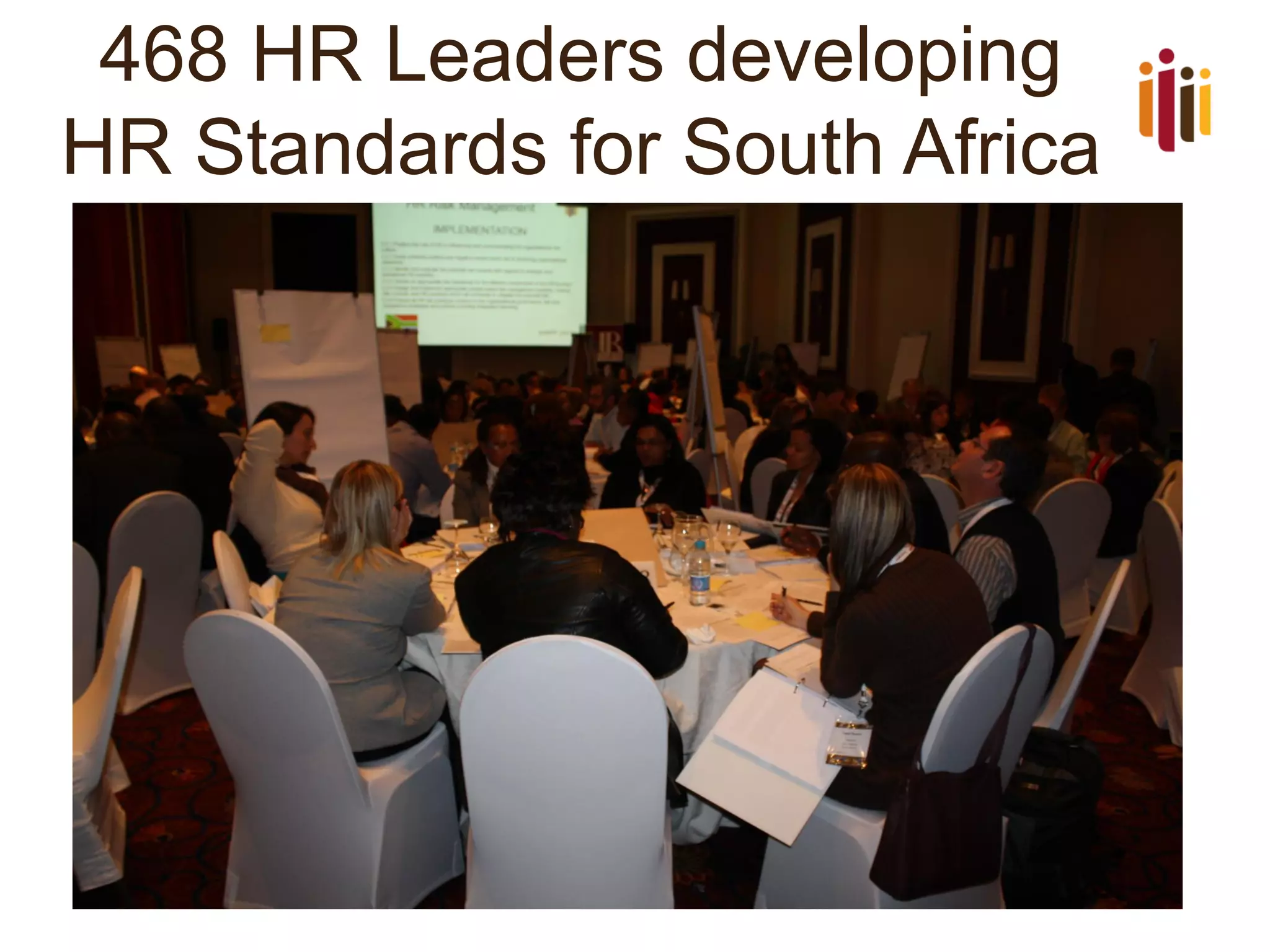
It all started on 21 May 2013 with 13 Standard facilitators
468 HR Leaders developing HR Standards for South Africa
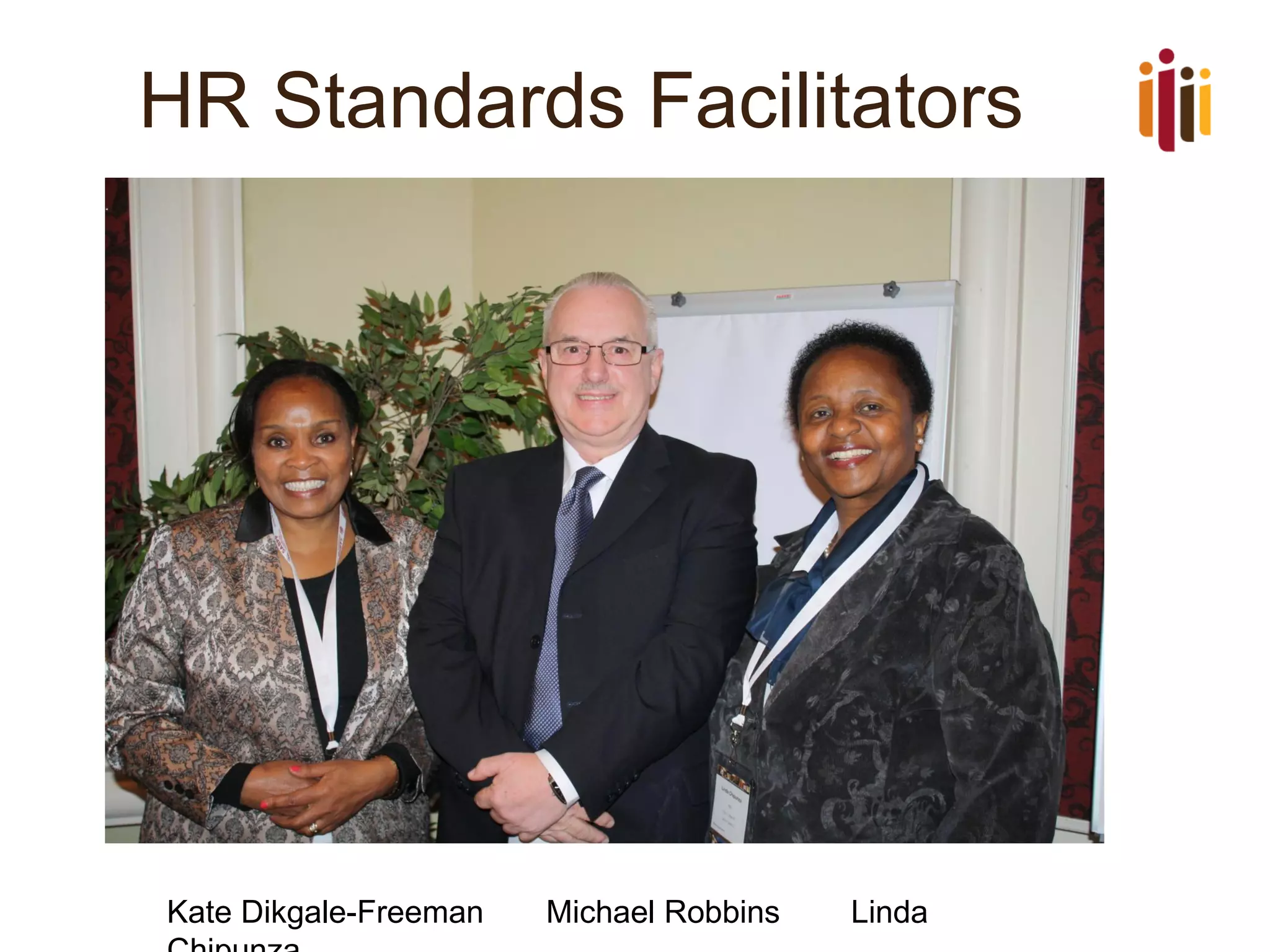
HR Standards Facilitators 
Kate Dikgale-Freeman Michael Robbins Linda Chipunza
BUSINESS STRATEGY –HR BUSINESS ALIGNMENT 
❶Strategic 
HRM 
❷Talent 
Management 
❸HR Risk 
Management 
HR ARCHITECTURE 
HR VALUE & 
DELIVERY PLATFORM 
❹ Work- force 
planning 
❺ 
Learning 
❻ 
Perfor- mance 
❼ 
Reward 
❽ 
Well- ness 
❾ 
ERM 
❿ 
OD 
⓫HR Service Delivery 
⓬ 
HR Technology 
(HRIS) 
Prepare 
Imple- 
ment 
Review 
Improve 
⓭HR MEASUREMENT 
HR Audit: Standards & Metrics 
H R C O M P E T E N C I E S 
© SABPP HRM SYSTEM STANDARDS MODEL
HR Standards Journey 
Phase 1: 
HR MANAGEMENT SYSTEM STANDARD 
(21 May 2013) 
Phase 2: 
HR MANAGEMENT SYSTEM APPLICATION STANDARD 
(20-21 Aug 2013) 
Phase 3: 
HR PROFESSIONAL 
PRACTICE STANDARDS 
(14 May 2014) 
“WHAT” STANDARD 
What are the elements of the HR system? 
13 elements: 
Definition 
Objectives 
Implementation 
(High level) 
“HOW TO” STANDARD 
How can we apply the HR System standard? 
How to apply the 13 standard elements 
“WHAT” AND “HOW” OF SPECIFIC PROFESSIONAL PRACTICE STANDARDS 
•Succession Planning 
•Employment Equity 
•Career Development 
•Engagement 
•Learning culture 
•Change management
HR Standards Files 
13 standards (2013) 
19 standards (2014)
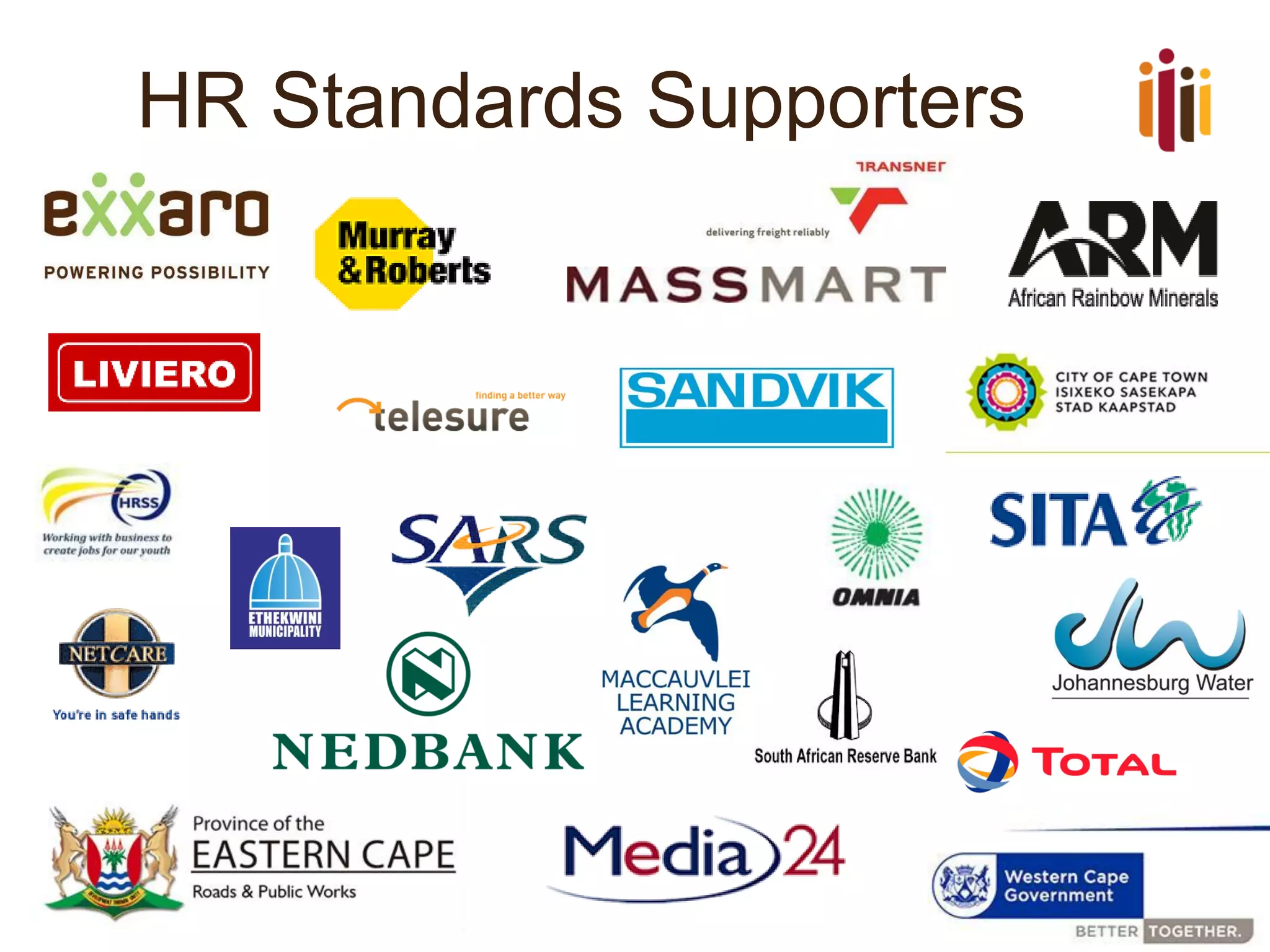
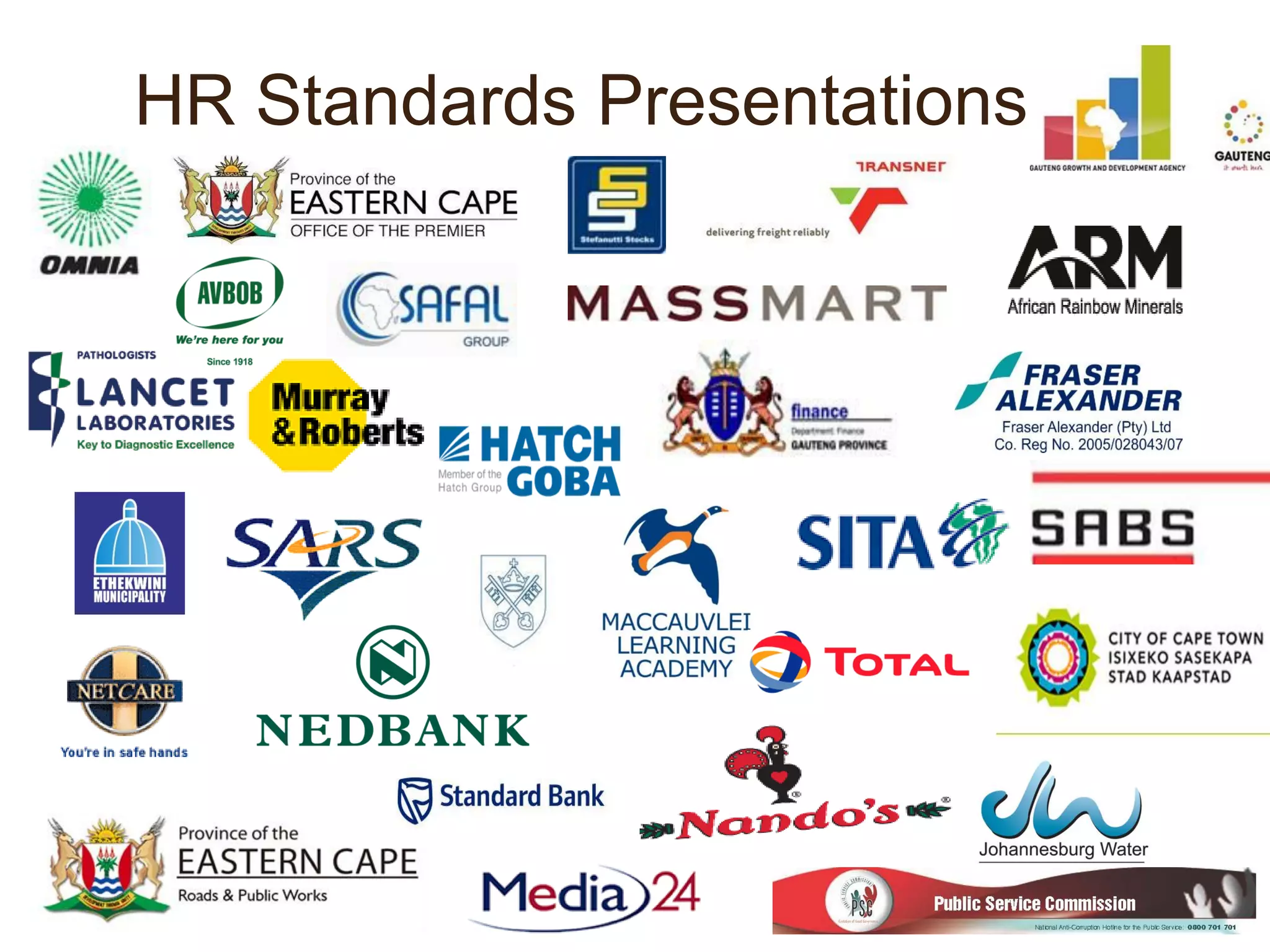
HR Standards Supporters
HR Standards Presentations
Business chamber support
HR Standards Case Studies
Professional forum support
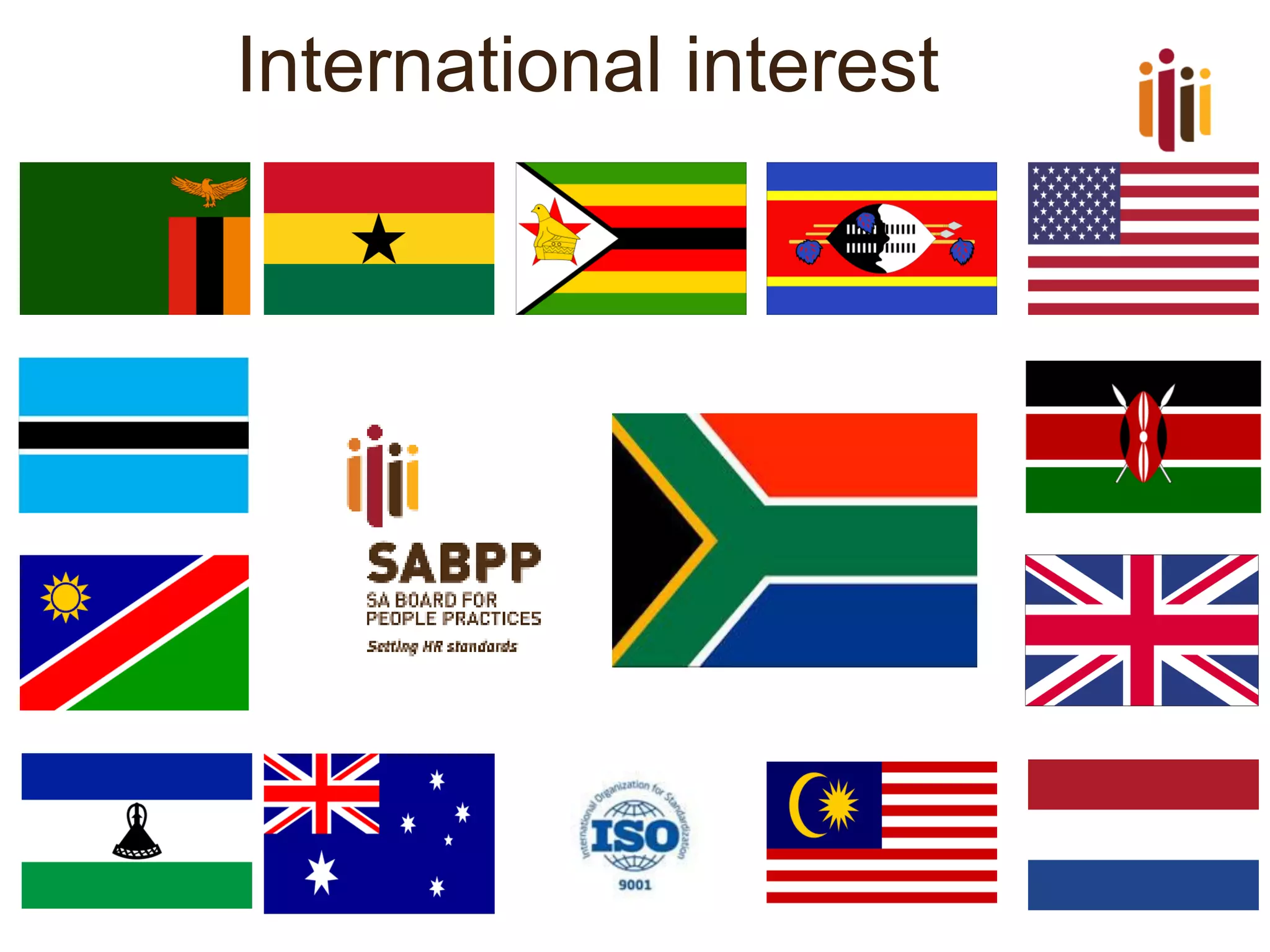
International HR bodies 
Tim Ekandjo, President: IPM Namibia & 
Marius Meyer, CEO: SABPP in Windhoek
Support from consulting firms
20+ Universities
International interest
BUSINESS STRATEGY –HR BUSINESS ALIGNMENT 
❶Strategic 
HRM 
❷Talent 
Management 
❸HR Risk 
Management 
HR ARCHITECTURE 
HR VALUE & 
DELIVERY PLATFORM 
❹ Work- force 
planning 
❺ 
Learning 
❻ 
Perfor- mance 
❼ 
Reward 
❽ 
Well- ness 
❾ 
ERM 
❿ 
OD 
⓫HR Service Delivery 
⓬ 
HR Technology 
(HRIS) 
Prepare 
Imple- 
ment 
Review 
Improve 
⓭HR MEASUREMENT 
HR Audit: Standards & Metrics 
H R C O M P E T E N C I E S 
SABPP HRM SYSTEM STANDARDS MODEL
STANDARD ELEMENT #1 
STRATEGIC HR MANAGEMENT 
❶
STRATEGIC HR MANAGEMENT STANDARD 
DEFINITION 
Strategic HR Management is a systematicapproach to developing and implementing long-term HRM strategies, policies and plans that enable the organisation to achieve its objectives. 
SABPP (2013)
STRATEGIC HR MANAGEMENT STANDARD 
OBJECTIVES 
1.2.1 To ensure the HR strategy is derived from and aligned to the organisation’s objectives in consultation with key organisational stakeholders. 
1.2.2 To analyse the internal and external socio-economic, political and technological environment and provide proactive people-related business solutions. 
1.2.3 To provide strategic direction and measurements for strategic innovation and sustainable people practices. 
1.2.4 To provide a foundation for the employment value proposition of the organisation. 
1.2.5 To establish a framework for the HR element of the organisation’s governance, risk and compliance policies, practices and procedures which balance the needs of all stakeholders. 
1.2.6 To determine an appropriate HR structure, allocate tasks and monitor the development of HR competence to deliver HR strategic objectives. 
SABPP (2013)
STRATEGIC HRM PROCESS 
Framework of HR policies & programmes 
Environmental scan (PESTL) 
HR structure, service model and capability development 
People strategy 
HR strategic agenda 
Organisation’s strategic intent 
HR strategic agenda 
HR business plan 
People strategy 
Allocate roles & responsibilities (line/HR/support functions) 
MONITOR & EVALUATE
Strategic HR: It is all about alignment
STANDARD ELEMENT 2 
TALENT MANAGEMENT 
❷
TALENT MANAGEMENT STANDARD 
DEFINITION 
Talent Management is the proactive design and implementation of an integrated talent- driven organisational strategy directed to attracting, deploying, developing, retaining and optimising the appropriate talent requirements as identified in the workforce plan to ensure a sustainable organisation. 
SABPP (2013)
TALENT MANAGEMENT 
OBJECTIVES 
2.2.1 To build a talent culture which defines the organisation’s philosophy, principles and integrated approach to talent, which leverages diversity and is communicated in a clear employment value proposition. 
2.2.2 To identify strategically critical positions and leadership roles and capabilities in the organisation into the future from the Workforce Plan that will determine the sustainability and growth of the organisation. 
2.2.3 To set up processes and systems which will: 
•Attract a sustainable pool of talent for current objectives and future organisation needs. 
•Achieve employment equity progress in the spirit of the legislation to achieve transformation. 
•Manage the retention and reward of talent. 
•Develop the required leadership skills. 
•Plan for succession to key roles 
•Identify high potential employees and link them with key future roles in the organisation through monitored development plans. 
•Identify through assessment the optimal development opportunities for talent. 
2.2.4 To agree appropriate roles for relevant stakeholders in the development and management of talent. 
2.2.5 To monitor and report on talent management key results areas and indicators. 
SABPP (2013)
Talent management
STANDARD ELEMENT 3 
HR RISK MANAGEMENT 
❸
HR RISK MANAGEMENT STANDARD 
DEFINITION 
HR Risk Management is a systematic approach of identifying and addressing people risks (uncertainties and opportunities) that can either have a positive or negative effect on the realisation of the objectives of an organisation.
HR Risk?
HR Risk Management 
OBJECTIVES 
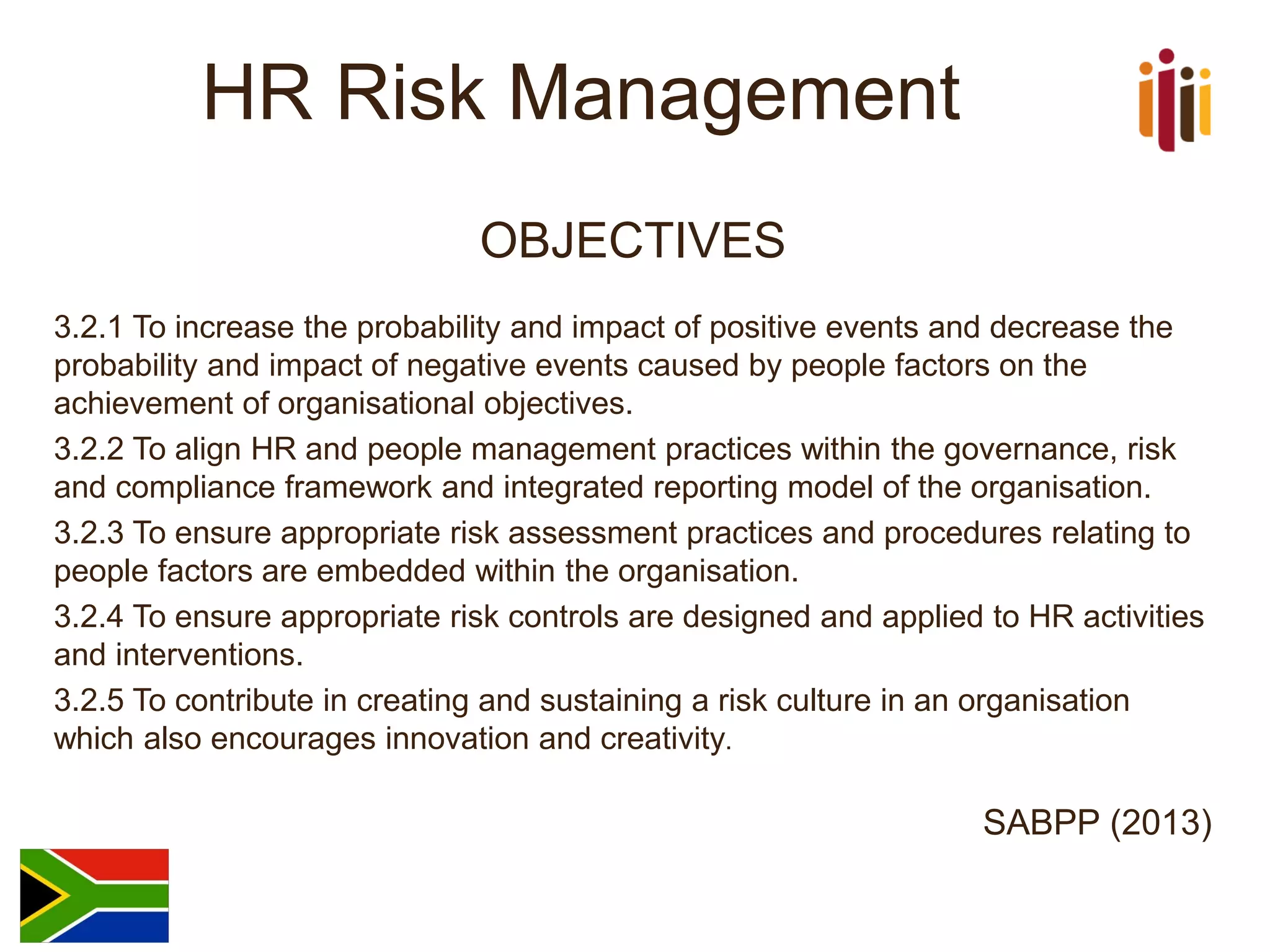
3.2.1 To increase the probability and impact of positive events and decrease the probability and impact of negative events caused by people factors on the achievement of organisational objectives. 
3.2.2 To align HR and people management practices within the governance, risk and compliance framework and integrated reporting model of the organisation. 
3.2.3 To ensure appropriate risk assessment practices and procedures relating to people factors are embedded within the organisation. 
3.2.4 To ensure appropriate risk controls are designed and applied to HR activities and interventions. 
3.2.5 To contribute in creating and sustaining a risk culture in an organisation which also encourages innovation and creativity. 
SABPP (2013)
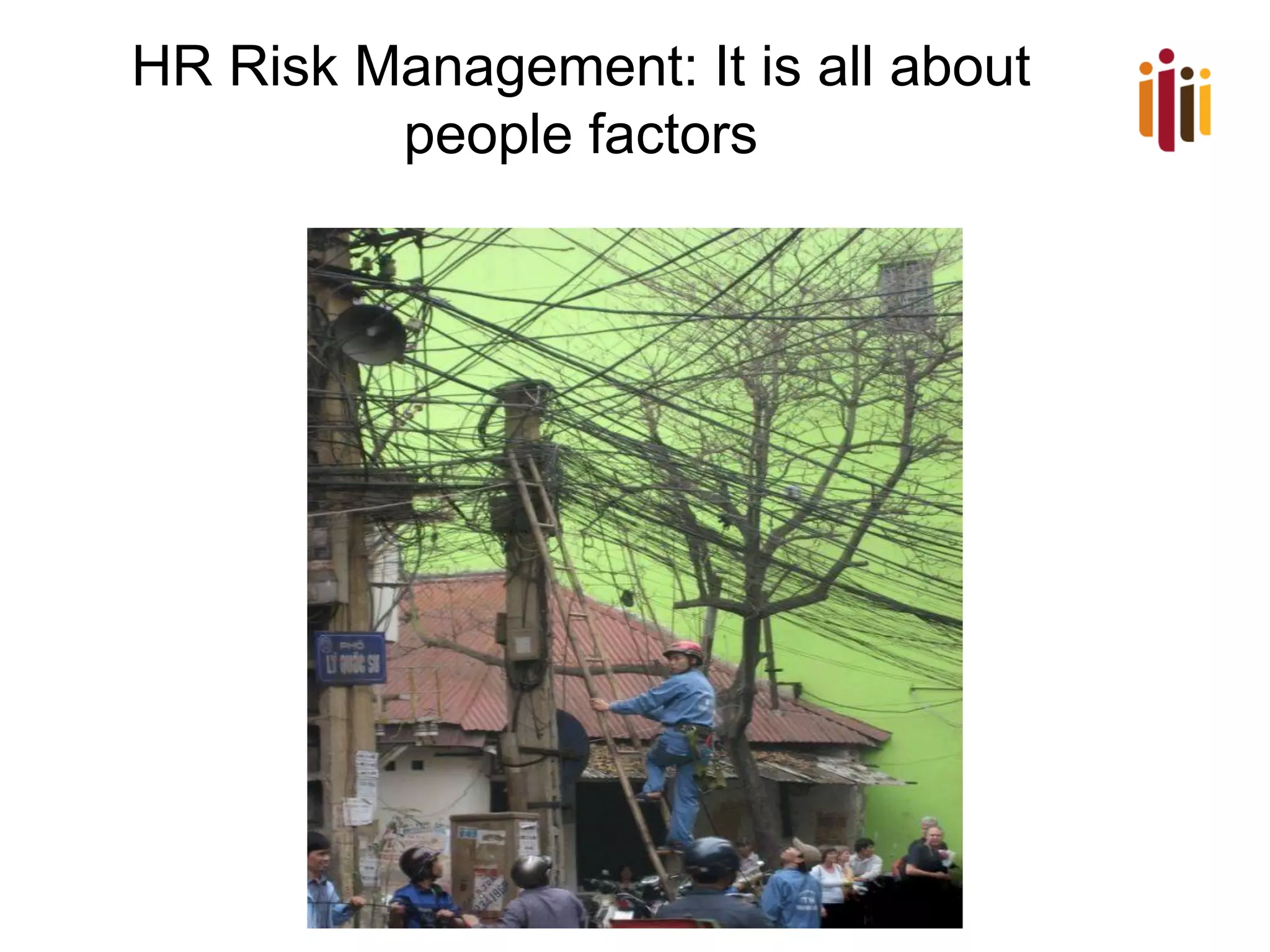
HR Risk Management: It is all about people factors
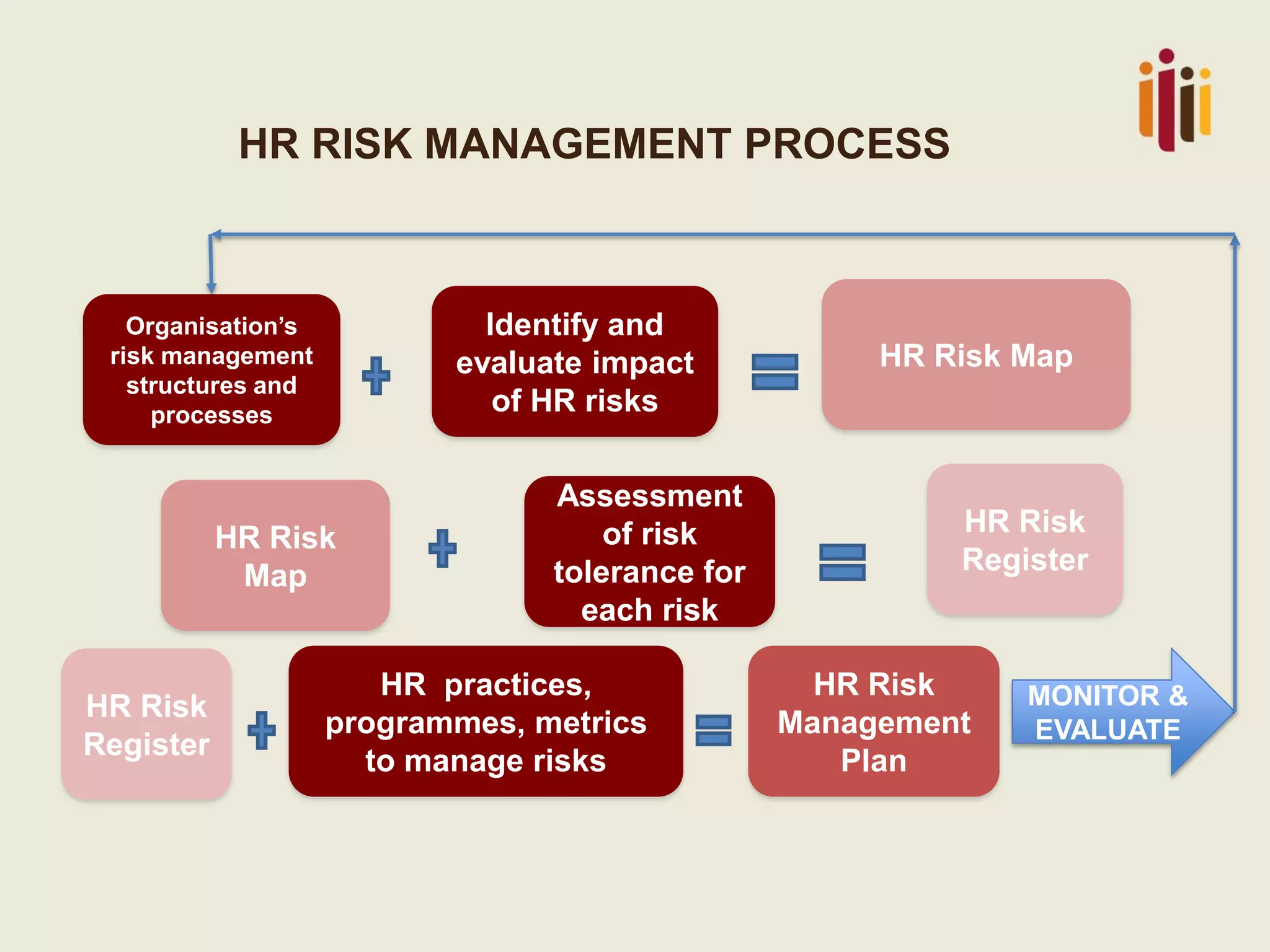
HR RISK MANAGEMENT PROCESS 
Assessment of risk tolerance for each risk 
Identify and evaluate impact of HR risks 
HR practices, programmes, metrics to manage risks 
HR Risk Map 
HR Risk Register 
Organisation’s risk management structures and processes 
HR Risk Register 
HR Risk Management Plan 
HR Risk Map 
MONITOR & EVALUATE
STANDARD ELEMENT 4 
WORKFORCE PLANNING 
❹
WORKFORCE PLANNING 
DEFINITION 
Workforce Planning is the systematic identification and analysis of organisational workforce needs culminating in a workforce plan to ensure sustainable organisational capability in pursuit of the achievement of its strategic and operational objectives.The workforce plan will set out the actions necessary to have the right people in the right place at the right time.
WORKFORCE PLANNING 
OBJECTIVES 
•To design a workforce plan which meets the needs of the organisation in consultation with line management, and adjust strategy accordingly, taking into account workforce and labour market trends in relation to the relevant industry sector, within the spirit of the employment equity legislation 
•To align the workforce planning cycle with the strategic planning and budgeting cycle of the organisation, as well as talent management where relevant 
•To ensure appropriate budgeting and cost modelling to prepare the budget for the workforce plan 
•To ensure an adequate supply and pipeline of appropriately qualified staff through sourcing staff and building the future supply of the right skills to meet the needs of the organisation 
SABPP (2013)
WORFORCE PLANNING PROCESS 
Future workforce forecasts - costed scenarios 
GAP ANALYSIS 
PLANS TO CLOSE GAPS 
Present workforce 
MONITOR & EVALUATE 
Business strategy & plans 
Internal & external trends 
COMPARE 
Workforce scheduling 
Recruitment, assessment and selection
STANDARD ELEMENT 5 
LEARNING AND DEVELOPMENT 
❺
LEARNING & DEVELOPMENT 
DEFINITION 
Learning and development is the practice of providing occupationally directed and other learning activities that enable and enhance the knowledge, practical skills and work place experience and behaviour of individuals and teams based on current and future occupational requirements for optimal organisational performance and sustainability. 
SABPP (2013)
LEARNING & DEVELOPMENT 
OBJECTIVES 
•To create an occupationally competent and engaged workforce which builds organisational capability, providing employees with opportunities to develop new knowledge and skills 
•To focus learning and development plans on improving people’s ability to perform to achieve organisational objectives and provide the means for measuring the impact of learning and development interventions. 
•To support and accelerate skills development and achievement of employment equity and organisational transformation and limit the impact of skills shortages. 
•To create a learning culture and environment that enables optimal individual, team and organisation learning and growth in both competencies and behaviour. 
•To capture and replicate and enhance critical knowledge within the organisation. 
•To ensure learning and development is a catalyst for continuous improvement, change and innovation. 
SABPP (2013)
LEARNING AND DEVELOPMENT PROCESS 
Integrated L&D approach & programmes 
Structure & capability of L&D resources 
MONITOR & EVALUATE 
Business strategy & plans 
External trends 
Knowledge management 
Skills develop- mentlegislation 
Current compet- encies
L&D is key
STANDARD ELEMENT 6 
PERFORMANCE MANAGEMENT 
❻
PERFORMANCE MANAGEMENT 
DEFINITION 
Performance management is a planned process of directing, developing, supporting, aligning and improving individual and team performance in enabling the sustained achievement of organisational objectives. 
SABPP (2013)
PERFORMANCE MANAGEMENT 
OBJECTIVES 
6.2.1 To translate and cascade broad organisational performance drivers into team and individual performance targets. 
6.2.2 To establish an appropriate performance management system, process, methodology relevant to the needs, size, scope and complexity of the organisation which will support the development of a performance culture. 
6.2.3 To link performance management to other HR processes to align appropriate performance consequences (reward, recognition and development opportunities) that attract, retain and motivate employees and to address poor performance. 
6.2.4 To ensure fair, ethical and organisation cultural practices focusing on the achievement of performance targets (that is, a high performance culture) in a sustainable way. 
6.2.5 To measure progress against agreed individual and team objectives that enable attainment of organisational objectives. 
SABPP (2013)
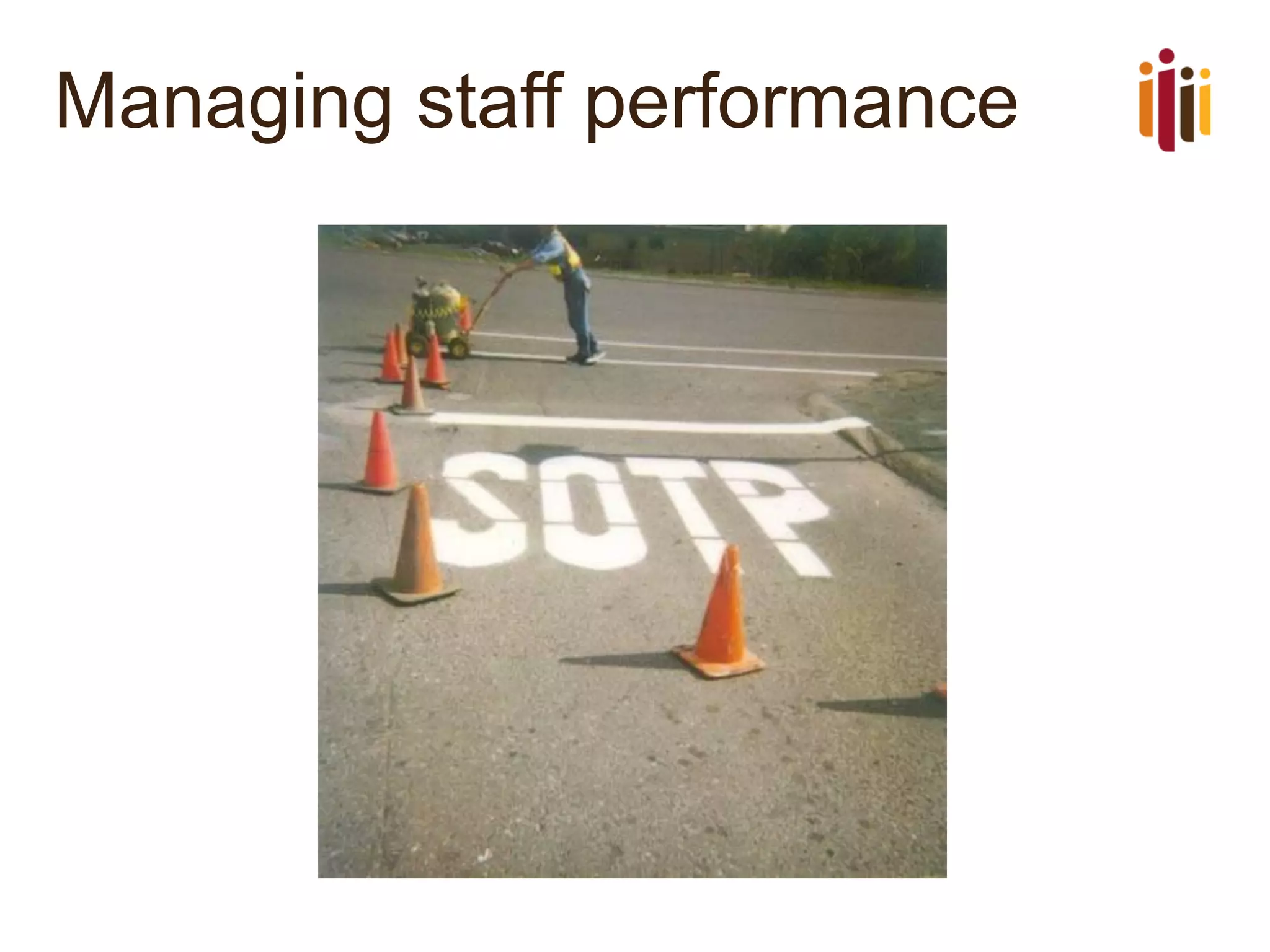
Managing staff performance
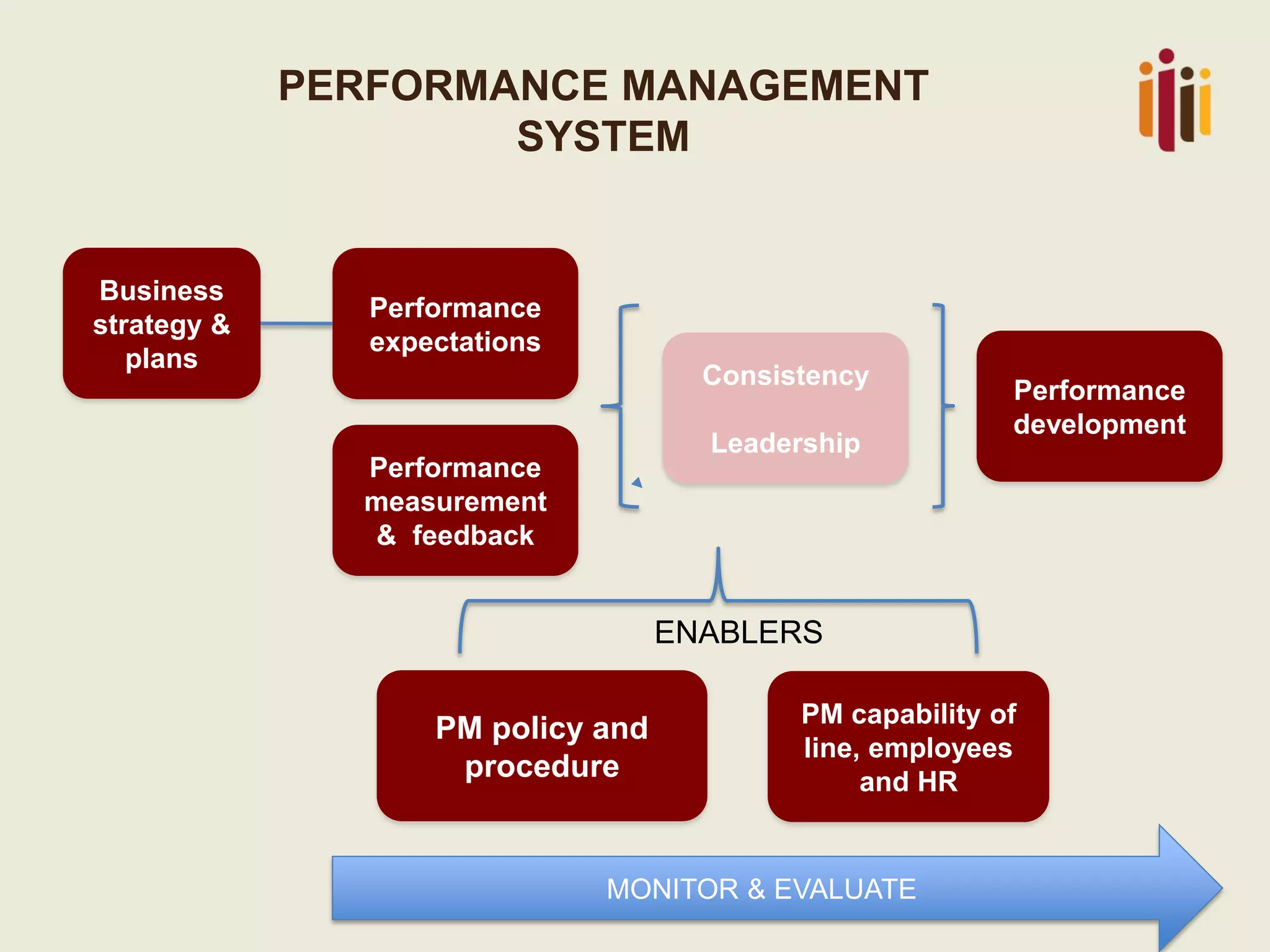
PERFORMANCE MANAGEMENT SYSTEM 
PM capability of line, employees and HR 
MONITOR & EVALUATE 
Business strategy & plans 
Performance expectations 
PM policy and procedure 
Performance measurement & feedback 
Consistency 
Leadership 
Performance development 
ENABLERS
STANDARD ELEMENT 7 
REWARD AND RECOGNITION 
❼
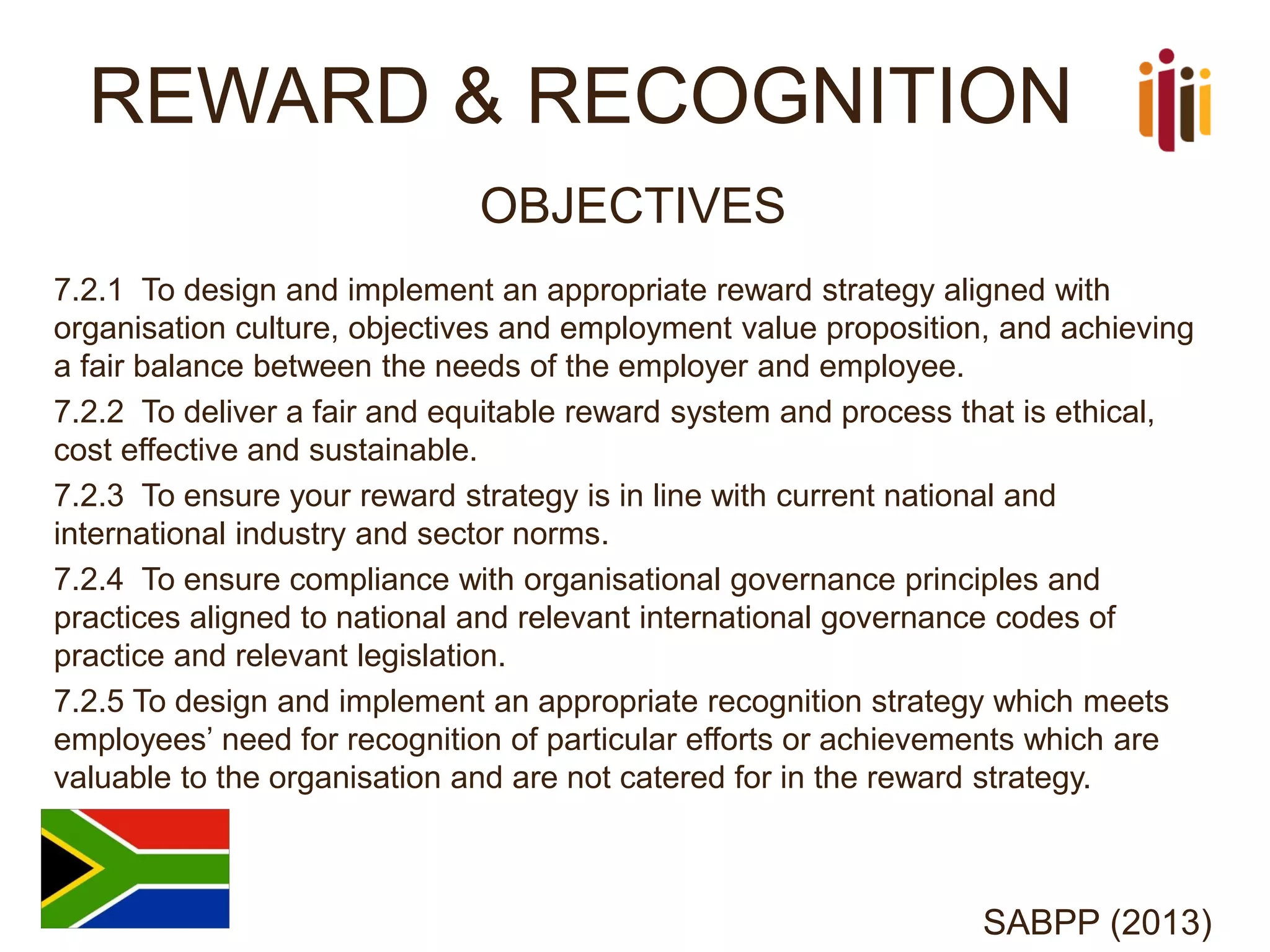
REWARD & RECOGNITION 
DEFINITION 
Reward is a strategy and system that enables organisations to offer fair and appropriate levels of pay and benefits in recognition for their contribution to the achievement of agreed deliverables in line with organisational objectives and values. 
Recognition is a related strategy and system that seeks to reward employees for other achievements through mechanisms outside the pay and benefits structure. 
SABPP (2013)
REWARD & RECOGNITION 
OBJECTIVES 
7.2.1 To design and implement an appropriate reward strategy aligned with organisation culture, objectives and employment value proposition, and achieving a fair balance between the needs of the employer and employee. 
7.2.2 To deliver a fair and equitable reward system and process that is ethical, cost effective and sustainable. 
7.2.3 To ensure your reward strategy is in line with current national and international industry and sector norms. 
7.2.4 To ensure compliance with organisational governance principles and practices aligned to national and relevant international governance codes of practice and relevant legislation. 
7.2.5 To design and implement an appropriate recognition strategy which meets employees’ need for recognition of particular efforts or achievements which are valuable to the organisation and are not catered for in the reward strategy. 
SABPP (2013)
Employee perspective on reward
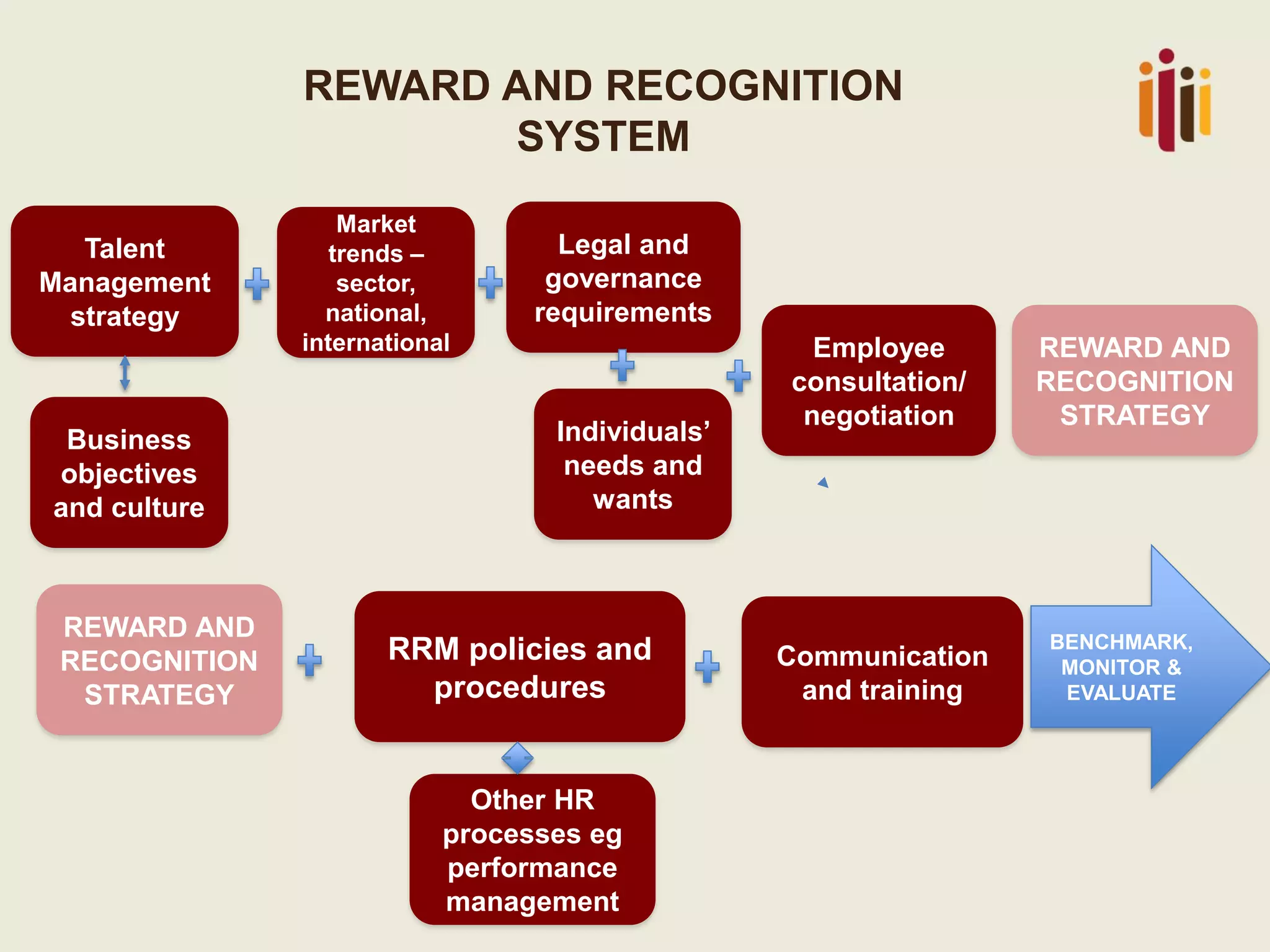
REWARD AND RECOGNITION SYSTEM 
Communication and training 
BENCHMARK, MONITOR & EVALUATE 
Business objectives and culture 
Other HR processes egperformance management 
RRM policies and procedures 
REWARD AND RECOGNITION STRATEGY 
Individuals’ needs and wants 
Legal and governance requirements 
Market trends – sector, national, international 
Talent Management strategy 
Employee consultation/ negotiation 
REWARD AND RECOGNITION STRATEGY
STANDARD ELEMENT 8 
EMPLOYEE WELLNESS 
❽
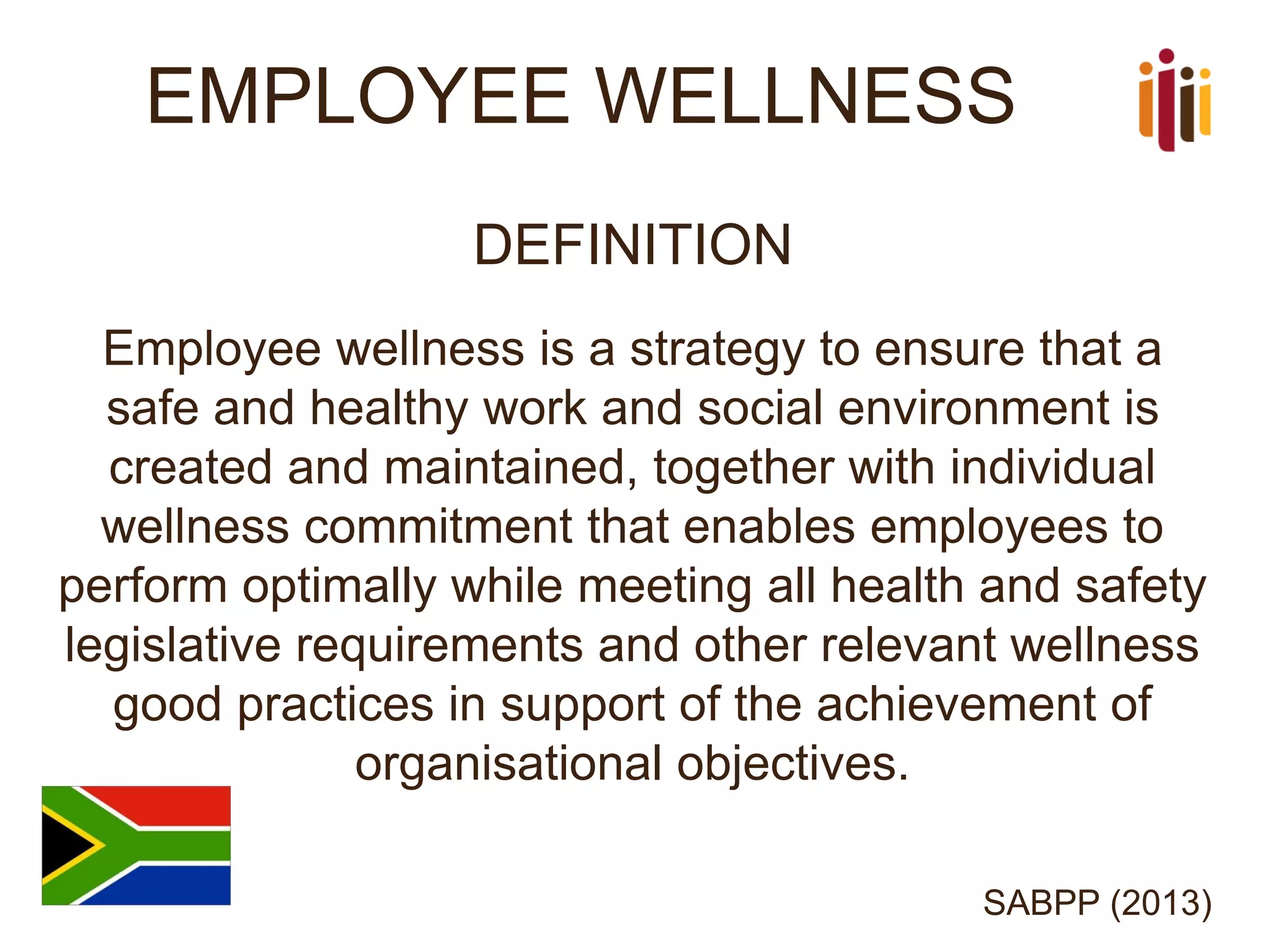
EMPLOYEE WELLNESS 
DEFINITION 
Employee wellness is a strategy to ensure that a safe and healthy work and social environment is created and maintained, together with individual wellness commitment that enables employees to perform optimally while meeting all health and safety legislative requirements and other relevant wellness good practices in support of the achievement of organisational objectives. 
SABPP (2013)
EMPLOYEE WELLNESS 
OBJECTIVES 
8.2.1 To promote opportunities and guidance that enable employees to engage in effective management of their own physical, mental, spiritual, financial and social well-being. 
8.2.2 To enable the employer to manage all aspects of employee wellness that can have a negative impact on employees’ ability to deliver on organisational objectives and to demonstrate the impact of wellness activities on the achievement of organisational objectives. 
8.2.3 To promote a safe and healthy working environment in pursuit of optimum productivity and preservation of human life and health. 
8.2.4 To reduce employee risk emanating from health and wellness issues. 
8.2.5 To contain health and wellness costs. 
8.2.6 To enhance the employment value proposition by means of promoting a culture of individual health and overall organisational wellness. 
SABPP (2013)
Importance of employee wellness
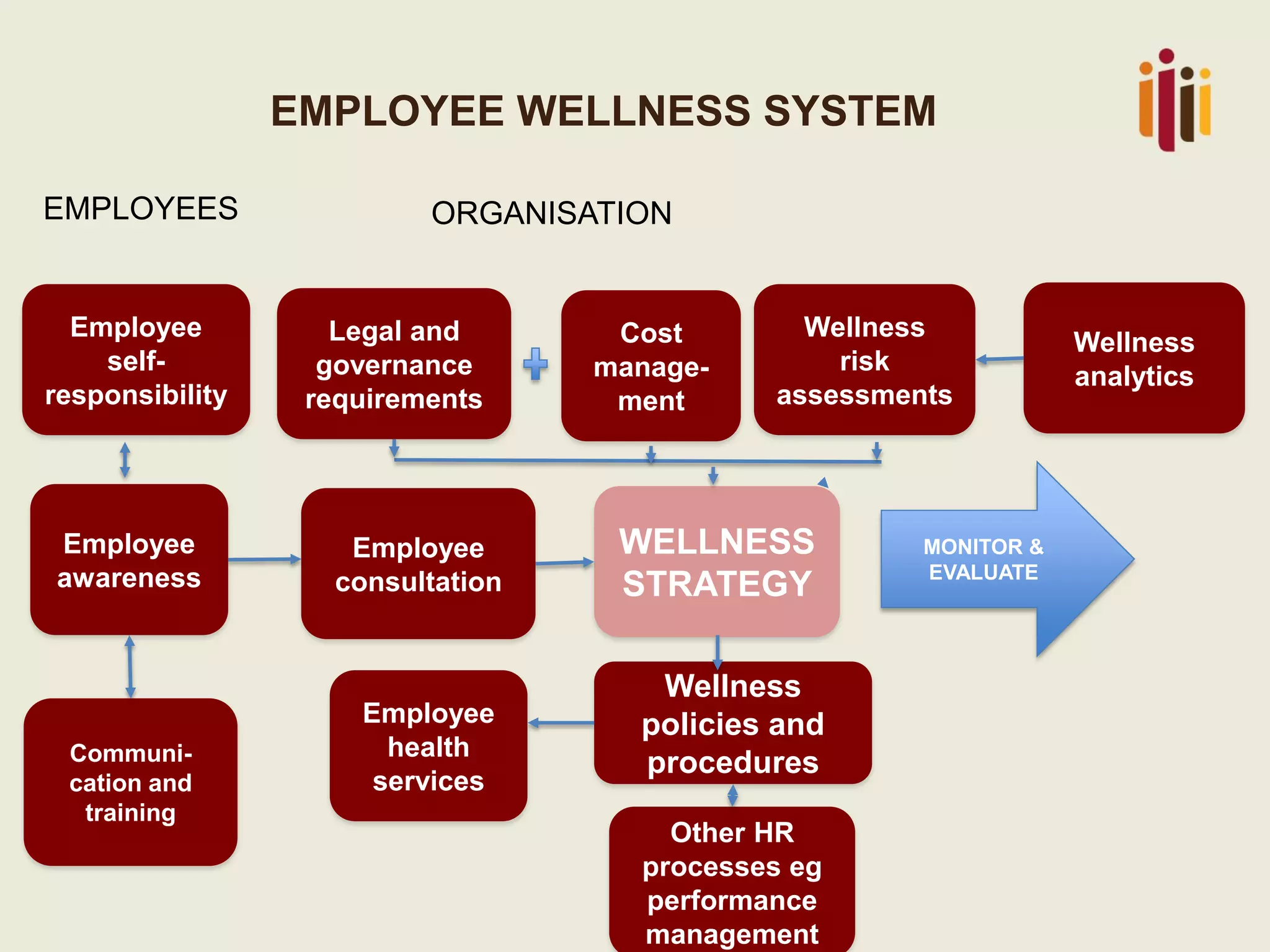
EMPLOYEE WELLNESS SYSTEM 
Communi- cationand training 
MONITOR & EVALUATE 
Employee awareness 
Other HR processes egperformance management 
Wellness policies and procedures 
WELLNESS STRATEGY 
Legal and governance requirements 
Wellness risk assessments 
Employee self- responsibility 
Employee consultation 
Employee health services 
EMPLOYEES 
ORGANISATION 
Wellness analytics 
Cost manage- ment
STANDARD ELEMENT 9 
EMPLOYMENT RELATIONS MANAGEMENT 
❾
EMPLOYMENT RELATIONS MANAGEMENT 
DEFINITION 
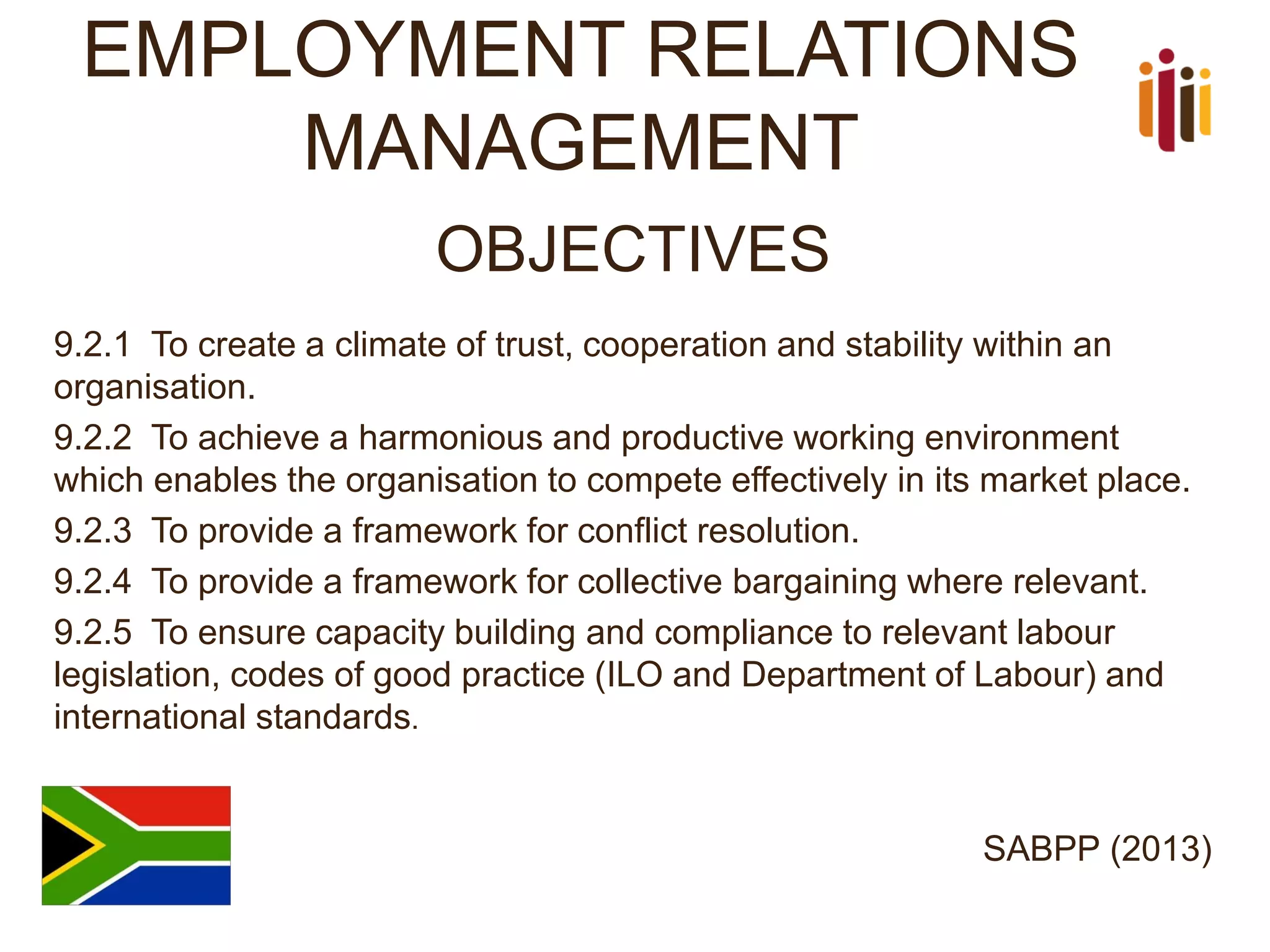
Employment relations is the management of individual and collective relationships in an organisation through the implementation of good practices that enable the achievement of organisational objectives compliant with the legislative framework and appropriate to socio-economic conditions. 
SABPP (2013)
EMPLOYMENT RELATIONS MANAGEMENT 
OBJECTIVES 
9.2.1 To create a climate of trust, cooperation and stability within an organisation. 
9.2.2 To achieve a harmonious and productive working environment which enables the organisation to compete effectively in its market place. 
9.2.3 To provide a framework for conflict resolution. 
9.2.4 To provide a framework for collective bargaining where relevant. 
9.2.5 To ensure capacity building and compliance to relevant labour legislation, codes of good practice (ILO and Department of Labour) and international standards. 
SABPP (2013)
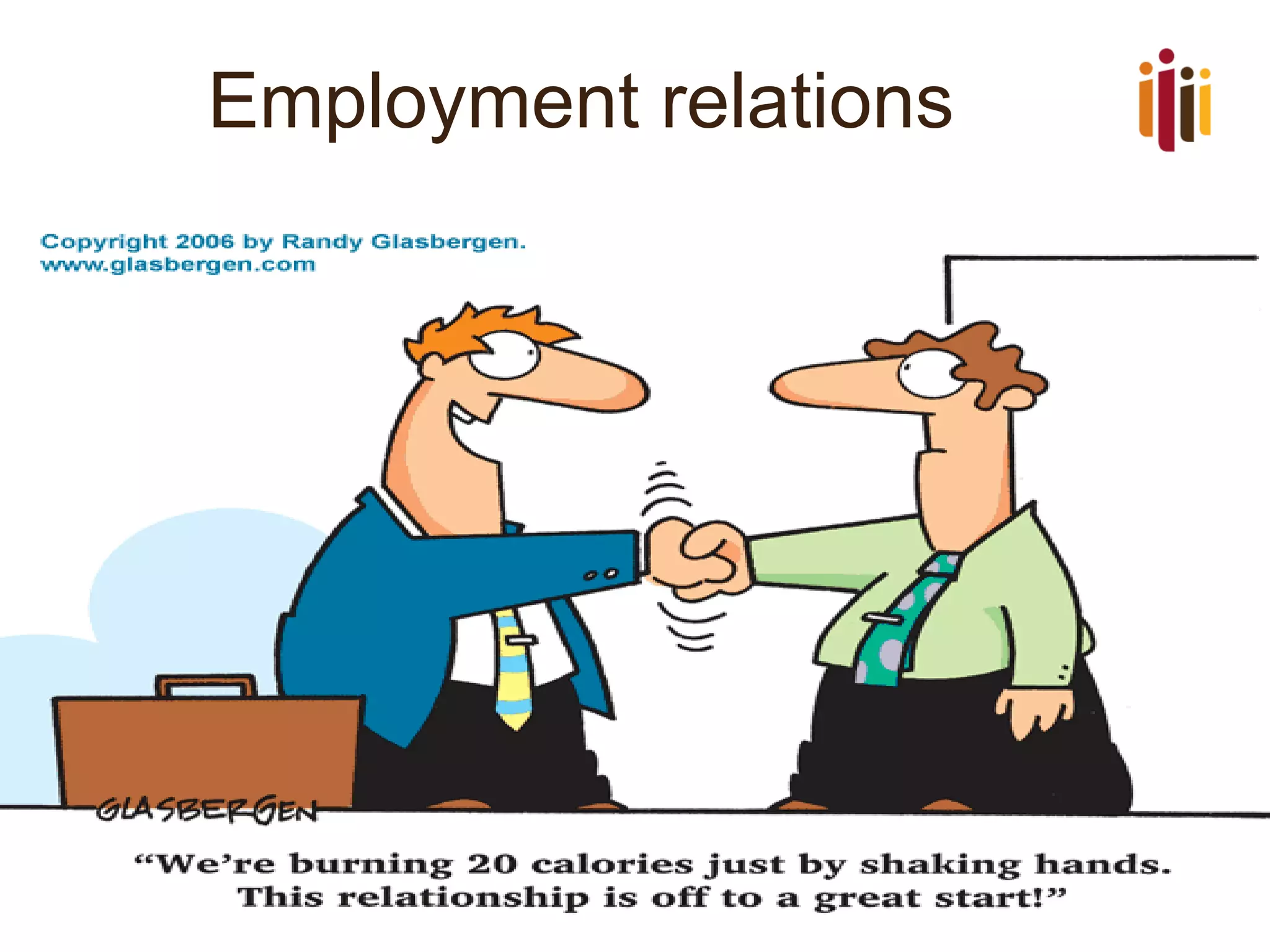
Employment relations
EMPLOYMENT RELATIONS MANAGEMENT SYSTEM 
Communi- cationand training 
MONITOR & EVALUATE 
Other HR processes egperformance management 
ERM policies and procedures 
ERM STRATEGY 
Legal requirements, agreements 
ER philosophy 
Workforce characteristics 
ERM STRATEGY 
ER resources & structures 
Leadership behaviour –build trust and respect 
Socio/economic/political trends
STANDARD ELEMENT 10 
ORGANISATION DEVELOPMENT 
❿
ORGANISATION DEVELOPMENT 
DEFINITION 
Organisation development (OD) is a planned systemic change process to continually improve an organisation’s effectiveness and efficiency by utilising diagnostic data, and designing and implementing appropriate solutions and interventions to measurably enable the organisation to optimise its purpose and strategy. 
SABPP (2013)
ORGANISATION DEVELOPMENT 
OBJECTIVES 
10.2.1 To establish links with organisational purpose across all levels and functions of an organisation. 
10.2.2 To ensure organisation design facilitates the purpose of the organisation. 
10.2.3 To improve the ability of individuals, teams, departments and functions to work co-operatively to meet organisation objectives and optimise engagement at work. 
10.2.4 To facilitate stakeholder engagement in all OD processes to ensure optimum buy-in. 
10.2.5 To build the relevant OD capability to meet organisational needs. 
10.2.6 To ensure compliance with relevant continuous improvement principles and practices. 
SABPP (2013)
ORGANISATION DEVELOPMENT PROCESS 
MONITOR & EVALUATE 
Other HR processes egL&D 
Organisational purpose 
Employees’ capability to work together 
Organisational design 
Diagnose 
Consultation with appropriate stakeholders 
ELEMENTS TO BE LINKED & OPTIMISED 
Define intended outcomes, design intervention 
Prioritise and integrate 
PROCESS 
OUTPUTS 
Employee communication 
ENABLERS
STANDARD ELEMENT 11 
HR SERVICE DELIVERY 
⓫
HR SERVICE DELIVERY 
DEFINITION 
HR Service Delivery is the influencing and partnering approach in the provision of HR services meeting the needs of the organisation and its employees which enables delivery of organisational goals and targets. 
SABPP (2013)
HR SERVICE DELIVERY 
OBJECTIVES 
11.2.1 To ensure timeousness, consistency, credibility and quality in the delivery of HR services, using resources productively and measuring and improving on delivery. 
11.2.2 To ensure sustainability of HR practices within the organisation. 
11.2.3 To support the effective management of the human element in an organisation by means of an effective HR service delivery model and system. 
11.2.4 To provide effective professional advice and guidance to managers and employees regarding the correct implementation of labour laws and other legislative requirements, HR policies, practices and procedures. 
11.2.5 To establish functional standards for accurate HR record-keeping and administration, developing and implementing an end-user friendly administrative process and system enabling proper data management. 
11.2.6. To measure employee engagement on the one hand, and satisfaction with the delivery of HR services on the other hand. 
SABPP (2013)
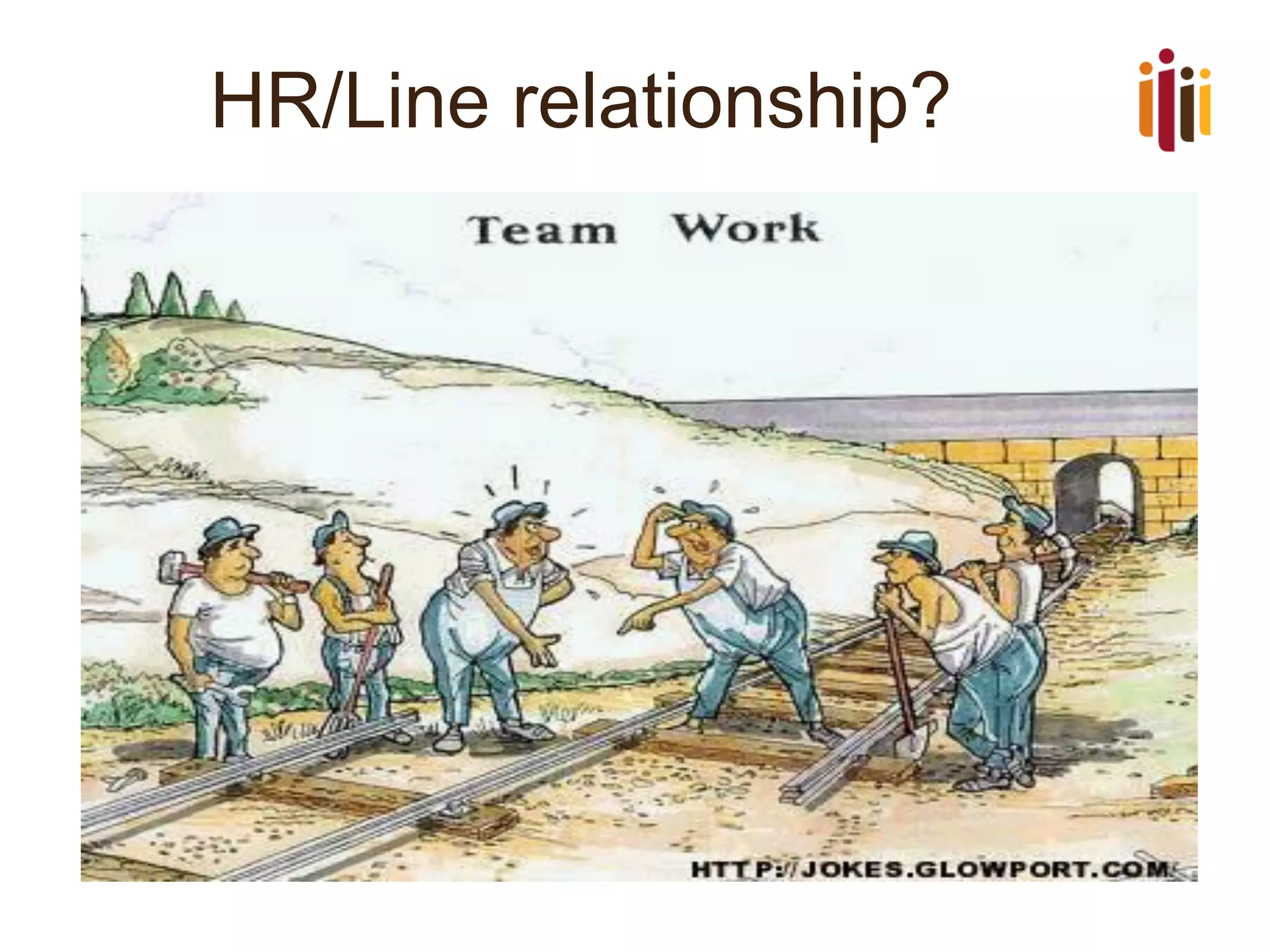
HR/Line relationship?
HR SERVICE DELIVERY SYSTEM 
MONITOR & EVALUATE 
HR strategy 
HR policies and procedures 
Clear roles and responsibilities for management of people in the workplace 
HR service delivery model and system 
Service Level Agreement 
Compliance monitoring 
Employee communication 
Laws, regulations, codes, agreements 
Management and employee support – guidance, consultation, coaching
STANDARD ELEMENT 12 
HR TECHNOLOGY 
⓬
HR TECHNOLOGY 
DEFINITION 
HR Technology is the effective utilisation of technological applications and platforms that make information both accessible and accurate, providing HR and line management with the knowledge and intelligence required for more effective decision- making, to align all employees towards the implementation of the organisation’s strategy. 
SABPP (2013)
HR TECHNOLOGY 
OBJECTIVES 
1.To leverage modern technology to allow easy access to relevant data (real-time, self- service) in compliance with relevant data security and other information technology compliance requirements, laws, codes and standards (privacy); and to support efficiency and effectiveness in HR functions, for example Learning and Development (for example, e-learning); and to create more capacity within existing HR structures to deliver value- adding activities. 
2.To consolidate and rapidly extract HR information in real time to deliver effective presentation of HR information to the board or governing body, line management and executive committee meetings to support planning, decision-making and management of the workforce with full knowledge of potential people risks. 
3.To streamline the HR Management System and its associated processes for effective and efficient use. 
4.To ensure that appropriate information security principles, policies and practices are developed and implemented. 
5.To enable the effective implementation of change and improvements to the technology solutions to ensure they remain continually aligned with the organisation’s objectives. 
SABPP (2013)
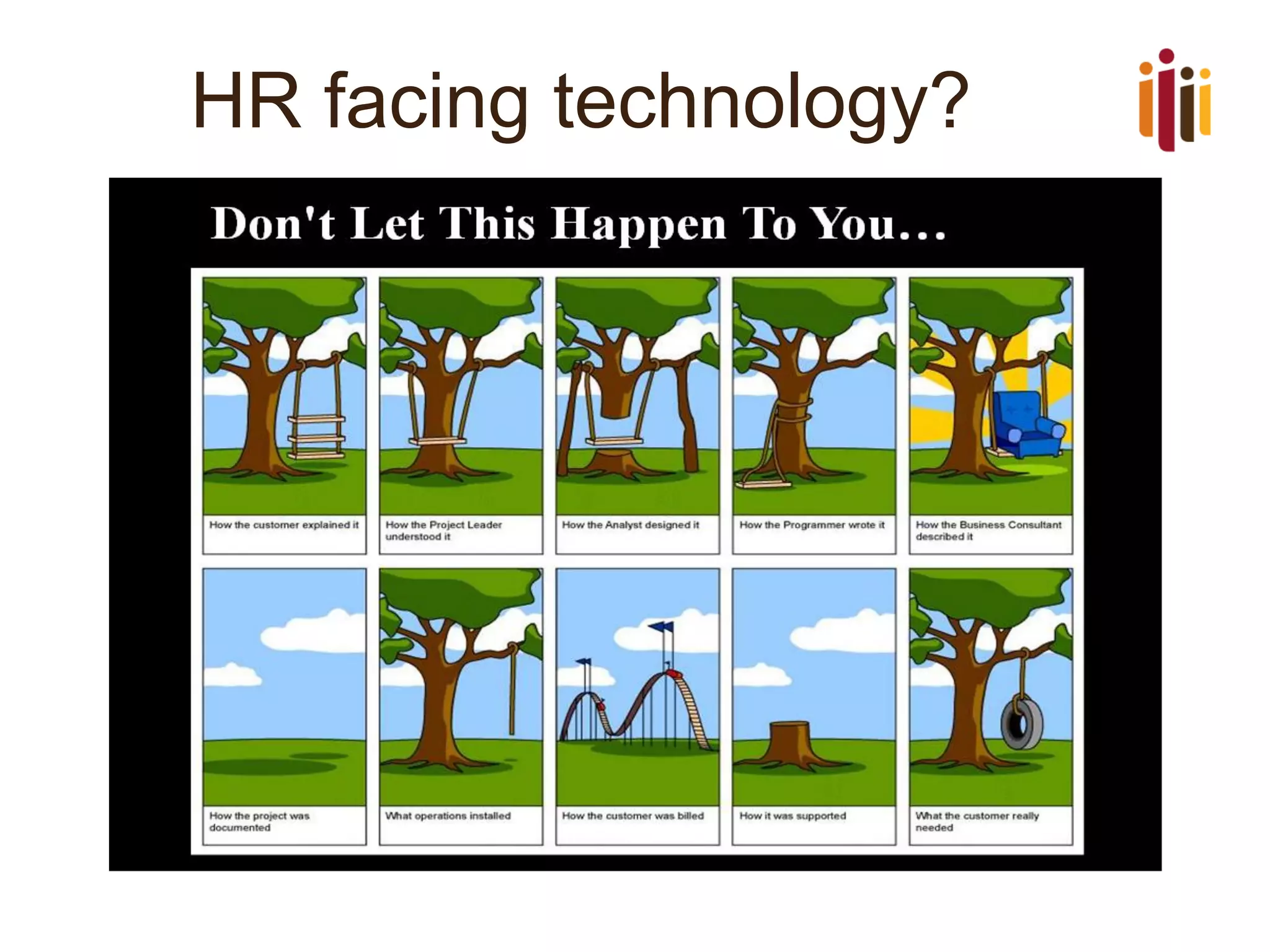
HR facing technology?
HR TECHNOLOGY MANAGEMENT SYSTEM 
MONITOR & EVALUATE 
IT governance & security rules 
Available technology (cost, ROI) 
HR management system & processes 
HRIS & other HR/HRD requirements 
Plan and implement approved developments 
Environmental scanning for new developments 
Training and support 
Legislative reqirements
STANDARD ELEMENT 13 
HR MEASUREMENT 
⓭
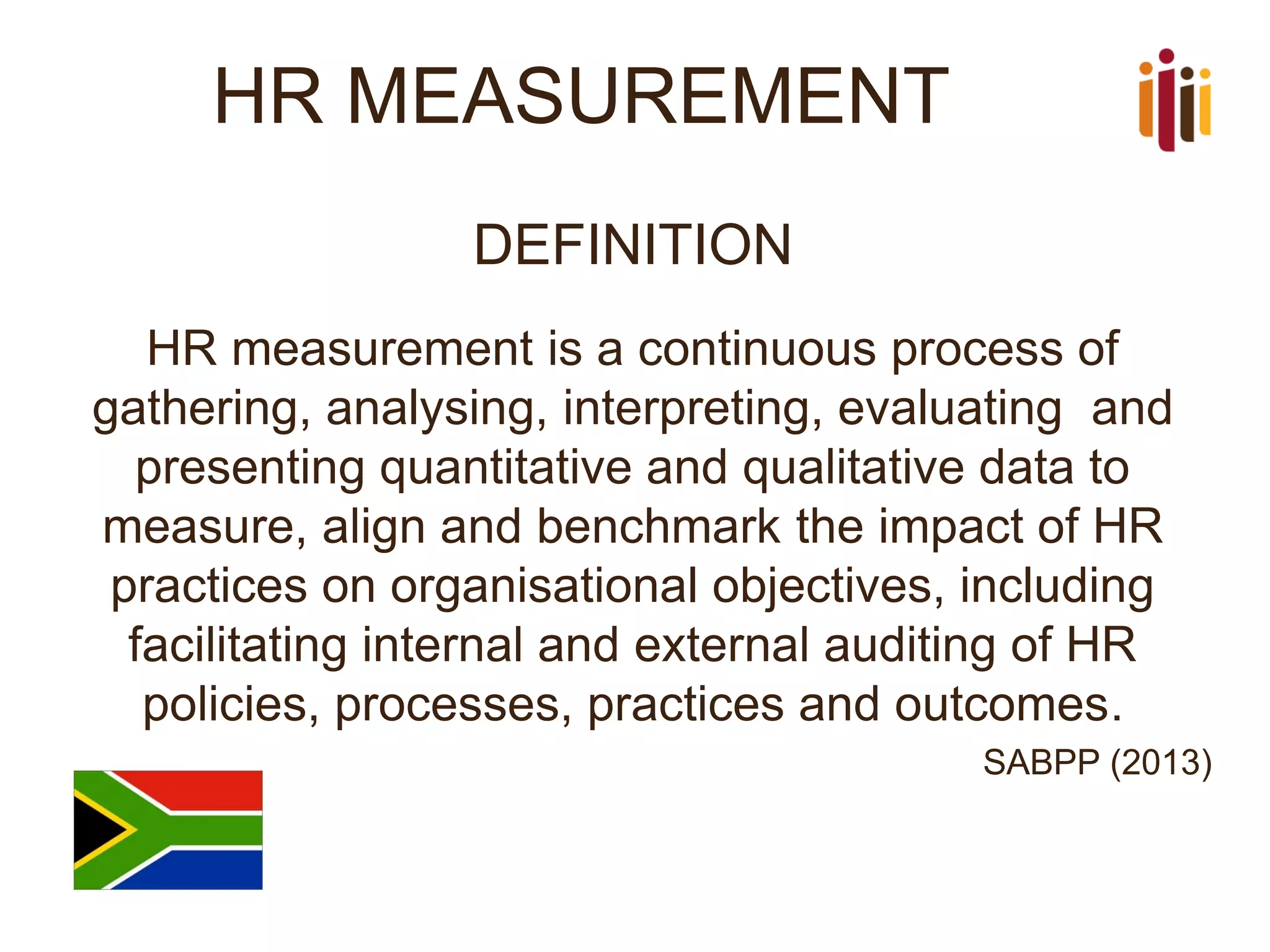
HR MEASUREMENT 
DEFINITION 
HR measurement is a continuous process of gathering, analysing, interpreting, evaluating and presenting quantitative and qualitative data to measure, align and benchmark the impact of HR practices on organisational objectives, including facilitating internal and external auditing of HR policies, processes, practices and outcomes. 
SABPP (2013)
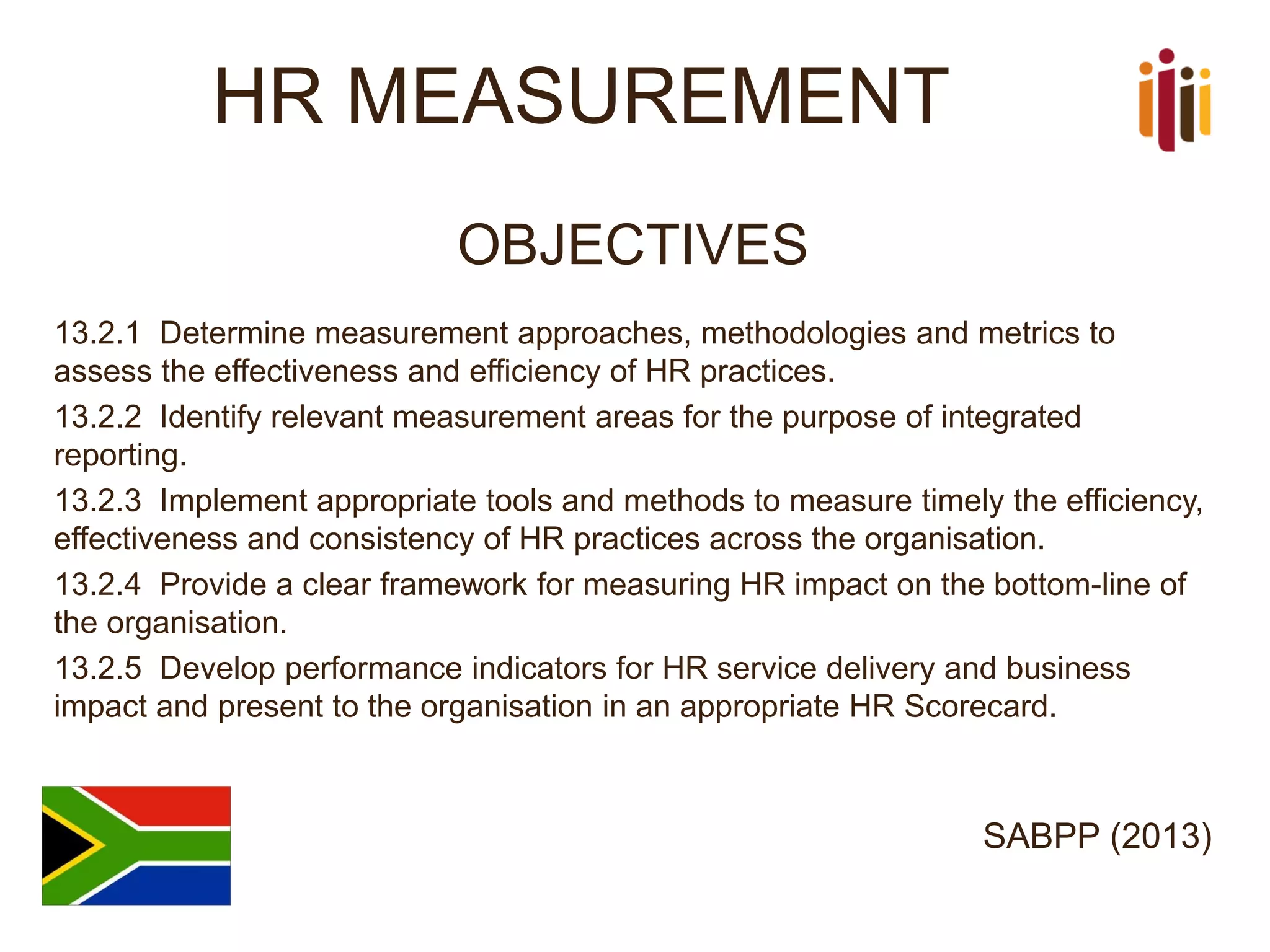
HR MEASUREMENT 
OBJECTIVES 
13.2.1 Determine measurement approaches, methodologies and metrics to assess the effectiveness and efficiency of HR practices. 
13.2.2 Identify relevant measurement areas for the purpose of integrated reporting. 
13.2.3 Implement appropriate tools and methods to measure timely the efficiency, effectiveness and consistency of HR practices across the organisation. 
13.2.4 Provide a clear framework for measuring HR impact on the bottom-line of the organisation. 
13.2.5 Develop performance indicators for HR service delivery and business impact and present to the organisation in an appropriate HR Scorecard. 
SABPP (2013)
HR manager’s response to metrics?
HR MEASUREMENT SYSTEM 
MONITOR & EVALUATE 
What are the drivers behind those issues? 
What issues do we need to manage (risks/opportunities) ? 
What are the outcomes specified in the SLA? 
How can we measure those in a Balanced Score Card? 
METRICS 
METRICS FOR PEOPLE MANAGEMENT IN THE ORGANISATION 
METRICS FOR HR EFFECTIVENESS/ 
EFFICIENCY 
How can we measure those drivers? 
Management system & resources to collect and report 
Financial and operational reporting systems in organisation
Marius Meyer 
@SABPP1
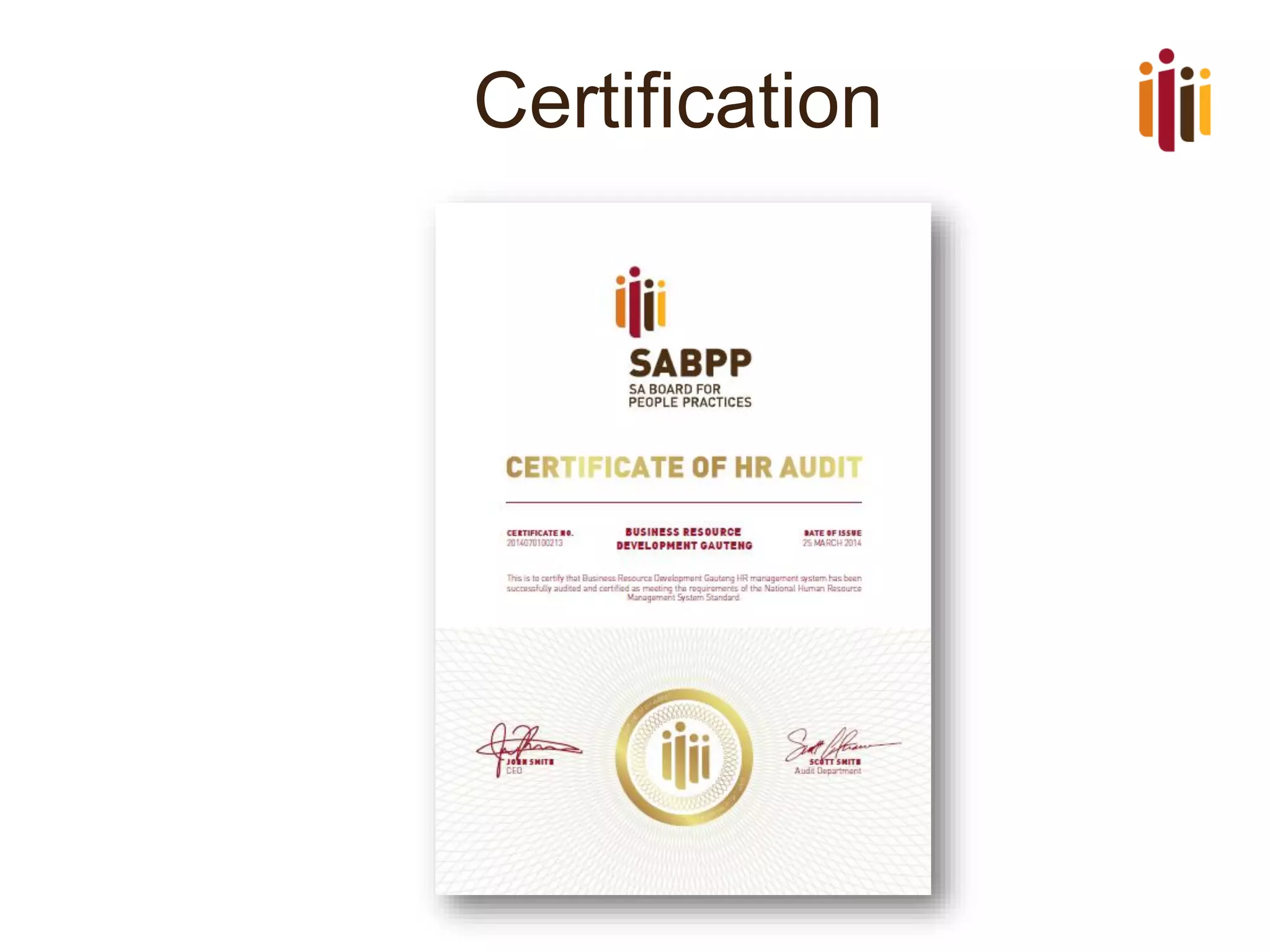
Certification
National HR Governance Strategy Alignment 
HR Professional Standards: 
•HRMS (13) 
•HRMSAS (13) 
•HRPPS (30+) 
HR Products/Services: 
•CPD 
•Mentoring 
•Professional registration 
•Research 
•HR Academy –QCTO 
•Curriculum standards 
HR Metrics: 
•National HR Scorecard 
•HR Service Standards 
HR Auditing: 
•Internal Audit 
•External Audit 
King IV: 
HR Governance 
ISO: HR 
Integrated 
Reporting 
HR Competencies
The need for consistency and quality
Conclusion 
HR standards are needed to improve the consistency and quality of HR management. We thank all HR professionals for your interest and support. 
Best wishes with the application of the HR Standards at SeifsaCompanies.
We set HR standards! 
professional@sabpp.co.za(Professional Registration) 
xolani@sabpp.co.za(Operations) 
kenneth@sabpp.co.za(Stakeholder Relations) 
penny@sabpp.co.za(Research) 
naren@sabpp.co.za(Learning & Quality) 
marius@sabpp.co.za(Strategy inputs) 
voice@sabpp.co.za(Social media) 
Website: www.sabpp.co.zaBlog: hrtoday.me 
Office: 8 SherborneStr, Parktown 
Tel: 011 045-5400 Fax: 011 482-4830 
Cel: 082 859 3593 (Marius Meyer)

SABPP HR Standards - SEIFSA 2014

  • 1.
    24 October 2014 Marius Meyer @SABPP1
  • 2.
    Where can youget the slides? OPTION 1: FAST WAY •www.slideshare.net/SABPP •Twitter: @SABPP1 •Blog: hrtoday.me OPTION 2: SLOW WAY •Via email on Monday
  • 3.
    SABPP Professional Values RESPONSIBILITY I RESPECT INTEGRITY COMPETENCE
  • 4.
  • 5.
  • 6.
    New SABPP Model:HR Voice for Professionals Human resource development Research - info Value & visibility Openfor alliances Innovation CPD Excel- lence Quality assurance Learning growth & develop- ment Knowledge Self-governance Duty to society Ethics
  • 7.
    Professional registration levels •M/D degree + 6 years top level experience •LoW= executive level MHRP (Master) CHRP (Chartered) •Degree/ND + 3 years experience •LoW= middle management HRP (Professional) HRA (Associate) •Certificate + 1 year experience •LoW= entry HRT (Technician) •Hons degree + 4 years sr experience •LoW = senior management •2 year dip + 2 years experience •LoW = junior level
  • 8.
    NEXT STEP –BECOMEA REGISTERED HR PROFESSIONAL Apply to professional@sabpp.co.za so that we can register you as an HR professional in accordance with NQF Act (Act no 67 of 2008).
  • 9.
    Marius Meyer, SABPPCEO receiving the SAQA certificate of professional body recognition from the Minister of Higher Education and Training, Dr Blade Nzimande.
  • 10.
    SABPP BLOG Forregular updates join our special HR Standards Blog: www.hrtoday.me
  • 11.
  • 12.
    SOUTH AFRICAN HRCOMPETENCY MODEL STRATEGY TALENT MANAGEMENT HR GOVERNANCE, RISK, COMPLIANCE ANALYTICS & MEASUREMENT HR SERVICE DELIVERY 5 HR CAPABILITIES LEADERSHIP & PERSONAL CREDIBILITY ORGANISATIONAL CAPABILITY SOLUTION CREATION & IMPLEMENTATION INTERPERSONAL & COMMUNICATION CITIZENSHIP FOR FUTURE: INNOVATION, TECHNOLOGY, SUSTAINABILITY CORE COMPETENCIES HR & BUSINESS KNOWLEDGE DUTY TO SOCIETY ETHICS PROFESSIONALISM 4 PILLARS
  • 13.
    OperationalManagement Consistency inthe Management of People One of the toughest things to be is consistent
  • 14.
  • 15.
    Critical questions 1.Howmany of you would like to eat in a restaurant without standards? 2.Or stay in a hotel without standards? 3.Or send your child to a school (or pre- school) without standards? 4.Or get operated in a hospital without any standards? 5.Or drive a car without standards? 6.Or use an airline without standards?
  • 16.
    Then when itcomes to HR … Why do we continue to manage people and govern the most precious part of our organisations (i.e. people) without standards?
  • 17.
    Top facts aboutHR •Human Capital is the biggest concern for CEOs (PwC). •Only 18% of CEOs feel confident that they have the right people in place to execute strategy (CEB). •Human Capital is the biggest risk in business (HCI Africa). •Skills crisis is the top obstacle to economic growth. •Strikes cost SA R 200 million+ per day.
  • 18.
    More facts aboutHR •SA losing R12 billion a year due to absenteeism. •Only 19% auditors feel they use HR optimally (CG Index –Institute of Internal Auditors) •Only 5% employees understand business strategy. •World-wide 13% of employees actively engaged. •Companies with engaged employees outperform others by 202% (Dale Carnegie). •Companies with good HR Practices outperform others by treating HR as critical business function, these companies are 105% more profitable. •Average ROI on wellness programmes: 300%.
  • 19.
    Why a nationalHR Standard? •We need to improve the quality of HR practice. •HR will not be seen as a true profession without standards. •Inconsistencies –practices, sites, business units, companies, industries. •Too many bad examples of things going wrong –Marikana, Medupi. •Raising the bar for the HR profession and business impact.
  • 20.
    Myths about standards •Impose an onerous compliance regime •Duplicate best practices •Our company is so unique syndrome •Standards stifle innovation •Take flexibility away •Ignore industry differences •Too practical, not based on theory/research •Standards are cast in stone
  • 21.
  • 22.
    Types of standards •Unit standards / Curriculum standards •Service delivery standards •Competence standards •Metrics/benchmarking standards •Professional practice standards •Business/industry/process/system standards -ISO
  • 23.
    Global approaches tostandards •Production and safety lead –ISO standards •Professional standards –accounting •Top global companies –their own standards •Canada –HR Standards & Metrics •UK –Human Capital Standard (BSI/CIPD) •ISO HR project started •South African National HR Standards •HR Standards in Namibia
  • 24.
    It all startedon 21 May 2013 with 13 Standard facilitators
  • 25.
    468 HR Leadersdeveloping HR Standards for South Africa
  • 26.
    HR Standards Facilitators Kate Dikgale-Freeman Michael Robbins Linda Chipunza
  • 27.
    BUSINESS STRATEGY –HRBUSINESS ALIGNMENT ❶Strategic HRM ❷Talent Management ❸HR Risk Management HR ARCHITECTURE HR VALUE & DELIVERY PLATFORM ❹ Work- force planning ❺ Learning ❻ Perfor- mance ❼ Reward ❽ Well- ness ❾ ERM ❿ OD ⓫HR Service Delivery ⓬ HR Technology (HRIS) Prepare Imple- ment Review Improve ⓭HR MEASUREMENT HR Audit: Standards & Metrics H R C O M P E T E N C I E S © SABPP HRM SYSTEM STANDARDS MODEL
  • 28.
    HR Standards Journey Phase 1: HR MANAGEMENT SYSTEM STANDARD (21 May 2013) Phase 2: HR MANAGEMENT SYSTEM APPLICATION STANDARD (20-21 Aug 2013) Phase 3: HR PROFESSIONAL PRACTICE STANDARDS (14 May 2014) “WHAT” STANDARD What are the elements of the HR system? 13 elements: Definition Objectives Implementation (High level) “HOW TO” STANDARD How can we apply the HR System standard? How to apply the 13 standard elements “WHAT” AND “HOW” OF SPECIFIC PROFESSIONAL PRACTICE STANDARDS •Succession Planning •Employment Equity •Career Development •Engagement •Learning culture •Change management
  • 29.
    HR Standards Files 13 standards (2013) 19 standards (2014)
  • 30.
  • 31.
  • 32.
  • 33.
  • 34.
  • 35.
    International HR bodies Tim Ekandjo, President: IPM Namibia & Marius Meyer, CEO: SABPP in Windhoek
  • 36.
  • 37.
  • 38.
  • 39.
    BUSINESS STRATEGY –HRBUSINESS ALIGNMENT ❶Strategic HRM ❷Talent Management ❸HR Risk Management HR ARCHITECTURE HR VALUE & DELIVERY PLATFORM ❹ Work- force planning ❺ Learning ❻ Perfor- mance ❼ Reward ❽ Well- ness ❾ ERM ❿ OD ⓫HR Service Delivery ⓬ HR Technology (HRIS) Prepare Imple- ment Review Improve ⓭HR MEASUREMENT HR Audit: Standards & Metrics H R C O M P E T E N C I E S SABPP HRM SYSTEM STANDARDS MODEL
  • 40.
    STANDARD ELEMENT #1 STRATEGIC HR MANAGEMENT ❶
  • 41.
    STRATEGIC HR MANAGEMENTSTANDARD DEFINITION Strategic HR Management is a systematicapproach to developing and implementing long-term HRM strategies, policies and plans that enable the organisation to achieve its objectives. SABPP (2013)
  • 42.
    STRATEGIC HR MANAGEMENTSTANDARD OBJECTIVES 1.2.1 To ensure the HR strategy is derived from and aligned to the organisation’s objectives in consultation with key organisational stakeholders. 1.2.2 To analyse the internal and external socio-economic, political and technological environment and provide proactive people-related business solutions. 1.2.3 To provide strategic direction and measurements for strategic innovation and sustainable people practices. 1.2.4 To provide a foundation for the employment value proposition of the organisation. 1.2.5 To establish a framework for the HR element of the organisation’s governance, risk and compliance policies, practices and procedures which balance the needs of all stakeholders. 1.2.6 To determine an appropriate HR structure, allocate tasks and monitor the development of HR competence to deliver HR strategic objectives. SABPP (2013)
  • 43.
    STRATEGIC HRM PROCESS Framework of HR policies & programmes Environmental scan (PESTL) HR structure, service model and capability development People strategy HR strategic agenda Organisation’s strategic intent HR strategic agenda HR business plan People strategy Allocate roles & responsibilities (line/HR/support functions) MONITOR & EVALUATE
  • 44.
    Strategic HR: Itis all about alignment
  • 45.
    STANDARD ELEMENT 2 TALENT MANAGEMENT ❷
  • 46.
    TALENT MANAGEMENT STANDARD DEFINITION Talent Management is the proactive design and implementation of an integrated talent- driven organisational strategy directed to attracting, deploying, developing, retaining and optimising the appropriate talent requirements as identified in the workforce plan to ensure a sustainable organisation. SABPP (2013)
  • 47.
    TALENT MANAGEMENT OBJECTIVES 2.2.1 To build a talent culture which defines the organisation’s philosophy, principles and integrated approach to talent, which leverages diversity and is communicated in a clear employment value proposition. 2.2.2 To identify strategically critical positions and leadership roles and capabilities in the organisation into the future from the Workforce Plan that will determine the sustainability and growth of the organisation. 2.2.3 To set up processes and systems which will: •Attract a sustainable pool of talent for current objectives and future organisation needs. •Achieve employment equity progress in the spirit of the legislation to achieve transformation. •Manage the retention and reward of talent. •Develop the required leadership skills. •Plan for succession to key roles •Identify high potential employees and link them with key future roles in the organisation through monitored development plans. •Identify through assessment the optimal development opportunities for talent. 2.2.4 To agree appropriate roles for relevant stakeholders in the development and management of talent. 2.2.5 To monitor and report on talent management key results areas and indicators. SABPP (2013)
  • 48.
  • 50.
    STANDARD ELEMENT 3 HR RISK MANAGEMENT ❸
  • 51.
    HR RISK MANAGEMENTSTANDARD DEFINITION HR Risk Management is a systematic approach of identifying and addressing people risks (uncertainties and opportunities) that can either have a positive or negative effect on the realisation of the objectives of an organisation.
  • 52.
  • 53.
    HR Risk Management OBJECTIVES 3.2.1 To increase the probability and impact of positive events and decrease the probability and impact of negative events caused by people factors on the achievement of organisational objectives. 3.2.2 To align HR and people management practices within the governance, risk and compliance framework and integrated reporting model of the organisation. 3.2.3 To ensure appropriate risk assessment practices and procedures relating to people factors are embedded within the organisation. 3.2.4 To ensure appropriate risk controls are designed and applied to HR activities and interventions. 3.2.5 To contribute in creating and sustaining a risk culture in an organisation which also encourages innovation and creativity. SABPP (2013)
  • 54.
    HR Risk Management:It is all about people factors
  • 55.
    HR RISK MANAGEMENTPROCESS Assessment of risk tolerance for each risk Identify and evaluate impact of HR risks HR practices, programmes, metrics to manage risks HR Risk Map HR Risk Register Organisation’s risk management structures and processes HR Risk Register HR Risk Management Plan HR Risk Map MONITOR & EVALUATE
  • 56.
    STANDARD ELEMENT 4 WORKFORCE PLANNING ❹
  • 57.
    WORKFORCE PLANNING DEFINITION Workforce Planning is the systematic identification and analysis of organisational workforce needs culminating in a workforce plan to ensure sustainable organisational capability in pursuit of the achievement of its strategic and operational objectives.The workforce plan will set out the actions necessary to have the right people in the right place at the right time.
  • 58.
    WORKFORCE PLANNING OBJECTIVES •To design a workforce plan which meets the needs of the organisation in consultation with line management, and adjust strategy accordingly, taking into account workforce and labour market trends in relation to the relevant industry sector, within the spirit of the employment equity legislation •To align the workforce planning cycle with the strategic planning and budgeting cycle of the organisation, as well as talent management where relevant •To ensure appropriate budgeting and cost modelling to prepare the budget for the workforce plan •To ensure an adequate supply and pipeline of appropriately qualified staff through sourcing staff and building the future supply of the right skills to meet the needs of the organisation SABPP (2013)
  • 59.
    WORFORCE PLANNING PROCESS Future workforce forecasts - costed scenarios GAP ANALYSIS PLANS TO CLOSE GAPS Present workforce MONITOR & EVALUATE Business strategy & plans Internal & external trends COMPARE Workforce scheduling Recruitment, assessment and selection
  • 60.
    STANDARD ELEMENT 5 LEARNING AND DEVELOPMENT ❺
  • 61.
    LEARNING & DEVELOPMENT DEFINITION Learning and development is the practice of providing occupationally directed and other learning activities that enable and enhance the knowledge, practical skills and work place experience and behaviour of individuals and teams based on current and future occupational requirements for optimal organisational performance and sustainability. SABPP (2013)
  • 62.
    LEARNING & DEVELOPMENT OBJECTIVES •To create an occupationally competent and engaged workforce which builds organisational capability, providing employees with opportunities to develop new knowledge and skills •To focus learning and development plans on improving people’s ability to perform to achieve organisational objectives and provide the means for measuring the impact of learning and development interventions. •To support and accelerate skills development and achievement of employment equity and organisational transformation and limit the impact of skills shortages. •To create a learning culture and environment that enables optimal individual, team and organisation learning and growth in both competencies and behaviour. •To capture and replicate and enhance critical knowledge within the organisation. •To ensure learning and development is a catalyst for continuous improvement, change and innovation. SABPP (2013)
  • 63.
    LEARNING AND DEVELOPMENTPROCESS Integrated L&D approach & programmes Structure & capability of L&D resources MONITOR & EVALUATE Business strategy & plans External trends Knowledge management Skills develop- mentlegislation Current compet- encies
  • 64.
  • 65.
    STANDARD ELEMENT 6 PERFORMANCE MANAGEMENT ❻
  • 66.
    PERFORMANCE MANAGEMENT DEFINITION Performance management is a planned process of directing, developing, supporting, aligning and improving individual and team performance in enabling the sustained achievement of organisational objectives. SABPP (2013)
  • 67.
    PERFORMANCE MANAGEMENT OBJECTIVES 6.2.1 To translate and cascade broad organisational performance drivers into team and individual performance targets. 6.2.2 To establish an appropriate performance management system, process, methodology relevant to the needs, size, scope and complexity of the organisation which will support the development of a performance culture. 6.2.3 To link performance management to other HR processes to align appropriate performance consequences (reward, recognition and development opportunities) that attract, retain and motivate employees and to address poor performance. 6.2.4 To ensure fair, ethical and organisation cultural practices focusing on the achievement of performance targets (that is, a high performance culture) in a sustainable way. 6.2.5 To measure progress against agreed individual and team objectives that enable attainment of organisational objectives. SABPP (2013)
  • 68.
  • 69.
    PERFORMANCE MANAGEMENT SYSTEM PM capability of line, employees and HR MONITOR & EVALUATE Business strategy & plans Performance expectations PM policy and procedure Performance measurement & feedback Consistency Leadership Performance development ENABLERS
  • 70.
    STANDARD ELEMENT 7 REWARD AND RECOGNITION ❼
  • 71.
    REWARD & RECOGNITION DEFINITION Reward is a strategy and system that enables organisations to offer fair and appropriate levels of pay and benefits in recognition for their contribution to the achievement of agreed deliverables in line with organisational objectives and values. Recognition is a related strategy and system that seeks to reward employees for other achievements through mechanisms outside the pay and benefits structure. SABPP (2013)
  • 72.
    REWARD & RECOGNITION OBJECTIVES 7.2.1 To design and implement an appropriate reward strategy aligned with organisation culture, objectives and employment value proposition, and achieving a fair balance between the needs of the employer and employee. 7.2.2 To deliver a fair and equitable reward system and process that is ethical, cost effective and sustainable. 7.2.3 To ensure your reward strategy is in line with current national and international industry and sector norms. 7.2.4 To ensure compliance with organisational governance principles and practices aligned to national and relevant international governance codes of practice and relevant legislation. 7.2.5 To design and implement an appropriate recognition strategy which meets employees’ need for recognition of particular efforts or achievements which are valuable to the organisation and are not catered for in the reward strategy. SABPP (2013)
  • 73.
  • 74.
    REWARD AND RECOGNITIONSYSTEM Communication and training BENCHMARK, MONITOR & EVALUATE Business objectives and culture Other HR processes egperformance management RRM policies and procedures REWARD AND RECOGNITION STRATEGY Individuals’ needs and wants Legal and governance requirements Market trends – sector, national, international Talent Management strategy Employee consultation/ negotiation REWARD AND RECOGNITION STRATEGY
  • 75.
    STANDARD ELEMENT 8 EMPLOYEE WELLNESS ❽
  • 76.
    EMPLOYEE WELLNESS DEFINITION Employee wellness is a strategy to ensure that a safe and healthy work and social environment is created and maintained, together with individual wellness commitment that enables employees to perform optimally while meeting all health and safety legislative requirements and other relevant wellness good practices in support of the achievement of organisational objectives. SABPP (2013)
  • 77.
    EMPLOYEE WELLNESS OBJECTIVES 8.2.1 To promote opportunities and guidance that enable employees to engage in effective management of their own physical, mental, spiritual, financial and social well-being. 8.2.2 To enable the employer to manage all aspects of employee wellness that can have a negative impact on employees’ ability to deliver on organisational objectives and to demonstrate the impact of wellness activities on the achievement of organisational objectives. 8.2.3 To promote a safe and healthy working environment in pursuit of optimum productivity and preservation of human life and health. 8.2.4 To reduce employee risk emanating from health and wellness issues. 8.2.5 To contain health and wellness costs. 8.2.6 To enhance the employment value proposition by means of promoting a culture of individual health and overall organisational wellness. SABPP (2013)
  • 78.
  • 79.
    EMPLOYEE WELLNESS SYSTEM Communi- cationand training MONITOR & EVALUATE Employee awareness Other HR processes egperformance management Wellness policies and procedures WELLNESS STRATEGY Legal and governance requirements Wellness risk assessments Employee self- responsibility Employee consultation Employee health services EMPLOYEES ORGANISATION Wellness analytics Cost manage- ment
  • 80.
    STANDARD ELEMENT 9 EMPLOYMENT RELATIONS MANAGEMENT ❾
  • 81.
    EMPLOYMENT RELATIONS MANAGEMENT DEFINITION Employment relations is the management of individual and collective relationships in an organisation through the implementation of good practices that enable the achievement of organisational objectives compliant with the legislative framework and appropriate to socio-economic conditions. SABPP (2013)
  • 82.
    EMPLOYMENT RELATIONS MANAGEMENT OBJECTIVES 9.2.1 To create a climate of trust, cooperation and stability within an organisation. 9.2.2 To achieve a harmonious and productive working environment which enables the organisation to compete effectively in its market place. 9.2.3 To provide a framework for conflict resolution. 9.2.4 To provide a framework for collective bargaining where relevant. 9.2.5 To ensure capacity building and compliance to relevant labour legislation, codes of good practice (ILO and Department of Labour) and international standards. SABPP (2013)
  • 83.
  • 84.
    EMPLOYMENT RELATIONS MANAGEMENTSYSTEM Communi- cationand training MONITOR & EVALUATE Other HR processes egperformance management ERM policies and procedures ERM STRATEGY Legal requirements, agreements ER philosophy Workforce characteristics ERM STRATEGY ER resources & structures Leadership behaviour –build trust and respect Socio/economic/political trends
  • 85.
    STANDARD ELEMENT 10 ORGANISATION DEVELOPMENT ❿
  • 86.
    ORGANISATION DEVELOPMENT DEFINITION Organisation development (OD) is a planned systemic change process to continually improve an organisation’s effectiveness and efficiency by utilising diagnostic data, and designing and implementing appropriate solutions and interventions to measurably enable the organisation to optimise its purpose and strategy. SABPP (2013)
  • 87.
    ORGANISATION DEVELOPMENT OBJECTIVES 10.2.1 To establish links with organisational purpose across all levels and functions of an organisation. 10.2.2 To ensure organisation design facilitates the purpose of the organisation. 10.2.3 To improve the ability of individuals, teams, departments and functions to work co-operatively to meet organisation objectives and optimise engagement at work. 10.2.4 To facilitate stakeholder engagement in all OD processes to ensure optimum buy-in. 10.2.5 To build the relevant OD capability to meet organisational needs. 10.2.6 To ensure compliance with relevant continuous improvement principles and practices. SABPP (2013)
  • 88.
    ORGANISATION DEVELOPMENT PROCESS MONITOR & EVALUATE Other HR processes egL&D Organisational purpose Employees’ capability to work together Organisational design Diagnose Consultation with appropriate stakeholders ELEMENTS TO BE LINKED & OPTIMISED Define intended outcomes, design intervention Prioritise and integrate PROCESS OUTPUTS Employee communication ENABLERS
  • 89.
    STANDARD ELEMENT 11 HR SERVICE DELIVERY ⓫
  • 90.
    HR SERVICE DELIVERY DEFINITION HR Service Delivery is the influencing and partnering approach in the provision of HR services meeting the needs of the organisation and its employees which enables delivery of organisational goals and targets. SABPP (2013)
  • 91.
    HR SERVICE DELIVERY OBJECTIVES 11.2.1 To ensure timeousness, consistency, credibility and quality in the delivery of HR services, using resources productively and measuring and improving on delivery. 11.2.2 To ensure sustainability of HR practices within the organisation. 11.2.3 To support the effective management of the human element in an organisation by means of an effective HR service delivery model and system. 11.2.4 To provide effective professional advice and guidance to managers and employees regarding the correct implementation of labour laws and other legislative requirements, HR policies, practices and procedures. 11.2.5 To establish functional standards for accurate HR record-keeping and administration, developing and implementing an end-user friendly administrative process and system enabling proper data management. 11.2.6. To measure employee engagement on the one hand, and satisfaction with the delivery of HR services on the other hand. SABPP (2013)
  • 92.
  • 93.
    HR SERVICE DELIVERYSYSTEM MONITOR & EVALUATE HR strategy HR policies and procedures Clear roles and responsibilities for management of people in the workplace HR service delivery model and system Service Level Agreement Compliance monitoring Employee communication Laws, regulations, codes, agreements Management and employee support – guidance, consultation, coaching
  • 94.
    STANDARD ELEMENT 12 HR TECHNOLOGY ⓬
  • 95.
    HR TECHNOLOGY DEFINITION HR Technology is the effective utilisation of technological applications and platforms that make information both accessible and accurate, providing HR and line management with the knowledge and intelligence required for more effective decision- making, to align all employees towards the implementation of the organisation’s strategy. SABPP (2013)
  • 96.
    HR TECHNOLOGY OBJECTIVES 1.To leverage modern technology to allow easy access to relevant data (real-time, self- service) in compliance with relevant data security and other information technology compliance requirements, laws, codes and standards (privacy); and to support efficiency and effectiveness in HR functions, for example Learning and Development (for example, e-learning); and to create more capacity within existing HR structures to deliver value- adding activities. 2.To consolidate and rapidly extract HR information in real time to deliver effective presentation of HR information to the board or governing body, line management and executive committee meetings to support planning, decision-making and management of the workforce with full knowledge of potential people risks. 3.To streamline the HR Management System and its associated processes for effective and efficient use. 4.To ensure that appropriate information security principles, policies and practices are developed and implemented. 5.To enable the effective implementation of change and improvements to the technology solutions to ensure they remain continually aligned with the organisation’s objectives. SABPP (2013)
  • 97.
  • 98.
    HR TECHNOLOGY MANAGEMENTSYSTEM MONITOR & EVALUATE IT governance & security rules Available technology (cost, ROI) HR management system & processes HRIS & other HR/HRD requirements Plan and implement approved developments Environmental scanning for new developments Training and support Legislative reqirements
  • 99.
    STANDARD ELEMENT 13 HR MEASUREMENT ⓭
  • 100.
    HR MEASUREMENT DEFINITION HR measurement is a continuous process of gathering, analysing, interpreting, evaluating and presenting quantitative and qualitative data to measure, align and benchmark the impact of HR practices on organisational objectives, including facilitating internal and external auditing of HR policies, processes, practices and outcomes. SABPP (2013)
  • 101.
    HR MEASUREMENT OBJECTIVES 13.2.1 Determine measurement approaches, methodologies and metrics to assess the effectiveness and efficiency of HR practices. 13.2.2 Identify relevant measurement areas for the purpose of integrated reporting. 13.2.3 Implement appropriate tools and methods to measure timely the efficiency, effectiveness and consistency of HR practices across the organisation. 13.2.4 Provide a clear framework for measuring HR impact on the bottom-line of the organisation. 13.2.5 Develop performance indicators for HR service delivery and business impact and present to the organisation in an appropriate HR Scorecard. SABPP (2013)
  • 102.
  • 103.
    HR MEASUREMENT SYSTEM MONITOR & EVALUATE What are the drivers behind those issues? What issues do we need to manage (risks/opportunities) ? What are the outcomes specified in the SLA? How can we measure those in a Balanced Score Card? METRICS METRICS FOR PEOPLE MANAGEMENT IN THE ORGANISATION METRICS FOR HR EFFECTIVENESS/ EFFICIENCY How can we measure those drivers? Management system & resources to collect and report Financial and operational reporting systems in organisation
  • 104.
  • 105.
  • 106.
    National HR GovernanceStrategy Alignment HR Professional Standards: •HRMS (13) •HRMSAS (13) •HRPPS (30+) HR Products/Services: •CPD •Mentoring •Professional registration •Research •HR Academy –QCTO •Curriculum standards HR Metrics: •National HR Scorecard •HR Service Standards HR Auditing: •Internal Audit •External Audit King IV: HR Governance ISO: HR Integrated Reporting HR Competencies
  • 107.
    The need forconsistency and quality
  • 108.
    Conclusion HR standardsare needed to improve the consistency and quality of HR management. We thank all HR professionals for your interest and support. Best wishes with the application of the HR Standards at SeifsaCompanies.
  • 109.
    We set HRstandards! professional@sabpp.co.za(Professional Registration) xolani@sabpp.co.za(Operations) kenneth@sabpp.co.za(Stakeholder Relations) penny@sabpp.co.za(Research) naren@sabpp.co.za(Learning & Quality) marius@sabpp.co.za(Strategy inputs) voice@sabpp.co.za(Social media) Website: www.sabpp.co.zaBlog: hrtoday.me Office: 8 SherborneStr, Parktown Tel: 011 045-5400 Fax: 011 482-4830 Cel: 082 859 3593 (Marius Meyer)