Objectives of this session:
Acquire a general familiarity of the Toyota
Production System
Review the critical elements of the curriculum
Examine the uniqueness of the curriculum
Develop awareness of the benefits and metric
improvements that can be realized as a result of
training and implementation
Discuss the unique selling proposition of the
program
Discuss the opportunities and challenges associated
with the program
TRADITIONAL CULTURE LEAN CULTURE
 Functional Silos
 Managers Direct
 Benchmark
 Blame People
 Rewards: Individual
 Supplier is Enemy
 Guard Information
 Volume Lowers Cost
 Internal Focus
 Expert Driven
 Interdisciplinary Teams
 Managers Teach/Enable
 Seek the Ultimate Performance
 Root Cause Analysis
 Rewards: Group Sharing
 Supplier is Ally
 Share Information
 Removing Waste Lowers Cost
 Customer Focus
 Process Driven
MIT researchers coined the term
after discovering
that the Toyota Production System
produced goods with…
HIGHER QUALITY
and LOWER COST
in HALF the TIME
( Womack , Jones & Roos, 1991)
 Rule 1: All activities of work
are clearly specified by
content, sequence, timing,
and outcome
 Rule 2: Connections are
direct
 Rule 3: Pathways are simple
and each step is essential
 Rule 4: Improvement –
direct response, as close to
the problem as possible, as
an experiment, by those
doing the work, supported
by a coach
The Value Stream Map
VSMs identify every way that a request can
be made
Reserving a Conference Room
Confirmation
- confirm
received info w /
customer
- make sure to
have all
necessary info
Schedule Room
- Check available dates
- Check available tables
and chairs
- Reserve room
Schedule A.V.
- Check available A.V.
equipment
- Reserve A.V.
equipment
Catering
- Order food
- Order beverages
Confirm
- Call/ email/ fax
customer confirmation
Bill
- Review charges
- Create bill
- Send bill
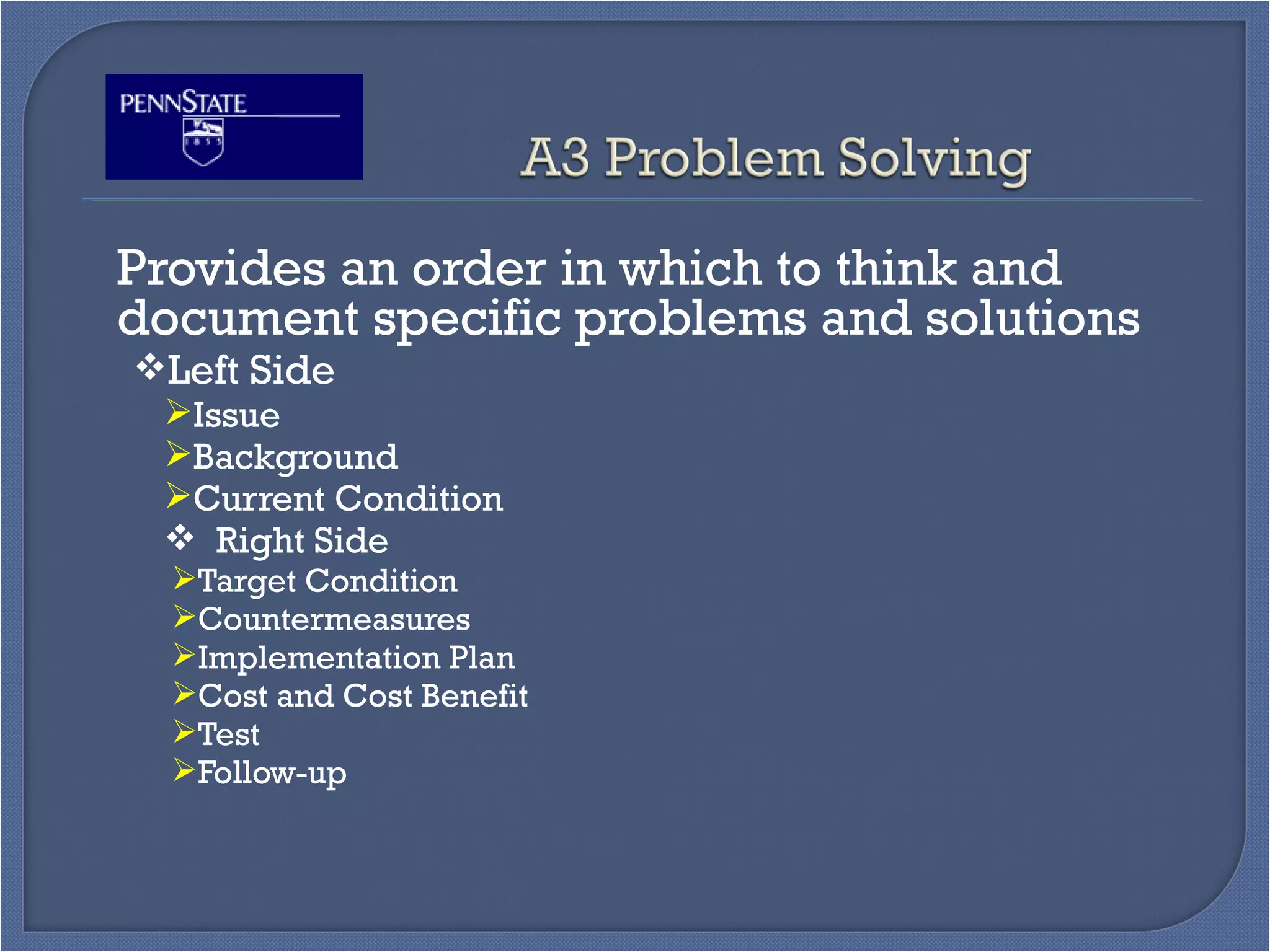
Provides an order in which to think and
document specific problems and solutions
Left Side
Issue
Background
Current Condition
 Right Side
Target Condition
Countermeasures
Implementation Plan
Cost and Cost Benefit
Test
Follow-up
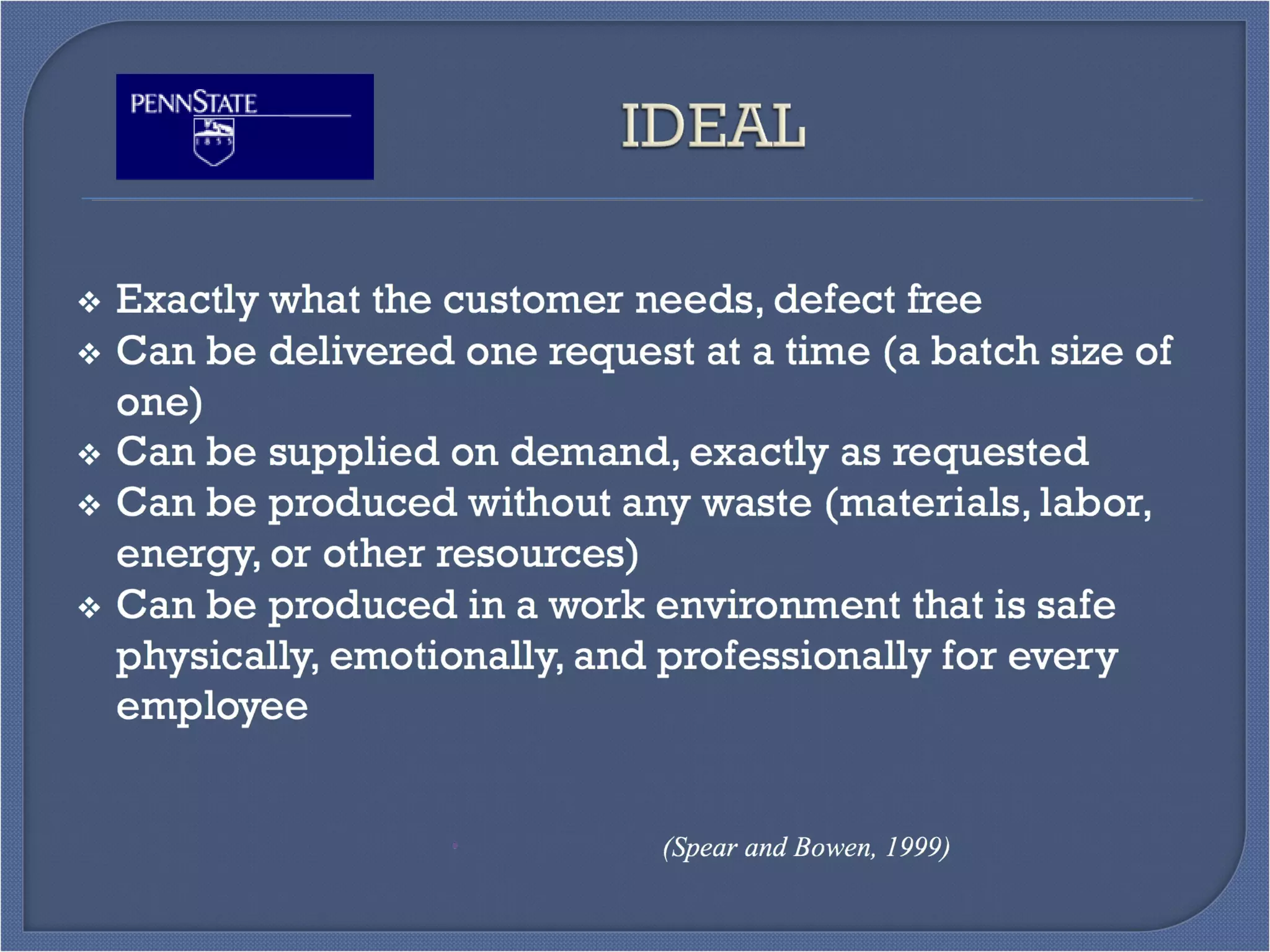
 IDEAL
 Four Rules in Use
 Observation
 Method for deeply understanding work activities
 Skills must be developed and practiced – it’s not easy!
 Value Stream Mapping
 Lean method for identifying the flow of value to the customer
 10,000 foot view of a process
 A3 Problem Solving
 Problem solving in the course of work
 By people doing the work
 Supported by a coach
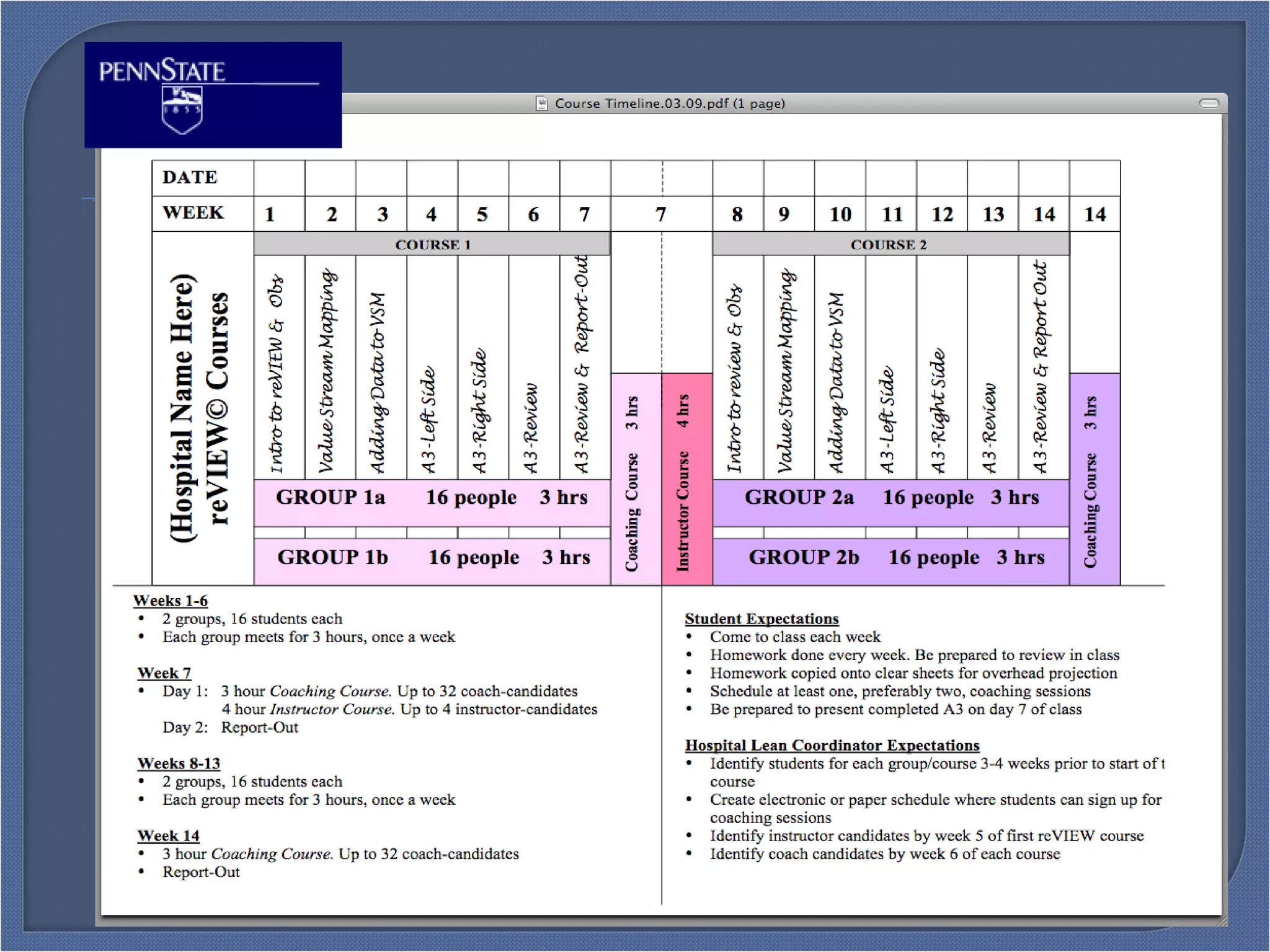
7 Day Course Spread over 7 weeks or more
Schedule for days 1 - 6:
3 hour class time (includes time for project work)
minimum of 1 hour coaching time for participants
Schedule for day 7:
2-3 hour report out of projects
5-6 hour training for participants to learn coaching skills
1 Full Day of Train the Trainer
Training for 2 internal trainers
7 Day Course – Same as Above
New Trainers will co-teach the second course with help from the
instructor
• Opportunity for senior management buy-
in through Executive Overview
• Combination of training and
implementation
• Improvements made by people doing the
work
• Enhances leadership and communication
skills
• Self-sustaining model for lean
implementation
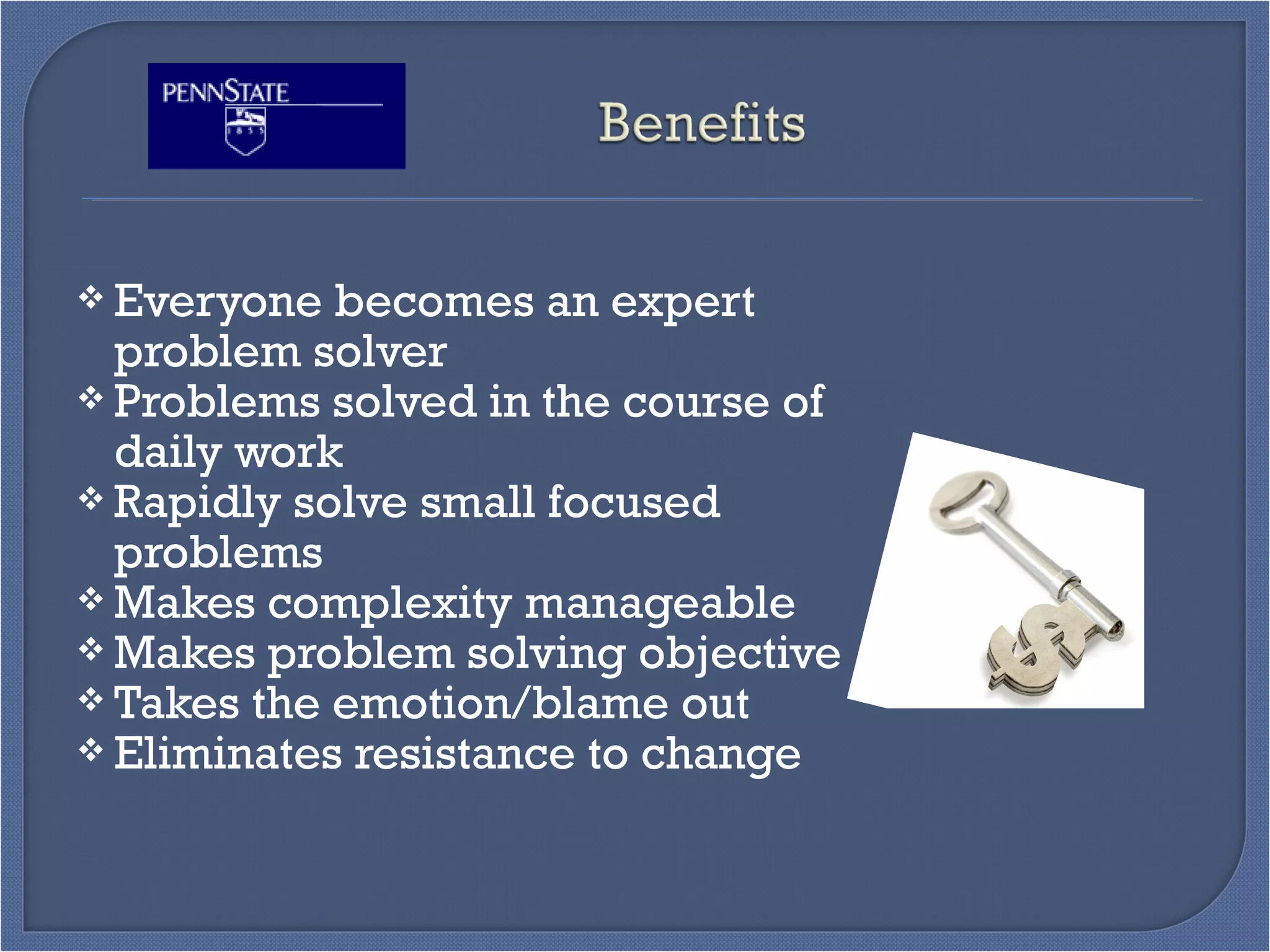
 Everyone becomes an expert
problem solver
 Problems solved in the course of
daily work
 Rapidly solve small focused
problems
 Makes complexity manageable
 Makes problem solving objective
 Takes the emotion/blame out
 Eliminates resistance to change
 Develops a common problem
solving process and language
throughout the hospital system
 Replaces complaining with A3
thinking
 Helps solve problems across
departments
 Done by all those involved -
more buy-in
 Naturally results in culture
change
Elimination of defects
Reduced waste –
improved flow
Improved patient
satisfaction
Reduced costs
Increased employee
engagement
Reduced employee
turnover
 Short-Term Rehab Discharge to Home
 Business Impact
Reduced time that social services spends coordinating
short-term rehab discharges by 25%
Reduced the number of missed short-term rehab
patients due to a delay in another patients discharge
by approximately 20%
Improved employee and patient satisfaction
ROI = 154%
 Dressing Change Delays (TPS reVIEW
©
Project)
 Business Impact:
Reduced the combined nursing time spent looking
for dressing supplies by 3.75 hours per day
Reduced the amount of wasted medical supplies to
inaccurate inventory
Improved employee and resident satisfaction
ROI = 590%
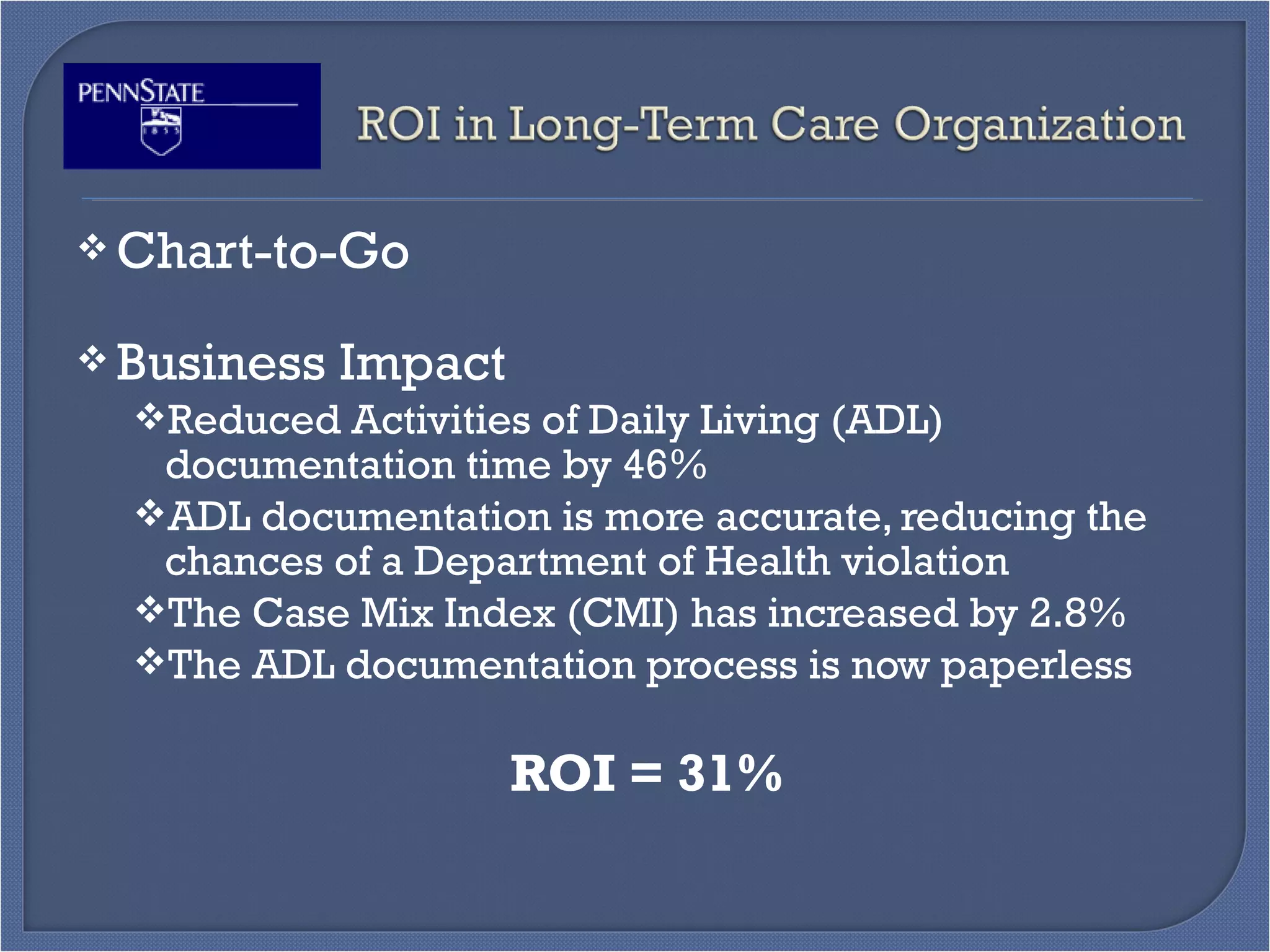
 Chart-to-Go
 Business Impact
Reduced Activities of Daily Living (ADL)
documentation time by 46%
ADL documentation is more accurate, reducing the
chances of a Department of Health violation
The Case Mix Index (CMI) has increased by 2.8%
The ADL documentation process is now paperless
ROI = 31%
Flyer used
for marketing
purposes
“But what really sets this training apart from other problem –solving
process improvement courses is the potential to empower front line staff
to help develop and implement solutions, which helps them feel more
connected and thus motivated to continue giving their best efforts
because they can make a difference.”
Michelle
DiGilarmo
Director of HR
and OD
WRC Senior
Services
“TPS in Healthcare using reVIEW
©
provides you with the tools to look at a
process in a way that will assist in finding the best and most efficient
practice.You can ultimately “see” the Return-on-Investment.”
Catherine Grove
Chairperson
NCWIB Healthcare
Partnership
 Research-Based
 Experiential
 Simple
 Sustainable (the gift that keeps on giving)
 Coaching Component
 Can Easily Illustrate Metric Improvement
(Level IV Evaluation) a Return-on-
Investment (Level V Evaluation)
 JCAHO likes Lean
 Others?
TPS Lean Healthcare Overview

TPS Lean Healthcare Overview

  • 2.
    Objectives of thissession: Acquire a general familiarity of the Toyota Production System Review the critical elements of the curriculum Examine the uniqueness of the curriculum Develop awareness of the benefits and metric improvements that can be realized as a result of training and implementation Discuss the unique selling proposition of the program Discuss the opportunities and challenges associated with the program
  • 4.
    TRADITIONAL CULTURE LEANCULTURE  Functional Silos  Managers Direct  Benchmark  Blame People  Rewards: Individual  Supplier is Enemy  Guard Information  Volume Lowers Cost  Internal Focus  Expert Driven  Interdisciplinary Teams  Managers Teach/Enable  Seek the Ultimate Performance  Root Cause Analysis  Rewards: Group Sharing  Supplier is Ally  Share Information  Removing Waste Lowers Cost  Customer Focus  Process Driven
  • 5.
    MIT researchers coinedthe term after discovering that the Toyota Production System produced goods with… HIGHER QUALITY and LOWER COST in HALF the TIME ( Womack , Jones & Roos, 1991)
  • 7.
     Rule 1:All activities of work are clearly specified by content, sequence, timing, and outcome  Rule 2: Connections are direct  Rule 3: Pathways are simple and each step is essential  Rule 4: Improvement – direct response, as close to the problem as possible, as an experiment, by those doing the work, supported by a coach
  • 10.
    The Value StreamMap VSMs identify every way that a request can be made Reserving a Conference Room Confirmation - confirm received info w / customer - make sure to have all necessary info Schedule Room - Check available dates - Check available tables and chairs - Reserve room Schedule A.V. - Check available A.V. equipment - Reserve A.V. equipment Catering - Order food - Order beverages Confirm - Call/ email/ fax customer confirmation Bill - Review charges - Create bill - Send bill
  • 12.
    Provides an orderin which to think and document specific problems and solutions Left Side Issue Background Current Condition  Right Side Target Condition Countermeasures Implementation Plan Cost and Cost Benefit Test Follow-up
  • 15.
     IDEAL  FourRules in Use  Observation  Method for deeply understanding work activities  Skills must be developed and practiced – it’s not easy!  Value Stream Mapping  Lean method for identifying the flow of value to the customer  10,000 foot view of a process  A3 Problem Solving  Problem solving in the course of work  By people doing the work  Supported by a coach
  • 16.
    7 Day CourseSpread over 7 weeks or more Schedule for days 1 - 6: 3 hour class time (includes time for project work) minimum of 1 hour coaching time for participants Schedule for day 7: 2-3 hour report out of projects 5-6 hour training for participants to learn coaching skills 1 Full Day of Train the Trainer Training for 2 internal trainers 7 Day Course – Same as Above New Trainers will co-teach the second course with help from the instructor
  • 17.
    • Opportunity forsenior management buy- in through Executive Overview • Combination of training and implementation • Improvements made by people doing the work • Enhances leadership and communication skills • Self-sustaining model for lean implementation
  • 19.
     Everyone becomesan expert problem solver  Problems solved in the course of daily work  Rapidly solve small focused problems  Makes complexity manageable  Makes problem solving objective  Takes the emotion/blame out  Eliminates resistance to change
  • 20.
     Develops acommon problem solving process and language throughout the hospital system  Replaces complaining with A3 thinking  Helps solve problems across departments  Done by all those involved - more buy-in  Naturally results in culture change
  • 21.
    Elimination of defects Reducedwaste – improved flow Improved patient satisfaction Reduced costs Increased employee engagement Reduced employee turnover
  • 22.
     Short-Term RehabDischarge to Home  Business Impact Reduced time that social services spends coordinating short-term rehab discharges by 25% Reduced the number of missed short-term rehab patients due to a delay in another patients discharge by approximately 20% Improved employee and patient satisfaction ROI = 154%
  • 23.
     Dressing ChangeDelays (TPS reVIEW © Project)  Business Impact: Reduced the combined nursing time spent looking for dressing supplies by 3.75 hours per day Reduced the amount of wasted medical supplies to inaccurate inventory Improved employee and resident satisfaction ROI = 590%
  • 24.
     Chart-to-Go  BusinessImpact Reduced Activities of Daily Living (ADL) documentation time by 46% ADL documentation is more accurate, reducing the chances of a Department of Health violation The Case Mix Index (CMI) has increased by 2.8% The ADL documentation process is now paperless ROI = 31%
  • 25.
  • 26.
    “But what reallysets this training apart from other problem –solving process improvement courses is the potential to empower front line staff to help develop and implement solutions, which helps them feel more connected and thus motivated to continue giving their best efforts because they can make a difference.” Michelle DiGilarmo Director of HR and OD WRC Senior Services “TPS in Healthcare using reVIEW © provides you with the tools to look at a process in a way that will assist in finding the best and most efficient practice.You can ultimately “see” the Return-on-Investment.” Catherine Grove Chairperson NCWIB Healthcare Partnership
  • 27.
     Research-Based  Experiential Simple  Sustainable (the gift that keeps on giving)  Coaching Component  Can Easily Illustrate Metric Improvement (Level IV Evaluation) a Return-on- Investment (Level V Evaluation)  JCAHO likes Lean  Others?

Editor's Notes

  • #3 Point out journal article – Decoding the DNA of the Toyota Production System for a better overview. Jimmerson article for TPS in Healthcare using reVIEW
  • #4 Some organizations look at TPS as a set of tools – using some and not all. You have to buy into the whole system – you have to buy into the culture that it will create as a result of using the system.
  • #5 What are some of the cultural elements of an organization that has embraced TPS in Healthcare?
  • #6 Lean does not mean staff reduction
  • #7 In the first slide, we discovered that the Toyota Production System continually pursues perfection – they express in the form of IDEAL. This is IDEAL is to TPS.
  • #8 A very important set of principles are the 4 rules. 3 rules related to process design and one to improvement. When you have a problem in a process it is because of one are several of these principles are being broken. Rule 4 the scientific method is a very important part in TPS. When you make an improvement you test or conduct an experiment it to make you sure it is what you want to achieve.
  • #9 Important: the focus of a process is the customer or patient – examples in healthcare Office visit, Inpatient stay, ER visit, Surgery.
  • #10 Show example of VS Map Current state, Current state with data, and Future state
  • #13 A3 gets its name because 11x17 paper in Europe is called A3
  • #15 Research based – NSF grant with Durward Sobek – studied the manufacturing model and integrated into healthcare. Refer to article.
  • #16 Curriculum is simple – this is what is taught
  • #18 reVIEW stands for:
  • #19 Schedule by week showing what will be covered each day.
  • #20 I
  • #22 What metrics can be impacted as a result of this program?