Operational Excellence

      Through

  HUMAN PROCESS
    ENGINEERING


                         © Pankaj Anand
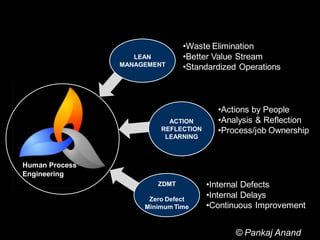
•Waste Elimination
                   LEAN        •Better Value Stream
                MANAGEMENT     •Standardized Operations


                                        •Actions by People
                           ACTION       •Analysis & Reflection
                         REFLECTION     •Process/job Ownership
                          LEARNING


Human Process
Engineering
                        ZDMT          •Internal Defects
                      Zero Defect
                                      •Internal Delays
                     Minimum Time     •Continuous Improvement


                                            © Pankaj Anand
Human Process Engineering - Introduction

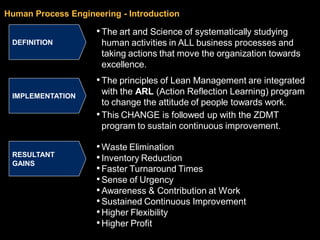
                     • The art and Science of systematically studying
 DEFINITION           human activities in ALL business processes and
                      taking actions that move the organization towards
                      excellence.
                     • The principles of Lean Management are integrated
 IMPLEMENTATION
                       with the ARL (Action Reflection Learning) program
                       to change the attitude of people towards work.
                     • This CHANGE is followed up with the ZDMT
                       program to sustain continuous improvement.

                     • Waste Elimination
 RESULTANT
 GAINS
                     • Inventory Reduction
                     • Faster Turnaround Times
                     • Sense of Urgency
                     • Awareness & Contribution at Work
                     • Sustained Continuous Improvement
                     • Higher Flexibility
                     • Higher Profit                                       2
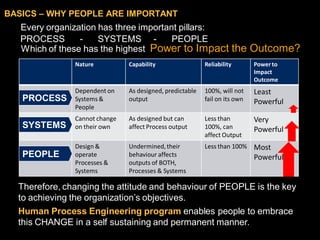
BASICS – WHY PEOPLE ARE IMPORTANT
   Every organization has three important pillars:
   PROCESS       -    SYSTEMS -         PEOPLE
   Which of these has the highest Power to Impact the Outcome?
               Nature          Capability                 Reliability       Power to
                                                                            Impact
                                                                            Outcome
               Dependent on    As designed, predictable   100%, will not    Least
   PROCESS     Systems &       output                     fail on its own   Powerful
               People
               Cannot change   As designed but can        Less than         Very
   SYSTEMS     on their own    affect Process output      100%, can         Powerful
                                                          affect Output
               Design &        Undermined, their          Less than 100% Most
   PEOPLE      operate         behaviour affects                            Powerful
               Processes &     outputs of BOTH,
               Systems         Processes & Systems

  Therefore, changing the attitude and behaviour of PEOPLE is the key
  to achieving the organization’s objectives.
  Human Process Engineering program enables people to embrace
  this CHANGE in a self sustaining and permanent manner.
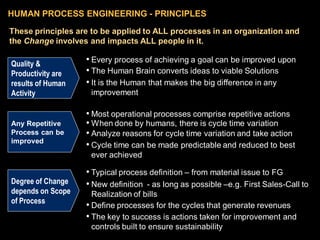
HUMAN PROCESS ENGINEERING - PRINCIPLES

• These principles are to be applied to ALL processes in an organization and
 the Change involves and impacts ALL people in it.

 Quality &           • Every process of achieving a goal can be improved upon
 Productivity are    • The Human Brain converts ideas to viable Solutions
 results of Human    • It is the Human that makes the big difference in any
 Activity             improvement

                     • Most operational processes comprise repetitive actions
 Any Repetitive      • When done by humans, there is cycle time variation
 Process can be      • Analyze reasons for cycle time variation and take action
 improved
                     • Cycle time can be made predictable and reduced to best
                      ever achieved

                     • Typical process definition – from material issue to FG
 Degree of Change    • New definition - as long as possible –e.g. First Sales-Call to
 depends on Scope      Realization of bills
 of Process
                     • Define processes for the cycles that generate revenues
                     • The key to success is actions taken for improvement and
                       controls built to ensure sustainability
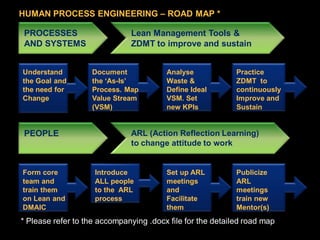
HUMAN PROCESS ENGINEERING – ROAD MAP *

PROCESSES                     Lean Management Tools &
AND SYSTEMS                   ZDMT to improve and sustain


Understand         Document             Analyse             Practice
the Goal and       the ‘As-Is’          Waste &             ZDMT to
the need for       Process. Map         Define Ideal        continuously
Change             Value Stream         VSM. Set            Improve and
                   (VSM)                new KPIs            Sustain


PEOPLE                        ARL (Action Reflection Learning)
                              to change attitude to work


Form core           Introduce           Set up ARL          Publicize
team and            ALL people          meetings            ARL
train them          to the ARL          and                 meetings
on Lean and         process             Facilitate          train new
DMAIC                                   them                Mentor(s)
* Please refer to the accompanying .docx file for the detailed road map
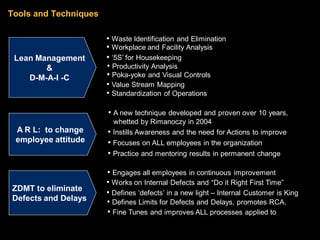
Tools and Techniques

                       • Waste Identification and Elimination
                       • Workplace and Facility Analysis
 Lean Management       • ‘5S’ for Housekeeping
        &              • Productivity Analysis
    D-M-A-I -C         • Poka-yoke and Visual Controls
                       • Value Stream Mapping
                       • Standardization of Operations

                       • A new technique developed and proven over 10 years,
                           whetted by Rimanoczy in 2004
 A R L: to change      •   Instills Awareness and the need for Actions to improve
 employee attitude     •   Focuses on ALL employees in the organization
                       •   Practice and mentoring results in permanent change

                       • Engages all employees in continuous improvement
                       • Works on Internal Defects and “Do it Right First Time”
ZDMT to eliminate
                       • Defines ‘defects’ in a new light – Internal Customer is King
Defects and Delays     • Defines Limits for Defects and Delays, promotes RCA.
                       • Fine Tunes and improves ALL processes applied to
Background
• Mr Pankaj Anand has 32 years of Projects, manufacturing and management experience in
 Mechanical, Electrical and Electronics manufacturing and Foundry practice.
•Ten years in the Corporate sector – MICO (Bosch) and Kirloskar Oil Engines (KOEL)
• Twenty two years of setting up and running successfully an Electronics manufacturing
 company.
• He has made it his mission to help industries achieve excellence through Lean
 Management/ Manufacturing, innovative techniques and structured mentoring.
• Consultancy to Companies in the Kirloskar Group, amongst other objectives, to
 improve the Quality, Productivity and Commitment of some of their Vendors.

• Has wide bandwidth of understanding the Engineering industry, with focus on Human
 contribution to achieving goals. His flexibility in finding situation driven solutions has
 delivered immense value to his clients.

Credentials
• BE (Mechanical) College of Engineering, Pune, India
• Lean Management Certification - Benchmark Six Sigma
• SMEP – IIM Ahmedabad
• Value Engineering – NITIE, Powai, Mumbai                                                    7

Human Process Engineering

  • 1.
    Operational Excellence Through HUMAN PROCESS ENGINEERING © Pankaj Anand
  • 2.
    •Waste Elimination LEAN •Better Value Stream MANAGEMENT •Standardized Operations •Actions by People ACTION •Analysis & Reflection REFLECTION •Process/job Ownership LEARNING Human Process Engineering ZDMT •Internal Defects Zero Defect •Internal Delays Minimum Time •Continuous Improvement © Pankaj Anand
  • 3.
    Human Process Engineering- Introduction • The art and Science of systematically studying DEFINITION human activities in ALL business processes and taking actions that move the organization towards excellence. • The principles of Lean Management are integrated IMPLEMENTATION with the ARL (Action Reflection Learning) program to change the attitude of people towards work. • This CHANGE is followed up with the ZDMT program to sustain continuous improvement. • Waste Elimination RESULTANT GAINS • Inventory Reduction • Faster Turnaround Times • Sense of Urgency • Awareness & Contribution at Work • Sustained Continuous Improvement • Higher Flexibility • Higher Profit 2
  • 4.
    BASICS – WHYPEOPLE ARE IMPORTANT Every organization has three important pillars: PROCESS - SYSTEMS - PEOPLE Which of these has the highest Power to Impact the Outcome? Nature Capability Reliability Power to Impact Outcome Dependent on As designed, predictable 100%, will not Least PROCESS Systems & output fail on its own Powerful People Cannot change As designed but can Less than Very SYSTEMS on their own affect Process output 100%, can Powerful affect Output Design & Undermined, their Less than 100% Most PEOPLE operate behaviour affects Powerful Processes & outputs of BOTH, Systems Processes & Systems Therefore, changing the attitude and behaviour of PEOPLE is the key to achieving the organization’s objectives. Human Process Engineering program enables people to embrace this CHANGE in a self sustaining and permanent manner.
  • 5.
    HUMAN PROCESS ENGINEERING- PRINCIPLES • These principles are to be applied to ALL processes in an organization and the Change involves and impacts ALL people in it. Quality & • Every process of achieving a goal can be improved upon Productivity are • The Human Brain converts ideas to viable Solutions results of Human • It is the Human that makes the big difference in any Activity improvement • Most operational processes comprise repetitive actions Any Repetitive • When done by humans, there is cycle time variation Process can be • Analyze reasons for cycle time variation and take action improved • Cycle time can be made predictable and reduced to best ever achieved • Typical process definition – from material issue to FG Degree of Change • New definition - as long as possible –e.g. First Sales-Call to depends on Scope Realization of bills of Process • Define processes for the cycles that generate revenues • The key to success is actions taken for improvement and controls built to ensure sustainability
  • 6.
    HUMAN PROCESS ENGINEERING– ROAD MAP * PROCESSES Lean Management Tools & AND SYSTEMS ZDMT to improve and sustain Understand Document Analyse Practice the Goal and the ‘As-Is’ Waste & ZDMT to the need for Process. Map Define Ideal continuously Change Value Stream VSM. Set Improve and (VSM) new KPIs Sustain PEOPLE ARL (Action Reflection Learning) to change attitude to work Form core Introduce Set up ARL Publicize team and ALL people meetings ARL train them to the ARL and meetings on Lean and process Facilitate train new DMAIC them Mentor(s) * Please refer to the accompanying .docx file for the detailed road map
  • 7.
    Tools and Techniques • Waste Identification and Elimination • Workplace and Facility Analysis Lean Management • ‘5S’ for Housekeeping & • Productivity Analysis D-M-A-I -C • Poka-yoke and Visual Controls • Value Stream Mapping • Standardization of Operations • A new technique developed and proven over 10 years, whetted by Rimanoczy in 2004 A R L: to change • Instills Awareness and the need for Actions to improve employee attitude • Focuses on ALL employees in the organization • Practice and mentoring results in permanent change • Engages all employees in continuous improvement • Works on Internal Defects and “Do it Right First Time” ZDMT to eliminate • Defines ‘defects’ in a new light – Internal Customer is King Defects and Delays • Defines Limits for Defects and Delays, promotes RCA. • Fine Tunes and improves ALL processes applied to
  • 8.
    Background • Mr PankajAnand has 32 years of Projects, manufacturing and management experience in Mechanical, Electrical and Electronics manufacturing and Foundry practice. •Ten years in the Corporate sector – MICO (Bosch) and Kirloskar Oil Engines (KOEL) • Twenty two years of setting up and running successfully an Electronics manufacturing company. • He has made it his mission to help industries achieve excellence through Lean Management/ Manufacturing, innovative techniques and structured mentoring. • Consultancy to Companies in the Kirloskar Group, amongst other objectives, to improve the Quality, Productivity and Commitment of some of their Vendors. • Has wide bandwidth of understanding the Engineering industry, with focus on Human contribution to achieving goals. His flexibility in finding situation driven solutions has delivered immense value to his clients. Credentials • BE (Mechanical) College of Engineering, Pune, India • Lean Management Certification - Benchmark Six Sigma • SMEP – IIM Ahmedabad • Value Engineering – NITIE, Powai, Mumbai 7