The Irish Context
Syeda Fatima Tuz Zahra
Group 3
Introduction
● Not restricted to non-European contexts
● Michael Cronin
● "Translating Ireland explores centuries of translation
activity during which the languages, cultures
and literatures of Ireland have been
affected by the work of Irish translators
in Ireland and elsewhere...”
Cronin’s Concern
● Issue with Niranjana and other
writers on translation and post
colonialism
● Simple opposition of Europe and the
New World or Europe and the
Colony, and their neglect of the
‘internal colonialism’ within Europe
itself.
Marginalization of Irish
● He concentrates on the role of translation in the
linguistic and political battle between the Irish
and English languages, to examine how Irish
translators throughout history have discussed and
presented their work in prefaces, commentaries
and other writings.
● Of particular interest is his description of this
process from historical, political and cultural
angles and the way translation is seen, at different
times, to serve the interests of both colonizer
and colonized.
Role of Language
● The role of language in the subjugation of Ireland by the English is
evident in the 1537 Act for the English Order which was designed
to make the Irish speak English.
● “Translation at a cultural level – the embrace of English
acculturation – is paralleled by translation at a territorial level, the
forcible displacement and movement of populations”. (Cronin
1996: 49)
Irish and English over the Centuries, 15th
Century
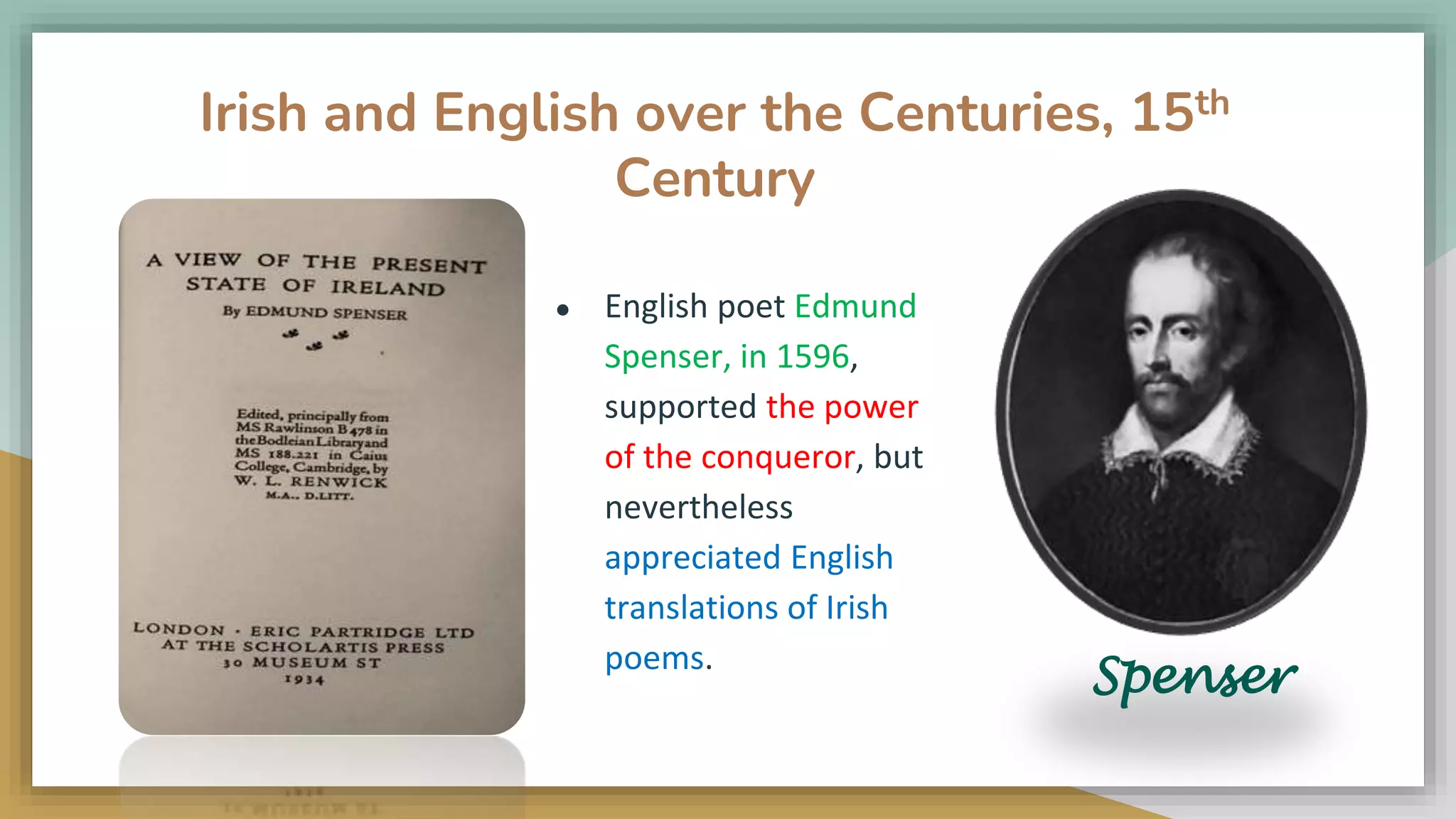
● English poet Edmund
Spenser, in 1596,
supported the power
of the conqueror, but
nevertheless
appreciated English
translations of Irish
poems.
Spenser
Irish and English over the Centuries, 17th
Century
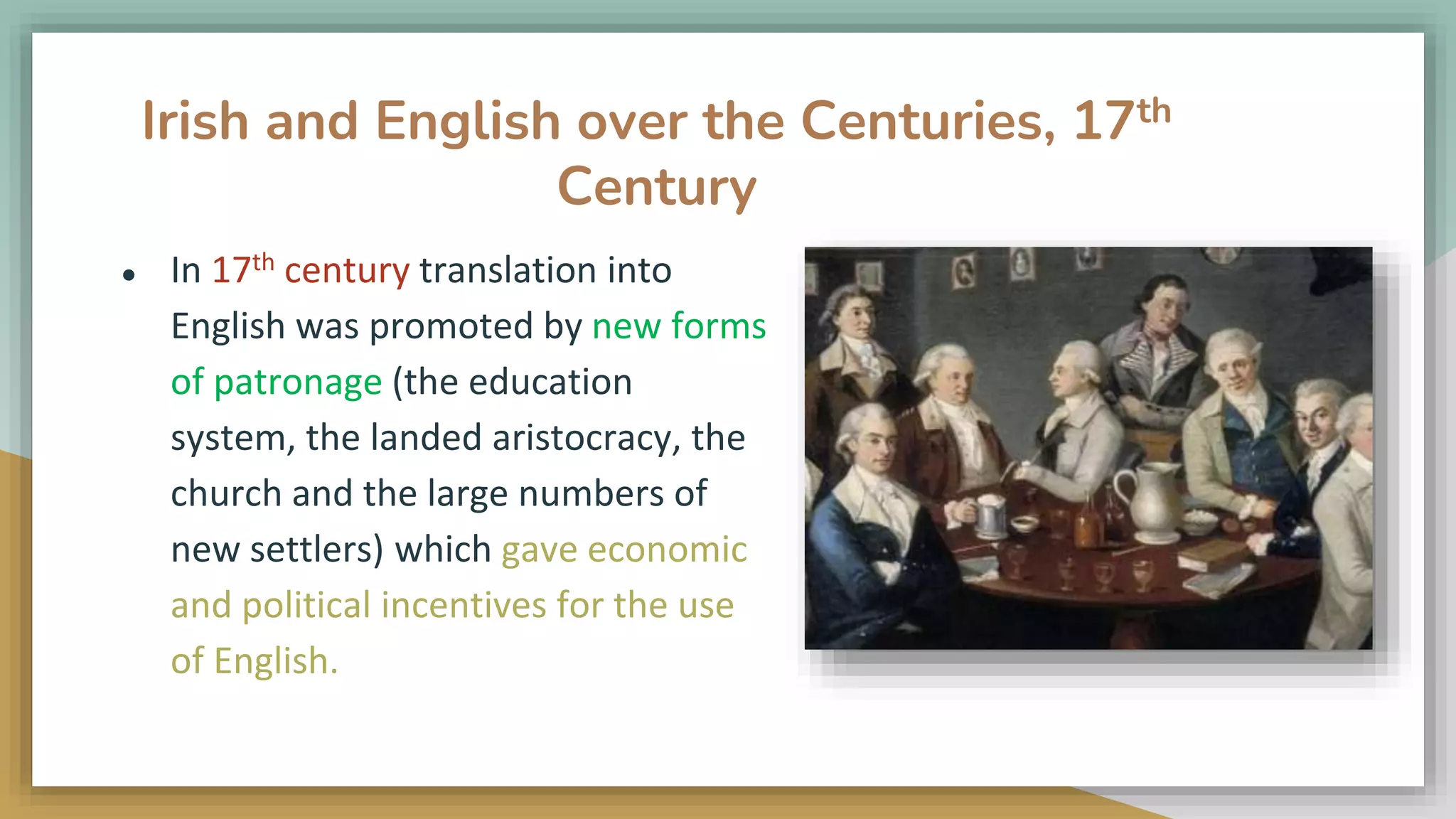
● In 17th century translation into
English was promoted by new forms
of patronage (the education
system, the landed aristocracy, the
church and the large numbers of
new settlers) which gave economic
and political incentives for the use
of English.
Irish and English over the Centuries, Then
vs. Now
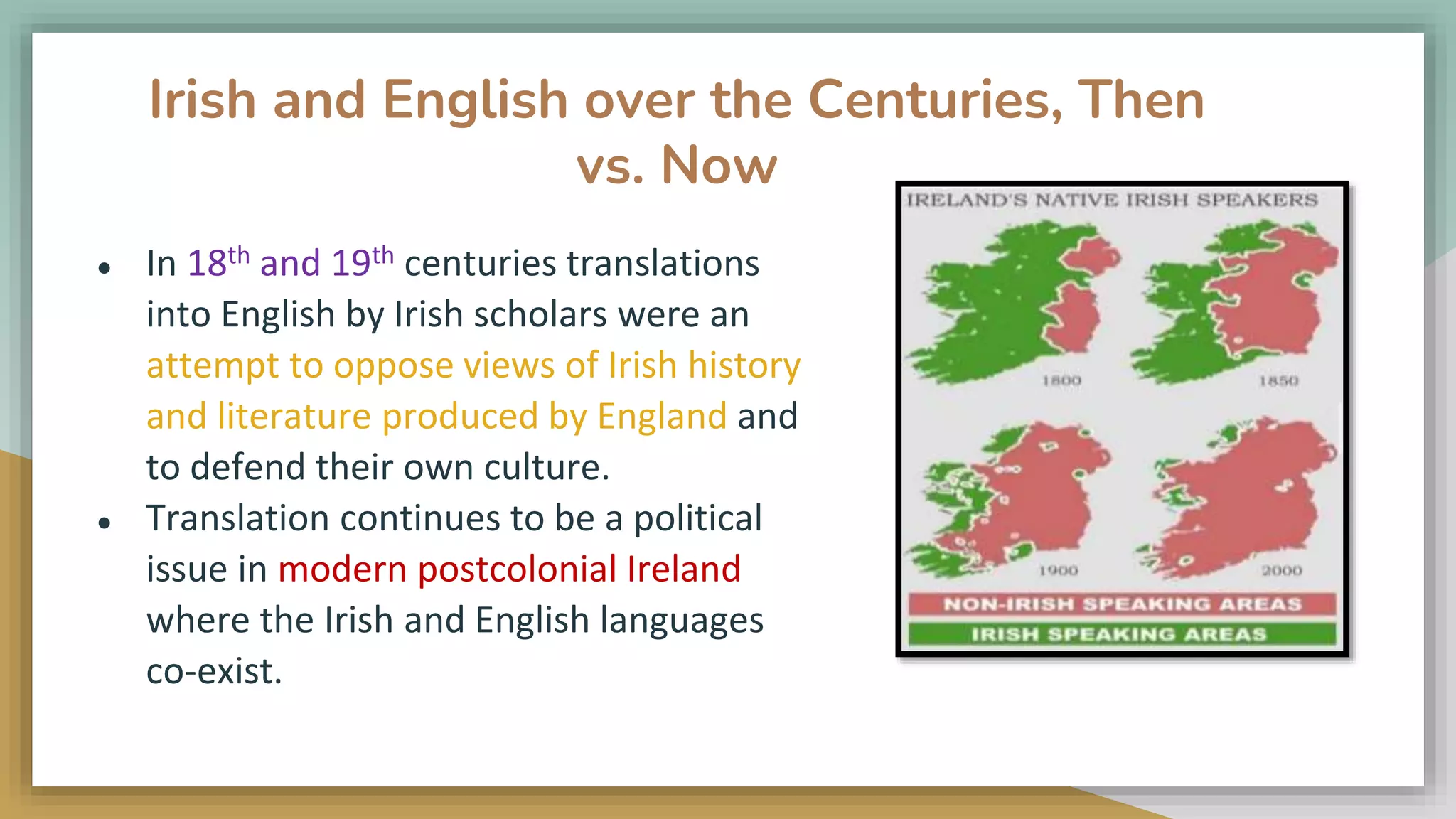
● In 18th and 19th centuries translations
into English by Irish scholars were an
attempt to oppose views of Irish history
and literature produced by England and
to defend their own culture.
● Translation continues to be a political
issue in modern postcolonial Ireland
where the Irish and English languages
co-exist.
Arts Council in Ireland
● Financially supports the translation into the other
European languages of literature written in both Irish
and English by Irish writers
● Cronin about Council’s Laurence Cassidy says that, “It is
of the most crucial importance that an independent
country with an independent literature in two
languages takes onto itself its own representation of
that literature and doesn’t leave it to London
[publishing] houses who are really only promoting the
authorial end and the economic end of the process and
are not concerned about the Irish image”. (pg. 174)
Arts Council in Ireland, Economics vs. Culture
● This reveals the economic power over
culture that remains with the former
colonial power.
● The political stance of Cronin’s book
demonstrates that the postcolonial
power relations within translation do
not just operate on a globally North–
South or West–East scale.
The Irish Context in Translation Studies

The Irish Context in Translation Studies

  • 1.
    The Irish Context SyedaFatima Tuz Zahra Group 3
  • 2.
    Introduction ● Not restrictedto non-European contexts ● Michael Cronin ● "Translating Ireland explores centuries of translation activity during which the languages, cultures and literatures of Ireland have been affected by the work of Irish translators in Ireland and elsewhere...”
  • 3.
    Cronin’s Concern ● Issuewith Niranjana and other writers on translation and post colonialism ● Simple opposition of Europe and the New World or Europe and the Colony, and their neglect of the ‘internal colonialism’ within Europe itself.
  • 4.
    Marginalization of Irish ●He concentrates on the role of translation in the linguistic and political battle between the Irish and English languages, to examine how Irish translators throughout history have discussed and presented their work in prefaces, commentaries and other writings. ● Of particular interest is his description of this process from historical, political and cultural angles and the way translation is seen, at different times, to serve the interests of both colonizer and colonized.
  • 5.
    Role of Language ●The role of language in the subjugation of Ireland by the English is evident in the 1537 Act for the English Order which was designed to make the Irish speak English. ● “Translation at a cultural level – the embrace of English acculturation – is paralleled by translation at a territorial level, the forcible displacement and movement of populations”. (Cronin 1996: 49)
  • 6.
    Irish and Englishover the Centuries, 15th Century ● English poet Edmund Spenser, in 1596, supported the power of the conqueror, but nevertheless appreciated English translations of Irish poems. Spenser
  • 7.
    Irish and Englishover the Centuries, 17th Century ● In 17th century translation into English was promoted by new forms of patronage (the education system, the landed aristocracy, the church and the large numbers of new settlers) which gave economic and political incentives for the use of English.
  • 8.
    Irish and Englishover the Centuries, Then vs. Now ● In 18th and 19th centuries translations into English by Irish scholars were an attempt to oppose views of Irish history and literature produced by England and to defend their own culture. ● Translation continues to be a political issue in modern postcolonial Ireland where the Irish and English languages co-exist.
  • 9.
    Arts Council inIreland ● Financially supports the translation into the other European languages of literature written in both Irish and English by Irish writers ● Cronin about Council’s Laurence Cassidy says that, “It is of the most crucial importance that an independent country with an independent literature in two languages takes onto itself its own representation of that literature and doesn’t leave it to London [publishing] houses who are really only promoting the authorial end and the economic end of the process and are not concerned about the Irish image”. (pg. 174)
  • 10.
    Arts Council inIreland, Economics vs. Culture ● This reveals the economic power over culture that remains with the former colonial power. ● The political stance of Cronin’s book demonstrates that the postcolonial power relations within translation do not just operate on a globally North– South or West–East scale.