SAMSUNG ELECTRONICS
    Seoul, Korea

        Ali Soltani
       Spring 2011
Agenda
• Samsung Group – History & Structure
• Samsung Electronics
  –   History
  –   Company Focus
  –   Financial Overview
  –   Strategy
  –   Organizational Structure
  –   Challenges
Samsung Group
• Founded in 1938
   – exporter of dried fish, vegetables, and fruits
   – flour mill and confectionery machines
• 1950’s Economic Stabilization
   – Korean War - Samsung lost all assets
   – aimed to help rebuild Korean economy; entered the
     manufacturing industry (sugar, fabrics)
   – became a leader in modern business practices (recruiting
     from outside)
• 1960’s Expansion of Key Industries
   – entered electronics and chemical industries
   – 1969 established Samsung Electronics Co.
Samsung Electronics
• Established in January, 1969
• 1970’s: Bet the future on electronics
   – laid the groundwork for electronics in Korea
   – helped the domestic economy grow
   – paved the way for exports
• 1980’s: A more comprehensive electronics company
   – established plants in Portugal and US
   – established Semiconductor and Communication corporation
   – began memory chip business
• Early 90’s: Integration and Globalization
• Mid-Late 90’s: Implementing new management
  strategies
• New Millenium: Digital Vision
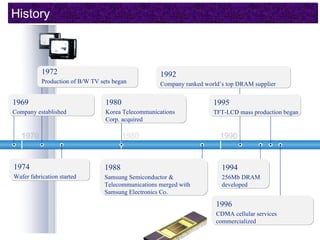
History


           1972                                     1992
           Production of B/W TV sets began          Company ranked world’s top DRAM supplier


1969                              1980                                1995
Company established               Korea Telecommunications            TFT-LCD mass production began
                                  Corp. acquired


1974                             1988                                    1994
Wafer fabrication started        Samsung Semiconductor &                 256Mb DRAM
                                 Telecommunications merged with          developed
                                 Samsung Electronics Co.

                                                                       1996
                                                                       CDMA cellular services
                                                                       commercialized
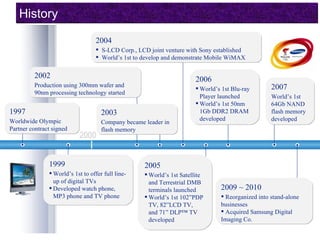
History

                                   2004
                                    S-LCD Corp., LCD joint venture with Sony established
                                    World’s 1st to develop and demonstrate Mobile WiMAX


         2002                                                           2006
         Production using 300mm wafer and                                                           2007
                                                                         World’s 1st Blu-ray
         90nm processing technology started
                                                                          Player launched           World’s 1st
                                                                         World’s 1st 50nm          64Gb NAND
1997                                 2003                                 1Gb DDR2 DRAM             flash memory
Worldwide Olympic                                                         developed                 developed
                                     Company became leader in
Partner contract signed              flash memory


               1999                                 2005
                World’s 1st to offer full line-     World’s 1st Satellite
                 up of digital TVs                    and Terrestrial DMB
                Developed watch phone,               terminals launched         2009 ~ 2010
                 MP3 phone and TV phone              World’s 1st 102”PDP         Reorganized into stand-alone
                                                      TV, 82”LCD TV,             businesses
                                                      and 71” DLP™ TV             Acquired Samsung Digital
                                                      developed                  Imaging Co.
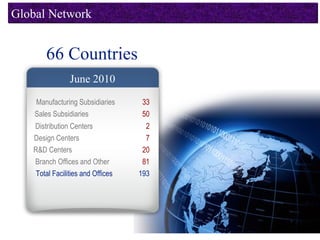
Global Network


       66 Countries
                June 2010

    Manufacturing Subsidiaries      33
    Sales Subsidiaries              50
   Distribution Centers              2
   Design Centers                    7
   R&D Centers                      20
   Branch Offices and Other         81
    Total Facilities and Offices   193
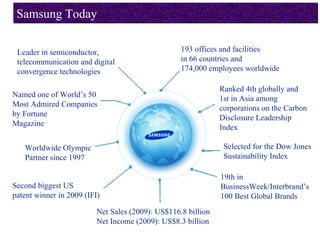
Samsung Today

 Leader in semiconductor,                          193 offices and facilities
 telecommunication and digital                     in 66 countries and
 convergence technologies                          174,000 employees worldwide

                                                               Ranked 4th globally and
Named one of World’s 50                                        1st in Asia among
Most Admired Companies                                         corporations on the Carbon
by Fortune                                                     Disclosure Leadership
Magazine                                                       Index

   Worldwide Olympic                                            Selected for the Dow Jones
   Partner since 1997                                           Sustainability Index

                                                               19th in
Second biggest US                                              BusinessWeek/Interbrand’s
patent winner in 2009 (IFI)                                    100 Best Global Brands
                          Net Sales (2009): US$116.8 billion
                          Net Income (2009): US$8.3 billion
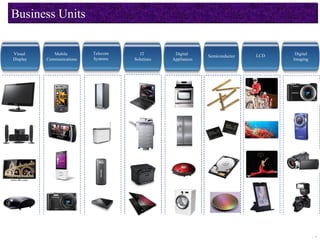
Business Units


Visual       Mobile        Telecom      IT        Digital                            Digital
                                                              Semiconductor   LCD      LCD
Display   Communications   Systems   Solutions   Appliances                         Imaging


                                                                                               | 9
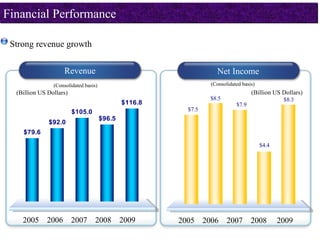
Financial Performance

 Strong revenue growth


                    Revenue                                          Net Income
                (Consolidated basis)                               (Consolidated basis)
  (Billion US Dollars)                                                               (Billion US Dollars)
                                                                   $8.5                           $8.3
                                               $116.8                         $7.9
                         $105.0                           $7.5
                                       $96.5
              $92.0
    $79.6

                                                                                          $4.4


    2005     2006        2007      2008        2009     2005     2006     2007       2008        2009
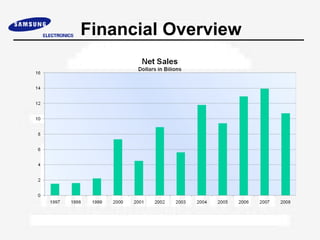
Financial Overview
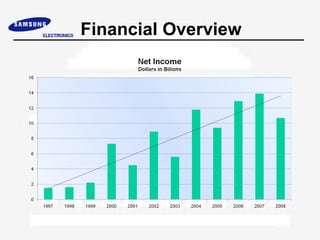
Financial Overview
Strategy
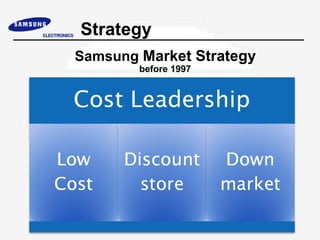
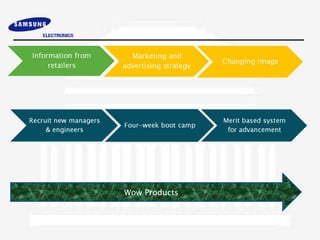
Samsung Market Strategy
        before 1997
Strategy
 Strengths
    Long-time experience in producing technical
     components and low cost manufactured products for
     well-known companies.
    High –quality products
 Weaknesses
   Low-price and down-market image
   Its capital eroded by the Asian financial crisis in 1997
   Distribution via discount chain at very low price
   Communication messages were not consistent due to
    using so many advertising agencies with more than
     20 slogans
Strategy

• Opportunities
  – Development of digital technology
  – New powerful advertising channel: Internet

• Threats
   – The global memory chip market dramatically
     decreased due to the shrinking demand and
     excess supply
   – Chinese cheap products
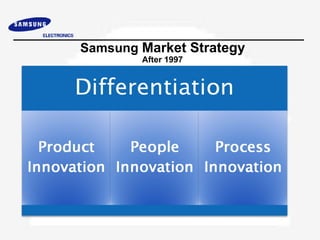
Samsung Market Strategy
        After 1997
Strategy
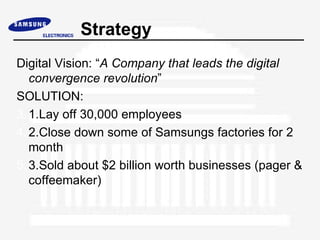
Digital Vision: “A Company that leads the digital
   convergence revolution”
SOLUTION:
3. 1.Lay off 30,000 employees
4. 2.Close down some of Samsungs factories for 2
   month
5. 3.Sold about $2 billion worth businesses (pager &
   coffeemaker)
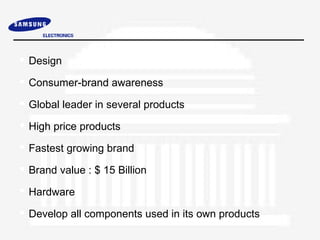
 Design

 Consumer-brand awareness

 Global leader in several products

 High price products

 Fastest growing brand

 Brand value : $ 15 Billion

 Hardware

 Develop all components used in its own products
Strategy
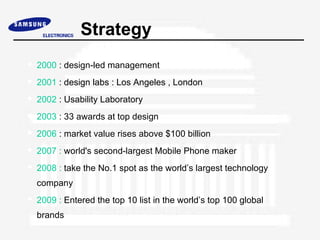
 2000 : design-led management
 2001 : design labs : Los Angeles , London
 2002 : Usability Laboratory
 2003 : 33 awards at top design
 2006 : market value rises above $100 billion
 2007 : world's second-largest Mobile Phone maker
 2008 : take the No.1 spot as the world’s largest technology
  company
 2009 : Entered the top 10 list in the world’s top 100 global
  brands
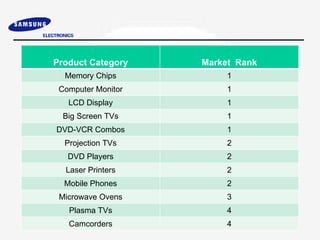
Product Category    Market Rank
  Memory Chips           1
 Computer Monitor        1
   LCD Display           1
  Big Screen TVs         1
DVD-VCR Combos           1
  Projection TVs         2
   DVD Players           2
  Laser Printers         2
  Mobile Phones          2
 Microwave Ovens         3
   Plasma TVs            4
   Camcorders            4
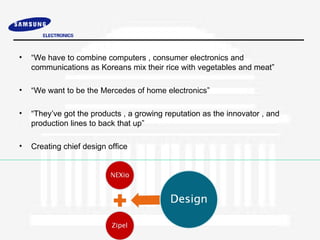
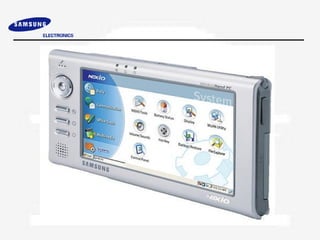
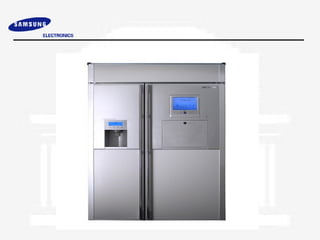
Wow Products
•   “We have to combine computers , consumer electronics and
    communications as Koreans mix their rice with vegetables and meat”

•   “We want to be the Mercedes of home electronics”

•   “They’ve got the products , a growing reputation as the innovator , and
    production lines to back that up”

•   Creating chief design office
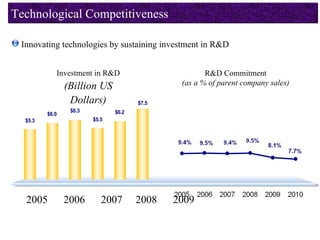
Technological Competitiveness

 Innovating technologies by sustaining investment in R&D


            Investment in R&D                        R&D Commitment
                (Billion US                   (as a % of parent company sales)

                 Dollars)             $7.5
                 $6.3          $6.2
         $6.0
  $5.3                  $5.5


  2005          2006       2007       2008   2009
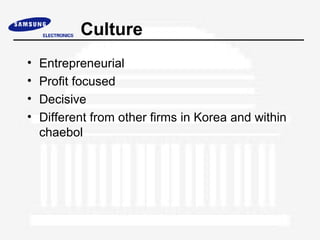
Culture
•   Entrepreneurial
•   Profit focused
•   Decisive
•   Different from other firms in Korea and within
    chaebol
Thank you

Cheap Samsung Phones: The History

  • 1.
    SAMSUNG ELECTRONICS Seoul, Korea Ali Soltani Spring 2011
  • 2.
    Agenda • Samsung Group– History & Structure • Samsung Electronics – History – Company Focus – Financial Overview – Strategy – Organizational Structure – Challenges
  • 3.
    Samsung Group • Foundedin 1938 – exporter of dried fish, vegetables, and fruits – flour mill and confectionery machines • 1950’s Economic Stabilization – Korean War - Samsung lost all assets – aimed to help rebuild Korean economy; entered the manufacturing industry (sugar, fabrics) – became a leader in modern business practices (recruiting from outside) • 1960’s Expansion of Key Industries – entered electronics and chemical industries – 1969 established Samsung Electronics Co.
  • 4.
    Samsung Electronics • Establishedin January, 1969 • 1970’s: Bet the future on electronics – laid the groundwork for electronics in Korea – helped the domestic economy grow – paved the way for exports • 1980’s: A more comprehensive electronics company – established plants in Portugal and US – established Semiconductor and Communication corporation – began memory chip business • Early 90’s: Integration and Globalization • Mid-Late 90’s: Implementing new management strategies • New Millenium: Digital Vision
  • 5.
    History 1972 1992 Production of B/W TV sets began Company ranked world’s top DRAM supplier 1969 1980 1995 Company established Korea Telecommunications TFT-LCD mass production began Corp. acquired 1974 1988 1994 Wafer fabrication started Samsung Semiconductor & 256Mb DRAM Telecommunications merged with developed Samsung Electronics Co. 1996 CDMA cellular services commercialized
  • 6.
    History 2004  S-LCD Corp., LCD joint venture with Sony established  World’s 1st to develop and demonstrate Mobile WiMAX 2002 2006 Production using 300mm wafer and 2007  World’s 1st Blu-ray 90nm processing technology started Player launched World’s 1st  World’s 1st 50nm 64Gb NAND 1997 2003 1Gb DDR2 DRAM flash memory Worldwide Olympic developed developed Company became leader in Partner contract signed flash memory 1999 2005  World’s 1st to offer full line-  World’s 1st Satellite up of digital TVs and Terrestrial DMB  Developed watch phone, terminals launched 2009 ~ 2010 MP3 phone and TV phone  World’s 1st 102”PDP  Reorganized into stand-alone TV, 82”LCD TV, businesses and 71” DLP™ TV  Acquired Samsung Digital developed Imaging Co.
  • 7.
    Global Network 66 Countries June 2010 Manufacturing Subsidiaries 33 Sales Subsidiaries 50 Distribution Centers 2 Design Centers 7 R&D Centers 20 Branch Offices and Other 81 Total Facilities and Offices 193
  • 8.
    Samsung Today Leaderin semiconductor, 193 offices and facilities telecommunication and digital in 66 countries and convergence technologies 174,000 employees worldwide Ranked 4th globally and Named one of World’s 50 1st in Asia among Most Admired Companies corporations on the Carbon by Fortune Disclosure Leadership Magazine Index Worldwide Olympic Selected for the Dow Jones Partner since 1997 Sustainability Index 19th in Second biggest US BusinessWeek/Interbrand’s patent winner in 2009 (IFI) 100 Best Global Brands Net Sales (2009): US$116.8 billion Net Income (2009): US$8.3 billion
  • 9.
    Business Units Visual Mobile Telecom IT Digital Digital Semiconductor LCD LCD Display Communications Systems Solutions Appliances Imaging | 9
  • 10.
    Financial Performance Strongrevenue growth Revenue Net Income (Consolidated basis) (Consolidated basis) (Billion US Dollars) (Billion US Dollars) $8.5 $8.3 $116.8 $7.9 $105.0 $7.5 $96.5 $92.0 $79.6 $4.4 2005 2006 2007 2008 2009 2005 2006 2007 2008 2009
  • 11.
  • 12.
  • 13.
  • 14.
    Strategy  Strengths  Long-time experience in producing technical components and low cost manufactured products for well-known companies.  High –quality products  Weaknesses  Low-price and down-market image  Its capital eroded by the Asian financial crisis in 1997  Distribution via discount chain at very low price  Communication messages were not consistent due to using so many advertising agencies with more than 20 slogans
  • 15.
    Strategy • Opportunities – Development of digital technology – New powerful advertising channel: Internet • Threats – The global memory chip market dramatically decreased due to the shrinking demand and excess supply – Chinese cheap products
  • 16.
  • 17.
    Strategy Digital Vision: “ACompany that leads the digital convergence revolution” SOLUTION: 3. 1.Lay off 30,000 employees 4. 2.Close down some of Samsungs factories for 2 month 5. 3.Sold about $2 billion worth businesses (pager & coffeemaker)
  • 18.
     Design  Consumer-brandawareness  Global leader in several products  High price products  Fastest growing brand  Brand value : $ 15 Billion  Hardware  Develop all components used in its own products
  • 19.
    Strategy  2000 :design-led management  2001 : design labs : Los Angeles , London  2002 : Usability Laboratory  2003 : 33 awards at top design  2006 : market value rises above $100 billion  2007 : world's second-largest Mobile Phone maker  2008 : take the No.1 spot as the world’s largest technology company  2009 : Entered the top 10 list in the world’s top 100 global brands
  • 20.
    Product Category Market Rank Memory Chips 1 Computer Monitor 1 LCD Display 1 Big Screen TVs 1 DVD-VCR Combos 1 Projection TVs 2 DVD Players 2 Laser Printers 2 Mobile Phones 2 Microwave Ovens 3 Plasma TVs 4 Camcorders 4
  • 21.
  • 22.
    “We have to combine computers , consumer electronics and communications as Koreans mix their rice with vegetables and meat” • “We want to be the Mercedes of home electronics” • “They’ve got the products , a growing reputation as the innovator , and production lines to back that up” • Creating chief design office
  • 25.
    Technological Competitiveness Innovatingtechnologies by sustaining investment in R&D Investment in R&D R&D Commitment (Billion US (as a % of parent company sales) Dollars) $7.5 $6.3 $6.2 $6.0 $5.3 $5.5 2005 2006 2007 2008 2009
  • 26.
    Culture • Entrepreneurial • Profit focused • Decisive • Different from other firms in Korea and within chaebol
  • 27.