M26BSS
STRATEGIC MANAGEMENT
Group A11
Qilin Lou 5213030
Yuqi Yang 4204079
Fei Xue 4547851
Aziza Bendera 5399219
Mohammed Faham 5323052
1. Introduction
2. External Analysis
3. Internal Analysis
4. Product Diversification
5. Mergers & Acquisition
6. Corporate Social Responsibility
7. Conclusion & Recommendations
Contents
About Unilever
• Multinational firm (Dutch and British Joint Venture)
• Founded in 1930
• 400 brands, 100 countries, 174000 employees
• Fast-moving consumer goods
• To meet everyday needs of people everywhere in the
world
External Analysis
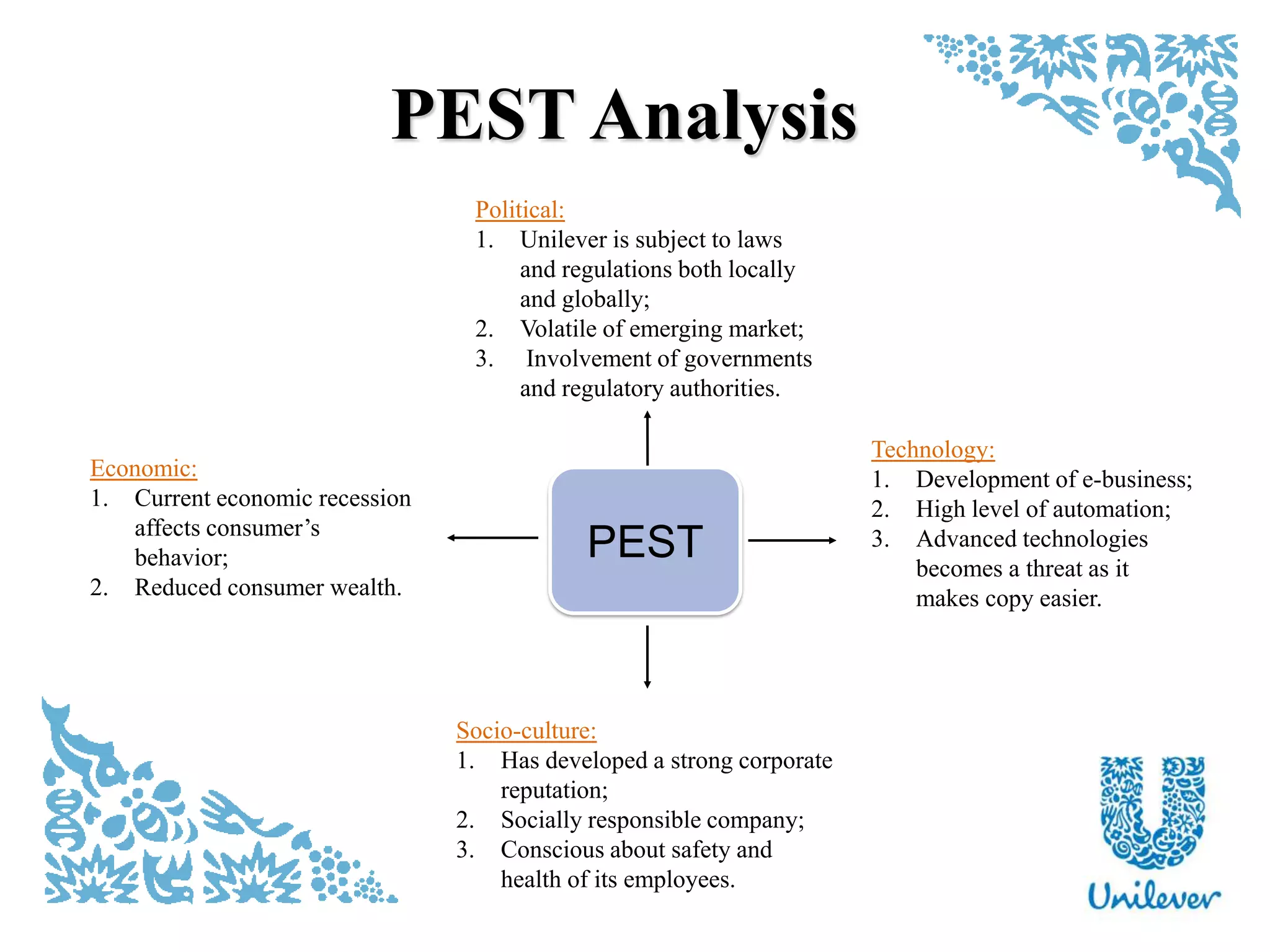
PEST Analysis
Technology:
1. Development of e-business;
2. High level of automation;
3. Advanced technologies
becomes a threat as it
makes copy easier.
Political:
1. Unilever is subject to laws
and regulations both locally
and globally;
2. Volatile of emerging market;
3. Involvement of governments
and regulatory authorities.
Economic:
1. Current economic recession
affects consumer‟s
behavior;
2. Reduced consumer wealth.
Socio-culture:
1. Has developed a strong corporate
reputation;
2. Socially responsible company;
3. Conscious about safety and
health of its employees.
PEST
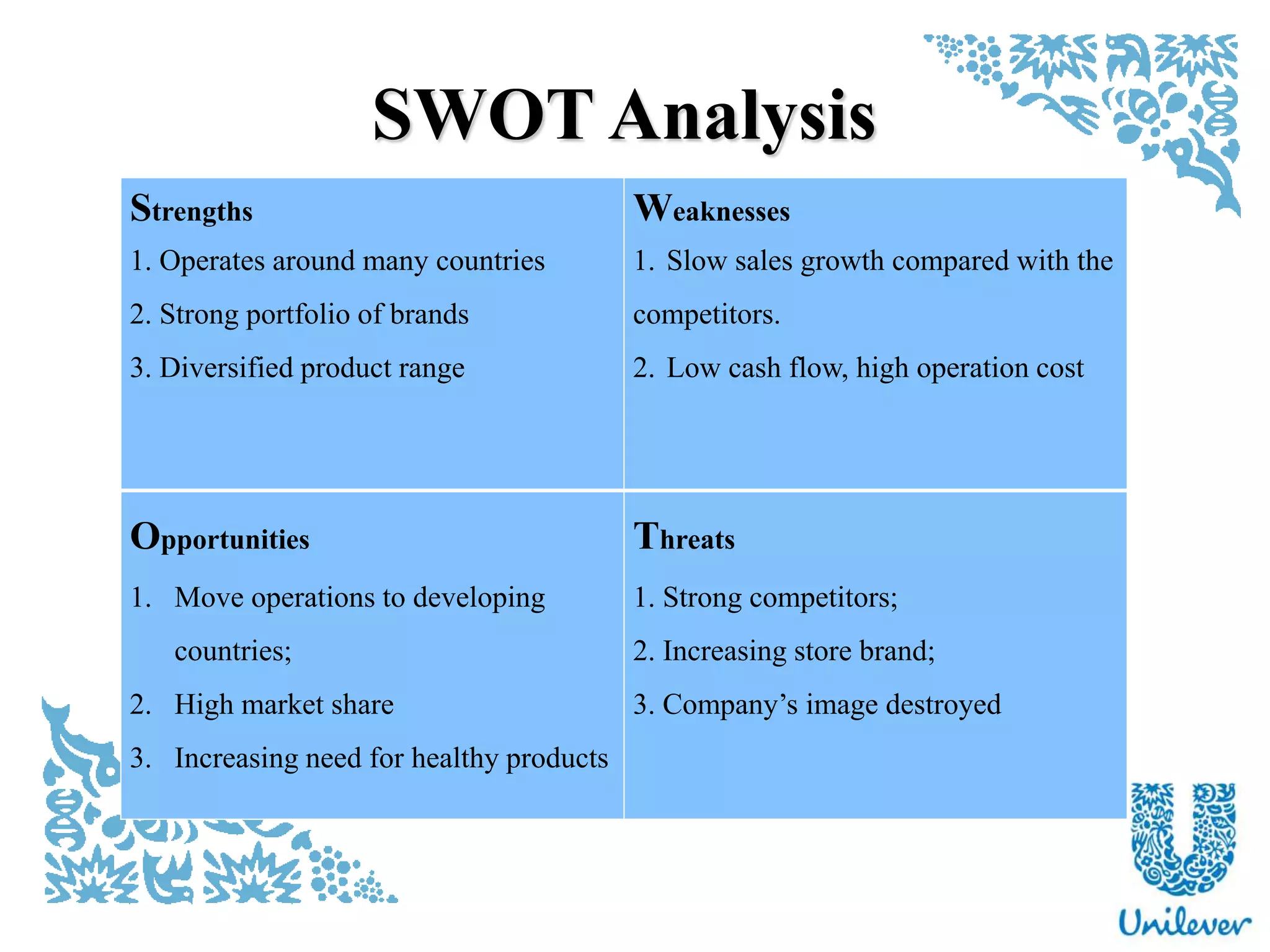
SWOT Analysis
Strengths
1. Operates around many countries
2. Strong portfolio of brands
3. Diversified product range
Weaknesses
1. Slow sales growth compared with the
competitors.
2. Low cash flow, high operation cost
Opportunities
1. Move operations to developing
countries;
2. High market share
3. Increasing need for healthy products
Threats
1. Strong competitors;
2. Increasing store brand;
3. Company‟s image destroyed
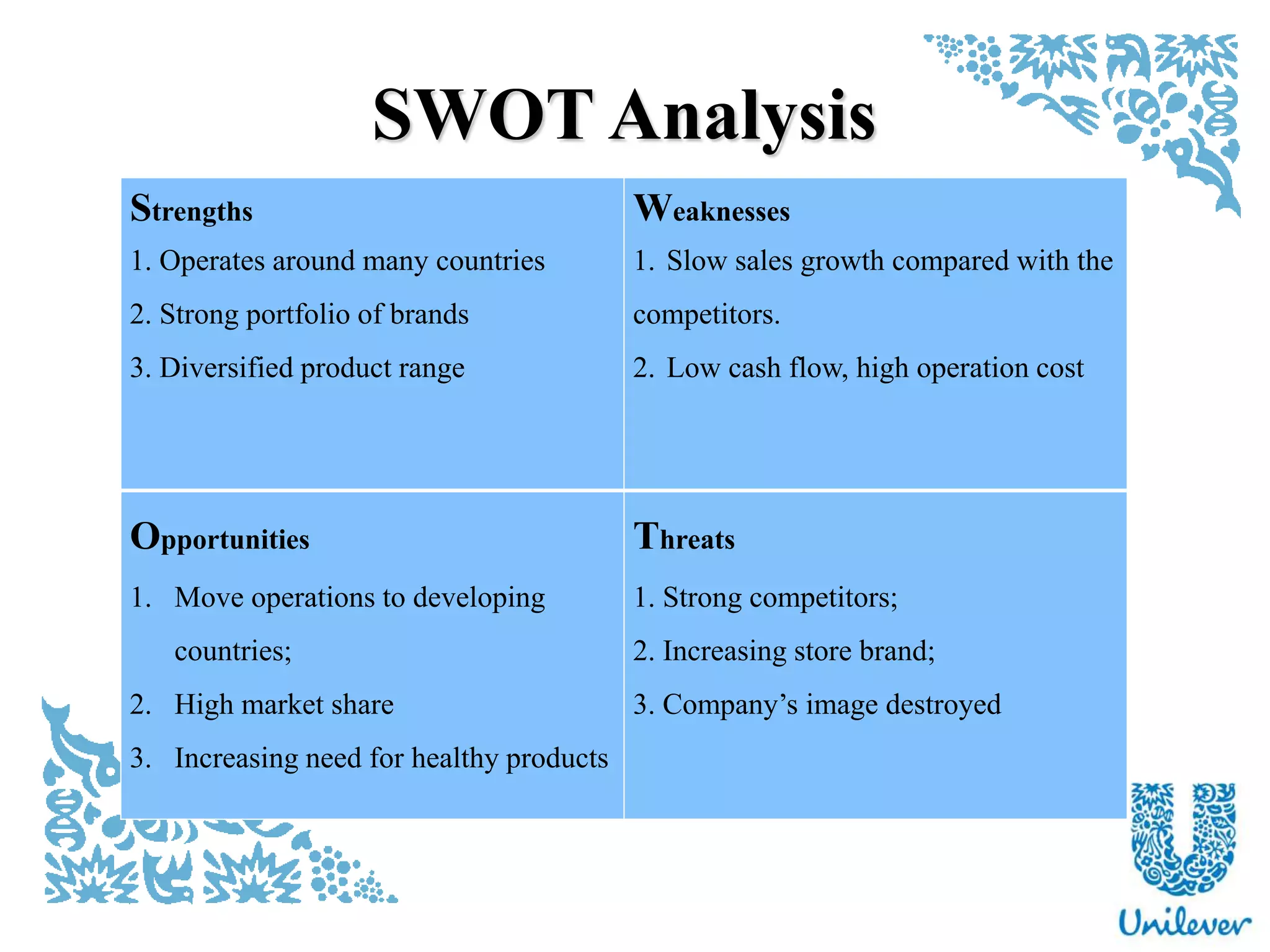
SWOT Analysis
Strengths
1. Operates around many countries
2. Strong portfolio of brands
3. Diversified product range
Weaknesses
1. Slow sales growth compared with the
competitors.
2. Low cash flow, high operation cost
Opportunities
1. Move operations to developing
countries;
2. High market share
3. Increasing need for healthy products
Threats
1. Strong competitors;
2. Increasing store brand;
3. Company‟s image destroyed
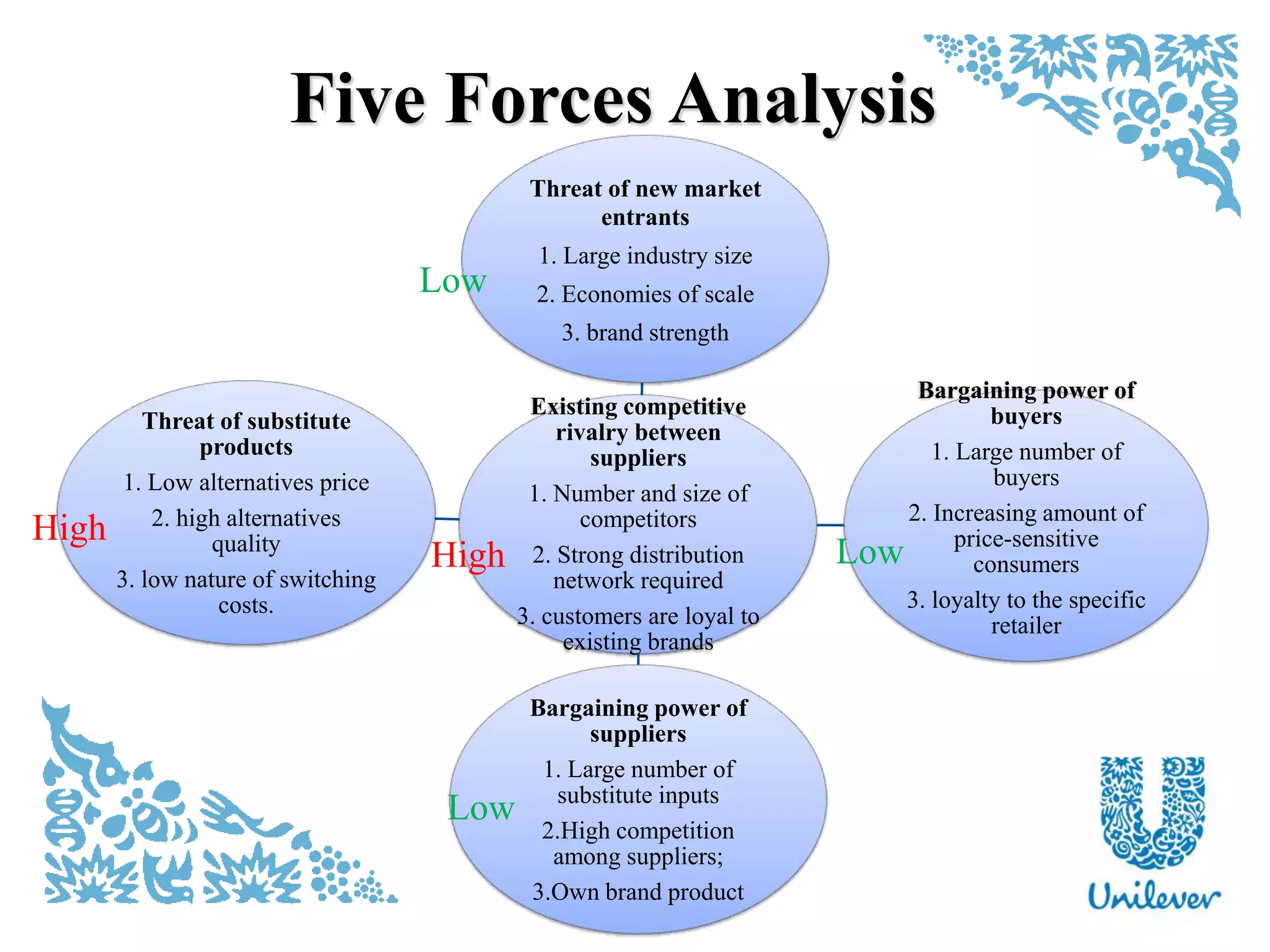
Five Forces Analysis
Existing competitive
rivalry between
suppliers
1. Number and size of
competitors
2. Strong distribution
network required
3. customers are loyal to
existing brands
Threat of new market
entrants
1. Large industry size
2. Economies of scale
3. brand strength
Bargaining power of
buyers
1. Large number of
buyers
2. Increasing amount of
price-sensitive
consumers
3. loyalty to the specific
retailer
Bargaining power of
suppliers
1. Large number of
substitute inputs
2.High competition
among suppliers;
3.Own brand product
Threat of substitute
products
1. Low alternatives price
2. high alternatives
quality
3. low nature of switching
costs.
Low
Low
Low
High
High
Internal Analysis
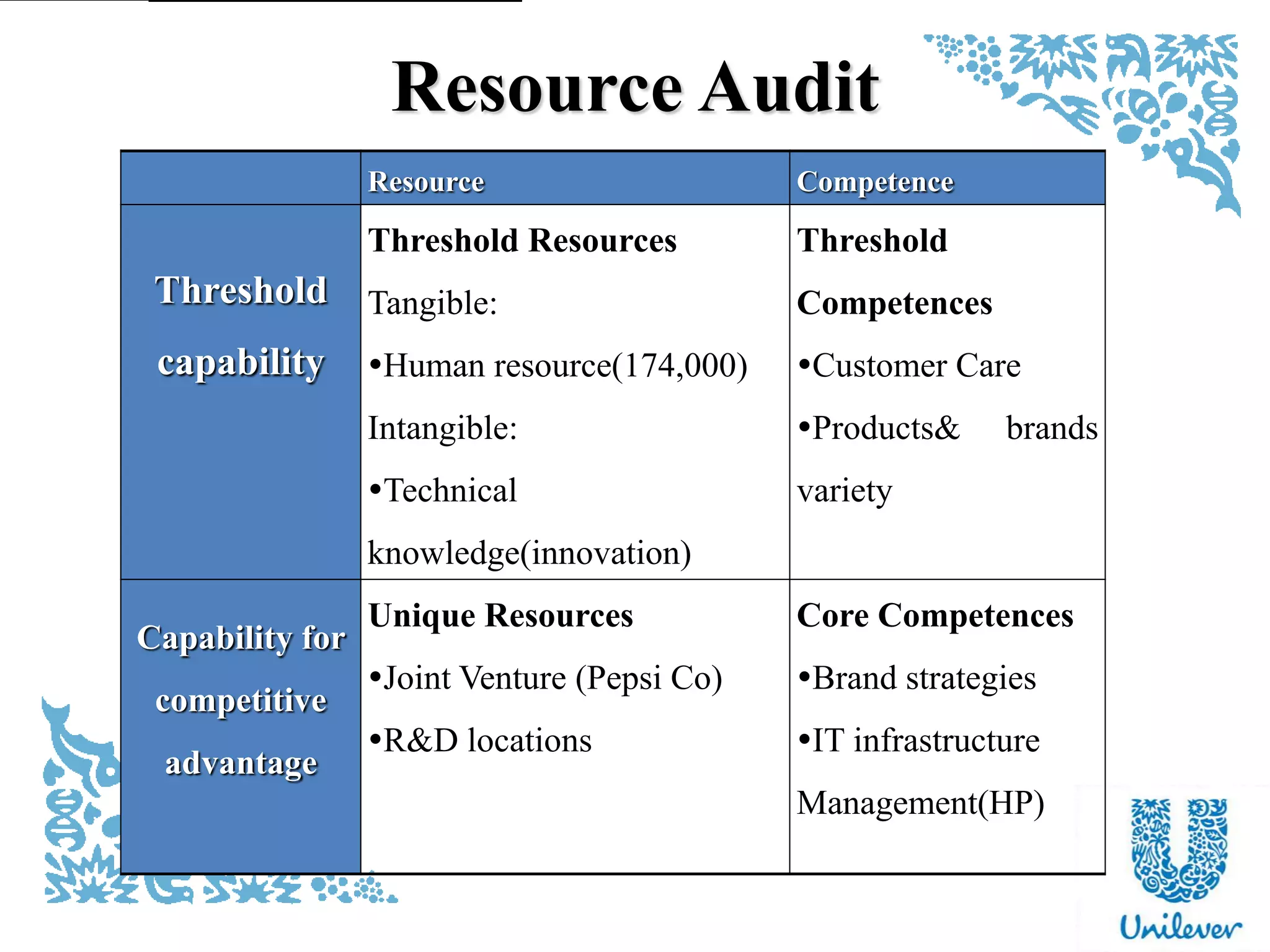
Resource Audit
Resource Competence
Threshold
capability
Threshold Resources
Tangible:
Human resource(174,000)
Intangible:
Technical
knowledge(innovation)
Threshold
Competences
Customer Care
Products& brands
variety
Capability for
competitive
advantage
Unique Resources
Joint Venture (Pepsi Co)
R&D locations
Core Competences
Brand strategies
IT infrastructure
Management(HP)
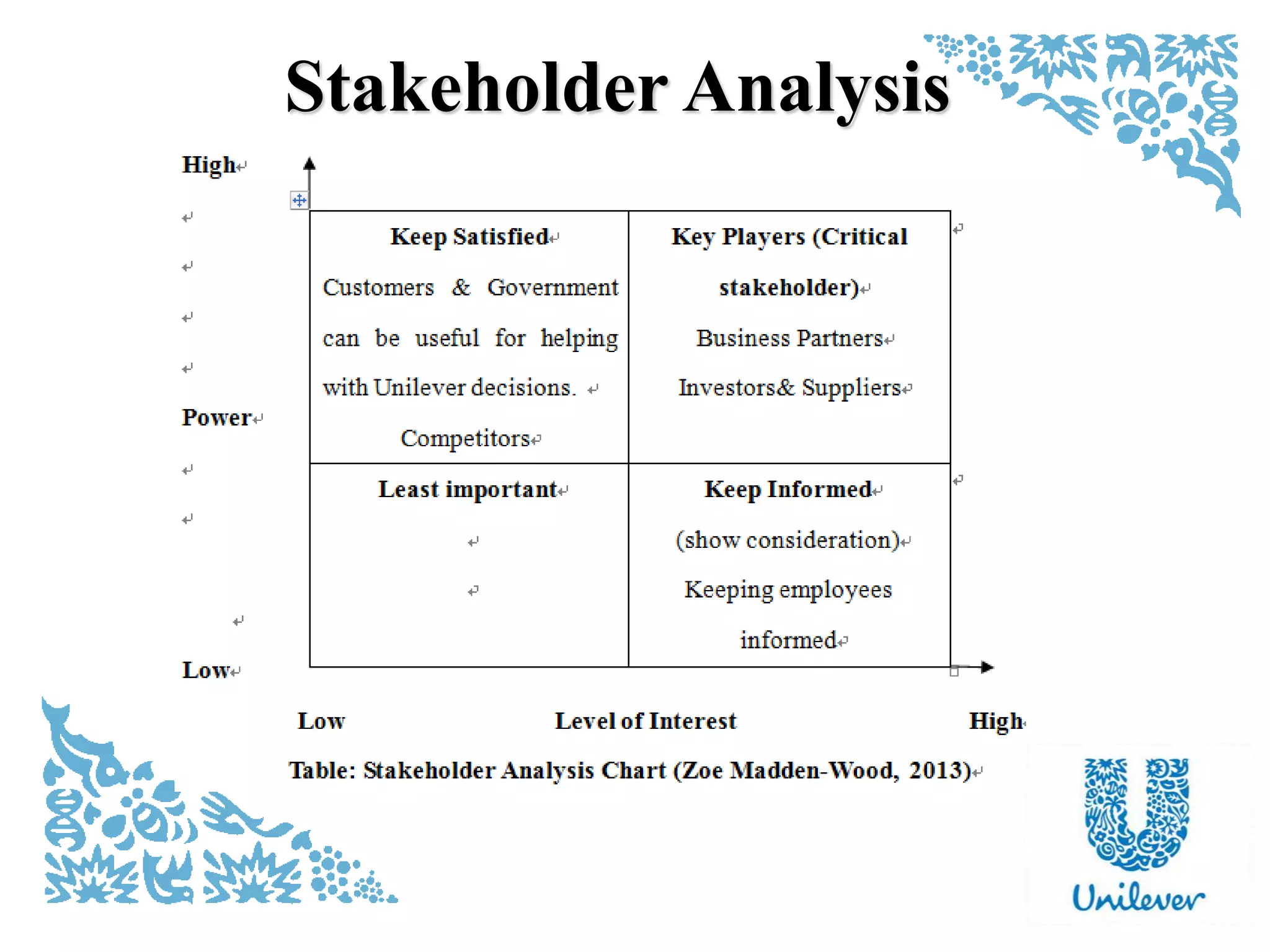
Stakeholder Analysis
Corporate-Level Strategy
Analysis One
“We add vitality to life”
Corporate Vision:
• We work to create a better future every day.
• We help people feel good look good and get more out of
life with brands and services that are good for them and
good for others.
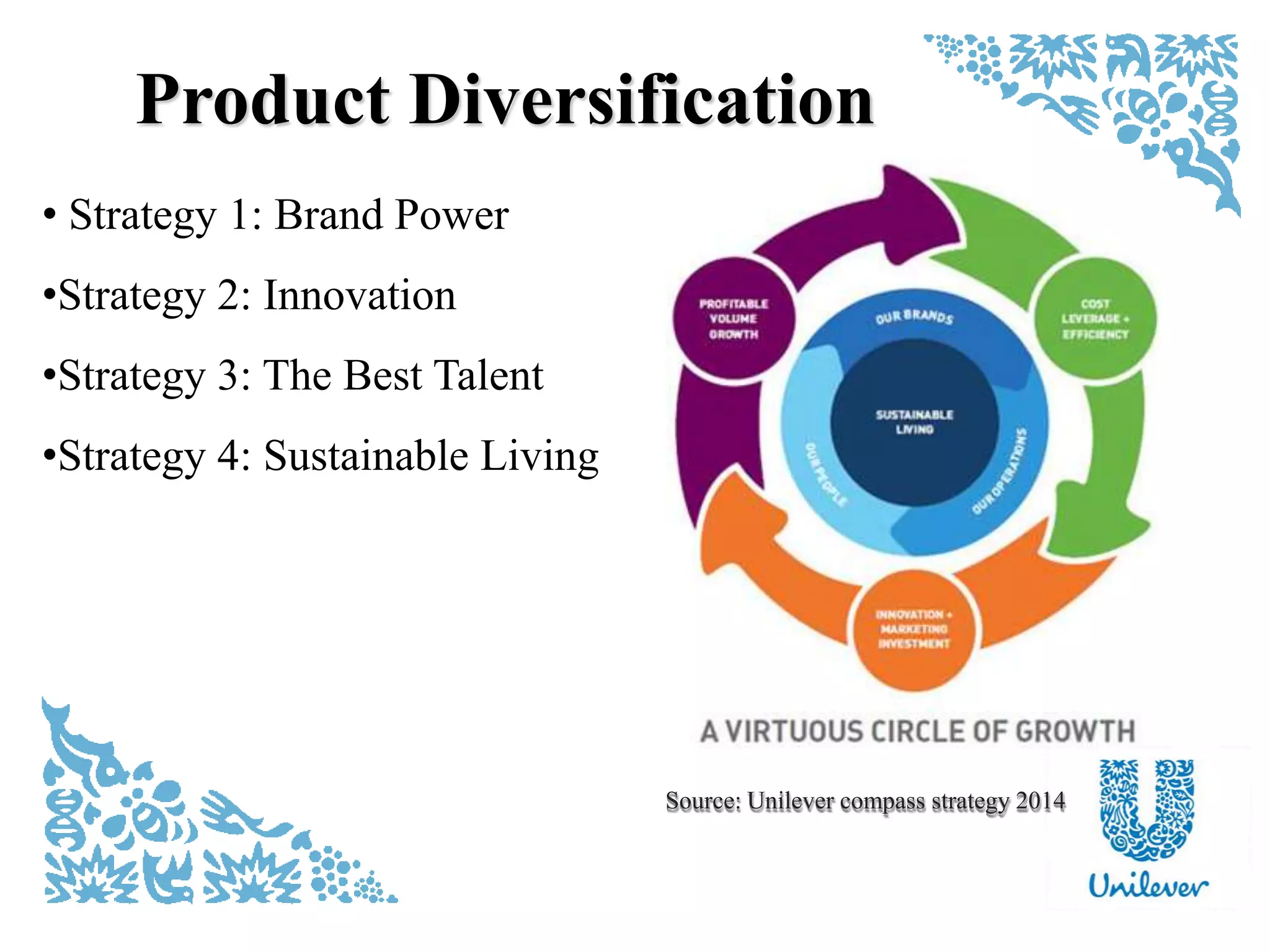
Product Diversification
• Strategy 1: Brand Power
•Strategy 2: Innovation
•Strategy 3: The Best Talent
•Strategy 4: Sustainable Living
Source: Unilever compass strategy 2014
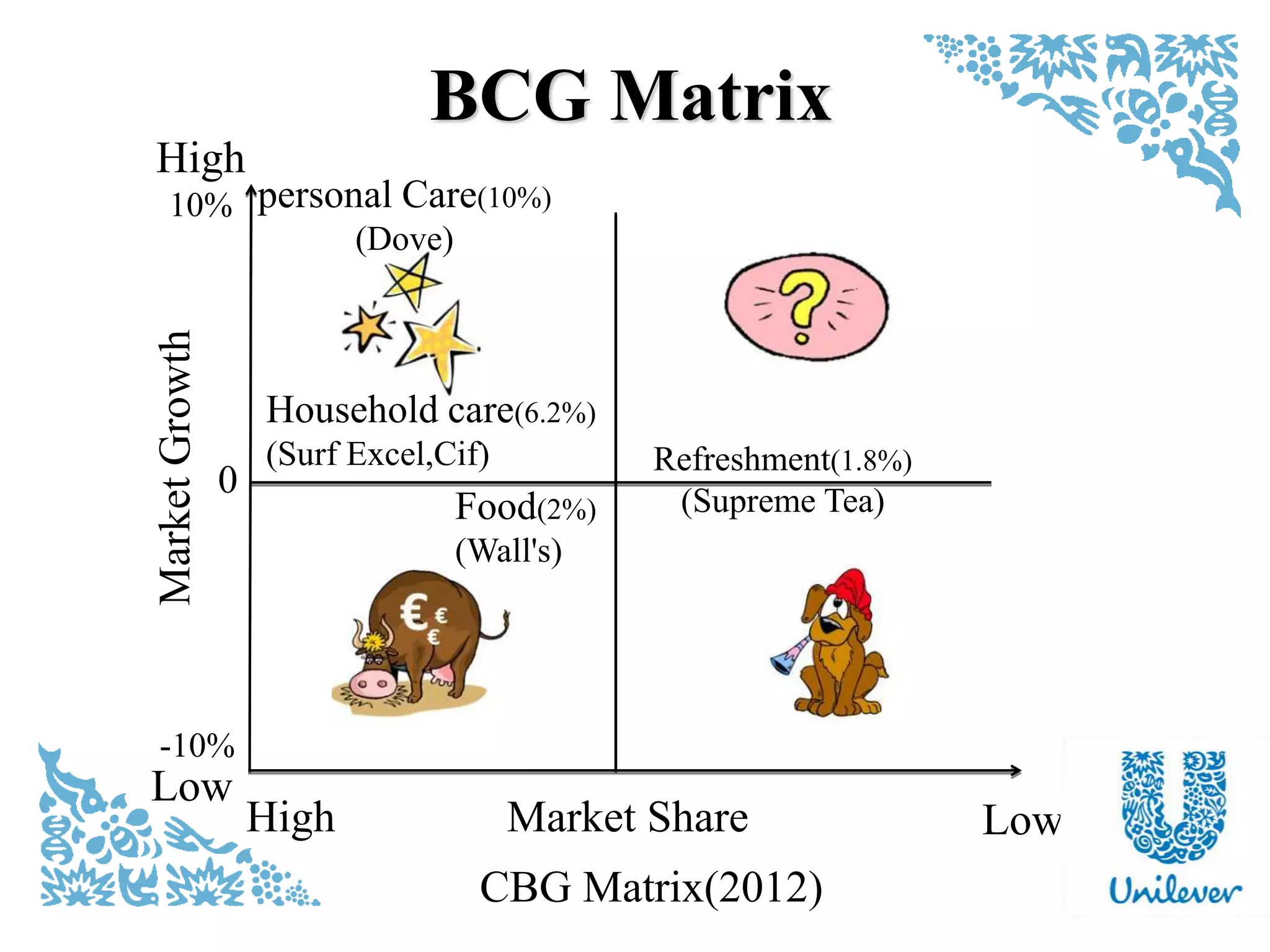
BCG Matrix
Household care(6.2%)
(Surf Excel,Cif) Refreshment(1.8%)
(Supreme Tea)Food(2%)
(Wall's)
MarketGrowth
Market ShareHigh Low
High
10%
-10%
0
personal Care(10%)
(Dove)
Low
CBG Matrix(2012)
Corporate-Level Strategy
Analysis Three
M&A
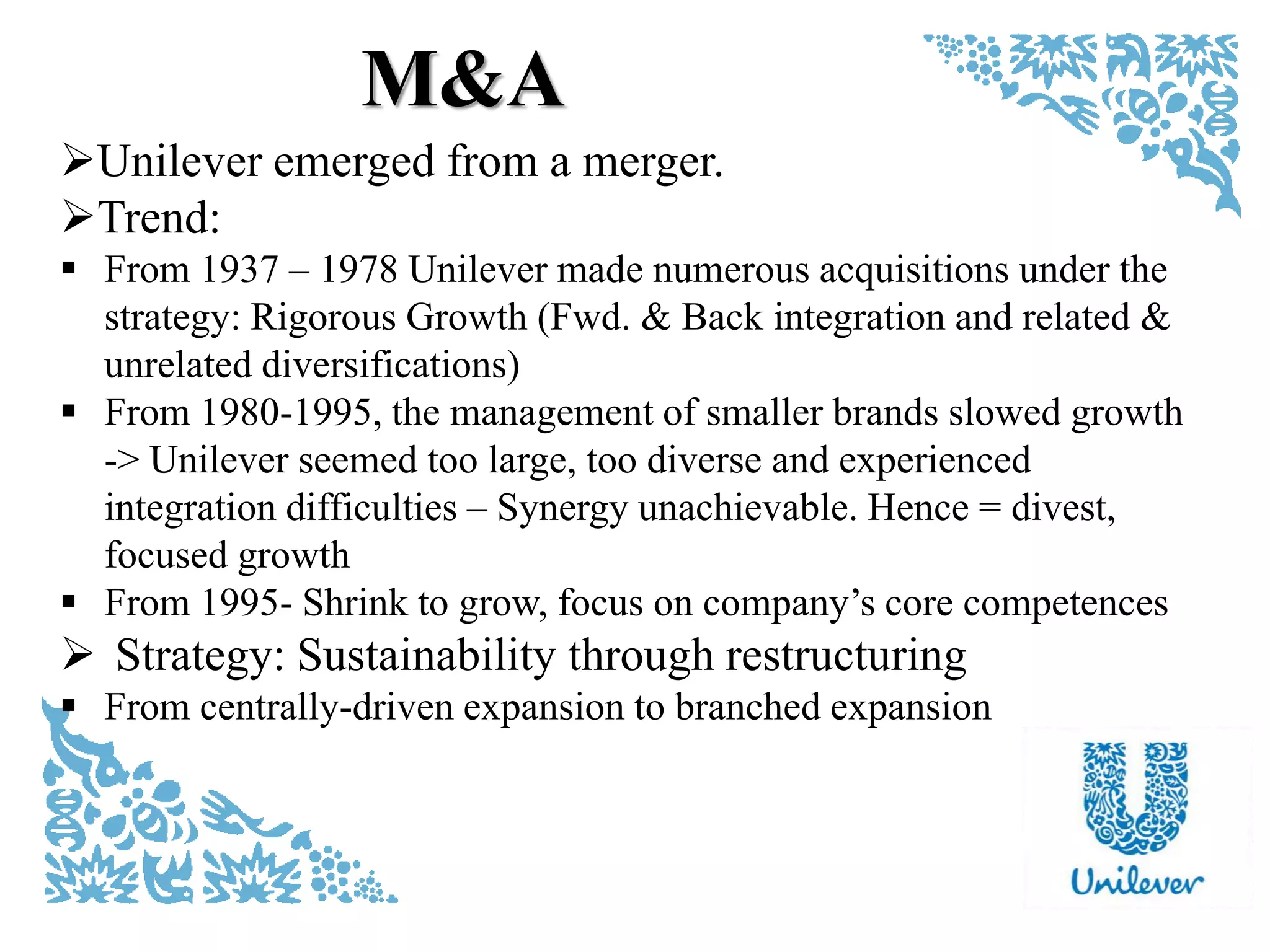
Unilever emerged from a merger.
Trend:
 From 1937 – 1978 Unilever made numerous acquisitions under the
strategy: Rigorous Growth (Fwd. & Back integration and related &
unrelated diversifications)
 From 1980-1995, the management of smaller brands slowed growth
-> Unilever seemed too large, too diverse and experienced
integration difficulties – Synergy unachievable. Hence = divest,
focused growth
 From 1995- Shrink to grow, focus on company‟s core competences
 Strategy: Sustainability through restructuring
 From centrally-driven expansion to branched expansion
Resource: Riley,J (2010)
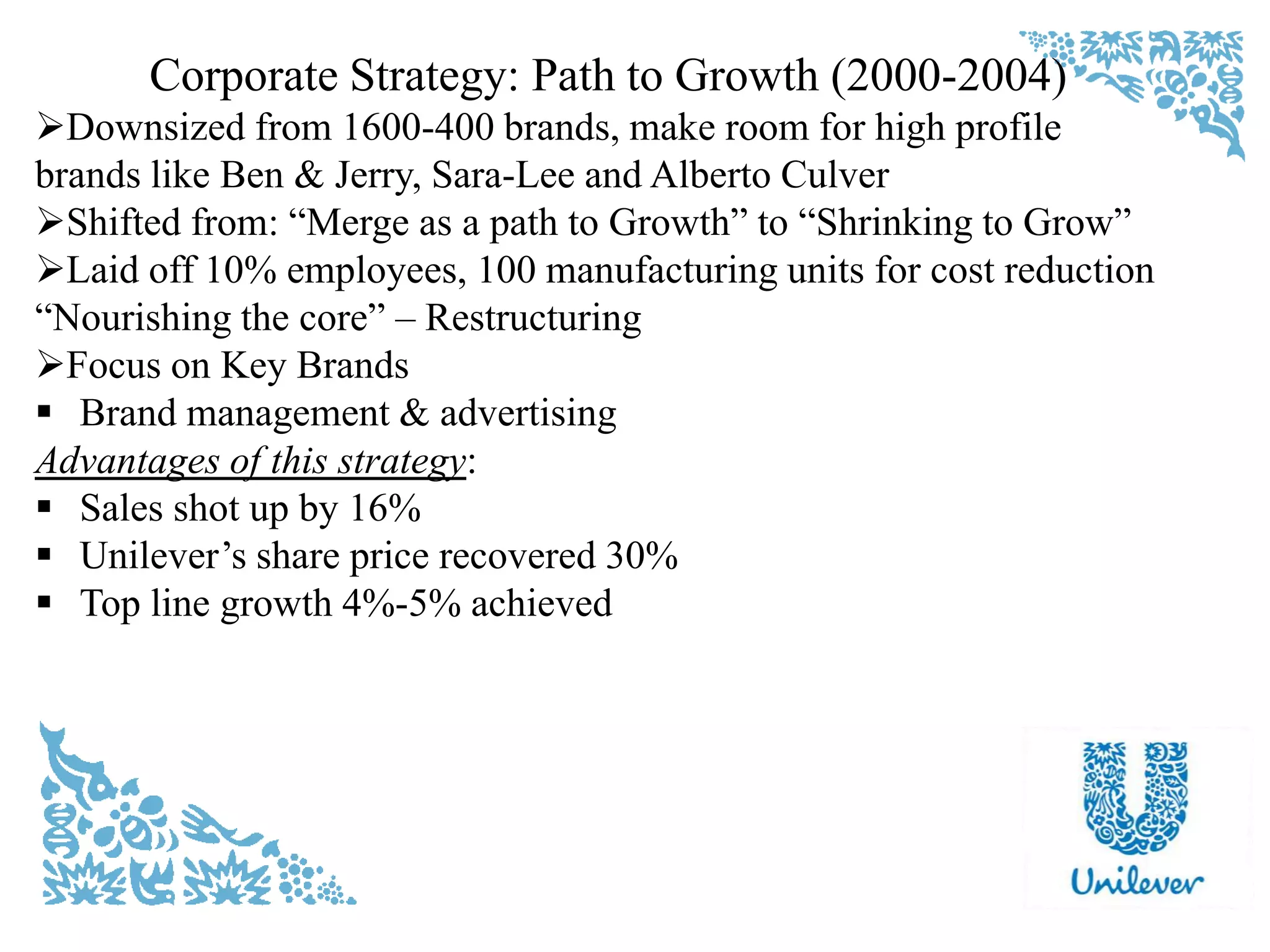
Corporate Strategy: Path to Growth (2000-2004)
Downsized from 1600-400 brands, make room for high profile
brands like Ben & Jerry, Sara-Lee and Alberto Culver
Shifted from: “Merge as a path to Growth” to “Shrinking to Grow”
Laid off 10% employees, 100 manufacturing units for cost reduction
“Nourishing the core” – Restructuring
Focus on Key Brands
 Brand management & advertising
Advantages of this strategy:
 Sales shot up by 16%
 Unilever‟s share price recovered 30%
 Top line growth 4%-5% achieved
Corporate Strategy: Growth to vitality 2004-2010
 Focus on 40 Mega world brands > billion $
 Focus on developed and emerging markets
 Concept of “One Unilever” to boost Focused Growth,
divestment and acquisitions were employed
The good news is… Unilever‟s acquisition has:
 Increased market power, Optimization - supply chain,
economies of scale, reduced risk & cost to new products and
their speed to market.
 Reshaped the firms comp. scope = reduces dependence on
specific markets
Risks associated with M&A:
 Too large (too diverse) + decentralised structure= slow growth
 Inability to achieve synergy
• When synergies do not generate real cash flows
 Workers lay offs
• Employee rights
• Effects on employee morale
• Loss of human capital + lower performance
Restructuring strategies:
1. Downsizing
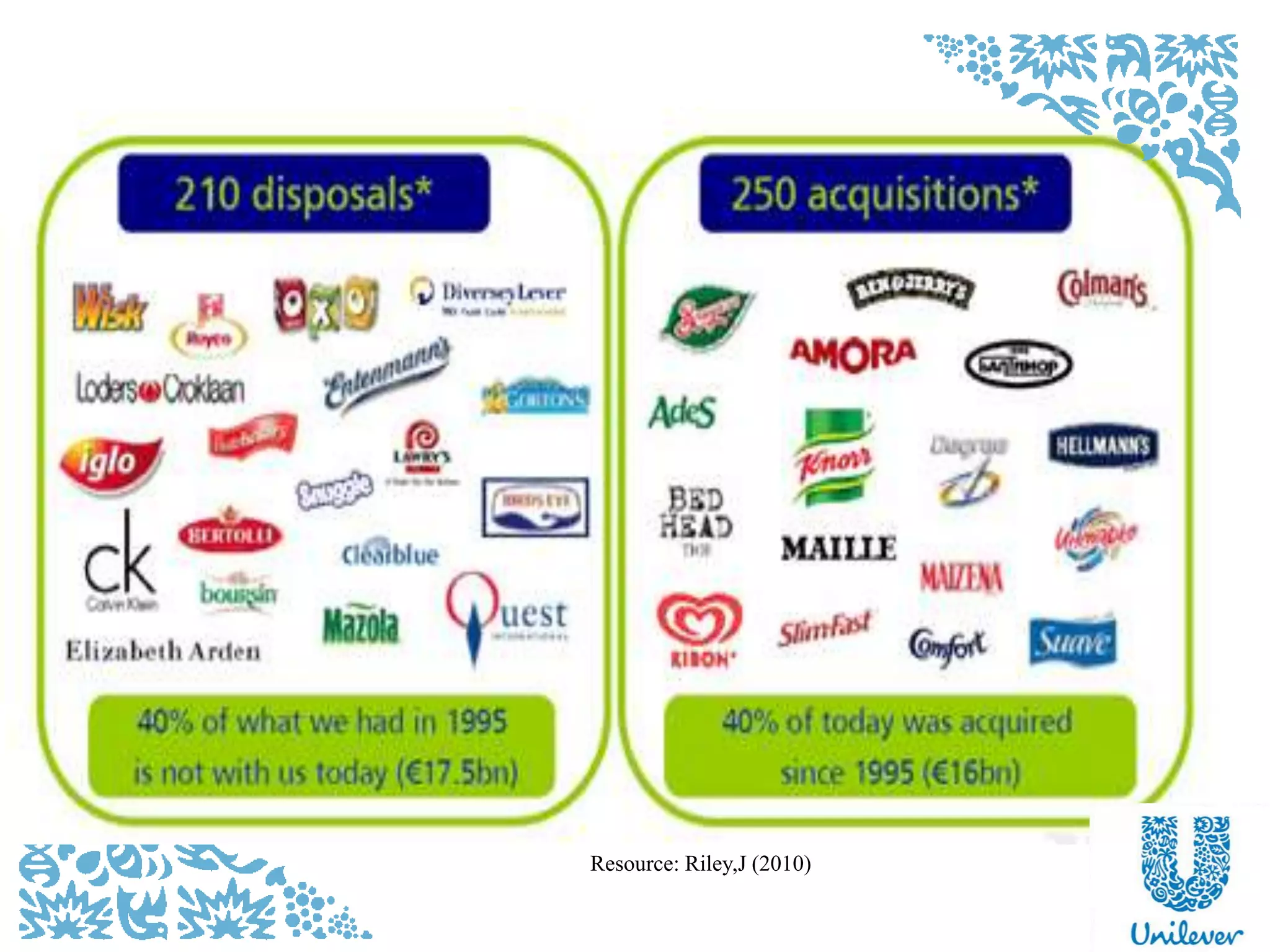
2. Down scoping: divest ( 210 disposals) for non core business
“Leads to greater focus”
3. Unilever complementary acquisitions create value and
revenue schemes
4. Gives Unilever strategic positioning in markets it competes in
Corporate-Level Strategy
Analysis Four
CSR
Unilever in the Victorian England era
•Motives : Strategic leadership
Unilever during world war I, II post war activities
•Motives: market forces.
The Lady Lever Art gallery
 USLP
• Responsible investment
• Stakeholder theory: focused from mass employees to mass
consumers..
• Utilizes a powerful integrated business strategy – not a hold on
(selective/invisible approach)
Product & brands + Brand strategies
•The power of brands and that brands do drive behavioural change for
the better
Unilever Sustainability Living Plan (USLP)
2010-2020
Has three main goals
 Improve hygiene & nutrition (People)
 Halve greenhouse gases impact (Environment)
 Source 100 percent of a product‟s raw materials sustainably.
(Profit)
How sustainability works for Unilever?
Links Financial success and sustainability
• Cost reduction along the supply chain “environmental case”
 Sustainable brands grow market share and profits
• sustainability and revenues is achieved by offering healthier
and more sustainable brands
• engaging current and prospective customers through
awareness outreach campaigns
USLP …
 „Glocal‟ Marketing strategy and social projects
e.g. Project sunlight, “love your heart” and “Brush Day and
Night” oral health campaign
The changing Social contract:
 Using BRANDS and strong roots in the local market (D&E)
and first hand knowledge of the local & regional culture
 Competitive Rivalry => Brand Royalty
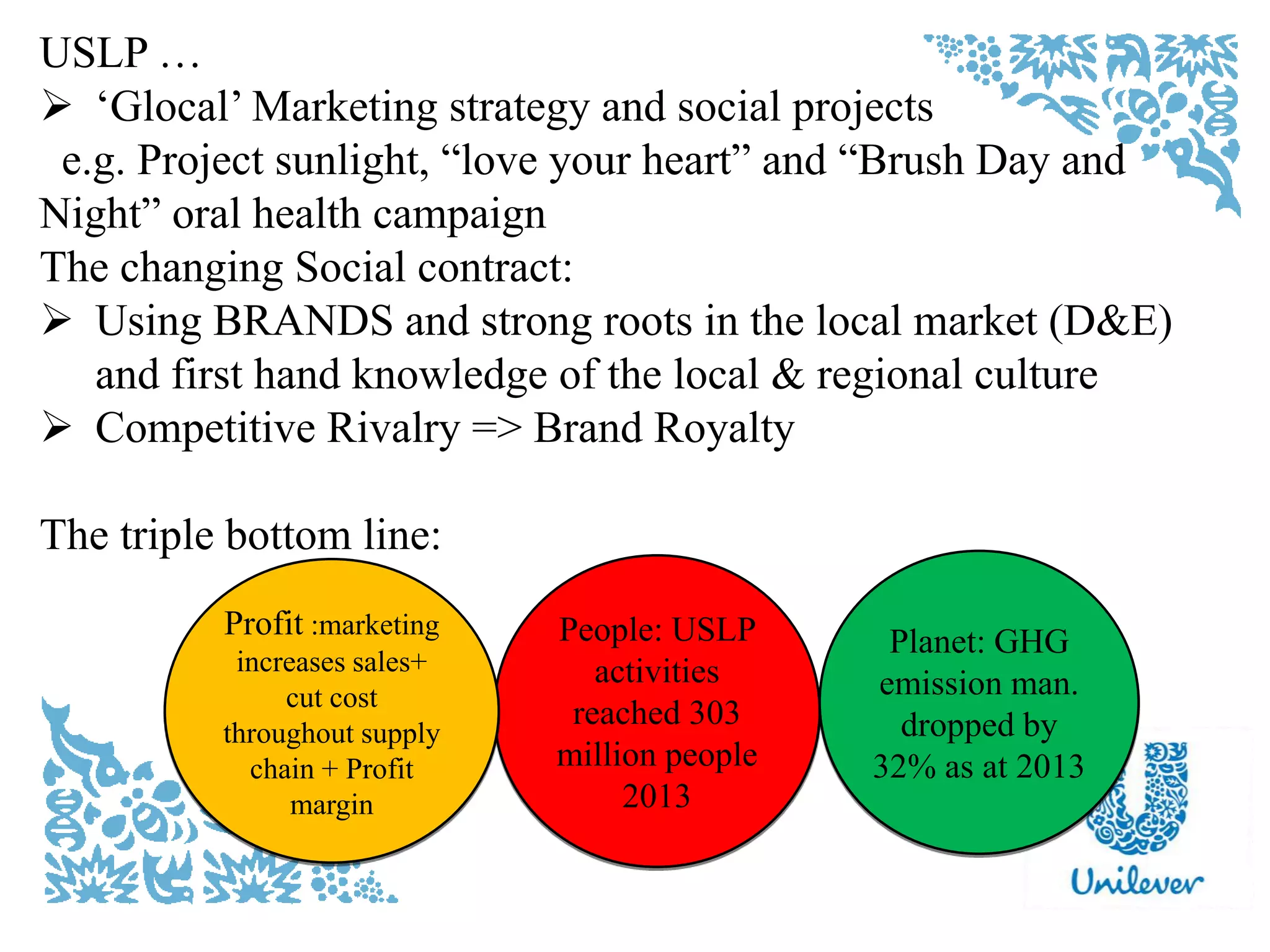
The triple bottom line:
People: USLP
activities
reached 303
million people
2013
Profit :marketing
increases sales+
cut cost
throughout supply
chain + Profit
margin
Planet: GHG
emission man.
dropped by
32% as at 2013
Conclusion
and
Recommendations
Conclusion
• Unilever offers value in terms of price and quality
• Initiating projects to improve and manage the
environmental impacts
• Huge transformation in terms of geographical and product
portfolio
• Decreasing turnover in western Europe: from 65% to 34%
overall sales
Recommendations
Although Unilever is already on the brink of its success but there is
always room for improvement.
• Being a global company it needs to operate according to local
preferences
• Needs to make its brand name stronger in order to make sure they
don‟t go unnoticed
• Improving the quality instead of increasing the price- adds value
• Better strategy to maintain its level over the local competitors
References
Angwin, D., Cummings, S. and Smith, C. (2007) The Strategy Pathfinder: Core Concepts and Micro-cases, Oxford :
Blackwell Publishing. Library classification to be advised.
Cashian, P. (2007) Economics, Strategy and the Firm, Hampshire: Palgrave Macmillan.
Johnson, G., Scholes, K., and Whittington R., (2008) Exploring Corporate Strategy, 8th Edn., Financial Times/Prentice
Hall, Harlow . Library classification 658.401 JOH.
Lynch, R. (2006) Corporate Strategy, 4th Edition,Harlow: Financial Times Prentice Hall. Library Classification
658.4012 LYN.
Stacey, R (2007) Strategic Management and Organisational Dynamics: The Challenge of Complexity, 5th edition,
Harlow : Financial Times/Prentice Hall, Library Classification 658.4012 STA
DeWit, B & Meyer, R (2004) Strategy, Process, Context and Content: An International Perspective, 3rd edition,
Thomson International Business, Library Classification
Reader, W. J. (1980) Fifty years of Unilever, 1930-1980 London:Heinemann
Unilever annual report (2012) [online] available from
<http://www.unilever.com/images/ir_Unilever_AR12_tcm13-348376.pdf >
[27 Feb 2014]
Figures &business facts (2014) [online] available from
<http://www.unilever.com/aboutus/introductiontounilever/unileverataglance/index.aspx> [27 Feb 2014]
Unilever mission (2014) [online] available from
<http://www.unilever.com/aboutus/introductiontounilever/ourmission/> [27 Feb 2014]
Supply management (2013) Unilever named best supply chain in Europe [online] available from
<http://www.supplymanagement.com/news/2013/unilever-named-best-supply-chain-in-europe> [27 Feb 2014]
Value Chain picture [online] available from
<http://www.smartersolutions.com/blog/forrestbreyfogle/wp-content/uploads/2010/07/Michael-Porters-Value-Chain-
Cc984967_BusDrivenEvalofDistComp02en-usMSDN_10.jpg > [27 Feb 2014]
References
Unilever HR management (2013) [online] available from
<http://www.unilever.co.uk/Images/6550_Unilever_MBY_6pp_HR_tcm28-365478.pdf > [28 Feb 2014]
Unilever innovation (2014) [online] available from
<http://www.unilever.co.uk/innovation/> [28 Feb 2014]
Unilever procurement (2014) [online] available from
<http://www.unilever.com/aboutus/supplier/unileverprocurement/> [28 Feb 2014]
Distribution &transport (2014) [online] available from
<http://www.unilever.com/sustainable-living/greenhousegases/transport/> [28 Feb 2014]
Unilever & PepsiCo to expand ready-to-drink tea joint venture (2007) [online] available from
<http://www.unilever.com/mediacentre/pressreleases/2007/UnileverPepsicotoexpand.aspx> [27 Feb 2014]
Stakeholder analysis map
http://leadershiplearning.org/blog/zoe-madden-wood/2013-01-29/project-management-starting-your-project-change
The World Bank. (2007) „Tools for institutional political, and social analysis of policy reform‟. Journal of writing studies
[online], 125-126. Available from
<http://books.google.com.hk/books?id=gZWncS4cd4gC&pg=PA126&dq=stakeholder+analysis&hl=zh-
CN&sa=X&ei=vKsQU9ilCcmshQfoz4GgDQ&ved=0CEYQ6AEwAw#v=onepage&q=stakeholder%20analysis&f=true
> [28 Feb 2014]
Our suppliers (2014) [online] available from<http://www.unilever.com/aboutus/supplier/> [28 Feb 2014]
Thank You
Any Questions

M26 unilever presentation

  • 1.
    M26BSS STRATEGIC MANAGEMENT Group A11 QilinLou 5213030 Yuqi Yang 4204079 Fei Xue 4547851 Aziza Bendera 5399219 Mohammed Faham 5323052
  • 2.
    1. Introduction 2. ExternalAnalysis 3. Internal Analysis 4. Product Diversification 5. Mergers & Acquisition 6. Corporate Social Responsibility 7. Conclusion & Recommendations Contents
  • 3.
    About Unilever • Multinationalfirm (Dutch and British Joint Venture) • Founded in 1930 • 400 brands, 100 countries, 174000 employees • Fast-moving consumer goods • To meet everyday needs of people everywhere in the world
  • 4.
  • 5.
    PEST Analysis Technology: 1. Developmentof e-business; 2. High level of automation; 3. Advanced technologies becomes a threat as it makes copy easier. Political: 1. Unilever is subject to laws and regulations both locally and globally; 2. Volatile of emerging market; 3. Involvement of governments and regulatory authorities. Economic: 1. Current economic recession affects consumer‟s behavior; 2. Reduced consumer wealth. Socio-culture: 1. Has developed a strong corporate reputation; 2. Socially responsible company; 3. Conscious about safety and health of its employees. PEST
  • 6.
    SWOT Analysis Strengths 1. Operatesaround many countries 2. Strong portfolio of brands 3. Diversified product range Weaknesses 1. Slow sales growth compared with the competitors. 2. Low cash flow, high operation cost Opportunities 1. Move operations to developing countries; 2. High market share 3. Increasing need for healthy products Threats 1. Strong competitors; 2. Increasing store brand; 3. Company‟s image destroyed
  • 7.
    SWOT Analysis Strengths 1. Operatesaround many countries 2. Strong portfolio of brands 3. Diversified product range Weaknesses 1. Slow sales growth compared with the competitors. 2. Low cash flow, high operation cost Opportunities 1. Move operations to developing countries; 2. High market share 3. Increasing need for healthy products Threats 1. Strong competitors; 2. Increasing store brand; 3. Company‟s image destroyed
  • 8.
    Five Forces Analysis Existingcompetitive rivalry between suppliers 1. Number and size of competitors 2. Strong distribution network required 3. customers are loyal to existing brands Threat of new market entrants 1. Large industry size 2. Economies of scale 3. brand strength Bargaining power of buyers 1. Large number of buyers 2. Increasing amount of price-sensitive consumers 3. loyalty to the specific retailer Bargaining power of suppliers 1. Large number of substitute inputs 2.High competition among suppliers; 3.Own brand product Threat of substitute products 1. Low alternatives price 2. high alternatives quality 3. low nature of switching costs. Low Low Low High High
  • 9.
  • 10.
    Resource Audit Resource Competence Threshold capability ThresholdResources Tangible: Human resource(174,000) Intangible: Technical knowledge(innovation) Threshold Competences Customer Care Products& brands variety Capability for competitive advantage Unique Resources Joint Venture (Pepsi Co) R&D locations Core Competences Brand strategies IT infrastructure Management(HP)
  • 11.
  • 12.
  • 13.
    “We add vitalityto life” Corporate Vision: • We work to create a better future every day. • We help people feel good look good and get more out of life with brands and services that are good for them and good for others.
  • 14.
    Product Diversification • Strategy1: Brand Power •Strategy 2: Innovation •Strategy 3: The Best Talent •Strategy 4: Sustainable Living Source: Unilever compass strategy 2014
  • 15.
    BCG Matrix Household care(6.2%) (SurfExcel,Cif) Refreshment(1.8%) (Supreme Tea)Food(2%) (Wall's) MarketGrowth Market ShareHigh Low High 10% -10% 0 personal Care(10%) (Dove) Low CBG Matrix(2012)
  • 16.
  • 17.
    M&A Unilever emerged froma merger. Trend:  From 1937 – 1978 Unilever made numerous acquisitions under the strategy: Rigorous Growth (Fwd. & Back integration and related & unrelated diversifications)  From 1980-1995, the management of smaller brands slowed growth -> Unilever seemed too large, too diverse and experienced integration difficulties – Synergy unachievable. Hence = divest, focused growth  From 1995- Shrink to grow, focus on company‟s core competences  Strategy: Sustainability through restructuring  From centrally-driven expansion to branched expansion
  • 18.
  • 19.
    Corporate Strategy: Pathto Growth (2000-2004) Downsized from 1600-400 brands, make room for high profile brands like Ben & Jerry, Sara-Lee and Alberto Culver Shifted from: “Merge as a path to Growth” to “Shrinking to Grow” Laid off 10% employees, 100 manufacturing units for cost reduction “Nourishing the core” – Restructuring Focus on Key Brands  Brand management & advertising Advantages of this strategy:  Sales shot up by 16%  Unilever‟s share price recovered 30%  Top line growth 4%-5% achieved
  • 20.
    Corporate Strategy: Growthto vitality 2004-2010  Focus on 40 Mega world brands > billion $  Focus on developed and emerging markets  Concept of “One Unilever” to boost Focused Growth, divestment and acquisitions were employed The good news is… Unilever‟s acquisition has:  Increased market power, Optimization - supply chain, economies of scale, reduced risk & cost to new products and their speed to market.  Reshaped the firms comp. scope = reduces dependence on specific markets
  • 21.
    Risks associated withM&A:  Too large (too diverse) + decentralised structure= slow growth  Inability to achieve synergy • When synergies do not generate real cash flows  Workers lay offs • Employee rights • Effects on employee morale • Loss of human capital + lower performance Restructuring strategies: 1. Downsizing 2. Down scoping: divest ( 210 disposals) for non core business “Leads to greater focus” 3. Unilever complementary acquisitions create value and revenue schemes 4. Gives Unilever strategic positioning in markets it competes in
  • 22.
  • 23.
    CSR Unilever in theVictorian England era •Motives : Strategic leadership Unilever during world war I, II post war activities •Motives: market forces. The Lady Lever Art gallery  USLP • Responsible investment • Stakeholder theory: focused from mass employees to mass consumers.. • Utilizes a powerful integrated business strategy – not a hold on (selective/invisible approach) Product & brands + Brand strategies •The power of brands and that brands do drive behavioural change for the better
  • 24.
    Unilever Sustainability LivingPlan (USLP) 2010-2020 Has three main goals  Improve hygiene & nutrition (People)  Halve greenhouse gases impact (Environment)  Source 100 percent of a product‟s raw materials sustainably. (Profit) How sustainability works for Unilever? Links Financial success and sustainability • Cost reduction along the supply chain “environmental case”  Sustainable brands grow market share and profits • sustainability and revenues is achieved by offering healthier and more sustainable brands • engaging current and prospective customers through awareness outreach campaigns
  • 25.
    USLP …  „Glocal‟Marketing strategy and social projects e.g. Project sunlight, “love your heart” and “Brush Day and Night” oral health campaign The changing Social contract:  Using BRANDS and strong roots in the local market (D&E) and first hand knowledge of the local & regional culture  Competitive Rivalry => Brand Royalty The triple bottom line: People: USLP activities reached 303 million people 2013 Profit :marketing increases sales+ cut cost throughout supply chain + Profit margin Planet: GHG emission man. dropped by 32% as at 2013
  • 26.
  • 27.
    Conclusion • Unilever offersvalue in terms of price and quality • Initiating projects to improve and manage the environmental impacts • Huge transformation in terms of geographical and product portfolio • Decreasing turnover in western Europe: from 65% to 34% overall sales
  • 28.
    Recommendations Although Unilever isalready on the brink of its success but there is always room for improvement. • Being a global company it needs to operate according to local preferences • Needs to make its brand name stronger in order to make sure they don‟t go unnoticed • Improving the quality instead of increasing the price- adds value • Better strategy to maintain its level over the local competitors
  • 29.
    References Angwin, D., Cummings,S. and Smith, C. (2007) The Strategy Pathfinder: Core Concepts and Micro-cases, Oxford : Blackwell Publishing. Library classification to be advised. Cashian, P. (2007) Economics, Strategy and the Firm, Hampshire: Palgrave Macmillan. Johnson, G., Scholes, K., and Whittington R., (2008) Exploring Corporate Strategy, 8th Edn., Financial Times/Prentice Hall, Harlow . Library classification 658.401 JOH. Lynch, R. (2006) Corporate Strategy, 4th Edition,Harlow: Financial Times Prentice Hall. Library Classification 658.4012 LYN. Stacey, R (2007) Strategic Management and Organisational Dynamics: The Challenge of Complexity, 5th edition, Harlow : Financial Times/Prentice Hall, Library Classification 658.4012 STA DeWit, B & Meyer, R (2004) Strategy, Process, Context and Content: An International Perspective, 3rd edition, Thomson International Business, Library Classification Reader, W. J. (1980) Fifty years of Unilever, 1930-1980 London:Heinemann Unilever annual report (2012) [online] available from <http://www.unilever.com/images/ir_Unilever_AR12_tcm13-348376.pdf > [27 Feb 2014] Figures &business facts (2014) [online] available from <http://www.unilever.com/aboutus/introductiontounilever/unileverataglance/index.aspx> [27 Feb 2014] Unilever mission (2014) [online] available from <http://www.unilever.com/aboutus/introductiontounilever/ourmission/> [27 Feb 2014] Supply management (2013) Unilever named best supply chain in Europe [online] available from <http://www.supplymanagement.com/news/2013/unilever-named-best-supply-chain-in-europe> [27 Feb 2014] Value Chain picture [online] available from <http://www.smartersolutions.com/blog/forrestbreyfogle/wp-content/uploads/2010/07/Michael-Porters-Value-Chain- Cc984967_BusDrivenEvalofDistComp02en-usMSDN_10.jpg > [27 Feb 2014]
  • 30.
    References Unilever HR management(2013) [online] available from <http://www.unilever.co.uk/Images/6550_Unilever_MBY_6pp_HR_tcm28-365478.pdf > [28 Feb 2014] Unilever innovation (2014) [online] available from <http://www.unilever.co.uk/innovation/> [28 Feb 2014] Unilever procurement (2014) [online] available from <http://www.unilever.com/aboutus/supplier/unileverprocurement/> [28 Feb 2014] Distribution &transport (2014) [online] available from <http://www.unilever.com/sustainable-living/greenhousegases/transport/> [28 Feb 2014] Unilever & PepsiCo to expand ready-to-drink tea joint venture (2007) [online] available from <http://www.unilever.com/mediacentre/pressreleases/2007/UnileverPepsicotoexpand.aspx> [27 Feb 2014] Stakeholder analysis map http://leadershiplearning.org/blog/zoe-madden-wood/2013-01-29/project-management-starting-your-project-change The World Bank. (2007) „Tools for institutional political, and social analysis of policy reform‟. Journal of writing studies [online], 125-126. Available from <http://books.google.com.hk/books?id=gZWncS4cd4gC&pg=PA126&dq=stakeholder+analysis&hl=zh- CN&sa=X&ei=vKsQU9ilCcmshQfoz4GgDQ&ved=0CEYQ6AEwAw#v=onepage&q=stakeholder%20analysis&f=true > [28 Feb 2014] Our suppliers (2014) [online] available from<http://www.unilever.com/aboutus/supplier/> [28 Feb 2014]
  • 31.