Case Presentation 1.1


                  HONDA
                   Group 4
        Matthew Cruz, Brooke Feery,
Jacob Hostetler, Daniela Nicula, Manh Duc Tran
Who is Honda?
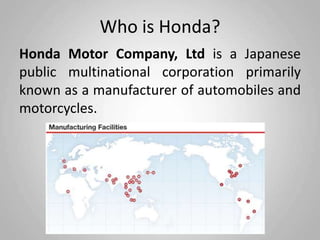
Honda Motor Company, Ltd is a Japanese
public multinational corporation primarily
known as a manufacturer of automobiles and
motorcycles.
Honda at a Glance
               Is Honda a MNE? YES!
• Industry: Automotive              Forbes Lists
• Founded: 1948
• Country: Japan               #59 Global 500
• CEO: Takanobu Ito            #19 Most Powerful
• Website:                     Brands
     world.honda.com           #44 in Sales
• Employees: 179,000           #77 in Profit
• 2012 Sales: $96.7 trillion   #178 in Assets
• Headquarters:
  Minato, Tokyo, Japan         #93 in Market value
The Honda Portfolio
Subsidiaries:
• Many subsidiaries are companies that manufacture specific
  components (i.e. Honda Lock Manufacturing).
• These companies manufacture transmission parts, motorcycle
  exhaust components, electronic safety systems, solar cells, brake
  discs, etc.

Affiliates:
• Multiple companies’ supply components go into Honda products
  (i.e. Keihin Corporation, Masuda Manufacturing).
• These companies make automobile body parts, fuel systems, air
  conditioning systems, injection-molded plastic parts, etc.
• Most affiliates and subsidiaries are Japanese (single diamond).
• For example, Honda is starting to install Krell stereo systems on
  Acura vehicles.
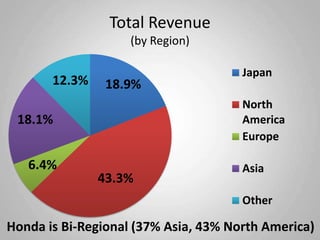
Total Revenue
                    (by Region)

                                      Japan
       12.3%    18.9%
                                      North
 18.1%                                America
                                      Europe

   6.4%                               Asia
               43.3%
                                      Other

Honda is Bi-Regional (37% Asia, 43% North America)
Case Study Questions
1.   What was Honda's distinct resource base that provided
     internationally transferable FSAs?
2.   Which value-added activities in which foreign locations permitted
     Honda to exploit and augment to the fullest its distinct resource
     base?
3.   What were the expected costs and difficulties Honda faced when
     transferring this distinct resource base?
4.   What specific resource recombination was required so as to make
     the proposed international value-added activities successful?
5.   Did Honda have the required resource recombination capability
     in-house?
6.   What were the costs and benefits of using complementary
     resources of external actors to fill resource gaps?
7.   What were the main bounded rationality and bounded reliability
     problems Honda faced when extending the geographic scope of
     the firm's activities the changed linkages with outside
     stakeholders and the changes in its internal functioning?
Honda and the Four Distances
                         Cultural
• Honda hired American workers for their passion, not for
  their knowledge of motorcycle manufacturing.
• Honda sent American workers to Japan to learn about
  Honda’s manufacturing processes, and sent some
  Japanese workers to the US to instill Honda’s philosophy
  into the plant.

                     Administrative
• US government passed the Clean Air Act imposing
  stricter requirements on tailpipe emissions.
• Honda feared that if demand rose for their fuel efficient
  cars, the US would impose export restrictions.
Honda and the Four Distances
                         Geographic
• Honda had to search for a long time before finding the proper
  place to being manufacturing – Marysville, Ohio.
• Only a few suppliers agreed to follow Honda and build their
  own plants in the US.
                          Economic
• The rising price of the yen against the dollar in the 1970s
  made continued exporting problematic.
• The Oil Crisis of 1973 caused the price of Honda’s exports to
  increase while causing consumer demand for more fuel-
  efficient cars to increase as well.

Honda’s approach to bridging the Four Distances in the 1970s
  classifies it as an International Projector.
International Expansion
• Honda is striving to be the world's leader in
  environmental and energy technologies through its
  product development, production, and other
  activities.
• By 2014 North American capacity will hit 1.92 million
  vehicles annually.
• The automaker is targeting a stronger position in
  mini-vehicle and compact vehicle segments to
  reinforce business operations in Japan.
• Honda plans to terminate 800 jobs at its South
  Marston plant in England due to sagging demand for
  its vehicles in Europe.
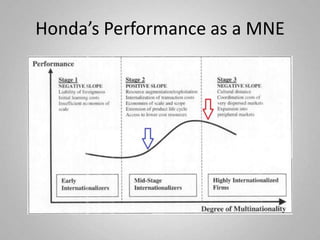
Honda’s Performance as a MNE
Degree of Multinationality
Licensing – Honda licenses its technology to other
companies in different countries (i.e. India) and
engages in international joint ventures.
Export – Honda is a net exporter, exporting more
American–built vehicles than it imports from Japan.
Honda exports 11 models accounting for over 100,000
units shipped to more than 40 countries.
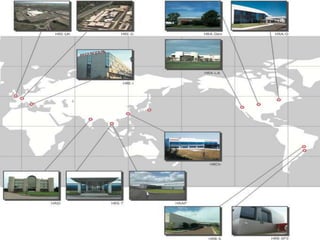
Local Packaging / Assembly – Honda has 57 factories
worldwide, 49 outside of Japan and 12 plants in North
America .
FDI – Honda establishes relationships with suppliers in
host countries.
Firm Specific Advantages
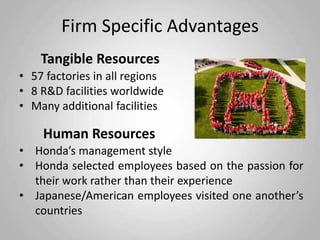
    Tangible Resources
• 57 factories in all regions
• 8 R&D facilities worldwide
• Many additional facilities

    Human Resources
• Honda’s management style
• Honda selected employees based on the passion for
  their work rather than their experience
• Japanese/American employees visited one another’s
  countries
Firm Specific Advantages (cont’d)
              Intangible Resources
• Manufacturing process
• Brand reputation: practical, reliable, high-quality products
• Immense experience with internal combustion engines
• Partnerships with many affiliates who manufacture parts
  for motorcycles, cars, and other products
• More than 17,600 patents in Japan and 25,300 patents
  abroad as well as 29,400 patents pending worldwide.
• Supply chain management
• Green initiatives such as reducing PVC use and fuel
  efficient car and motorcycle engines
Firm Specific Advantages (cont’d)

     Subsidiary Specific Advantages
• Subsidiary HAM in case study had connections to
  Ford that Honda was able to leverage
• Over 25,000 patents in foreign markets
• Decentralized manufacturing allowed Honda to
  overcome the Earthquake and Tsunami in 2011
  that disrupted Japanese manufacturing
Country Specific Advantages
• The 1970 Clean Air Act passed by US Congress
  opened up an opportunity for Honda to bring
  fuel efficient cars into America.
• European Union fuel costs are high and
  environmental restrictions are very severe on
  products with internal combustion engines.

The mix of strong CSAs and strong FSAs places
Honda in the 3rd Quadrant of the FSA-CSA Matrix
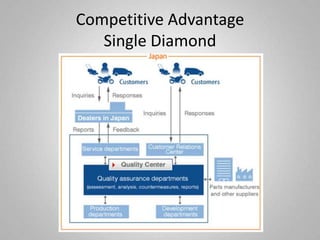
Competitive Advantage
   Single Diamond
Foreign Direct Investment
Efficiency-seeking:
  Honda has mainly taken advantage of low-wage
  countries like Indonesia, Vietnam, Thailand and
  India
Market-seeking:
  Honda Motor of Japan is going to expand its
  operations into India
Strategic Asset -seeking:
  8 R&D facilities worldwide
Recombination Patterns
                      Type III
• Internationally transferrable FSAs are developed at
  home but in order to exploit them in host
  countries, location-bound knowledge must be added.
• Honda recombined its FSAs such as its manufacturing
  process to better cater to international consumers.
• Honda manufactures automobiles targeted specifically
  towards the host country’s consumers.
• Honda’s extensive knowledge and experience with
  internal combustion engines is easily applied to many
  diverse markets.
Recombination Patterns
                    Type VIII
• Honda also features characteristics of this pattern.
• Affiliates of the MNE located in various countries
  develop FSAs together, contributing knowledge
  upstream and downstream.
• Honda R&D and other facilities worldwide
  cooperate to create new technologies that can be
  applied to innovative products in multiple host
  countries.
Summary
• Bi-Regional MNE (NAFTA     • FSAs are Primarily
  and Asia)                    Transferrable
• Activity Level:            • Single Diamond
  Licensing, Export, Assem     Framework
  bly, FDI                   • FSA-CSA Matrix:
• International                Quadrant 3
  Performance: Stage 3       • FDI Types:
• Revenues are declining       Market, Efficiency, &
• MNE Archetype:               Strategic Asset Seeking
  International Projector    • Recombination Patterns:
                               3&8
Works Cited
• http://world.honda.com/group/Manufacturing/index.html
• http://world.honda.com/group/manufacturing-facilities
• http://www.consumerreports.org/content/cro/en/cars/best-
  car-brands-consumer-perception-consumer-reports.html
• http://www.interbrand.com/en/best-global-
  brands/2012/Best-Global-Brands-2012-Brand-View.aspx
• http://www.wikinvest.com/stock/Honda_Motor_Company_(H
  MC)/Patents_Licenses
• http://world.honda.com/investors/library/annual_report/201
  2/honda2012ar-Cover-03.pdf

Honda International Case Study

  • 1.
    Case Presentation 1.1 HONDA Group 4 Matthew Cruz, Brooke Feery, Jacob Hostetler, Daniela Nicula, Manh Duc Tran
  • 2.
    Who is Honda? HondaMotor Company, Ltd is a Japanese public multinational corporation primarily known as a manufacturer of automobiles and motorcycles.
  • 4.
    Honda at aGlance Is Honda a MNE? YES! • Industry: Automotive Forbes Lists • Founded: 1948 • Country: Japan #59 Global 500 • CEO: Takanobu Ito #19 Most Powerful • Website: Brands world.honda.com #44 in Sales • Employees: 179,000 #77 in Profit • 2012 Sales: $96.7 trillion #178 in Assets • Headquarters: Minato, Tokyo, Japan #93 in Market value
  • 5.
    The Honda Portfolio Subsidiaries: •Many subsidiaries are companies that manufacture specific components (i.e. Honda Lock Manufacturing). • These companies manufacture transmission parts, motorcycle exhaust components, electronic safety systems, solar cells, brake discs, etc. Affiliates: • Multiple companies’ supply components go into Honda products (i.e. Keihin Corporation, Masuda Manufacturing). • These companies make automobile body parts, fuel systems, air conditioning systems, injection-molded plastic parts, etc. • Most affiliates and subsidiaries are Japanese (single diamond). • For example, Honda is starting to install Krell stereo systems on Acura vehicles.
  • 6.
    Total Revenue (by Region) Japan 12.3% 18.9% North 18.1% America Europe 6.4% Asia 43.3% Other Honda is Bi-Regional (37% Asia, 43% North America)
  • 7.
    Case Study Questions 1. What was Honda's distinct resource base that provided internationally transferable FSAs? 2. Which value-added activities in which foreign locations permitted Honda to exploit and augment to the fullest its distinct resource base? 3. What were the expected costs and difficulties Honda faced when transferring this distinct resource base? 4. What specific resource recombination was required so as to make the proposed international value-added activities successful? 5. Did Honda have the required resource recombination capability in-house? 6. What were the costs and benefits of using complementary resources of external actors to fill resource gaps? 7. What were the main bounded rationality and bounded reliability problems Honda faced when extending the geographic scope of the firm's activities the changed linkages with outside stakeholders and the changes in its internal functioning?
  • 8.
    Honda and theFour Distances Cultural • Honda hired American workers for their passion, not for their knowledge of motorcycle manufacturing. • Honda sent American workers to Japan to learn about Honda’s manufacturing processes, and sent some Japanese workers to the US to instill Honda’s philosophy into the plant. Administrative • US government passed the Clean Air Act imposing stricter requirements on tailpipe emissions. • Honda feared that if demand rose for their fuel efficient cars, the US would impose export restrictions.
  • 9.
    Honda and theFour Distances Geographic • Honda had to search for a long time before finding the proper place to being manufacturing – Marysville, Ohio. • Only a few suppliers agreed to follow Honda and build their own plants in the US. Economic • The rising price of the yen against the dollar in the 1970s made continued exporting problematic. • The Oil Crisis of 1973 caused the price of Honda’s exports to increase while causing consumer demand for more fuel- efficient cars to increase as well. Honda’s approach to bridging the Four Distances in the 1970s classifies it as an International Projector.
  • 10.
    International Expansion • Hondais striving to be the world's leader in environmental and energy technologies through its product development, production, and other activities. • By 2014 North American capacity will hit 1.92 million vehicles annually. • The automaker is targeting a stronger position in mini-vehicle and compact vehicle segments to reinforce business operations in Japan. • Honda plans to terminate 800 jobs at its South Marston plant in England due to sagging demand for its vehicles in Europe.
  • 11.
  • 12.
    Degree of Multinationality Licensing– Honda licenses its technology to other companies in different countries (i.e. India) and engages in international joint ventures. Export – Honda is a net exporter, exporting more American–built vehicles than it imports from Japan. Honda exports 11 models accounting for over 100,000 units shipped to more than 40 countries. Local Packaging / Assembly – Honda has 57 factories worldwide, 49 outside of Japan and 12 plants in North America . FDI – Honda establishes relationships with suppliers in host countries.
  • 13.
    Firm Specific Advantages Tangible Resources • 57 factories in all regions • 8 R&D facilities worldwide • Many additional facilities Human Resources • Honda’s management style • Honda selected employees based on the passion for their work rather than their experience • Japanese/American employees visited one another’s countries
  • 14.
    Firm Specific Advantages(cont’d) Intangible Resources • Manufacturing process • Brand reputation: practical, reliable, high-quality products • Immense experience with internal combustion engines • Partnerships with many affiliates who manufacture parts for motorcycles, cars, and other products • More than 17,600 patents in Japan and 25,300 patents abroad as well as 29,400 patents pending worldwide. • Supply chain management • Green initiatives such as reducing PVC use and fuel efficient car and motorcycle engines
  • 15.
    Firm Specific Advantages(cont’d) Subsidiary Specific Advantages • Subsidiary HAM in case study had connections to Ford that Honda was able to leverage • Over 25,000 patents in foreign markets • Decentralized manufacturing allowed Honda to overcome the Earthquake and Tsunami in 2011 that disrupted Japanese manufacturing
  • 16.
    Country Specific Advantages •The 1970 Clean Air Act passed by US Congress opened up an opportunity for Honda to bring fuel efficient cars into America. • European Union fuel costs are high and environmental restrictions are very severe on products with internal combustion engines. The mix of strong CSAs and strong FSAs places Honda in the 3rd Quadrant of the FSA-CSA Matrix
  • 17.
    Competitive Advantage Single Diamond
  • 18.
    Foreign Direct Investment Efficiency-seeking: Honda has mainly taken advantage of low-wage countries like Indonesia, Vietnam, Thailand and India Market-seeking: Honda Motor of Japan is going to expand its operations into India Strategic Asset -seeking: 8 R&D facilities worldwide
  • 19.
    Recombination Patterns Type III • Internationally transferrable FSAs are developed at home but in order to exploit them in host countries, location-bound knowledge must be added. • Honda recombined its FSAs such as its manufacturing process to better cater to international consumers. • Honda manufactures automobiles targeted specifically towards the host country’s consumers. • Honda’s extensive knowledge and experience with internal combustion engines is easily applied to many diverse markets.
  • 20.
    Recombination Patterns Type VIII • Honda also features characteristics of this pattern. • Affiliates of the MNE located in various countries develop FSAs together, contributing knowledge upstream and downstream. • Honda R&D and other facilities worldwide cooperate to create new technologies that can be applied to innovative products in multiple host countries.
  • 21.
    Summary • Bi-Regional MNE(NAFTA • FSAs are Primarily and Asia) Transferrable • Activity Level: • Single Diamond Licensing, Export, Assem Framework bly, FDI • FSA-CSA Matrix: • International Quadrant 3 Performance: Stage 3 • FDI Types: • Revenues are declining Market, Efficiency, & • MNE Archetype: Strategic Asset Seeking International Projector • Recombination Patterns: 3&8
  • 22.
    Works Cited • http://world.honda.com/group/Manufacturing/index.html •http://world.honda.com/group/manufacturing-facilities • http://www.consumerreports.org/content/cro/en/cars/best- car-brands-consumer-perception-consumer-reports.html • http://www.interbrand.com/en/best-global- brands/2012/Best-Global-Brands-2012-Brand-View.aspx • http://www.wikinvest.com/stock/Honda_Motor_Company_(H MC)/Patents_Licenses • http://world.honda.com/investors/library/annual_report/201 2/honda2012ar-Cover-03.pdf