The
Balance Scorecard
& Nestle…
Jayanta Kumar Bisoi
16/06/DBM/09 (4th sem)
Business Best Practices
Dept. of Business Management
Key Q’s
1. What is a balance scorecard and why it is?
2. Why business need it?
3. What are the challenges to balance scorecard while implementing it?
4. Is Nestle successfully used it, for their success?
5. How it helps in performance analysis?
Why Business Need it?
While financial measures tell part of the story, the Balanced Scorecard offers an
overarching view a business’s strategic plan from the executive perspective. This, in turn,
provides a framework for the entire organization in terms of guiding performance. Specific
reasons that a company would use a Balanced Scorecard might include:
 Communicate the business vision and strategy.
 Share objectives that support the business’s vision and strategy
 Show how these strategic objectives impact long-term goals and budgets.
 Compare performance among diverse business units.
 The Balanced Scorecard cascades your strategy.
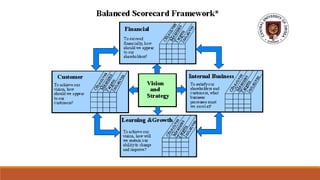
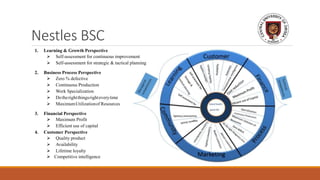
Nestles BSC
1. Learning & Growth Perspective
 Self-assessment for continuous improvement
 Self-assessment for strategic & tactical planning
2. Business Process Perspective
 Zero % defective
 Continuous Production
 Work Specialization
 Dotherightthingsrighteverytime
 MaximumUtilizationof Resources
3. Financial Perspective
 Maximum Profit
 Efficient use of capital
4. Customer Perspective
 Quality product
 Availability
 Lifetime loyalty
 Competitive intelligence
How it helps in Performance analysis?
 Firstly, the financial perspective can help the company understand its
shareholders’ perception.
 Secondly, an internal analysis makes it possible to identify the level of
operational procedures of Nestlé.
 Nestlé seems to have a strong focus on Learning & Innovation perspective.
 Finally, the consumer perspective is related to how customers perceive Nestlé.
Challenges
 Absence of a Common Vocabulary
 Complicating the initial implementation
 Cascading to individual level is a challenge
 Getting lost in the mechanics of tracking
Thank You

Bsc

  • 1.
    The Balance Scorecard & Nestle… JayantaKumar Bisoi 16/06/DBM/09 (4th sem) Business Best Practices Dept. of Business Management
  • 2.
    Key Q’s 1. Whatis a balance scorecard and why it is? 2. Why business need it? 3. What are the challenges to balance scorecard while implementing it? 4. Is Nestle successfully used it, for their success? 5. How it helps in performance analysis?
  • 4.
    Why Business Needit? While financial measures tell part of the story, the Balanced Scorecard offers an overarching view a business’s strategic plan from the executive perspective. This, in turn, provides a framework for the entire organization in terms of guiding performance. Specific reasons that a company would use a Balanced Scorecard might include:  Communicate the business vision and strategy.  Share objectives that support the business’s vision and strategy  Show how these strategic objectives impact long-term goals and budgets.  Compare performance among diverse business units.  The Balanced Scorecard cascades your strategy.
  • 5.
    Nestles BSC 1. Learning& Growth Perspective  Self-assessment for continuous improvement  Self-assessment for strategic & tactical planning 2. Business Process Perspective  Zero % defective  Continuous Production  Work Specialization  Dotherightthingsrighteverytime  MaximumUtilizationof Resources 3. Financial Perspective  Maximum Profit  Efficient use of capital 4. Customer Perspective  Quality product  Availability  Lifetime loyalty  Competitive intelligence
  • 6.
    How it helpsin Performance analysis?  Firstly, the financial perspective can help the company understand its shareholders’ perception.  Secondly, an internal analysis makes it possible to identify the level of operational procedures of Nestlé.  Nestlé seems to have a strong focus on Learning & Innovation perspective.  Finally, the consumer perspective is related to how customers perceive Nestlé.
  • 7.
    Challenges  Absence ofa Common Vocabulary  Complicating the initial implementation  Cascading to individual level is a challenge  Getting lost in the mechanics of tracking
  • 8.