LEADERSHI
P DEFINED
LEADERSHIP
A process whereby an
individual influences a
group of individuals to
achieve a common goal.
- Peter G. Northhouse
PRESENTATION TITLE
LEADERSHIP
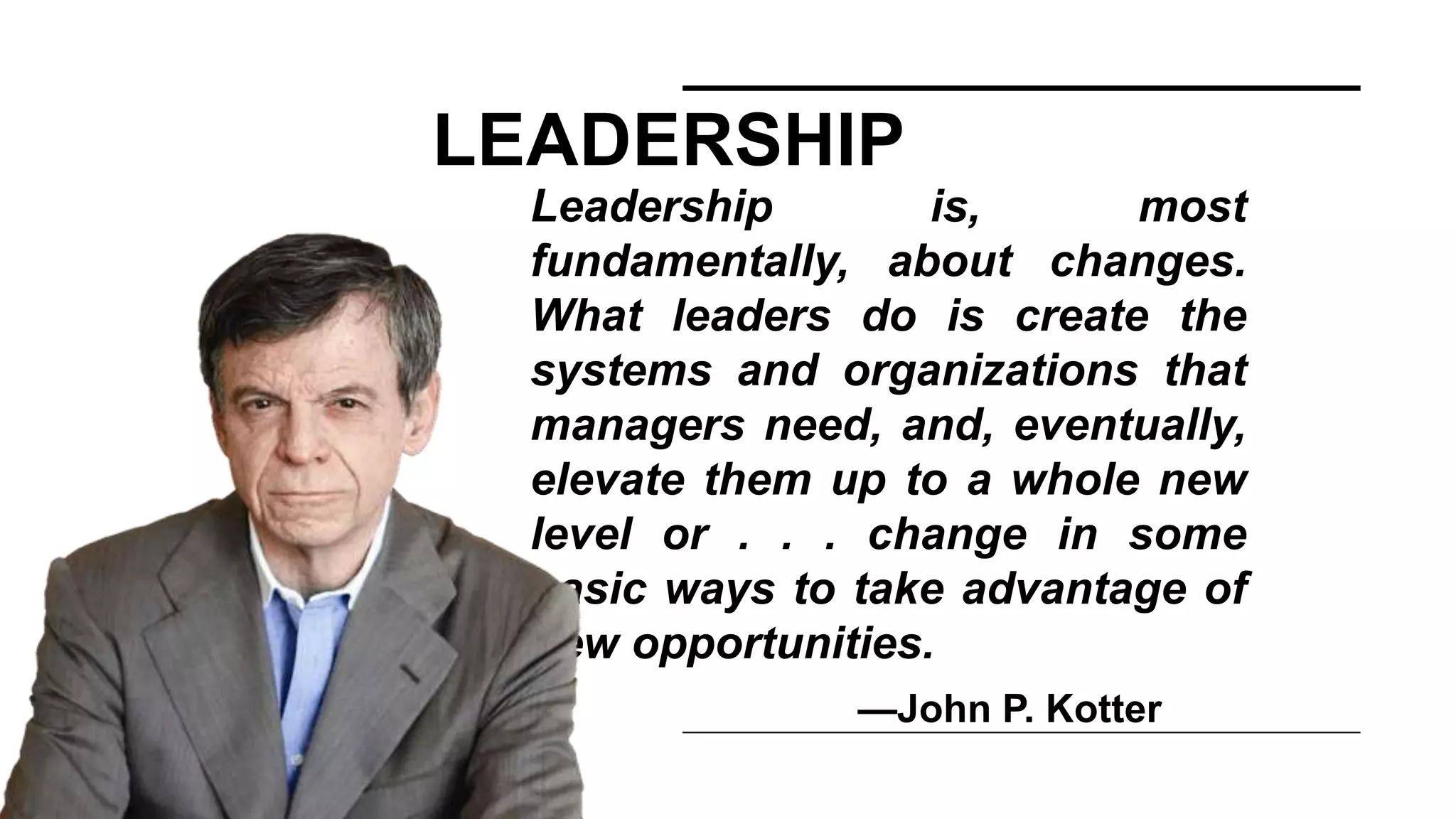
Leadership is, most
fundamentally, about changes.
What leaders do is create the
systems and organizations that
managers need, and, eventually,
elevate them up to a whole new
level or . . . change in some
basic ways to take advantage of
new opportunities.
—John P. Kotter
PRESENTATION TITLE
EVOLUTION OF LEADERSHIP
DEFINITION:
-1900-21st century
-scholars agree that
there is no common
definition of leadership
PRESENTATION TITLE
1900-
1929
Emphasizes on control
and centralization of
power with a common
theme of domination.
For example, at a
conference on
leadership in 1927,
leadership was defined
as “the ability to
impress the will of the
leader on those led and
induce obedience,
respect, loyalty, and
cooperation” (Moore,
1927, p. 124).
1930
S
Traits became the focus
of defining leadership,
with an emerging view of
leadership as influence
rather than domination.
Leadership was also
identified as the
interaction of an
individual’s specific
personality traits with
those of a group; it was
noted that while the
attitudes and activities of
the many may be
changed by the one
(leader), the many may
1940
S
The group approach
came into the forefront
with leadership being
defined as the
behavior of an
individual while
involved in directing
group activities
(Hemphill, 1949). At
the same time,
leadership by
persuasion was
distinguished from
“drivership” or
1950
S
Three themes dominated
leadership definitions
during this decade:
• continuance of group
theory, which framed
leadership as what leaders
do in groups;
• leadership as a
relationship that develops
shared goals, which defined
leadership based on
behavior of the leader; and
• effectiveness, in which
leadership was defined by
the ability to influence overall
group effectiveness.
1960
S
The 1960s is a
tumultuous time for
world affairs, saw
harmony amongst
leadership scholars. The
prevailing definition of
leadership as behavior
that influences people
toward shared goals was
underscored by Seeman
(1960) who described
leadership as “acts by
persons which influence
other persons in a
shared direction” (p. 53).
1970
S
The group focus gave way to the
organizational behavior approach,
where leadership became viewed as
“initiating and maintaining groups or
organizations to accomplish group or
organizational goals” (Rost, 1991, p.
59). Burns’s (1978) definition, however,
was the most important concept of
leadership to emerge: “Leadership is
the reciprocal process of mobilizing by
persons with certain motives and
values, various economic, political,
and other resources, in a context of
competition and conflict, in order to
realize goals independently or
mutually held by both leaders and
1980
S
This decade exploded with
scholarly and popular works
on the nature of leadership,
bringing the topic to the
apex of the academic and
public consciousnesses. As
a result, the number of
definitions for leadership
became a prolific stew with
several persevering themes:
1)Do as the leader wishes
2)Influence
3)Traits
4)Transformation
1980
S
• Do as the leader wishes.
Leadership definitions still
predominantly delivered the
message that leadership is
getting followers to do what the
leader wants done.
• Influence. Probably the most
often used word in leadership
definitions of the 1980s,
influence was examined from
every angle. In an effort to
distinguish leadership from
management, however,
scholars insisted that
leadership is noncoercive
influence.
1980
S
• Traits. Spurred by the national best
seller In Search of Excellence (Peters &
Waterman, 1982), the leadership-as-
excellence movement brought leader
traits back to the spotlight. As a result,
many people’s understanding of
leadership is based on a trait
orientation.
• Transformation. Burns (1978) is
credited for initiating a movement
defining leadership as a
transformational process, stating that
leadership occurs “when one or more
persons engage with others in such a
way that leaders and followers raise
one another to higher levels of
motivation and morality” (p. 83).
21ST
CENTUR
Y
Debate continues as to
whether leadership and
management are separate
processes, but emerging
research emphasizes the
process of leadership,
whereby an individual
influences a group of
individuals to achieve a
common goal, rather than
developing new ways of
defining leadership. Among
these emerging leadership
approaches are:
1) Authentic Leadership
2) Spiritual Leadership
3) Servant Leadership
4) Adaptive Leadership
21ST
CENTUR
Y
• authentic
leadership, in which
the authenticity of
leaders and their
leadership is
emphasized;
• spiritual leadership,
which focuses on
leadership that utilizes
values and sense of
calling and
membership to
motivate followers;
21ST
CENTUR
Y
• servant leadership, which
puts the leader in the role of
servant, who utilizes “caring
principles” to focus on
followers’ needs to help these
followers become more
autonomous, knowledgeable,
and like servants themselves;
and
• adaptive leadership, in
which leaders encourage
followers to adapt by
confronting and solving
problems, challenges, and
changes.
CONCEPTUALIZI
NG LEADERSHIP
- Focus of group processes
- Act or a behavior
- Personality perspective
- Power relationship
- Transformational process
- Skills perspective
PRESENTATION TITLE 2/11/20XX
COMPONENTS OF
LEADERSHIP
1)Leadership is a process
2)Leadership involves
influence
3)Leadership occurs in
groups
4)Leadership involves
common goals

Leadership Defined

  • 1.
  • 2.
    LEADERSHIP A process wherebyan individual influences a group of individuals to achieve a common goal. - Peter G. Northhouse PRESENTATION TITLE
  • 3.
    LEADERSHIP Leadership is, most fundamentally,about changes. What leaders do is create the systems and organizations that managers need, and, eventually, elevate them up to a whole new level or . . . change in some basic ways to take advantage of new opportunities. —John P. Kotter PRESENTATION TITLE
  • 4.
    EVOLUTION OF LEADERSHIP DEFINITION: -1900-21stcentury -scholars agree that there is no common definition of leadership PRESENTATION TITLE
  • 5.
    1900- 1929 Emphasizes on control andcentralization of power with a common theme of domination. For example, at a conference on leadership in 1927, leadership was defined as “the ability to impress the will of the leader on those led and induce obedience, respect, loyalty, and cooperation” (Moore, 1927, p. 124).
  • 6.
    1930 S Traits became thefocus of defining leadership, with an emerging view of leadership as influence rather than domination. Leadership was also identified as the interaction of an individual’s specific personality traits with those of a group; it was noted that while the attitudes and activities of the many may be changed by the one (leader), the many may
  • 7.
    1940 S The group approach cameinto the forefront with leadership being defined as the behavior of an individual while involved in directing group activities (Hemphill, 1949). At the same time, leadership by persuasion was distinguished from “drivership” or
  • 8.
    1950 S Three themes dominated leadershipdefinitions during this decade: • continuance of group theory, which framed leadership as what leaders do in groups; • leadership as a relationship that develops shared goals, which defined leadership based on behavior of the leader; and • effectiveness, in which leadership was defined by the ability to influence overall group effectiveness.
  • 9.
    1960 S The 1960s isa tumultuous time for world affairs, saw harmony amongst leadership scholars. The prevailing definition of leadership as behavior that influences people toward shared goals was underscored by Seeman (1960) who described leadership as “acts by persons which influence other persons in a shared direction” (p. 53).
  • 10.
    1970 S The group focusgave way to the organizational behavior approach, where leadership became viewed as “initiating and maintaining groups or organizations to accomplish group or organizational goals” (Rost, 1991, p. 59). Burns’s (1978) definition, however, was the most important concept of leadership to emerge: “Leadership is the reciprocal process of mobilizing by persons with certain motives and values, various economic, political, and other resources, in a context of competition and conflict, in order to realize goals independently or mutually held by both leaders and
  • 11.
    1980 S This decade explodedwith scholarly and popular works on the nature of leadership, bringing the topic to the apex of the academic and public consciousnesses. As a result, the number of definitions for leadership became a prolific stew with several persevering themes: 1)Do as the leader wishes 2)Influence 3)Traits 4)Transformation
  • 12.
    1980 S • Do asthe leader wishes. Leadership definitions still predominantly delivered the message that leadership is getting followers to do what the leader wants done. • Influence. Probably the most often used word in leadership definitions of the 1980s, influence was examined from every angle. In an effort to distinguish leadership from management, however, scholars insisted that leadership is noncoercive influence.
  • 13.
    1980 S • Traits. Spurredby the national best seller In Search of Excellence (Peters & Waterman, 1982), the leadership-as- excellence movement brought leader traits back to the spotlight. As a result, many people’s understanding of leadership is based on a trait orientation. • Transformation. Burns (1978) is credited for initiating a movement defining leadership as a transformational process, stating that leadership occurs “when one or more persons engage with others in such a way that leaders and followers raise one another to higher levels of motivation and morality” (p. 83).
  • 14.
    21ST CENTUR Y Debate continues asto whether leadership and management are separate processes, but emerging research emphasizes the process of leadership, whereby an individual influences a group of individuals to achieve a common goal, rather than developing new ways of defining leadership. Among these emerging leadership approaches are: 1) Authentic Leadership 2) Spiritual Leadership 3) Servant Leadership 4) Adaptive Leadership
  • 15.
    21ST CENTUR Y • authentic leadership, inwhich the authenticity of leaders and their leadership is emphasized; • spiritual leadership, which focuses on leadership that utilizes values and sense of calling and membership to motivate followers;
  • 16.
    21ST CENTUR Y • servant leadership,which puts the leader in the role of servant, who utilizes “caring principles” to focus on followers’ needs to help these followers become more autonomous, knowledgeable, and like servants themselves; and • adaptive leadership, in which leaders encourage followers to adapt by confronting and solving problems, challenges, and changes.
  • 17.
    CONCEPTUALIZI NG LEADERSHIP - Focusof group processes - Act or a behavior - Personality perspective - Power relationship - Transformational process - Skills perspective PRESENTATION TITLE 2/11/20XX
  • 18.
    COMPONENTS OF LEADERSHIP 1)Leadership isa process 2)Leadership involves influence 3)Leadership occurs in groups 4)Leadership involves common goals