Leadership
A leader…
Leads by example
Strives to make a positive difference
Inspires and encourages
Respect others
Provides support
Recognizes the contributions of
others
1900–1929
 emphasized control and centralization of power with a
common theme of domination. Leadership was defined as
“the ability to impress the will of the leader on those led
and induce obedience, respect, loyalty, and cooperation”
(Moore, 1927, p. 124).
1930s
 Traits became the focus of defining leadership
 influence rather than domination
1940s
 The group approach came into the forefront with
leadership being defined as the behavior of an individual
while involved in directing group activities (Hemphill, 1949).
1960s
 Behavior that influences people toward shared goals.
Leadership as “acts by persons which influence other
persons in a shared direction” (Seeman 1960 p. 53).
SOURCE: Adapted from Leadership for the Twenty-First Century, by J. C. Rost, 1991, New York: Praeger.
The Evolution of Leadership
Definitions
1980s
 Do as the leader wishes. Leadership definitions still predominantly
delivered the message that leadership is getting followers to do what the
leader wants done.
 Influence. Scholars insisted that leadership is noncoercive influence.
 Traits. Leadership is based on a trait orientation.
 Transformation. Burns (1978) is credited for initiating a movement
defining leadership as a transformational process, stating that leadership
occurs “when one or more persons engage with others in such a way
that leaders and followers raise one another to higher levels of
motivation and morality” (p. 83).
Into the 21st Century
 authentic leadership, in which the authenticity of leaders and their
leadership is emphasized;
 servant leadership, which puts the leader in the role of servant, who
utilizes “caring principles” to focus on followers’ needs to help these
followers become more autonomous, knowledgeable, and like servants
themselves; and
 adaptive leadership, in which leaders encourage followers to adapt by
confronting and solving problems, challenges, and changes.
SOURCE: Adapted from Leadership for the Twenty-First Century, by J. C. Rost, 1991, New York: Praeger.
The Evolution of Leadership
Definitions
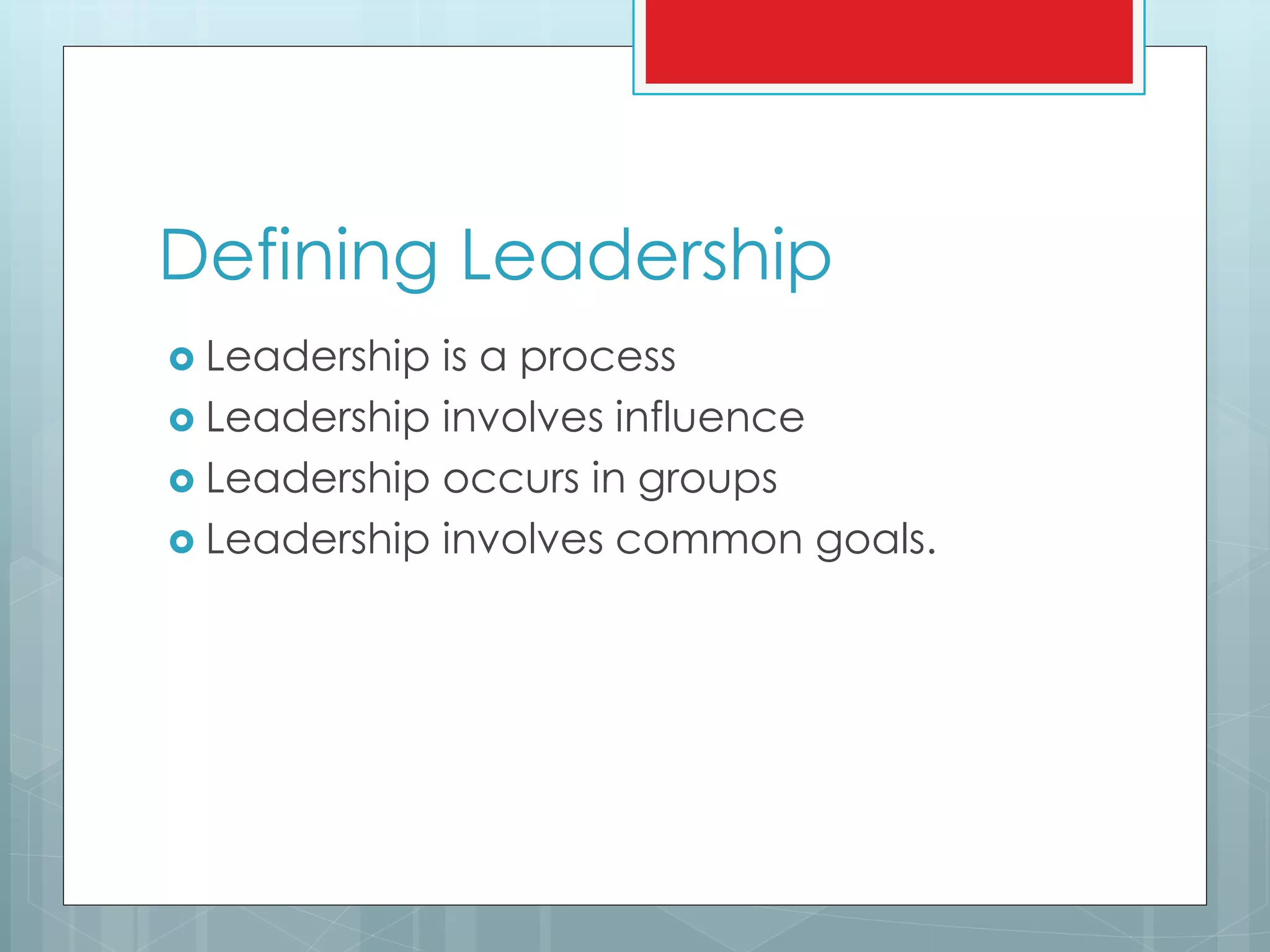
 Leadership is a process
 Leadership involves influence
 Leadership occurs in groups
 Leadership involves common goals.
Defining Leadership
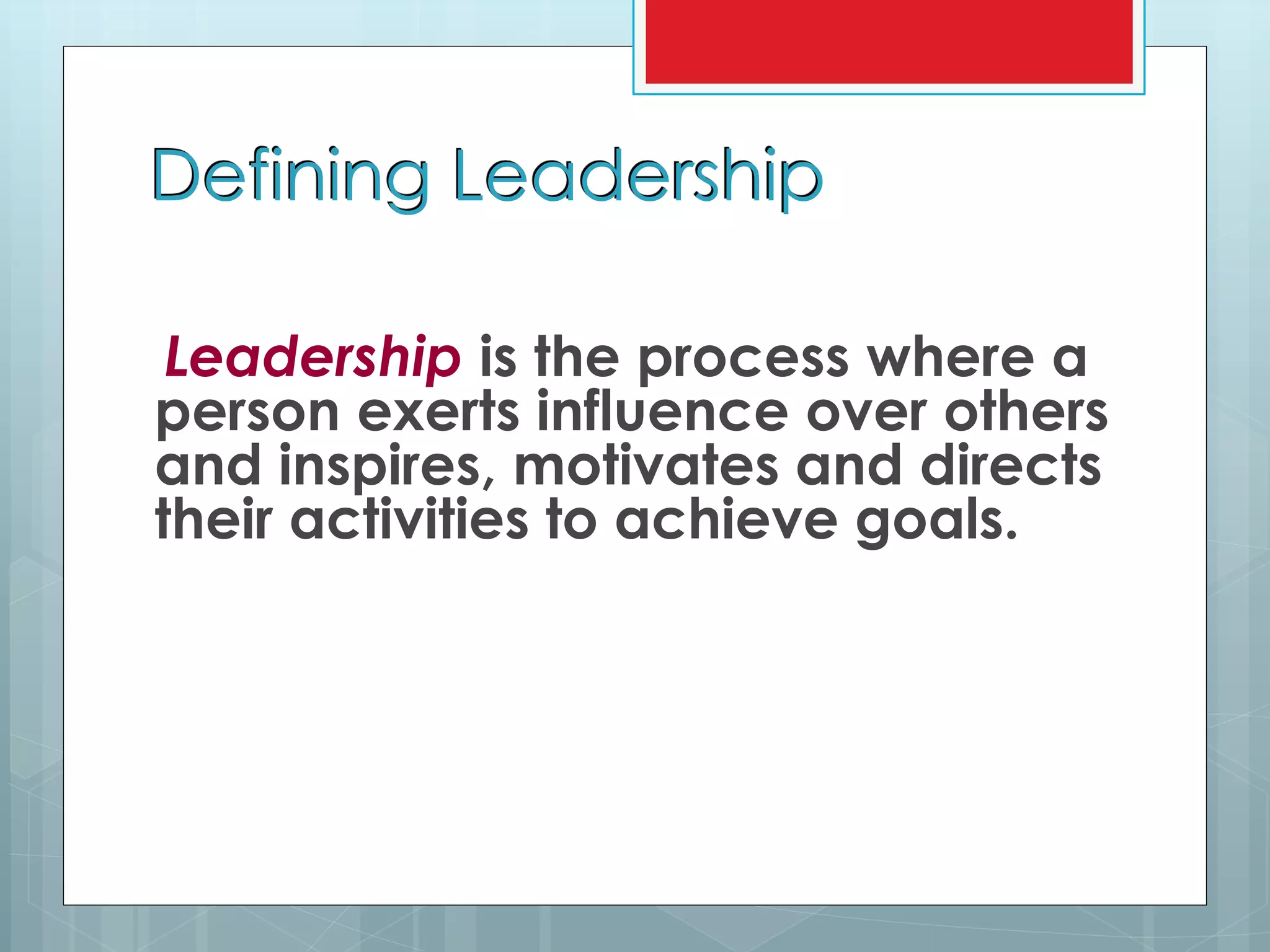
Defining Leadership
Leadership is the process where a
person exerts influence over others
and inspires, motivates and directs
their activities to achieve goals.
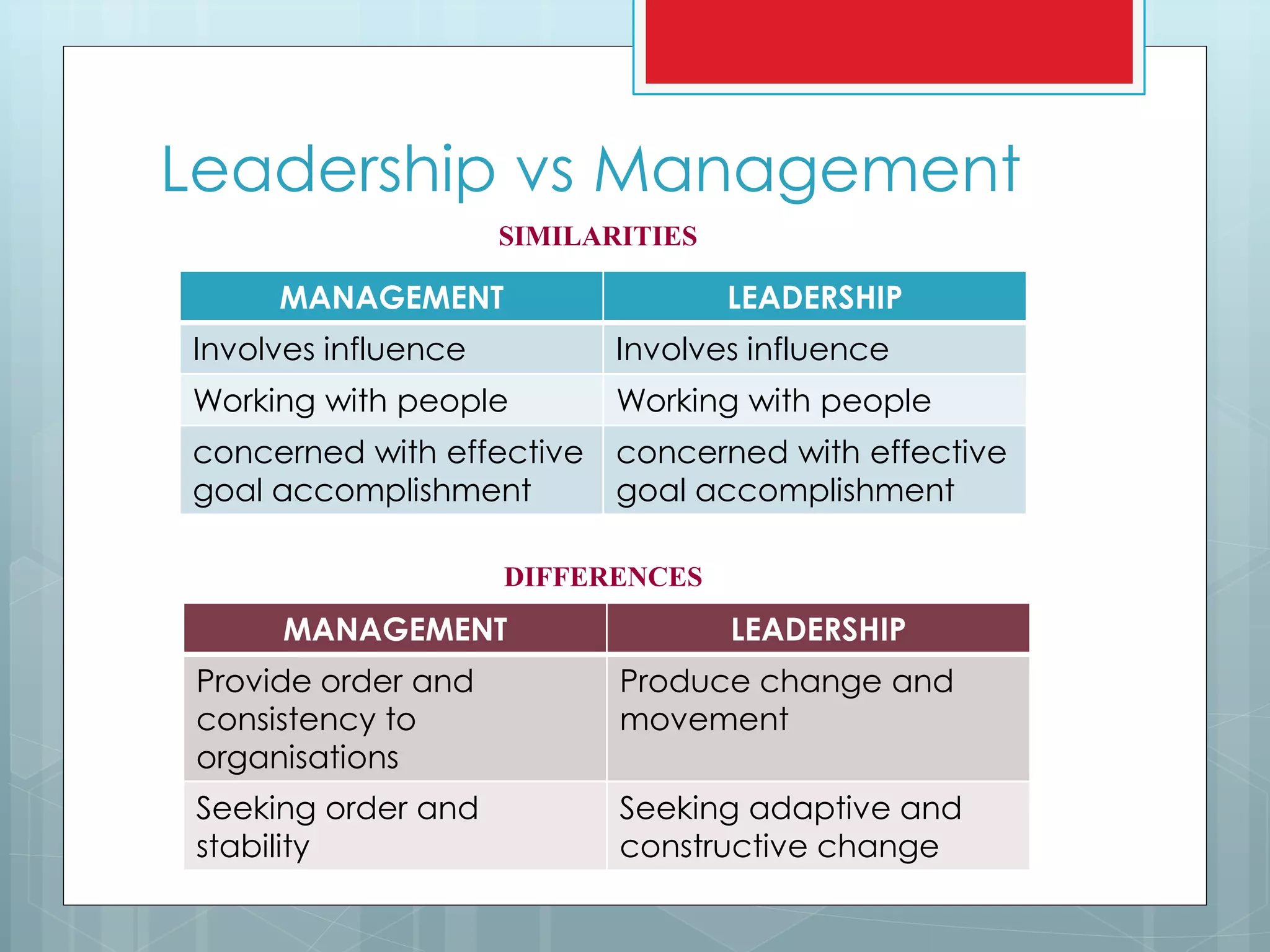
Leadership vs Management
SIMILARITIES
MANAGEMENT LEADERSHIP
Involves influence Involves influence
Working with people Working with people
concerned with effective
goal accomplishment
concerned with effective
goal accomplishment
MANAGEMENT LEADERSHIP
Provide order and
consistency to
organisations
Produce change and
movement
Seeking order and
stability
Seeking adaptive and
constructive change
DIFFERENCES
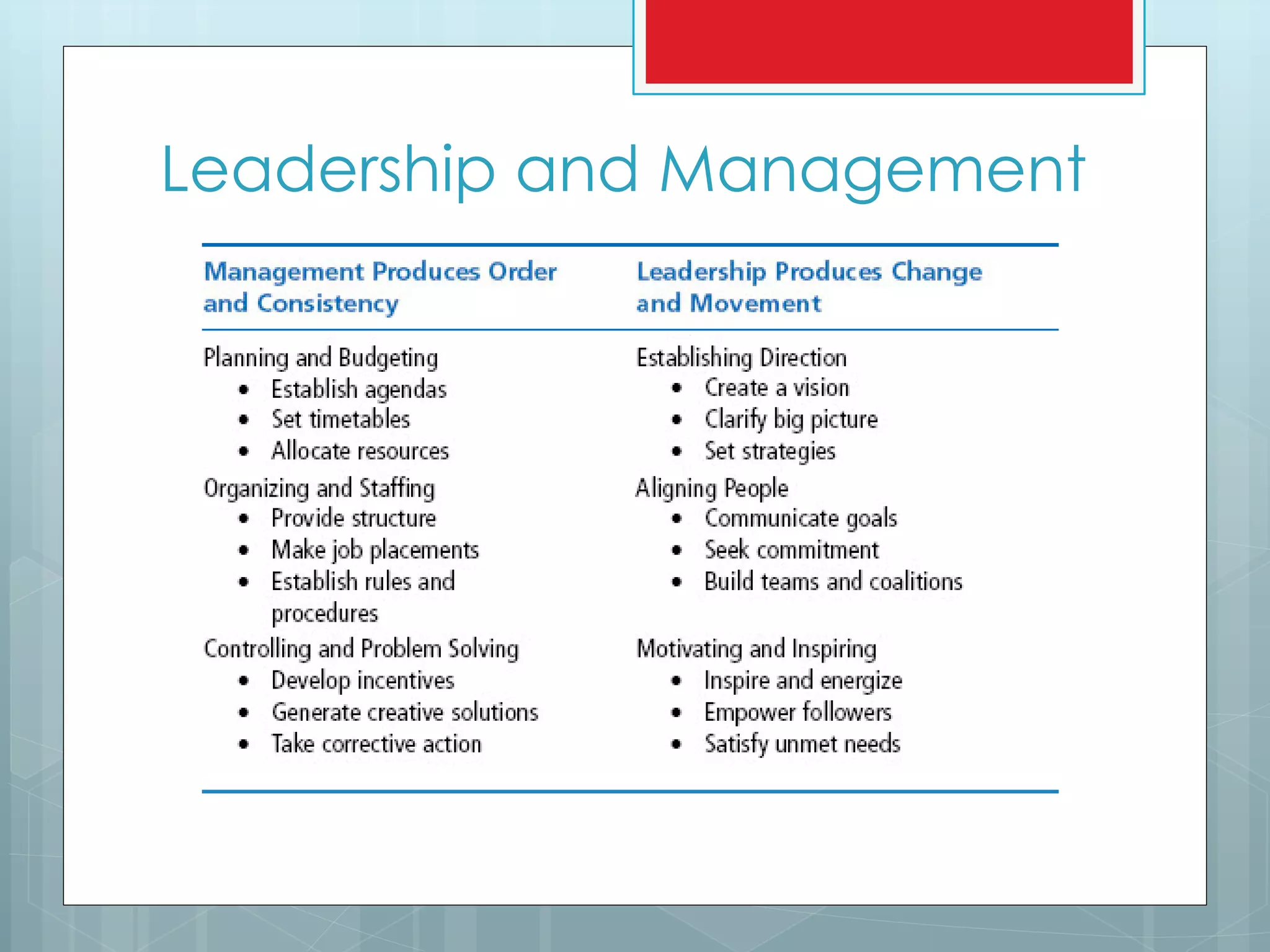
Leadership and Management
Assigned vs Emergent
Leadership
 Leadership that is based on occupying a
position in an organization is assigned
leadership.
 Example - Team leaders, plant managers,
department heads, directors, and
administrators
Assigned vs Emergent
Leadership
 When others perceive an individual as the
most influential member of a group or an
organization, regardless of the title, the person
is exhibiting emergent leadership.
 The individual acquires emergent leadership
through other people in the organization who
support and accept that individual’s
behavior.
 This type of leadership is not assigned by
position; rather, it emerges over a period
through communication.
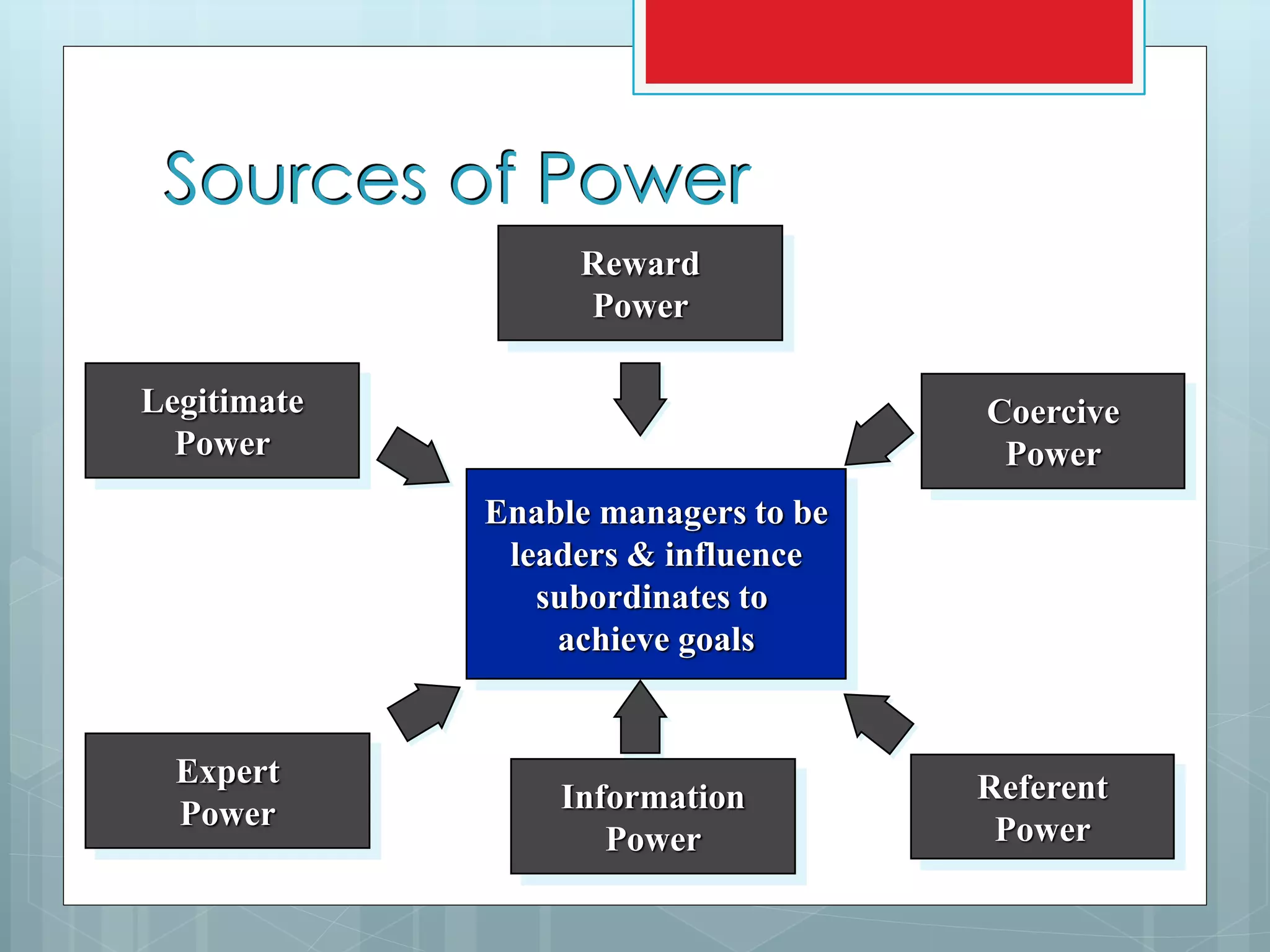
Sources of Power
Reward
Power
Legitimate
Power
Coercive
Power
Expert
Power
Referent
Power
Enable managers to be
leaders & influence
subordinates to
achieve goals
Information
Power
Sources of Power
 Used to affect other’s behavior and get them to act
in given ways.
 Legitimate Power: manager’s authority resulting by
their management position in the firm.
 Can be power to hire/fire workers, assign work.
 Reward Power: based on the manager’s ability to give
or withhold rewards.
 Pay raises, bonuses, verbal praise.
 Effective managers use reward power to signal
employees they are doing a good job.
 Coercive Power: based in ability to punish others.
 Ranges from verbal reprimand to pay cuts to firing.
 Can have serious negative side effects.
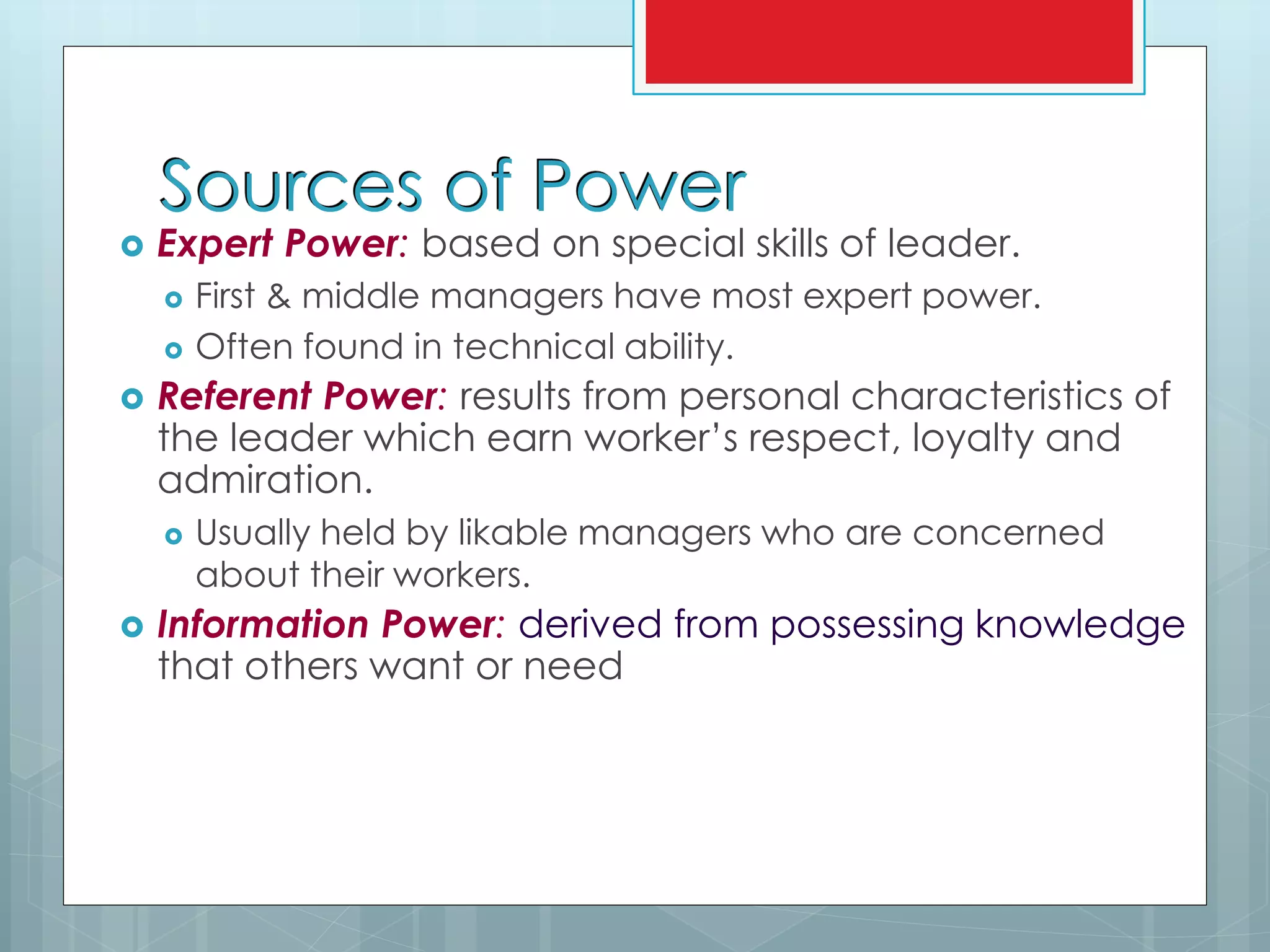
Sources of Power
 Expert Power: based on special skills of leader.
 First & middle managers have most expert power.
 Often found in technical ability.
 Referent Power: results from personal characteristics of
the leader which earn worker’s respect, loyalty and
admiration.
 Usually held by likable managers who are concerned
about their workers.
 Information Power: derived from possessing knowledge
that others want or need
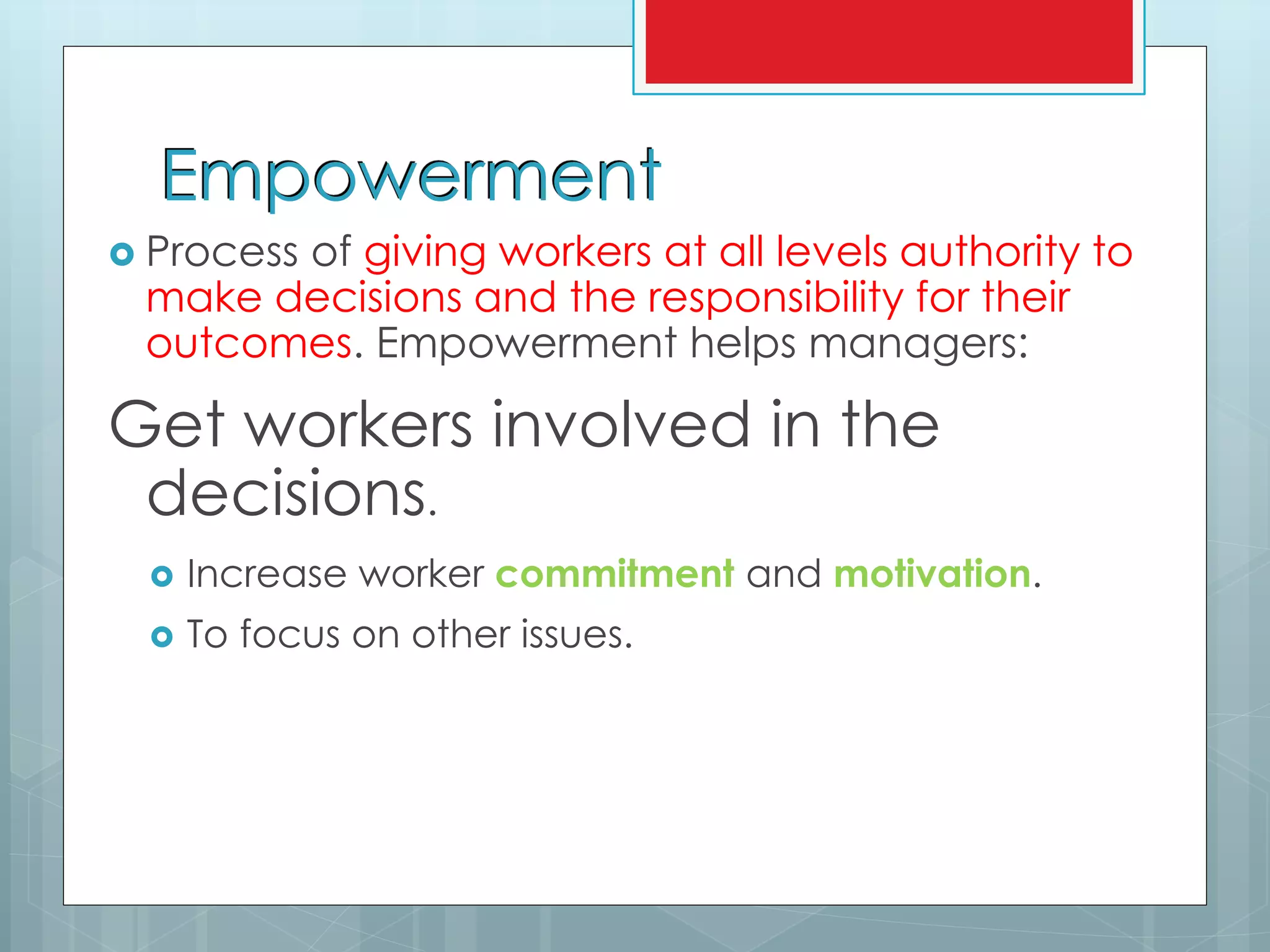
Empowerment
 Process of giving workers at all levels authority to
make decisions and the responsibility for their
outcomes. Empowerment helps managers:
Get workers involved in the
decisions.
 Increase worker commitment and motivation.
 To focus on other issues.
LEADERSHIP
APPROACHES
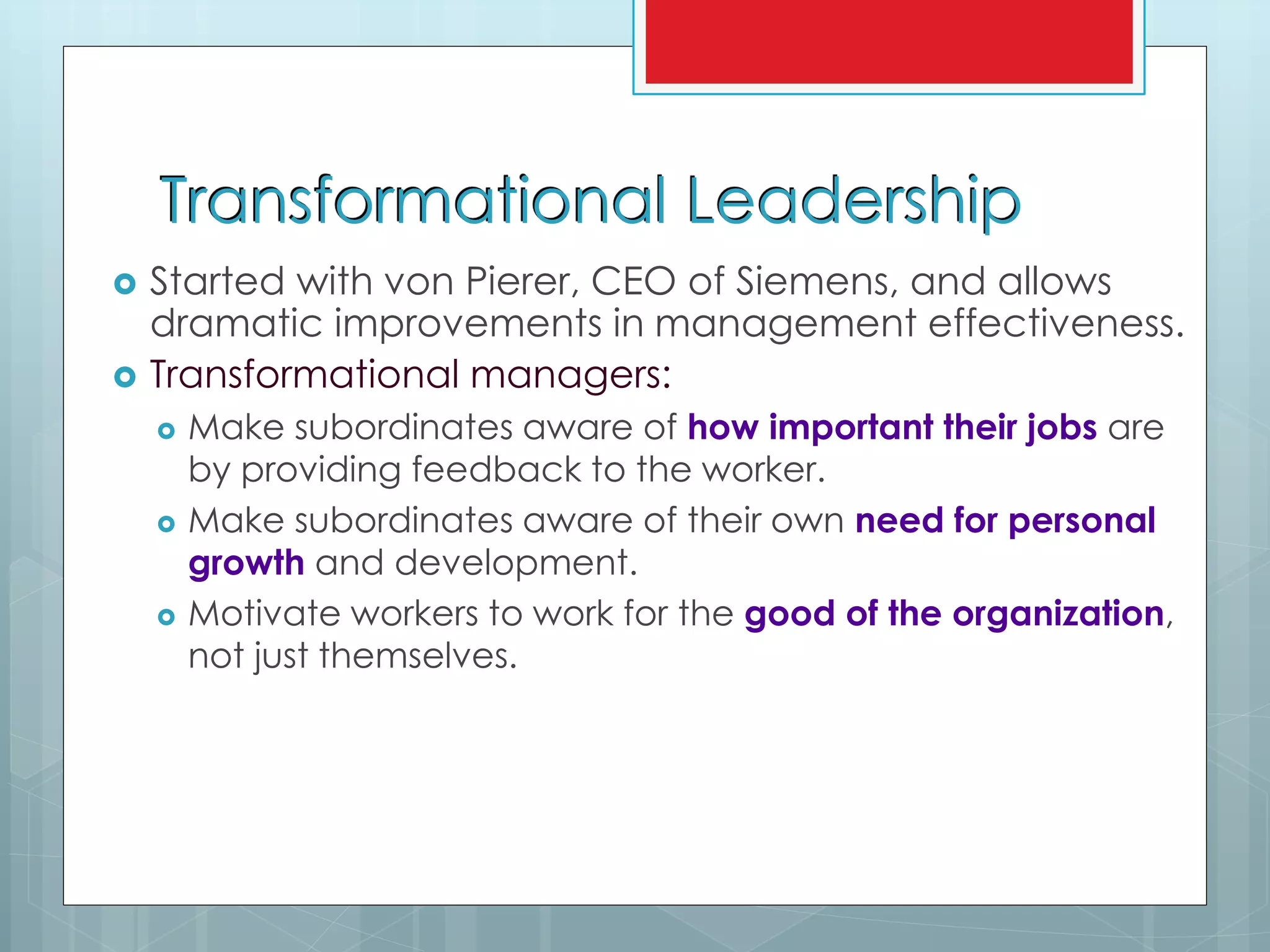
Transformational Leadership
 Started with von Pierer, CEO of Siemens, and allows
dramatic improvements in management effectiveness.
 Transformational managers:
 Make subordinates aware of how important their jobs are
by providing feedback to the worker.
 Make subordinates aware of their own need for personal
growth and development.
 Motivate workers to work for the good of the organization,
not just themselves.
Transformational Leaders
 Transformational leaders are charismatic and have a
vision of how good things can be.
 They are excited and clearly communicate this to
subordinates.
 Transformational leaders openly share information with
workers.
 Everyone is aware of problems and the need for change.
 Empowers workers to help with solutions.
 Transformational leaders engage in development of
workers.
 Manager works hard to help them build skills.
Transactional Leadership
 Involves managers using the reward and coercive
power to encourage high performance.
 Managers who push subordinates to change but
do not seem to change themselves are
transactional.
 The transactional manager does not have the
“vision” of the Transformational leader.
Authentic Leadership
 Focus on whether leadership is genuine or
“real”
 People long for leaders they can trust and
for leaders who are honest and good
 Exhibit genuine leadership, lead from
conviction and are originals.
Servant Leadership
 Can leadership be both service and
influence? Leader influence and
servants follows?
 Want to lead, serve first
 Attentive to the concerns of their
followers, empathize them and nurture
them
 Put follower first
Adaptive Leadership
 Encourage people to adapt, face and
deal with problems, challenges and
change
 Follower centred – concerned with how
people change and adjust to the new
circumstances
 Engage in activities that mobilize,
motivate, organize, orient and focus on
the attention of others.
Leadership Across Cultures
 Leadership styles may vary over different cultures.
 European managers tend to be more people-oriented
than American or Japanese managers.
 Japanese culture is very collective oriented, while
American focuses more on profitability.
 Time horizons also are affected by cultures.
 U.S. firms often focus on short-run efforts.
 Japanese firms take a longer-term outlook.
 Globalization created the need for leaders to be
competent in cross-cultural awareness and practices.
Gender and Leadership
 The number of women managers is rising but still
relatively low in top levels.
 Stereotypes suggest women are supportive and
concerned with interpersonal relations.
 Similarly, men are seen as task-focused.
 Research indicates that actually there is no gender-
based difference in leadership effectiveness.
 However, women are seen to be more participative than
men.
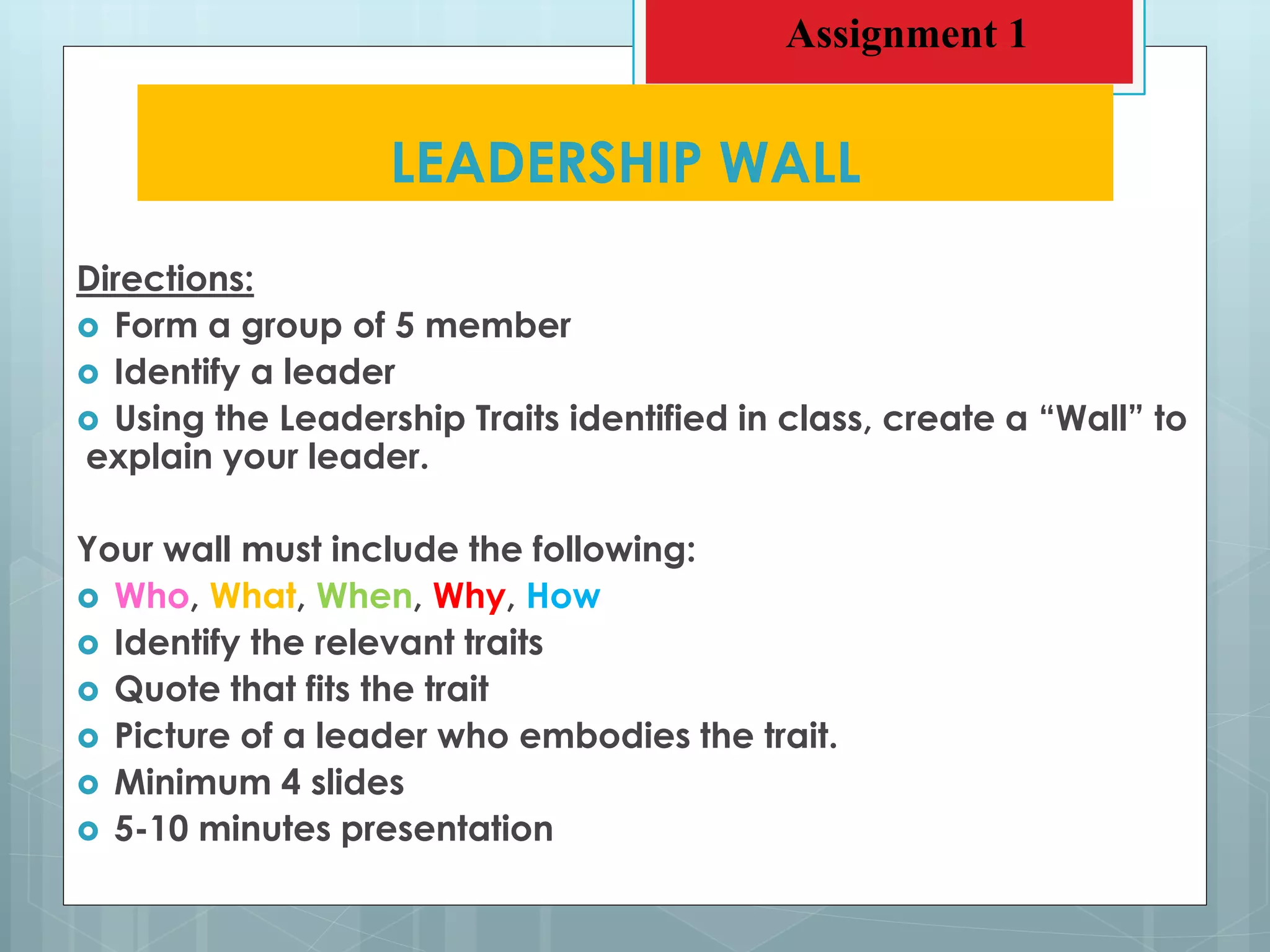
Directions:
 Form a group of 5 member
 Identify a leader
 Using the Leadership Traits identified in class, create a “Wall” to
explain your leader.
Your wall must include the following:
 Who, What, When, Why, How
 Identify the relevant traits
 Quote that fits the trait
 Picture of a leader who embodies the trait.
 Minimum 4 slides
 5-10 minutes presentation
LEADERSHIP WALL
Assignment 1
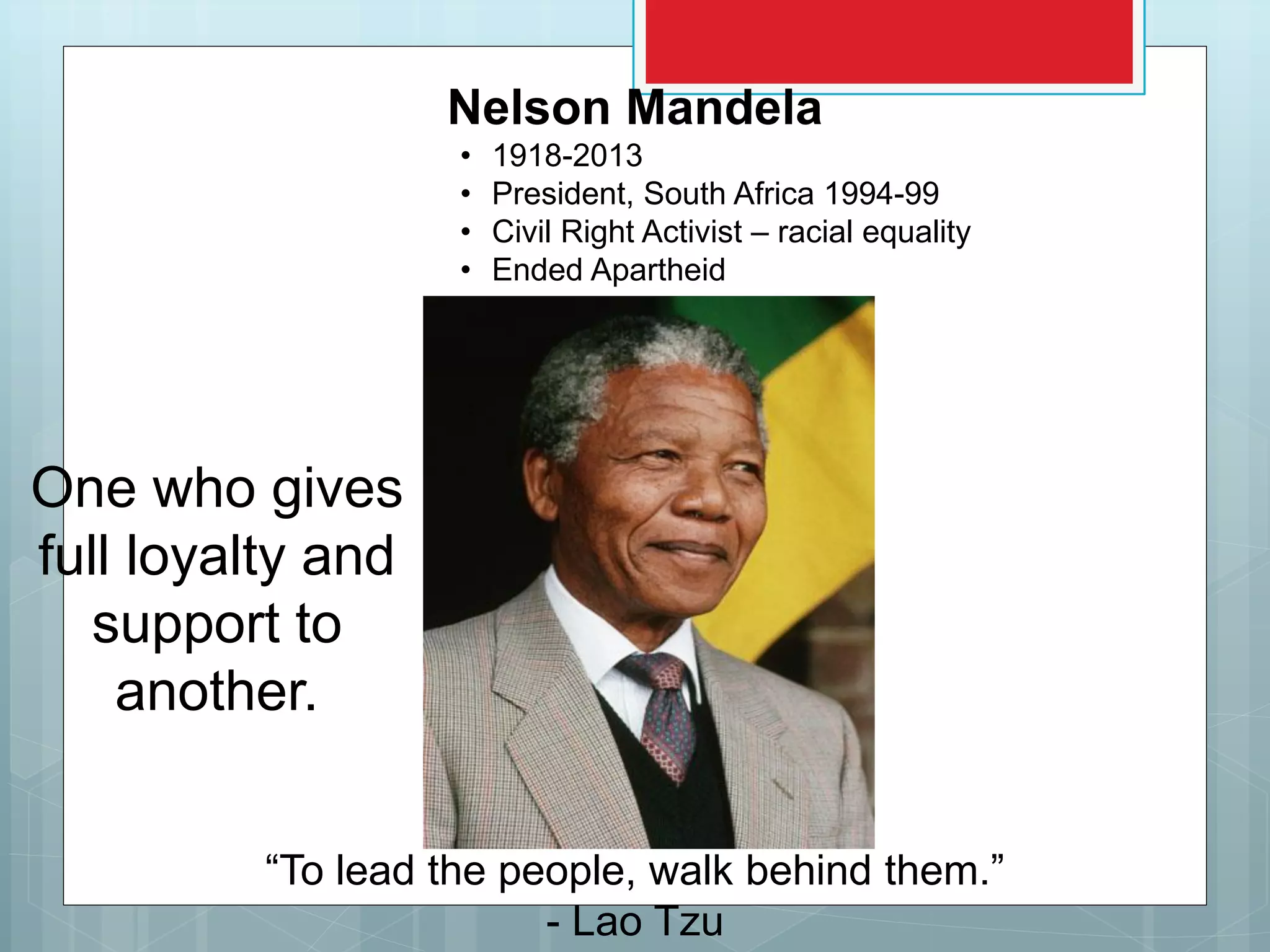
One who gives
full loyalty and
support to
another.
“To lead the people, walk behind them.”
- Lao Tzu
Nelson Mandela
• 1918-2013
• President, South Africa 1994-99
• Civil Right Activist – racial equality
• Ended Apartheid
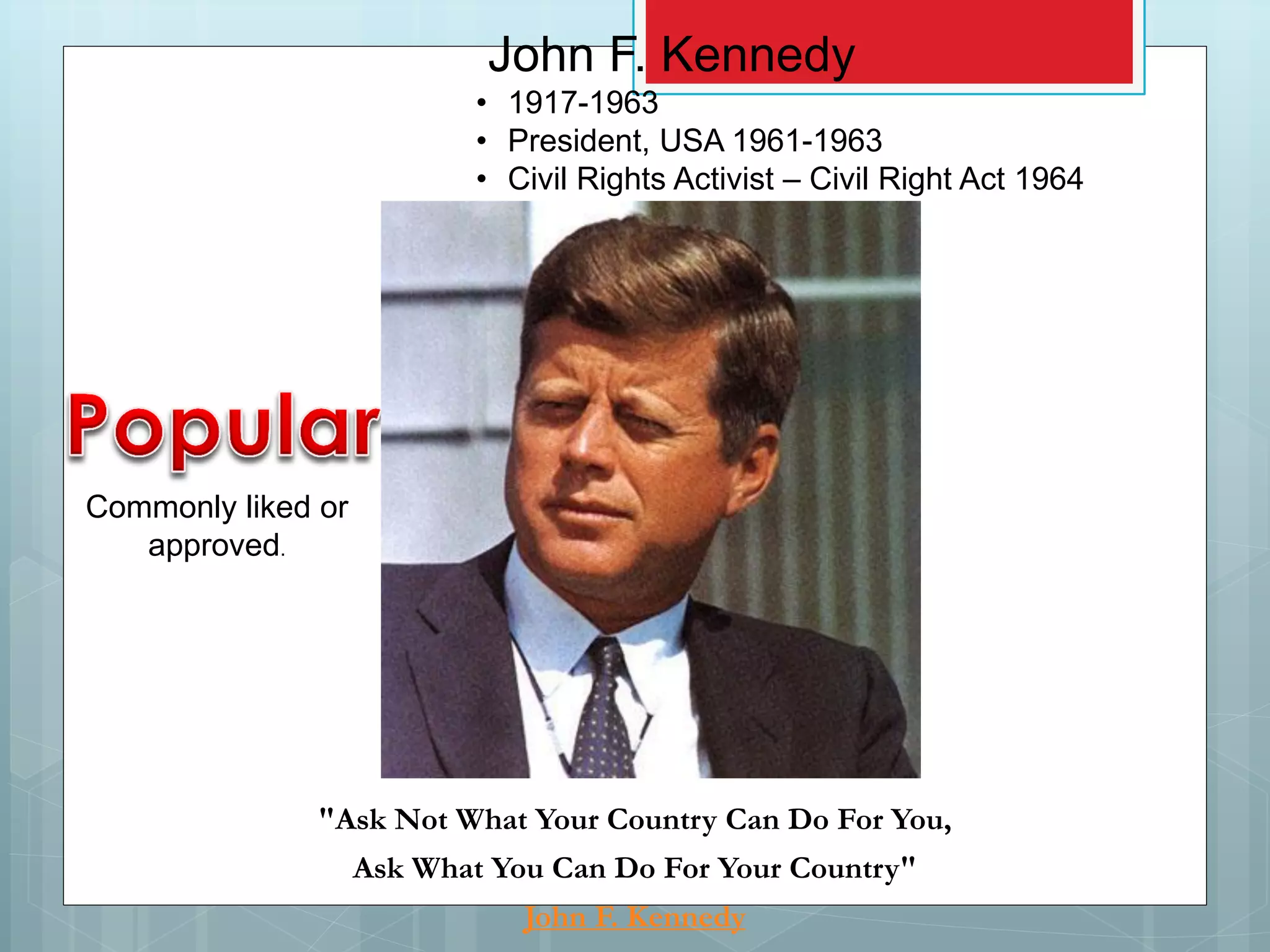
Commonly liked or
approved.
"Ask Not What Your Country Can Do For You,
Ask What You Can Do For Your Country"
John F. Kennedy
John F. Kennedy
• 1917-1963
• President, USA 1961-1963
• Civil Rights Activist – Civil Right Act 1964

Sem 2 lecture 1 lead

  • 1.
  • 2.
    A leader… Leads byexample Strives to make a positive difference Inspires and encourages Respect others Provides support Recognizes the contributions of others
  • 3.
    1900–1929  emphasized controland centralization of power with a common theme of domination. Leadership was defined as “the ability to impress the will of the leader on those led and induce obedience, respect, loyalty, and cooperation” (Moore, 1927, p. 124). 1930s  Traits became the focus of defining leadership  influence rather than domination 1940s  The group approach came into the forefront with leadership being defined as the behavior of an individual while involved in directing group activities (Hemphill, 1949). 1960s  Behavior that influences people toward shared goals. Leadership as “acts by persons which influence other persons in a shared direction” (Seeman 1960 p. 53). SOURCE: Adapted from Leadership for the Twenty-First Century, by J. C. Rost, 1991, New York: Praeger. The Evolution of Leadership Definitions
  • 4.
    1980s  Do asthe leader wishes. Leadership definitions still predominantly delivered the message that leadership is getting followers to do what the leader wants done.  Influence. Scholars insisted that leadership is noncoercive influence.  Traits. Leadership is based on a trait orientation.  Transformation. Burns (1978) is credited for initiating a movement defining leadership as a transformational process, stating that leadership occurs “when one or more persons engage with others in such a way that leaders and followers raise one another to higher levels of motivation and morality” (p. 83). Into the 21st Century  authentic leadership, in which the authenticity of leaders and their leadership is emphasized;  servant leadership, which puts the leader in the role of servant, who utilizes “caring principles” to focus on followers’ needs to help these followers become more autonomous, knowledgeable, and like servants themselves; and  adaptive leadership, in which leaders encourage followers to adapt by confronting and solving problems, challenges, and changes. SOURCE: Adapted from Leadership for the Twenty-First Century, by J. C. Rost, 1991, New York: Praeger. The Evolution of Leadership Definitions
  • 5.
     Leadership isa process  Leadership involves influence  Leadership occurs in groups  Leadership involves common goals. Defining Leadership
  • 6.
    Defining Leadership Leadership isthe process where a person exerts influence over others and inspires, motivates and directs their activities to achieve goals.
  • 7.
    Leadership vs Management SIMILARITIES MANAGEMENTLEADERSHIP Involves influence Involves influence Working with people Working with people concerned with effective goal accomplishment concerned with effective goal accomplishment MANAGEMENT LEADERSHIP Provide order and consistency to organisations Produce change and movement Seeking order and stability Seeking adaptive and constructive change DIFFERENCES
  • 8.
  • 9.
    Assigned vs Emergent Leadership Leadership that is based on occupying a position in an organization is assigned leadership.  Example - Team leaders, plant managers, department heads, directors, and administrators
  • 10.
    Assigned vs Emergent Leadership When others perceive an individual as the most influential member of a group or an organization, regardless of the title, the person is exhibiting emergent leadership.  The individual acquires emergent leadership through other people in the organization who support and accept that individual’s behavior.  This type of leadership is not assigned by position; rather, it emerges over a period through communication.
  • 11.
    Sources of Power Reward Power Legitimate Power Coercive Power Expert Power Referent Power Enablemanagers to be leaders & influence subordinates to achieve goals Information Power
  • 12.
    Sources of Power Used to affect other’s behavior and get them to act in given ways.  Legitimate Power: manager’s authority resulting by their management position in the firm.  Can be power to hire/fire workers, assign work.  Reward Power: based on the manager’s ability to give or withhold rewards.  Pay raises, bonuses, verbal praise.  Effective managers use reward power to signal employees they are doing a good job.  Coercive Power: based in ability to punish others.  Ranges from verbal reprimand to pay cuts to firing.  Can have serious negative side effects.
  • 13.
    Sources of Power Expert Power: based on special skills of leader.  First & middle managers have most expert power.  Often found in technical ability.  Referent Power: results from personal characteristics of the leader which earn worker’s respect, loyalty and admiration.  Usually held by likable managers who are concerned about their workers.  Information Power: derived from possessing knowledge that others want or need
  • 14.
    Empowerment  Process ofgiving workers at all levels authority to make decisions and the responsibility for their outcomes. Empowerment helps managers: Get workers involved in the decisions.  Increase worker commitment and motivation.  To focus on other issues.
  • 15.
  • 16.
    Transformational Leadership  Startedwith von Pierer, CEO of Siemens, and allows dramatic improvements in management effectiveness.  Transformational managers:  Make subordinates aware of how important their jobs are by providing feedback to the worker.  Make subordinates aware of their own need for personal growth and development.  Motivate workers to work for the good of the organization, not just themselves.
  • 17.
    Transformational Leaders  Transformationalleaders are charismatic and have a vision of how good things can be.  They are excited and clearly communicate this to subordinates.  Transformational leaders openly share information with workers.  Everyone is aware of problems and the need for change.  Empowers workers to help with solutions.  Transformational leaders engage in development of workers.  Manager works hard to help them build skills.
  • 18.
    Transactional Leadership  Involvesmanagers using the reward and coercive power to encourage high performance.  Managers who push subordinates to change but do not seem to change themselves are transactional.  The transactional manager does not have the “vision” of the Transformational leader.
  • 20.
    Authentic Leadership  Focuson whether leadership is genuine or “real”  People long for leaders they can trust and for leaders who are honest and good  Exhibit genuine leadership, lead from conviction and are originals.
  • 21.
    Servant Leadership  Canleadership be both service and influence? Leader influence and servants follows?  Want to lead, serve first  Attentive to the concerns of their followers, empathize them and nurture them  Put follower first
  • 22.
    Adaptive Leadership  Encouragepeople to adapt, face and deal with problems, challenges and change  Follower centred – concerned with how people change and adjust to the new circumstances  Engage in activities that mobilize, motivate, organize, orient and focus on the attention of others.
  • 23.
    Leadership Across Cultures Leadership styles may vary over different cultures.  European managers tend to be more people-oriented than American or Japanese managers.  Japanese culture is very collective oriented, while American focuses more on profitability.  Time horizons also are affected by cultures.  U.S. firms often focus on short-run efforts.  Japanese firms take a longer-term outlook.  Globalization created the need for leaders to be competent in cross-cultural awareness and practices.
  • 24.
    Gender and Leadership The number of women managers is rising but still relatively low in top levels.  Stereotypes suggest women are supportive and concerned with interpersonal relations.  Similarly, men are seen as task-focused.  Research indicates that actually there is no gender- based difference in leadership effectiveness.  However, women are seen to be more participative than men.
  • 25.
    Directions:  Form agroup of 5 member  Identify a leader  Using the Leadership Traits identified in class, create a “Wall” to explain your leader. Your wall must include the following:  Who, What, When, Why, How  Identify the relevant traits  Quote that fits the trait  Picture of a leader who embodies the trait.  Minimum 4 slides  5-10 minutes presentation LEADERSHIP WALL Assignment 1
  • 26.
    One who gives fullloyalty and support to another. “To lead the people, walk behind them.” - Lao Tzu Nelson Mandela • 1918-2013 • President, South Africa 1994-99 • Civil Right Activist – racial equality • Ended Apartheid
  • 27.
    Commonly liked or approved. "AskNot What Your Country Can Do For You, Ask What You Can Do For Your Country" John F. Kennedy John F. Kennedy • 1917-1963 • President, USA 1961-1963 • Civil Rights Activist – Civil Right Act 1964