LEADERS AND MANAGERS:
ARE THEY DIFFERENT?
A FOUR LENS PERSPECTIVE
Outline provided by Dr. Richard Dool
PRESENTED BY NEW DELHI INSTITUTE OF MANAGEMENT
LEADERS AND MANAGERS:
ARE THEY DIFFERENT?
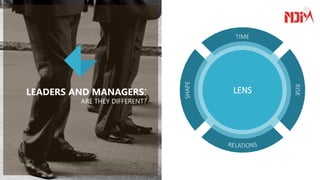
LENS
LEADERS AND MANAGERS: ARE THEY DIFFERENT?
02
“A leader is one who sees more than others see, who sees farther than others see and who sees before others do” - Eims
Leaders live in the future, managers live in the here and now, imitate
the past
• The manager has a short-range view; the leader has a long-
range perspective
The leader will challenge the “system,” do things differently and have
the courage to think outside the box
Leaders create a vision for the future – must “see” a new place, time
or possibilities
• Leaders use their Peripheral vision; paying attention to what’s
happening at the edges. Always scanning up, down, sideways,
even behind - connecting seemingly disconnected dots.
Managers deliver on the vision
• The manager will execute the Vision: break it down into a
roadmap - the day-to-day work efforts and the resources
needed.
Leaders venture out into unknown, managers seek the “tried and
true”
Leaders set direction, managers follow direction
• Managers explain “what we have to do.” Leaders explain
“where we are going.”
• The manager asks how and when; the leader asks what and
why.
• Leaders think “what if”, managers think “how”
Leaders look for possibilities, managers calculate probabilities
A CRITICAL DISTINCTION: VISIONING
03
Leaders have a unique ability to rally employees around a vision. Because their belief in the vision is so strong, employees will naturally want to
follow them. Leaders also tend to be willing to take risks in pursuit of the vision.
Managers, on the other hand, are more adept at executing the vision in a very systemic way and directing employees on how to do so. They can see
all of the intricate moving parts and understand how to make them harmonize. Managers are usually very risk-adverse.
Kurt Richardson, Founder of Otter =Box
These are people who have the ability to “see around corners,” (GE’s CEO Jeff Immelt). Those who can keep maximum
perspective even while engaged in day to day pursuits.
Leaders and Managers working together…..
Create a compelling Vision, communicate it to create deep and broad buy-in,
execute to meet the expected outcomes.
LEADERS AND MANAGERS: ARE THEY DIFFERENT?
04
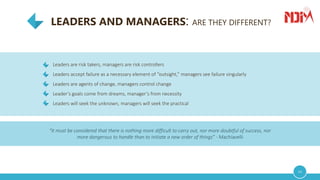
Leaders are risk takers, managers are risk controllers
Leaders accept failure as a necessary element of “outsight,” managers see failure singularly
Leaders are agents of change, managers control change
Leader’s goals come from dreams, manager’s from necessity
Leaders will seek the unknown, managers will seek the practical
“It must be considered that there is nothing more difficult to carry out, nor more doubtful of success, nor
more dangerous to handle than to initiate a new order of things” - Machiavelli
LEADERS AND MANAGERS: ARE THEY DIFFERENT?
05
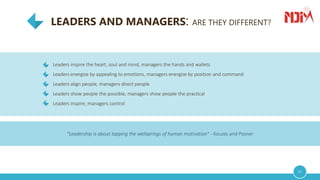
“Leadership is about tapping the wellsprings of human motivation” - Kouzes and Posner
Leaders inspire the heart, soul and mind, managers the hands and wallets
Leaders energize by appealing to emotions, managers energize by position and command
Leaders align people, managers direct people
Leaders show people the possible, managers show people the practical
Leaders inspire, managers control
LEADERS AND MANAGERS: ARE THEY DIFFERENT?
06
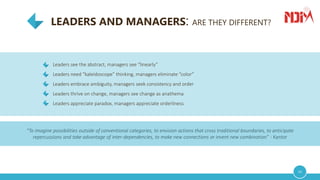
“To imagine possibilities outside of conventional categories, to envision actions that cross traditional boundaries, to anticipate
repercussions and take advantage of inter-dependencies, to make new connections or invent new combination” - Kantor
Leaders see the abstract, managers see “linearly”
Leaders need “kaleidoscope” thinking, managers eliminate “color”
Leaders embrace ambiguity, managers seek consistency and order
Leaders thrive on change, managers see change as anathema
Leaders appreciate paradox, managers appreciate orderliness
LEADERS AND MANAGERS: ARE THEY DIFFERENT?
07
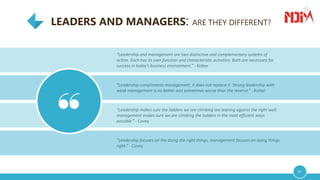
“Leadership and management are two distinctive and complementary systems of
action. Each has its own function and characteristic activities. Both are necessary for
success in today’s business environment.” - Kotter
“Leadership compliments management, it does not replace it. Strong leadership with
weak management is no better and sometimes worse than the reverse.” - Kotter
“Leadership makes sure the ladders we are climbing are leaning against the right wall;
management makes sure we are climbing the ladders in the most efficient ways
possible.” - Covey
“Leadership focuses on the doing the right things, management focuses on doing things
right.” - Covey
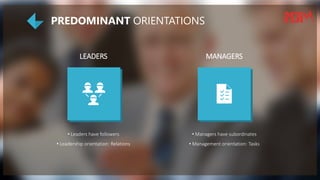
PREDOMINANT ORIENTATIONS
• Leaders have followers
• Leadership orientation: Relations
• Managers have subordinates
• Management orientation: Tasks
LEADERS MANAGERS
TWO SIDES OF THE SAME COINS
09
Often Management is presented as inferior or subordinate
There is clear overlap and shared competencies
• Gray distinctions at times
There is a need for both
Too much of either can create unintended consequences
• The needs may not be equal at times, situational imperatives create need/demand
Can someone be equally adept at both? Examples?
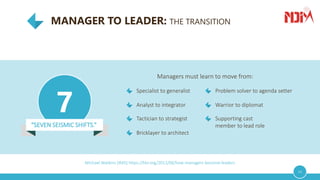
MANAGER TO LEADER: THE TRANSITION
10
Michael Watkins (IMD) https://hbr.org/2012/06/how-managers-become-leaders
7
Specialist to generalist
Analyst to integrator
Tactician to strategist
Bricklayer to architect
Problem solver to agenda setter
Warrior to diplomat
Supporting cast
member to lead role
Managers must learn to move from:
“SEVEN SEISMIC SHIFTS.”
WE NEED BOTH
“Often in making the distinction, management is characterized as less important, or somehow inferior to leadership. For some
strange reason leaders are seen as the good guys, managers the bad guys.” - Mitch McCrimmon
“Both leadership and management are functions but only management is a role. One is appointed to a managerial position, but
anyone can show leadership regardless of whether they are managers or not.”
“Inspired leaders are not necessarily good organizers and excellent managers.”
The most effective managers are also leaders, and the quality of leadership has become and increasingly important part of
management ability. Modern managers are more like coaches, facilitators or catalysts than assembly-line controllers.
“Great leaders and great managers listen well, are curious, manage their self-talk, and hold themselves accountable for moving
the business forward.” - Ericka Anderson, Proteus
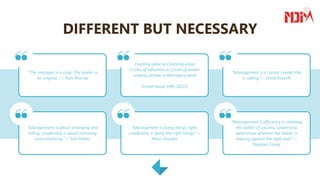
“The manager is a copy; The leader is
an original..” – Alan Murray
Creating value vs Counting value
Circles of influence vs Circles of power
Leading people vs Managing work
Vineet Nayar HBR (2013)
“Management is a career. Leadership
is calling.” – Leslie Kossoff
“Management is about arranging and
telling. Leadership is about nurturing
and enhancing.” – Tom Peters
“Management is doing things right;
Leadership is doing the right things.” –
Peter Drucker
“Management is efficiency in climbing
the ladder of success; Leadership
determines whether the ladder is
leaning against the right wall.” –
Stephen Covey
DIFFERENT BUT NECESSARY
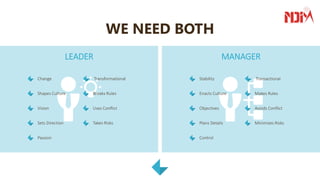
WE NEED BOTH
LEADER MANAGER
Change
Shapes Culture
Vision
Sets Direction
Passion
Transformational
Breaks Rules
Uses Conflict
Takes Risks
Stability
Enacts Culture
Objectives
Plans Details
Control
Transactional
Makes Rules
Avoids Conflict
Minimizes Risks
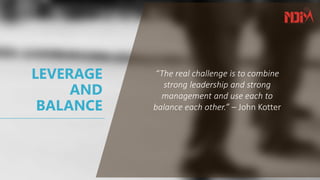
LEVERAGE
AND
BALANCE
“The real challenge is to combine
strong leadership and strong
management and use each to
balance each other.” – John Kotter
THANK YOU

Leader vs manager

  • 1.
    LEADERS AND MANAGERS: ARETHEY DIFFERENT? A FOUR LENS PERSPECTIVE Outline provided by Dr. Richard Dool PRESENTED BY NEW DELHI INSTITUTE OF MANAGEMENT
  • 2.
    LEADERS AND MANAGERS: ARETHEY DIFFERENT? LENS
  • 3.
    LEADERS AND MANAGERS:ARE THEY DIFFERENT? 02 “A leader is one who sees more than others see, who sees farther than others see and who sees before others do” - Eims Leaders live in the future, managers live in the here and now, imitate the past • The manager has a short-range view; the leader has a long- range perspective The leader will challenge the “system,” do things differently and have the courage to think outside the box Leaders create a vision for the future – must “see” a new place, time or possibilities • Leaders use their Peripheral vision; paying attention to what’s happening at the edges. Always scanning up, down, sideways, even behind - connecting seemingly disconnected dots. Managers deliver on the vision • The manager will execute the Vision: break it down into a roadmap - the day-to-day work efforts and the resources needed. Leaders venture out into unknown, managers seek the “tried and true” Leaders set direction, managers follow direction • Managers explain “what we have to do.” Leaders explain “where we are going.” • The manager asks how and when; the leader asks what and why. • Leaders think “what if”, managers think “how” Leaders look for possibilities, managers calculate probabilities
  • 4.
    A CRITICAL DISTINCTION:VISIONING 03 Leaders have a unique ability to rally employees around a vision. Because their belief in the vision is so strong, employees will naturally want to follow them. Leaders also tend to be willing to take risks in pursuit of the vision. Managers, on the other hand, are more adept at executing the vision in a very systemic way and directing employees on how to do so. They can see all of the intricate moving parts and understand how to make them harmonize. Managers are usually very risk-adverse. Kurt Richardson, Founder of Otter =Box These are people who have the ability to “see around corners,” (GE’s CEO Jeff Immelt). Those who can keep maximum perspective even while engaged in day to day pursuits. Leaders and Managers working together….. Create a compelling Vision, communicate it to create deep and broad buy-in, execute to meet the expected outcomes.
  • 5.
    LEADERS AND MANAGERS:ARE THEY DIFFERENT? 04 Leaders are risk takers, managers are risk controllers Leaders accept failure as a necessary element of “outsight,” managers see failure singularly Leaders are agents of change, managers control change Leader’s goals come from dreams, manager’s from necessity Leaders will seek the unknown, managers will seek the practical “It must be considered that there is nothing more difficult to carry out, nor more doubtful of success, nor more dangerous to handle than to initiate a new order of things” - Machiavelli
  • 6.
    LEADERS AND MANAGERS:ARE THEY DIFFERENT? 05 “Leadership is about tapping the wellsprings of human motivation” - Kouzes and Posner Leaders inspire the heart, soul and mind, managers the hands and wallets Leaders energize by appealing to emotions, managers energize by position and command Leaders align people, managers direct people Leaders show people the possible, managers show people the practical Leaders inspire, managers control
  • 7.
    LEADERS AND MANAGERS:ARE THEY DIFFERENT? 06 “To imagine possibilities outside of conventional categories, to envision actions that cross traditional boundaries, to anticipate repercussions and take advantage of inter-dependencies, to make new connections or invent new combination” - Kantor Leaders see the abstract, managers see “linearly” Leaders need “kaleidoscope” thinking, managers eliminate “color” Leaders embrace ambiguity, managers seek consistency and order Leaders thrive on change, managers see change as anathema Leaders appreciate paradox, managers appreciate orderliness
  • 8.
    LEADERS AND MANAGERS:ARE THEY DIFFERENT? 07 “Leadership and management are two distinctive and complementary systems of action. Each has its own function and characteristic activities. Both are necessary for success in today’s business environment.” - Kotter “Leadership compliments management, it does not replace it. Strong leadership with weak management is no better and sometimes worse than the reverse.” - Kotter “Leadership makes sure the ladders we are climbing are leaning against the right wall; management makes sure we are climbing the ladders in the most efficient ways possible.” - Covey “Leadership focuses on the doing the right things, management focuses on doing things right.” - Covey
  • 9.
    PREDOMINANT ORIENTATIONS • Leadershave followers • Leadership orientation: Relations • Managers have subordinates • Management orientation: Tasks LEADERS MANAGERS
  • 10.
    TWO SIDES OFTHE SAME COINS 09 Often Management is presented as inferior or subordinate There is clear overlap and shared competencies • Gray distinctions at times There is a need for both Too much of either can create unintended consequences • The needs may not be equal at times, situational imperatives create need/demand Can someone be equally adept at both? Examples?
  • 11.
    MANAGER TO LEADER:THE TRANSITION 10 Michael Watkins (IMD) https://hbr.org/2012/06/how-managers-become-leaders 7 Specialist to generalist Analyst to integrator Tactician to strategist Bricklayer to architect Problem solver to agenda setter Warrior to diplomat Supporting cast member to lead role Managers must learn to move from: “SEVEN SEISMIC SHIFTS.”
  • 12.
    WE NEED BOTH “Oftenin making the distinction, management is characterized as less important, or somehow inferior to leadership. For some strange reason leaders are seen as the good guys, managers the bad guys.” - Mitch McCrimmon “Both leadership and management are functions but only management is a role. One is appointed to a managerial position, but anyone can show leadership regardless of whether they are managers or not.” “Inspired leaders are not necessarily good organizers and excellent managers.” The most effective managers are also leaders, and the quality of leadership has become and increasingly important part of management ability. Modern managers are more like coaches, facilitators or catalysts than assembly-line controllers. “Great leaders and great managers listen well, are curious, manage their self-talk, and hold themselves accountable for moving the business forward.” - Ericka Anderson, Proteus
  • 13.
    “The manager isa copy; The leader is an original..” – Alan Murray Creating value vs Counting value Circles of influence vs Circles of power Leading people vs Managing work Vineet Nayar HBR (2013) “Management is a career. Leadership is calling.” – Leslie Kossoff “Management is about arranging and telling. Leadership is about nurturing and enhancing.” – Tom Peters “Management is doing things right; Leadership is doing the right things.” – Peter Drucker “Management is efficiency in climbing the ladder of success; Leadership determines whether the ladder is leaning against the right wall.” – Stephen Covey DIFFERENT BUT NECESSARY
  • 14.
    WE NEED BOTH LEADERMANAGER Change Shapes Culture Vision Sets Direction Passion Transformational Breaks Rules Uses Conflict Takes Risks Stability Enacts Culture Objectives Plans Details Control Transactional Makes Rules Avoids Conflict Minimizes Risks
  • 15.
    LEVERAGE AND BALANCE “The real challengeis to combine strong leadership and strong management and use each to balance each other.” – John Kotter
  • 16.