What does it take to be a good leader?
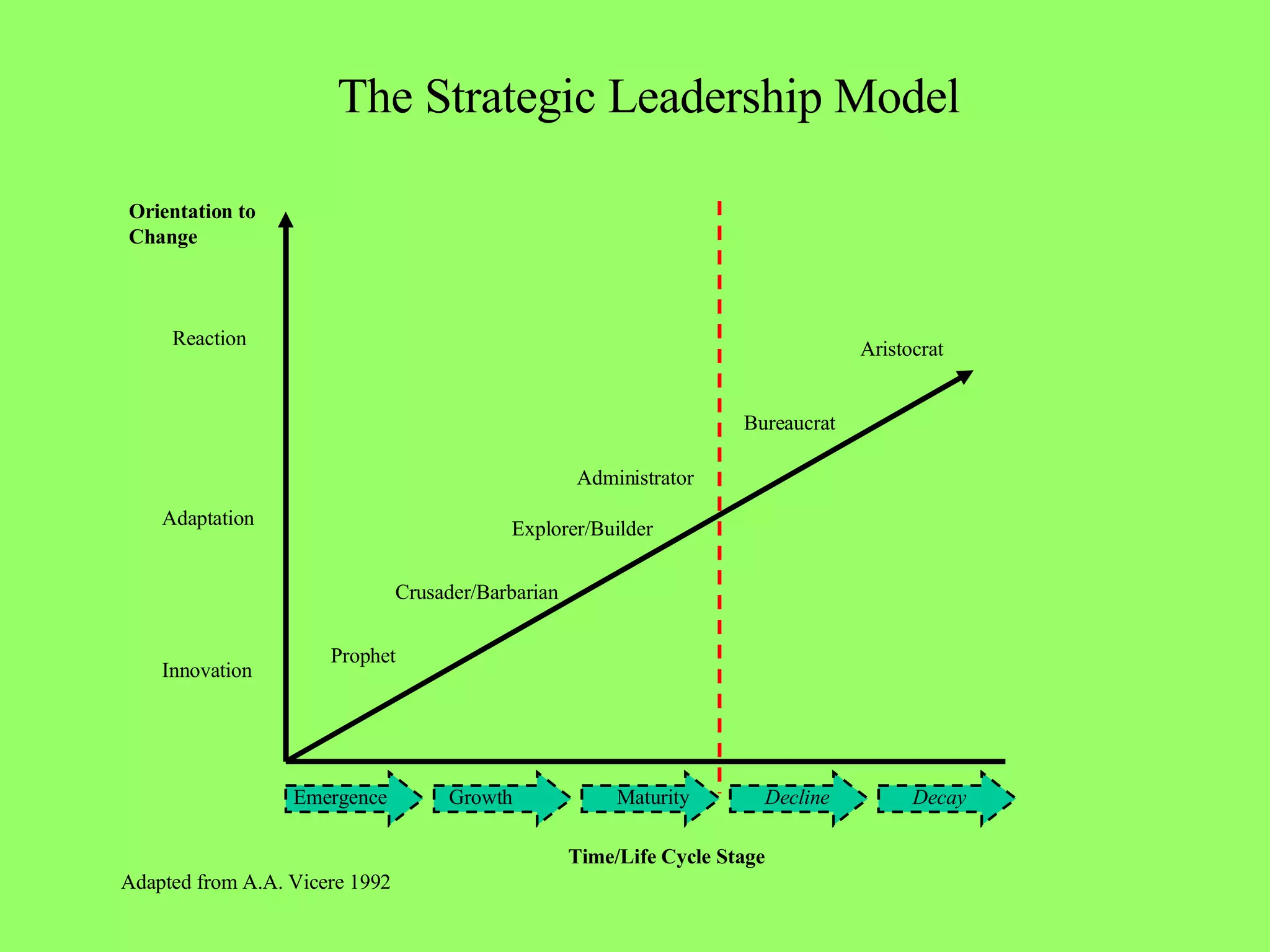
Adapted from A.A. Vicere 1992 Orientation to Change Innovation Adaptation Reaction Prophet Crusader/Barbarian Explorer/Builder The Strategic Leadership Model Administrator Bureaucrat Aristocrat Time/Life Cycle Stage Emergence Growth Maturity Decline Decay
Emergence DLS-C 2006 Low Middle High The Strategic Leadership Model/Service Life-Cycle Model Revenues Time/Life Cycle Stage Decay Growth Maturity Extension Decline Saturation
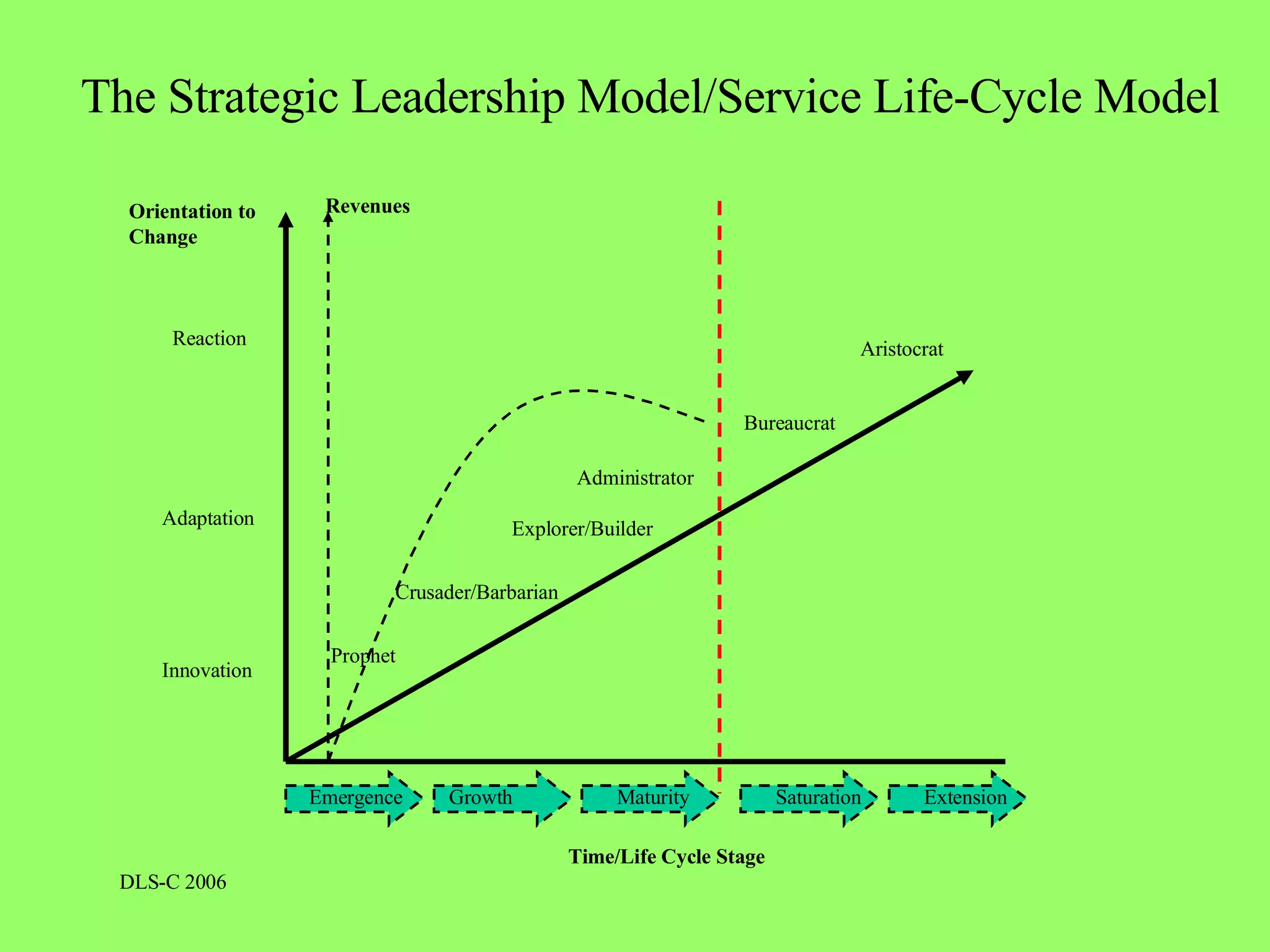
Emergence DLS-C 2006 Orientation to Change Innovation Adaptation Reaction Prophet Crusader/Barbarian Explorer/Builder The Strategic Leadership Model/Service Life-Cycle Model Administrator Bureaucrat Aristocrat Revenues Time/Life Cycle Stage Decay Growth Maturity Extension Decline Saturation
Emergence DLS-C 2006 Orientation to Change Innovation Adaptation Reaction Prophet Crusader/Barbarian Explorer/Builder The Strategic Leadership Model/Service Life-Cycle Model Administrator Bureaucrat Aristocrat Time/Life Cycle Stage ? Revenues Growth Maturity Saturation Extension
Dichotomy of Leadership   I II   Theorists Frederick W. Taylor Elton Mayo Perspective  Objectivist Humanist Domain Science  Art Dominant Brain Lobe Left Right Gender-Association Male Feminine Learning style Linear Intuitive Geometry Euclidean Fractal Personalities A B Theory X Y Period Modern Post-modern
Example: McGregor, 1960 People view work as being natural as play and rest They will exercise self-direction and control towards achieving goals they are committed too They learn to accept and seek responsibility Theory X Theory Y People inherently dislike work They must be coerced or controlled to do work to achieve goals They prefer to be directed
Some observations We live in a  post  post-modern world. Where the world is flat  (Thomas Friedman).  Indeed  the only thing that is constant is rapid change. A more  balanced  approach to leadership is required. Continuous  innovation is key.
According to Gartner, Inc.  (May 15, 2006) Information Technology “is creating an unstoppable  whirlwind  of change that will bring about a level of  transformation  in people's personal lives, within the  enterprise , and within  society  that is possibly  greater  than at any time since the industrial revolution.”
4 Trends (as of May 15, 2006) Commoditization and Consumerization (shift in balance of power between consumer and business)  Virtualization and Tera-Architectures (pooling resources) Software Delivery Models and Development Styles (simpler/shorter product life cycles) Community and Collaboration (youth at the forefront of social networks, e.g. friendster)
8 Intelligences of Balanced  Leadership Creative/Expressive Intelligence  - fostering generative growth, creativity and innovation,  Perceptual Intelligence  - sensing the emergent needs in your organization,  Emotional Intelligence  - a resilience and responsiveness, informed by emotions, to meet challenges in a powerful way,  Pathfinding Intelligence  - bringing individual and organisational action into alignment with a larger sense of purpose (Mike Bell, 2001)
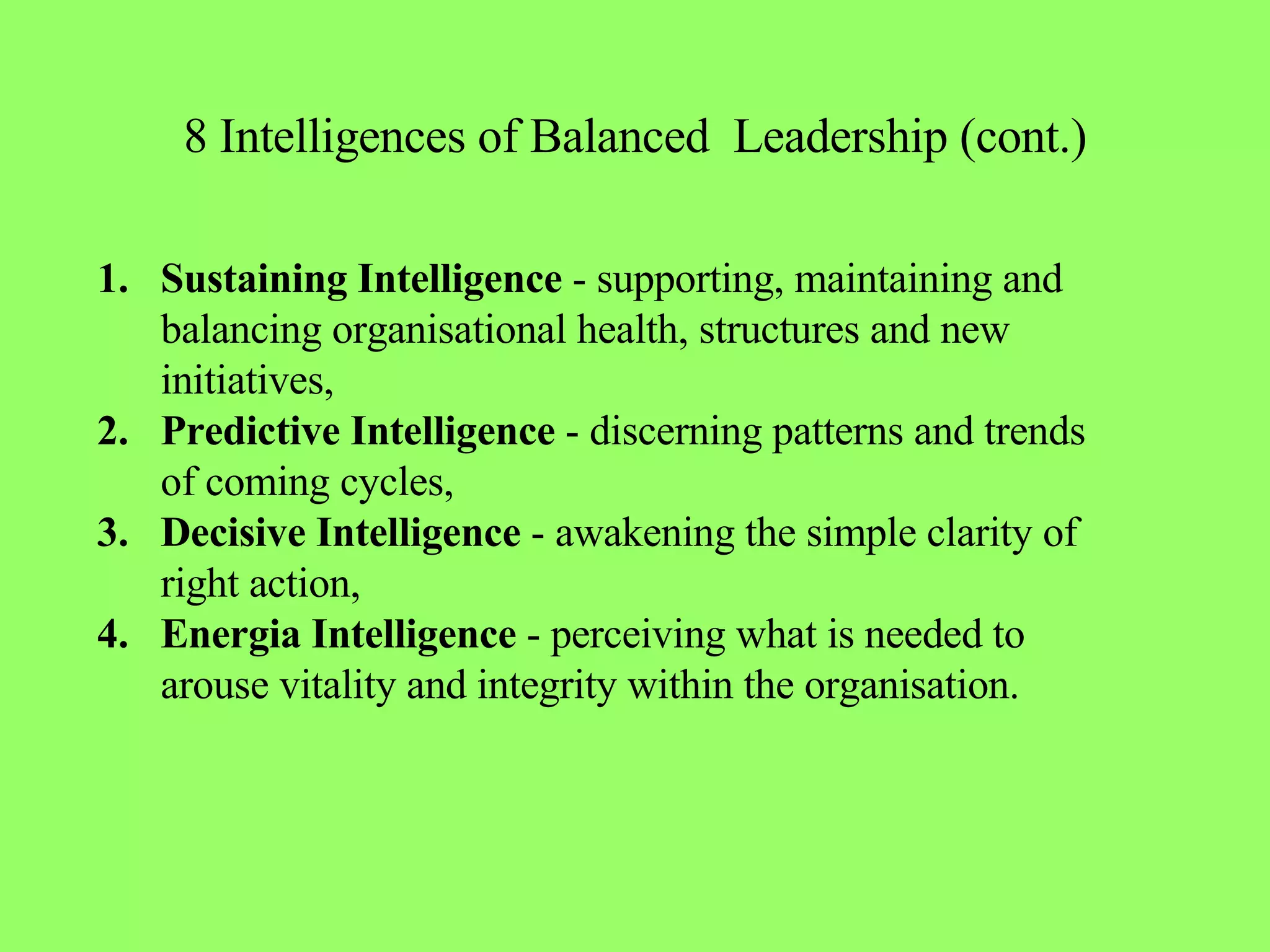
8 Intelligences of Balanced  Leadership (cont.) Sustaining Intelligence  - supporting, maintaining and balancing organisational health, structures and new initiatives,  Predictive Intelligence  - discerning patterns and trends of coming cycles,  Decisive Intelligence  - awakening the simple clarity of right action,  Energia Intelligence  - perceiving what is needed to arouse vitality and integrity within the organisation.
Innovation is as much a matter of  will power as imagination. - Winston Churchill

Strategic Leadership Model

  • 1.
    What does ittake to be a good leader?
  • 2.
    Adapted from A.A.Vicere 1992 Orientation to Change Innovation Adaptation Reaction Prophet Crusader/Barbarian Explorer/Builder The Strategic Leadership Model Administrator Bureaucrat Aristocrat Time/Life Cycle Stage Emergence Growth Maturity Decline Decay
  • 3.
    Emergence DLS-C 2006Low Middle High The Strategic Leadership Model/Service Life-Cycle Model Revenues Time/Life Cycle Stage Decay Growth Maturity Extension Decline Saturation
  • 4.
    Emergence DLS-C 2006Orientation to Change Innovation Adaptation Reaction Prophet Crusader/Barbarian Explorer/Builder The Strategic Leadership Model/Service Life-Cycle Model Administrator Bureaucrat Aristocrat Revenues Time/Life Cycle Stage Decay Growth Maturity Extension Decline Saturation
  • 5.
    Emergence DLS-C 2006Orientation to Change Innovation Adaptation Reaction Prophet Crusader/Barbarian Explorer/Builder The Strategic Leadership Model/Service Life-Cycle Model Administrator Bureaucrat Aristocrat Time/Life Cycle Stage ? Revenues Growth Maturity Saturation Extension
  • 6.
    Dichotomy of Leadership  I II   Theorists Frederick W. Taylor Elton Mayo Perspective Objectivist Humanist Domain Science Art Dominant Brain Lobe Left Right Gender-Association Male Feminine Learning style Linear Intuitive Geometry Euclidean Fractal Personalities A B Theory X Y Period Modern Post-modern
  • 7.
    Example: McGregor, 1960People view work as being natural as play and rest They will exercise self-direction and control towards achieving goals they are committed too They learn to accept and seek responsibility Theory X Theory Y People inherently dislike work They must be coerced or controlled to do work to achieve goals They prefer to be directed
  • 8.
    Some observations Welive in a post post-modern world. Where the world is flat (Thomas Friedman). Indeed the only thing that is constant is rapid change. A more balanced approach to leadership is required. Continuous innovation is key.
  • 9.
    According to Gartner,Inc. (May 15, 2006) Information Technology “is creating an unstoppable whirlwind of change that will bring about a level of transformation in people's personal lives, within the enterprise , and within society that is possibly greater than at any time since the industrial revolution.”
  • 10.
    4 Trends (asof May 15, 2006) Commoditization and Consumerization (shift in balance of power between consumer and business) Virtualization and Tera-Architectures (pooling resources) Software Delivery Models and Development Styles (simpler/shorter product life cycles) Community and Collaboration (youth at the forefront of social networks, e.g. friendster)
  • 11.
    8 Intelligences ofBalanced Leadership Creative/Expressive Intelligence - fostering generative growth, creativity and innovation, Perceptual Intelligence - sensing the emergent needs in your organization, Emotional Intelligence - a resilience and responsiveness, informed by emotions, to meet challenges in a powerful way, Pathfinding Intelligence - bringing individual and organisational action into alignment with a larger sense of purpose (Mike Bell, 2001)
  • 12.
    8 Intelligences ofBalanced Leadership (cont.) Sustaining Intelligence - supporting, maintaining and balancing organisational health, structures and new initiatives, Predictive Intelligence - discerning patterns and trends of coming cycles, Decisive Intelligence - awakening the simple clarity of right action, Energia Intelligence - perceiving what is needed to arouse vitality and integrity within the organisation.
  • 13.
    Innovation is asmuch a matter of will power as imagination. - Winston Churchill