

MANAGEMENT AND LEADERSHIP
Management and Leadership are often interchanged within the business
world; however, they are two very distinct skill sets.
MANAGEMENT AND LEADERSHIP
Management is essentially process/task focussed and centres on the
current and immediate future. Whereas, Leadership is much more people
focused and future focused. It includes setting culture & direction for the
organisation
MANAGEMENT AND LEADERSHIP
“Every Leader is a manager but every manager is not necessarily a leader
“ Are all managers leaders? The single fact of being put in charge of others
does not immediately confer leadership status. Organizations need both
managers and leaders - sometimes they are one and the same.However,
many managers will never make the grade of leader and many leaders are
hopeless managers. Both leaders and managers have their role to play in
business life today but the two roles are not one and the same
MANAGEMENT AND LEADERSHIP
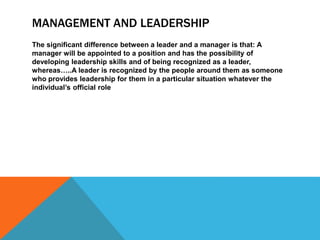
The significant difference between a leader and a manager is that: A
manager will be appointed to a position and has the possibility of
developing leadership skills and of being recognized as a leader,
whereas…..A leader is recognized by the people around them as someone
who provides leadership for them in a particular situation whatever the
individual’s official role
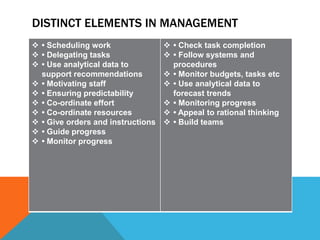
DISTINCT ELEMENTS IN MANAGEMENT
 • Scheduling work
 • Delegating tasks
 • Use analytical data to
support recommendations
 • Motivating staff
 • Ensuring predictability
 • Co-ordinate effort
 • Co-ordinate resources
 • Give orders and instructions
 • Guide progress
 • Monitor progress
 • Check task completion
 • Follow systems and
procedures
 • Monitor budgets, tasks etc
 • Use analytical data to
forecast trends
 • Monitoring progress
 • Appeal to rational thinking
 • Build teams
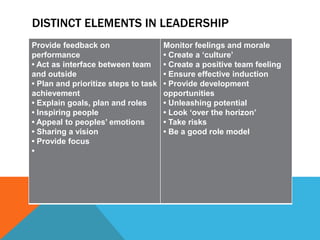
DISTINCT ELEMENTS IN LEADERSHIP
Provide feedback on
performance
• Act as interface between team
and outside
• Plan and prioritize steps to task
achievement
• Explain goals, plan and roles
• Inspiring people
• Appeal to peoples’ emotions
• Sharing a vision
• Provide focus
•
Monitor feelings and morale
• Create a ‘culture’
• Create a positive team feeling
• Ensure effective induction
• Provide development
opportunities
• Unleashing potential
• Look ‘over the horizon’
• Take risks
• Be a good role model
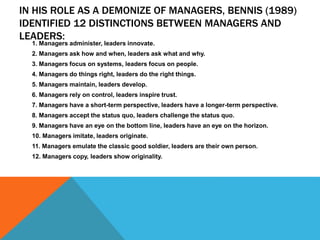
IN HIS ROLE AS A DEMONIZE OF MANAGERS, BENNIS (1989)
IDENTIFIED 12 DISTINCTIONS BETWEEN MANAGERS AND
LEADERS:
1. Managers administer, leaders innovate.
2. Managers ask how and when, leaders ask what and why.
3. Managers focus on systems, leaders focus on people.
4. Managers do things right, leaders do the right things.
5. Managers maintain, leaders develop.
6. Managers rely on control, leaders inspire trust.
7. Managers have a short-term perspective, leaders have a longer-term perspective.
8. Managers accept the status quo, leaders challenge the status quo.
9. Managers have an eye on the bottom line, leaders have an eye on the horizon.
10. Managers imitate, leaders originate.
11. Managers emulate the classic good soldier, leaders are their own person.
12. Managers copy, leaders show originality.
MORE POSITIVE DISTINCTIONS BETWEEN
MANAGEMENT AND LEADERSHIP WERE MADE BY
KOTTER (1991), AS SET OUT AS FOLLOWS :
Management involves
1. Focusing on managing complexity by planning and budgeting with the
aim of producing orderly results, not change.
2. Developing the capacity to achieve plans by creating an organization
structure and staffing it – developing human systems that can
implement plans as precisely and efficiently as possible.
3. Ensuring planning accomplishment by controlling and problem-
solving – formally and informally comparing results to the plan,
identifying deviations and then planning and organizing to solve the
problems
MORE POSITIVE DISTINCTIONS BETWEEN MANAGEMENT AND
LEADERSHIP WERE MADE BY KOTTER (1991), AS SET OUT AS FOLLOWS :
Leadership involves
1. Focusing on producing change by developing a vision for the future along
with strategies for bringing about the changes needed to achieve that
vision.
2. Aligning people by communicating the new direction and creating
coalitions that understand the vision and are committed to its
achievement.
3. Using motivation to energize people, not by pushing them in the right
direction as control mechanisms do, but by satisfying basic human needs
for achievement, a sense of belonging, recognition, self-esteem, a feeling
of control over one’s life and the ability to live up to one’s ideals.
Manager vs leader A Presentation by Mr Allah dad Khan

Manager vs leader A Presentation by Mr Allah dad Khan

  • 3.
    MANAGEMENT AND LEADERSHIP Managementand Leadership are often interchanged within the business world; however, they are two very distinct skill sets.
  • 4.
    MANAGEMENT AND LEADERSHIP Managementis essentially process/task focussed and centres on the current and immediate future. Whereas, Leadership is much more people focused and future focused. It includes setting culture & direction for the organisation
  • 5.
    MANAGEMENT AND LEADERSHIP “EveryLeader is a manager but every manager is not necessarily a leader “ Are all managers leaders? The single fact of being put in charge of others does not immediately confer leadership status. Organizations need both managers and leaders - sometimes they are one and the same.However, many managers will never make the grade of leader and many leaders are hopeless managers. Both leaders and managers have their role to play in business life today but the two roles are not one and the same
  • 6.
    MANAGEMENT AND LEADERSHIP Thesignificant difference between a leader and a manager is that: A manager will be appointed to a position and has the possibility of developing leadership skills and of being recognized as a leader, whereas…..A leader is recognized by the people around them as someone who provides leadership for them in a particular situation whatever the individual’s official role
  • 7.
    DISTINCT ELEMENTS INMANAGEMENT  • Scheduling work  • Delegating tasks  • Use analytical data to support recommendations  • Motivating staff  • Ensuring predictability  • Co-ordinate effort  • Co-ordinate resources  • Give orders and instructions  • Guide progress  • Monitor progress  • Check task completion  • Follow systems and procedures  • Monitor budgets, tasks etc  • Use analytical data to forecast trends  • Monitoring progress  • Appeal to rational thinking  • Build teams
  • 8.
    DISTINCT ELEMENTS INLEADERSHIP Provide feedback on performance • Act as interface between team and outside • Plan and prioritize steps to task achievement • Explain goals, plan and roles • Inspiring people • Appeal to peoples’ emotions • Sharing a vision • Provide focus • Monitor feelings and morale • Create a ‘culture’ • Create a positive team feeling • Ensure effective induction • Provide development opportunities • Unleashing potential • Look ‘over the horizon’ • Take risks • Be a good role model
  • 9.
    IN HIS ROLEAS A DEMONIZE OF MANAGERS, BENNIS (1989) IDENTIFIED 12 DISTINCTIONS BETWEEN MANAGERS AND LEADERS: 1. Managers administer, leaders innovate. 2. Managers ask how and when, leaders ask what and why. 3. Managers focus on systems, leaders focus on people. 4. Managers do things right, leaders do the right things. 5. Managers maintain, leaders develop. 6. Managers rely on control, leaders inspire trust. 7. Managers have a short-term perspective, leaders have a longer-term perspective. 8. Managers accept the status quo, leaders challenge the status quo. 9. Managers have an eye on the bottom line, leaders have an eye on the horizon. 10. Managers imitate, leaders originate. 11. Managers emulate the classic good soldier, leaders are their own person. 12. Managers copy, leaders show originality.
  • 10.
    MORE POSITIVE DISTINCTIONSBETWEEN MANAGEMENT AND LEADERSHIP WERE MADE BY KOTTER (1991), AS SET OUT AS FOLLOWS : Management involves 1. Focusing on managing complexity by planning and budgeting with the aim of producing orderly results, not change. 2. Developing the capacity to achieve plans by creating an organization structure and staffing it – developing human systems that can implement plans as precisely and efficiently as possible. 3. Ensuring planning accomplishment by controlling and problem- solving – formally and informally comparing results to the plan, identifying deviations and then planning and organizing to solve the problems
  • 11.
    MORE POSITIVE DISTINCTIONSBETWEEN MANAGEMENT AND LEADERSHIP WERE MADE BY KOTTER (1991), AS SET OUT AS FOLLOWS : Leadership involves 1. Focusing on producing change by developing a vision for the future along with strategies for bringing about the changes needed to achieve that vision. 2. Aligning people by communicating the new direction and creating coalitions that understand the vision and are committed to its achievement. 3. Using motivation to energize people, not by pushing them in the right direction as control mechanisms do, but by satisfying basic human needs for achievement, a sense of belonging, recognition, self-esteem, a feeling of control over one’s life and the ability to live up to one’s ideals.