Architect/Planner Hari K.G.Nambiar
Villa Savoie at Poissy,1929-31
Villa Savoie at Poissy
 The house was not to have a front, situated at the top
of the dome-like rise of a pasture it had to open to all
directions. The dwelling level with its hanging garden
is positioned above the columns in such a way as to
permit distant views to the horizon.
 Between the columns, on the ground floor, are the
vehicular circulation, domestic services and the
garage. The entrance is in the middle, between the
columns and a very slightly inclined ramp leads to the
upper level.
Villa Savoie at Poissy
Villa Savoie at Poissy, the roof
garden
“Clarte” Apartment in Geneva,
1930-32; 45 apartments with double floor
heights; a steel structure columns, beams & windows
The Sarabhai House at Ahmedabad,
1955
 Oriented to winds and
façade furnished with
brise-soliel in brick &
concrete.
 Structure : Catalanian
vaults: cradle vaults of flat
tiles set in plaster without
formwork, coupled with a
row of bricks cast roughly
in cement . These half-
cylinders are carried to the
walls by the intermediary
of a rough concrete lintel
The Sarabhai House at Ahmedabad,
Plans
The Sarabhai House at Ahmedabad
Dr.Curretchet’s house at La Plata,1949
Dr.Curretchet’s house at La Plata
 The site is surrounded on three sides by walls and
facing onto an avenue with a boulevard and a green
park. A view of the park was important so a roof
garden was created to enjoy sun, light & sky.
 There is a R.C.C. brise-soliel designed in accordance
with the angle & direction of the sun at this latitude.
Dr.Curretchet’s house at La Plata,
Plans
Dr.Curretchet’s house at La Plata
The Shodhan house at Ahmedabad,
1956, Plans
The Shodhan house at Ahmedabad
 A brise-soliel elevation
and a roof parasol. The
raw concrete of the
facades, with the rough
finish of the wooden
shuttering.
 There are three
apartments on the top
level.
The Shodhan house at Ahmedabad
Ahmedabad Millowners Association
Building 1954,Plan
Ahmedabad Millowners Association
Building
 Oriented to wind, the east and west facades have brise-
soliel. The North and South facades are constructed of
unplastered brick ; the East and West facades are of
raw unfinished concrete; the brise-soliel are clad in
wood, and the walls in sheet metal
 The assembly hall is constructed of double thin brick
walls panelled in wood.
Ahmedabad Millowners Association
Building
Design for the Palace of the League
of Nations, Geneva
 The international panel of architects that assessed the
competition held in 1927 for the Palace of the League of Nations
for which there were 377 entries. This scheme was awarded the
first prize & recommended its definite adoption, inspite of which
this particular scheme was put aside and the actual commission
for carrying out the building was awarded to four academic
architects.
 There was public outrage over this as this scheme was forward
thinking. It incorporated entirely new technical solutions in the
Office Wing, an acoustically perfect assembly hall, both
horizontal & vertical means of communication within the
building, modern systems of heating & ventilation, rational
access for motor cars and adequate parking. The idea of a palace
constructed of reinforced concrete was then unprecedented.
Design for the Palace of the League
of Nations, Geneva
Design for the Palace of the League
of Nations, Geneva
The Centrosoyus Building in
Moscow 1929
 The program involved provision of modern offices for 3500
employees, communal facilities such as restaurant , lecture
halls, theater, club, physical culture, etc.
 The building was in reinforced concrete, with in-filling
walls of red tuff stone from Caucasus. These stones of 16 in.
thickness were to serve as thermal insulation between an
outside temperature of -40*F and an interior at 66*F.
 The principle of “ respiration exacte”(air-conditioning)
which had been devised especially for this building was not
accepted by the Russian authorities. This principle was
eventually executed in the Salvation Army Refuge in Paris.
The Centrosoyus Building in
Moscow 1929
The Centrosoyus Building in
Moscow 1929
Palace of the Soviets in Moscow
1931
 The program called for an immense complex of halls,
offices, libraries, restaurants, etc : an auditorium for 15,000
spectators for massive productions, with a stage capable of
accomodating 1500 actors and a considerable amount of
scenery. The hall annexe was to be quite extensive: first the
cloak-rooms(due to snowfall in Moscow) and the
vestibules, all sorts of lounges and restaurants. A very exact
network of circulation permitting the various categories of
spectators access to their respective locations:
ambassadors, foreign press, Soviet press, extensive
accomodations for the actors.
 In addition there had to be a way for long lines of people
coming from outside to cross over the stage and then make
their exit, once having made their appearance.
Palace of the Soviets in Moscow
The Swiss Home at the Citi
Universitaire in Paris 1930-32
 This project was entrusted without a competition by
the Committee of Swiss Universities to Le Corbusier &
Pierre Jeanneret who first refused to accept it ,as the
experience in the League of Nations competition was
not forgotten by them. Nevertheless , at the insistence
of the Swiss authorities they accepted the project.
The Swiss Home at the Citi Universitaire
in Paris
The Swiss Home at the Citi Universitaire
in Paris
The Swiss Home at the Citi Universitaire
in Paris
Salvation Army Refuge in Paris
1929
 It is the first building for human habitation entirely
hermetically sealed, comprising 10,000sq.ft. of
fenestration without opening sash, the entire building
is air-conditioned.
 The construction is of reinforced concrete: a frame of
concrete columns & slabs with hollow terra-cotta wall
& floor units. The columns rest on reinforced concrete
piles driven to a depth of 36-45 ft, the sub-surface was
instable, being subject to the underground waters of
the Siene.
Salvation Army Refuge in Paris
Apartment-house in Algiers
 The building is located on a site characteristic of this
hill-side city. A primary proposal: there should be a
municipal regulation obliging all buildings along the
boulevard paralleling the bay to be constructed on
columns, thus leaving the ground-floor entirely free
so as to allow the inhabitants of Algiers an
unobstructed view to the sea.
 A second feature of this building is the arrangement of
the “ brise-soliel” on the south & west facades.
Apartment-house in Algiers 1933
Apartment-house in Algiers
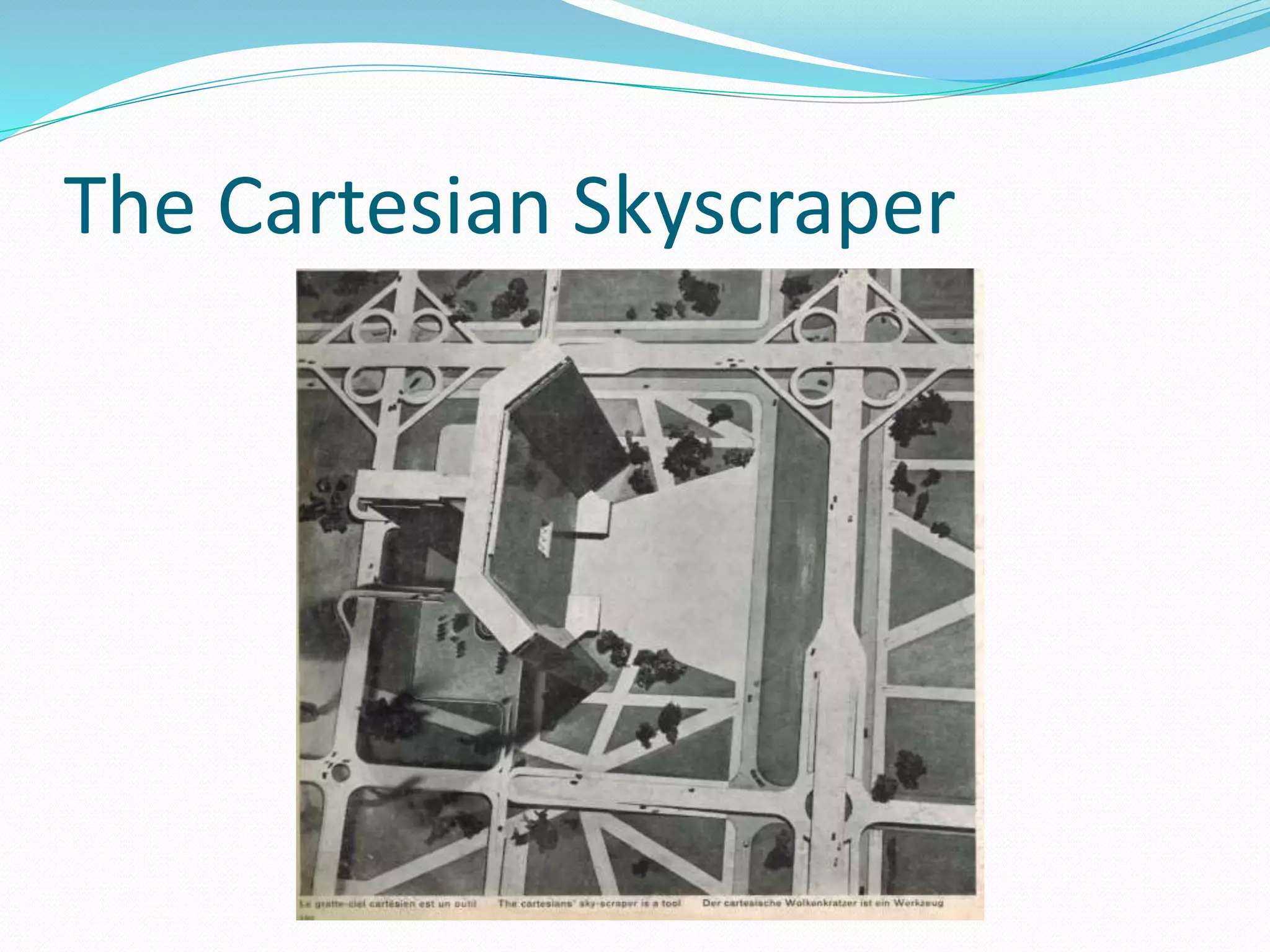
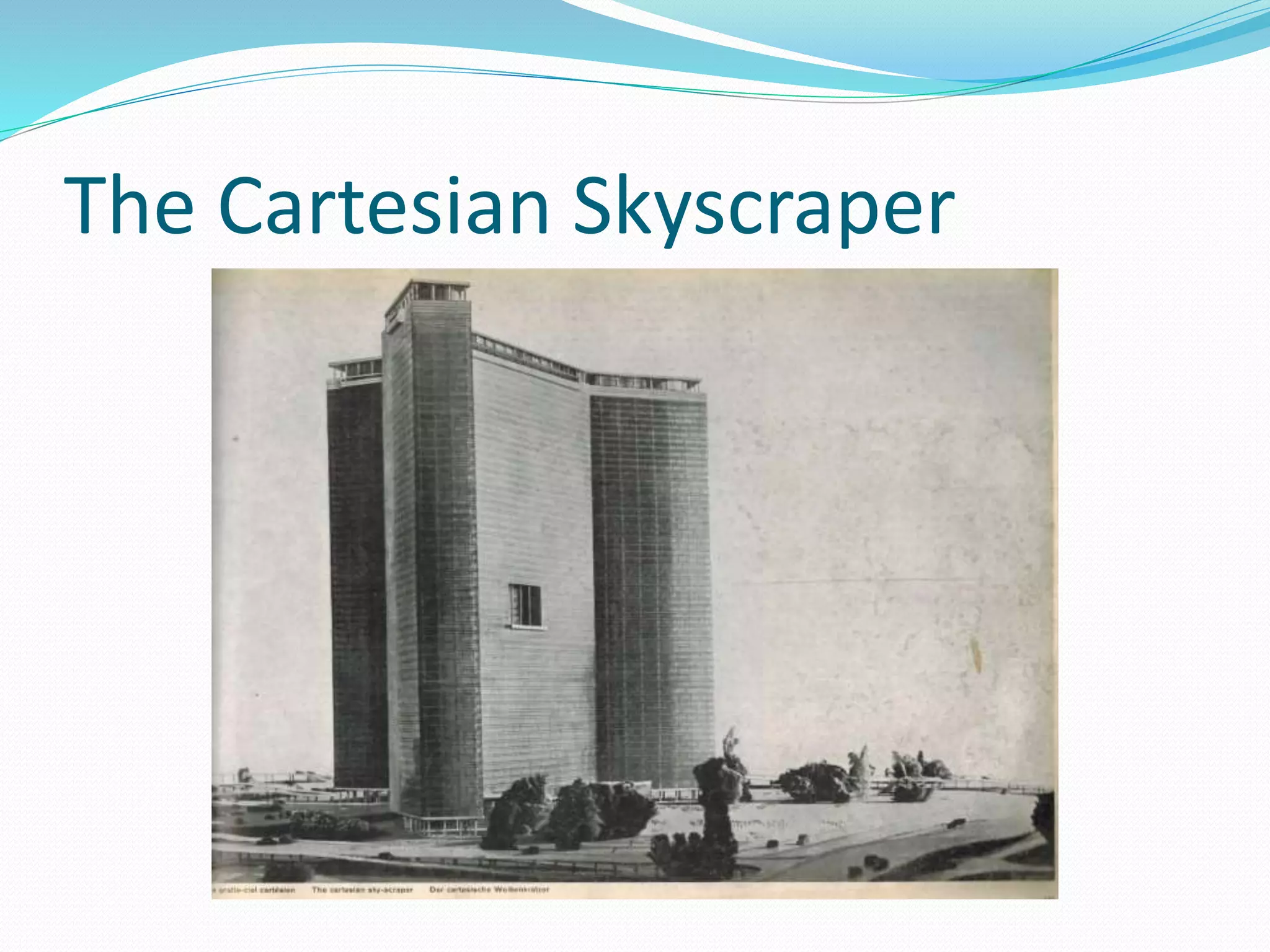
The Cartesian Skyscraper 1938
 This type of administration building had its sources in
the first sketches for “I’ Esprit-Noveau” in 1919. The
cruciform skyscraper does not receive sunlight on its
North side as the cruciform plan has 2 axes which does
not adapt itself to the path of the sun which has only
one axis.
 As a result, a new form was introduced: the “chicken-
claw” form.
The Cartesian Skyscraper
The skyscraper of the “Quartier de
la Marine” at Algiers 1938-42
 The Algier’s municipal planning efforts being taken
further, this urbanistic solution was transformed to its
present form by the Master Plan of 1942.
 The skyscraper the glass façade with sunbreakers
keeping out the summer sun & letting in the winter
sun.
 Transport planning of the building & parking.
The skyscraper of the “Quartier de
la Marine” at Algiers
Ministry of National Education and
Public Health at Rio de Janierio 1936-45
 In 1936 Le Corbusier was called in by the committee of
architects charged with the construction of the
Ministry of National Education and Public Health.
 The brise-soliel helped in this case as the
orientation of the building was not ideal due to
site conditions.
 Corbusier made use of local gray & rose-coloured
granite for the end walls of the building & the
immense paved area.
Ministry of National Education and
Public Health at Rio de Janierio
 North Elevation
The UNO Buildings on the East
river, New York 1947
 Le Corbusier was designated as the first of the ten
experts after being part of the Site Commission, in
setting up the seat of UNO in the United States.
 A discussion of this committee of ten on Corbusiers
proposal which is the model 23A , which consists of
three buildings the Secretariat 200m high, the General
Assemblies block and the future annexe for General
Agencies.
 However Le Corbusier was not invited to take part in
the realisation of this work.
The UNO Buildings on the East
river, New York
The concours for 800 apartments
at Strassberg 1951
 The programme required the construction of 800
dwellings on an enclosed site. Le Corbusier’s project
comprised two similar Unites d’habitation, each with
400 dwellings and also a group of 100 small dwellings
in a cylindrical tower: although more dwellings were
provided than the programme required, less than 6%
of the site area was built over. The Unites covering as
little as 2%. 93% of the area remained free for a park, a
school, a stadium, a swimming pool, a sports ground &
garages. The cost was estimated at some millions less
than the programme stipulated.
The concours for 800 apartments
at Strassberg
The concours for 800 apartments
at Strassberg
The Factory of St.Die 1946-51
 Elements pertaining to modern architecture contained
in this scheme:
 1. it is proportioned entirely by the Modulor;
 2. the section is strongly expressed
 3. the ceilings wood work, plumbing etc. are intensely
colored
The Factory of St.Die ; Plans
The Factory of St.Die
L’ Unite d’habitation a Marseille
1947-52
 This project was awarded to Corbusier in the summer of 1945 by the Minister of
Reconstruction, he was given all liberties & freedom to try out his ideas on
modern middle-income housing. The then current problems were:
 1. Determination of the dwelling(bachelors, couples, families of different sizes);
 2. prefabrication of the elements of the dwelling;
 3. independent structural frame;
 4. questions of lighting & sunshine;
 5. extensions of the dwelling
 6. facilities for communal services
 The first study was made for the terrain of La Madrague, dominating the port
of Marseilles: it comprised three bldgs. offering a wide variety of apartments in
respect to quality, size & function. The second study was made for the
Boulevard Michelet, a prolongation of the Prado, a site in a well-to-do
neighbourhood.
 Each apartment has a view of the landscape in the foreground & the
captivating horizon.
 The buildings had sun-louvres his well studied solution.
L’ Unite d’habitation a Marseille
Unite d’habitation of Nantes-Reze
1952-53
Unite d’habitation of Nantes-Reze
 This was not an experimental building for the
government but a commission received directly from
the future occupants of the building. Economy was of
paramount importance & strictness in this project.
 The concept was a system of “ Shoe Boxes”, each
apartment is an independent box of prestressed
concrete having no contact with its neighbours.
Unite d’habitation of Nantes-Reze
L’ Unite d’habitation a Berlin
1956-58
L’ Unite d’habitation a Berlin
1956-58
La maison du Bresil a la Cite Universitaire de
Paris 1957-59 (Brasilian Student House)
La maison du Bresil a la Cite
Universitaire de Paris
Youth and Cultural Center in
Firminy 1956-65
Youth and Cultural Center in Firminy
French Embassy in Brasilia 1964-65
French Embassy in Brasilia
Visual Arts Center, Cambridge,
Mass., USA 1961-64
 The building is an example of Corbusier’s brutalism.
The supervision of the project was in the hands Jose
Luis Sert and his associates in Cambridge,
Massachussets. There are free standing structural
columns on each of the five floors and brise-soliel.
 This is Corbusier’s only building in the United States.
Visual Arts Center, Cambridge,
Mass., USA
Visual Arts Center, Cambridge,
Mass., USA
Visual Arts Center, Cambridge,
Mass., USA
Museum of Unlimited extension
1939
Museum of Unlimited extension
1939
 Built on columns, the
entrance at ground level
is in the center of the
building complex where
the main hall is located.
Museum Ahmedabad 1954
 The museum is on a pilotis through which the
building is entered into an open court from which a
ramp , open to sky ,leads to the exhibition levels. One
enters the main level in a nave of spiral squares 14
metres wide, consisting of 7x7m structural bays.
 The museum is not limited in respect to growth and
therefore the 50x50m sides (2500sq.m.) can be
extended to 84x84m(7000sq.m.).
Museum Ahmedabad 1954
The Tokyo Museum 1957-59
 The impressionist art (both painting & sculpture)
collection of a wealthy Japanese resident. The Japanese
government comissioned Le Corbusier for this project.
They provided a site in a park already occupied by the
Museums of Natural History, of Fine Arts, of Science,
etc. The site is covered with beautiful trees located on
the edge of a plateau overlooking Tokyo.
 Corbusier installed on this site a version of the “
square spiral museum”, accompanied with a Pavilion
for Temporary Exhibitions, and a building dedicated to
theatre – thus a cultural centre.
The Tokyo Museum
The Tokyo Museum
The Tokyo Museum
The Chapel of Ron Champ 1950-54
The Chapel of Ron Champ
 The roof consists of two concrete membranes seperated by a space of
6’11” forming a shell, which is insulating & watertight. The roof is
supported by short struts, which form part of a vertical surface of
concrete covered with “gunnite”. These walls without buttresses follow,
in plan, the curvilinear forms calculated to provide stability to this
rough masonry. A space of several centimetres between the shell of the
roof and the vertical envelope of the walls furnishes a significant entry
for daylight.
 The floor of the chapel follows the natural slope of the hill down
towards the altar. The floor is constructed of a cement paving poured in
place between battens.
 The towers are constructed of stone masonry and are capped by cement
domes. The vertical elements of the Chapel are surfaced with mortar
sprayed on with a cement gun and then whitewashed - both on the
interior & exterior. The concrete shell of the roof is left rough
,highlighting the roughness of the shuttering.
The Chapel of Ron Champ
 Watertightness is effected
by a built-up roofing with
an external cladding of
aluminium. On the
interior the walls are white
; the ceiling grey and the
benches of African wood.
Daylighting is provided by
a system of openings
covered with clear glass
,and in places ,with colored
glass
The Chapel of Ron Champ, North
facade
The Chapel of Ron Champ, the
West facade
The Chapel of Ron Champ-
Axonometric view
The Convent of La Tourette1957-60
 Located at Eveux-sur-Arbresle, near Lyon; located in a small vale
that opens out onto a forest. The buildings contain sleeping
rooms for teachers & students, study halls , a hall for work and
one for recreation, a library and a refectory.
 On two levels ,the loggias crowning the building form brise-
soleil. The study halls ,work and recreation halls and library
occupy the upper level. Below are the refectory and the cloister
in the form of a cross leading to the church. The piles carrying
the four convent buildings can be seen rising from the original
terrain left in its original condition without terracing.
 The building is in R.C.C.. The panes of the glass located on the
three exterior faces achieve for the first time, the system called:
“the undulatory glass surface”.
The Convent of La Tourette- South
facade
The Convent of La Tourette-Plan
The Convent of La Tourette- West
Elevation
Town Planning- La ville radieuse
La Cite Industrielle

Le corbusier major works 1910 1965

  • 1.
  • 2.
    Villa Savoie atPoissy,1929-31
  • 3.
    Villa Savoie atPoissy  The house was not to have a front, situated at the top of the dome-like rise of a pasture it had to open to all directions. The dwelling level with its hanging garden is positioned above the columns in such a way as to permit distant views to the horizon.  Between the columns, on the ground floor, are the vehicular circulation, domestic services and the garage. The entrance is in the middle, between the columns and a very slightly inclined ramp leads to the upper level.
  • 4.
  • 5.
    Villa Savoie atPoissy, the roof garden
  • 6.
    “Clarte” Apartment inGeneva, 1930-32; 45 apartments with double floor heights; a steel structure columns, beams & windows
  • 7.
    The Sarabhai Houseat Ahmedabad, 1955  Oriented to winds and façade furnished with brise-soliel in brick & concrete.  Structure : Catalanian vaults: cradle vaults of flat tiles set in plaster without formwork, coupled with a row of bricks cast roughly in cement . These half- cylinders are carried to the walls by the intermediary of a rough concrete lintel
  • 8.
    The Sarabhai Houseat Ahmedabad, Plans
  • 9.
    The Sarabhai Houseat Ahmedabad
  • 10.
  • 11.
    Dr.Curretchet’s house atLa Plata  The site is surrounded on three sides by walls and facing onto an avenue with a boulevard and a green park. A view of the park was important so a roof garden was created to enjoy sun, light & sky.  There is a R.C.C. brise-soliel designed in accordance with the angle & direction of the sun at this latitude.
  • 12.
  • 13.
  • 14.
    The Shodhan houseat Ahmedabad, 1956, Plans
  • 15.
    The Shodhan houseat Ahmedabad  A brise-soliel elevation and a roof parasol. The raw concrete of the facades, with the rough finish of the wooden shuttering.  There are three apartments on the top level.
  • 16.
    The Shodhan houseat Ahmedabad
  • 17.
  • 18.
    Ahmedabad Millowners Association Building Oriented to wind, the east and west facades have brise- soliel. The North and South facades are constructed of unplastered brick ; the East and West facades are of raw unfinished concrete; the brise-soliel are clad in wood, and the walls in sheet metal  The assembly hall is constructed of double thin brick walls panelled in wood.
  • 19.
  • 20.
    Design for thePalace of the League of Nations, Geneva  The international panel of architects that assessed the competition held in 1927 for the Palace of the League of Nations for which there were 377 entries. This scheme was awarded the first prize & recommended its definite adoption, inspite of which this particular scheme was put aside and the actual commission for carrying out the building was awarded to four academic architects.  There was public outrage over this as this scheme was forward thinking. It incorporated entirely new technical solutions in the Office Wing, an acoustically perfect assembly hall, both horizontal & vertical means of communication within the building, modern systems of heating & ventilation, rational access for motor cars and adequate parking. The idea of a palace constructed of reinforced concrete was then unprecedented.
  • 21.
    Design for thePalace of the League of Nations, Geneva
  • 22.
    Design for thePalace of the League of Nations, Geneva
  • 23.
    The Centrosoyus Buildingin Moscow 1929  The program involved provision of modern offices for 3500 employees, communal facilities such as restaurant , lecture halls, theater, club, physical culture, etc.  The building was in reinforced concrete, with in-filling walls of red tuff stone from Caucasus. These stones of 16 in. thickness were to serve as thermal insulation between an outside temperature of -40*F and an interior at 66*F.  The principle of “ respiration exacte”(air-conditioning) which had been devised especially for this building was not accepted by the Russian authorities. This principle was eventually executed in the Salvation Army Refuge in Paris.
  • 24.
  • 25.
  • 26.
    Palace of theSoviets in Moscow 1931  The program called for an immense complex of halls, offices, libraries, restaurants, etc : an auditorium for 15,000 spectators for massive productions, with a stage capable of accomodating 1500 actors and a considerable amount of scenery. The hall annexe was to be quite extensive: first the cloak-rooms(due to snowfall in Moscow) and the vestibules, all sorts of lounges and restaurants. A very exact network of circulation permitting the various categories of spectators access to their respective locations: ambassadors, foreign press, Soviet press, extensive accomodations for the actors.  In addition there had to be a way for long lines of people coming from outside to cross over the stage and then make their exit, once having made their appearance.
  • 27.
    Palace of theSoviets in Moscow
  • 28.
    Palace of theSoviets in Moscow
  • 29.
    Palace of theSoviets in Moscow
  • 30.
    The Swiss Homeat the Citi Universitaire in Paris 1930-32  This project was entrusted without a competition by the Committee of Swiss Universities to Le Corbusier & Pierre Jeanneret who first refused to accept it ,as the experience in the League of Nations competition was not forgotten by them. Nevertheless , at the insistence of the Swiss authorities they accepted the project.
  • 31.
    The Swiss Homeat the Citi Universitaire in Paris
  • 32.
    The Swiss Homeat the Citi Universitaire in Paris
  • 33.
    The Swiss Homeat the Citi Universitaire in Paris
  • 34.
    Salvation Army Refugein Paris 1929  It is the first building for human habitation entirely hermetically sealed, comprising 10,000sq.ft. of fenestration without opening sash, the entire building is air-conditioned.  The construction is of reinforced concrete: a frame of concrete columns & slabs with hollow terra-cotta wall & floor units. The columns rest on reinforced concrete piles driven to a depth of 36-45 ft, the sub-surface was instable, being subject to the underground waters of the Siene.
  • 35.
  • 36.
  • 37.
    Apartment-house in Algiers The building is located on a site characteristic of this hill-side city. A primary proposal: there should be a municipal regulation obliging all buildings along the boulevard paralleling the bay to be constructed on columns, thus leaving the ground-floor entirely free so as to allow the inhabitants of Algiers an unobstructed view to the sea.  A second feature of this building is the arrangement of the “ brise-soliel” on the south & west facades.
  • 38.
  • 39.
  • 40.
    The Cartesian Skyscraper1938  This type of administration building had its sources in the first sketches for “I’ Esprit-Noveau” in 1919. The cruciform skyscraper does not receive sunlight on its North side as the cruciform plan has 2 axes which does not adapt itself to the path of the sun which has only one axis.  As a result, a new form was introduced: the “chicken- claw” form.
  • 41.
  • 42.
  • 43.
    The skyscraper ofthe “Quartier de la Marine” at Algiers 1938-42  The Algier’s municipal planning efforts being taken further, this urbanistic solution was transformed to its present form by the Master Plan of 1942.  The skyscraper the glass façade with sunbreakers keeping out the summer sun & letting in the winter sun.  Transport planning of the building & parking.
  • 44.
    The skyscraper ofthe “Quartier de la Marine” at Algiers
  • 45.
    Ministry of NationalEducation and Public Health at Rio de Janierio 1936-45  In 1936 Le Corbusier was called in by the committee of architects charged with the construction of the Ministry of National Education and Public Health.  The brise-soliel helped in this case as the orientation of the building was not ideal due to site conditions.  Corbusier made use of local gray & rose-coloured granite for the end walls of the building & the immense paved area.
  • 46.
    Ministry of NationalEducation and Public Health at Rio de Janierio  North Elevation
  • 47.
    The UNO Buildingson the East river, New York 1947  Le Corbusier was designated as the first of the ten experts after being part of the Site Commission, in setting up the seat of UNO in the United States.  A discussion of this committee of ten on Corbusiers proposal which is the model 23A , which consists of three buildings the Secretariat 200m high, the General Assemblies block and the future annexe for General Agencies.  However Le Corbusier was not invited to take part in the realisation of this work.
  • 48.
    The UNO Buildingson the East river, New York
  • 49.
    The concours for800 apartments at Strassberg 1951  The programme required the construction of 800 dwellings on an enclosed site. Le Corbusier’s project comprised two similar Unites d’habitation, each with 400 dwellings and also a group of 100 small dwellings in a cylindrical tower: although more dwellings were provided than the programme required, less than 6% of the site area was built over. The Unites covering as little as 2%. 93% of the area remained free for a park, a school, a stadium, a swimming pool, a sports ground & garages. The cost was estimated at some millions less than the programme stipulated.
  • 50.
    The concours for800 apartments at Strassberg
  • 51.
    The concours for800 apartments at Strassberg
  • 52.
    The Factory ofSt.Die 1946-51  Elements pertaining to modern architecture contained in this scheme:  1. it is proportioned entirely by the Modulor;  2. the section is strongly expressed  3. the ceilings wood work, plumbing etc. are intensely colored
  • 53.
    The Factory ofSt.Die ; Plans
  • 54.
  • 55.
    L’ Unite d’habitationa Marseille 1947-52  This project was awarded to Corbusier in the summer of 1945 by the Minister of Reconstruction, he was given all liberties & freedom to try out his ideas on modern middle-income housing. The then current problems were:  1. Determination of the dwelling(bachelors, couples, families of different sizes);  2. prefabrication of the elements of the dwelling;  3. independent structural frame;  4. questions of lighting & sunshine;  5. extensions of the dwelling  6. facilities for communal services  The first study was made for the terrain of La Madrague, dominating the port of Marseilles: it comprised three bldgs. offering a wide variety of apartments in respect to quality, size & function. The second study was made for the Boulevard Michelet, a prolongation of the Prado, a site in a well-to-do neighbourhood.  Each apartment has a view of the landscape in the foreground & the captivating horizon.  The buildings had sun-louvres his well studied solution.
  • 56.
  • 57.
  • 58.
  • 59.
  • 60.
    Unite d’habitation ofNantes-Reze 1952-53
  • 61.
    Unite d’habitation ofNantes-Reze  This was not an experimental building for the government but a commission received directly from the future occupants of the building. Economy was of paramount importance & strictness in this project.  The concept was a system of “ Shoe Boxes”, each apartment is an independent box of prestressed concrete having no contact with its neighbours.
  • 62.
  • 63.
    L’ Unite d’habitationa Berlin 1956-58
  • 64.
    L’ Unite d’habitationa Berlin 1956-58
  • 65.
    La maison duBresil a la Cite Universitaire de Paris 1957-59 (Brasilian Student House)
  • 66.
    La maison duBresil a la Cite Universitaire de Paris
  • 67.
    Youth and CulturalCenter in Firminy 1956-65
  • 68.
    Youth and CulturalCenter in Firminy
  • 69.
    French Embassy inBrasilia 1964-65
  • 70.
  • 71.
    Visual Arts Center,Cambridge, Mass., USA 1961-64  The building is an example of Corbusier’s brutalism. The supervision of the project was in the hands Jose Luis Sert and his associates in Cambridge, Massachussets. There are free standing structural columns on each of the five floors and brise-soliel.  This is Corbusier’s only building in the United States.
  • 72.
    Visual Arts Center,Cambridge, Mass., USA
  • 73.
    Visual Arts Center,Cambridge, Mass., USA
  • 74.
    Visual Arts Center,Cambridge, Mass., USA
  • 75.
    Museum of Unlimitedextension 1939
  • 76.
    Museum of Unlimitedextension 1939  Built on columns, the entrance at ground level is in the center of the building complex where the main hall is located.
  • 77.
    Museum Ahmedabad 1954 The museum is on a pilotis through which the building is entered into an open court from which a ramp , open to sky ,leads to the exhibition levels. One enters the main level in a nave of spiral squares 14 metres wide, consisting of 7x7m structural bays.  The museum is not limited in respect to growth and therefore the 50x50m sides (2500sq.m.) can be extended to 84x84m(7000sq.m.).
  • 78.
  • 79.
  • 80.
    The Tokyo Museum1957-59  The impressionist art (both painting & sculpture) collection of a wealthy Japanese resident. The Japanese government comissioned Le Corbusier for this project. They provided a site in a park already occupied by the Museums of Natural History, of Fine Arts, of Science, etc. The site is covered with beautiful trees located on the edge of a plateau overlooking Tokyo.  Corbusier installed on this site a version of the “ square spiral museum”, accompanied with a Pavilion for Temporary Exhibitions, and a building dedicated to theatre – thus a cultural centre.
  • 81.
  • 82.
  • 83.
  • 84.
    The Chapel ofRon Champ 1950-54
  • 85.
    The Chapel ofRon Champ  The roof consists of two concrete membranes seperated by a space of 6’11” forming a shell, which is insulating & watertight. The roof is supported by short struts, which form part of a vertical surface of concrete covered with “gunnite”. These walls without buttresses follow, in plan, the curvilinear forms calculated to provide stability to this rough masonry. A space of several centimetres between the shell of the roof and the vertical envelope of the walls furnishes a significant entry for daylight.  The floor of the chapel follows the natural slope of the hill down towards the altar. The floor is constructed of a cement paving poured in place between battens.  The towers are constructed of stone masonry and are capped by cement domes. The vertical elements of the Chapel are surfaced with mortar sprayed on with a cement gun and then whitewashed - both on the interior & exterior. The concrete shell of the roof is left rough ,highlighting the roughness of the shuttering.
  • 86.
    The Chapel ofRon Champ
  • 87.
    The Chapel ofRon Champ  Watertightness is effected by a built-up roofing with an external cladding of aluminium. On the interior the walls are white ; the ceiling grey and the benches of African wood. Daylighting is provided by a system of openings covered with clear glass ,and in places ,with colored glass
  • 88.
    The Chapel ofRon Champ, North facade
  • 89.
    The Chapel ofRon Champ, the West facade
  • 90.
    The Chapel ofRon Champ- Axonometric view
  • 91.
    The Convent ofLa Tourette1957-60  Located at Eveux-sur-Arbresle, near Lyon; located in a small vale that opens out onto a forest. The buildings contain sleeping rooms for teachers & students, study halls , a hall for work and one for recreation, a library and a refectory.  On two levels ,the loggias crowning the building form brise- soleil. The study halls ,work and recreation halls and library occupy the upper level. Below are the refectory and the cloister in the form of a cross leading to the church. The piles carrying the four convent buildings can be seen rising from the original terrain left in its original condition without terracing.  The building is in R.C.C.. The panes of the glass located on the three exterior faces achieve for the first time, the system called: “the undulatory glass surface”.
  • 92.
    The Convent ofLa Tourette- South facade
  • 93.
    The Convent ofLa Tourette-Plan
  • 94.
    The Convent ofLa Tourette-Plan
  • 95.
    The Convent ofLa Tourette- West Elevation
  • 96.
    Town Planning- Laville radieuse
  • 97.