ARCHITECT OF MODERNISM:
Made by Tajrian Hoque Rumaisha
o Introduction
o Early life and education
o Early Career: Experimentation & New Ideas
o Early Urban Theories
o Ideas
o Five points of architecture
o The Modulor
o Open Hand
o Furniture
o Famous projects
o Chandigarh, New Delhi
o Villa Savoy, Poissy, France
o Chapel of Ronchamp, Ronchamp, France
o More Projects
o Paintings and sculptures
o Impact on Modern Architecture
o References
1
2
3 -7
8
9
10
11
12
13-15
16-17
18-19
20
21
22
23
Le Corbusier (born Charles-Édouard Jeanneret, 1887–1965) was a visionary
architect, urban planner, designer, painter, and writer whose ideas reshaped
20th-century architecture. A pioneer of Modernism, he believed that
architecture should respond to the needs of modern life — focusing on function,
simplicity, and clarity.
1
o Born as Charles-Édouard Jeanneret-Gris in La Chaux-de-Fonds, a small Swiss town near the
French border, nestled in the Jura mountains.
o Fell in love with visual arts early and studied at the La-Chaux-de-Fonds Art School, mentored by
Charles L'Eplattenier and architect René Chapallaz, who shaped his first architectural ideas.
o Restless in his hometown, he began traveling across Europe to broaden his horizons.
o In 1907, moved to Paris and worked with Auguste Perret, a pioneer of reinforced concrete.
o Studied in Vienna under Josef Hoffmann, then worked in Berlin for Peter Behrens, where he may
have crossed paths with future modernist giants like Mies van der Rohe and Walter Gropius.
o In 1911, he went on a solo trip through the Balkans, Greece, and Turkey, sketching classical ruins—
especially the Parthenon, which deeply inspired his future theories in Towards a New Architecture.
o During World War I, he taught at his old school in La-Chaux-de-Fonds
o These four years in Switzerland, he worked on theoretical architectural studies using modern
techniques
2
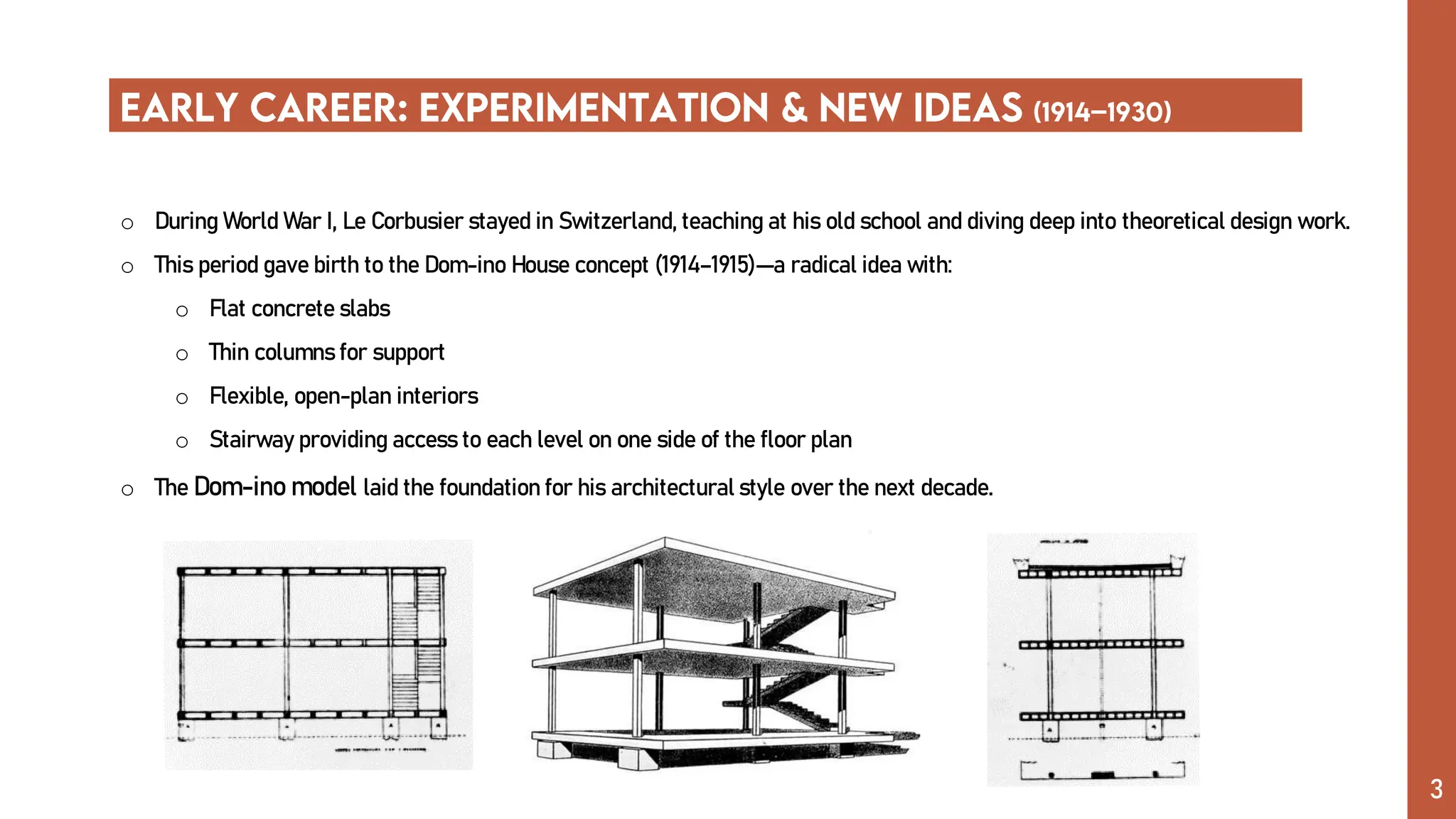
o During World War I, Le Corbusier stayed in Switzerland, teaching at his old school and diving deep into theoretical design work.
o This period gave birth to the Dom-ino House concept (1914–1915)—a radical idea with:
o Flat concrete slabs
o Thin columns for support
o Flexible, open-plan interiors
o Stairway providing access to each level on one side of the floor plan
o The Dom-ino model laid the foundation for his architectural style over the next decade.
3
o In 1918, he met Amédée Ozenfant, a Cubist painter who became a creative
partner. Together, they rejected Cubism as “irrational” and "romantic”, and
launched Purism, a cleaner, more rational art style. Characteristics of
Purism:
o Simplified Forms
o Embrace of Technology
o Geometric Compositions
o Neutral Color Palettes
o Emphasis on Balance and Monumentality
o After the war, he moved back to Paris and started his own practice
with his cousin Pierre Jeanneret, a collaboration that would last until
1940.
Le Corbusier and Pierre Jeanneret
Le Corbusier and Amédée Ozenfant Example of Purism art
4
o In 1920, Charles-Édouard Jeanneret adopted the name Le Corbusier, inspired by a
variation of his maternal grandfather’s surname, “Lecorbésier”.
o The name change reflected his belief that anyone could reinvent themselves, especially
in the creative world.
o Using a single-name pseudonym was quite popular among artists in Paris at the time—it
helped build a bold, modern identity.
o Between 1918 and 1922, Le Corbusier didn’t build anything—he focused instead on
developing his theories about architecture and art, especially through Purism and
painting.
o In 1922, he and Ozenfant opened a design studio in Paris, setting the stage for a new
phase of experimentation.
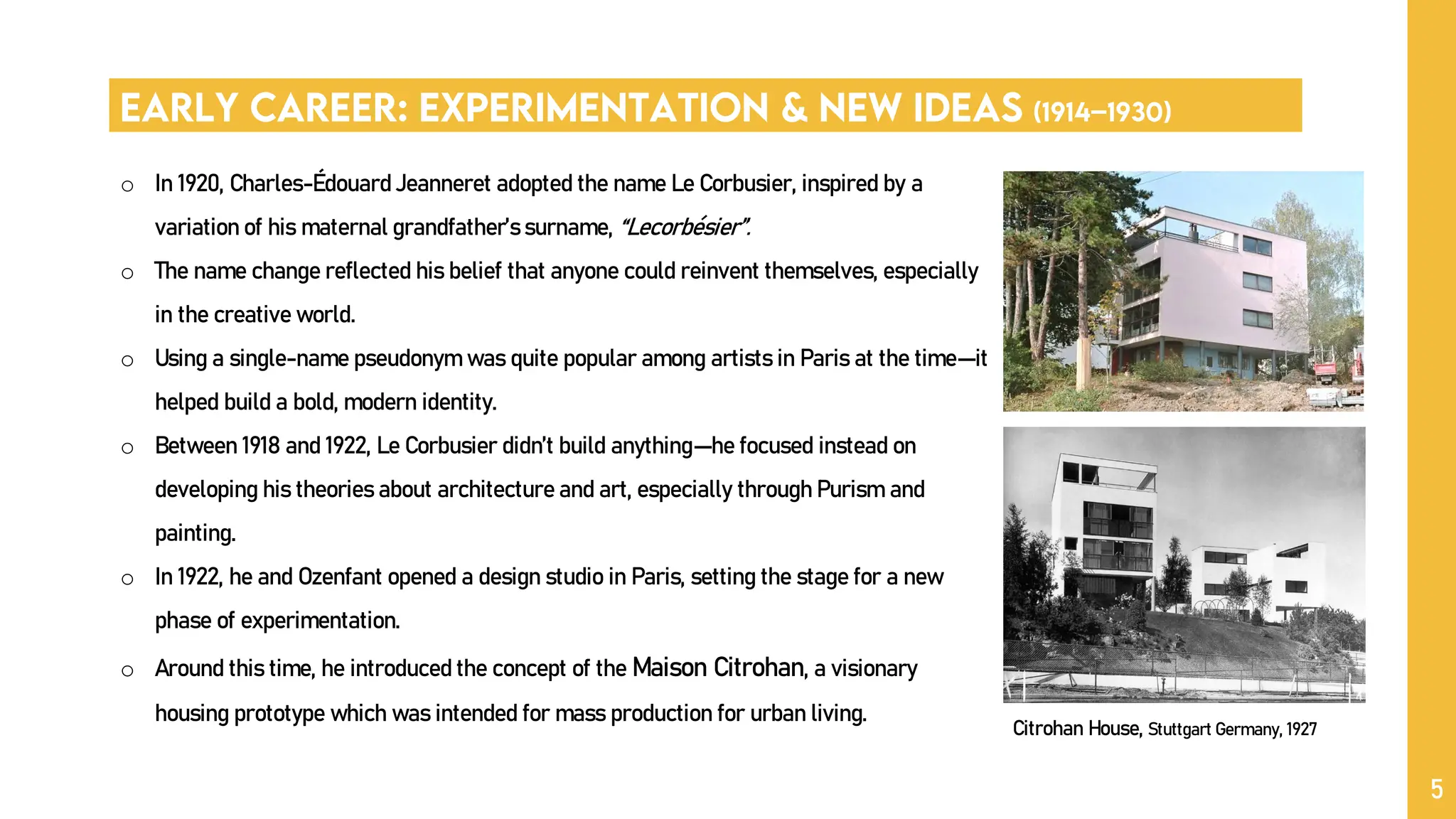
o Around this time, he introduced the concept of the Maison Citrohan, a visionary
housing prototype which was intended for mass production for urban living.
Citrohan House, Stuttgart Germany, 1927
5
o The design featured a three-story layout with a dramatic double-height living room, bedrooms on the second floor, and a kitchen
on the third.
o The flat roof was transformed into a sun terrace, and the house had an exterior staircase that led straight to the upper floors.
o The interior was kept deliberately sparse—white walls, steel-framed furniture, and exposed light bulbs emphasized simplicity
and function.
o His houses often featured large horizontal windows, letting in natural light and creating a seamless connection with the
outdoors.
o The house used a rectangular plan, with exterior walls that were not filled by windows, left as white, stuccoed spaces
Double heighted living room
Three-story layout
Exterior staircase
flat roof was transformed into
a sun terrace
large horizontal windows
6
o Between 1922 and 1927, Le Corbusier and Pierre Jeanneret designed several private
villas in and around Paris:
o Villa Lipschitz
o Maison Cook
o Maison Planeix
o And the Maison La Roche–Albert Jeanneret, which today houses the Fondation Le
Corbusier
Villa Lipschitz, 1925
Maison Cook, 1926 Maison Planeix, 1924-1926 Maison La Roche–Albert Jeanneret, 1923-1925
7
o Paris was struggling with slums and poor living conditions—Le Corbusier believed
modern architecture could solve this.
o He promoted a city shaped by efficiency, order, and industrial methods.
o His early project Immeubles Villas (1922) imagined compact apartment blocks with
garden terraces, stacking quality living units vertically.
o After WWII, he designed Unité d’Habitation in Marseille (1946–1952)—a concrete
“vertical city” with apartments, shops, and even a rooftop gym.
Immeubles Villas (1922)
Unité d’Habitation (1946–1952) Appartement unit of Unité d’Habitation
Unité d’Habitation (1946–1952)
8
o In the 1950s, Le Corbusier was invited to design Chandigarh, the new
capital of Punjab and Haryana, India
o Located at the picturesque junction of foothills of the Himalayas
Mountain range and the Ganges plains
o Total area 114 sqkm & population of 1,054,600 inhabitants
o Sector of size 800 x 1200 meters
o He developed the city’s master plan, dividing it into sectors. Each sector
is a self-sufficient unit having shops, school, health centers and places
of recreations and worship
o Le Corbusier designed the city keeping three disciplines in his mind. Those are -
o The Discipline of Money: he aimed for economical construction without compromising functionality or aesthetics.
o The Discipline of Technology: Embraced modern construction methods and materials like reinforced concrete to
build durable, scalable structures.
o The Discipline of Climate: Designed with local climate in mind—deep overhangs, shaded walkways, and orientation
of buildings reduced heat and maximized comfort.
13
o Analogous to human body
o Head (the Capitol Complex,
Sector 1),
o Heart (the City Centre
Sector-17),
o Lungs (the leisure valley,
innumerable open spaces
and sector greens),
o Intellect (the cultural and
educational institutions),
o Circulatory system (the
network of roads, the 7Vs)
o Viscera (the Industrial Area).
14
Palace of Justice Palace of Assembly Secretariat Building
Geometric Hill Open Hand Monument Martyr's Memorial Tower of Shadows 15
o Villa Savoye is one of Le Corbusier’s most iconic works and a symbol of modern architecture. It
was designed as a weekend retreat for the Savoye family and showcases his “Five Points of
Architecture.”
o Material: Reinforced concrete
o Functions & Architectural Features:
o Horizontal Ribbon Windows: Long, uninterrupted bands of windows flooded the interior
with natural light and offered sweeping views of the surrounding countryside.
o Pilotis (Slender Columns): Lifted the structure off the ground, creating open space
underneath for circulation, car parking, and an uninterrupted natural landscape.
o Free Floor Plan: Since walls weren’t load-bearing, interior spaces could be arranged and
adjusted freely to suit the needs of the inhabitants—a revolutionary idea at the time.
o Free Façade Design: With structural support coming from the pilotis, the façade could be
designed independently—allowing for more creativity and clean, geometric simplicity.
o Roof Garden: The flat roof doubled as a garden and terrace, restoring green space lost to
the building footprint and offering a place for leisure and relaxation.
16
Plan
Elevation
Section
17
A major departure from Le Corbusier’s usual geometric, machine-like style, this
chapel shows his more sculptural, spiritual, and expressive side.
o The curved roof resembles a sail or shell, symbolizing shelter.
o The thick walls and scattered windows control light dramatically, adding a
sacred, mystical feeling.
o Its form follows the natural shape of the hill, blending architecture with the
landscape.
o A Place for Pilgrimage & Worship: Built on a historic pilgrimage site, the
chapel serves as a spiritual retreat for prayer, reflection, and religious
gatherings—especially on feast days like August 15 (Assumption of Mary).
o Asymmetrical Windows: Small, scattered openings of various sizes let in
dramatic beams of natural light. Some are filled with colorful stained glass,
creating a spiritual and dynamic interior.
o Material: Reinforced concrete and Stone.
18
Plan
Section
Section
Elevation of
asymmetric
windows
19
1. Pilotis- Replacement of supporting walls by a grid of reinforced concrete columns that bears the structural load is the basis of
the aesthetic
2. The free designing of the ground plan- the absence of supporting walls mean the house is unrestrained in its internal use
3. The free design of the façade- separating the exterior of the building from its structural function-sets the façade free from
structural constraints.
4. The horizontal window, which cuts the façade along its entire length, lights rooms equally.
5. Roof gardens on a flat roof can serve a domestic purpose while providing essential protection to the concrete roof.
9
o The graphic representation of the Modulor, a stylised human figure with one arm raised, stands next
to two vertical measurements
o Attempts to discover mathematical proportions in the human body and then to use that knowledge to
improve both the appearance and function of architecture
o The system is based on human measurements, the double unit, the Fibonacci numbers, and the
golden ratio
o Le Corbusier described it as a "range of harmonious measurements to suit the human scale,
universally applicable to architecture and to mechanical things"
o Inspired by ancient civilizations who used measuring systems linked to the human body: elbow
(cubit), finger (digit), thumb (inch) etc.
o A red series based on the figure's navel height then segmented according to Phi
o A blue series based on the figure's entire height, double the navel height segmented similarly
o A spiral, graphically developed between the red and blue segments, seems to mimic the volume of
the human figure
10
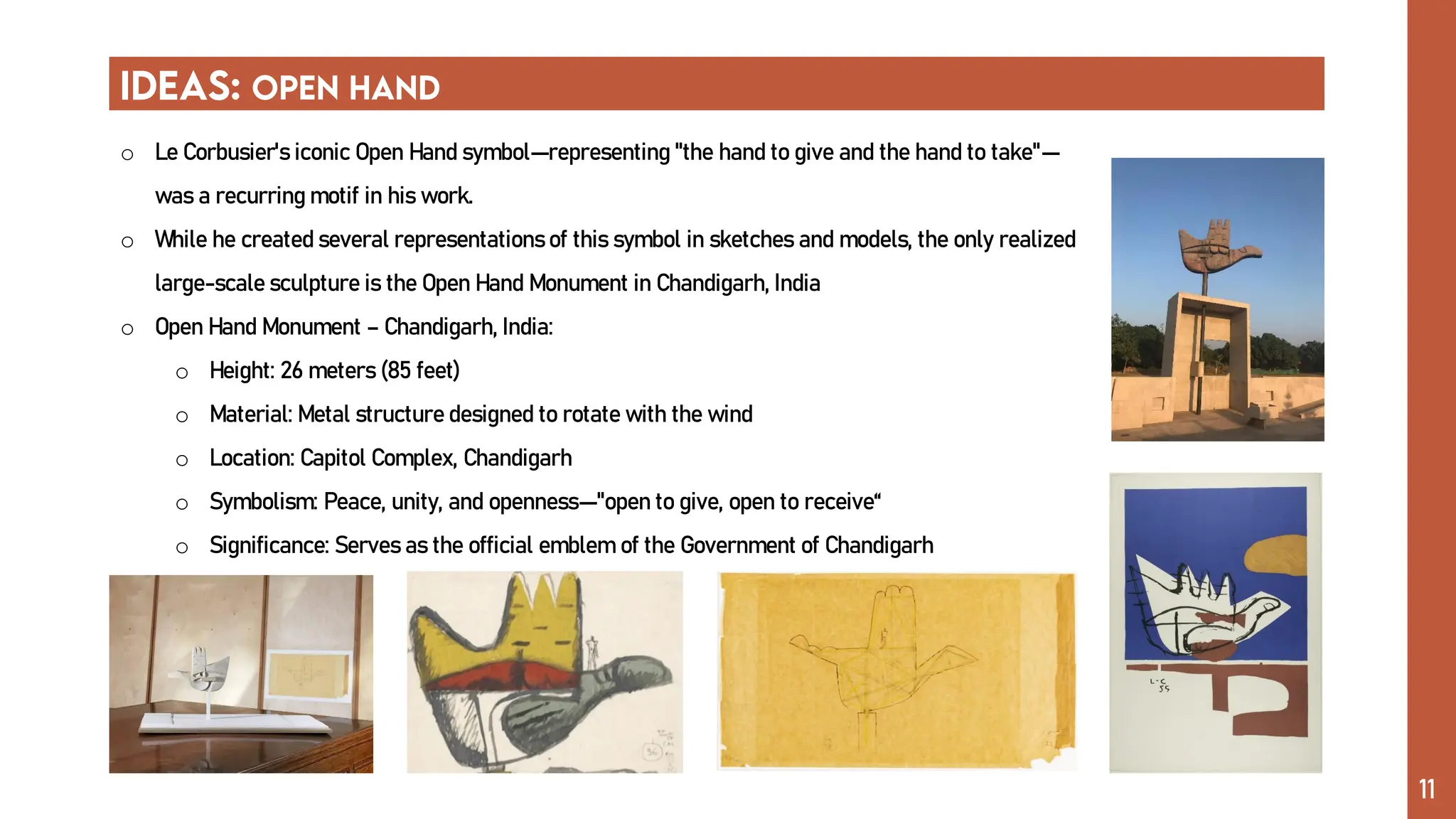
o Le Corbusier's iconic Open Hand symbol—representing "the hand to give and the hand to take"—
was a recurring motif in his work.
o While he created several representations of this symbol in sketches and models, the only realized
large-scale sculpture is the Open Hand Monument in Chandigarh, India
o Open Hand Monument – Chandigarh, India:
o Height: 26 meters (85 feet)
o Material: Metal structure designed to rotate with the wind
o Location: Capitol Complex, Chandigarh
o Symbolism: Peace, unity, and openness—"open to give, open to receive“
o Significance: Serves as the official emblem of the Government of Chandigarh
11
"Chairs are architecture, sofas are bourgeois." – Le Corbusier
o In 1928, Le Corbusier teamed up with Charlotte Perriand and his
cousin Pierre Jeanneret to rethink what furniture could be. Before
this, he used ready-made pieces (mostly from Thonet), but now he
was ready to create furniture that matched his architectural vision.
o Inspired by his book L'Art Décoratif d'aujourd'hui, he introduced three
ideas:
o Type-needs – furniture driven by necessity
o Type-furniture – practical, standardized design
o Human-limb objects – furniture as extensions of the human
body: functional, discreet, and beautifully crafted
His most famous chairs:
•LC-1: the “Basculant” chair
•LC-2 & LC-3: petit and grand confort chairs
•LC-4: the ultimate chaise lounge
12
United Nations
Headquarters
Cabanon de Le Corbusier Heidi Weber Museum Sainte Marie de la Tourette
Maison de la Culture The National Museum
of Western Art
Mill Owners’
Association Building
Saint-Pierre
20
La pêcheuse d'huitres Taureau Totem 3 Thèmes Ubu Parurge et Alma Rio
Icône Petite confidence L'enfant est là Panurge
21
o Modernist Architecture Pioneer: Le Corbusier helped shift architecture from
ornate, decorative styles to clean, functional forms — flat roofs, open plans,
pilotis (columns), and ribbon windows became standard.
o Open Floor Plans: His idea of flexible, flowing interior spaces influenced
everything from modern homes to office buildings.
o Urban Planning Concepts: His city plans — like Ville Radieuse — introduced
ideas of zoning, green spaces, and high-rise living, which still shape urban
design globally (think: Brasília, Chandigarh, post-war housing blocks).
o Modulor System & Human Scale: His focus on human-centered design inspired architects to think more critically about proportion,
comfort, and usability.
o Brutalism & Raw Concrete Aesthetic: He popularized béton brut (raw concrete), influencing Brutalism — visible in universities,
government buildings, and housing estates worldwide.
o Furniture Design Legacy: His iconic LC chairs continue to influence modern furniture design and are still manufactured today.
o Influence on Major Architects: Names like Zaha Hadid, Tadao Ando, Richard Meier, and Rem Koolhaas have cited Le Corbusier as a
major inspiration. 22
o https://en.wikipedia.org/wiki/Le_Corbusier
o https://assetyogi.com/chandigarh-master-plan/
o https://www.archdaily.com/975989/has-the-influence-of-mass-production-in-architecture-resulted-in-an-
impoverishment-of-design
o https://drawingmatter.org/le-corbusier-open-hand/
o https://archi-monarch.com/le-corbusiers-villa-savoye/
o https://www.re-thinkingthefuture.com/know-your-architects/a622-le-corbusier-15-projects/
o https://www.fondationlecorbusier.fr/en/le-corbusier/works/architecture/
o https://whc.unesco.org/en/list/1321
23

Le Corbusier: Modernism in Architecture

  • 1.
    ARCHITECT OF MODERNISM: Madeby Tajrian Hoque Rumaisha
  • 2.
    o Introduction o Earlylife and education o Early Career: Experimentation & New Ideas o Early Urban Theories o Ideas o Five points of architecture o The Modulor o Open Hand o Furniture o Famous projects o Chandigarh, New Delhi o Villa Savoy, Poissy, France o Chapel of Ronchamp, Ronchamp, France o More Projects o Paintings and sculptures o Impact on Modern Architecture o References 1 2 3 -7 8 9 10 11 12 13-15 16-17 18-19 20 21 22 23
  • 3.
    Le Corbusier (bornCharles-Édouard Jeanneret, 1887–1965) was a visionary architect, urban planner, designer, painter, and writer whose ideas reshaped 20th-century architecture. A pioneer of Modernism, he believed that architecture should respond to the needs of modern life — focusing on function, simplicity, and clarity. 1
  • 4.
    o Born asCharles-Édouard Jeanneret-Gris in La Chaux-de-Fonds, a small Swiss town near the French border, nestled in the Jura mountains. o Fell in love with visual arts early and studied at the La-Chaux-de-Fonds Art School, mentored by Charles L'Eplattenier and architect René Chapallaz, who shaped his first architectural ideas. o Restless in his hometown, he began traveling across Europe to broaden his horizons. o In 1907, moved to Paris and worked with Auguste Perret, a pioneer of reinforced concrete. o Studied in Vienna under Josef Hoffmann, then worked in Berlin for Peter Behrens, where he may have crossed paths with future modernist giants like Mies van der Rohe and Walter Gropius. o In 1911, he went on a solo trip through the Balkans, Greece, and Turkey, sketching classical ruins— especially the Parthenon, which deeply inspired his future theories in Towards a New Architecture. o During World War I, he taught at his old school in La-Chaux-de-Fonds o These four years in Switzerland, he worked on theoretical architectural studies using modern techniques 2
  • 5.
    o During WorldWar I, Le Corbusier stayed in Switzerland, teaching at his old school and diving deep into theoretical design work. o This period gave birth to the Dom-ino House concept (1914–1915)—a radical idea with: o Flat concrete slabs o Thin columns for support o Flexible, open-plan interiors o Stairway providing access to each level on one side of the floor plan o The Dom-ino model laid the foundation for his architectural style over the next decade. 3
  • 6.
    o In 1918,he met Amédée Ozenfant, a Cubist painter who became a creative partner. Together, they rejected Cubism as “irrational” and "romantic”, and launched Purism, a cleaner, more rational art style. Characteristics of Purism: o Simplified Forms o Embrace of Technology o Geometric Compositions o Neutral Color Palettes o Emphasis on Balance and Monumentality o After the war, he moved back to Paris and started his own practice with his cousin Pierre Jeanneret, a collaboration that would last until 1940. Le Corbusier and Pierre Jeanneret Le Corbusier and Amédée Ozenfant Example of Purism art 4
  • 7.
    o In 1920,Charles-Édouard Jeanneret adopted the name Le Corbusier, inspired by a variation of his maternal grandfather’s surname, “Lecorbésier”. o The name change reflected his belief that anyone could reinvent themselves, especially in the creative world. o Using a single-name pseudonym was quite popular among artists in Paris at the time—it helped build a bold, modern identity. o Between 1918 and 1922, Le Corbusier didn’t build anything—he focused instead on developing his theories about architecture and art, especially through Purism and painting. o In 1922, he and Ozenfant opened a design studio in Paris, setting the stage for a new phase of experimentation. o Around this time, he introduced the concept of the Maison Citrohan, a visionary housing prototype which was intended for mass production for urban living. Citrohan House, Stuttgart Germany, 1927 5
  • 8.
    o The designfeatured a three-story layout with a dramatic double-height living room, bedrooms on the second floor, and a kitchen on the third. o The flat roof was transformed into a sun terrace, and the house had an exterior staircase that led straight to the upper floors. o The interior was kept deliberately sparse—white walls, steel-framed furniture, and exposed light bulbs emphasized simplicity and function. o His houses often featured large horizontal windows, letting in natural light and creating a seamless connection with the outdoors. o The house used a rectangular plan, with exterior walls that were not filled by windows, left as white, stuccoed spaces Double heighted living room Three-story layout Exterior staircase flat roof was transformed into a sun terrace large horizontal windows 6
  • 9.
    o Between 1922and 1927, Le Corbusier and Pierre Jeanneret designed several private villas in and around Paris: o Villa Lipschitz o Maison Cook o Maison Planeix o And the Maison La Roche–Albert Jeanneret, which today houses the Fondation Le Corbusier Villa Lipschitz, 1925 Maison Cook, 1926 Maison Planeix, 1924-1926 Maison La Roche–Albert Jeanneret, 1923-1925 7
  • 10.
    o Paris wasstruggling with slums and poor living conditions—Le Corbusier believed modern architecture could solve this. o He promoted a city shaped by efficiency, order, and industrial methods. o His early project Immeubles Villas (1922) imagined compact apartment blocks with garden terraces, stacking quality living units vertically. o After WWII, he designed Unité d’Habitation in Marseille (1946–1952)—a concrete “vertical city” with apartments, shops, and even a rooftop gym. Immeubles Villas (1922) Unité d’Habitation (1946–1952) Appartement unit of Unité d’Habitation Unité d’Habitation (1946–1952) 8
  • 11.
    o In the1950s, Le Corbusier was invited to design Chandigarh, the new capital of Punjab and Haryana, India o Located at the picturesque junction of foothills of the Himalayas Mountain range and the Ganges plains o Total area 114 sqkm & population of 1,054,600 inhabitants o Sector of size 800 x 1200 meters o He developed the city’s master plan, dividing it into sectors. Each sector is a self-sufficient unit having shops, school, health centers and places of recreations and worship o Le Corbusier designed the city keeping three disciplines in his mind. Those are - o The Discipline of Money: he aimed for economical construction without compromising functionality or aesthetics. o The Discipline of Technology: Embraced modern construction methods and materials like reinforced concrete to build durable, scalable structures. o The Discipline of Climate: Designed with local climate in mind—deep overhangs, shaded walkways, and orientation of buildings reduced heat and maximized comfort. 13
  • 12.
    o Analogous tohuman body o Head (the Capitol Complex, Sector 1), o Heart (the City Centre Sector-17), o Lungs (the leisure valley, innumerable open spaces and sector greens), o Intellect (the cultural and educational institutions), o Circulatory system (the network of roads, the 7Vs) o Viscera (the Industrial Area). 14
  • 13.
    Palace of JusticePalace of Assembly Secretariat Building Geometric Hill Open Hand Monument Martyr's Memorial Tower of Shadows 15
  • 14.
    o Villa Savoyeis one of Le Corbusier’s most iconic works and a symbol of modern architecture. It was designed as a weekend retreat for the Savoye family and showcases his “Five Points of Architecture.” o Material: Reinforced concrete o Functions & Architectural Features: o Horizontal Ribbon Windows: Long, uninterrupted bands of windows flooded the interior with natural light and offered sweeping views of the surrounding countryside. o Pilotis (Slender Columns): Lifted the structure off the ground, creating open space underneath for circulation, car parking, and an uninterrupted natural landscape. o Free Floor Plan: Since walls weren’t load-bearing, interior spaces could be arranged and adjusted freely to suit the needs of the inhabitants—a revolutionary idea at the time. o Free Façade Design: With structural support coming from the pilotis, the façade could be designed independently—allowing for more creativity and clean, geometric simplicity. o Roof Garden: The flat roof doubled as a garden and terrace, restoring green space lost to the building footprint and offering a place for leisure and relaxation. 16
  • 15.
  • 16.
    A major departurefrom Le Corbusier’s usual geometric, machine-like style, this chapel shows his more sculptural, spiritual, and expressive side. o The curved roof resembles a sail or shell, symbolizing shelter. o The thick walls and scattered windows control light dramatically, adding a sacred, mystical feeling. o Its form follows the natural shape of the hill, blending architecture with the landscape. o A Place for Pilgrimage & Worship: Built on a historic pilgrimage site, the chapel serves as a spiritual retreat for prayer, reflection, and religious gatherings—especially on feast days like August 15 (Assumption of Mary). o Asymmetrical Windows: Small, scattered openings of various sizes let in dramatic beams of natural light. Some are filled with colorful stained glass, creating a spiritual and dynamic interior. o Material: Reinforced concrete and Stone. 18
  • 17.
  • 18.
    1. Pilotis- Replacementof supporting walls by a grid of reinforced concrete columns that bears the structural load is the basis of the aesthetic 2. The free designing of the ground plan- the absence of supporting walls mean the house is unrestrained in its internal use 3. The free design of the façade- separating the exterior of the building from its structural function-sets the façade free from structural constraints. 4. The horizontal window, which cuts the façade along its entire length, lights rooms equally. 5. Roof gardens on a flat roof can serve a domestic purpose while providing essential protection to the concrete roof. 9
  • 19.
    o The graphicrepresentation of the Modulor, a stylised human figure with one arm raised, stands next to two vertical measurements o Attempts to discover mathematical proportions in the human body and then to use that knowledge to improve both the appearance and function of architecture o The system is based on human measurements, the double unit, the Fibonacci numbers, and the golden ratio o Le Corbusier described it as a "range of harmonious measurements to suit the human scale, universally applicable to architecture and to mechanical things" o Inspired by ancient civilizations who used measuring systems linked to the human body: elbow (cubit), finger (digit), thumb (inch) etc. o A red series based on the figure's navel height then segmented according to Phi o A blue series based on the figure's entire height, double the navel height segmented similarly o A spiral, graphically developed between the red and blue segments, seems to mimic the volume of the human figure 10
  • 20.
    o Le Corbusier'siconic Open Hand symbol—representing "the hand to give and the hand to take"— was a recurring motif in his work. o While he created several representations of this symbol in sketches and models, the only realized large-scale sculpture is the Open Hand Monument in Chandigarh, India o Open Hand Monument – Chandigarh, India: o Height: 26 meters (85 feet) o Material: Metal structure designed to rotate with the wind o Location: Capitol Complex, Chandigarh o Symbolism: Peace, unity, and openness—"open to give, open to receive“ o Significance: Serves as the official emblem of the Government of Chandigarh 11
  • 21.
    "Chairs are architecture,sofas are bourgeois." – Le Corbusier o In 1928, Le Corbusier teamed up with Charlotte Perriand and his cousin Pierre Jeanneret to rethink what furniture could be. Before this, he used ready-made pieces (mostly from Thonet), but now he was ready to create furniture that matched his architectural vision. o Inspired by his book L'Art Décoratif d'aujourd'hui, he introduced three ideas: o Type-needs – furniture driven by necessity o Type-furniture – practical, standardized design o Human-limb objects – furniture as extensions of the human body: functional, discreet, and beautifully crafted His most famous chairs: •LC-1: the “Basculant” chair •LC-2 & LC-3: petit and grand confort chairs •LC-4: the ultimate chaise lounge 12
  • 22.
    United Nations Headquarters Cabanon deLe Corbusier Heidi Weber Museum Sainte Marie de la Tourette Maison de la Culture The National Museum of Western Art Mill Owners’ Association Building Saint-Pierre 20
  • 23.
    La pêcheuse d'huitresTaureau Totem 3 Thèmes Ubu Parurge et Alma Rio Icône Petite confidence L'enfant est là Panurge 21
  • 24.
    o Modernist ArchitecturePioneer: Le Corbusier helped shift architecture from ornate, decorative styles to clean, functional forms — flat roofs, open plans, pilotis (columns), and ribbon windows became standard. o Open Floor Plans: His idea of flexible, flowing interior spaces influenced everything from modern homes to office buildings. o Urban Planning Concepts: His city plans — like Ville Radieuse — introduced ideas of zoning, green spaces, and high-rise living, which still shape urban design globally (think: Brasília, Chandigarh, post-war housing blocks). o Modulor System & Human Scale: His focus on human-centered design inspired architects to think more critically about proportion, comfort, and usability. o Brutalism & Raw Concrete Aesthetic: He popularized béton brut (raw concrete), influencing Brutalism — visible in universities, government buildings, and housing estates worldwide. o Furniture Design Legacy: His iconic LC chairs continue to influence modern furniture design and are still manufactured today. o Influence on Major Architects: Names like Zaha Hadid, Tadao Ando, Richard Meier, and Rem Koolhaas have cited Le Corbusier as a major inspiration. 22
  • 25.
    o https://en.wikipedia.org/wiki/Le_Corbusier o https://assetyogi.com/chandigarh-master-plan/ ohttps://www.archdaily.com/975989/has-the-influence-of-mass-production-in-architecture-resulted-in-an- impoverishment-of-design o https://drawingmatter.org/le-corbusier-open-hand/ o https://archi-monarch.com/le-corbusiers-villa-savoye/ o https://www.re-thinkingthefuture.com/know-your-architects/a622-le-corbusier-15-projects/ o https://www.fondationlecorbusier.fr/en/le-corbusier/works/architecture/ o https://whc.unesco.org/en/list/1321 23