RONCHAMP
By Le Corbusier
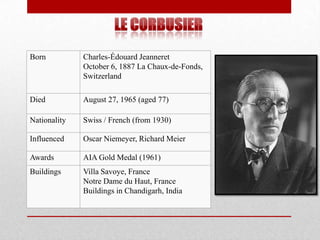
Born          Charles-Édouard Jeanneret
              October 6, 1887 La Chaux-de-Fonds,
              Switzerland

Died          August 27, 1965 (aged 77)

Nationality   Swiss / French (from 1930)

Influenced    Oscar Niemeyer, Richard Meier

Awards        AIA Gold Medal (1961)
Buildings     Villa Savoye, France
              Notre Dame du Haut, France
              Buildings in Chandigarh, India
Born as Charles Edouard Jeanneret on
      October 6, 1887 in La Chaux de Fonds,
  Switzerland. He studied at the La Chaux de
   Fonds Art School. His career spanned five
       decades and he made significant
       contributions to the Modernists or
International Style. He has built works in North
   America, South America, Europe and Asia.
  He died on August 27, 1965 of a heart attack
 while swimming in the Mediterranean Sea in
                  south France.
1905 Villa Fallet, La Chaux de fonds, Switzerland
1912 Villa Jeanneret, Paris
1916 Villa Schwob, Paris
1923 Villa LaRoche, Paris
1924 Pavilion de L’Esprit Nouveau, Paris
1924 Quartiers Modernes Fruges, Pessac France
1926 Villa Cook, Boulogne-sue-Seine, France
1927 Villas at Weissenhof Estate, Stuttgart, Germany
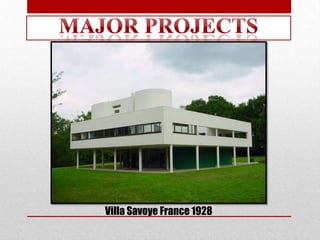
1928 Villa Savoye, Poissy-sur-Seine, France
1929 Armee du Salut, Cite de Refuge, Paris
1930 Pavilion Suisse, Cite Universitaire, Paris
1931 Palace of the Soviets, Moscow, USSR
1933 Tsentrosoyuz, Moscow, USSR
1936 Palace of the Ministry of National Education and Public Health, Rio de
Janerio
1938 The Cartesian Sky-scrapper.
1946 Duval Factory in Saint Die, France
1947-1952 Unite d’Habition, Marseille, France
1948 Curutchet House, La Plata, Argentina
1949 Usine Cluade et Duval, Saint Die-des-Vosges
1950 UN Headquarters, New York
1950-1954 Chapel Notre Dame du Haut, Ronchamp, France
1951 Cabanon Le Corbusier, Roquebrune-Cap-Martin
1951 Maisons Jaoul, Neuilly-sur-Seine, France
1952 Unite d’Habitation of Nantes-Reze, Nantes, France
1952-1959 Buildings in Chandigarh, India.
1905 Museum at Ahmedabad, India
1912 Unite d’Habitation of Briey en Foret, France
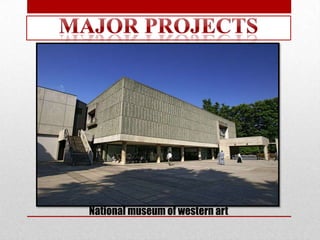
1957 National Museum of Western Art, Tokyo
1913 Masison du Bresil, Cite Universataire, Paris
1957-1960 Sainte Marie de la Tourette Lyon, France
1957 Unite Habitation of Berlin-Charlottenburg, Flatowallee 16, Berlin
Villa Savoye France 1928
National museum of western art
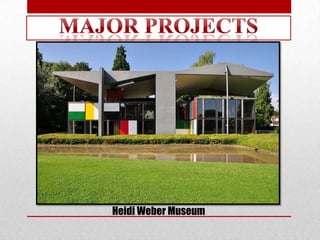
Heidi Weber Museum
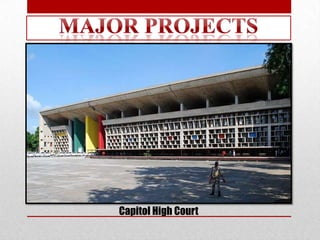
Capitol High Court
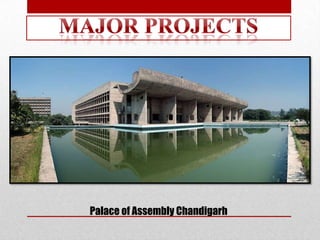
Palace of Assembly Chandigarh
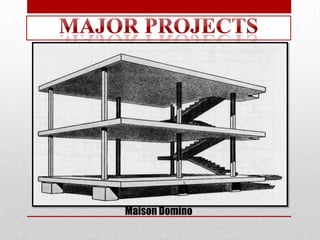
Maison Domino
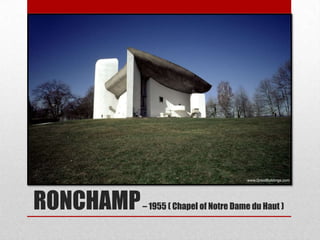
RONCHAMP   – 1955 ( Chapel of Notre Dame du Haut )
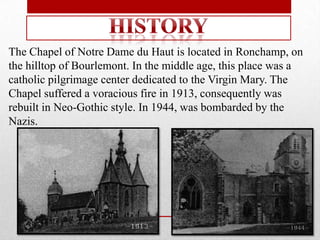
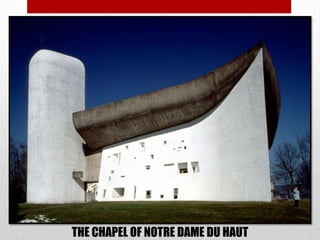
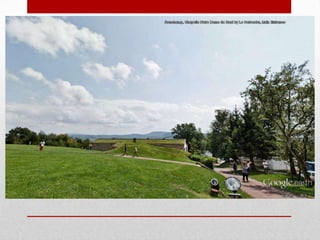
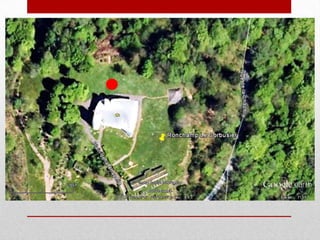
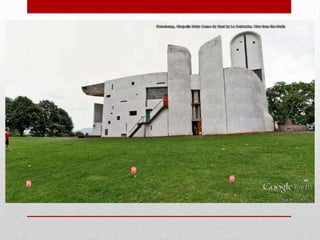
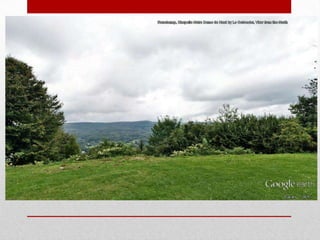
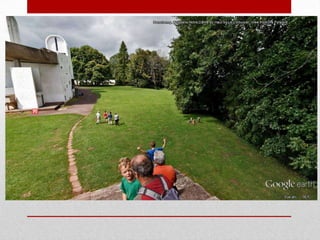
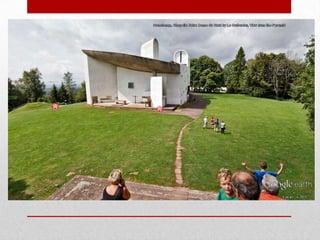
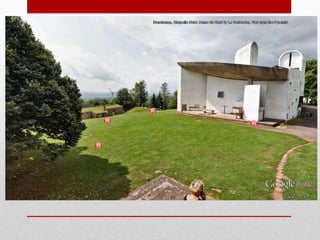
The Chapel of Notre Dame du Haut is located in Ronchamp, on
the hilltop of Bourlemont. In the middle age, this place was a
catholic pilgrimage center dedicated to the Virgin Mary. The
Chapel suffered a voracious fire in 1913, consequently was
rebuilt in Neo-Gothic style. In 1944, was bombarded by the
Nazis.
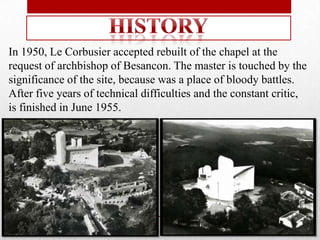
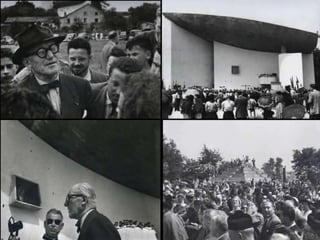
In 1950, Le Corbusier accepted rebuilt of the chapel at the
request of archbishop of Besancon. The master is touched by the
significance of the site, because was a place of bloody battles.
After five years of technical difficulties and the constant critic,
is finished in June 1955.
"Surrealism is a key to other late works of Le Corbusier,
most notably the church at Ronchamp, France, of 1950-55.
Notre-Dame-du-Haut was a more extreme statement of Le
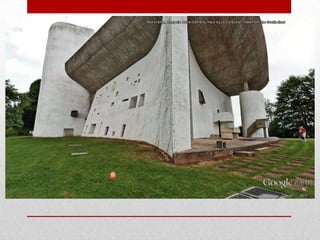
   Corbusier's late style. Programmatically, the church is
simple, an oblong nave, two side entrances, an axial main
altar, and three chapels beneath towers—as is its structure,
with rough masonry walls faced with whitewashed Gunite
   (sprayed concrete) and a roof of contrasting beton brut
    (architectural concrete left unfinished). Formally and
 symbolically, however, this small building, which is sited
  atop a hillside with access from the south, is immensely
                   powerful and complex.‖
•    Location: Ronchamp, France
•   Date: 1955
•   Building Type: church
•   Construction System: reinforced concrete
•   Climate: temperate
•   Context: rural, mountains
•   Style: Expressionist Modern
•   Physical Characteristics:
           Simplicity
           Oblong nave
           Two side entrances
           Axial main alter
           Three chapels
           Three towers
           4 ft to 12 ft thick, whitewashed, sprayed concrete walls (known
           as Gunite or Gunnire)
           Beton brut roof
           Southern facing wall of windows
           Exterior alter
           Sculpture of the Virgin Mary
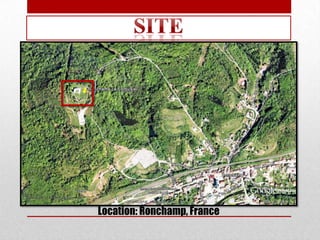
Location: Ronchamp, France
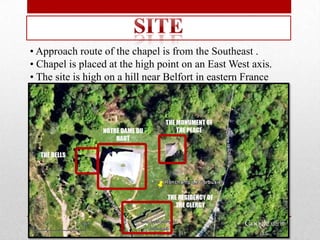
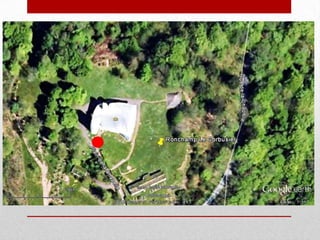
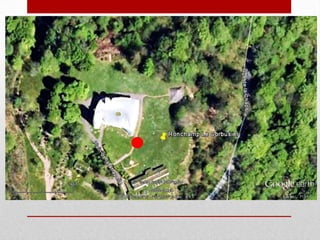
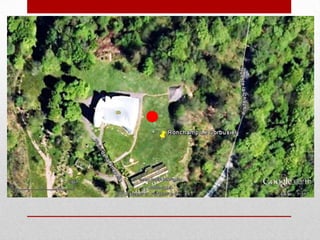
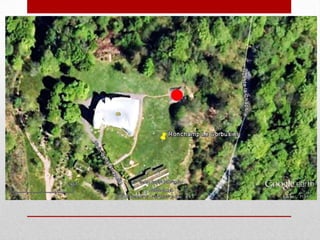
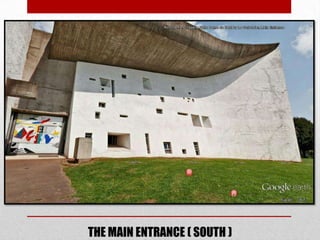
• Approach route of the chapel is from the Southeast .
• Chapel is placed at the high point on an East West axis.
• The site is high on a hill near Belfort in eastern France
THE CHAPEL OF NOTRE DAME DU HAUT
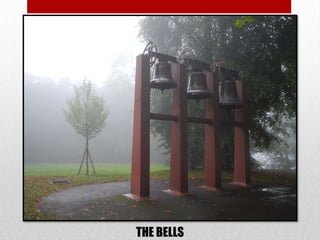
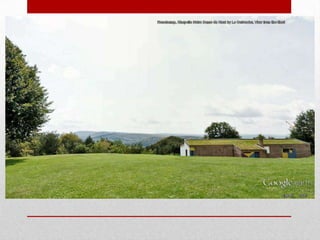
To the west is located a
bell tower, a very simple
composition, comprising
 a metal frame holding 3
           bells.
THE BELLS
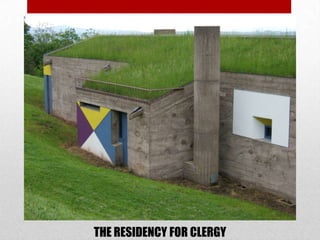
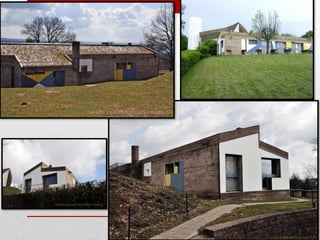
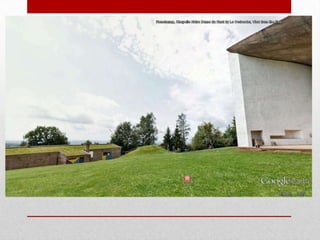
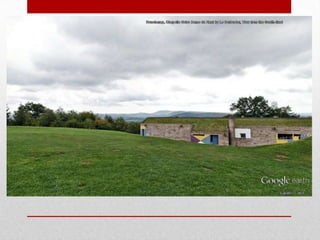
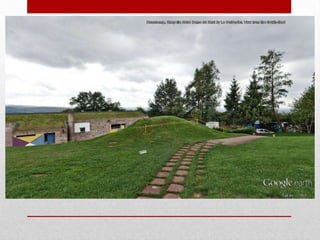
Towards the southern end, and in a lower
      area of the topography, stands a
rectangular volume made of concrete, that
   contrasts in both form and color with
  chapel. This volume, perpendicular and
  closer to the access path, contains the
residence of the monks and was designed
 by Le Corbusier in 1953 and completed in
 1959. The building, austere and sober, has
classrooms, library, refectory, kitchen and
               cells for monks.
THE RESIDENCY FOR CLERGY
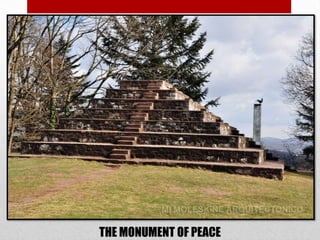
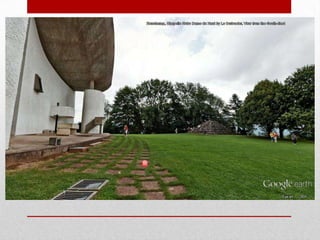
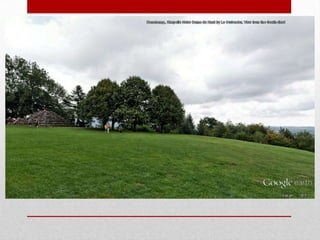
At the northern end a stepped
pyramid is located, built with
 the remnants of the original
  church, which serves as a
     monument to peace.
THE MONUMENT OF PEACE
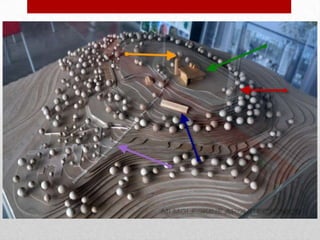
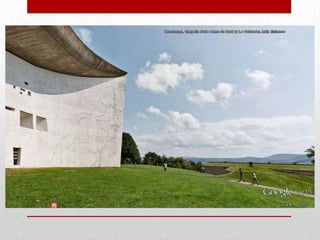
The Chapels act as periscopes
 which establish contact with the
    distant horizon. The site that
  provided an irresistible genius
   loci for the response, with the
        horizon visible on all
    four sides of the hill and its
historical legacy for centuries as a
          place of worship.
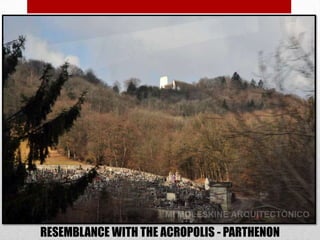
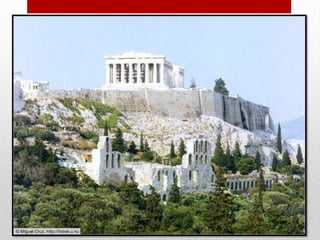
RESEMBLANCE WITH THE ACROPOLIS - PARTHENON
The program had some difficult requirements: a
   church to serve a parish of 200, but capable of
dealing with crowds of pilgrims on important feast
  days (like August 15th and September 8th); two
small chapels to hold services separately from the
main Mass; a sacristy; a small office; a housing for
 a 17th century polychrome wood sculpture of the
Virgin and Child; and a means to collect rainwater
    as water resources are scarce on the hilltop.
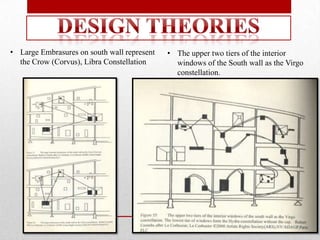
• Large Embrasures on south wall represent   • The upper two tiers of the interior
  the Crow (Corvus), Libra Constellation       windows of the South wall as the Virgo
                                               constellation.
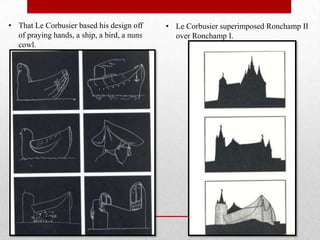
• That Le Corbusier based his design off     • Le Corbusier superimposed Ronchamp II
  of praying hands, a ship, a bird, a nuns     over Ronchamp I.
  cowl.
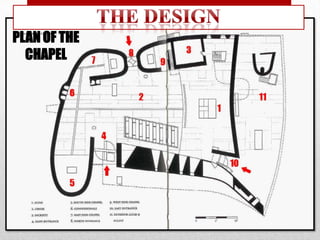
PLAN OF THE
  CHAPEL
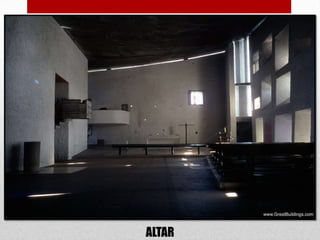
ALTAR
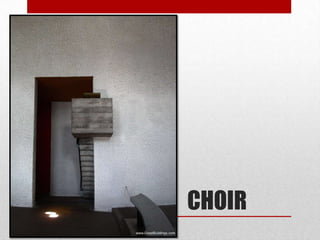
CHOIR
THE MAIN ENTRANCE ( SOUTH )
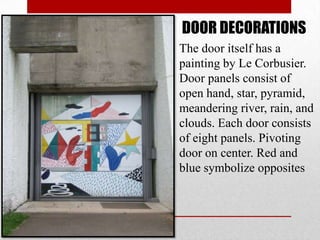
DOOR DECORATIONS
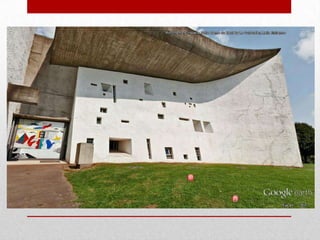
The door itself has a
painting by Le Corbusier.
Door panels consist of
open hand, star, pyramid,
meandering river, rain, and
clouds. Each door consists
of eight panels. Pivoting
door on center. Red and
blue symbolize opposites
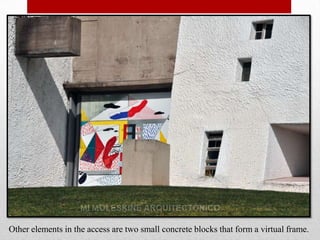
Other elements in the access are two small concrete blocks that form a virtual frame.
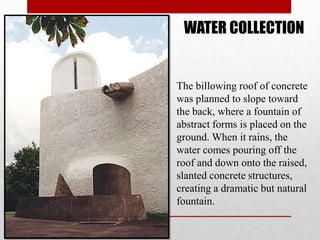
WATER COLLECTION


The billowing roof of concrete
was planned to slope toward
the back, where a fountain of
abstract forms is placed on the
ground. When it rains, the
water comes pouring off the
roof and down onto the raised,
slanted concrete structures,
creating a dramatic but natural
fountain.
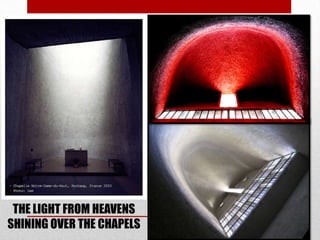
THE LIGHT FROM HEAVENS
SHINING OVER THE CHAPELS
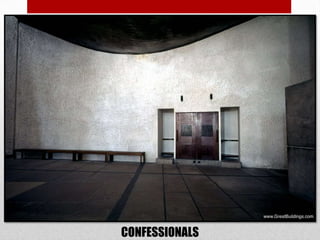
CONFESSIONALS
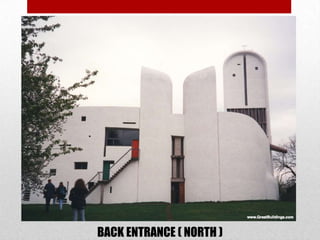
BACK ENTRANCE ( NORTH )
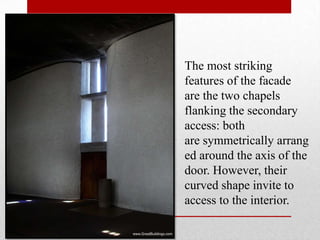
The most striking
features of the facade
are the two chapels
flanking the secondary
access: both
are symmetrically arrang
ed around the axis of the
door. However, their
curved shape invite to
access to the interior.
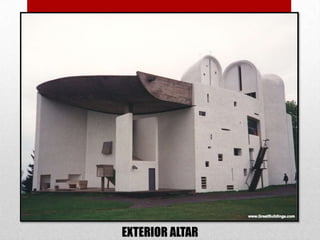
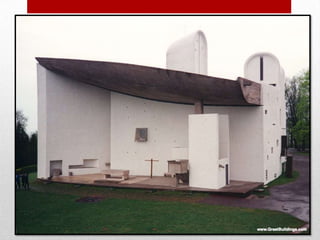
The complex shapes at Ronchamp
   start from a theme of acoustic
parabolas, playing a practical role on
  the east wall to reflect the sound
    from the outside altar for the
    pilgrims gathered on the hill.
EXTERIOR ALTAR
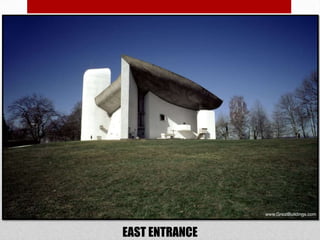
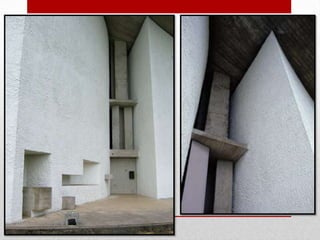
EAST ENTRANCE
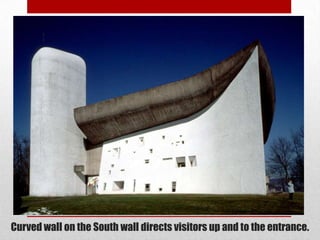
Curved wall on the South wall directs visitors up and to the entrance.
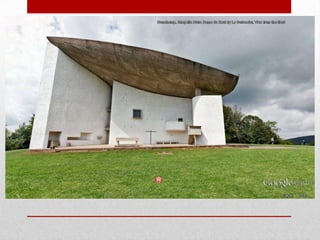
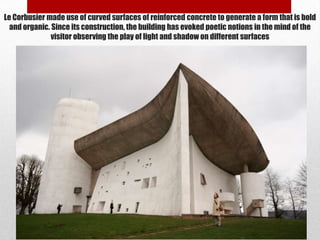
Le Corbusier made use of curved surfaces of reinforced concrete to generate a form that is bold
  and organic. Since its construction, the building has evoked poetic notions in the mind of the
               visitor observing the play of light and shadow on different surfaces
• Le Corbusier was given free reign to create a total work of art, the way he liked it.
• The south and east walls act as receptors for the majority of sunlight that enters
the chapel through the gap between the roof and the vertical surfaces in an attempt to
break the static nature of the enclosed interior space, whereas the north and west walls act
as containers that define the sacred from the profane in a manner that removes any
immediate connection with the outside environment.
• The slope of the floor follows the natural slope of the hill, and slopes towards the alter.
• Towers are stone masonry topped with cement domes
• Concrete roof is the shell (idea came from crab shell on beach when he was visiting
   Nivolas. He imagined its curved strength)
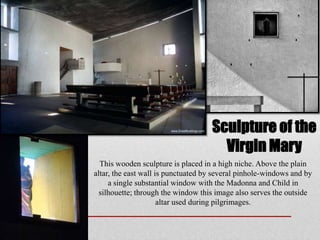
Sculpture of the
                                      Virgin Mary
  This wooden sculpture is placed in a high niche. Above the plain
altar, the east wall is punctuated by several pinhole-windows and by
     a single substantial window with the Madonna and Child in
  silhouette; through the window this image also serves the outside
                      altar used during pilgrimages.
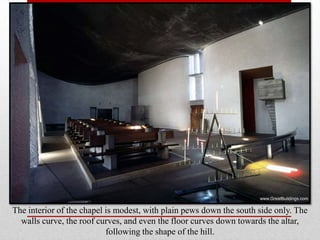
The interior of the chapel is modest, with plain pews down the south side only. The
  walls curve, the roof curves, and even the floor curves down towards the altar,
                           following the shape of the hill.
PLAY OF LIGHT
―The shell has been put on walls which
    are absurdly but practically thick.
   Inside them however are reinforced
concrete columns. The shell will rest on
 these columns but it will not touch the
 wall. A horizontal crack of light 10cm
            wide will amaze.‖
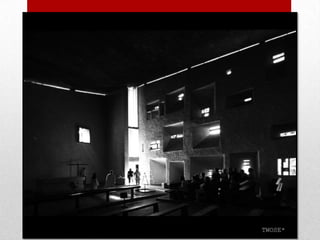
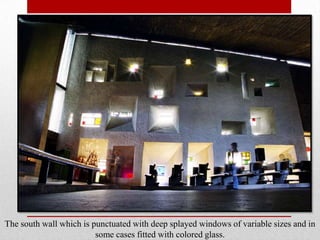
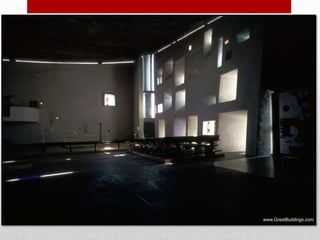
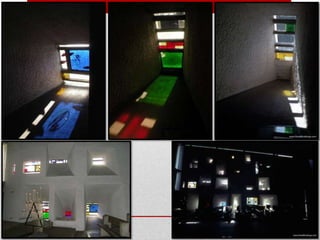
The south wall which is punctuated with deep splayed windows of variable sizes and in
                         some cases fitted with colored glass.
The chambers within this thick wall are
 splayed and tapered to delay and trap
    passing light, making each void
  inwardly strategy excludes sky glare
stabilizing incoming light and creates a
 contemplative luminous environment.
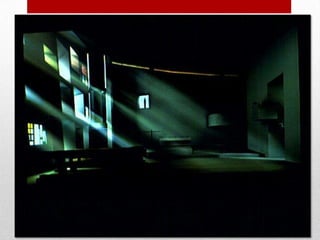
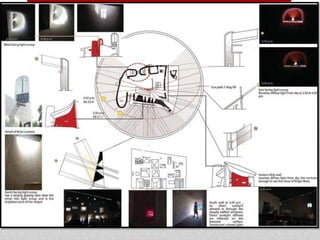
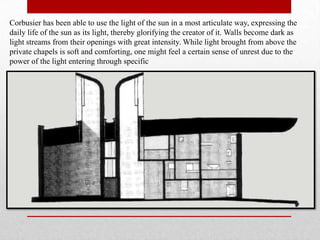
Corbusier has been able to use the light of the sun in a most articulate way, expressing the
daily life of the sun as its light, thereby glorifying the creator of it. Walls become dark as
light streams from their openings with great intensity. While light brought from above the
private chapels is soft and comforting, one might feel a certain sense of unrest due to the
power of the light entering through specific
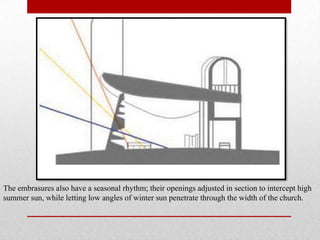
The embrasures also have a seasonal rhythm; their openings adjusted in section to intercept high
summer sun, while letting low angles of winter sun penetrate through the width of the church.
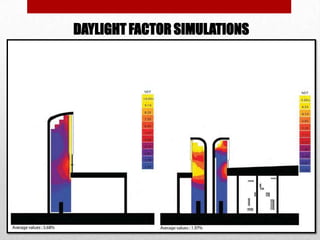
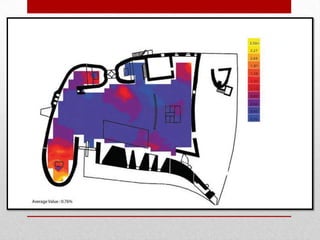
DAYLIGHT FACTOR SIMULATIONS
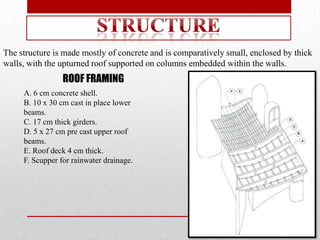
The structure is made mostly of concrete and is comparatively small, enclosed by thick
walls, with the upturned roof supported on columns embedded within the walls.
                 ROOF FRAMING
     A. 6 cm concrete shell.
     B. 10 x 30 cm cast in place lower
     beams.
     C. 17 cm thick girders.
     D. 5 x 27 cm pre cast upper roof
     beams.
     E. Roof deck 4 cm thick.
     F. Scupper for rainwater drainage.
The main structural system in the chapel is composed of
reinforced concrete that has been used to construct the
required framework for the building. It has been filled
with stone recovered from the ruins of the old chapel.
The roof is composed of two membranes, each of which
acts as a thin shell separated by a gap of 2.26 m
conforming to the modular proportion.
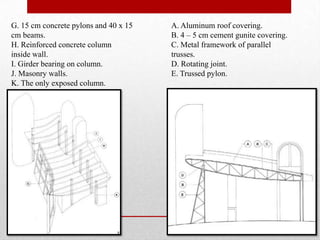
G. 15 cm concrete pylons and 40 x 15   A. Aluminum roof covering.
cm beams.                              B. 4 – 5 cm cement gunite covering.
H. Reinforced concrete column          C. Metal framework of parallel
inside wall.                           trusses.
I. Girder bearing on column.           D. Rotating joint.
J. Masonry walls.                      E. Trussed pylon.
K. The only exposed column.
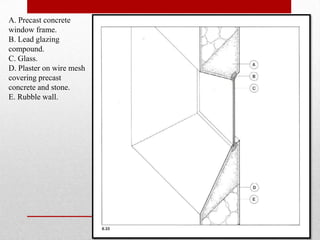
A. Precast concrete
window frame.
B. Lead glazing
compound.
C. Glass.
D. Plaster on wire mesh
covering precast
concrete and stone.
E. Rubble wall.
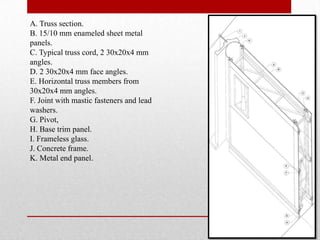
A. Truss section.
B. 15/10 mm enameled sheet metal
panels.
C. Typical truss cord, 2 30x20x4 mm
angles.
D. 2 30x20x4 mm face angles.
E. Horizontal truss members from
30x20x4 mm angles.
F. Joint with mastic fasteners and lead
washers.
G. Pivot,
H. Base trim panel.
I. Frameless glass.
J. Concrete frame.
K. Metal end panel.
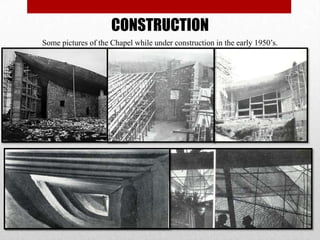
CONSTRUCTION
Some pictures of the Chapel while under construction in the early 1950’s.
Simplicity- The chapel appears completely organic both in form and in materials. Notre Dame
Du Haut lacks any obvious attempts at accentuating geometry. The materials are left in the raw
and allowed to age naturally. The simplicity of form gives the chapel the feel of sculpture.

Lack of ornate detail allows the building to completely exist as a religious space without any
distractions to pilgrims and worshippers. Lacking mass-produced materials the structure is pure
and simple exemplifying the desired way of life for those who came to the chapel.

Beton Brut Roof-It is said that the smooth curve of the roof is symbolic of praying hands.

South Facing Wall of Windows-Light has been a long time symbol of religion. Gothic
Architecture took this concept to the extreme considering light one of the most important
elements of any religious structure. Light gives the space an ethereal quality.

Sculpture of the Virgin Mary-
BIBLIOGRAPHY
• http://architecturalmoleskine.blogspot.com/search?q=LE+CORBUSIER%3A+CHAPE
  L+OF+NOTRE-DAME-DU+HAUT%2C+RONCHAMP
• http://en.wikipedia.org/wiki/Notre_Dame_du_Haut
• http://www.greatbuildings.com/cgi-bin/gbc-
  search.cgi?search=building&building=Notre+Dame+du+Haut
• http://elplanb-
  arquitectura.blogspot.com/search?q=Le+Corbusier%27s+Ronchamp+Chapel
• http://en.wikipedia.org/wiki/Ronchamp
• http://architecturalmoleskine.blogspot.com/search?q=RENZO+PIANO%3A+MONAS
  TERY+IN+RONCHAMP
• http://openbuildings.com/buildings/grid?keyword=Notre+Dame+du+Haut
• http://nixpixmix.blogspot.com/search?q=RONCHAMP+CHAPEL+-+FRANCE
• http://en.wikipedia.org/wiki/Le_Corbusier
• http://www.flickr.com/photos/tags/ronchamp/
• http://www.archdaily.com/84988/ad-classics-ronchamp-le-corbusier/
• http://everything2.com/title/Notre+Dame+Du+Haut
ARTICLES
• Wallfahrtskirche „Notre Dame du Haut― in Ronchamp
• Notre-Dame du Haut, Ronchamp:A Symbol of Vatican II
• THE CHAPEL AT RONCHAMP AND THE FREE PLAN
• A STUDY OF THE CHARACTERISTICS OF NATURAL LIGHT IN SELECTED
  BUILDINGS DESIGNED BY LE CORBUSIER, LOUIS I. KAHN AND TADAO
  ANDO
• Notre Dame du Haut, Ronchamp
• A study on the Phenomenon of Light
• GEOMETRIC OPTIMIZATION OF FENESTRATION
THE END

Ronchamp By Le Corbusier

  • 1.
  • 2.
    Born Charles-Édouard Jeanneret October 6, 1887 La Chaux-de-Fonds, Switzerland Died August 27, 1965 (aged 77) Nationality Swiss / French (from 1930) Influenced Oscar Niemeyer, Richard Meier Awards AIA Gold Medal (1961) Buildings Villa Savoye, France Notre Dame du Haut, France Buildings in Chandigarh, India
  • 3.
    Born as CharlesEdouard Jeanneret on October 6, 1887 in La Chaux de Fonds, Switzerland. He studied at the La Chaux de Fonds Art School. His career spanned five decades and he made significant contributions to the Modernists or International Style. He has built works in North America, South America, Europe and Asia. He died on August 27, 1965 of a heart attack while swimming in the Mediterranean Sea in south France.
  • 4.
    1905 Villa Fallet,La Chaux de fonds, Switzerland 1912 Villa Jeanneret, Paris 1916 Villa Schwob, Paris 1923 Villa LaRoche, Paris 1924 Pavilion de L’Esprit Nouveau, Paris 1924 Quartiers Modernes Fruges, Pessac France 1926 Villa Cook, Boulogne-sue-Seine, France 1927 Villas at Weissenhof Estate, Stuttgart, Germany 1928 Villa Savoye, Poissy-sur-Seine, France 1929 Armee du Salut, Cite de Refuge, Paris 1930 Pavilion Suisse, Cite Universitaire, Paris 1931 Palace of the Soviets, Moscow, USSR 1933 Tsentrosoyuz, Moscow, USSR 1936 Palace of the Ministry of National Education and Public Health, Rio de Janerio 1938 The Cartesian Sky-scrapper. 1946 Duval Factory in Saint Die, France 1947-1952 Unite d’Habition, Marseille, France
  • 5.
    1948 Curutchet House,La Plata, Argentina 1949 Usine Cluade et Duval, Saint Die-des-Vosges 1950 UN Headquarters, New York 1950-1954 Chapel Notre Dame du Haut, Ronchamp, France 1951 Cabanon Le Corbusier, Roquebrune-Cap-Martin 1951 Maisons Jaoul, Neuilly-sur-Seine, France 1952 Unite d’Habitation of Nantes-Reze, Nantes, France 1952-1959 Buildings in Chandigarh, India. 1905 Museum at Ahmedabad, India 1912 Unite d’Habitation of Briey en Foret, France 1957 National Museum of Western Art, Tokyo 1913 Masison du Bresil, Cite Universataire, Paris 1957-1960 Sainte Marie de la Tourette Lyon, France 1957 Unite Habitation of Berlin-Charlottenburg, Flatowallee 16, Berlin
  • 6.
  • 7.
    National museum ofwestern art
  • 8.
  • 9.
  • 10.
  • 11.
  • 12.
    RONCHAMP – 1955 ( Chapel of Notre Dame du Haut )
  • 13.
    The Chapel ofNotre Dame du Haut is located in Ronchamp, on the hilltop of Bourlemont. In the middle age, this place was a catholic pilgrimage center dedicated to the Virgin Mary. The Chapel suffered a voracious fire in 1913, consequently was rebuilt in Neo-Gothic style. In 1944, was bombarded by the Nazis.
  • 14.
    In 1950, LeCorbusier accepted rebuilt of the chapel at the request of archbishop of Besancon. The master is touched by the significance of the site, because was a place of bloody battles. After five years of technical difficulties and the constant critic, is finished in June 1955.
  • 16.
    "Surrealism is akey to other late works of Le Corbusier, most notably the church at Ronchamp, France, of 1950-55. Notre-Dame-du-Haut was a more extreme statement of Le Corbusier's late style. Programmatically, the church is simple, an oblong nave, two side entrances, an axial main altar, and three chapels beneath towers—as is its structure, with rough masonry walls faced with whitewashed Gunite (sprayed concrete) and a roof of contrasting beton brut (architectural concrete left unfinished). Formally and symbolically, however, this small building, which is sited atop a hillside with access from the south, is immensely powerful and complex.‖
  • 17.
    Location: Ronchamp, France • Date: 1955 • Building Type: church • Construction System: reinforced concrete • Climate: temperate • Context: rural, mountains • Style: Expressionist Modern • Physical Characteristics: Simplicity Oblong nave Two side entrances Axial main alter Three chapels Three towers 4 ft to 12 ft thick, whitewashed, sprayed concrete walls (known as Gunite or Gunnire) Beton brut roof Southern facing wall of windows Exterior alter Sculpture of the Virgin Mary
  • 18.
  • 19.
    • Approach routeof the chapel is from the Southeast . • Chapel is placed at the high point on an East West axis. • The site is high on a hill near Belfort in eastern France
  • 21.
    THE CHAPEL OFNOTRE DAME DU HAUT
  • 22.
    To the westis located a bell tower, a very simple composition, comprising a metal frame holding 3 bells.
  • 23.
  • 24.
    Towards the southernend, and in a lower area of the topography, stands a rectangular volume made of concrete, that contrasts in both form and color with chapel. This volume, perpendicular and closer to the access path, contains the residence of the monks and was designed by Le Corbusier in 1953 and completed in 1959. The building, austere and sober, has classrooms, library, refectory, kitchen and cells for monks.
  • 25.
  • 27.
    At the northernend a stepped pyramid is located, built with the remnants of the original church, which serves as a monument to peace.
  • 28.
  • 29.
    The Chapels actas periscopes which establish contact with the distant horizon. The site that provided an irresistible genius loci for the response, with the horizon visible on all four sides of the hill and its historical legacy for centuries as a place of worship.
  • 53.
    RESEMBLANCE WITH THEACROPOLIS - PARTHENON
  • 55.
    The program hadsome difficult requirements: a church to serve a parish of 200, but capable of dealing with crowds of pilgrims on important feast days (like August 15th and September 8th); two small chapels to hold services separately from the main Mass; a sacristy; a small office; a housing for a 17th century polychrome wood sculpture of the Virgin and Child; and a means to collect rainwater as water resources are scarce on the hilltop.
  • 56.
    • Large Embrasureson south wall represent • The upper two tiers of the interior the Crow (Corvus), Libra Constellation windows of the South wall as the Virgo constellation.
  • 57.
    • That LeCorbusier based his design off • Le Corbusier superimposed Ronchamp II of praying hands, a ship, a bird, a nuns over Ronchamp I. cowl.
  • 58.
  • 59.
  • 60.
  • 61.
  • 62.
    DOOR DECORATIONS The dooritself has a painting by Le Corbusier. Door panels consist of open hand, star, pyramid, meandering river, rain, and clouds. Each door consists of eight panels. Pivoting door on center. Red and blue symbolize opposites
  • 63.
    Other elements inthe access are two small concrete blocks that form a virtual frame.
  • 64.
    WATER COLLECTION The billowingroof of concrete was planned to slope toward the back, where a fountain of abstract forms is placed on the ground. When it rains, the water comes pouring off the roof and down onto the raised, slanted concrete structures, creating a dramatic but natural fountain.
  • 65.
    THE LIGHT FROMHEAVENS SHINING OVER THE CHAPELS
  • 66.
  • 67.
  • 68.
    The most striking featuresof the facade are the two chapels flanking the secondary access: both are symmetrically arrang ed around the axis of the door. However, their curved shape invite to access to the interior.
  • 69.
    The complex shapesat Ronchamp start from a theme of acoustic parabolas, playing a practical role on the east wall to reflect the sound from the outside altar for the pilgrims gathered on the hill.
  • 70.
  • 72.
  • 74.
    Curved wall onthe South wall directs visitors up and to the entrance.
  • 75.
    Le Corbusier madeuse of curved surfaces of reinforced concrete to generate a form that is bold and organic. Since its construction, the building has evoked poetic notions in the mind of the visitor observing the play of light and shadow on different surfaces
  • 76.
    • Le Corbusierwas given free reign to create a total work of art, the way he liked it. • The south and east walls act as receptors for the majority of sunlight that enters the chapel through the gap between the roof and the vertical surfaces in an attempt to break the static nature of the enclosed interior space, whereas the north and west walls act as containers that define the sacred from the profane in a manner that removes any immediate connection with the outside environment. • The slope of the floor follows the natural slope of the hill, and slopes towards the alter. • Towers are stone masonry topped with cement domes • Concrete roof is the shell (idea came from crab shell on beach when he was visiting Nivolas. He imagined its curved strength)
  • 77.
    Sculpture of the Virgin Mary This wooden sculpture is placed in a high niche. Above the plain altar, the east wall is punctuated by several pinhole-windows and by a single substantial window with the Madonna and Child in silhouette; through the window this image also serves the outside altar used during pilgrimages.
  • 78.
    The interior ofthe chapel is modest, with plain pews down the south side only. The walls curve, the roof curves, and even the floor curves down towards the altar, following the shape of the hill.
  • 79.
    PLAY OF LIGHT ―Theshell has been put on walls which are absurdly but practically thick. Inside them however are reinforced concrete columns. The shell will rest on these columns but it will not touch the wall. A horizontal crack of light 10cm wide will amaze.‖
  • 81.
    The south wallwhich is punctuated with deep splayed windows of variable sizes and in some cases fitted with colored glass.
  • 85.
    The chambers withinthis thick wall are splayed and tapered to delay and trap passing light, making each void inwardly strategy excludes sky glare stabilizing incoming light and creates a contemplative luminous environment.
  • 87.
    Corbusier has beenable to use the light of the sun in a most articulate way, expressing the daily life of the sun as its light, thereby glorifying the creator of it. Walls become dark as light streams from their openings with great intensity. While light brought from above the private chapels is soft and comforting, one might feel a certain sense of unrest due to the power of the light entering through specific
  • 88.
    The embrasures alsohave a seasonal rhythm; their openings adjusted in section to intercept high summer sun, while letting low angles of winter sun penetrate through the width of the church.
  • 89.
  • 91.
    The structure ismade mostly of concrete and is comparatively small, enclosed by thick walls, with the upturned roof supported on columns embedded within the walls. ROOF FRAMING A. 6 cm concrete shell. B. 10 x 30 cm cast in place lower beams. C. 17 cm thick girders. D. 5 x 27 cm pre cast upper roof beams. E. Roof deck 4 cm thick. F. Scupper for rainwater drainage.
  • 92.
    The main structuralsystem in the chapel is composed of reinforced concrete that has been used to construct the required framework for the building. It has been filled with stone recovered from the ruins of the old chapel. The roof is composed of two membranes, each of which acts as a thin shell separated by a gap of 2.26 m conforming to the modular proportion.
  • 93.
    G. 15 cmconcrete pylons and 40 x 15 A. Aluminum roof covering. cm beams. B. 4 – 5 cm cement gunite covering. H. Reinforced concrete column C. Metal framework of parallel inside wall. trusses. I. Girder bearing on column. D. Rotating joint. J. Masonry walls. E. Trussed pylon. K. The only exposed column.
  • 94.
    A. Precast concrete windowframe. B. Lead glazing compound. C. Glass. D. Plaster on wire mesh covering precast concrete and stone. E. Rubble wall.
  • 95.
    A. Truss section. B.15/10 mm enameled sheet metal panels. C. Typical truss cord, 2 30x20x4 mm angles. D. 2 30x20x4 mm face angles. E. Horizontal truss members from 30x20x4 mm angles. F. Joint with mastic fasteners and lead washers. G. Pivot, H. Base trim panel. I. Frameless glass. J. Concrete frame. K. Metal end panel.
  • 96.
    CONSTRUCTION Some pictures ofthe Chapel while under construction in the early 1950’s.
  • 97.
    Simplicity- The chapelappears completely organic both in form and in materials. Notre Dame Du Haut lacks any obvious attempts at accentuating geometry. The materials are left in the raw and allowed to age naturally. The simplicity of form gives the chapel the feel of sculpture. Lack of ornate detail allows the building to completely exist as a religious space without any distractions to pilgrims and worshippers. Lacking mass-produced materials the structure is pure and simple exemplifying the desired way of life for those who came to the chapel. Beton Brut Roof-It is said that the smooth curve of the roof is symbolic of praying hands. South Facing Wall of Windows-Light has been a long time symbol of religion. Gothic Architecture took this concept to the extreme considering light one of the most important elements of any religious structure. Light gives the space an ethereal quality. Sculpture of the Virgin Mary-
  • 98.
    BIBLIOGRAPHY • http://architecturalmoleskine.blogspot.com/search?q=LE+CORBUSIER%3A+CHAPE L+OF+NOTRE-DAME-DU+HAUT%2C+RONCHAMP • http://en.wikipedia.org/wiki/Notre_Dame_du_Haut • http://www.greatbuildings.com/cgi-bin/gbc- search.cgi?search=building&building=Notre+Dame+du+Haut • http://elplanb- arquitectura.blogspot.com/search?q=Le+Corbusier%27s+Ronchamp+Chapel • http://en.wikipedia.org/wiki/Ronchamp • http://architecturalmoleskine.blogspot.com/search?q=RENZO+PIANO%3A+MONAS TERY+IN+RONCHAMP • http://openbuildings.com/buildings/grid?keyword=Notre+Dame+du+Haut • http://nixpixmix.blogspot.com/search?q=RONCHAMP+CHAPEL+-+FRANCE • http://en.wikipedia.org/wiki/Le_Corbusier • http://www.flickr.com/photos/tags/ronchamp/ • http://www.archdaily.com/84988/ad-classics-ronchamp-le-corbusier/ • http://everything2.com/title/Notre+Dame+Du+Haut
  • 99.
    ARTICLES • Wallfahrtskirche „NotreDame du Haut― in Ronchamp • Notre-Dame du Haut, Ronchamp:A Symbol of Vatican II • THE CHAPEL AT RONCHAMP AND THE FREE PLAN • A STUDY OF THE CHARACTERISTICS OF NATURAL LIGHT IN SELECTED BUILDINGS DESIGNED BY LE CORBUSIER, LOUIS I. KAHN AND TADAO ANDO • Notre Dame du Haut, Ronchamp • A study on the Phenomenon of Light • GEOMETRIC OPTIMIZATION OF FENESTRATION
  • 100.