


L&D Strategy
Examples
What you can learn from
high-impact organisations.
The L&D Strategy
The learning and development (L&D) strategy plays a
fundamental role in high-impact organisations. It outlines how
an organisation uses employee training to achieve business
objectives.
There is no one-size-fits-all approach, but there are common
approaches that can be applied in most circumstances.
Key Elements of
Impactful L&D
Strategies
Forethinking
Many organisations wait until a problem arises and then use
it as a trigger for formal training. An effective L&D strategy
looks at predictive analytics (like skills gaps analyses) to
determine what is needed in the future business environment
and then tailors training to fulfill these needs now.
Employee-Centricity
Employees are at the heart of what you do as they literally
drive business strategy. A functional people strategy
supports this. But what supports the constantly evolving
culture and talent pipeline as your organisation grows?
Learning and development.
Learning Institutionalisation
On the job learning happens every day. Creating a culture of
learning is important because it ensures employees stay
motivated to contribute to your organisation’s mission by
seeing how valuable their impact is.
Example:
Yelp
An L&D strategy for
learning culture
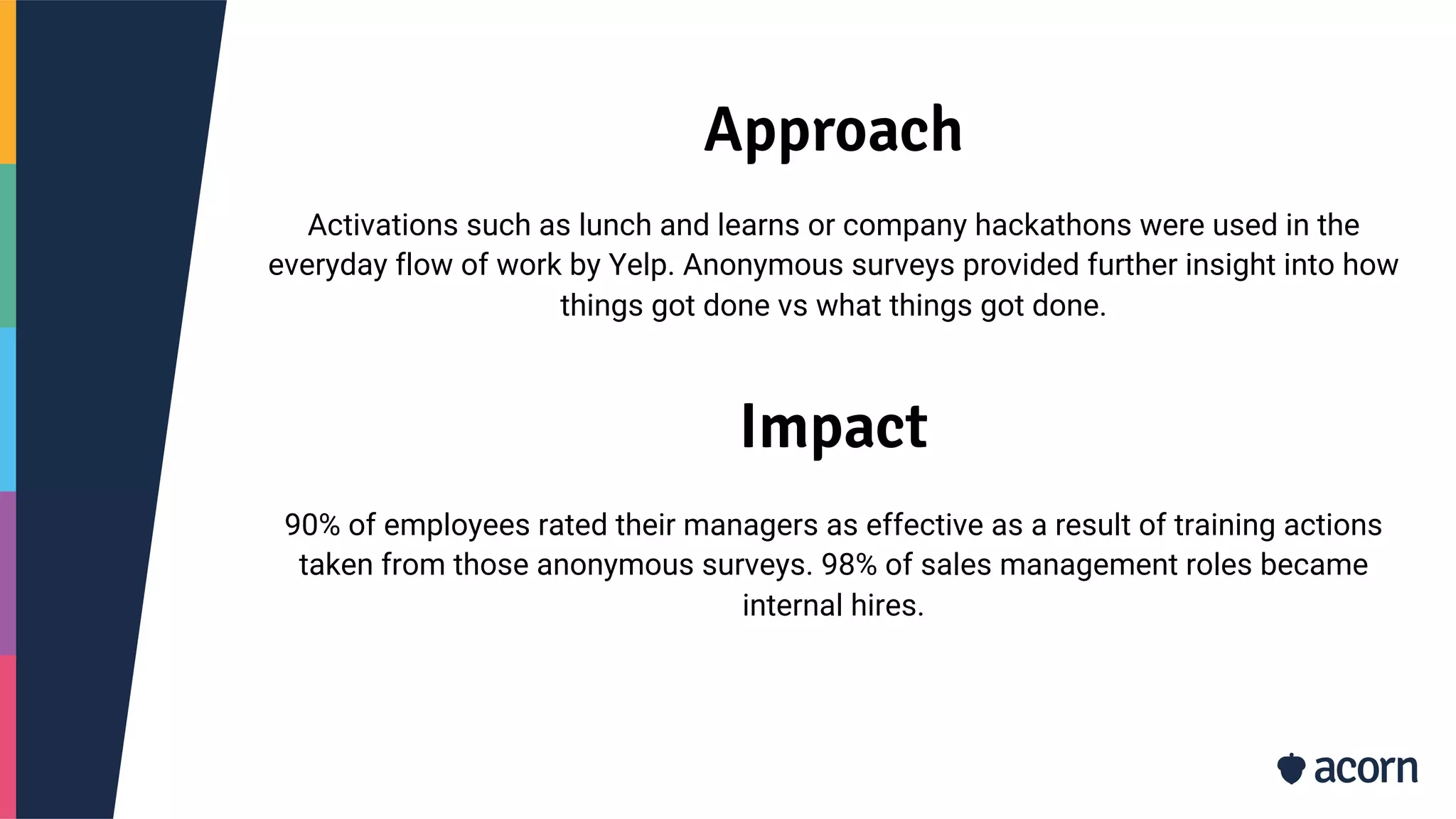
Approach
Activations such as lunch and learns or company hackathons were used in the
everyday flow of work by Yelp. Anonymous surveys provided further insight into how
things got done vs what things got done.
Impact
90% of employees rated their managers as effective as a result of training actions
taken from those anonymous surveys. 98% of sales management roles became
internal hires.
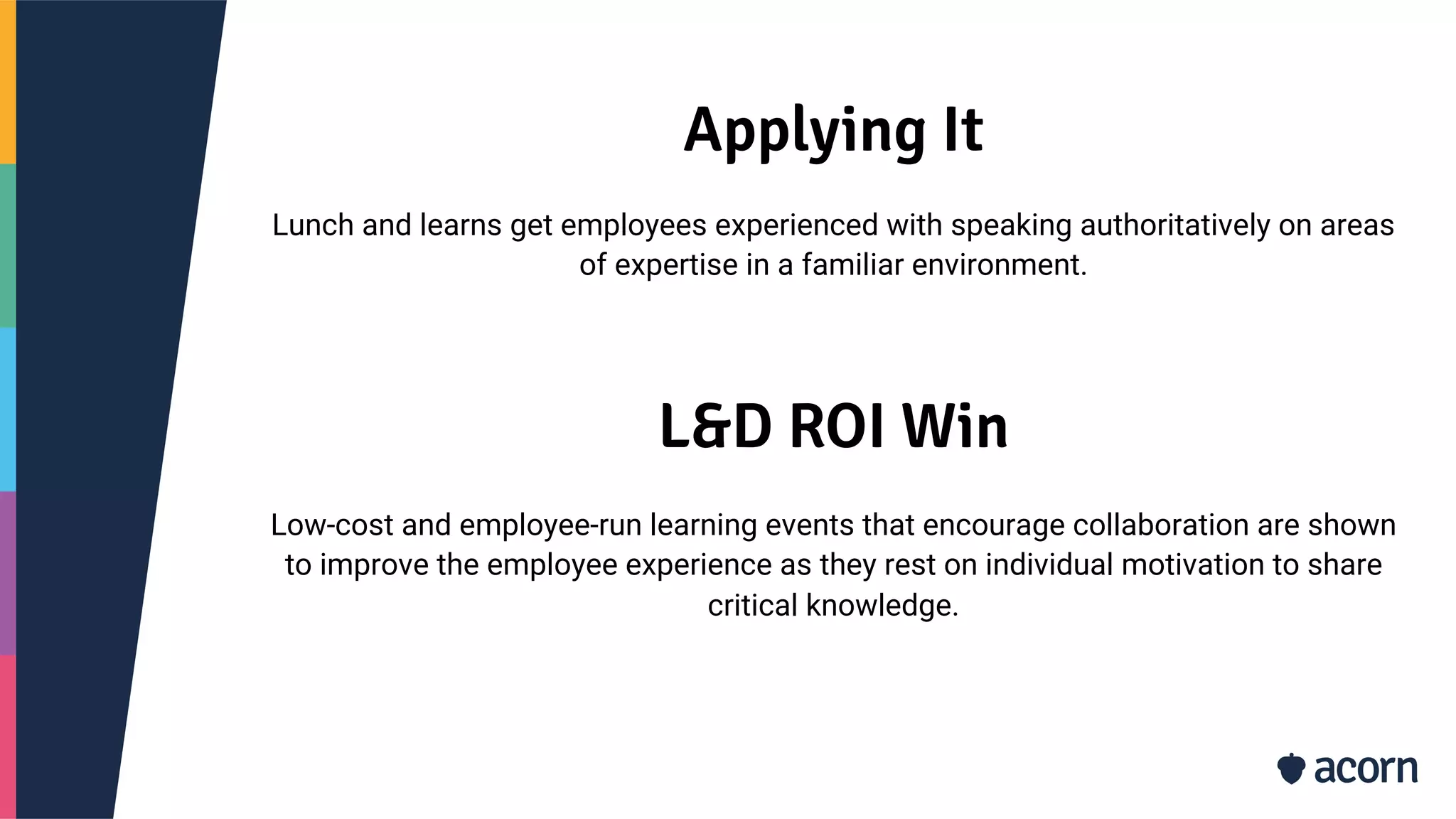
Applying It
Lunch and learns get employees experienced with speaking authoritatively on areas
of expertise in a familiar environment.
L&D ROI Win
Low-cost and employee-run learning events that encourage collaboration are shown
to improve the employee experience as they rest on individual motivation to share
critical knowledge.
Example:
Google
An L&D strategy for
continuous learning
Approach
Google utilises microlearning through ‘Whisper Courses’ – a series of emails that
suggest something for managers to try in 1:1s or team meetings.
Impact
New ‘Whisper Course’ series were sent to managers based on their weakest skills.
Google managers improved on that behaviour by up to 40%.
Applying It
The program helps contextualise learning within the working environment and helps
encourage behavioural change.
L&D ROI Win
Nurturing skills on the job means you’re meeting people where they’re already
applying them, and using technology means you can get analytics on
engagement rates.
Example:
itsu
An L&D strategy for
employee experience
Approach
The company made their training masterclass for fish cutters an accredited course.
Trainees graduated with a recognised certificate, pay rise, new title (Fish Pro) and
ongoing support post training.
Impact
itsu saved almost $1 million in decreased labour costs and almost double that
amount on otherwise wasted food. The number of itsu shops without a Fish Pro
dropped from 40% to 9%.
Applying It
Tie individual courses more closely to your overall business strategy with something
like a Capability Academy. This is a digital spot for mapping learning content to
capabilities and capability gaps.
L&D ROI Win
Connecting L&D needs to business outcomes means you’re able to prove the direct
line of causation between L&D and business impacts. This helps employees feel
more confident in their abilities, positively impacting their employee experience.
You can learn more about this
topic by checking out the full
article:
https://acornlms.com/resources/learning-and-
development-strategy-examples

L&D Strategy Examples: Yelp, Google and itsu

  • 1.
    L&D Strategy Examples What youcan learn from high-impact organisations.
  • 2.
    The L&D Strategy Thelearning and development (L&D) strategy plays a fundamental role in high-impact organisations. It outlines how an organisation uses employee training to achieve business objectives. There is no one-size-fits-all approach, but there are common approaches that can be applied in most circumstances.
  • 4.
  • 5.
    Forethinking Many organisations waituntil a problem arises and then use it as a trigger for formal training. An effective L&D strategy looks at predictive analytics (like skills gaps analyses) to determine what is needed in the future business environment and then tailors training to fulfill these needs now.
  • 6.
    Employee-Centricity Employees are atthe heart of what you do as they literally drive business strategy. A functional people strategy supports this. But what supports the constantly evolving culture and talent pipeline as your organisation grows? Learning and development.
  • 7.
    Learning Institutionalisation On thejob learning happens every day. Creating a culture of learning is important because it ensures employees stay motivated to contribute to your organisation’s mission by seeing how valuable their impact is.
  • 9.
  • 10.
    An L&D strategyfor learning culture
  • 11.
    Approach Activations such aslunch and learns or company hackathons were used in the everyday flow of work by Yelp. Anonymous surveys provided further insight into how things got done vs what things got done. Impact 90% of employees rated their managers as effective as a result of training actions taken from those anonymous surveys. 98% of sales management roles became internal hires.
  • 12.
    Applying It Lunch andlearns get employees experienced with speaking authoritatively on areas of expertise in a familiar environment. L&D ROI Win Low-cost and employee-run learning events that encourage collaboration are shown to improve the employee experience as they rest on individual motivation to share critical knowledge.
  • 13.
  • 14.
    An L&D strategyfor continuous learning
  • 15.
    Approach Google utilises microlearningthrough ‘Whisper Courses’ – a series of emails that suggest something for managers to try in 1:1s or team meetings. Impact New ‘Whisper Course’ series were sent to managers based on their weakest skills. Google managers improved on that behaviour by up to 40%.
  • 16.
    Applying It The programhelps contextualise learning within the working environment and helps encourage behavioural change. L&D ROI Win Nurturing skills on the job means you’re meeting people where they’re already applying them, and using technology means you can get analytics on engagement rates.
  • 17.
  • 18.
    An L&D strategyfor employee experience
  • 19.
    Approach The company madetheir training masterclass for fish cutters an accredited course. Trainees graduated with a recognised certificate, pay rise, new title (Fish Pro) and ongoing support post training. Impact itsu saved almost $1 million in decreased labour costs and almost double that amount on otherwise wasted food. The number of itsu shops without a Fish Pro dropped from 40% to 9%.
  • 20.
    Applying It Tie individualcourses more closely to your overall business strategy with something like a Capability Academy. This is a digital spot for mapping learning content to capabilities and capability gaps. L&D ROI Win Connecting L&D needs to business outcomes means you’re able to prove the direct line of causation between L&D and business impacts. This helps employees feel more confident in their abilities, positively impacting their employee experience.
  • 21.
    You can learnmore about this topic by checking out the full article: https://acornlms.com/resources/learning-and- development-strategy-examples