MODULE 8
Title : Layout Strategies
Period : 4 hours
I. Objectives:
At the end of the period, the students should be able to:
1. develop a layout plan;
2. compute cycle time for product oriented layout; and
3. analyze the different layout strategies.
II. Subject Matter
1. Topics
1.1. The Strategic Importance of Layout Decisions
1.2. Types of Layout
2. Educational Resources
Heizer, J. and Render, B. (2014). Operations Management Sustainability and
Supply Chain Management, 11th Edition. Singapore: Pearson Education
Asia.
3. Materials
3.1. Coupon bond
3.2. Pen
3.3. Handouts
3.4. Worksheets
3.5 Calculator
4. Values Focus
Globally competitive to communicate logically, analytically and tactfully
one’s ideas and opinions and academically proficient to apply theoretical learning
into practice.
III.Learning Procedures and Strategies
a. Preparatory Activity
Suppose you've already determined where to place your first shop. The next thing
you need to do is build or design the store you like, including furniture, displays,
fixtures, lighting, and signage. You can use any digital or freehand drawing method
to design your first store. Each student must provide feedback on their classmate's
layout design.
b. Lesson Proper
1. The Strategic Importance of Layout Decisions
1.1 Layout has numerous strategic implications because it establishes an
organization’s competitive priorities in regard to capacity, processes, flexibility,
and cost, as well as quality of work life, customer contact, and image.
1.2 The objective of layout strategy is to develop an effective and efficient layout
that will meet the firm’s competitive requirements.
2 Types of Layout
2.1 Types of layout and examples of their typical objectives include:
2.1.1 Office layout: Locate workers requiring frequent contact close to one
another.
2.1.2 Retail layout: Expose customers to high-margin items.
2.1.3 Warehouse layout: Balance low-cost storage with low-cost material
handling.
2.1.4 Fixed-position layout: Move material to the limited storage areas around
the site.
2.1.5 Process-oriented layout: Manage varied material flow for each product.
2.1.6 Work-cell layout: Identify a product family, build teams, and cross-train
team members.
2.1.7 Product-oriented layout: Equalize the task time at each workstation.
2.2 Office layout —The grouping of workers, their equipment, and spaces/offices to
provide for comfort, safety, and movement of information.
2.2.1 A relationship chart displays a “closeness value” between each pair of
people and/or departments that need to be placed in the office layout.
2.3 Retail layout —An approach that addresses flow, allocates space, and responds
to customer behavior.
2.3.1 Retail layouts are based on the idea that sales and profitability vary
directly with customer exposure to products. The main objective of retail
layout is to maximize profitability per square foot of floor space (or, in
some stores, per linear foot of shelf space).
2.3.2 Slotting fees —Fees manufacturers pay to get shelf space for their
products.
2.3.3 Servicescape —The physical surroundings in which a service takes
place and how they affect customers and employees.
2.4 Warehouse layout —A design that attempts to minimize total cost by addressing
trade-offs between space and material handling.
2.4.1 The variety of items stored and the number of items “picked” has direct
bearing on the optimal layout. Modern warehouse management is often
an automated procedure using automated storage and retrieval systems
(ASRSs).
2.4.2 Cross-docking —Avoiding the placement of materials or supplies in
storage by processing them as they are received for shipment. Cross-
docking requires both tight scheduling and accurate inbound product
identification.
2.4.3 Random stocking —Used in warehousing to locate stock wherever there
is an open location.
2.4.4 Customizing —Using warehousing to add value to a product through
component modification, repair, labeling, and packaging.
2.5 Fixed-position layout —A system that addresses the layout requirements of
stationary projects.
2.5.1 Fixed-position layouts involve three complications:
2.5.1.1 there is limited space at virtually all sites,
2.5.1.2 different materials are needed at different stages of a project, and
2.5.1.3 The volume of materials needed is dynamic.
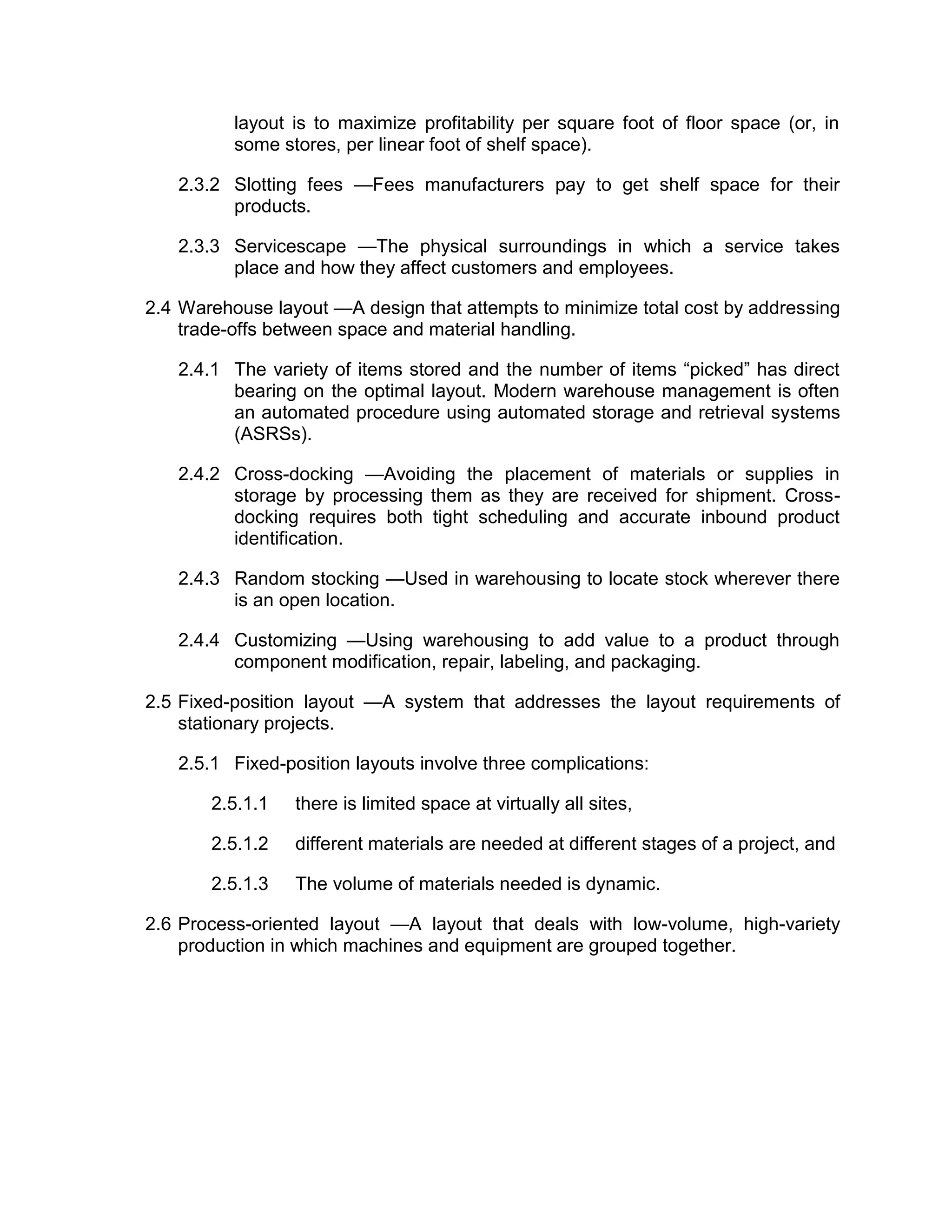
2.6 Process-oriented layout —A layout that deals with low-volume, high-variety
production in which machines and equipment are grouped together.
2.6.1 Job lots —Groups or batches of parts processed together.
2.7 Work cell —An arrangement of machines and personnel that focuses on making
a single product or family of related products.
2.7.1 Takt time —Pace of production to meet customer demands.
Takt time = Total work time available/
Units required to satisfy customer demand
Workers required = Total operation time required/Takt time
2.7.2 Focused work center —A permanent or semi-permanent product-
oriented arrangement of machines and personnel.
2.7.3 Focused factory —A facility designed to produce similar products or
components.
2.8 Repetitive and Product-Oriented Layout
2.8.1 Fabrication line —A machine-paced, product-oriented facility for building
components.
2.8.2 Assembly line —An approach that puts fabricated parts together at a
series of workstations; a repetitive process.
2.8.3 Assembly-line balancing —Obtaining output at each workstation on a
production line in order to minimize delay.
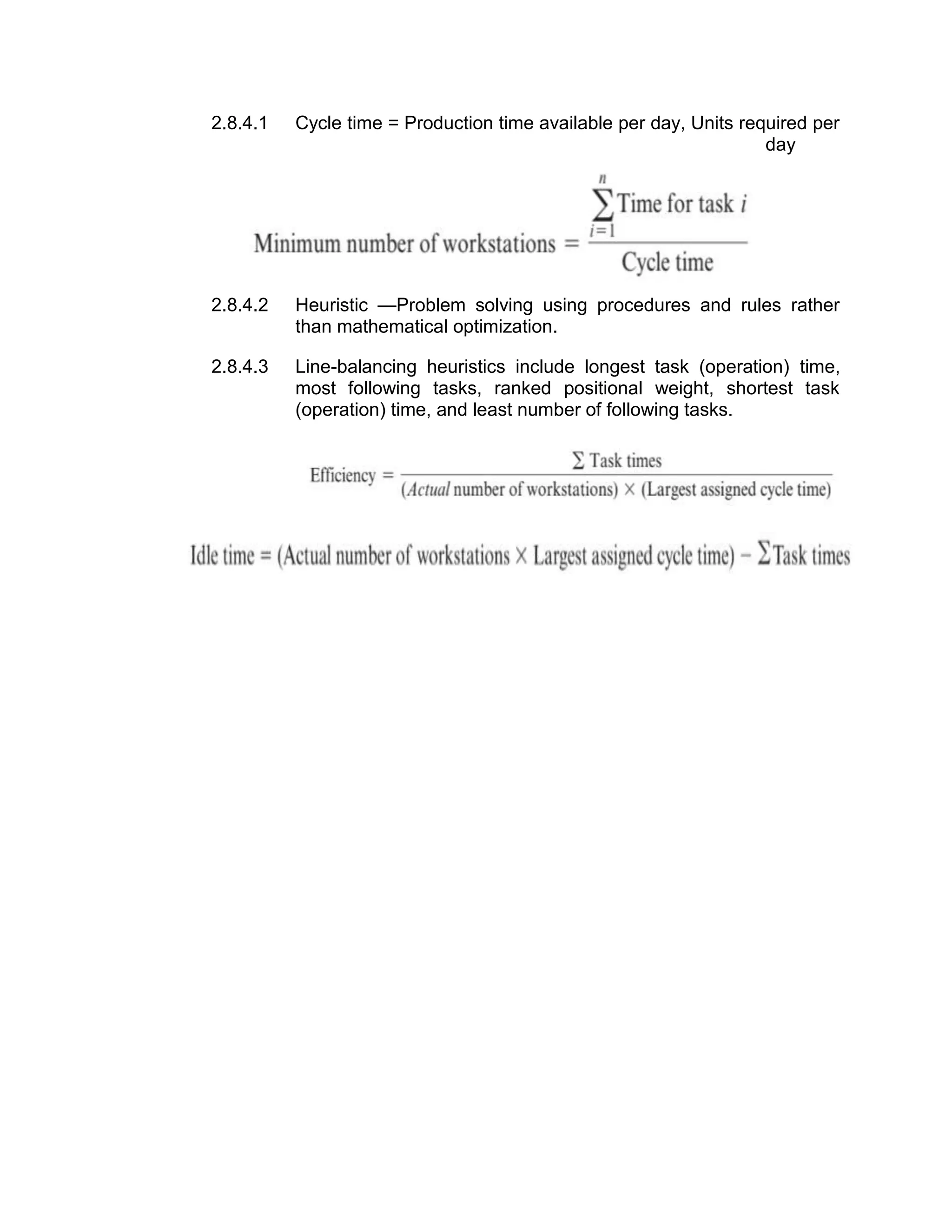
2.8.4 Cycle time —The maximum time that a product is allowed at each
workstation.
2.8.4.1 Cycle time = Production time available per day, Units required per
day
2.8.4.2 Heuristic —Problem solving using procedures and rules rather
than mathematical optimization.
2.8.4.3 Line-balancing heuristics include longest task (operation) time,
most following tasks, ranked positional weight, shortest task
(operation) time, and least number of following tasks.

MODULE 8.docx

  • 1.
    MODULE 8 Title :Layout Strategies Period : 4 hours I. Objectives: At the end of the period, the students should be able to: 1. develop a layout plan; 2. compute cycle time for product oriented layout; and 3. analyze the different layout strategies. II. Subject Matter 1. Topics 1.1. The Strategic Importance of Layout Decisions 1.2. Types of Layout 2. Educational Resources Heizer, J. and Render, B. (2014). Operations Management Sustainability and Supply Chain Management, 11th Edition. Singapore: Pearson Education Asia. 3. Materials 3.1. Coupon bond 3.2. Pen 3.3. Handouts 3.4. Worksheets 3.5 Calculator 4. Values Focus Globally competitive to communicate logically, analytically and tactfully one’s ideas and opinions and academically proficient to apply theoretical learning into practice. III.Learning Procedures and Strategies a. Preparatory Activity Suppose you've already determined where to place your first shop. The next thing you need to do is build or design the store you like, including furniture, displays,
  • 2.
    fixtures, lighting, andsignage. You can use any digital or freehand drawing method to design your first store. Each student must provide feedback on their classmate's layout design. b. Lesson Proper 1. The Strategic Importance of Layout Decisions 1.1 Layout has numerous strategic implications because it establishes an organization’s competitive priorities in regard to capacity, processes, flexibility, and cost, as well as quality of work life, customer contact, and image. 1.2 The objective of layout strategy is to develop an effective and efficient layout that will meet the firm’s competitive requirements. 2 Types of Layout 2.1 Types of layout and examples of their typical objectives include: 2.1.1 Office layout: Locate workers requiring frequent contact close to one another. 2.1.2 Retail layout: Expose customers to high-margin items. 2.1.3 Warehouse layout: Balance low-cost storage with low-cost material handling. 2.1.4 Fixed-position layout: Move material to the limited storage areas around the site. 2.1.5 Process-oriented layout: Manage varied material flow for each product. 2.1.6 Work-cell layout: Identify a product family, build teams, and cross-train team members. 2.1.7 Product-oriented layout: Equalize the task time at each workstation. 2.2 Office layout —The grouping of workers, their equipment, and spaces/offices to provide for comfort, safety, and movement of information. 2.2.1 A relationship chart displays a “closeness value” between each pair of people and/or departments that need to be placed in the office layout. 2.3 Retail layout —An approach that addresses flow, allocates space, and responds to customer behavior. 2.3.1 Retail layouts are based on the idea that sales and profitability vary directly with customer exposure to products. The main objective of retail
  • 3.
    layout is tomaximize profitability per square foot of floor space (or, in some stores, per linear foot of shelf space). 2.3.2 Slotting fees —Fees manufacturers pay to get shelf space for their products. 2.3.3 Servicescape —The physical surroundings in which a service takes place and how they affect customers and employees. 2.4 Warehouse layout —A design that attempts to minimize total cost by addressing trade-offs between space and material handling. 2.4.1 The variety of items stored and the number of items “picked” has direct bearing on the optimal layout. Modern warehouse management is often an automated procedure using automated storage and retrieval systems (ASRSs). 2.4.2 Cross-docking —Avoiding the placement of materials or supplies in storage by processing them as they are received for shipment. Cross- docking requires both tight scheduling and accurate inbound product identification. 2.4.3 Random stocking —Used in warehousing to locate stock wherever there is an open location. 2.4.4 Customizing —Using warehousing to add value to a product through component modification, repair, labeling, and packaging. 2.5 Fixed-position layout —A system that addresses the layout requirements of stationary projects. 2.5.1 Fixed-position layouts involve three complications: 2.5.1.1 there is limited space at virtually all sites, 2.5.1.2 different materials are needed at different stages of a project, and 2.5.1.3 The volume of materials needed is dynamic. 2.6 Process-oriented layout —A layout that deals with low-volume, high-variety production in which machines and equipment are grouped together.
  • 4.
    2.6.1 Job lots—Groups or batches of parts processed together. 2.7 Work cell —An arrangement of machines and personnel that focuses on making a single product or family of related products. 2.7.1 Takt time —Pace of production to meet customer demands. Takt time = Total work time available/ Units required to satisfy customer demand Workers required = Total operation time required/Takt time 2.7.2 Focused work center —A permanent or semi-permanent product- oriented arrangement of machines and personnel. 2.7.3 Focused factory —A facility designed to produce similar products or components. 2.8 Repetitive and Product-Oriented Layout 2.8.1 Fabrication line —A machine-paced, product-oriented facility for building components. 2.8.2 Assembly line —An approach that puts fabricated parts together at a series of workstations; a repetitive process. 2.8.3 Assembly-line balancing —Obtaining output at each workstation on a production line in order to minimize delay. 2.8.4 Cycle time —The maximum time that a product is allowed at each workstation.
  • 5.
    2.8.4.1 Cycle time= Production time available per day, Units required per day 2.8.4.2 Heuristic —Problem solving using procedures and rules rather than mathematical optimization. 2.8.4.3 Line-balancing heuristics include longest task (operation) time, most following tasks, ranked positional weight, shortest task (operation) time, and least number of following tasks.